Revisiting the Parentage of Eleanora “Ella” B. Gibbs

In October 2020, I published a post outlining the evidence I had at the time regarding the parentage of my second great-grandmother, Eleanora “Ella” B. Gibbs, wife of John Wortman. That post laid out the problem clearly: census records placed Eleanora in proximity to multiple Gibbs households in Dryden, Lapeer County, Michigan, but did not explicitly state her relationship to any of them.¹

At the time, the strongest conclusion I could reach — based on marriage, probate, and census evidence — was that Eleanora was the daughter of Lester Gibbs and Mary Conly. However, gaps remained, particularly concerning what became of Lester Gibbs, who appeared to vanish from the records after 1860.

Over the past several years, additional records have come to light. When examined together, they significantly strengthen the original conclusion and clarify why earlier records appeared contradictory.


The Core Question, Revisited

The question has never really been who raised Eleanora, but who her biological father was.

In 2020, the competing possibilities were:

  • Lester Gibbs, who married Mary Conly in 1850
  • Philo Gibbs, with whom Eleanora appears in close proximity in census records

Because nineteenth-century census schedules do not identify relationships, proximity alone could not prove parentage.² What resolves the question is land ownership, guardianship, and inheritance — records that do imply legal relationships.


What We Know Now About Lester Gibbs

Lester Gibbs Did Not Disappear After 1860

Earlier assumptions placed Lester Gibbs’s death near 1860, but new evidence clearly disproves that.

In the 1860 federal census, Lester Gibbs appears in Dryden Township, Lapeer County, Michigan, listed as a farmer with both real and personal estate.³ He was alive, resident, and economically established.

More importantly, an 1863 landowners map of Dryden Township identifies an “L. Gibbs” owning land in close proximity to J. Blow, a man later appearing in court-related records connected to this family.⁴ This confirms that Lester Gibbs was alive and a landholder at least as late as 1863.
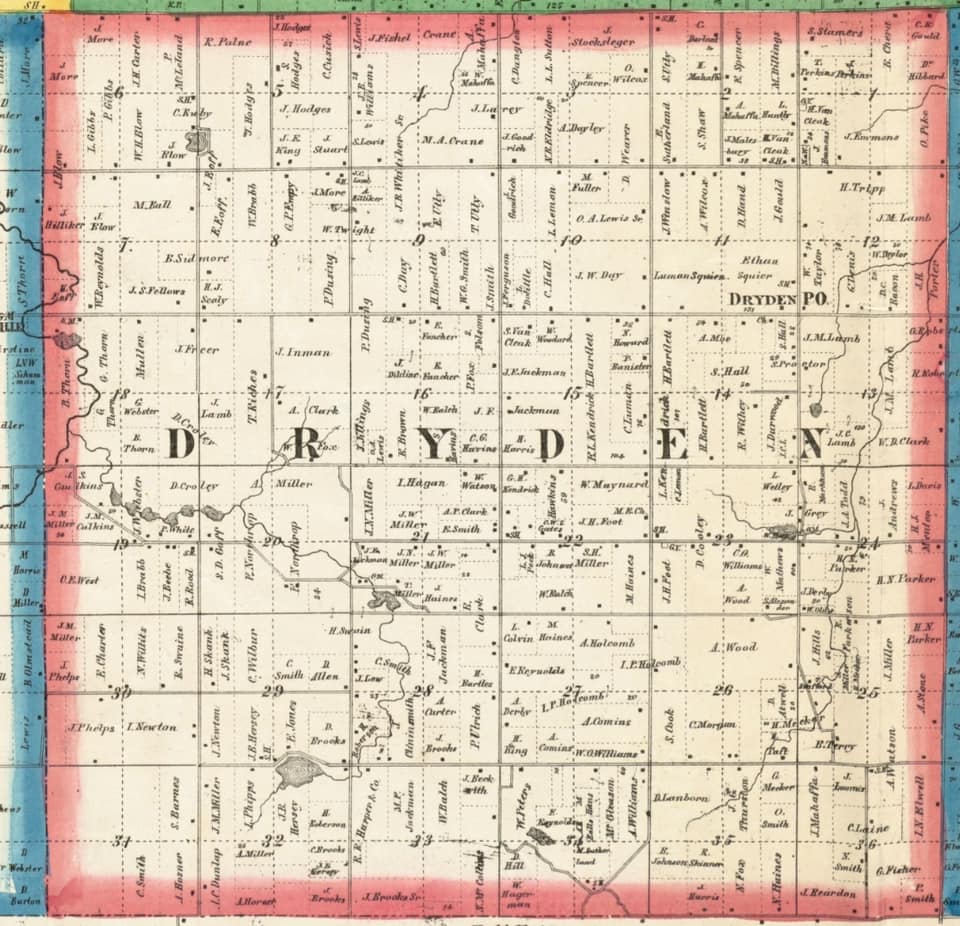
1863 Land owernship map of Dryden, Lapeer County, Michigan. L. Gibbs owns land in the upper left corner.

Mary Conly’s Movements Explain the Census Confusion

The apparent absence of Mary Conly from Michigan in 1860 and Eleanora’s later association with other households long contributed to confusion. Those movements now make sense.

Mary Conly married Lester Gibbs in Lapeer County in November 1850.⁵ By 1861, she had remarried in New York to Charles Garner.⁶ The couple was living in New York by the mid-1860s, where Mary appears with Eleanora in the 1865 New York State Census.⁷

Charles Garner enlisted in the Union Army in 1863 and died as a prisoner of war at Salisbury Prison, North Carolina, on 21 December 1864.⁸ Mary was again widowed, this time with multiple minor children.

By 1868, Mary had returned to Lapeer County, Michigan, and married Mortimer Hilliker.⁹ These movements fully explain why Mary and Eleanora are absent from Michigan records during parts of the 1860s and why Eleanora later appears associated with extended family rather than her biological father.


The Most Important Evidence: Inheritance and Guardianship

The decisive records are not census schedules, but court-ordered guardianship and land transactions.

In December 1868, the Lapeer County Circuit Court appointed Mary Hilliker as special guardian of Eleanora (“Ella”) Gibbs, authorizing her to sell the minor child’s interest in real estate.¹⁰ The court approved both the guardianship and the conveyance.

Such proceedings occur only when:

  1. The child inherited property, and
  2. The property-owning parent is deceased

This establishes that Lester Gibbs died between 1863 and December 1868, and that Eleanora was his legal heir.

Philo Gibbs was not the landowner; Lester Gibbs was.


Why There Is No Probate Record for Lester Gibbs

The absence of a probate estate for Lester Gibbs once appeared problematic. In fact, it is consistent with Michigan legal practice of the period.

When a man died intestate leaving only minor heirs and land as the principal asset, courts often handled the matter through guardianship proceedings rather than formal probate administration.¹¹ This allowed the land to be sold for the child’s benefit without opening an estate.

That is precisely what occurred in this case.


What This Means for Eleanora’s Parentage

When all records are considered together:

  • Marriage of Lester Gibbs and Mary Conly (1850)⁵
  • Birth of Eleanora Gibbs (1854)¹²
  • Census evidence of Lester Gibbs alive in 1860³
  • Land ownership by Lester Gibbs in 1863⁴
  • Court-ordered guardianship and inheritance in 1868¹⁰
  • Probate of Mary Hilliker naming Ella Wortman as an heir¹³

…the conclusion is no longer tentative.

Eleanora “Ella” B. Gibbs was the daughter of Lester Gibbs and Mary Conly.


A Final Reflection

This case illustrates a fundamental genealogical principle:
census records suggest relationships; land and court records confirm them.

Six years ago, the evidence pointed in the right direction. Today, it firmly supports that conclusion.


Footnotes

  1. The parentage of Eleanora ‘Ella’ B. Gibbs,” blog post, 27 October 2020.
  2. U.S. Bureau of the Census, Instructions to Enumerators, 1860.
  3. 1860 U.S. Census, Lapeer County, Michigan, Dryden Township, Lester Gibbs household.
  4. Map of Lapeer County, Michigan (1863), Dryden Township landowners, “L. Gibbs.”
  5. Lapeer County, Michigan, Marriage Records, Lester Gibbs and Mary Conly, 12 November 1850.
  6. New York State Marriage Records, Mary Conly and Charles Garner, 1861.
  7. 1865 New York State Census, Cayuga County, Sterling, Mary Garner household.
  8. Compiled Military Service Record, Charles Garner, Union Army; died 21 December 1864, Salisbury Prison, North Carolina.
  9. Lapeer County, Michigan, Marriage Records, Mary Conly and Mortimer Hilliker, 29 March 1868.
  10. Lapeer County, Michigan, Circuit Court Records, Guardianship and deed of Eleanora D. Gibbs, December 1868.
  11. Michigan Probate Law and Practice, mid-nineteenth century (see Michigan Revised Statutes).
  12. Birth information for Eleanora D. Gibbs, as reported in multiple census and marriage records.
  13. Lapeer County, Michigan, Probate Records, Estate of Mary Hilliker, 1872.
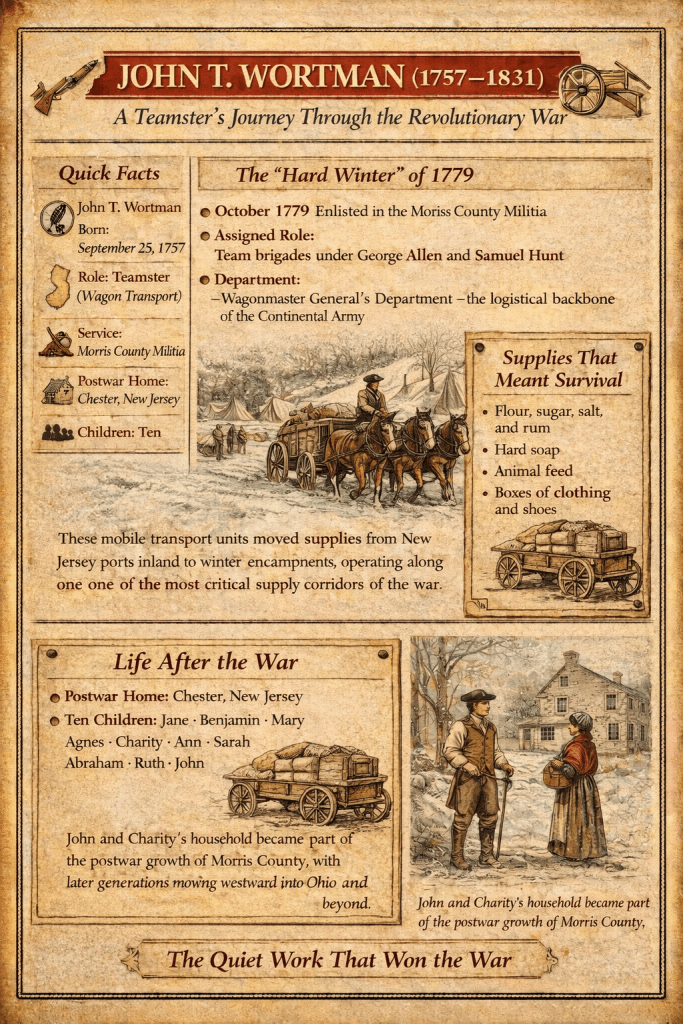
John T. Wortman: A Teamster’s Journey Through the Revolutionary War

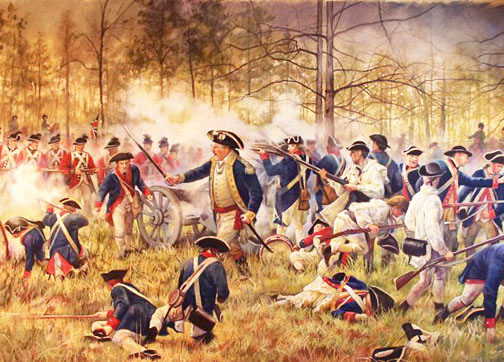
When we talk about Revolutionary War service, we often picture soldiers on the battlefield or officers directing maneuvers. But for many men in New Jersey, the war was fought on the roads — muddy, frozen, rutted roads that carried the lifeblood of Washington’s army. Few stories illustrate this better than that of John T. Wortman, born in Morristown on September 25, 1757, and later known in the records as the teamster who helped keep the Continental Army alive during its darkest winters [1]. His life offers a window into the logistical backbone of the Revolution, a side of the war we rarely talk about but absolutely should.

John Jr. grew up in a world already shaped by the long Dutch presence in New Jersey. His father, John Wortman Sr., remained rooted in Somerset County, but John Jr. came of age farther north, in the developing communities of Morris County. That shift in geography — a short distance on a modern map — made all the difference in the kind of service he would eventually render. While his father’s life revolved around Bedminster, John Jr.’s world centered on Morristown, Roxbury, and Chester, places that would become synonymous with the Continental Army’s winter encampments and supply struggles [1][6]. This geographic divide is one of the most important clues for genealogists trying to distinguish the two men.

Enlistment During the “Hard Winter”

By the fall of 1779, the war had entered one of its most desperate phases. The army was preparing for what would become the infamous “Hard Winter” at Morristown, a season so severe that even seasoned soldiers later recalled it with dread. It was in this moment that John Jr. enlisted in the Morris County Militia [1]. His role was not that of a traditional infantryman. Instead, he joined the specialized team brigades — the mobile transport units that hauled food, clothing, equipment, and forage across New Jersey’s interior.

These brigades, led by George Allen and Samuel Hunt, operated under the broader umbrella of the Wagonmaster General’s Department, the logistical backbone of the Continental Army [1][10]. Their work was relentless. Supplies arrived by water at Lamberton, a small but strategically vital port just south of Trenton, where sea‑going vessels could unload their cargo. From there, men like John Jr. took over, guiding heavily loaded wagons northward through the state’s most important military corridor [1]. This corridor — stretching from Lamberton to Morristown and then into the Hudson Highlands — was one of the most strategically important supply routes of the entire war.

What John Jr. Carried — and Why It Mattered

The pension testimony preserved by his widow, Charity Messler, paints a vivid picture of what this work entailed. John Jr. hauled:

  • Flour, sugar, salt, rum
  • Hard soap and animal feed
  • Boxes of clothing and shoes

These weren’t abstract “supplies”; they were the difference between endurance and collapse for the men stationed at Morristown, New Windsor, Pompton, Tappan, and even West Point [1]. Each load he carried represented a small but essential piece of the army’s survival. This is the kind of detail that helps us understand the daily realities of Revolutionary logistics in a way that battlefield reports never could.

The roads he traveled were not the smooth turnpikes of later centuries. They were often little more than dirt tracks, churned into deep mud by rain or frozen into jagged ridges by winter storms. Driving a wagon through such conditions required strength, patience, and a deep familiarity with the landscape. John Jr. had all three.

The Condict Papers: Witnesses Who Remembered Him

One of the most valuable pieces of evidence for his service comes from the Lewis Condict Papers, a collection of notes taken between 1833 and 1837 from pension applicants and their neighbors. In these papers, witnesses such as William Todd confirmed John Jr.’s enlistment in October 1779 and his work as a teamster in the Allen and Hunt brigades [12]. These testimonies, combined with Charity’s pension application (W100), firmly anchor him in Morris County and distinguish him from his father, whose service belonged to Somerset County [1][6].

This kind of corroboration is gold for anyone doing serious genealogical reconstruction, especially when dealing with repeated names across multiple counties.

Life After the War

After the war, John Jr. settled permanently in Chester, where he and Charity raised a large family of ten children — Jane, Benjamin, Mary, Agnes, Charity, Ann, Sarah, Abraham, Ruth, and John [1]. Their household became part of the post‑war growth of Morris County, and later generations would carry the family westward into Ohio and beyond.

His death on May 19, 1831, closed the chapter on a life defined not by battlefield heroics but by the unglamorous, indispensable labor that kept an army functioning [1]. His story reminds us that the Revolution was not only fought with muskets and bayonets, but with wagons, wheels, and the steady determination of ordinary men who understood that their work mattered.

Sources

  1. John T. Wortman (1757–1831) | WikiTreehttps://www.wikitree.com/wiki/Wortman-6
  2. Workman Family History Americanahttps://freepages.rootsweb.com/~n3kp/genealogy/workman_hist (freepages.rootsweb.com in Bing)
  3. Collections of the New York Historical Society – Internet Archive
  4. Centennial History of Somerset County, NJ – Genealogy Trails
  5. WorkmanFamily.org – Wortman Genealogy
  6. A Rare Opportunity – National Society Sons of the American Revolution
  7. Somerset County Historical Quarterly – Internet Archive
  8. WikiTree G2G: Revolutionary War Ancestors
  9. Essex County Rev War Project – Plainfield Public Library
  10. Geertjie (Messler) Wortman | WikiTreehttps://www.wikitree.com/wiki/Messler-2
  11. New Jersey Historical Society Proceedings, Vol. 9 (1924) – Internet Archive
  12. Lewis Condict Papers, 1833–1837 | New Jersey Historical Society
  13. Clarke County Historical Association Proceedings, Vol. 17

Revolutionary War connections

1f69225b-36df-4706-8d49-15e34373ac5a

In 2014, I joined the Daughters of the American Revolution under my 6th great-grandfather, Benjamin Byam. I did my application through him because he was an already established patriot and I already had most of the documentation needed to prove my descent from him, so it was an easy application to do. In reality, I do have other Revolutionary War Patriots in my ancestry that I could have submitted under – and I’ll probably submit them as supplementals one day.

Benjamin Byam was born November 29, 1733 in Chelmsford, Massachusetts. He had some military service prior to the Revolution, but during the War, he served both in Massachusetts and New Hampshire (where he moved to). Benjamin ended up dying in Randolph, Vermont on November 22, 1795.

Lot Hutchinson, another 6th great-grandfather, was born in Sutton, Massachusetts on August 1, 1741. Lot served as a Sergeant in Captain Abijah Burbank’s company among others during the war, marching from Sutton to Providence, Rhode Island. Lot would eventually move his family from Massachusetts to Braintree, Vermont where he died on March 24, 1818. Lot has not previously been proven a patriot in the DAR database.

Lot’s father-in-law, Moody Morse, my 7th great-grandfather, was born April 1, 1719 in Newbury, Massachusetts. Moody is a proven DAR patriot for performing civil service during the war. Moody died on August 14, 1805 in Sutton, Massachusetts.

Josiah Blanchard was born on December 10, 1733 in Concord, Massachusetts and is another 6th great-grandfather. Josiah is not a currently approved DAR patriot, but he does appear on the muster roll for Cogswell’s Regiment of the Militia in 1778 (part of the 16th Regiment for Massachusetts). He also appears on the rolls for Captain Danforth’s company of Colonel Nixon’s regiment. Josiah died March 18, 1800 in Barre, Vermont.

Abraham Smith (one of several in my tree) was born in 1730 in Subury, Massachusetts and is yet another 6th great-grandfather. He is a DAR approved patriot who served under Captains Brownson, Simonds and Colonels Allen, Warner and Bradley. He died in Tinmouth, Vermont on November 4, 1809.

Bartholomew Towne was a private in Captain Josiah Crosby’s Company of Colonel Moses Nichol’s Regiment of New Hampshire Volunteers. Bartholomew was born April 8, 1741 in Topsfield, Massachusetts and died in 1800 in Milford, New Hampshire. Bartholomew is not currently a DAR approved patriot.

Eli Stiles was born May 22, 1746 in Westfield, Massachusetts. He appears on the rolls as serving under Captain Darby’s company of Colonel Scammel’s registment in New Hampshire. It is not known yet exactly when Eli died. He is not currently an approved DAR patriot.

John T. Wortman was born August 25, 1757 in New Jersey and is a fourth great-grandfather. John is an approved DAR patriot who was a teamster in George Allen’s & Samuel Hunt’s teams.  John died on May 19, 1831 in New Jersey.

John’s father, another John Wortman was born November 16, 1730 in Somerset County, New Jersey. He is a DAR approved patriot for being a Corporal and a Wagon Master during the war. John died on August 25, 1807 in Bedminster, New Jersey.

Daniel Munson was born April 4, 1745 in Stratford, Connecticut and is a fifth great-grandfather. Daniel is an approved DAR patriot for having civil service during the war as he was a surveyor of highways in Milford. Daniel died on October 27, 1827 in Milford, Connecticut.

There are probably others that I just haven’t discovered yet. 9 out of 10 of these ancestors are through my mom’s side of the family. I’m sure there are probably more on dad’s side – I just haven’t discovered them yet.

Anna Wortman Conklin Hickmott

My great-grandmother Anna Wortman was born on October 11, 1876, probably in Dryden, Lapeer County, Michigan. I say probably because that is where her parents, John T. Wortman and Eleanora D. Gibbs were living at the time, although I have not actually found her birth record yet.

Anna’s life was a hard one and filled with sadness. When she was not quite 2 years old, her father John T. Wortman died in March 1878. Her mother Ella would re-marry in August of 1879 a man by the name of John Henry Hand. Her step-father would die in January 1891. Her mother did not re-marry after that and would die a widow in August 1914.

Anna would marry George Conklin on March 25, 1899. The marriage was short lived however, as they divorced on January 16, 1900. George was quite a bit older than Anna as he was 55 years old when they married while Anna was just 22 years old. Coincidentally, George would end up dying on April 22, 1914 – just a couple of months after Anna.

Anna wasn’t alone long after her divorce from George. She married my great-grandfather, Bert Hickmott, on August 22, 1900. This must have been a better marriage for her despite financial and emotional hardships as she and Bert were together until her death on February 2, 1914.

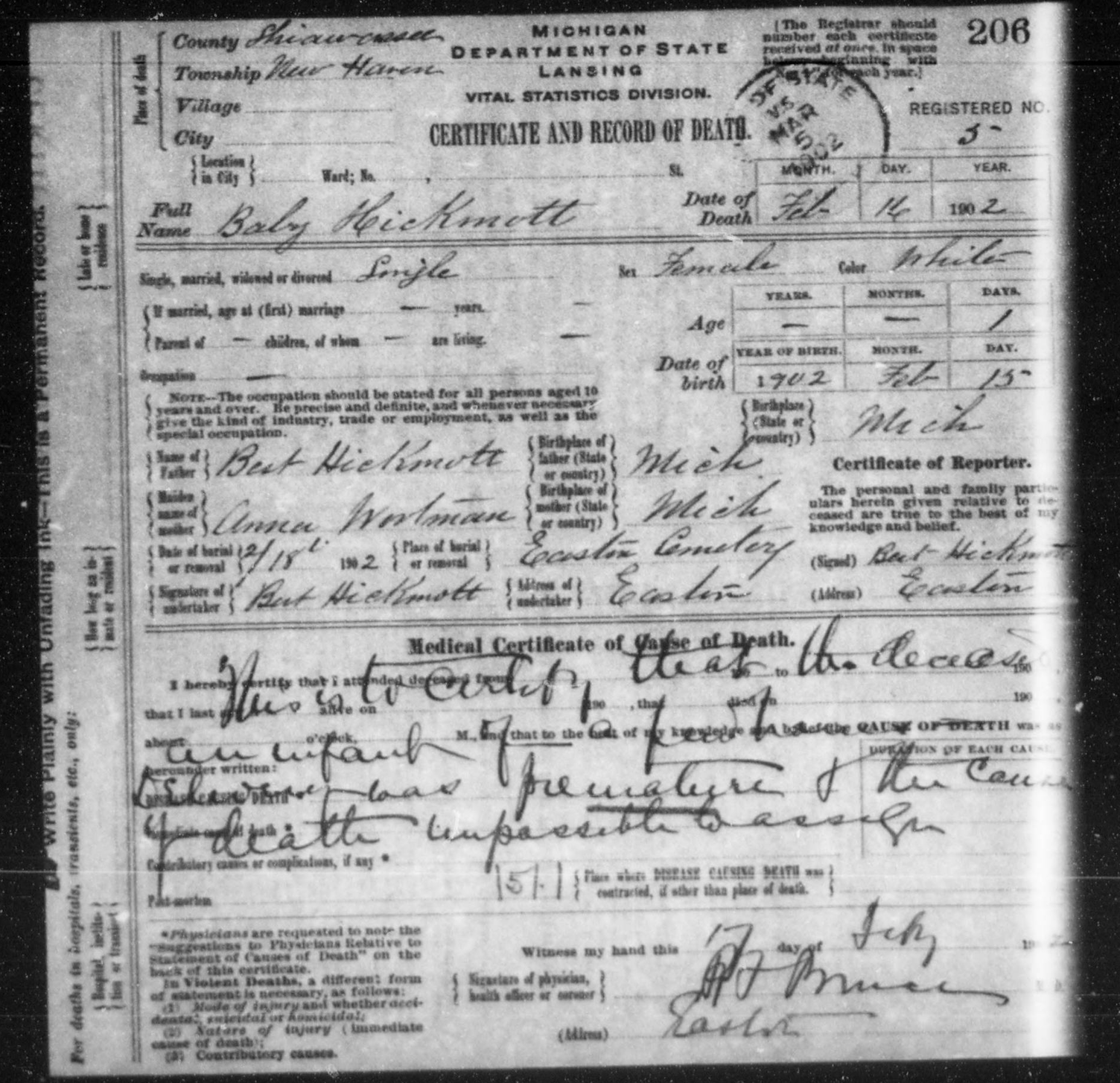
Anna had been pregnant 8 times and 5 of the children survived. The first child, a boy, was stillborn on May 5, 1901. The second child, a girl, was born on February 15, 1902 and died the next day.

Screen Shot 2018-02-01 at 12.01.00 PM
Cause of death states: “This is to certify that the deceased an infant of a few hours. Delivery was premature & the cause of death impossible to assign.”

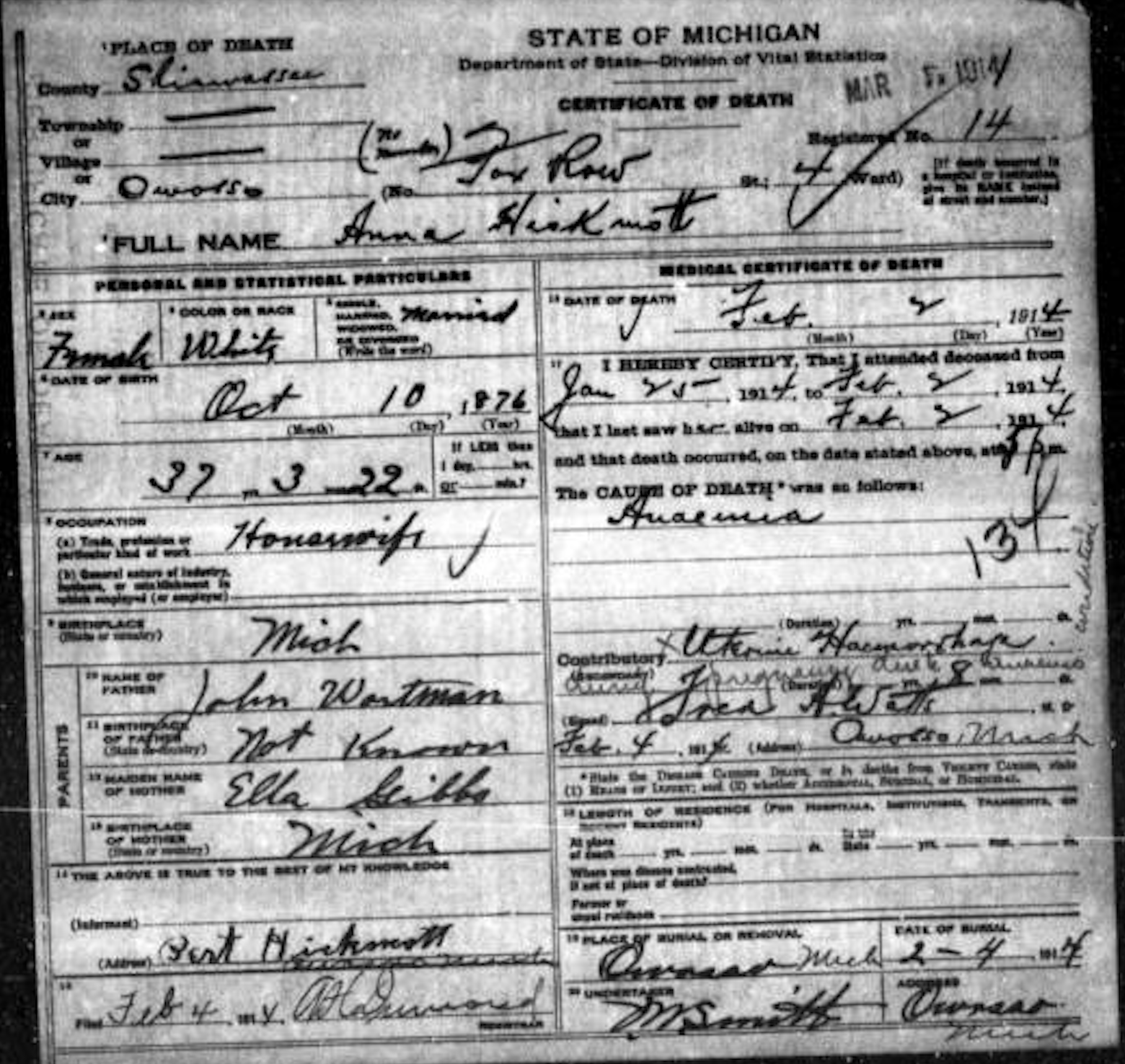
Then Anna had 5 successful births in a row – Charles in 1903, Raymond in 1904, Kenneth in 1908, Della in 1911 and John in 1913. Her last child, a baby girl died in-utero on January 26, 1914. Anna never recovered from that birth, passing away 5 days later at the age of 37 years.

Screen Shot 2018-02-01 at 11.46.04 AM

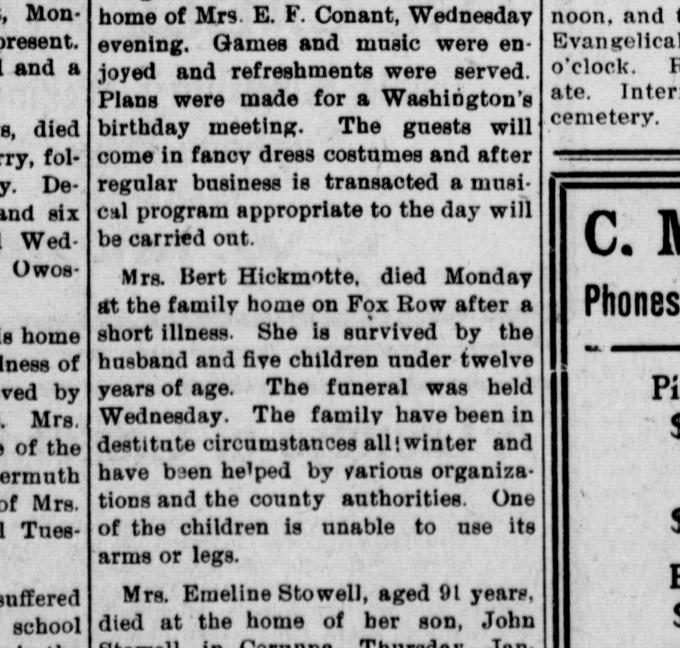
After her death, the children were taken from Bert because of the financial situation. My grandfather searched most of his adult life for his siblings and found all but one.

image_681x648_from_1156,6630_to_2518,7927
The Owosso times. (Owosso, Mich.) 1897-1926, February 06, 1914