The Case of John Whitney’s Wife

Back in 2018 I wrote about finding my second great-grandmother, Nancy J. Whitney, in the 1850 census and the immediate question that followed:

Who was her mother?

At the time, the census seemed to offer a straightforward answer. With the addition of DNA and Ancestry’s ThruLines®, I expected that question to finally be settled.

It wasn’t.

Instead, the combination of census records, a single marriage record, and a series of land transactions has created one of the most instructive conflicts in my research—and a perfect example of why no single source should ever stand alone.


What ThruLines Does — and Does Not — Tell Me

ThruLines confirms my descent from John Whitney.

It does not identify a wife for him.
It does not suggest a mother for Nancy.
It does not offer a second pathway through another marriage or through a different set of descendants.

In this case, ThruLines is doing exactly what it is designed to do—it is confirming a line. It is not resolving a documentary conflict.

And that silence is important.


The 1850 Census: A Household with Two Adult Women

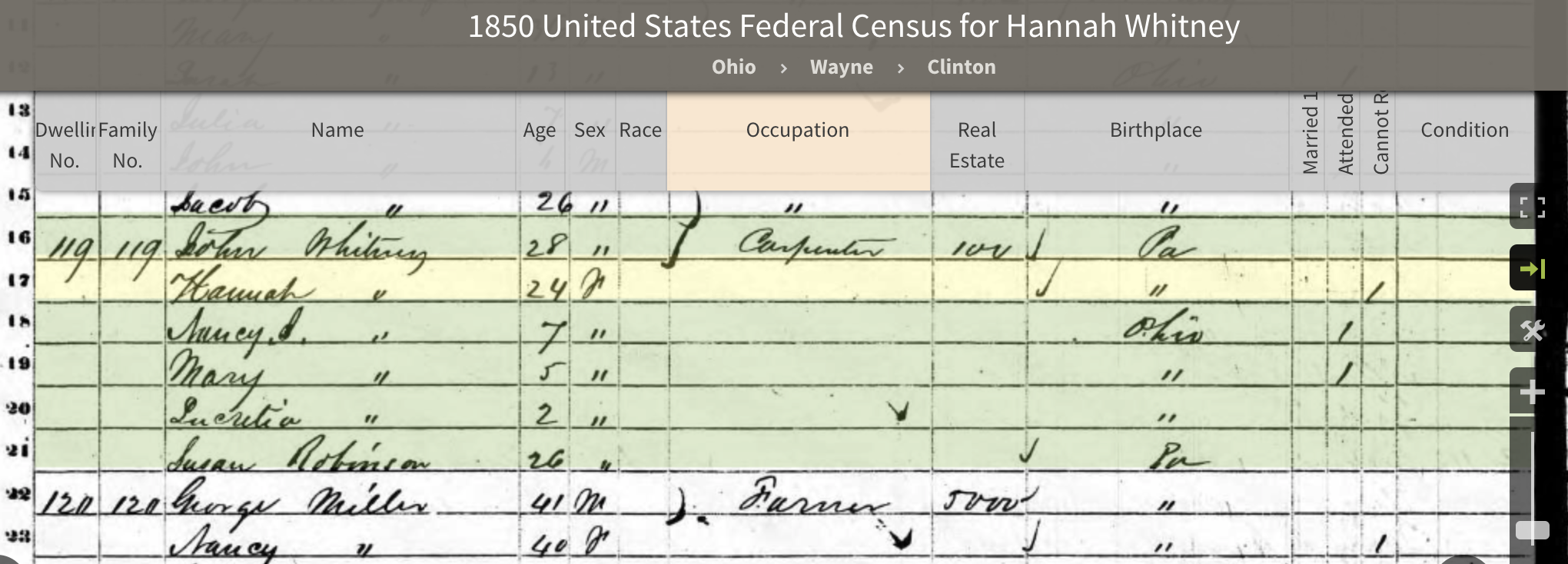
The 1850 census for Wayne County, Ohio, shows the household of John Whitney as:

  • John Whitney, 28
  • Hannah, 24
  • Nancy, 7
  • Mary Belle, 5
  • Lucretia, 3
  • Susannah Robison, 26¹

The census does not state relationships in 1850. Any identification of a spouse is based on the common pattern of enumeration, not on an explicit statement.
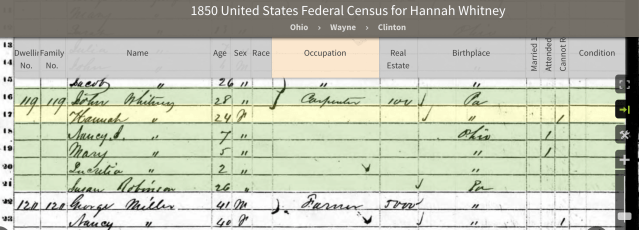
What is clear is that Hannah and Susannah are two separate individuals. They have different given names, different ages, and Susannah is listed with the surname Robison rather than Whitney.

Whatever their roles in the household, they are not the same person.


The Marriage Record That Complicates Everything

There is one—and only one—marriage record for John Whitney in Wayne County:

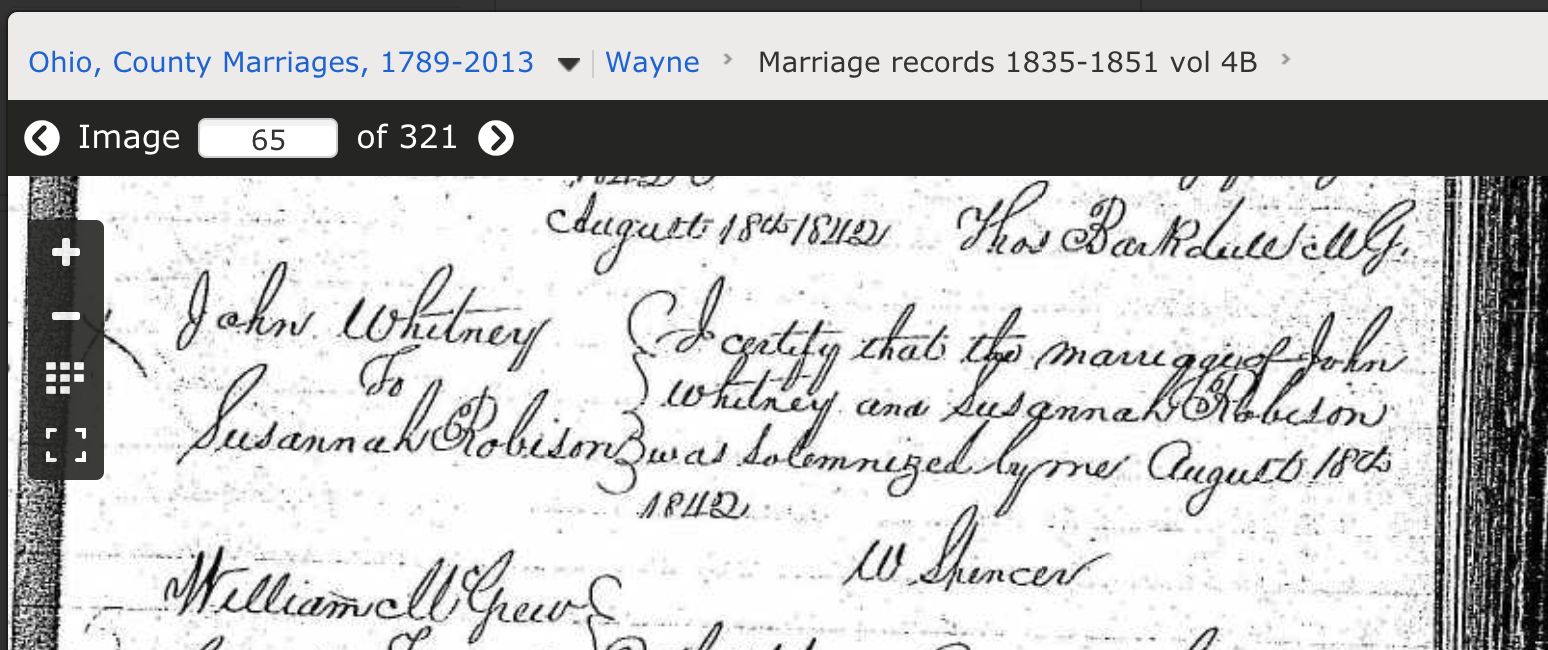
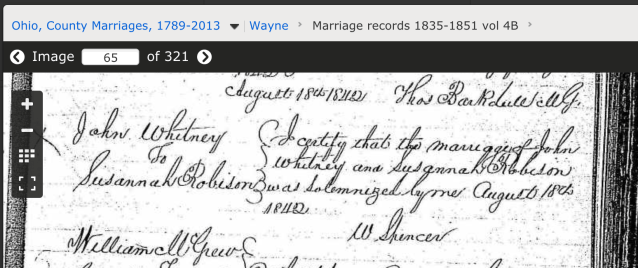
John Whitney to Susannah Robison, 18 August 1842.²
Nancy’s 1843 birth fits this marriage perfectly.

If this were the only record, the conclusion would be simple.

But it isn’t.


The Deeds: A Legally Identified Wife Named Hannah

In a deed, a wife is not named casually. She appears because she must relinquish her right of dower, and she is often examined separately to confirm that she is acting of her own free will.

John appears with Hannah as his wife in multiple land transactions:

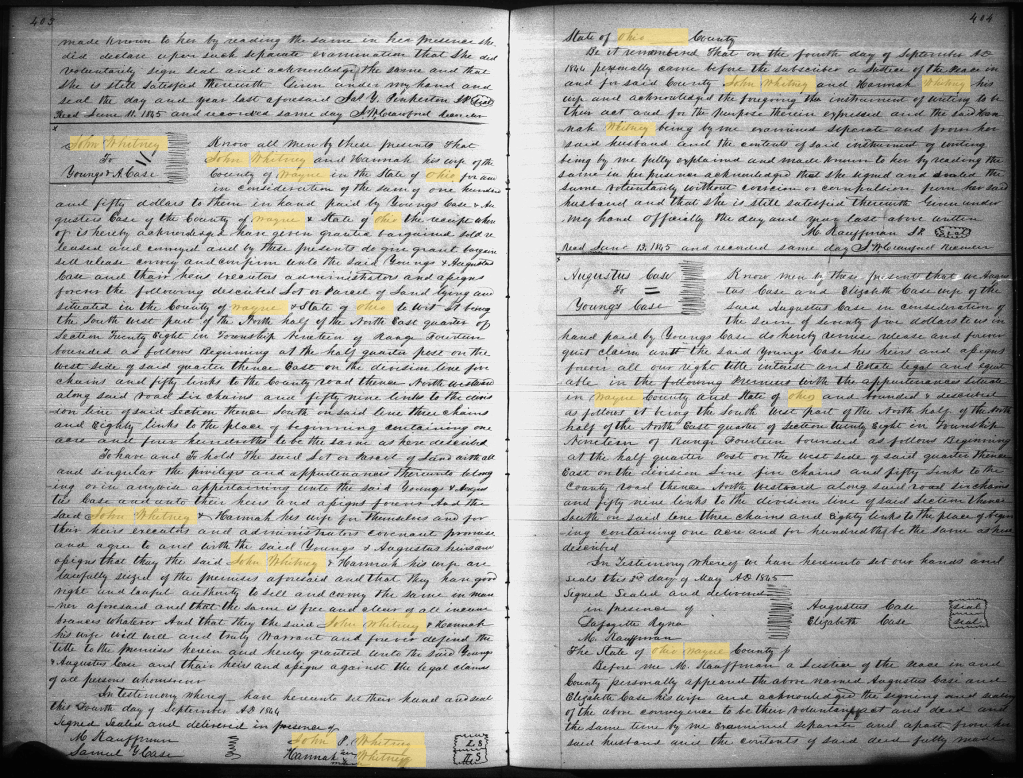
On 4 September 1844 (recorded 13 June 1845), John Whitney and Hannah his wife sold land in Wayne County.³
On 13 September 1853, John P. Whitney and Hannah his wife conveyed land to Cornelius Paugh.⁴

On 18 February 1854, John P. Whitney and Hannah his wife conveyed land to Israel Layton.⁵

These are not isolated references. They establish a legally recognized wife named Hannah over a period of at least ten years.

By 17 December 1862, when John sold land again in Wayne County, no wife was named.⁶

Hannah was no longer living—or no longer his legal spouse—by that date.


Establishing That This Is the Correct John Whitney

John’s father, Charles Whitney, died in 1836. His mother, Tamer (Pierce) Whitney, remarried Phillip Yarnell on 31 March 1840 in Wooster, Wayne County, Ohio.⁷

So when John P. Whitney appears in the June Term 1851 partition case with the Yarnell heirs, it confirms that these land and court records belong to the correct man.⁸

In the October Term 1851 case of Rinear Beall vs. John Whitney, the summons was served by leaving a copy at John’s residence “with his wife,” again placing him in a marital relationship at that time.⁹


The Negative Search

If the answer were in the usual places, this would not be a problem.

I have searched for:

  • a divorce record for John Whitney
  • a death record for Hannah Whitney
  • a death record for Susannah Robison or Susannah Whitney
  • any additional marriage for John Whitney

I have also looked for records that might name Nancy’s mother:

  • guardianships for John’s children
  • deeds involving his children
  • death records for Nancy and her sisters

None of them identify a mother.


Could the Marriage Record Be Wrong?

One possible explanation is that the 1842 marriage record misidentifies the bride as Susannah rather than Hannah.

However, the record clearly names Susannah, there is a separate woman of that name in the 1850 household, and there is currently no record connecting Hannah to the Robison family.

That makes this a hypothesis—not a conclusion.


One Conflict, One Conclusion

Taken together, the records establish five things:

John Whitney is Nancy’s father.
He married Susannah Robison in 1842.
He had a legally identified wife named Hannah from at least 1844 to 1854.
Hannah and Susannah were two different women in the 1850 household.
The land and court records all belong to the same John Whitney.

What they do not establish is which woman was the mother of Nancy, Mary Belle, and Lucretia.

ThruLines does not resolve that conflict. The census does not resolve that conflict. The marriage record does not resolve that conflict.

So the only evidence-based conclusion is the same one I reached years ago—now with far better documentation:

The identity of Nancy J. Whitney’s mother remains unproven.


Footnotes

  1. 1850 U.S. census, Wayne County, Ohio, population schedule, John Whitney household.
  2. Wayne County, Ohio, marriage record, John Whitney and Susannah Robison, 18 August 1842.
  3. Wayne County, Ohio, Deed Book, John Whitney and Hannah his wife to Youngs & Augustus Case, 4 September 1844 (recorded 13 June 1845).
  4. Wayne County, Ohio, Deed Book, John P. Whitney and Hannah his wife to Cornelius Paugh, 13 September 1853.
  5. Wayne County, Ohio, Deed Book, John P. Whitney and Hannah his wife to Israel Layton, 18 February 1854.
  6. Wayne County, Ohio, Deed Book, John P. Whitney to Jonathan Potts, 17 December 1862.
  7. Wayne County, Ohio, marriage record, Phillip Yarnell and Tamer Whitney, 31 March 1840.
  8. Wayne County, Ohio, Court of Common Pleas, partition case, June Term 1851, naming John P. Whitney and Yarnell heirs.
  9. Wayne County, Ohio, Court of Common Pleas, Rinear Beall vs. John Whitney, October Term 1851.
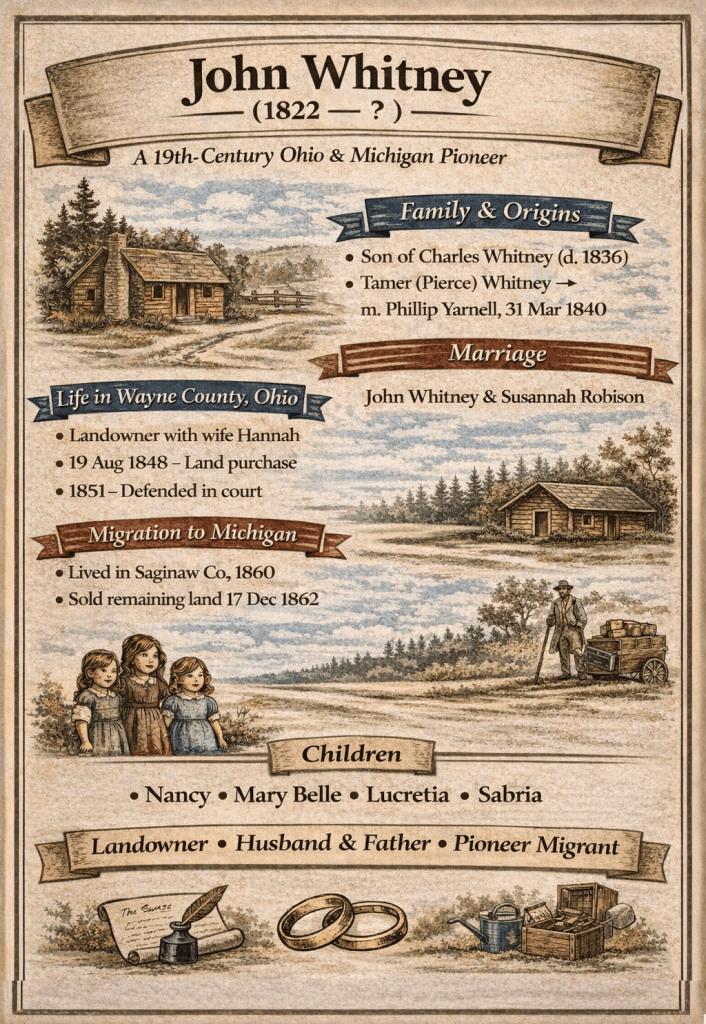
John Whitney Through Land and Court Records

Vital records are wonderful when they exist, but for many people in the early and mid-nineteenth century they are missing or were never created. In those cases, we are left to reconstruct a life from the records that document a person’s economic activity, legal standing, and family connections.

John Whitney of Wayne County, Ohio, and later Saginaw County, Michigan, is one of those men.

He was the son of Charles Whitney, who died in Wayne County in 1836. A few years later his mother, Tamer (Pierce) Whitney, remarried Phillip Yarnell on 31 March 1840 in Wooster, Wayne County, Ohio.¹ That remarriage becomes critical in identifying John in later records, because when John P. Whitney appears in the June Term 1851 partition case with the Yarnell heirs, it ties the adult man directly to his mother’s second marriage and distinguishes him from any other contemporary John Whitney in the county.²

Early Land Transactions

By the late 1840s John was participating in land transactions in his own name. On 19 August 1848 he purchased land in Wayne County, indicating that he had reached adulthood and was established enough in the community to engage in real property transactions.³

There is one—and only one—marriage record for a John Whitney in Wayne County during this period: John Whitney to Susannah Robison on 18 August 1842.⁴ That record fits the birth of his oldest known child the following year. As discussed in a separate post, later records consistently name a wife called Hannah, creating a conflict that remains unresolved. For the purpose of following John’s life, what matters here is that by mid-century he was a married man and the head of a household.

A Wife Named Hannah

The land records provide the clearest view of John’s economic life and identify the woman who was legally his wife for at least a decade.

On 4 September 1844, recorded 13 June 1845, John Whitney and Hannah his wife sold land in Wayne County.⁵ On 13 September 1853, John P. Whitney and Hannah his wife conveyed land to Cornelius Paugh.⁶ On 18 February 1854, John P. Whitney and Hannah his wife conveyed land to Israel Layton.⁷ In each case Hannah was required to relinquish her right of dower and was examined separately, confirming her legal identity as John’s spouse.

By 17 December 1862, when John sold land again in Wayne County, no wife was named, indicating that by that date he was either widowed or no longer legally married.⁸

The 1850 Household and the 1851 Lawsuit

In 1850 John’s household included three daughters—Nancy, Mary Belle, and Lucretia—all under the age of ten.⁹ This places him firmly in the role of a young father in mid-century Ohio.

A small but vivid glimpse of his daily life appears in the October Term 1851 case of Rinear Beall vs. John Whitney. The summons was served by leaving a copy at John’s residence “with his wife,” confirming that he maintained a fixed home and was still living in Wayne County at that time.¹⁰

Migration to Michigan

By 1860 John had left Ohio and was living in Saginaw County, Michigan, in the household of his siblings. This is a classic example of cluster migration, in which family members move together and re-establish themselves in a new location.

Even after relocating, he retained legal ties to Wayne County until the 1862 sale of his remaining land.⁸ That transaction marks the end of his economic presence in the place where he had grown up.

Following the Records

There is still no located death record for John. No probate file has yet been found for him. The identity of the mother of his children remains unresolved, and the absence of a divorce record or death record for either Susannah or Hannah leaves that question open.

What the surviving records do provide is a way to follow him through his life: a boy in a widowed household after 1836, a young man buying and selling land, a husband whose wife repeatedly appeared beside him in legal transactions, a father of three small daughters, a defendant in a county lawsuit, a migrant moving west with his siblings, and finally a man closing out his last piece of property in the county where he came of age.

The story is not finished, but the outline of his life is now visible.


Sources

  1. Wayne County, Ohio, Marriage Record, Phillip Yarnell and Tamer Whitney, 31 March 1840.
  2. Wayne County, Ohio, Court of Common Pleas, Partition Record, June Term 1851.
  3. Wayne County, Ohio, Deed, John Whitney purchase, 19 August 1848.
  4. Wayne County, Ohio, Marriage Record, John Whitney and Susannah Robison, 18 August 1842.
  5. Wayne County, Ohio, Deed Book, John Whitney and Hannah his wife to Youngs and Augustus Case, 4 September 1844, recorded 13 June 1845.
  6. Wayne County, Ohio, Deed Book, John P. Whitney and Hannah his wife to Cornelius Paugh, 13 September 1853.
  7. Wayne County, Ohio, Deed Book, John P. Whitney and Hannah his wife to Israel Layton, 18 February 1854.
  8. Wayne County, Ohio, Deed Book, John P. Whitney to Jonathan Potts, 17 December 1862.
  9. 1850 U.S. Census, Wayne County, Ohio, population schedule, John Whitney household.
  10. Wayne County, Ohio, Court of Common Pleas, Rinear Beall vs. John Whitney, October Term 1851.
Nancy J Whitney’s mother?

Researching family history can be challenging. Records were destroyed in various natural disasters, records were not kept at all, people changed their names, etc. One source that genealogists tend to like is the census. Why? Because starting in 1850, everyone in the household was enumerated – not just the head of the household. Generally, the enumeration went like this: name of head of household (usually this is the male), then the head of household’s spouse (usually his wife), then their children in descent from oldest to youngest then typically anyone else living in the household (borders, parents, in-laws, etc). Now it’s true, that this wasn’t always the case, but in general, that’s the principle. It’s also true that for the 1850, 1860 and 1870 census you can’t say for any certainty about the relationships of the people in the household because it’s not spelled out that way. Starting in 1880, the relationships were added to the census.

So, imagine for a moment my excitement to find my 2nd great-grandmother Nancy J. Whitney in the 1850 census.

Screen Shot 2018-10-02 at 8.14.27 AM

There she is, age 7 years old (which corresponds with other census records for her age) – the oldest of 3 children. It would appear from this enumeration that she is living with her parents – John Whitney (which is also independently confirmed) and probably Hannah. Hannah is 4 years younger than John – which isn’t unheard of for a husband and wife. Hannah would have been 17 when Nancy was born – again, not unheard of – it’s certainly possible. The last person in the household is Susan Robinson – age 26. This would seem to indicate that Susan is a border – even possibly a sibling to either John or Hannah.

Here’s the rub – neither Hannah nor Susan appear in later censuses with John and Nancy. In fact, this is the only instance that I have of Hannah. I do find a marriage record for John and Susannah Robinson in 1842 (hmmm… Nancy is born in 1843 – coincidence?).

Screen Shot 2018-10-02 at 8.18.51 AM

Since the 1850 census is for Wayne County and this marriage record is also for Wayne County – it stands to reason that these are the same people. So why 8 years after John and Susannah get married, they are enumerated in the same household – but she is listed with her maiden name and appears to not be married to him and John appears to be married to a Hannah?

I have not been able to find a divorce for John and Susannah. I have not found a marriage for John and Hannah. I have not been able to find a death for John, Susannah or Hannah.

So, who is Nancy’s mother?