The Josiah of New Braintree

A Tempting but Unproven Identification

The Josiah Many Trees Attach

A large number of online family trees identify my ancestor, Josiah Willington (husband of Polly Hutchinson), as the son of Josiah Willington and Susanna Stearns. This identification almost always rests on a single individual: the child described in Bond’s History of Watertown as “Josiah of New Braintree,” the only known child of Josiah Willington (b. 1745) and Susanna Stearns, who died in 1766.¹

At first glance, this seems appealing. The name matches. The time period overlaps. And “New Braintree” is geographically plausible within a Massachusetts–Vermont migration pattern. But genealogy is not built on plausibility alone.


What Bond Actually Says

Bond is careful, and his wording matters. He identifies Josiah Willington, born April 4, 1745, son of Thomas Willington and Margaret Stone, who married Susanna Stearns. Susanna died in 1766. Bond then lists one child, identified only as “Josiah of New Braintree.”²

Bond does not provide a birth date for that child, nor a marriage, spouse, children, migration trail, or death record. His entry ends there. This is not unusual in compiled genealogies, but it means the identification stops precisely where many modern trees begin to speculate.


The Age Question and the 1810 Census

The 1810 U.S. census for Braintree, Orange County, Vermont shows Josiah Willington as the sole adult male in his household, aged between 26 and 44.³ This bracket allows for a birth as early as 1766. If the “Josiah of New Braintree” were born in the same year his mother died, he would be 44 years old in 1810, which fits the census category.

Census age brackets establish possibility, not identity.
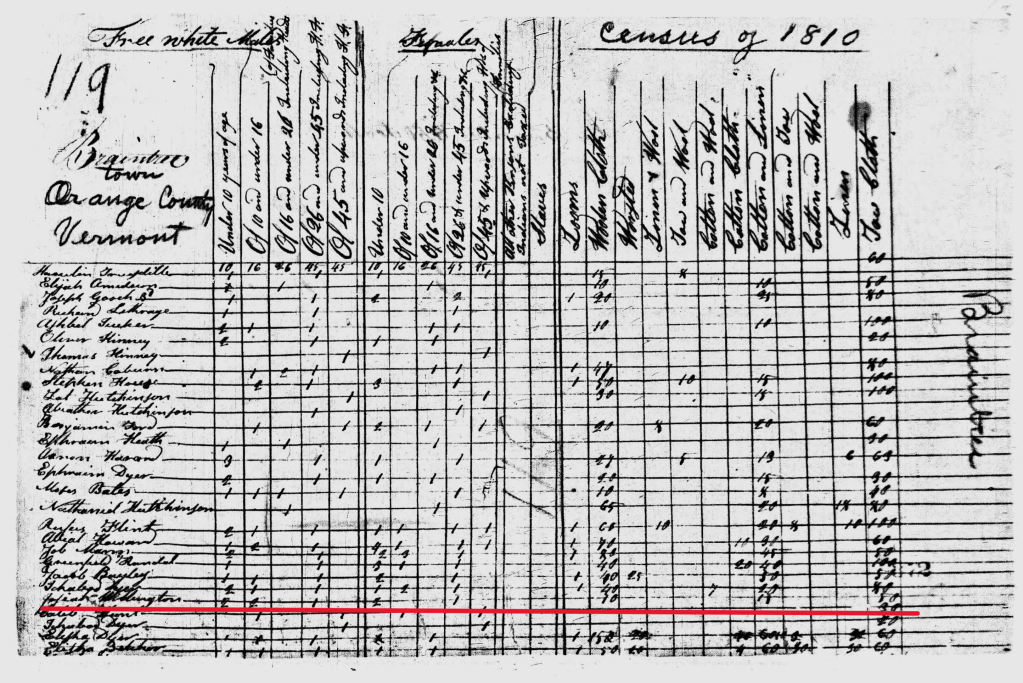
1810 US Federal Census for Braintree, Vermont.
Close-up of Josiah Willington household from the 1810 census.

The Age Gap with Polly Hutchinson

Polly Hutchinson was born in 1782.⁴ If Josiah were born in 1766, he would be approximately sixteen years older than his wife.

Such an age gap is not impossible in late eighteenth-century New England, but it is less typical for a first marriage. Larger gaps are more often associated with widowers, and there is no evidence that Josiah Willington had been previously married before his 1794 marriage to Polly Hutchinson in Worcester.⁵ The age difference does not disprove the theory, but it raises the standard of proof required to support it.


The Hutchinson Cluster in Braintree

The 1810 census page for Braintree is significant for another reason: the Hutchinson family appears on the same enumeration, near Josiah Willington’s household. The households of Lot Hutchinson and Abiathar Hutchinson are recorded in the same sequence as Josiah’s.³ These are not random names. Lot Hutchinson is Polly’s father, and Abiathar Hutchinson is Polly’s brother.⁶

This matters because early federal census schedules were recorded in the order the enumerator visited households, which typically reflects geographic proximity and often reflects kin-based settlement patterns. The Braintree census therefore shows Josiah living within Polly’s family network.

Equally important, there are no other Willington or Wellington households in Braintree in the 1810 census.³ Josiah appears as a single Willington household surrounded not by paternal kin, but by his wife’s family.

This does not prove his parentage, but it does show where his documented family network lies once the record trail becomes clear.


The Temptation to Explain Silence

At this point, it becomes tempting to construct a narrative: Susanna Stearns dies in childbirth or shortly thereafter; Josiah grows up motherless; his father remarries; Josiah becomes estranged from his paternal family; he leaves with no paper trail and reappears years later in Worcester and then Vermont.

This story is emotionally coherent, but genealogy cannot be built on satisfying explanations.

Estrangement is one of the hardest things to prove in eighteenth-century records, but it is rarely completely invisible. Even estranged children often appear in wills, guardianships, land divisions, apprenticeships, or church records. No such record has been found connecting the “Josiah of New Braintree” to the adult Josiah of Worcester and Vermont.

What we have is not evidence of estrangement. It is silence.


The Missing Documentary Bridge

If my Josiah were the son of Josiah and Susanna Stearns, at least one document would reasonably be expected to connect him forward in time: a record naming origin, a removal or church dismissal, a deed, a probate reference, or a Willington kin connection in Vermont.

Instead, the surviving records place him firmly in a different documented pattern: marriage in Worcester in 1794 with both parties “of Worcester,”⁵ residence in Braintree, Vermont by 1810 within the Hutchinson family cluster,³ and probate in Vermont with no references to Massachusetts Willington kin.⁷ No document links him backward to Watertown, Weston, or New Braintree.


Why This Identification Persists

The persistence of this theory in online trees is understandable. Researchers are confronted with multiple Josiah Willingtons in Massachusetts, incomplete birth records, and a conveniently named child whose adulthood is undocumented. Faced with a brick wall, many choose the explanation that makes the puzzle fit.

At present, identifying my ancestor Josiah Willington as the son of Josiah Willington and Susanna Stearns remains possible but unproven. It rests on age compatibility and name alone, without a single document bridging the gap between childhood and adulthood.

Possibility is not proof.


Sources

  1. Henry Bond, Genealogies of the Families and Descendants of the Early Settlers of Watertown, Massachusetts (Boston: Little, Brown and Company, 1860), Wellington section.
  2. Ibid.
  3. 1810 U.S. Census, Braintree, Orange County, Vermont, households including Josiah Willington, Lot Hutchinson, and Abiathar Hutchinson.
  4. Sutton, Massachusetts, vital records, birth of Molly (Polly) Hutchinson, 1782.
  5. Worcester, Massachusetts, marriage records, Josiah Willington and Polly Hutchinson, 6 September 1794.
  6. Perley Derby, The Hutchinson Family: or the Descendants of Barnard Hutchinson of Cowlam, England (Salem, MA: Essex Institute Press, 1870), entries for Lot Hutchinson and his children, including Polly and Abiathar.
  7. Vermont probate records, estate of Josiah Willington, proved 1818.
Following the Trail

Worcester, Vermont, and the Limits of Paper Records

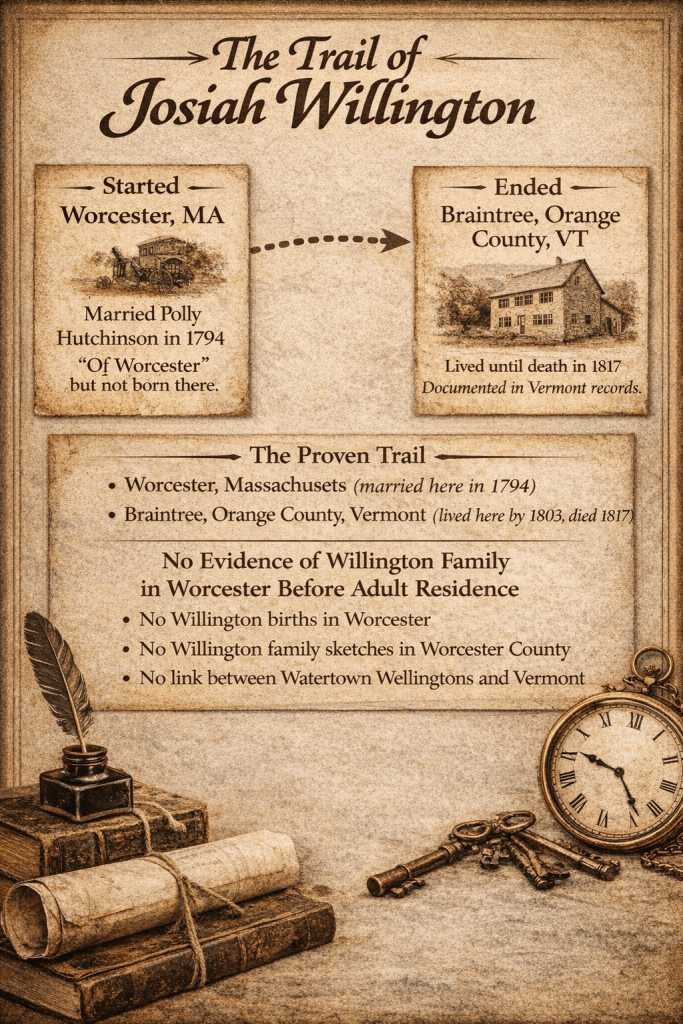
If the name problem explains how false parentage is created, geography explains how those errors persist. In the case of Josiah Willington who married Polly Hutchinson, the surviving records form a narrow but consistent geographic trail. That trail begins in Worcester, Massachusetts, and ends in Braintree, Orange County, Vermont. What lies outside that trail is just as important as what lies within it.


What “of Worcester” Actually Means

The 6 September 1794 marriage record for Josiah Willington and Polly Hutchinson states that both parties were “of Worcester.”¹ In Massachusetts vital records, this phrase identifies legal residence at the time of marriage, not place of birth. It does not imply parentage, childhood residence, or family origin.

This distinction matters. Many compiled genealogies treat “of Worcester” as synonymous with “born in Worcester,” but town clerks did not use the phrase in that way. A person could be “of” a town after residing there only briefly, particularly if employment or marriage brought them in.


Worcester Birth Records and a Meaningful Absence

A review of Worcester town birth records for the eighteenth century reveals no births for individuals with the surname Willington or Wellington.² This is not merely the absence of a Josiah; it is the absence of the surname entirely.

Worcester’s vital records for this period are comparatively robust. Numerous families appear repeatedly, and children born to transient laborers are often recorded. The complete absence of the Willington/Wellington surname strongly suggests that Josiah was not born in Worcester and that his family was not established there at the time of his birth.

Negative evidence of this kind does not identify parents, but it does eliminate Worcester as a likely place of origin.


Polly Hutchinson and Worcester County Context

Polly Hutchinson provides additional context. She was born in 1782 in Sutton, Worcester County, Massachusetts, a town located southeast of Worcester.³ Sutton’s birth records include multiple Hutchinson families but, like Worcester, contain no Willington or Wellington births during the relevant period.⁴

This pattern suggests that Josiah’s presence in Worcester was likely tied to adult residence or employment rather than family origin. It is consistent with a scenario in which Josiah relocated to Worcester County as a young man and met Polly there prior to their marriage.


The Vermont Migration Pattern

By the early nineteenth century, Josiah Willington appears consistently in Vermont records. His children’s births, his appearance in the 1810 federal census, and his probate all place him in Braintree, Orange County, Vermont.⁵

This movement fits a well-documented migration pattern: late eighteenth-century settlers moving from central Massachusetts into Vermont following land openings and post-Revolutionary settlement opportunities. Worcester County was a common staging area for this westward and northward movement, even for individuals who had not been born there.

Crucially, none of the Josiah Willingtons documented in Bond’s History of Watertown are traced into Vermont. Bond’s families remain centered in Middlesex County and adjacent towns, with no documented link to Orange County, Vermont.⁶


Why Watertown-Centered Lineages Struggle to Fit

Attempts to link the Vermont Josiah to the Watertown Willington families rely on circumstantial reasoning: shared given names, approximate ages, and geographic proximity. But proximity alone is not enough.

Worcester lies west of Watertown, and while travel between the two was certainly possible, no record has been found placing any of Bond’s Josiahs in Worcester prior to 1794. Likewise, no record places any Watertown-based Josiah in Vermont in the early nineteenth century.

Without documentation showing movement from Watertown to Worcester and then to Vermont, these connections remain speculative.


What the Records Do Show Consistently

Across all surviving records, the Josiah Willington who married Polly Hutchinson appears only in the following contexts:

Worcester, Massachusetts, at the time of marriage in 1794.¹
Braintree, Orange County, Vermont, from at least 1803 through his death in 1817.⁵
Vermont probate and newspaper notices following his death.⁷

He does not appear in Middlesex County town records as a child, does not appear in Watertown family sketches, and does not appear in Worcester birth records. This narrow geographic footprint argues for caution in assigning parentage.


The Value of Geographic Restraint

One of the most difficult disciplines in genealogical research is restraint: resisting the urge to extend a lineage beyond what the records can support. In this case, geography acts as a boundary. It limits which records can plausibly belong to the same individual and which cannot.

Rather than proving who Josiah Willington’s parents were, the geographic evidence clarifies who they likely were not. That clarification is essential groundwork for any future discovery.


Sources

  1. Worcester, Massachusetts, marriage records, 6 September 1794, Josiah Willington and Polly Hutchinson.
  2. Worcester town birth records, eighteenth century, review showing no entries for Willington or Wellington surnames.
  3. Sutton, Massachusetts, town birth records, 1782, birth of Molly (Polly) Hutchinson.
  4. Sutton, Massachusetts, town birth records, review showing no entries for Willington or Wellington surnames.
  5. Vermont vital records and federal census schedules, Braintree, Orange County, including births of children, 1810 census, and death of Josiah Willington in 1817.
  6. Henry Bond, History of Watertown, Massachusetts (Boston: Little, Brown and Company, 1860), Wellington family sketches.
  7. Vermont Republican and Journal (Windsor), probate notice for Josiah Willington, May 1818.

The Name Trap

Why Multiple Josiah Willingtons Create False Lineages

One of the most persistent sources of error in New England genealogy is the assumption that identical names refer to a single individual. When a name repeats across generations, towns, and families, records that belong to different men are easily—and often incorrectly—merged.

The case of Josiah Willington illustrates this problem clearly. Multiple men of the same name lived in Massachusetts during the eighteenth and early nineteenth centuries, some contemporaneously. These men are documented in respected published sources, yet none can be automatically identified as the Josiah Willington who married Polly Hutchinson in Worcester in 1794 and later settled in Vermont.


The Six Josiah Willingtons in Bond’s History of Watertown

Henry Bond’s History of Watertown, Massachusetts documents six distinct individuals named Josiah Willington across multiple generations of the Wellington family.¹ These entries demonstrate both the frequency of the name and the danger of assuming identity based on name alone.

The six Josiah Willingtons identified by Bond are:

Josiah Willington, baptized 23 May 1708, son of John Willington and Hannah Morse. Bond identifies this Josiah as “of Weston” and records that he married a woman named Mary.²

Josiah Willington, born 4 April 1745, son of Thomas Willington and Margaret Stone. This Josiah married Susanna Stearns, who died in 1766.³

Josiah Willington of New Braintree, identified by Bond as the son of Josiah Willington (born 1745) and Susanna Stearns.⁴

Josiah Willington, born 4 June 1780, son of Joseph Willington and Dorcas Stone.⁵

Josiah Willington, born 16 September 1796 and died 12 June 1797, son of Thaddeus Willington and Ruhanna Brown.⁶

Josiah Willington, born 17 March 1802, also a son of Thaddeus Willington and Ruhanna Brown.⁷

These entries represent six separate individuals appearing in distinct family sketches and generational contexts. Some lived only briefly, others reached adulthood, and several overlapped chronologically with the Josiah Willington who married Polly Hutchinson in 1794.


What Bond Does and Does Not Establish

Bond’s work demonstrates that the name Josiah Willington was reused repeatedly within the extended Wellington family. This repetition alone makes name-based identification unsafe.

At the same time, Bond does not identify a Josiah Willington who married Polly Hutchinson, does not place any Josiah Willington in Worcester, Massachusetts, and does not trace any Josiah Willington to Vermont. Bond’s sketches are centered on Watertown and nearby Middlesex County towns, and they do not extend to Worcester County or later Vermont settlers.

Bond therefore provides important context for name repetition, but it does not establish identity for the Josiah Willington associated with Worcester and Braintree, Vermont.


Documented Marriages Involving Men Named Josiah Willington

Independent of Bond, Massachusetts town records document several marriages involving men named Josiah Willington or Wellington during the same general period:

Josiah Wellington married Susanna Stearns in 1765.³
A Josiah Wellington married Mary Smith in Sudbury in the early 1770s.⁸
Josiah Wellington married Zilpah Delano in Norton in 1772.⁹
Josiah Willington married Polly Hutchinson in Worcester on 6 September 1794.¹⁰

These marriages involve different women, different towns, and different time frames. No record has been found that connects any of these men to one another through remarriage, migration, or parentage.


The Absence of Willington Births in Worcester

The marriage record of 1794 states that Josiah Willington was “of Worcester,” a phrase that denotes legal residence rather than birthplace. A review of Worcester town birth records reveals no births for individuals with the surname Willington or Wellington at all, not merely the absence of a Josiah.¹¹

This absence is significant. Worcester’s vital records for the eighteenth century are comparatively thorough, and many other families are well represented. The lack of any Willington or Wellington births indicates that the family was not established in Worcester during the period when Josiah would have been born.

This evidence supports the conclusion that Josiah was not born in Worcester, but arrived there from another town or county prior to his marriage.


Overlapping Lifespans and Separate Locations

The existence of multiple adult men named Josiah Willington is further supported by overlapping lifespans. Men marrying in the 1760s and 1770s could still have been living in the 1790s, making it unsafe to assume that a later marriage represents the same individual without corroborating evidence.

Geography reinforces this separation. The towns associated with these Josiahs—Watertown, Weston, Sudbury, Norton, and Worcester—span multiple counties. While movement between towns was common, no record has been found that traces a specific Josiah from any of Bond’s Watertown families into Worcester and then onward to Vermont.


Why Name Duplication Matters

In eighteenth-century New England, the reuse of given names across generations was common. Sons were often named for fathers, grandfathers, or uncles, resulting in multiple contemporaries with identical names living within a relatively small geographic area.

In this case, the presence of six documented Josiah Willingtons means that records must be assigned cautiously. Marriages cannot be merged without proof, and parentage cannot be inferred based solely on name similarity. Bond’s documentation confirms name repetition but does not resolve identity for men appearing outside his geographic scope.


Sources

  1. Henry Bond, History of Watertown, Massachusetts (Boston: Little, Brown and Company, 1860), Wellington family sketches.
  2. Ibid., entry for Josiah Willington, baptized 23 May 1708, son of John Willington and Hannah Morse.
  3. Ibid., entry for Josiah Willington, born 4 April 1745, son of Thomas Willington and Margaret Stone; marriage to Susanna Stearns.
  4. Ibid., entry identifying Josiah of New Braintree as son of Josiah Willington (b. 1745) and Susanna Stearns.
  5. Ibid., entry for Josiah Willington, born 4 June 1780, son of Joseph Willington and Dorcas Stone.
  6. Ibid., entry for Josiah Willington, born 16 September 1796, son of Thaddeus Willington and Ruhanna Brown.
  7. Ibid., entry for Josiah Willington, born 17 March 1802, son of Thaddeus Willington and Ruhanna Brown.
  8. Massachusetts town records, Sudbury, marriage of Josiah Wellington and Mary Smith.
  9. Massachusetts town records, Norton, marriage of Josiah Wellington and Zilpah Delano, 1772.
  10. Worcester, Massachusetts, marriage records, 6 September 1794, Josiah Willington and Polly Hutchinson.
  11. Worcester town birth records, eighteenth century, review of births showing no entries for the surnames Willington or Wellington.

Who Was Josiah Willington?

Establishing the Man Before Chasing the Parents

When a genealogical problem remains unresolved after decades of research, the difficulty is often not a lack of effort but a lack of clarity. Before asking who someone’s parents were, it is essential to establish a more basic fact: who the person actually was.

This post documents what can be stated with confidence about Josiah Willington, husband of Polly Hutchinson, without assigning unproven parentage or speculating about his birth.


Josiah Willington in Braintree, Vermont

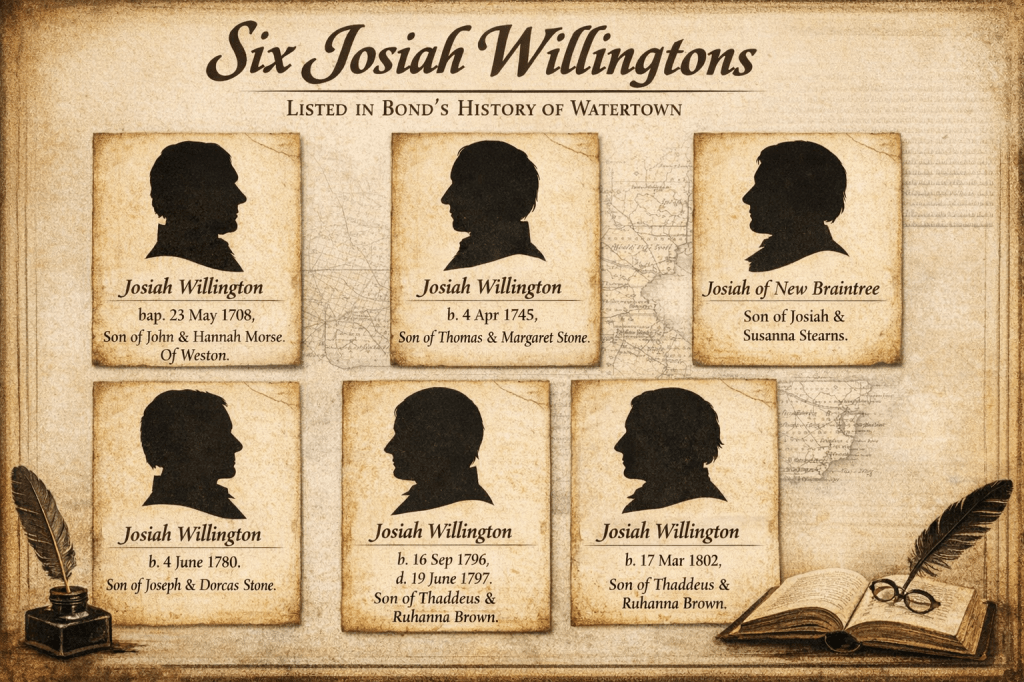
The most reliable summary of Josiah Willington’s adult life appears in H. Royce Bass’s History of Braintree, Vermont. Bass was writing from town-level records and local knowledge, and his work is generally careful in distinguishing settlers from one another. In his entry for Josiah Willington, Bass states that Josiah “came from Worcester, Mass.; m. Polly Hutchinson; d. in 1817; occupation, carpenter.”¹

Willington Family in History of Braintree, Vermont by H. Royce Bass.

This statement establishes several critical facts. Josiah resided in Worcester, Massachusetts, immediately before settling in Vermont. He married Polly Hutchinson, died in 1817, and worked as a carpenter. Bass then lists Josiah’s children, whose names and order form a consistent family group. There is no indication that Bass is referring to more than one man, nor does he express uncertainty about Josiah’s identity as a settler of Braintree.


Marriage in Worcester, Massachusetts

Josiah Willington married Polly Hutchinson on 6 September 1794 in Worcester, Massachusetts. The marriage record states that both parties were “of Worcester.”²

In late-eighteenth-century Massachusetts records, the phrase “of Worcester” denotes legal residence at the time of marriage rather than place of birth. This confirms that Josiah was a recognized resident of Worcester by 1794, not a transient individual marrying while passing through the town. The marriage record aligns closely with Bass’s statement that Josiah later “came from Worcester” when he removed to Vermont.


Occupation: Carpenter

Bass identifies Josiah’s occupation as carpenter, a detail that helps explain his migration pattern. Carpenters in this period typically learned their trade through apprenticeship or extended employment, lived for years in the towns where they worked, and relocated when land or opportunity became available elsewhere.

This occupational profile fits well with Josiah’s documented residence in Worcester during the early 1790s and his subsequent move to Vermont, where skilled tradesmen were in demand during early settlement.


Removal to Braintree and Death

Josiah eventually settled in Braintree, Orange County, Vermont, where he lived until his death in 1817. Vermont probate records dated the following year confirm his death and demonstrate continuity of identity from Worcester to Braintree.³ No evidence has been found to suggest that more than one man named Josiah Willington lived in Braintree during this period.


Children of Josiah Willington and Polly Hutchinson

H. Royce Bass includes a list of children for Josiah Willington and his wife Polly Hutchinson in his entry for early settlers of Braintree, Vermont.¹ Bass’s account establishes the composition of the household but does not provide full birth details for each child. As is common for early Vermont families, surviving vital records are incomplete, and not every child can be documented with a contemporaneous birth registration.

The children attributed to Josiah Willington and Polly Hutchinson through Bass’s account and corroborated by later records are as follows:

Ashley Hiram Willington, born 25 February 1795.⁴ Ashley’s birth is one of the few supported by a specific date and appears consistently in later Vermont records identifying him as a son of Josiah and Polly.

Lucy L. Willington, born about 1801.⁵ Lucy’s birth year is approximate and derived from later records rather than a surviving birth entry.

David Willington, born 8 April 1803 in Braintree, Orange County, Vermont.⁶ David’s birth is supported by Vermont vital records and consistently attributed to Josiah and Polly.

Polly Willington, born after 1803 and died in 1842.⁷ No contemporaneous birth record has been located for Polly, but her placement within the family is supported by compiled family records and probate-era documentation.

Luther Willington, born after 1803 and died in 1839.⁸ Luther does not appear in surviving birth registers, but his association with the Willington family is consistently reported in later records.

Levi Sylvester Willington, born in 1813 in Braintree, Orange County, Vermont.⁹ Levi’s birth year and parentage are supported by Vermont vital records.

Amos Hubbard Willington, born 24 March 1815 in Braintree, Orange County, Vermont.¹⁰ Amos is the youngest known child, born two years before Josiah’s death, and his birth is recorded in Vermont records.

Although individual birth records have not survived for every child, this group forms a coherent family unit across multiple independent sources. The names, sequence, and time span are consistent with a single household headed by Josiah Willington and Polly Hutchinson, residing in Vermont following their removal from Worcester, Massachusetts.


What Is Not Known

Despite the clarity of Josiah Willington’s adult life, certain facts remain unproven. His birthplace is unknown. His birth year is undocumented. His parents are not identified in any surviving record.

These gaps are not the result of casual research. Town records, county records, newspapers, and published genealogies have been examined repeatedly over many years. The absence of evidence must be acknowledged honestly.


Establishing Identity Before Parentage

In genealogical research, particularly when dealing with common given names, assigning parents before establishing identity often leads to error. This case involves multiple contemporaneous men named Josiah Willington or Wellington living in Massachusetts during the same period. Without careful separation, it is easy to merge records that do not belong together.

By first establishing who Josiah Willington was—where he lived, whom he married, what he did for a living, and where he died—we create a firm foundation for responsible analysis.


Sources

  1. H. Royce Bass, History of Braintree, Vermont (Braintree, VT: Town of Braintree, n.d.), entry for Josiah Willington.
  2. Worcester, Massachusetts, marriage records, 6 September 1794, Josiah Willington and Polly Hutchinson.
  3. Vermont probate records, Orange County, estate of Josiah Willington, proved 1818.
  4. Vermont Vital Records, birth of Ashley Hiram Willington, 25 February 1795.
  5. Vermont Vital Records and later compiled records, Lucy L. Willington, b. c. 1801.
  6. Vermont Vital Records, birth of David Willington, 8 April 1803, Braintree, Orange County, Vermont.
  7. Vermont Vital Records and compiled family records, Polly Willington, d. 1842.
  8. Vermont Vital Records and compiled family records, Luther Willington, d. 1839.
  9. Vermont Vital Records, birth of Levi Sylvester Willington, 1813, Braintree, Orange County, Vermont.
  10. Vermont Vital Records, birth of Amos Hubbard Willington, 24 March 1815, Braintree, Orange County, Vermont.