
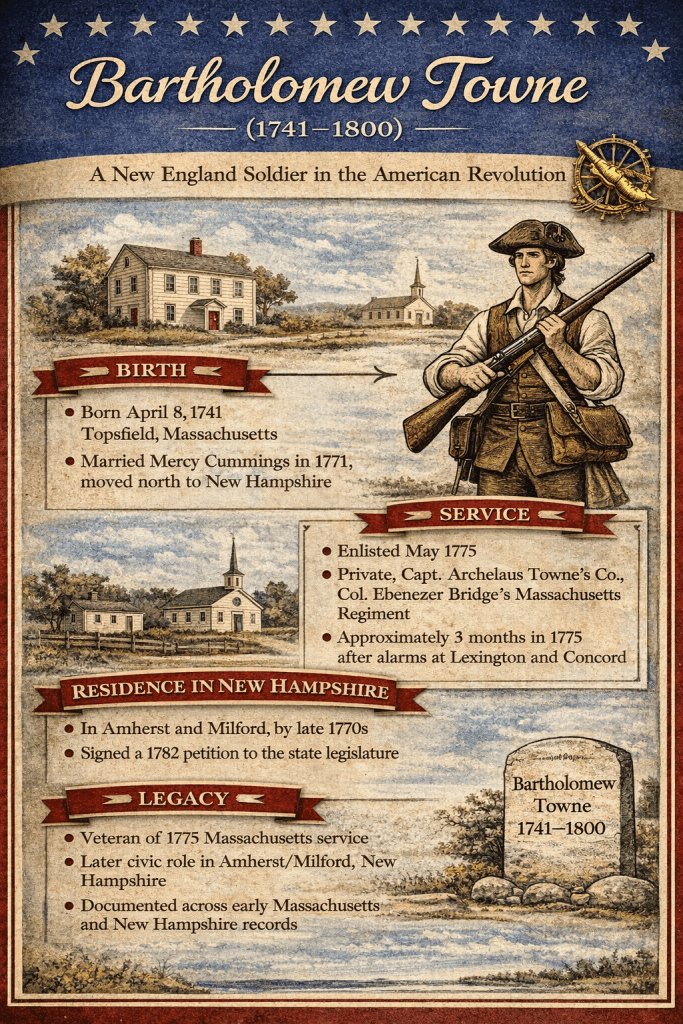
Bartholomew Towne’s Revolutionary War service is documented in both Massachusetts and New Hampshire records, placing him among the many New England men whose military and civic lives crossed colonial and early state boundaries. His service appears in compiled Massachusetts rolls from 1775 and later records from New Hampshire, reflecting the fluid movement of families and militia obligations during the war years.¹
Born in Massachusetts and later settled in New Hampshire, Towne’s life illustrates how Revolutionary service was often rooted in local communities while still contributing to the broader Continental effort.
Early Life in Massachusetts
Bartholomew Towne was born on 8 April 1741 in Topsfield, Essex County, Massachusetts, the son of Elisha Towne and Mercy Foster.² He grew up in a well-established Massachusetts family and reached adulthood during the years of mounting political and military tension between the colonies and Great Britain.
On 3 October 1771, he married Mercy Cummings in Andover, Massachusetts.³ Within a few years, the couple relocated northward into what would become Hillsborough County, New Hampshire, part of a broader pattern of late-colonial migration from coastal Massachusetts into interior New England.⁴
Revolutionary War Service
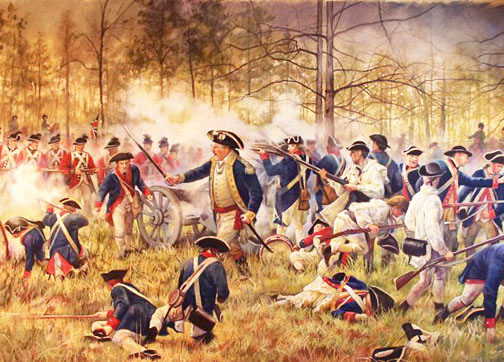
Bartholomew Towne’s military service is documented in Massachusetts Revolutionary War records. He appears as a private in Captain Archelaus Towne’s company, part of Colonel Ebenezer Bridge’s 27th Massachusetts Regiment.⁵ According to the compiled rolls, he enlisted in May 1775 and served approximately three months, with his service recorded on a muster roll dated 1 August 1775.⁶
Additional records show Towne received advance pay and later an order for a bounty coat, a benefit commonly issued to soldiers who met required service terms during the early months of the war.⁷ These details firmly place his service in the critical opening phase of the Revolution, following the alarms of April 1775 and the mobilization of Massachusetts militia forces.
Towne’s service was short-term, a pattern typical of Massachusetts soldiers in 1775, many of whom served limited enlistments before returning home or resuming civilian life.⁸
Residence and Civic Activity in New Hampshire
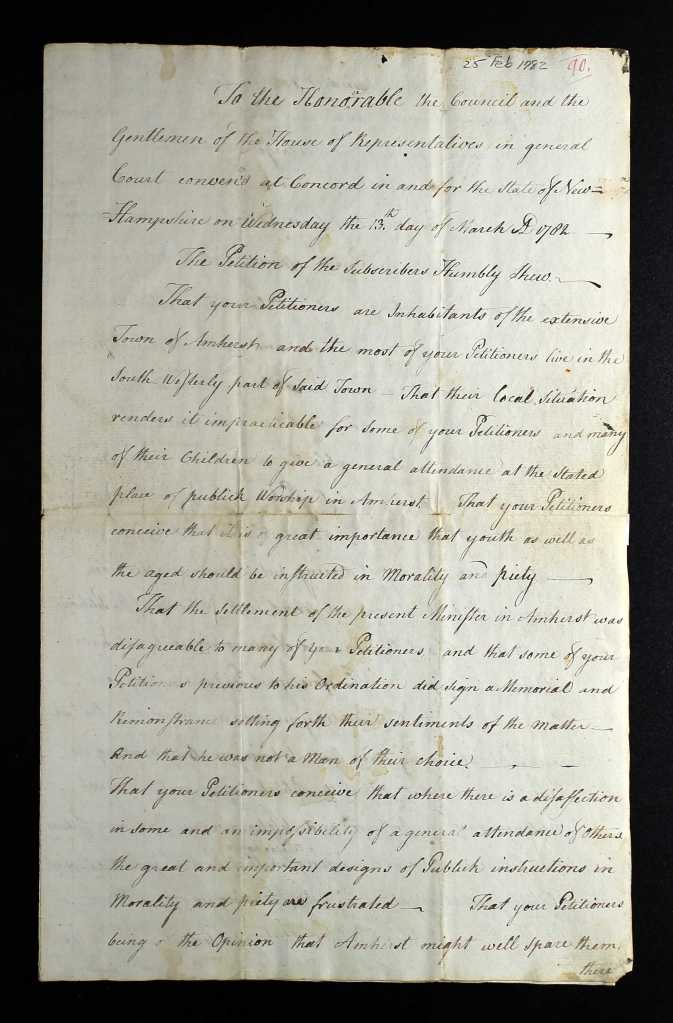
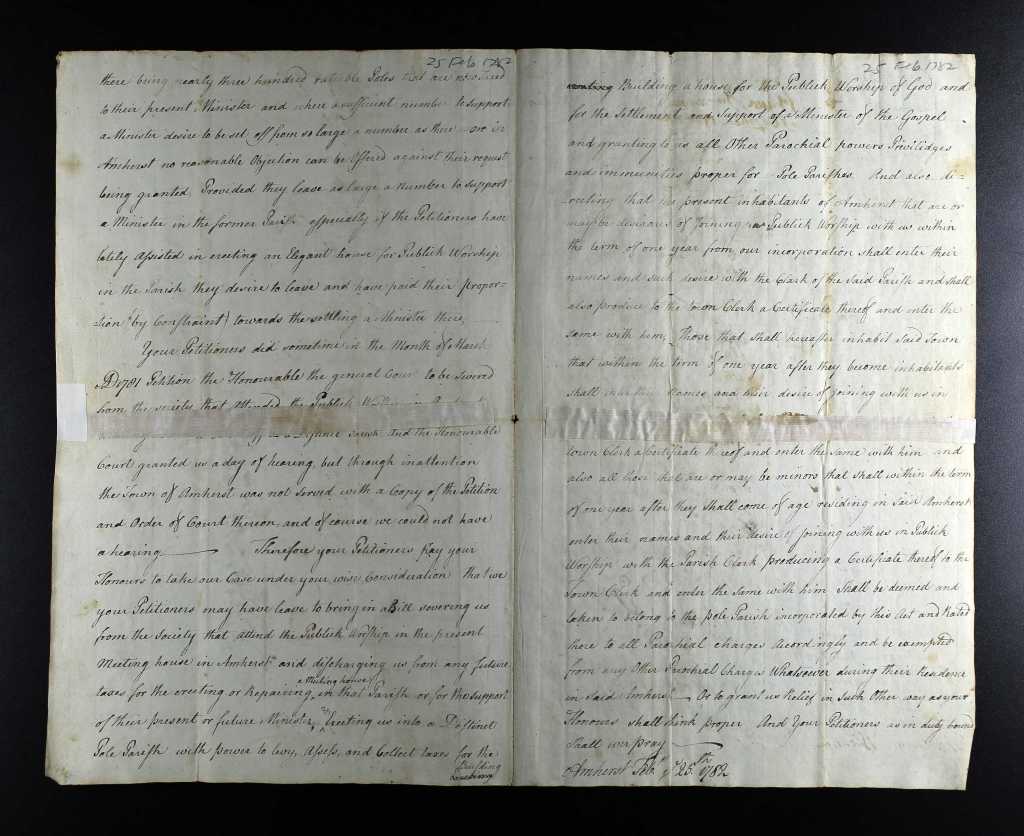
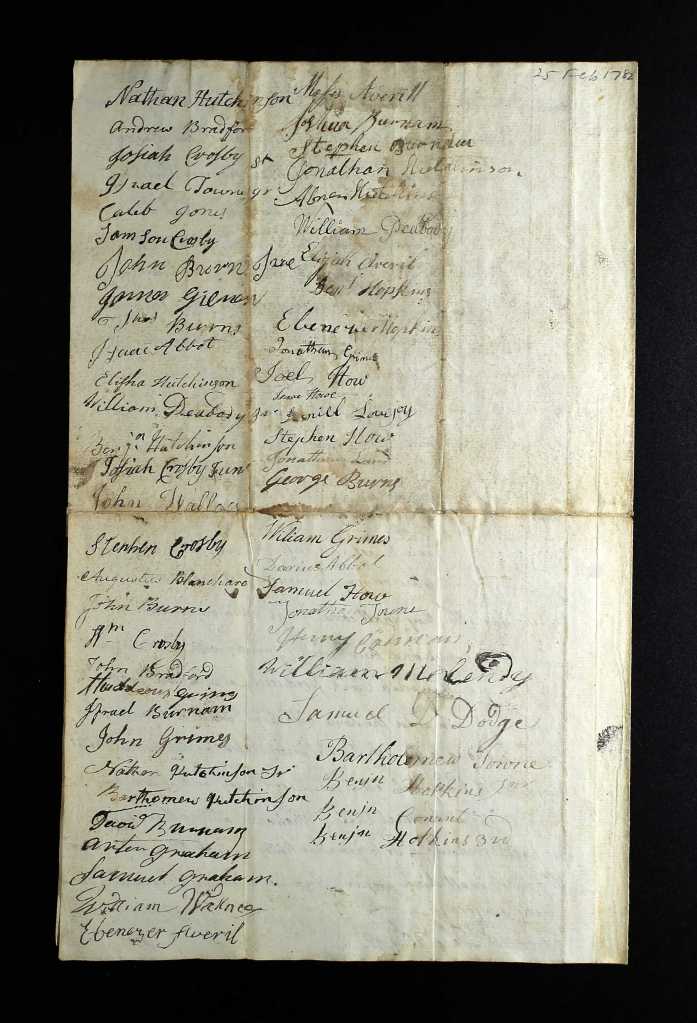
By the late 1770s, Bartholomew Towne was living in Amherst and Milford, Hillsborough County, New Hampshire. His presence there is confirmed not only through vital and census records but also through a surviving 1782 petition addressed to the New Hampshire legislature.⁹
That petition, signed by Towne and other inhabitants, concerned local religious organization and the establishment of public worship in the southern part of Amherst. Towne’s signature appears among the residents advocating for community governance and religious instruction, demonstrating his continued civic engagement after the war.¹⁰
This document places Towne squarely within the post-war civic life of New Hampshire and confirms his identity as the same man who earlier served in Massachusetts military units.
Later Life and Death
Bartholomew Towne appears in the 1790 federal census in Hillsborough County, New Hampshire, confirming his residence and household following the Revolutionary period.¹¹ He died in 1800 in Milford, Hillsborough County, New Hampshire.¹²
His life spanned the colonial era, the Revolutionary War, and the early years of the United States, with both his military service and later civic participation documented in contemporary records.
Assessing the Evidence
Bartholomew Towne’s Revolutionary War service rests on a solid evidentiary foundation. His enlistment and service in 1775 are supported by Massachusetts compiled rolls, including muster and pay records, while his later residence and civic activity in New Hampshire are corroborated by petitions and census data.¹³
The continuity of name, timeframe, and location across these records supports a confident identification without requiring speculative connections or later pension testimony.
Conclusion
Bartholomew Towne was not a long-term Continental soldier, but he was part of the first wave of New England men who answered the call in 1775. His service in a Massachusetts regiment during the opening months of the war, followed by his later civic role in New Hampshire, reflects the lived experience of many Revolutionary participants whose contributions were essential but modestly recorded.
By tracing his life across state lines and grounding his story in contemporary records, we preserve an accurate and meaningful account of his role in the Revolutionary generation.
Notes
- Massachusetts Soldiers and Sailors of the Revolutionary War; U.S. Revolutionary War Rolls, 1775–1783.
- Topsfield, Massachusetts, town birth records; compiled Massachusetts vital records.
- Massachusetts marriage records, Andover, 1771.
- Hillsborough County, New Hampshire, settlement patterns and family migration.
- Massachusetts Revolutionary War rolls, Capt. Archelaus Towne’s Company, Col. Ebenezer Bridge’s Regiment.
- Muster roll dated 1 August 1775, Massachusetts Revolutionary records.
- Massachusetts pay and bounty records, 1775.
- Massachusetts militia enlistment practices, early Revolutionary period.
- New Hampshire legislative petition, 1782, signed by Bartholomew Towne and others Bartholomew Towne on petition.
- Petition text and signatures, page 3, identifying Towne among Amherst inhabitants Bartholomew Towne on petition.
- 1790 U.S. Federal Census, Hillsborough County, New Hampshire.
- New Hampshire death records and compiled family histories.
- Correlation of military, civic, and residential records following genealogical proof standards.
 The Tumbleweed