Why the Episcopal Church Held the Answer

One of the most surprising lessons in the story of Elnathan, Lydia, and Fanny Tolles is not about war or DNA or probate. It is about churches.

For most people researching early New England families, the default assumption is that the Congregational church holds the records. That works for many families — but not for this one. The Tolles and Clark families belonged to the Episcopal Church, and that single fact explains why Fanny nearly disappeared from history.

Lydia Clark was baptized as an adult at Trinity Church in New Haven in May 1773. Two years later, her daughter Frances was baptized there in March 1775. These were not casual entries. Episcopal parishes kept detailed registers of baptisms, sponsors, and marriages that were entirely separate from the town and Congregational systems.

Meanwhile, in Milford, Daniel Munson was part of the Episcopal world as well. Records from St. George’s Church show him as a subscriber and vestryman in the late 1780s. When Frances married Daniel Munson in 1798, she did so in a community deeply tied to the Episcopal network — and to her Clark relatives.
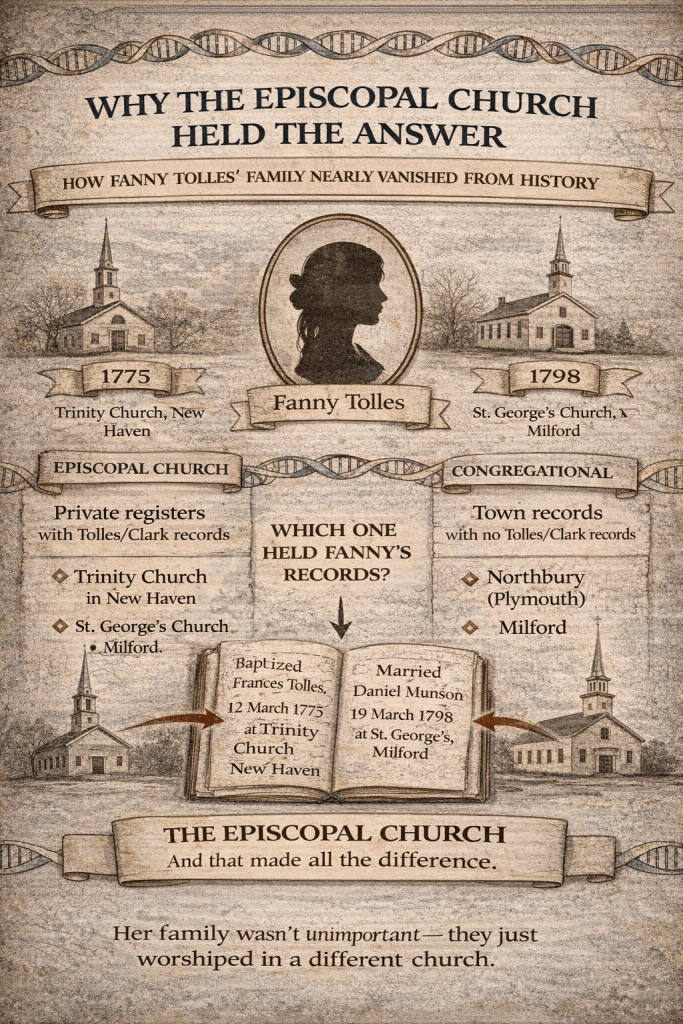
This is why older genealogists struggled. They searched town records and Congregational church books for Fanny Tolles and found very little. Without Episcopal registers, she looked unattached — a woman with a maiden name but no parents.

Donald Lines Jacobus solved this because he knew where to look. He drew from Trinity Church in New Haven, St. George’s in Milford, and the Plymouth parish records to reconstruct a family that existed almost entirely outside the Congregational system. When those church records were combined with probate law, the picture became clear.

Fanny Tolles did not vanish because her family was unimportant.
She vanished because her family worshiped in the “wrong” church.

And yet, it was those same Episcopal records that preserved her baptism, her name, and her marriage — quietly waiting for someone to connect them.

This is why genealogy is never just about names and dates. It is about institutions, beliefs, and communities — the frameworks that decide which lives are written down and which are forgotten.

For Fanny Tolles, the Episcopal Church kept her story alive long enough for us to finally find it.


Sources

  1. Trinity Church (Episcopal), New Haven, Connecticut, baptismal records, 23 May 1773 (Lydia Clark) and 12 March 1775 (Frances Tolles); abstracted in Donald Lines Jacobus, Families of New Haven, vol. VIII (1932).
  2. St. George’s Church, Milford, Connecticut, vestry and subscription lists, 1786–1788, showing Daniel Munson as a member of the Episcopal Society.
  3. Milford, Connecticut, Marriage Records, 19 March 1798, Daniel Munson and Frances (Fanny) Tolles.
  4. Donald Lines Jacobus, Deacon George Clark(e) of Milford, Connecticut and Some of His Descendants (1949), Clark and Tolles family entries.
  5. Probate of Elnathan and Lydia Tolles, Plymouth (Watertown) District, Litchfield County, Connecticut, 1789–1794.
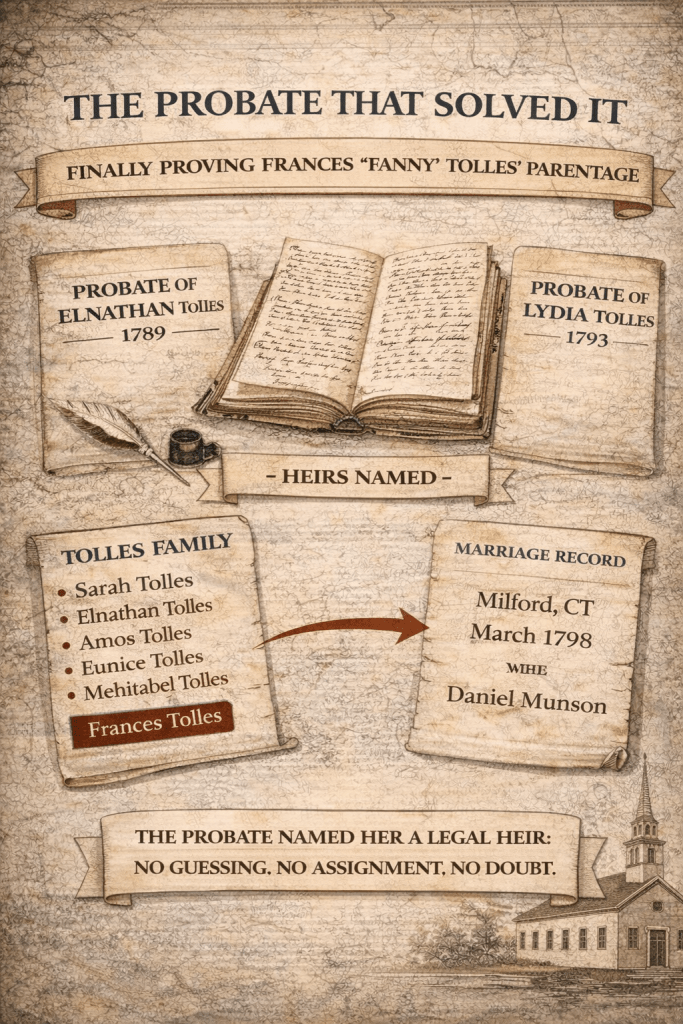
The Probate That Solved It

If DNA can mislead, probate records rarely do.

After years of uncertainty about Frances “Fanny” Tolles, the answer did not come from genetic matches or online trees. It came from something far more old-fashioned: a thick, handwritten court file created after the deaths of her parents.

When Elnathan Tolles died in 1789, he left behind a widow, Lydia, and six children. Lydia died in 1793, and their estates were administered together. The combined probate file for Elnathan and Lydia runs more than sixty pages, filled with inventories, accounts, and distributions. It is not easy reading — but it is extraordinarily valuable.

Buried in that paperwork is the simple truth genealogists search for:
the names of their children as legal heirs.

Among those heirs is Frances Tolles.

That single fact matters more than any later genealogy or DNA match. Probate law in eighteenth-century Connecticut was precise. Only legitimate children or legally recognized heirs were entitled to a share of an estate. Frances was not a guess, a rumor, or an assignment. She was acknowledged by the court as the daughter of Elnathan and Lydia Tolles.

The probate does not tell us whom Frances married. It does not say “wife of Daniel Munson.” But it does tell us something just as important: Frances Tolles lived to adulthood and inherited as Elnathan’s child.

That eliminates all of the uncertainty that once surrounded her. There was not one Frances Tolles who belonged to Elnathan and another who married Daniel Munson. There was only one Frances — born in 1775, raised in the Tolles household, and alive when her parents’ estates were settled.

When that legal fact is combined with the Episcopal church records that show Frances (“Fanny”) Tolles marrying Daniel Munson in Milford in 1798, the identity becomes clear. The girl baptized in New Haven, the heir named in probate, and the bride in Milford are the same person.

This is how real genealogical proof is built. Not from a single perfect document, but from the way independent records fit together without contradiction.

DNA raised the question.
The probate answered it.

In the next and final post of this series, I’ll show why the Episcopal Church — not town records or DNA — was the quiet key that held this whole story together.


Sources

  1. Probate of Elnathan Tolles (1789) and Probate of Lydia Tolles (1793), Plymouth (Watertown) District, Litchfield County, Connecticut, combined estate file (66 pages), naming Frances Tolles among the heirs.
  2. Donald Lines Jacobus, Families of New Haven, vol. VIII (1932), Tolles family, listing Frances baptized 12 March 1775 and identifying her as “Fanny” who married Daniel Munson.
  3. Milford, Connecticut, Marriage Records, 19 March 1798, Daniel Munson and Frances (Fanny) Tolles.

How DNA Almost Lied to Me

For most of the twentieth century, the question of who Frances “Fanny” Tolles really belonged to was a paper problem. In the twenty-first century, it became a DNA problem.

Like many genealogists, I had hoped DNA would provide the missing proof. If Fanny was truly the daughter of Elnathan and Lydia Tolles, then I should eventually match people who descend from their other children. And one day, I did.

An Ancestry DNA match appeared who traced their lineage back to another child of Elnathan Tolles — not through Fanny, but through a different branch of the Tolles family. According to Ancestry’s tools, we shared 9 centimorgans on one segment, a tiny match, but one that the Shared cM Project says can fall within the range of sixth cousins. That just happens to be exactly the relationship I would have if Fanny were Elnathan’s daughter.

For a moment, it felt like a breakthrough.

But genealogy is never that simple.

As I began building out that match’s family tree — generation by generation — another surname kept appearing: Mix. It was a name I recognized immediately. I already had Mix ancestors in my own tree. So I followed that line back.

And there it was.

The DNA match and I were not connected by just one line. We were connected by two — one through Tolles, and one through Mix. The Mix connection was older and more robust. That meant the small 9 cM segment could easily come from that shared ancestry instead of from Elnathan Tolles.

In other words, the DNA match did not prove what I wanted it to prove.

This is one of the hardest lessons in genetic genealogy: a match can be real, but still be misleading. Small segments, especially those under 10 cM, are easily inherited from distant ancestors and can survive for many generations. When multiple lines connect two people, DNA alone cannot tell you which ancestor supplied the shared segment.

So DNA did not solve the Tolles–Munson question. It simply told me that the two families were tangled together in more than one way.

And that meant I had to go back to something far older — something far more reliable.

I had to go back to the law.

In the next post, I’ll show how a thick, tedious, 66-page probate file did what DNA could not: it quietly but definitively tied Frances “Fanny” Tolles to the parents who raised her.


Sources

  1. AncestryDNA, shared DNA match between the author and a descendant of another child of Elnathan Tolles, showing 9 cM across one segment (author’s private test results).
  2. Shared cM Project 4.0, The DNA Painter, relationship probability tool for centimorgan values, indicating that 9 cM can be consistent with sixth-cousin relationships.
  3. Blaine T. Bettinger, “The Shared cM Project,” The Genetic Genealogist (https://thegeneticgenealogist.com), methodology for interpreting small DNA matches.
  4. International Society of Genetic Genealogy (ISOGG), guidelines on triangulation and multiple ancestral paths affecting DNA interpretation.
  5. Author’s compiled family tree and research notes on the Mix and Tolles families, showing multiple shared ancestral lines.

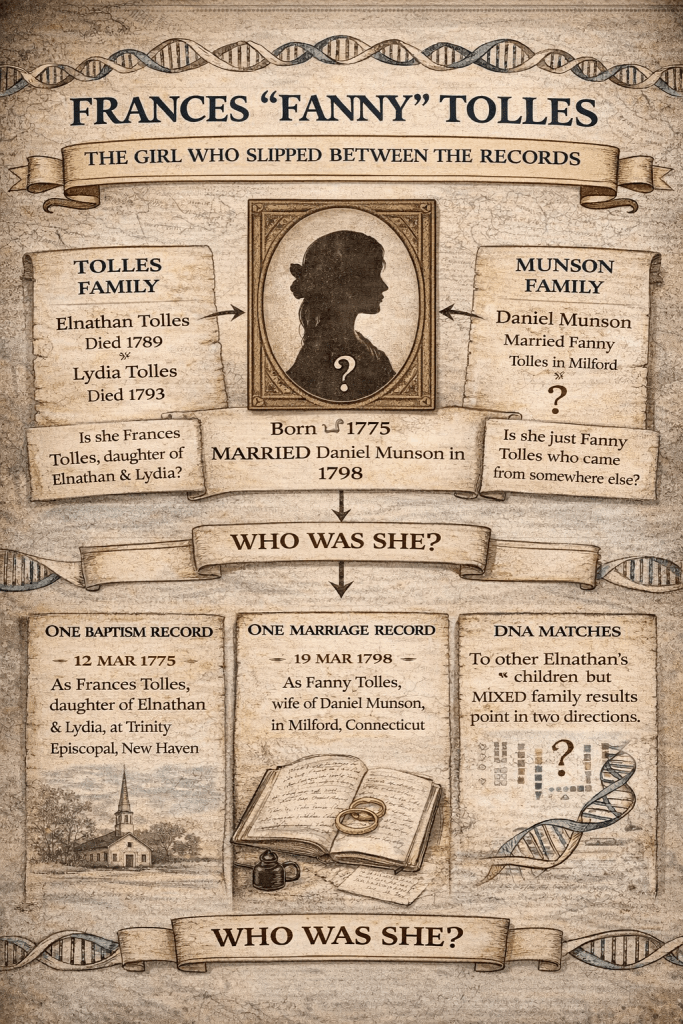
Frances “Fanny” Tolles: The Girl Who Slipped Between the Records

Genealogy often feels like assembling a puzzle — until you discover that one of the most important pieces was never cut to fit. That is what happens with Frances “Fanny” Tolles, the daughter of Elnathan and Lydia Tolles, and the woman who would later become the wife of Daniel Munson.

On paper, Fanny should be easy to find. She was baptized on 12 March 1775, just as the American Revolution was beginning. In the Episcopal records of New Haven she appears as “Frances,” daughter of Elnathan and Lydia Tolles.¹ But after that single entry, she seems to vanish.

Her parents lived in Northbury (later Plymouth), Connecticut, during the war years — a place where church and town records were scattered across jurisdictions and denominations. The Tolles family belonged to the Episcopal Church, not the Congregational churches that recorded most Connecticut vital events. As a result, many of Fanny’s milestones were preserved only in church books, not town ledgers.

Then her family fractured.

Elnathan Tolles died in 1789. Lydia followed in 1793. Their children were still young. Some were placed under guardianship, others went to live with relatives. The probate files confirm their identities as children of Elnathan and Lydia — but they do not track what happened to them afterward.²

This is where Fanny disappears.

By 1798, a Frances (or Fanny) Tolles married Daniel Munson in Milford, Connecticut — a town strongly associated with the Clark family, Fanny’s maternal kin.³ Yet nowhere in the marriage record are her parents named. There is no “daughter of Elnathan” to anchor her identity. She simply appears, gets married, and then moves on.

Later genealogies tried to solve this gap, but not all of them were confident. Early Tolles and Munson researchers knew that Daniel Munson’s wife was named Fanny Tolles, and they knew that Elnathan and Lydia had a daughter named Frances of the right age. But without a clear marriage record naming her parents, some writers hedged, quietly assigning her to Elnathan because she fit — not because a document said so.

That uncertainty lingered for generations.

In modern times, DNA added a new layer. A distant DNA match appeared to descend from another child of Elnathan Tolles, seemingly supporting Fanny’s placement in the family. But further research revealed a second, older connection through the Mix family, meaning the DNA could not be used to prove Fanny’s parentage after all. The evidence was real — but it pointed in two directions.

This is why I have over 64,000 people in my family tree. Not because I like big numbers, but because tiny errors in the 1700s ripple forward into the DNA era.

So who was Fanny Tolles?
Was she truly the daughter of Elnathan and Lydia?
Or was she “assigned” to them because no better answer existed?

To find out, we have to leave church books and DNA charts behind — and turn to something far more powerful: probate law.


Sources

  1. Trinity Church (Episcopal), New Haven, Connecticut, baptismal records, 12 March 1775, Frances Tolles, daughter of Elnathan and Lydia Tolles; abstracted in Donald Lines Jacobus, Families of New Haven, vol. VIII (1932).
  2. Probate of Elnathan and Lydia Tolles, Plymouth (Watertown) District, Litchfield County, Connecticut, 1789–1794, combined estate file, listing their children including Frances.
  3. Milford, Connecticut, Marriage Records, 19 March 1798, Daniel Munson and Frances (Fanny) Tolles; cited in The Munson Record and Milford town records.

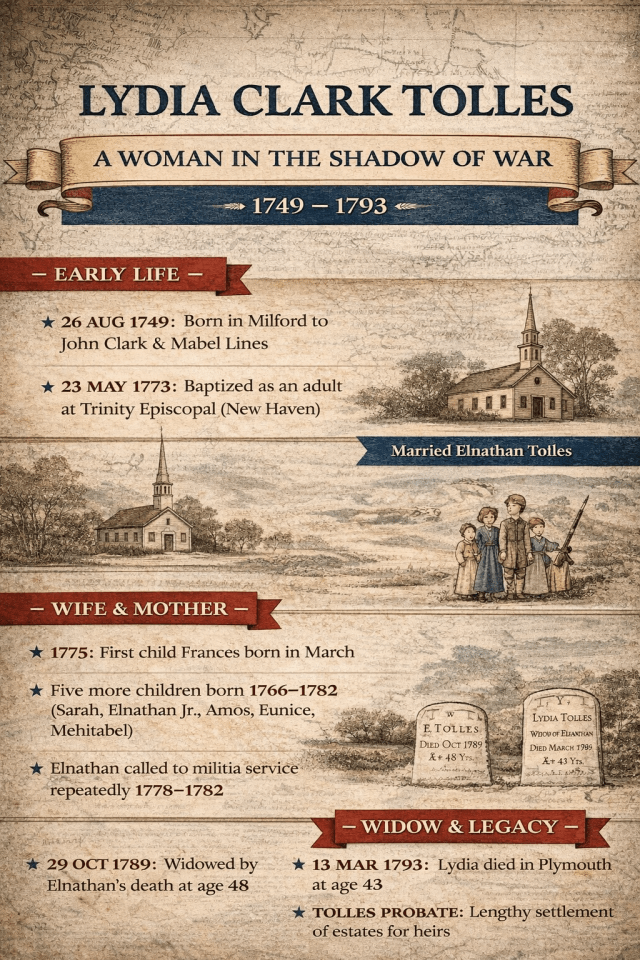
Lydia Clark Tolles (1749–1793): A Woman in the Shadow of War

When the American Revolution is told through the lives of men, it becomes a story of enlistments, campaigns, and patriotism. When it is told through the lives of women, it becomes something very different: endurance, uncertainty, and survival. Lydia Clark Tolles, the wife of Elnathan Tolles, lived her entire adult life inside that second story.

Lydia was born on 26 August 1749, the daughter of John Clark and Mabel Lines, members of one of the oldest and most prominent families in the Milford–New Haven area of Connecticut. Through her parents, Lydia was connected to a wide web of kin, land, and church ties that would quietly shape the course of her life.¹

On 23 May 1773, Lydia was baptized as an adult at Trinity Church in New Haven, an Episcopal parish. Adult baptisms were not unusual, but they often coincided with marriage or a conscious decision to join a particular congregation. Within a short time, Lydia married Elnathan Tolles, and the two established their household in the Northbury parish of Waterbury (later Plymouth), an upland farming community not far from New Haven.¹ ²

Within two years, the world around them changed. In March 1775, Lydia gave birth to her first daughter, Frances, just as colonial New England was sliding into war. Over the next decade, Lydia would give birth to at least five more children: Sarah, Elnathan, Amos, Eunice, and Mehitabel

While Lydia was raising young children, her husband was repeatedly called into military service. Connecticut records place Elnathan Tolles on militia duty in 1778, 1779, 1780, 1781, and 1782, meaning Lydia often ran their household without him during the most difficult years of the war.⁴

The war ended, but stability did not follow. Elnathan died on 29 October 1789, leaving Lydia a widow with six children. Four years later, on 13 March 1793, Lydia herself died in Plymouth at only 42 years of age. Their estates were handled together in a lengthy probate process that documented their surviving children and the property they left behind.⁵

Lydia left no diary and no personal letters. What survives instead are church entries, baptisms, militia lists, and probate records. Taken together, they show a woman who endured war, childbirth, widowhood, and early death — yet still raised a family that would carry this Connecticut story westward into the new nation.

In the next post, I’ll turn to Lydia’s daughter Frances “Fanny” Tolles, whose life and identity became one of the most complicated and revealing puzzles in this family’s history.


Sources

Probate of Elnathan and Lydia Tolles, Plymouth (Watertown) District, Litchfield County, Connecticut, 1789–1794, combined estate file (66 pages), showing Lydia as administratrix and naming their children as heirs.he most complicated and revealing puzzles in this family’s story.

Donald Lines Jacobus, Deacon George Clark(e) of Milford, Connecticut and Some of His Descendants (New Haven: Tuttle, Morehouse & Taylor, 1949), entry for Lydia Clark, wife of Elnathan Tolles.

Donald Lines Jacobus, Families of New Haven, vol. VIII (New Haven: Tuttle, Morehouse & Taylor, 1932), Tolles family, “Elnathan & Lydia (Clark) Tolles.”

Trinity Church (Episcopal), New Haven, Connecticut, baptismal records, Frances Tolles, 12 March 1775, as abstracted in Families of New Haven.

Connecticut Revolutionary War Military Lists, 1775–1783; and U.S. Compiled Revolutionary War Military Service Records, entries for Elnathan Tolles.