Rosa Susan (“Rosie”) Smith Revisited: What the Records Reveal Years Later

Looking Back at an Earlier Story

When I first wrote about my 2× great-grandmother Rosa Susan “Rosie” Smith in 2018, the outline of her life was already clear: a childhood in Pennsylvania and Michigan, a long marriage to William Doonan, years spent in northern Ontario, and a life that stretched into the early 1950s. What remained unclear then were the brief, uncomfortable gaps — especially Rosie’s short-lived first marriage to Thomas Osborn and the compressed timing of her remarriage to William Doonan.
In the years since, additional records, closer reading of familiar sources, and the availability of autosomal DNA evidence have allowed some of those gaps to be examined more carefully.

Re-examining the Marriage to Thomas Osborn

Rosie married Thomas Osborn on 17 February 1882 in Bay County, Michigan, when she was just sixteen years old.¹ The marriage was solemnized by Justice of the Peace Nathaniel Enman and witnessed by Charles Horsford and Mary Ann Leary.² It was formally recorded on 27 April 1882.

Marriage record of Thomas Osborn and Rosie Smith marriage.

At the time of the earlier post, it was unclear whether this marriage ended through divorce or death. A subsequent review of the complete 1880 federal census for Beaver Township and Kawkawlin Township — examined page by page — failed to locate Thomas Osborn in either community.³ No additional census, land, probate, or newspaper records have been identified that place him in Rosie’s orbit before or after the marriage.

The record, taken as a whole, suggests a marriage that existed briefly and left no lasting documentary footprint beyond the register itself.

A Compressed Timeline, Clarified

Rosie’s daughter, Rosa Jane Doonan, was born on 22 August 1882 — less than seven months after the Osborn marriage and several months before Rosie’s marriage to William Doonan on 11 November 1882.⁴ The timeline, while long visible, takes on sharper focus when examined alongside later evidence.

Marriage record of William Doonan and Rosie Smith

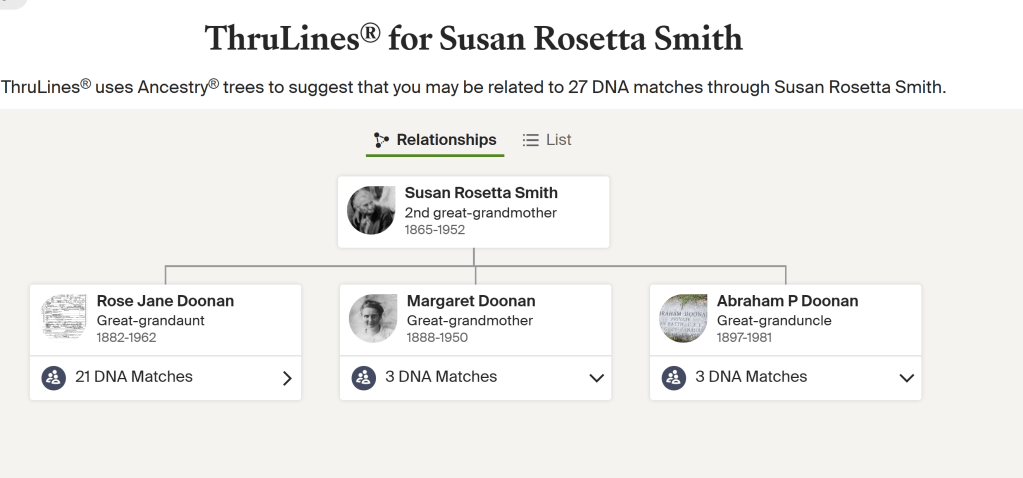
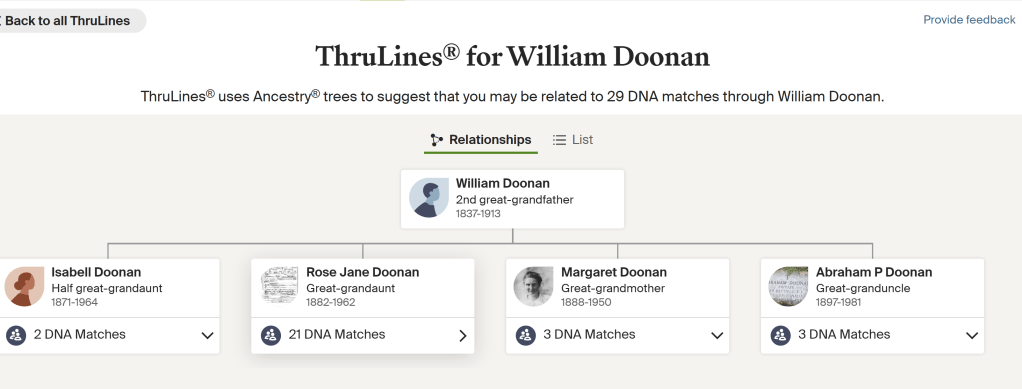
Modern autosomal DNA results now provide important clarification. Multiple DNA matches descending through independent children of Rosa Jane consistently align with William Doonan’s family.⁵ This pattern strongly supports William Doonan as Rosa Jane’s biological father and shows no comparable genetic connection to Thomas Osborn.

What once appeared as an unresolved question in the paper record is now better understood through the combination of documentation and DNA.
What the Witnesses — and Their Absence — Suggest

The Osborn marriage was witnessed by two community members who do not appear to have been relatives of either the bride or groom. No Osborn or Smith family members were listed as witnesses. Combined with Osborn’s absence from local census records, the marriage appears to have been formally executed but socially thin — a legally valid union that did not establish a shared household or lasting family connection.

This does not explain why the marriage occurred, but it helps explain why it disappeared so completely from the documentary record.

What Hasn’t Changed

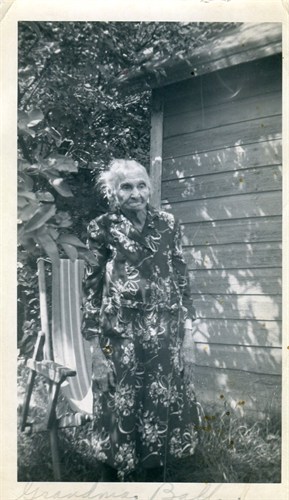
What has not changed since the earlier post is the broader shape of Rosie’s life. Her long marriage to William Doonan, the birth and loss of children, the move to northern Ontario in 1908, and her later years as “Grandma Ball” within the extended family remain exactly as they were first understood.

If anything, the additional research sharpens rather than softens that picture. Rosie’s brief marriage to Thomas Osborn now appears as a momentary interruption rather than a defining chapter — a small but telling episode in a life otherwise shaped by endurance, adaptation, and persistence.

Conclusion

Family history rarely unfolds neatly. What can be known at one moment often changes as new records surface and new tools become available. Rosie’s story is no exception. The outlines were always there, but time and patience have filled in some of the finer lines.

This later look at Rosie’s life does not replace the earlier telling. Instead, it reflects the ongoing nature of historical research — the understanding that some answers arrive only years after the first questions are asked.


Sources

  1. Bay County, Michigan, Marriage Register, Thomas Osborn and Rosie Smith, 17 February 1882.
  2. Bay County, Michigan, Marriage Register (officiant and witnesses), same entry.
  3. 1880 U.S. Federal Census, Beaver Township and Kawkawlin Township, Bay County, Michigan.
  4. Michigan Birth Records, Rosa Jane Doonan, 22 August 1882; Bay County, Michigan, Marriage Records, William Doonan and Rosie Smith, 11 November 1882.
  5. AncestryDNA autosomal matches through multiple independent descendant lines of Rosa Jane Doonan.
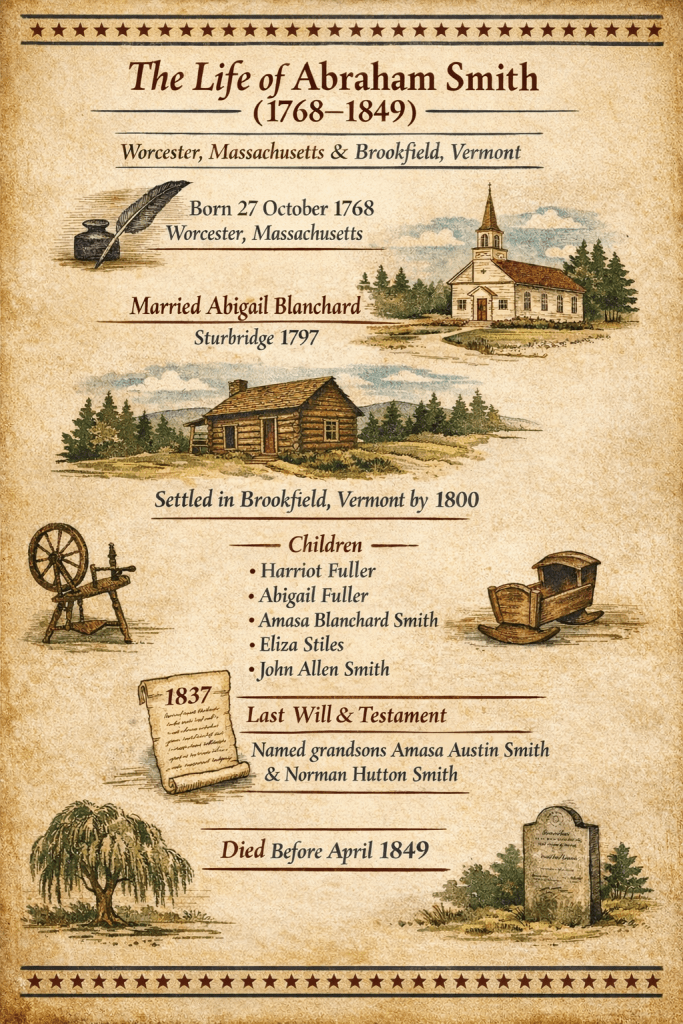
Abraham Smith (1768–1849) of Worcester, Massachusetts, and Brookfield, Vermont

From Massachusetts Roots to a Vermont Homestead

Abraham Smith was born on 27 October 1768 in Worcester, Worcester County, Massachusetts, the son of Abraham Smith and Lucy Allen.¹ He reached adulthood in the years following the American Revolution, a period shaped for him not by military service, but by marriage, migration, and the establishment of a household.

Abraham Smith Jr.’s adult life is well documented through marriage records, census context, probate files, and Vermont vital records, allowing his life and family to be reconstructed with confidence.

Marriage and Early Family Life

On 9 February 1797, Abraham Smith married Abigail Blanchard in Sturbridge, Massachusetts.² Shortly after their marriage, the couple began moving northward, a pattern common among young New England families seeking land and opportunity in the post-Revolutionary period.

Their first known child, Harriot Louise Smith, was born on 18 May 1798 in Cornish, Sullivan County, New Hampshire, suggesting a brief residence there before the family continued on to Vermont.³ By 1800, Abraham and Abigail had settled permanently in Brookfield, Orange County, Vermont, where Abraham appears as a resident in the 1800 federal census.⁴

Children of Abraham and Abigail Smith

Abraham Smith Jr. and Abigail Blanchard Smith were the parents of several children, documented through a combination of vital records and probate evidence. Their children included:

  • Harriot Smith, later Harriot Fuller, wife of Felix Fuller
  • Abigail Smith, later Abigail Fuller, wife of Sylvanus Fuller
  • Amasa Blanchard Smith, born about 1801 and died in 1808
  • Eliza Smith, later Eliza Stiles, wife of David Stiles
  • John Allen Smith, born 20 December 1809⁵

The early death of Amasa Blanchard Smith is recorded in Vermont vital records and explains his absence from later probate documents.⁶

Life in Brookfield, Vermont

From about 1800 until his death, Abraham Smith remained in Brookfield. The birthplaces of his younger children, census records, and probate jurisdiction all confirm Brookfield as his permanent residence. He lived there through the early decades of the nineteenth century, participating in the ordinary rhythms of rural Vermont life.

Abraham’s wife Abigail died in 1848.⁷ Abraham Smith himself died sometime before 10 April 1849, when probate proceedings for his estate were initiated in Orange County, Vermont.⁸

The Will and Probate of Abraham Smith

Abraham Smith wrote his will on 6 March 1837 in Brookfield.⁹ This document, together with the probate papers filed after his death, forms the most important body of evidence for understanding his family structure.

In his will, Abraham named his wife Abigail and his surviving children, identifying his daughters by their married names and explicitly associating them with their husbands. He named Harriot Fuller, Abigail Fuller, and Eliza Stiles, along with his son John Allen Smith.¹⁰

The will also made specific provisions for two grandsons, Amasa Austin Smith and Norman Hutton Smith, both explicitly identified as sons of John Allen Smith.¹¹

Two surviving versions of Abraham Smith’s probate file exist, preserved in different clerk’s books. These records represent parallel copies of the same estate proceedings and are consistent in substance, naming the same heirs, executor, and property interests.¹²

Conclusion

Abraham Smith Jr.’s life reflects the experience of a post-Revolutionary New England settler. Born in Massachusetts, briefly passing through New Hampshire, and ultimately establishing himself in Vermont, he represents a generation shaped by migration, family building, and landholding rather than by war.

Through careful examination of vital records and probate documents, Abraham Smith Jr.’s life and family can be reconstructed with confidence. His will, in particular, provides clear and direct evidence of his children and their marriages, anchoring the family structure firmly in the historical record.


Footnotes

  1. Worcester, Massachusetts, Town Birth Records; Massachusetts Town and Vital Records, 1620–1988 (Ancestry).
  2. Massachusetts Marriages, 1633–1850; Sturbridge marriage records (Ancestry).
  3. New Hampshire Birth Records, 1631–1920 (Ancestry).
  4. 1800 U.S. Federal Census, Brookfield, Orange County, Vermont (Ancestry).
  5. Vermont Vital Records, 1720–1908; Massachusetts and Vermont town records (Ancestry).
  6. Vermont Vital Records, death of Amasa Blanchard Smith, 1808 (Ancestry).
  7. Vermont Vital Records, death of Abigail (Blanchard) Smith, 1848 (Ancestry).
  8. Vermont, Wills and Probate Records, 1749–1999, Orange County, estate of Abraham Smith (d. 1849) (Ancestry).
  9. Will of Abraham Smith, dated 6 March 1837, Brookfield, Vermont.
  10. Ibid., clauses naming daughters Harriot Fuller, Abigail Fuller, and Eliza Stiles, and son John Allen Smith.
  11. Ibid., clauses naming “my grandsons Amasa Austin Smith and Norman Hutton Smith, sons of my son John Allen Smith.”
  12. Vermont probate clerk record books, Randolph District, Orange County.

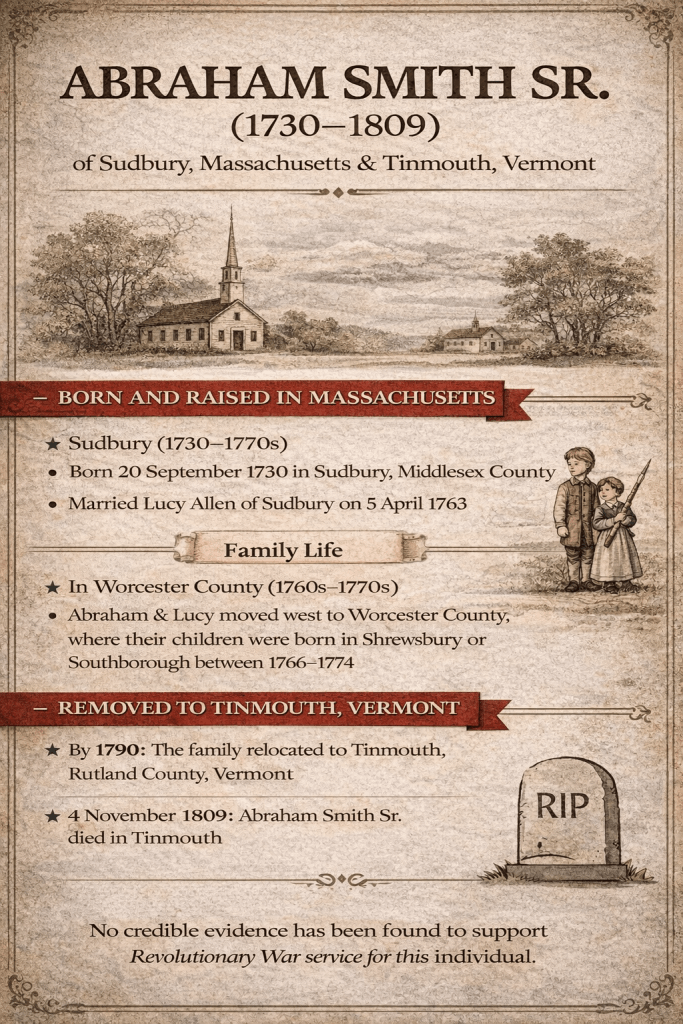
Abraham Smith (1730–1809) of Sudbury, Massachusetts, and Tinmouth, Vermont

A Man of the Revolutionary Era—But Not a Soldier

Abraham Smith was born on 20 September 1730 in Sudbury, Middlesex County, Massachusetts, a well-established New England town with extensive surviving eighteenth-century vital records.¹ He married Lucy Allen, and together they raised their family during a period that spanned the colonial era, the American Revolution, and the early years of the United States.²

Abraham’s adult life unfolded during the Revolutionary era, but surviving records do not demonstrate that he participated in the war as a soldier. Instead, the documentary evidence places him firmly in civilian life—raising a family, maintaining a household, and later participating in postwar migration patterns common to New England families.

Family and Household

Abraham Smith and his wife Lucy Allen were the parents of several children, including a son also named Abraham, born in 1768 in Worcester County, Massachusetts.³ This younger Abraham—referred to here as Abraham Smith Jr.—is clearly documented as a separate individual who later settled in Brookfield, Orange County, Vermont, where he left an extensive probate record.⁴

By the outbreak of the Revolutionary War in 1775, Abraham Smith Sr. was forty-five years old and had dependent children still at home. While men of this age sometimes served, many did not, particularly when responsible for sustaining farms and households, a pattern well documented in New England militia demographics.⁵

Move to Vermont

Following the Revolutionary War, Abraham Smith relocated north to Tinmouth in Rutland County, Vermont. This move aligns with a broader postwar migration pattern, as families from Massachusetts and southern New England moved into Vermont towns newly opened to settlement and formalized governance.⁶

Abraham Smith died in Tinmouth on 4 November 1809.⁷ His death is recorded in Vermont vital records, and his probate proceedings further confirm his residence in Tinmouth at the end of his life.⁸

The Question of Revolutionary War Service

Abraham Smith of Tinmouth has long been attributed Revolutionary War service in at least one early DAR lineage record.⁹ That attribution has been repeated in derivative family trees and secondary sources, despite the lack of supporting contemporary evidence.

The DAR Ancestor Database lists numerous men named Abraham Smith who served during the Revolutionary War, across multiple colonies and states, under different commanding officers and with differing life details.¹⁰ Careful comparison of these service profiles shows that none can be conclusively matched to the Abraham Smith born in Sudbury in 1730 and deceased in Tinmouth in 1809.

Critically, Abraham Smith’s probate file contains no references to military service, land bounties, pensions, arrears of pay, or other benefits commonly associated with Revolutionary War veterans or their heirs.¹¹ No pension application or verified service record has been identified that connects him to wartime service.

Resolving the Misattribution

The Revolutionary War service attributed to Abraham Smith of Tinmouth appears to be the result of name conflation. “Smith” is among the most common surnames in eighteenth-century New England, and Abraham was a frequently used given name. Early lineage applications often relied on incomplete records and did not have access to the full range of probate, census-context, and geographic evidence now available.

Subsequent analysis of birth, marriage, residence, probate, and family structure demonstrates that the military service cited in the early DAR record belongs to other men named Abraham Smith, not to the individual who died in Tinmouth in 1809.

Conclusion

Abraham Smith lived through the Revolutionary era, raised a family during a time of upheaval, and participated in the postwar settlement of Vermont. While he was not a Revolutionary War soldier, his life reflects the experience of many New England civilians whose labor, stability, and family networks sustained their communities before, during, and after the war.

Correcting the historical record does not diminish Abraham Smith’s legacy. Rather, it ensures that his story—and the story of Revolutionary War service—is told accurately and supported by evidence.


Footnotes

  1. Sudbury, Massachusetts, town vital records; Massachusetts Town and Vital Records, 1620–1988 (Ancestry).
  2. Marriage and family structure inferred from Massachusetts and Vermont vital records and probate context.
  3. Massachusetts Town Birth Records; Worcester County birth registers (Ancestry).
  4. Vermont, Wills and Probate Records, 1749–1999, Orange County, estate of Abraham Smith (d. 1849) (Ancestry).
  5. Massachusetts militia participation patterns discussed in contemporary town and county studies; absence of service-specific documentation for Abraham Smith.
  6. Vermont settlement and migration patterns following the Revolutionary War; Rutland County land and town histories.
  7. Tinmouth, Rutland County, Vermont, vital records.
  8. Rutland County, Vermont, probate records for Abraham Smith (d. 1809).
  9. DAR Ancestor Database, legacy entry for Abraham Smith, ancestor number A104615.
  10. DAR Ancestor Search results for “Abraham Smith,” multiple entries with divergent service profiles.
  11. Rutland County probate file for Abraham Smith (d. 1809), no military references noted.

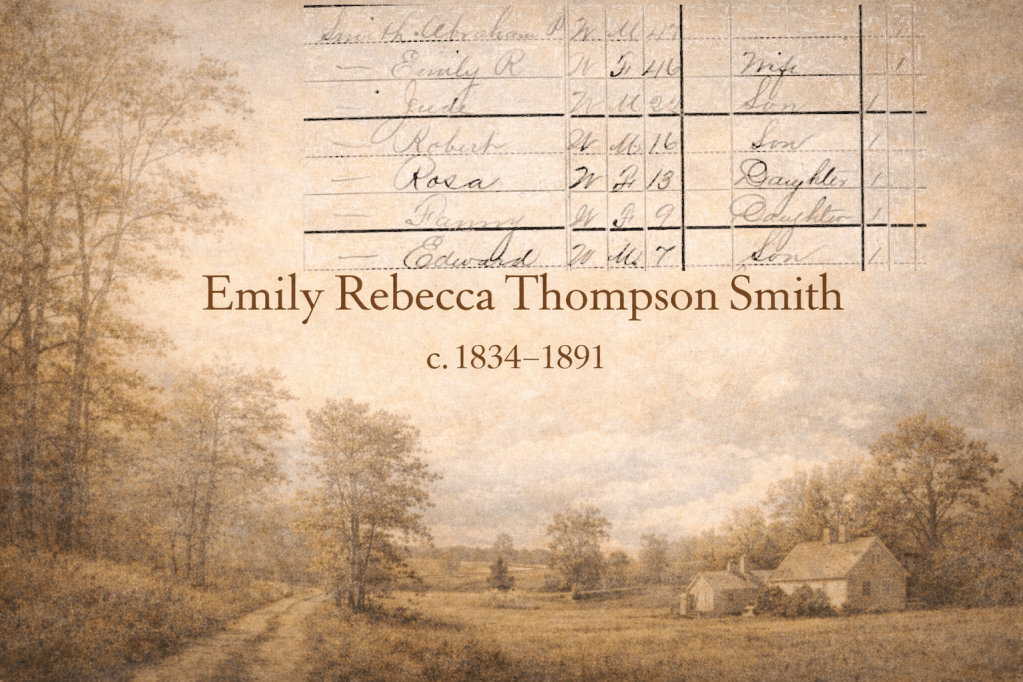
Emily Rebecca Thompson (c. 1834–1891)

Early Life in Pennsylvania

Emily Rebecca Thompson was born about 1834 in Pennsylvania, the daughter of John Thompson and his wife Mary.¹ Her early life is documented indirectly through later census records and family relationships rather than through a surviving birth record, a common circumstance for women born in rural Pennsylvania during this period.

Emily appears consistently in federal census records under the name “Rebecca,” suggesting that Rebecca was the name by which she was most commonly enumerated, while later records and newspapers refer to her as Emily.² This dual usage is not unusual for nineteenth-century women, particularly when a middle name or preferred given name was used interchangeably.

Marriage and Family

Before 1854, Emily married Abraham Possinger Smith, a Pennsylvania native born in 1833.³ The couple established their household in Monroe County, Pennsylvania, where they raised a large family. Their known children include:

  • Frank E. Smith (born 1855)
  • Hannah Smith (born about 1856)
  • Jude Smith (born about 1858)
  • Elmira Smith (born about 1862)
  • Robert Smith (born 6 May 1864)
  • Susan Rosetta Smith (born 1865)
  • Fanny Florence Smith (born 1870)
  • Abraham Edward Smith (born 1872)⁴

The family is enumerated in Tobyhanna Township, Monroe County, Pennsylvania, in both the 1860 and 1870 federal censuses, with Emily recorded as “Rebecca Smith,” wife of Abraham.⁵

Migration to Michigan

Sometime between 1872 and 1880, Emily and Abraham Smith relocated with their family to Michigan, settling in Beaver Township, Bay County. This move reflects a broader pattern of post–Civil War migration from Pennsylvania to the Midwest, particularly among families seeking agricultural or lumber-related opportunities.

The 1880 federal census places Emily, again enumerated as “Rebecca,” in Beaver Township, Bay County, Michigan, where she is listed as a married woman and wife of the household head.⁶

The Tragedy of 1890–1891

Emily’s final years were marked by extraordinary family trauma. On 6 December 1890, her son Jude Smith was shot and killed by his brother, Robert Smith, near Linwood in Bay County.⁷ The killing resulted in Robert’s arrest, trial, and eventual conviction for first-degree murder.

Contemporary newspaper accounts describe Emily as physically frail even before the shooting and report that she took to her bed shortly after Jude’s death. She did not attend her son Jude’s funeral and never saw Robert again following the crime. As Robert’s trial commenced in the spring of 1891, Emily’s condition worsened dramatically.⁸

Death

Emily Rebecca Thompson Smith died on 9 May 1891 in Garfield Township, Bay County, Michigan. Her death was recorded in multiple contemporaneous sources under slightly varying forms of her name.

A Bay County death register lists her as “Emily S. Smith,” married, aged 52 years, with parents John Thompson and Mary, residing in Garfield Township.⁹ The cause of death was recorded as dropsy, a term commonly used at the time for edema associated with chronic illness.

Newspaper coverage published shortly after her death attributed her decline to overwhelming grief following the killing of one son by another. One account stated that she “grieved to death over the killing of a son by another,” reflecting both the emotional tone of the period and the family’s widely known tragedy.¹⁰

Emily’s burial followed soon after her death, and she was survived by her husband Abraham Possinger Smith and several of her children.

Name Variations in the Records

Across her lifetime, Emily appears in records as Rebecca Smith, Emily Smith, and Emily S. Smith. These variations do not indicate multiple individuals but rather reflect common nineteenth-century record-keeping practices, especially for married women. Census enumerators frequently recorded women under a familiar or household name, while newspapers and civil registers often used a formal given name or abbreviated married form.

The consistent convergence of spouse, children, residence, parents’ names, and death date confirms that these records all refer to the same woman.

Conclusion

Emily Rebecca Thompson Smith lived a life shaped by migration, motherhood, and endurance. Like many women of her era, her story must be reconstructed from the records left by institutions rather than from documents created in her own voice. Yet through census records, civil registers, and contemporary reporting, her presence remains clear.

Her death in 1891 closed a chapter defined by family, loss, and resilience—leaving behind a lineage whose history would continue to be shaped by the events she lived through but did not survive.


Sources

  1. Bay County, Michigan, Death Register, 1891, entry for Emily S. Smith.
  2. 1860 U.S. Federal Census, Tobyhanna Township, Monroe County, Pennsylvania.
  3. Michigan county marriage records; Abraham Possinger Smith and Emily Thompson.
  4. Family structure compiled from census and vital records, 1855–1872.
  5. 1870 U.S. Federal Census, Tobyhanna Township, Monroe County, Pennsylvania.
  6. 1880 U.S. Federal Census, Beaver Township, Bay County, Michigan.
  7. Bay City newspapers, December 1890, reports on the killing of Jude Smith.
  8. The Bay City Times, spring 1891, coverage of Robert Smith’s trial.
  9. Bay County, Michigan, Return of Deaths, year ending 1891.
  10. The Bay City Times, May 1891, obituary and death coverage for Mrs. Abraham Smith.

Robert Smith (1864–1947): A Life Shaped by Tragedy

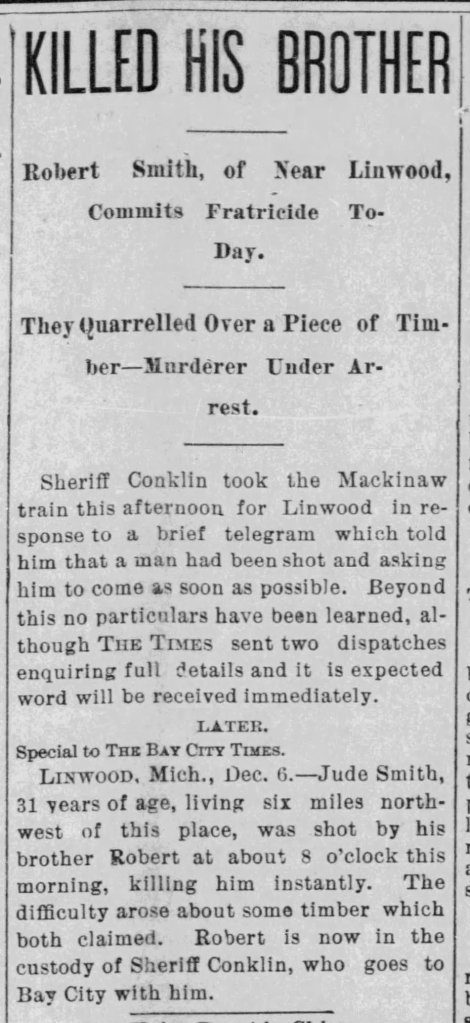
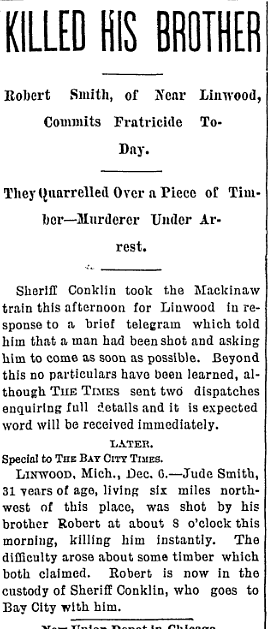
On 6 December 1890, a violent confrontation between two brothers near Linwood in Bay County, Michigan, ended with one man dead and the other facing the gravest criminal charge available under Michigan law. Robert Smith shot and killed his brother, Jude A. Smith, in what newspapers immediately characterized as the culmination of a long-standing family dispute over land and timber.¹ Within days, the case became one of the most closely followed criminal proceedings in Bay County.

The killing of Jude Smith

Early reports placed the shooting in Garfield Township, near Linwood, during an argument concerning ownership and removal of timber. Accounts varied in their details, but the central facts remained consistent: Robert Smith fired a shotgun at close range, killing his brother.² From the earliest coverage through the conclusion of the trial, newspapers referred to the accused almost uniformly as Robert S. Smith.³

The intensity of public interest was evident almost immediately. Smith was arrested, lodged in the Bay County jail, and photographed for inclusion in the local “rogue’s gallery,” an act reported in the press as a matter of routine but revealing the degree to which the case had already entered the public imagination.⁴

The Bay City Times, December 6, 1890.

Pretrial proceedings and public attention

Throughout December 1890 and into early 1891, Bay City newspapers printed frequent updates on the case. These included notices of arraignment, scheduling delays, and speculation regarding the defense strategy.⁵ At various points, reports suggested that Smith might pursue an insanity defense, though these references appear largely in the context of courtroom rumor rather than formal pleadings.⁶

The coverage also reflected the spectacle of the proceedings themselves: crowded courtrooms, lengthy jury selection, and the presence of spectators from Linwood and surrounding communities who were familiar with the Smith family.⁷

Trial and conviction

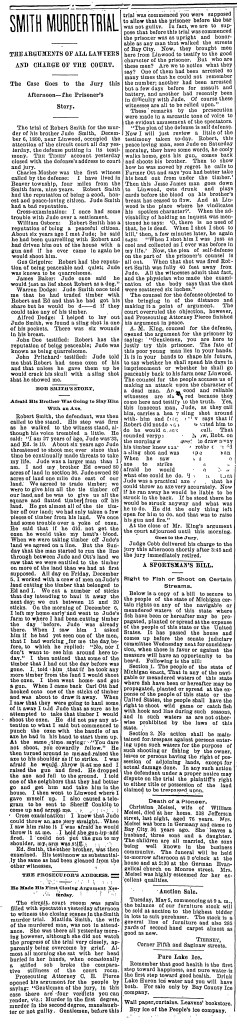
Robert Smith’s trial took place in the spring of 1891. Newspaper accounts summarized testimony from witnesses present at the scene, law enforcement officers, and medical professionals.⁸ Despite arguments advanced by the defense, the jury returned a verdict of guilty of murder in the first degree.⁹

The Bay City Daily Tribune, May 2, 1891.

On 12 May 1891, Smith was sentenced to life imprisonment. Several newspapers printed a statement attributed to him shortly thereafter, in which he denied guilt and attempted to justify his actions as self-defense, framing himself as the victim of prolonged harassment by his brother.¹⁰ The letter provides insight into Smith’s own view of events but does not alter the legal outcome of the case.

Incarceration and release

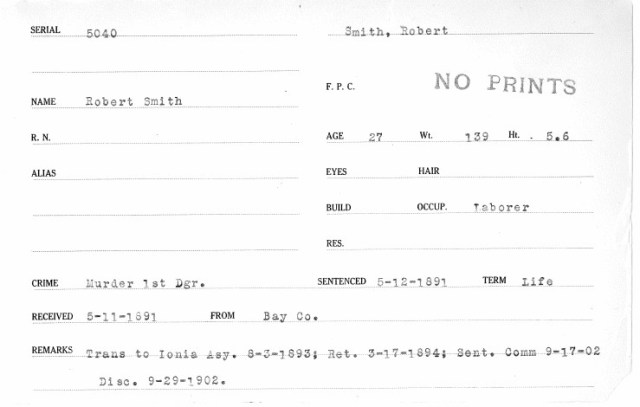
Michigan prison records confirm that Robert Smith was received at the state prison on 11 May 1891 following his conviction in Bay County.¹¹ Although sentenced to life, his incarceration did not remain static. In August 1893, Smith was transferred to the Ionia State Hospital for the Criminally Insane, where he remained for several months before being returned to prison in March 1894.¹²

More than a decade later, his case was reconsidered. In September 1902, Smith was granted a commutation of sentence and formally discharged from custody later that month.¹³ This record is critical, as it establishes that Smith was not imprisoned for life and that his release occurred well before the turn of the century.

Prison card for Robert Smith held at the Michigan Archives

A new life in Washington

Nearly two decades later, Robert Smith appears in Washington State records. On 9 June 1919, a marriage was recorded in Centralia, Lewis County, between Robert T. Smith and Edna Myers.¹⁴ The groom was reported as fifty-five years old, born in Pennsylvania, and entering his second marriage. His occupation was listed as laborer. The record names his father as Abraham T. Smith and gives his mother’s maiden name as Thompson.¹⁵

The use of the middle initial “T” in this record contrasts with the consistent use of “S” in Bay County newspaper coverage. Whether this reflects clerical variation, personal choice, or a deliberate alteration cannot be determined from the surviving records. What can be said is that the Washington marriage record aligns closely with other identifying details associated with the Bay County defendant, including age, birthplace, and parental names.

Death in Tacoma

Robert Smith’s life concluded in Tacoma, Pierce County, Washington. His death certificate records that Robert T. Smith died on 10 February 1947 at the age of eighty-two.¹⁶ His birth date is given as 6 May 1864, with birthplace recorded as Blakerlee, Pennsylvania. At the time of death, he was widowed and retired. He was buried at Oakwood Cemetery in Tacoma.¹⁷

The informant for the death certificate was hospital staff, and several personal details—including parental information—were listed as unobtainable.¹⁸ Nonetheless, the combination of birth date, birthplace, and earlier Washington records strongly suggests continuity between the man who married in Centralia in 1919 and the man who died in Tacoma in 1947.

Minnie, the first wife

The 1919 Washington marriage record explicitly states that it was Robert Smith’s second marriage, confirming the existence of an earlier wife. That woman is known from earlier records as Minnie, though it remains unclear whether this was her legal given name or a familiar nickname. Despite extensive documentation surrounding Robert Smith’s criminal case, imprisonment, and later life, no definitive record has yet been identified that accounts for Minnie’s fate. At present, what became of her remains unknown.

Conclusion

Robert Smith’s life cannot be reduced to a single violent act, yet neither can that act be separated from the years that followed. Convicted of first-degree murder in 1891 and sentenced to life imprisonment, he was later released, relocated across the country, remarried, and lived into old age. The surviving records trace a trajectory from public disgrace to relative obscurity, marked by gaps that resist easy explanation. As with many lives reconstructed from fragmentary sources, some questions remain unanswered—but the outline of the story is now firmly grounded in the historical record.


Notes

  1. Bay City newspapers reporting the killing of Jude A. Smith near Linwood, December 1890.
  2. Contemporary newspaper descriptions of the shooting and its circumstances, December 1890.
  3. Bay City press coverage consistently identifying the accused as Robert S. Smith, 1890–1891.
  4. Newspaper report noting Smith’s photograph taken at the Bay County jail for the rogue’s gallery.
  5. Bay City newspaper reports on arraignment and court scheduling, December 1890–January 1891.
  6. Newspaper references to a possible insanity defense during pretrial proceedings.
  7. Reports describing courtroom crowds and jury selection during early 1891.
  8. Trial testimony summaries published in Bay City newspapers, April–May 1891.
  9. Newspaper accounts of the guilty verdict and sentencing, May 1891.
  10. Published letter attributed to Robert Smith following conviction, May 1891.
  11. Michigan State Prison prisoner index card for Robert Smith, received May 1891.
  12. Prison record noting transfer to Ionia State Hospital and subsequent return.
  13. Prison record documenting commutation and discharge, September 1902.
  14. Lewis County, Washington, marriage record for Robert T. Smith and Edna Myers, 9 June 1919.
  15. Ibid., parental and birthplace information.
  16. Washington State death certificate for Robert T. Smith, Tacoma, 10 February 1947.
  17. Ibid., burial information.
  18. Ibid., informant and missing personal details.

Four Abraham Smiths in One Family Tree

One of the most challenging parts of family history research is sorting out people who share the same name. In my own family tree, I descend from four different men named Abraham Smith. They fall into two father–son pairs, belonging to two entirely separate families. Although their names are identical, their lives unfolded in different places and under very different circumstances.


The Massachusetts–Vermont Abraham Smiths

Abraham Smith (1730–1809)

Abraham Smith was born on 20 September 1730 in Sudbury, Middlesex County, Massachusetts, the son of Amos Smith (1699–1786) and Susanah Holman (1702–1778). He grew up in Sudbury alongside his brothers Jacob, Benjamin, and Jonathan. On 24 July 1763, he married Lucy Allen in Newton, Massachusetts. Lucy had been born in 1739 in Weston, Massachusetts. Their children were born in Massachusetts:

  • Polly Smith, born 20 November 1766
  • Abraham Smith, born 27 October 1768 in Worcester
  • Allen Smith, born 6 April 1770

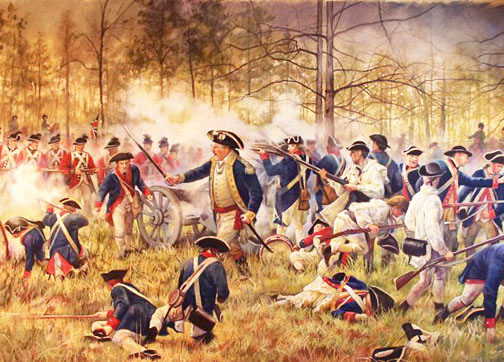
During the American Revolutionary War, Abraham Smith served in the Vermont militia. His service appears in The State of Vermont: Rolls of the Soldiers in the Revolutionary War 1775–1783, compiled by John E. Goodrich. Abraham Smith is listed on the roll of Captain Gideon Brownson’s Company, on a roster dated 26 February 1776 for the Montreal expedition, placing him in the northern theater of the war. This company was part of the militia forces raised in the Vermont region for operations connected with the occupation of Canada during the early stages of the war.

By 1790, Abraham was living in Tinmouth, Rutland County, Vermont, where he appears in the federal census. He remained there until his death on 4 November 1809, closing a life that spanned from colonial Massachusetts through the Revolutionary War and into the early years of the United States.


Abraham Smith (1768–before 1849)

The second Abraham in this line was born 27 October 1768 in Worcester, Massachusetts, the son of Abraham Smith and Lucy Allen. He married Abigail Blanchard on 9 February 1797 in Sturbridge, Massachusetts. Abigail was born in 1771 and later died in Brookfield, Vermont.

By the early 1800s, this family had settled in Orange County, Vermont, primarily in Brookfield. Their children included:

  • Harriot Louise Smith (1798–1878)
  • Abigail Smith (1800–1879)
  • Amasa Austin Smith (c.1801–1808)
  • Eliza Smith (1805–1889)
  • John Allen Smith (1809–1884)

Through these children, this Smith line later extended westward into Wisconsin and Michigan, particularly through the Fuller, Stiles, and Loomis families. Abraham Smith (1768) died before 10 April 1849 in Orange, Vermont.


The Pennsylvania Abraham Smiths

Abraham Smith (1793–c.1884)

A second, unrelated Abraham Smith was born on 29 January 1793, probably in Wrightstown, Bucks County, Pennsylvania. He was the son of John Smith (1756–1821) and Sarah Smith (1755–1829), a family associated with the Wrightstown Monthly Meeting of Friends (Quakers).

Abraham married Susanna Possinger (1795–1872), the daughter of John B. Possinger and Elizabeth Handelong. By 1830, Abraham and Susanna were living in Jackson Township, Monroe County, Pennsylvania, where Abraham appears in census records from 1830 through 1880. This area, in the Pocono region, became the permanent home of this branch of the family.

Their children included:

  • Fannie Smith (1813–1876)
  • Sarah Smith (1815–1900)
  • Catharine Smith (1826–1891)
  • Susan Smith (c.1828–1909)
  • Joseph Possinger Smith (1830–1882)
  • Abraham Possinger Smith (1833–1908)

The repeated use of “Possinger” as a middle name preserved Susanna’s maiden name and helps distinguish this Smith family from others in Pennsylvania.

Susanna died in 1872. Abraham remained in Jackson Township, Monroe County, until his death about 1884. He was buried in Tannersville Union Cemetery in Monroe County.


Abraham Possinger Smith (1833–1908)

The youngest of the four Abraham Smiths was born in May 1833 in Pennsylvania, the son of Abraham Smith and Susanna Possinger. He married Emily Rebecca Thompson before 1854 and later Susan Smith.

Over the course of his life, Abraham Possinger Smith lived in Pennsylvania, Michigan, and Washington State. He died on 29 June 1908 in Shelton, Mason County, Washington. His children included:

  • Frank E. Smith
  • Jude Smith
  • Elmira Smith
  • Robert Smith
  • Susan Rosetta Smith
  • Fanny Florence Smith
  • Abraham Edward Smith

Through this line, descendants spread into Bay County, Michigan, Ontario, Canada, and the Pacific Northwest, giving this Smith branch a wide geographic reach.


Two Names, Two Families

Although all four men bore the name Abraham Smith, the records show they belonged to two completely separate families:

Family LineFatherSon
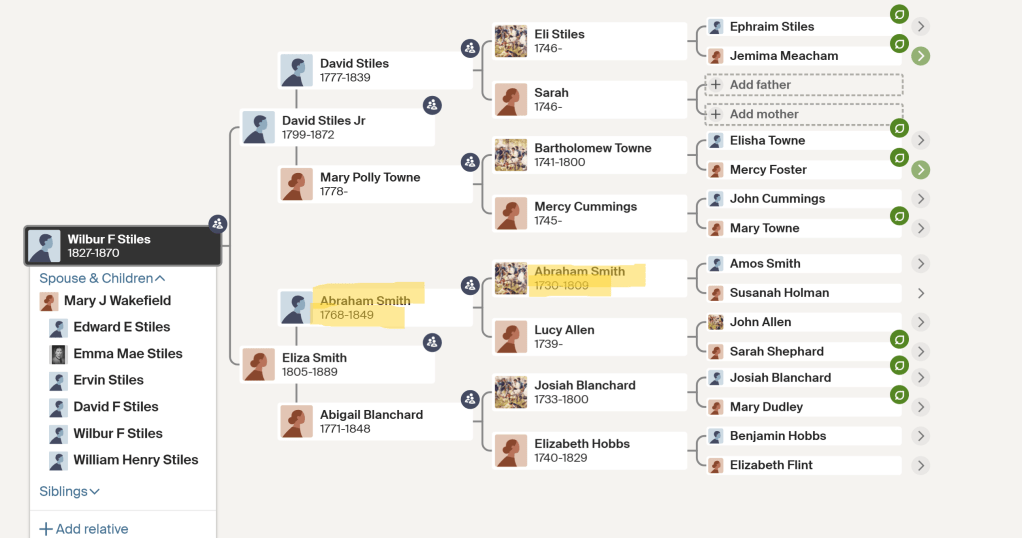
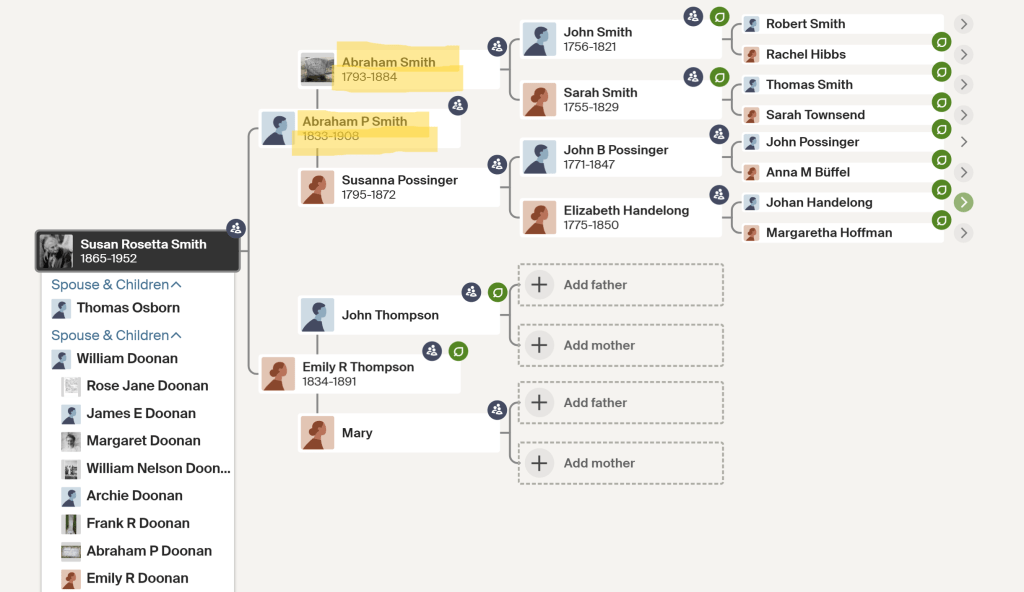
Massachusetts → VermontAbraham Smith (1730–1809)Abraham Smith (1768–1849)
Pennsylvania → Monroe County → WestAbraham Smith (1793–c.1884)Abraham Possinger Smith (1833–1908)

Their lives overlapped in time but not in place or ancestry. Together, they illustrate how a single name can run through multiple generations and unrelated families, creating confusion that only careful documentation can resolve.

Technically, I have 8 different Abraham Smith’s in my family tree. However, only 4 are direct ancestors – the others are “cousins” or married into the family.

Jude Smith’s legacy

Jude A Smith was born about 1858 in Pennsylvania to parents Abraham Possinger Smith and Emily Rebecca Thompson. Jude is not a direct ancestor – but the brother of my 3rd great-grandmother Rosa Smith.

Jude moved to Bay County Michigan with his family in the 1870’s.  He married Mary Mathilda Lago on October 29, 1887 in Beaver Township, Bay County. Jude and Mathilda had 2 children – Delbert on September 1, 1888 and Almina on May 6, 1890. Tragically, he was murdered by his own brother on December 6, 1890.

Bay City Daily Tribune 1890-12-06-1 clip
Bay City Daily Tribune, December 6, 1890. Page 1

After his murder, Jude’s widow, Mathilda married John F. Streu on July 19, 1891 just a couple of months after her former brother-in-law Robert was convicted of Jude’s murder. She and John would go on to have 3 children of their own – Emma, Carrie and William. John would help raise Jude’s children as in 1900, Delbert and Almina (Mina) were living with him and their mother in Bay Township. However, by 1912, Mathilda marries Horace Rickel in Flint, Michigan.  Mathilda marries a fourth time to Joseph Beech. She dies December 13, 1940 in Midland. I have not yet found evidence of her divorces or record of the last marriage. Her death certificate is the source of the last husband.

So far, I haven’t been able to definitively trace Delbert Smith past the 1900 census. I’m not sure if he moved, died or what.

However, Jude’s daughter Almina – who apparently went by Mina, was married and divorced 3 times. Almina first marries Ralph W. Watson on December 12, 1909 in Saginaw, Michigan. She is living with Ralph and his parents in 1910. They were divorced in Saginaw County on August 8, 1912. It doesn’t indicate who filed for divorce, but the claim of extreme cruelty was the grounds for the divorce.

Screen Shot 2018-03-14 at 11.12.27 AM
Divorce Records of Saginaw County, Michigan.

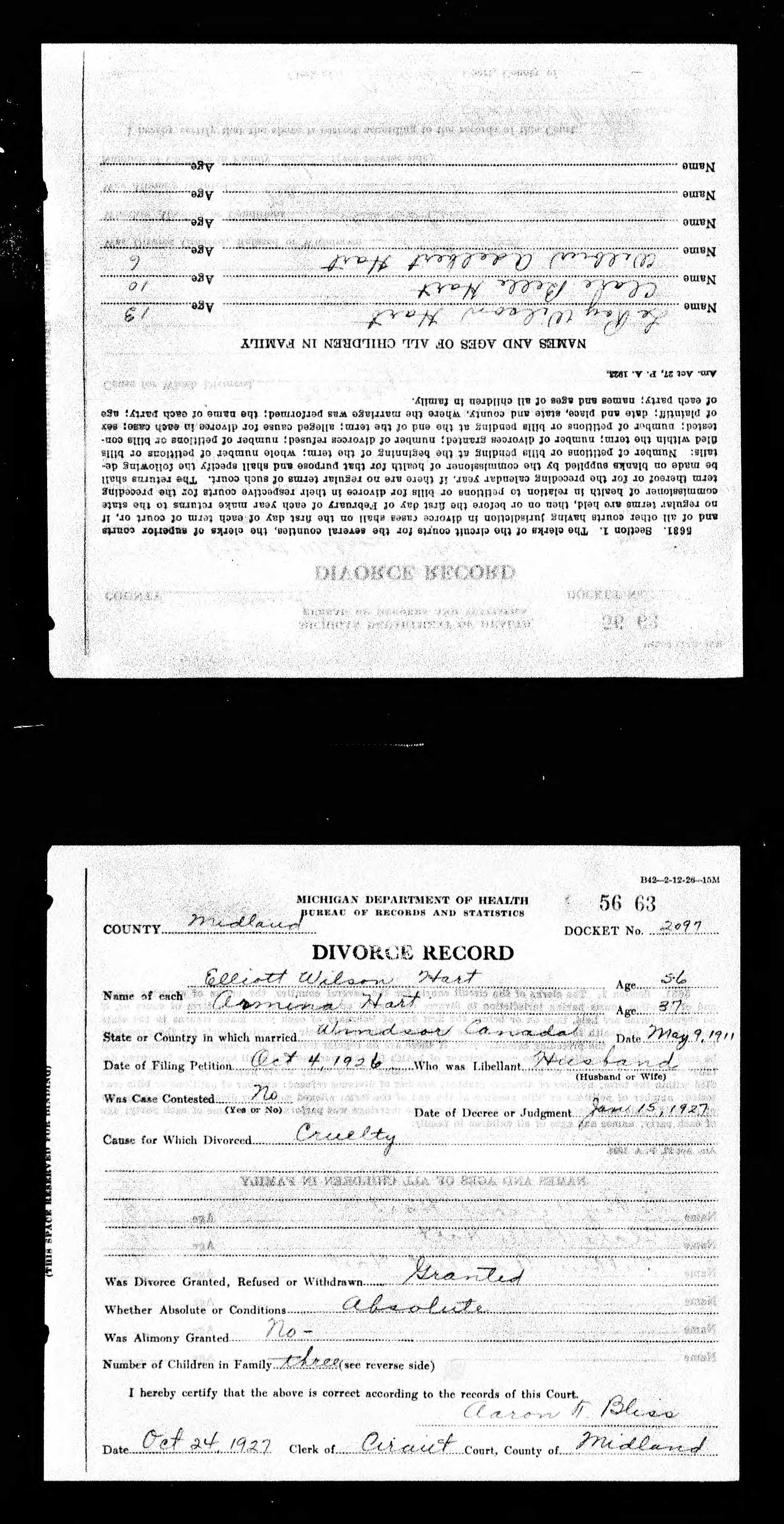
Almina would marry Elliot Wilson Hart on May 9, 1912 in Essex, Ontario, Canada. – Her son who was named Leroy (Roy) Wilson Hart was born October 1, 1911 in Michigan. So apparently Almina had met Elliot Wilson in early 1911 (or late 1910) and had a fling and eventually convince her second husband to marry her even though she was already married to Ralph. In all likelyhood, Ralph filed for the divorce and made the claim of extreme cruelty since she apparently ran off with another man – having his child and marrying him!

Almina would go on to have 2 other children with Elliot Wilson Hart – Clarabelle born in 1916 and Wilbur Adelbert born in 1918. They lived in Midland, Michigan in 1920. Unfortunately, it didn’t last. Almina and Elliot Wilson were divorced on January 15, 1927 in Midland.

41327_338658-01089
Midland County Michigan Divorce Records.

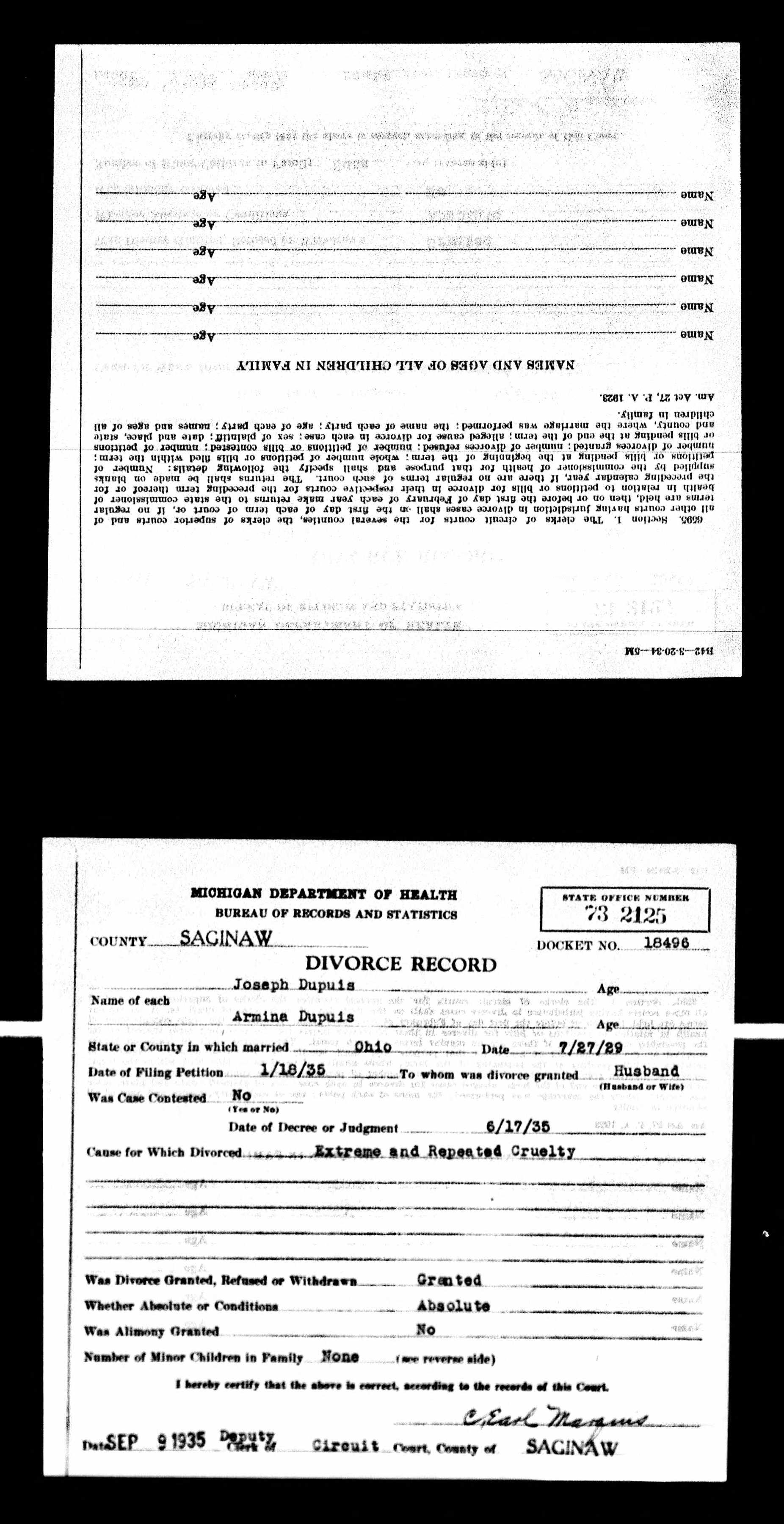
Almina goes on to marry Joseph Dupuis on July 27, 1929 in Lucas County, Ohio. That also ends in divorce on June 17, 1935 in Saginaw, Michigan.

41327_338667-01370
Saginaw County Michigan Divorce Records

Both of the last 2 divorces indicate the husband was the one who filed for the divorce and was claiming cruelty in each case. I have not yet found Almina’s death. That could be because she married a fourth time and died with that name instead. That’s pure speculation based on her record with husbands. It will probably take some courthouse research in order to determine if she did re-marry and when she died as those records are not necessarily available on the internet yet.

Revolutionary War connections

1f69225b-36df-4706-8d49-15e34373ac5a

In 2014, I joined the Daughters of the American Revolution under my 6th great-grandfather, Benjamin Byam. I did my application through him because he was an already established patriot and I already had most of the documentation needed to prove my descent from him, so it was an easy application to do. In reality, I do have other Revolutionary War Patriots in my ancestry that I could have submitted under – and I’ll probably submit them as supplementals one day.

Benjamin Byam was born November 29, 1733 in Chelmsford, Massachusetts. He had some military service prior to the Revolution, but during the War, he served both in Massachusetts and New Hampshire (where he moved to). Benjamin ended up dying in Randolph, Vermont on November 22, 1795.

Lot Hutchinson, another 6th great-grandfather, was born in Sutton, Massachusetts on August 1, 1741. Lot served as a Sergeant in Captain Abijah Burbank’s company among others during the war, marching from Sutton to Providence, Rhode Island. Lot would eventually move his family from Massachusetts to Braintree, Vermont where he died on March 24, 1818. Lot has not previously been proven a patriot in the DAR database.

Lot’s father-in-law, Moody Morse, my 7th great-grandfather, was born April 1, 1719 in Newbury, Massachusetts. Moody is a proven DAR patriot for performing civil service during the war. Moody died on August 14, 1805 in Sutton, Massachusetts.

Josiah Blanchard was born on December 10, 1733 in Concord, Massachusetts and is another 6th great-grandfather. Josiah is not a currently approved DAR patriot, but he does appear on the muster roll for Cogswell’s Regiment of the Militia in 1778 (part of the 16th Regiment for Massachusetts). He also appears on the rolls for Captain Danforth’s company of Colonel Nixon’s regiment. Josiah died March 18, 1800 in Barre, Vermont.

Abraham Smith (one of several in my tree) was born in 1730 in Subury, Massachusetts and is yet another 6th great-grandfather. He is a DAR approved patriot who served under Captains Brownson, Simonds and Colonels Allen, Warner and Bradley. He died in Tinmouth, Vermont on November 4, 1809.

Bartholomew Towne was a private in Captain Josiah Crosby’s Company of Colonel Moses Nichol’s Regiment of New Hampshire Volunteers. Bartholomew was born April 8, 1741 in Topsfield, Massachusetts and died in 1800 in Milford, New Hampshire. Bartholomew is not currently a DAR approved patriot.

Eli Stiles was born May 22, 1746 in Westfield, Massachusetts. He appears on the rolls as serving under Captain Darby’s company of Colonel Scammel’s registment in New Hampshire. It is not known yet exactly when Eli died. He is not currently an approved DAR patriot.

John T. Wortman was born August 25, 1757 in New Jersey and is a fourth great-grandfather. John is an approved DAR patriot who was a teamster in George Allen’s & Samuel Hunt’s teams.  John died on May 19, 1831 in New Jersey.

John’s father, another John Wortman was born November 16, 1730 in Somerset County, New Jersey. He is a DAR approved patriot for being a Corporal and a Wagon Master during the war. John died on August 25, 1807 in Bedminster, New Jersey.

Daniel Munson was born April 4, 1745 in Stratford, Connecticut and is a fifth great-grandfather. Daniel is an approved DAR patriot for having civil service during the war as he was a surveyor of highways in Milford. Daniel died on October 27, 1827 in Milford, Connecticut.

There are probably others that I just haven’t discovered yet. 9 out of 10 of these ancestors are through my mom’s side of the family. I’m sure there are probably more on dad’s side – I just haven’t discovered them yet.

Rosa Susan “Rosie” Smith

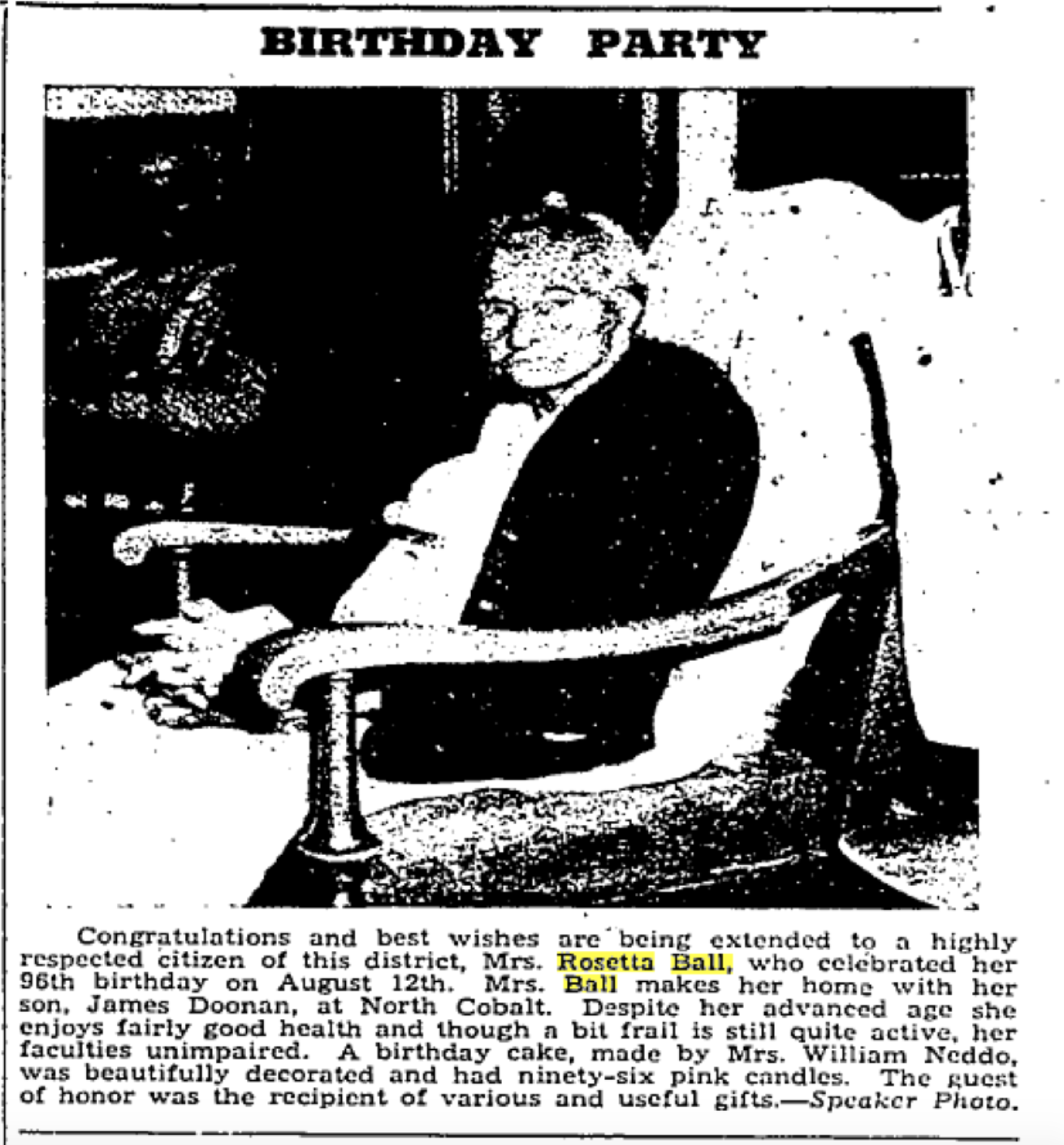
“Grandma Ball” as I had always heard her referred to was born on August 12, 1865 in Pennsylvania, the sixth child of Abraham Possinger Smith and Emily Rebecca Thompson.

Rosa Smith Doonan Ball

Sometime in the 1870’s, Rose moved to Bay County, Michigan with her family. On February 17, 1882, she married Thomas Osborn in Bay County. That marriage didn’t last very long though because just 9 months later, on November 11, 1882 she marries William Doonan. It is not clear what happened to Thomas Osborn – if they divorced or he died. Rosie would remain married to William Doonan until 1913 when he took his own life. Rosie would eventually marry Ernest Alfred Ball on August 26, 1919 in Timiskaming, Ontario, Canada. Ernest would die in 1935 and Rosie would never marry again.

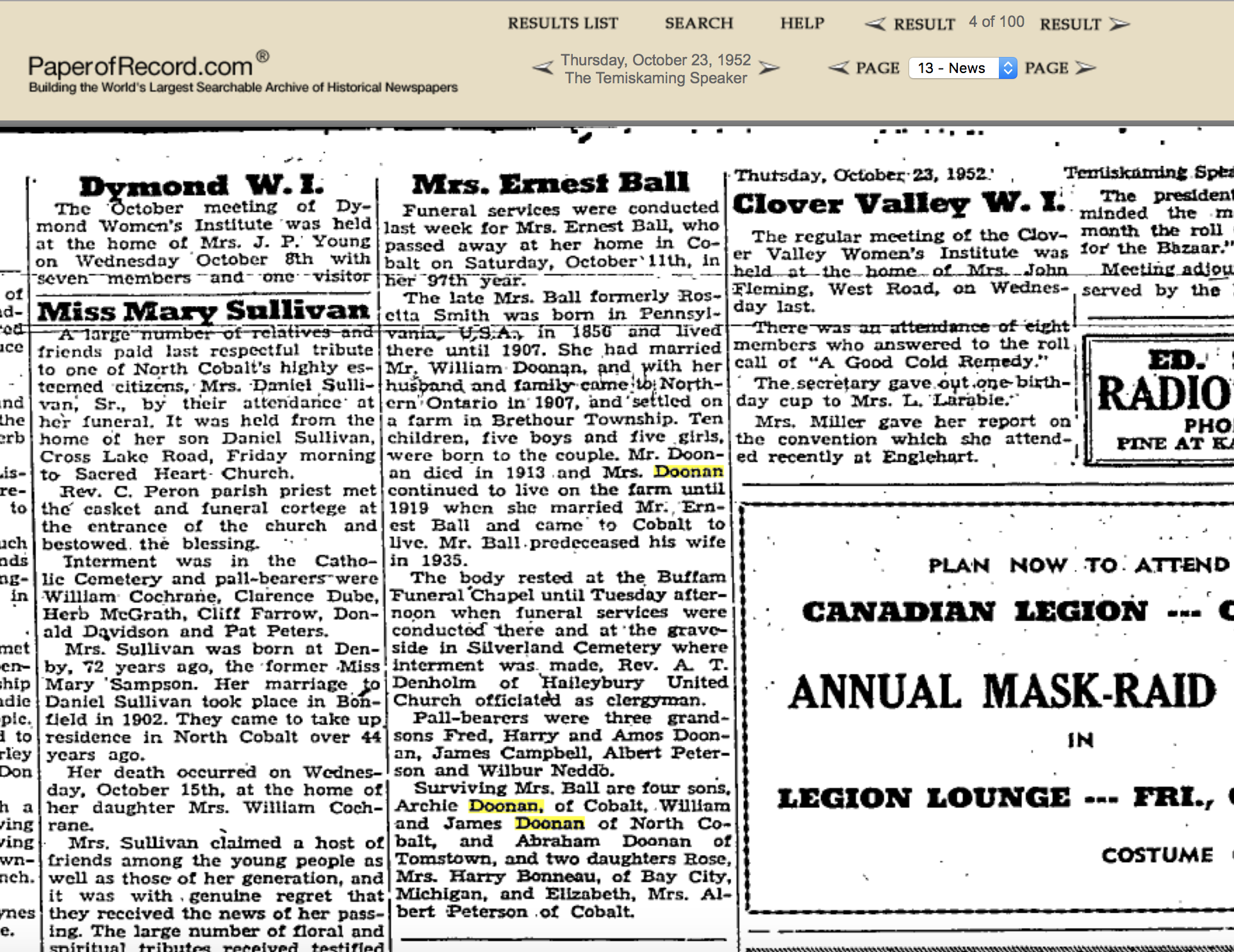
Rosie passed away on October 11, 1952. At some point they changed her birth year by 10, so the newspaper states that she was in her 97th year – when in reality it was her 87th year.

Screen Shot 2018-02-21 at 8.55.29 AM

Screen Shot 2018-02-21 at 8.45.30 AM
A copy of the article that appeared on the front page of the Temiskaming Speaker on August 21, 1952. This was just 2 months before her death.

The obituary leaves out my great-grandmother, Margaret Doonan who was married to John Phillips at the time and living in Saginaw, Michigan.

Rosie and William Doonan had ten children – but only 8 lived to be adults. Frank died at the age of 5 and Pearl died at the age of 4 months. Both of them are buried in Fraser Township, Bay County, Michigan. Another daughter, Emily, died at the age of 18. The oldest daughter is Rose Jane who was married to Harry Bonnaeau. Rosie and William had 3 sons who served in the Canadian Expeditionary Force during World War I – Archie, Abraham and William Nelson. Archie and Abraham were wounded in the war, but lived through it.

After their youngest daughter died in 1905, William and Rosie moved in 1908 to Pence Township, Temiskaming, Ontario, Canada. I remember once when I was little that my parents (and sister), and my uncle went to Cobalt, Ontario to visit the Doonan relatives. This was probably the late 1970’s early 1980’s. I was too young to really understand who they were though. It wasn’t my dad’s first trip there though – he had gone several times with my grandparents and great-grandma, but it was the last trip he made to see the Canadian relatives.