Gardner T. Rivers (1872–1945)

Early Life in Southern Saginaw County

Gardner T. Rivers was born on 16 April 1872 in Michigan, the son of John Rivers and Frances Jane Munson. He grew up in southern Saginaw County, in an area that included Albee Township, Taymouth Township, Bridgeport Township, Foster, Burt, and surrounding rural communities.¹ He was raised alongside several siblings, including Franklin, Burt Eugene, James Daniel, Mary Jane, Rose, and Joseph Edward Rivers.²

Gardner appears with his parents in the 1880 federal census in Albee Township, Saginaw County, where he was eight years old.³ Like many farming families in the region, the Rivers family moved within nearby townships rather than relocating long distances, remaining tied to the same general area throughout Gardner’s childhood.
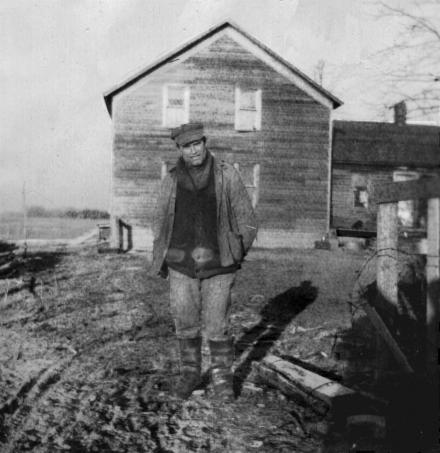
Gardner Rivers on the farm

Marriage and Family

On 13 June 1897, Gardner married Alice Mary Wickham in Freeland, Saginaw County.⁴ Alice was the daughter of Wickham and Munson families long established in the same part of the county. Alice’s mother, Emmaline Munson, was the sister of Gardner’s mother, Frances Jane Munson (known as Jane).⁵

Gardner and Alice had nine children between 1898 and 1913.⁶ Their children were born in Taymouth Township and nearby locations including St. Charles, Gaines Township, and Burt, reflecting brief periods of residence elsewhere before the family returned to Taymouth Township.
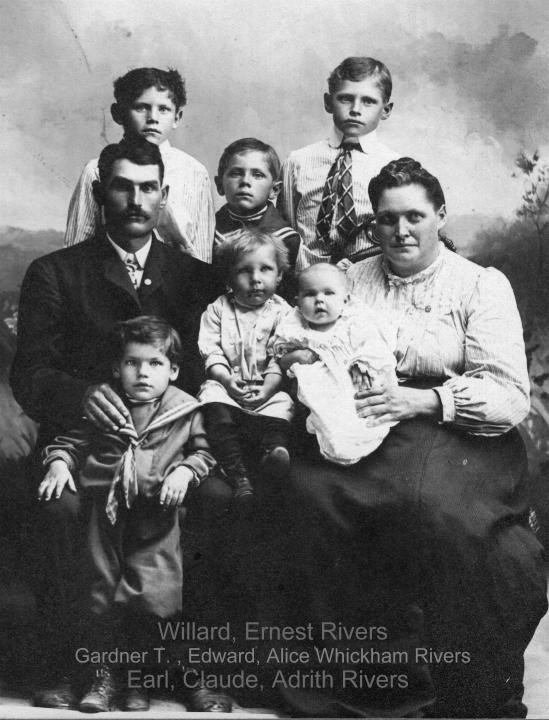
Gardner Rivers & family

Farming in Taymouth Township

Gardner Rivers was a farmer throughout his adult life. He is recorded as a farmer in the 1920, 1930, and 1940 federal censuses, all enumerated in Taymouth Township, Saginaw County.⁷ No records indicate that he pursued a different primary occupation.

Land ownership and residence in Taymouth Township are also documented in county plat maps. Gardner appears as “G. Rivers” on the 1916 Taymouth Township plat map and again on the 1920 plat map, placing him in the Burt area of the township during this period.⁸ These maps confirm his presence as a landholder in Taymouth Township in the years immediately before and after World War I, consistent with census records showing him farming in the same locality.
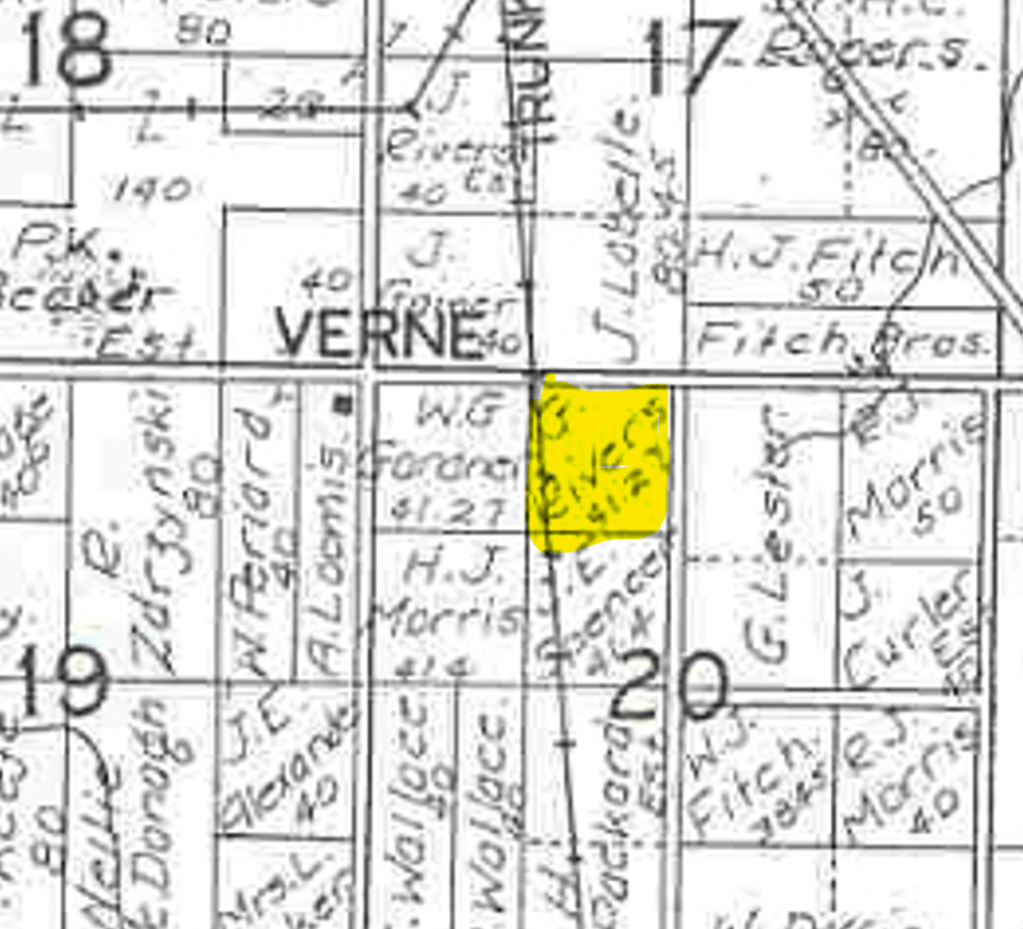
Part of the 1920 Plat Map for Taymouth Township. Highlighted is Gardner Rivers.

The 1910 Census Surname Error

The 1910 federal census is the only known record in which Gardner Rivers and his family were enumerated under the surname Munson rather than Rivers.⁹ The household composition, ages, birthplaces, and children align exactly with Gardner and Alice’s known family.

All other records before and after 1910—including censuses, vital records, newspapers, plat maps, and burial records—use the surname Rivers.¹⁰ The 1910 entry is therefore best understood as an isolated census error rather than a reflection of name usage by the family.

Later Years

By 1920, Gardner and Alice were living in Taymouth Township with several of their children still at home, and Gardner continued farming.¹¹ Census records from 1930 and 1940 show Gardner still residing in the township and engaged in farming into his late sixties.¹²

The family experienced significant losses during the 1930s, including the deaths of sons Ernest John Rivers in 1933 and Earl G. Rivers in 1935.¹³ Despite these losses, Gardner remained in Taymouth Township through the end of his life.
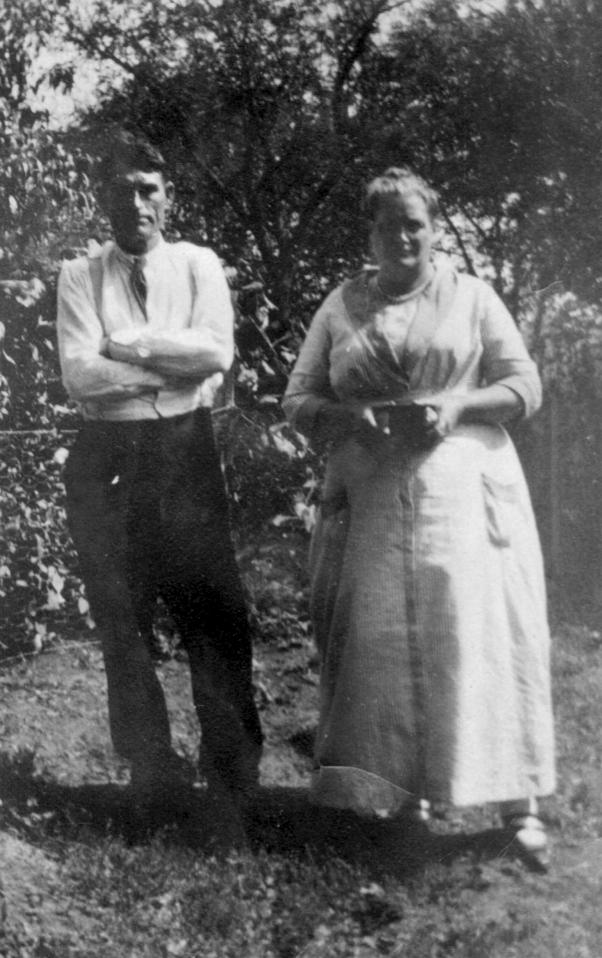
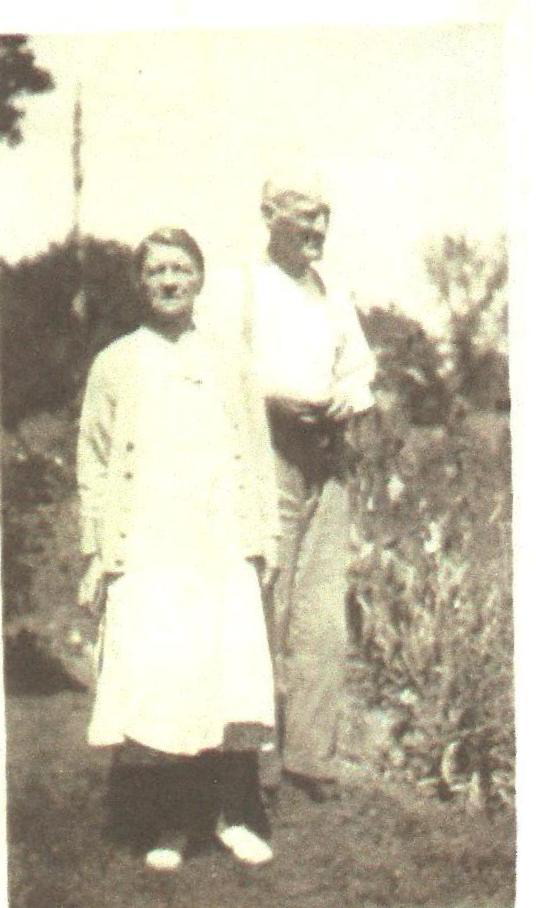
Gardner and Alice Munson Rivers

Death and Burial

Gardner T. Rivers died on 13 January 1945 in Taymouth Township, Saginaw County, Michigan, at the age of seventy-two.¹⁴ His Michigan death certificate lists coronary occlusion as the immediate cause of death, with coronary thrombosis noted as a contributing condition.¹⁵ He was buried on 14 January 1945 at Cook Cemetery in Taymouth Township.¹⁶ Alice Mary Rivers died later the same year.
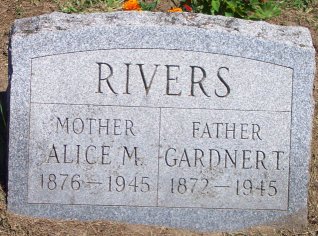
Headstone of Gardner Rivers and Alice Munson Rivers

Footnotes

  1. Michigan birth records; 1880 U.S. Federal Census, Albee Township, Saginaw County, Michigan.
  2. Ibid.; Michigan birth and death records for Rivers children.
  3. 1880 U.S. Federal Census, Albee Township, Saginaw County, Michigan.
  4. Michigan Marriage Records, Saginaw County, 13 June 1897.
  5. Michigan vital records; Munson family documentation.
  6. Michigan birth records, 1898–1913.
  7. 1920, 1930, and 1940 U.S. Federal Censuses, Taymouth Township, Saginaw County, Michigan.
  8. Plat Book of Saginaw County, Michigan, Taymouth Township (1916); Plat Book of Saginaw County, Michigan, Taymouth Township (1920).
  9. 1910 U.S. Federal Census, Taymouth Township, Saginaw County, Michigan.
  10. 1880, 1920, 1930, and 1940 U.S. Federal Censuses; Michigan vital records; plat maps; cemetery records.
  11. 1920 U.S. Federal Census, Taymouth Township, Saginaw County, Michigan.
  12. 1930 and 1940 U.S. Federal Censuses, Taymouth Township, Saginaw County, Michigan.
  13. Michigan death records for Ernest John Rivers (1933) and Earl G. Rivers (1935).
  14. Michigan Death Records, Gardner T. Rivers, 13 January 1945.
  15. Ibid.
  16. Cook Cemetery burial records, Taymouth Township, Michigan
John Rivers (1828–1902)

For many years, my second great-grandfather John Rivers was one of the most stubborn brick walls in my family tree. I knew when and where he lived as an adult, but his early life was completely undocumented. He appeared in Michigan in the early 1860s, married, and raised a large family—but nothing in U.S. records clearly revealed who he had been before crossing the border from Canada.

It took DNA evidence, careful work with French-Canadian church records, and a great deal of patience to finally reconstruct his origins.

A Man Who Appeared in Michigan

John Rivers was born in Quebec, Canada, in the late 1820s. Over the years, U.S. records reported his birth anywhere from 1824 to 1830, a common problem for 19th-century immigrants whose ages were often estimated. What was consistent was that he was Canadian-born.

In many U.S. census records, he was described specifically as “French Canadian.” That detail mattered: it pointed not just to Canada, but to French-speaking Quebec.

Long before DNA entered the picture, I found another clue. When I was a child, I discovered a handwritten note tucked into an old family Bible, written by my paternal grandmother, stating that John Rivers was born in Quebec. At the time, I had no way to verify it. Sadly, that slip of paper has since been lost. But years later, when I began working with census records, I realized something important: what my grandmother had written matched what the census takers had recorded decades earlier.

Two independent sources—one familial, one official—were quietly telling the same story.

By 1860, John had crossed into the United States. In 1862, he married Frances Jane Munson in Michigan. They settled in Saginaw County, where John worked and farmed while raising a large family.

Between 1863 and 1887, Frances gave birth to at least twelve children. Like many rural Michigan families of the period, they also experienced tragedy: two daughters born in 1868 and 1869 died in infancy, and a son, Franklin, born in 1874, died at age six.

Census records place John and Frances in Taymouth Township and later in Albee Township, part of the agricultural and lumber economy of mid-Michigan. By 1900, John was still living in Taymouth, surrounded by adult children beginning families of their own.

John died on 21 November 1902 in Taymouth Township, Saginaw County, Michigan, from broncho-pneumonia. He was buried two days later in Taymouth Township Cemetery. His Michigan death certificate, however, leaves both parents’ names blank.

Family Stories Without Proof

Two family stories followed John Rivers through the generations. One said he had come to Michigan as a Jesuit priest or with one. Another claimed he was part Native American.

These stories were preserved in family memory, but no documentation has yet been found to confirm either one. What has been discovered is that several of John’s ancestors and close relatives in Quebec were affiliated with the Jesuit order, which may explain how the priest story entered the family narrative—even if John himself was not a priest. The Native American claim, however, has not been supported by records or DNA.

The DNA Breakthrough

The real breakthrough came through genetic genealogy.

I tested in all the major DNA databases and had a male double first cousin test as well, giving us a broader pool of shared matches. His autosomal DNA produced connections I did not inherit by chance. Using results from Ancestry, 23andMe, and FamilyTreeDNA, I began building trees for our shared matches.

Again and again, the same French-Canadian families appeared.

Eventually, those matches converged on one Quebec couple:
Jean-Baptiste Larivière and Rose Dufault.

That gave me a working hypothesis. The next step was to find records.

How the “Dit” Name Led Me Down the Wrong Path

Early in the research, I found a baptism for Jean Beaudoin dit Larivière in 1824. It looked promising:

  • Jean → John
  • Larivière → Rivers
  • The timing was close

What confused me was the “dit” name. In French-Canadian records, a dit name is an alternate surname used by a branch of a family. I initially misunderstood it and thought this might be my ancestor.

Once DNA evidence was added, it became clear that this child belonged to a different family line and was not my John Rivers. That realization kept me searching.

The Right Jean

That search led me to a different baptism — this time simply Jean Larivière.

Original French (as written in the register)
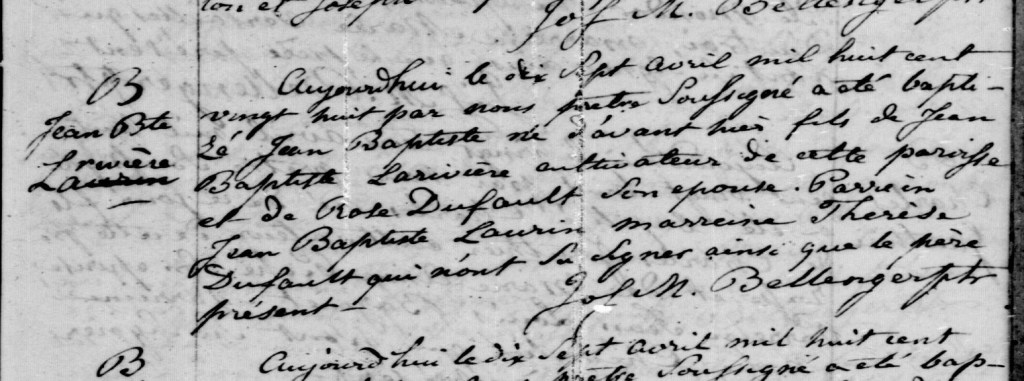
Aujourd’huy le dix sept avril mil huit cent vingt huit par nous prêtre soussigné a été baptisé Jean Baptiste né d’avant hier fils de Jean Baptiste Larivière cultivateur de cette paroisse et de Rose Dufault son épouse. Parrain Jean Baptiste Laurin marraine Thérèse Dufault qui n’ont su signer ainsi que le père présent. – J. M. Bellenger ptre

English Translation
“Today, the seventeenth of April eighteen hundred twenty-eight, by us the undersigned priest, was baptized Jean Baptiste, born the day before yesterday, son of Jean Baptiste Larivière, farmer of this parish, and of Rose Dufault his wife.
Godfather Jean Baptiste Laurin, godmother Thérèse Dufault, who did not know how to sign, as well as the father who was present. – J. M. Bellenger, priest.”

He was baptized on 17 April 1828 at Saint-Paul-de-Joliette, Quebec, born two days earlier on 15 April 1828, the son of Jean-Baptiste Larivière and Rose Dufault — the very couple identified by the DNA evidence.

The name fit.
The date fit.
And now, so did the DNA.

After adding Jean-Baptiste Larivière and Rose Dufault to my tree, DNA matches began appearing through ThruLines and shared match groups for their children, grandchildren, and extended family. While each match still needs individual verification, the genetic evidence lines up with the documentary trail.

There is no single record stating outright that “John Rivers of Michigan is Jean Larivière of Quebec.” His U.S. death certificate does not name his parents. But in genealogy, proof is built through converging evidence—and here, the church records, migration pattern, census data, family memory, and DNA all point to the same conclusion.

No Longer a Brick Wall

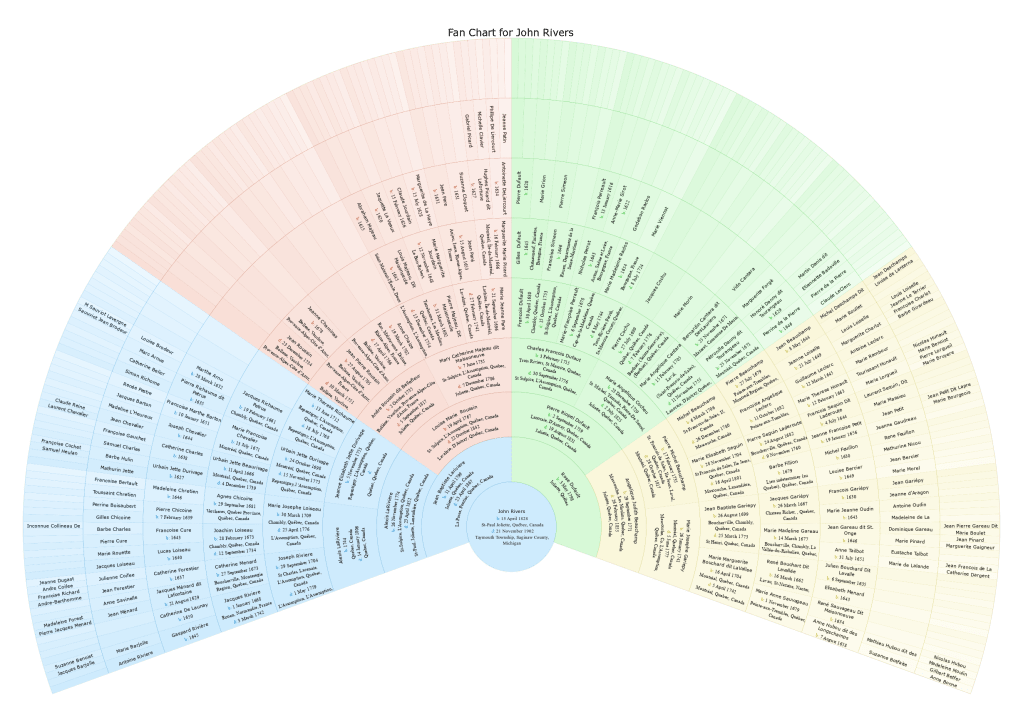
John Rivers is no longer a mystery man who appeared out of nowhere in Michigan. He was born Jean Larivière in Joliette, Quebec, in 1828, the son of Jean-Baptiste Larivière and Rose Dufault, part of a deep French-Canadian family whose lines extend back many generations.

His journey—from Quebec parish registers to Michigan farmland, from a French surname to an English one—was hidden for nearly two centuries. It was DNA, combined with traditional genealogy, that finally brought his story back into the family.

Fan chart showing the French-Canadian ancestry of John Rivers (Jean Larivière), reconstructed through DNA and Quebec parish records.

Rivers-Periard connection

Growing up, I always knew of the farmers who lived about a half mile away with the surname of Periard. My sister and I both knew of Periard class mates. I knew my dad had talked about them as well. Little did I know there was actually a family connection – until I started researching the family history. I suspect that most of the current generation didn’t know there was a family connection either.

I wrote previously about Rose Rivers who was married to August Malorey. I have seen the surname written as Mallory and Mallorey. Well, Rose and August had one child – Mary. Rose died while carrying their second child. August went on to marry Clara Macomber. Mary was born April 15, 1905. The year is in question – but 3 of the census records that I have found her in agree on 1905. Her death certificate has not been viewed yet, but the information extracted gives her birth year as 1903. Since the date would actually fall before her parents married, I’m inclined to believe the 1905 date rather than the 1903 date. So far, I haven’t been able to find a birth record.

Mary went to live with her Aunt Mary after her mother died. Aunt Mary was her mother’s sister, Mary Jane Rivers. Mary Jane was born April 12, 1881 in Albee Township to my 2nd great-grandparents, John Rivers and Frances Jane Munson. Mary Jane married Claud Alvin Hutchins on April 7, 1899. Shortly after they married, they moved to the Pontiac area. As far as I can tell, Claud and Mary Jane never had children of their own. So, when at 5 years old, Mary lost her mother, Claud and Mary Jane probably took in her niece and raised her as their own. Mary Jane died on August 11, 1950 and Claud died on January 13, 1954.

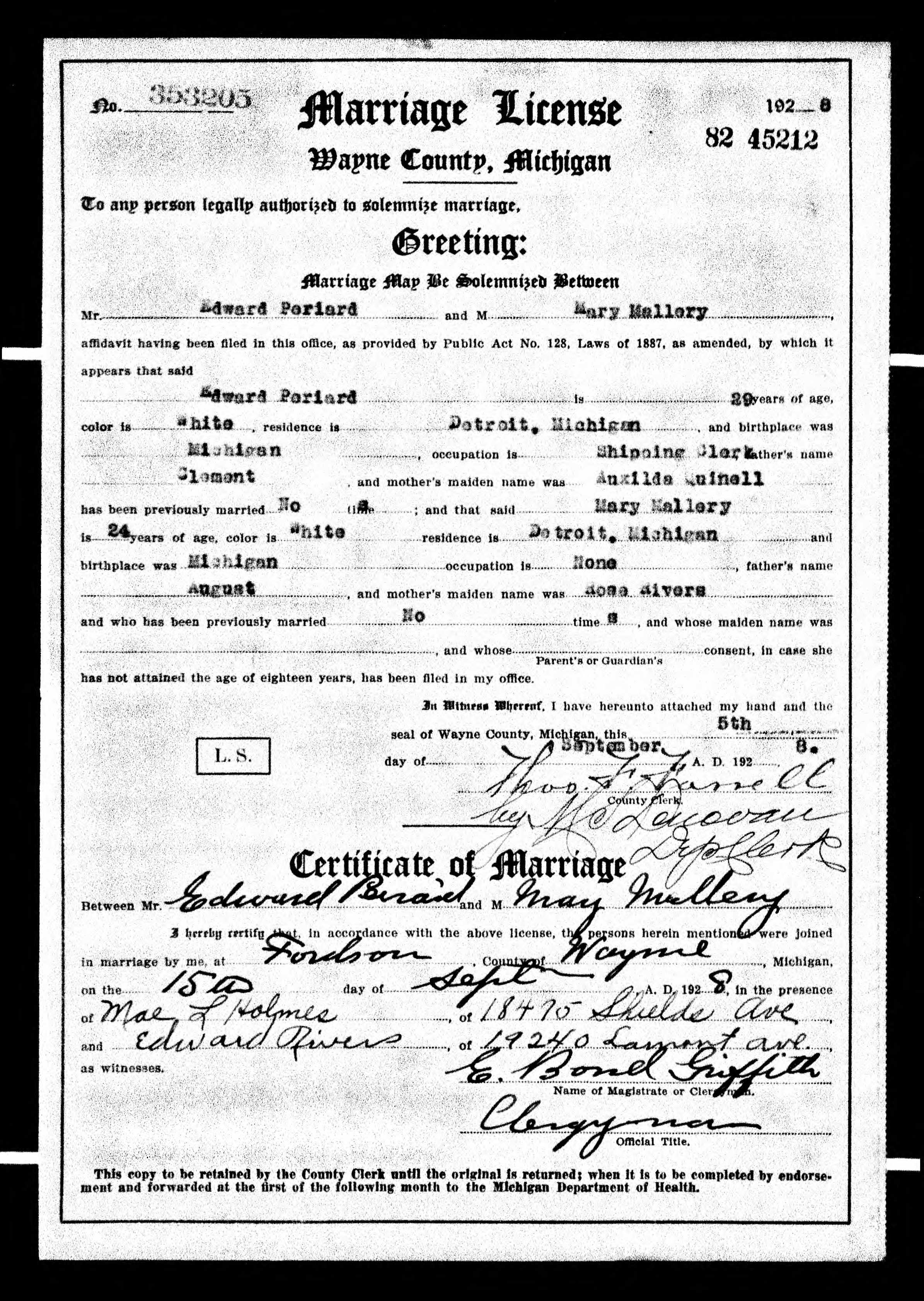
Mary married Edward J. Periard in 1927 in Wayne County, Michigan. They stayed in the Detroit area until sometime between 1935 and 1940 when they moved to Taymouth Township in Saginaw County.

41326_341678-01619

Prior to his marriage, Edward had lived for a time in Saginaw, and after they were married, he had a general store. Edward’s parents were Clement Periard and Auxilda Kennel (both were born in Canada but immigrated to Michigan in the 1880’s). Edward had a brother, William born in 1888. It is from William that the Periard neighbors descend from.

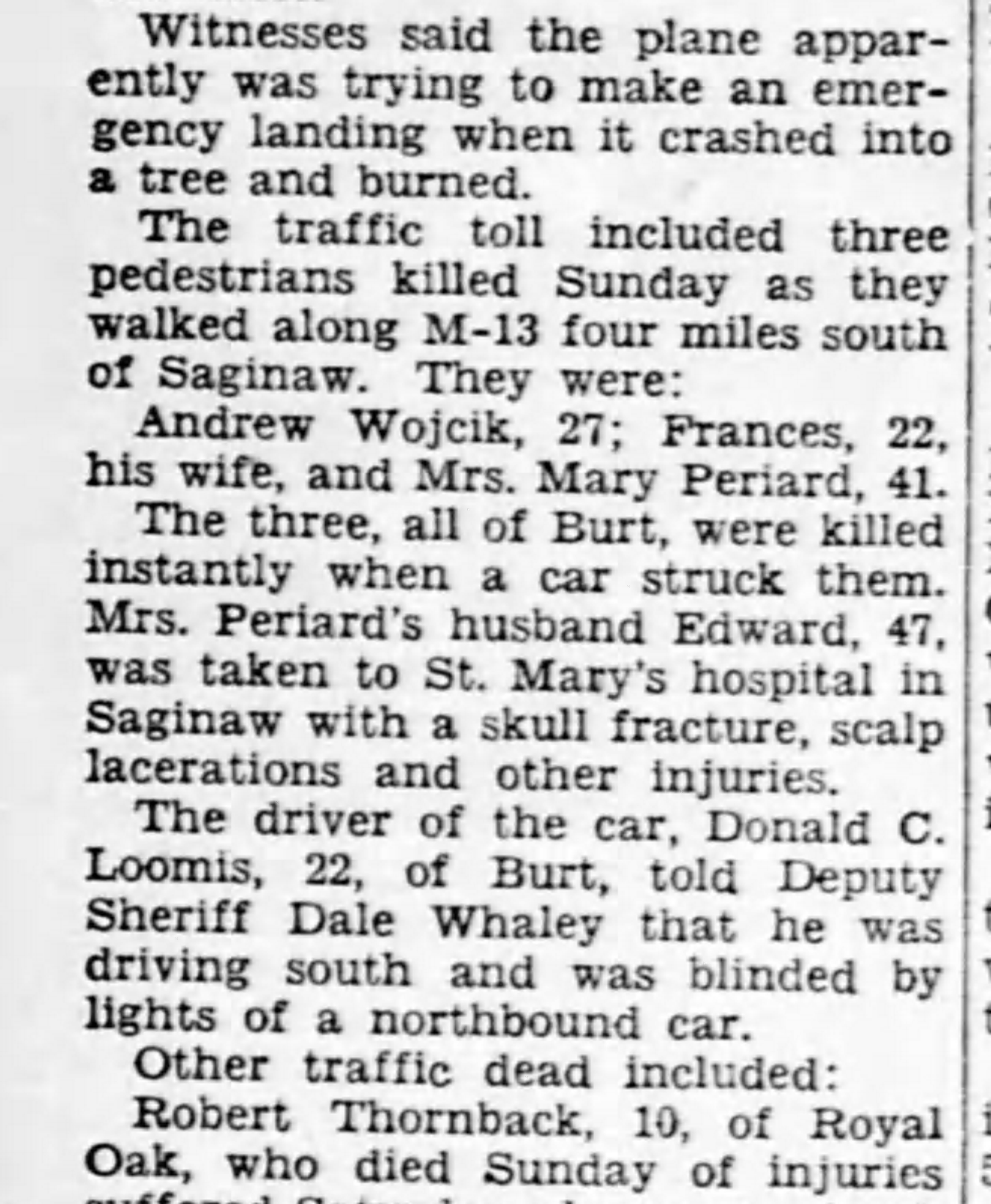
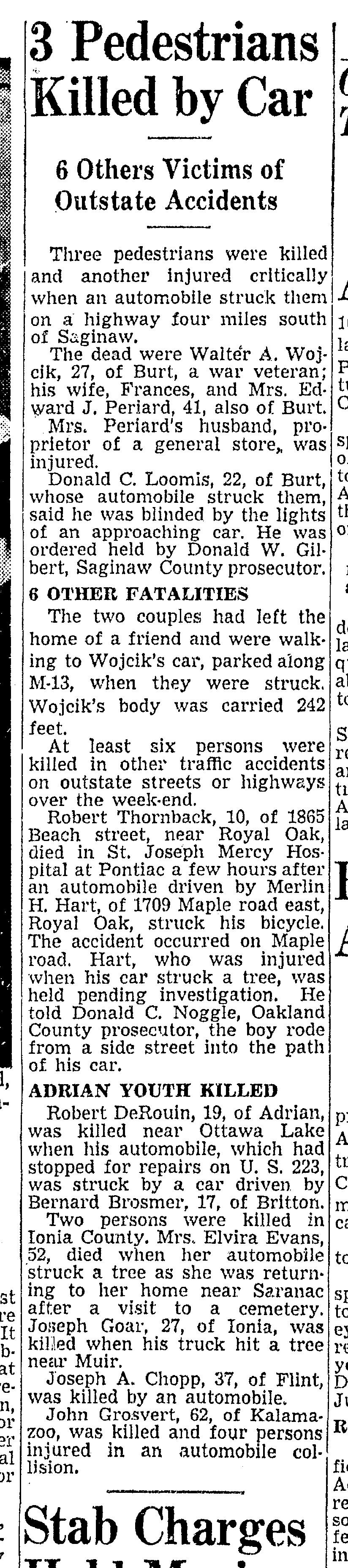
On May 26, 1946, Mary and Edward were walking with friends along M-13 when they were struck by a car. Their friends, Andrew Wojcik and his wife Frances along with Mary were killed instantly. Edward died of his injuries 4 days later.

Battle_Creek_Enquirer_Mon__May_27__1946_-2
Battle Creek Enquirer, May 27, 1946.

Detroit_News_1946-05-27_11-2
Detroit News, May 27, 1946 page 11.

As far as I can tell, Edward and Mary never had children. The only newspaper articles found so far are from Battle Creek and Detroit. However, I can’t imagine it not being in the Saginaw papers too.

Rose Rivers

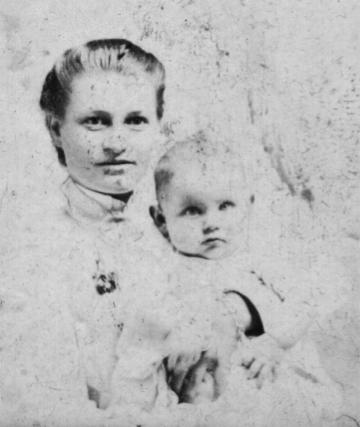
Aunt Rose and Willard Rivers
Written on the back: Aunt Rose & Willard Rivers. Picture was most likely taken in 1900 or very early 1901 based on Willard’s birth.

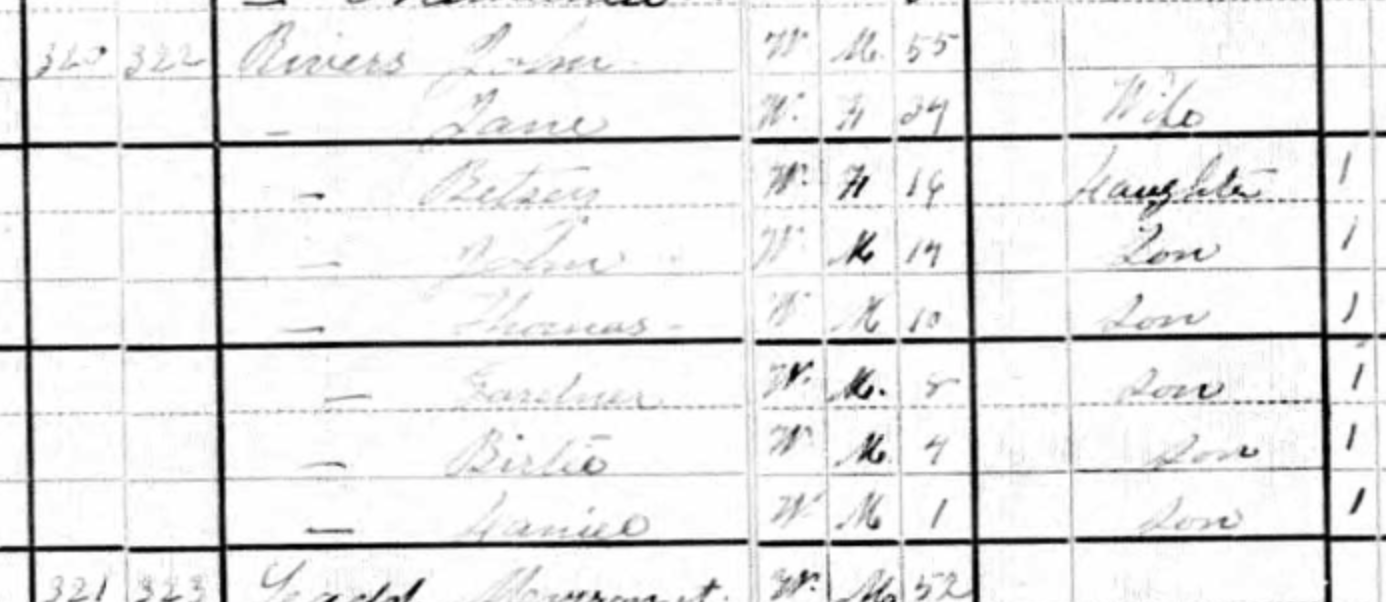
Rose Rivers was born March 1875, the eighth child of John Rivers and Frances Jane Munson. Her marriage record, death record and the 1900 census all testify to that. However, her birth record has not been found and oddly enough she doesn’t appear on the 1880 census with her family.

Screen Shot 2018-02-20 at 1.33.36 PM
1880 US Federal Census for Taymouth Township, Saginaw County Michigan.

It is not known why all of the other children appear (including 2 younger ones) and she doesn’t.

Screen Shot 2018-02-20 at 1.37.24 PM

Marriage Record of “Gust” Malory and Rosa Rivers

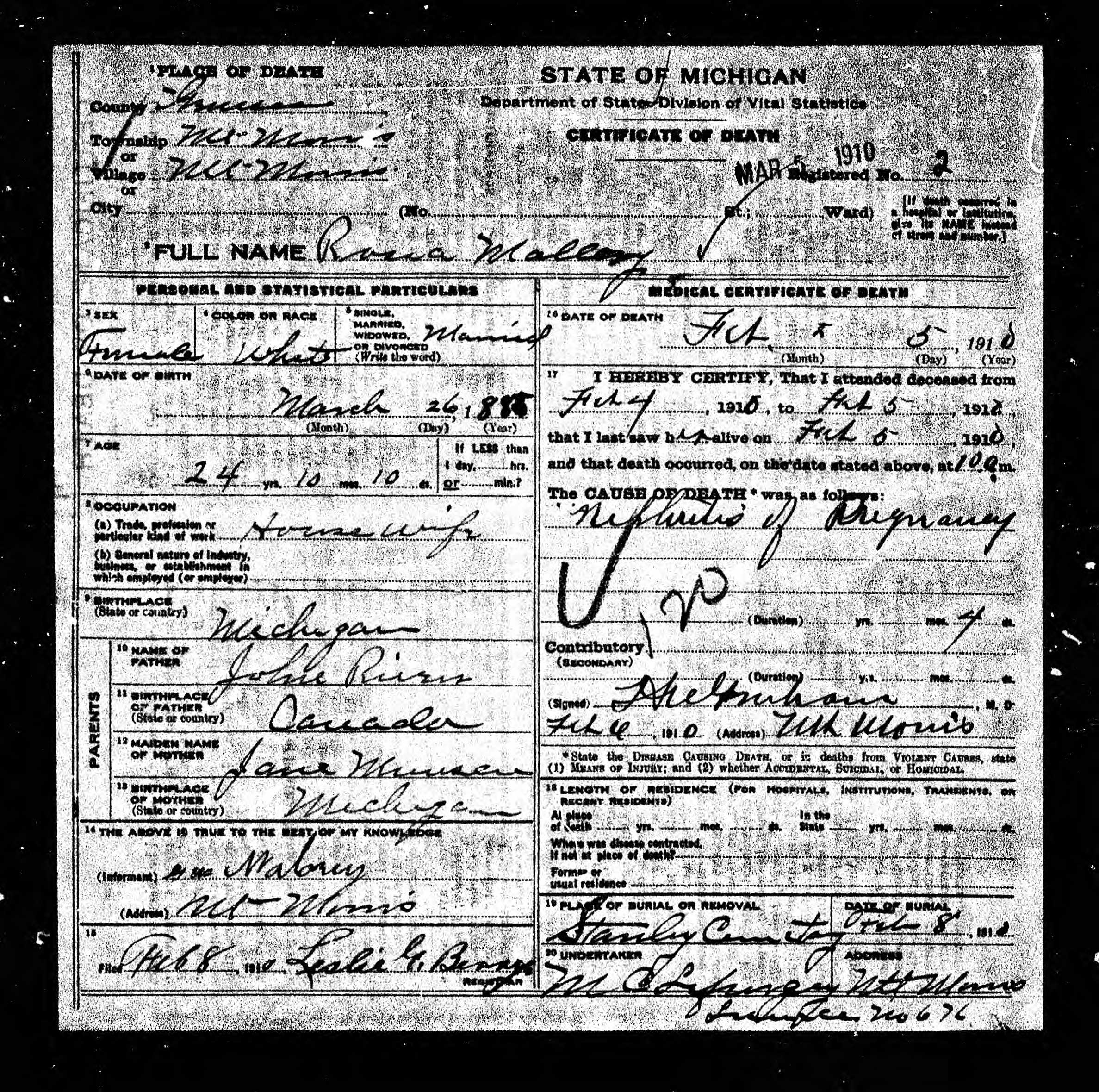
She married on July 3, 1903 August Louis Mallory. Her marriage record only gives her father’s name – John Rivers and not her mother’s. I suppose it could be said that this is a different John Rivers – and thus not a member of my family. However, when Rose died on February 5, 1910, her death certificate pretty clearly confirms that she is indeed the daughter of John Rivers and Frances Jane Munson (who went by her middle name of Jane).

44471_354710-03298
Death Certificate for Rose Rivers Mallory

August and Mary had one child – Mary. She was born April 15, 1903 (a couple of months before they were married). It appears from her death certificate, that Mary was pregnant with a second child when she died. In 1910, the daughter Mary is not found on the census with her father – who was living with his brother and their mother. August would later re-marry and have children with his second wife Clara Macomber. Mary would be married by 1930 however, she doesn’t appear in the 1910 and 1920 census with her maiden name. It might be said that August wasn’t the father of Mary – since the marriage is happening after her birth and August isn’t taking care of her as she is growing up, but her death certificate names August as her father.

John Rivers Jr aka Guy Morrison

John Rivers Jr is not a direct ancestor – but rather a great-grand-uncle. Or maybe not so great and grand… LOL He is the brother of my great-grandfather, Gardner Rivers.

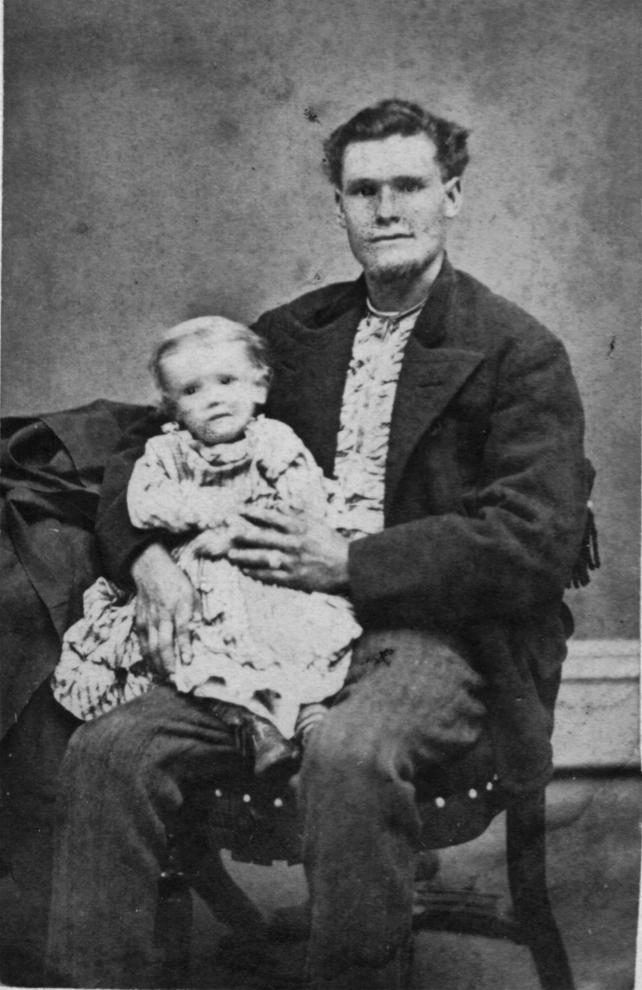
Guy and Katie Morrison
Guy Morrison and his wife Katy

John was born in 1865 and can be found on the census for 1870 and 1880 living with his family in Saginaw County, Michigan. However, after the 1880 census he seemingly disappears from any official record that I can find.

Probably 10-15 years ago now, I had heard from a cousin who had talked to one of the older generation before she passed and this cousin told me that according to her, John Jr had moved to the Petoskey area and changed his name to Guy Morrison. Also that he had married a woman by the name of Katy and they had twin girls. Oh, and the reason why he moved and changed his name? Well, that’s because he had killed someone and was trying to avoid the law.

I searched for years to find proof of this and was coming up short. I could indeed find a Guy Morrison with wife Katy and twin girls (among other children) in the 1900 to 1940 censuses in the Petoskey area. I could not find Guy Morrison before 1900 though. This seemed to fit the family story – but I still couldn’t say yes, this was definitely him. There wasn’t anything really connecting this Guy Morrison to my John Rivers Jr except the timeframe fit. And well, that’s just not enough to say for sure.

Then in 2016, I finally was able to make some progress. About a week after my uncle’s funeral, I had this overwhelming urge to research John Jr again (my uncle was my dad’s brother – and this is his side of the family). So, I started searching again. And again, I was coming up empty. Then I decided to check his “other” name – Guy Morrison. That’s when I hit the jackpot. Suddenly there was this family tree on ancestry.com that was posted by a descendant of Guy Morrison, and the little bit that was posted, seemed to fit. So, on a long-shot I contacted the owner of the tree. I explained that I had this family legend that John Rivers Jr changed his name to Guy Morrison and a bit about his family in the Petoskey area.  I left out the part about the murder as I didn’t want to scare off the contact. This cousin replied and shared that the family legend was true – she had the same legend (including as I would later confirm the part about murder). This cousin then shared with me one of the only pictures she had of Guy Morrison – which is posted above.

I compared it to some pictures that I had of some of Gardner and his siblings.

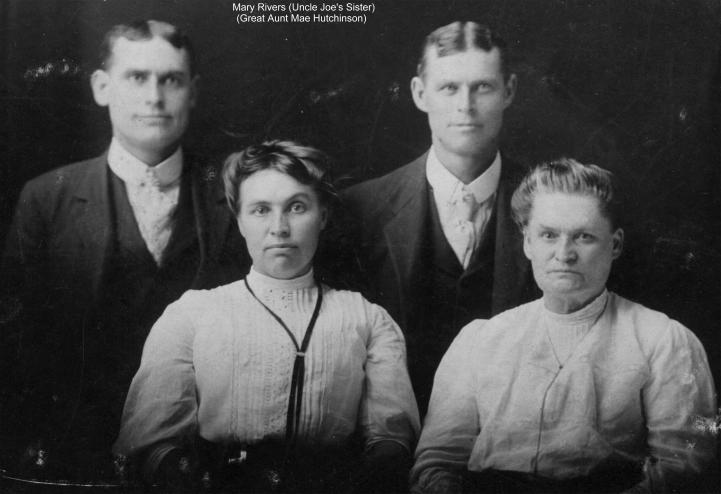
Dan, Mary, Burt and Frances Jane Munson Rivers
Mary Rivers, Frances Jane Munson Rivers with Dan and Burt Rivers behind them. (The text is the writing that was found on the back of the picture.)

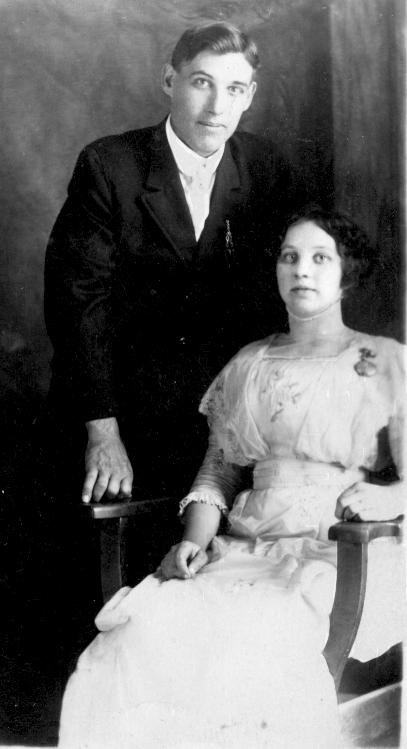
Joseph Rivers and Amelia Painter
Joseph Rivers with wife Amelia Painter Rivers

Thomas Rivers and Gertie Munson
Thomas Rivers with niece Gertrude Munson

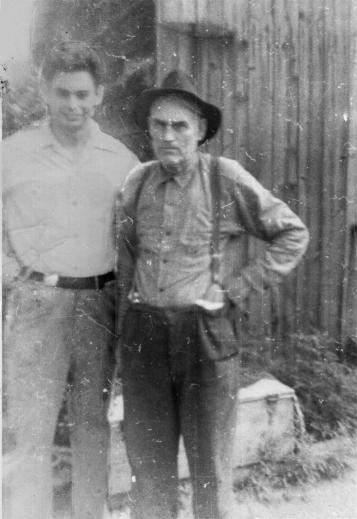
Ralph and Gardner Rivers
Gardner Rivers with nephew Ralph Rivers

I concluded that since the story matched up and there was a similarity in the pictures between Guy/John and Gardner, Burt, Daniel (James Daniel) and Joseph – who all would be brothers and even a bit of similarity between Mary and Guy too (as poor as the pictures are), that John Jr was this Guy Morrison. But I would prefer to have a bit better proof. Well, I would eventually get that too – in 2017 I was checking my AncestryDNA matches and who would show up – this cousin who is Guy Morrison’s descendant. Doing some quick checks to make sure that the DNA didn’t come from a different ancestor, gave me the proof that I was really looking for. John Rivers Jr is Guy Morrison.

So, this has got me to wondering, about the murder part of the story. Who did John Jr kill? Why did he kill this person? I spent some time going through the Saginaw newspapers on Genealogybank.com and so far have come up empty. There’s only one murder in the area that seemingly went unsolved – but that was in 1881 and was an infant who was found alongside a road. Now, in 1881, John Jr would have been about 16.

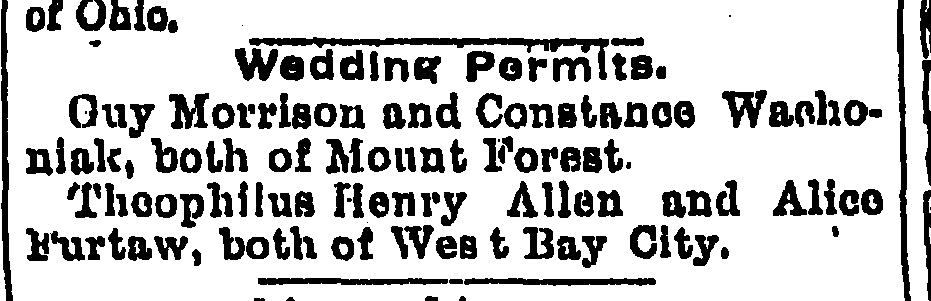
He married (as Guy Morrison) Constance Wachoviak in Mount Forest, Bay County, Michigan in May of 1893. Constance went by the nickname Katy in later records.

Bay_City_Times_1893-05-14_1-2
Bay City Times, May 14, 1893 page 1.

In checking where Mount Forest is – it very well could be that they married on their way to Petoskey area from the Taymouth Township area. So, if the 1881 baby was who John killed, it seems far fetched that he would wait around another 12 years before taking off and changing his name. It just doesn’t make sense.

At this point, I still don’t know who and why John supposedly killed. I would assume the murder went unsolved – or at the very least his name as John Rivers would be associated with the murder as a possible suspect. After all, why else would he change his name and move away to avoid the police? However, I have yet to find any evidence of it. This will require more digging – and I may never find out the details.