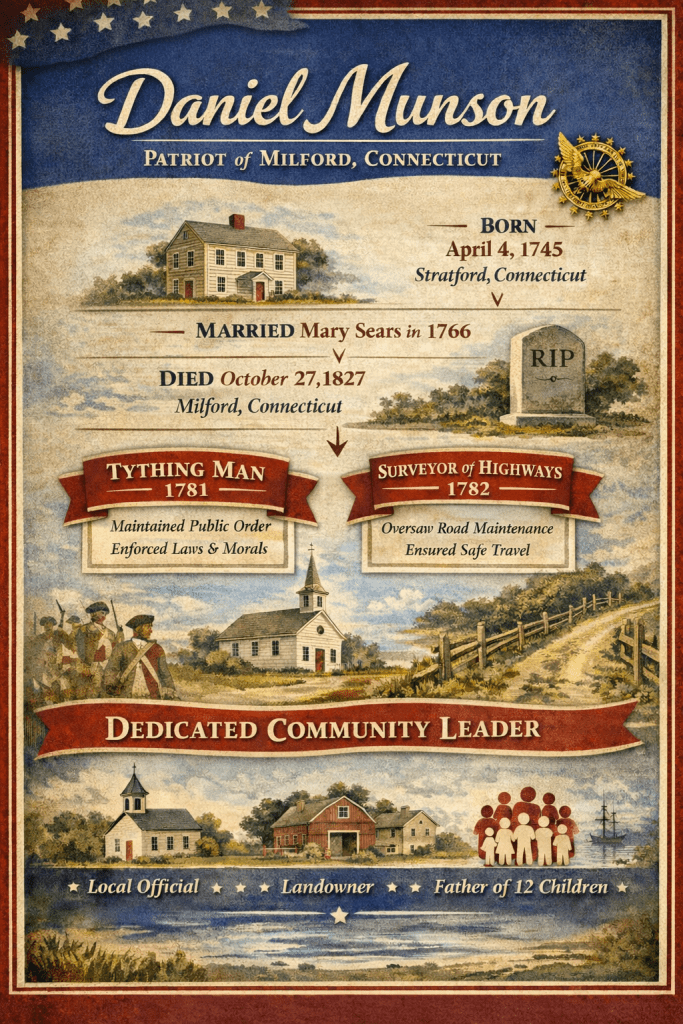
When we think of patriotic service during the American Revolution, it is easy to picture soldiers on the battlefield. Yet independence was secured just as surely by men who stayed home and kept their communities functioning during uncertain and dangerous times. One such patriot was Daniel Munson of Milford, Connecticut.
Born on April 4, 1745, in Stratford, Connecticut, Daniel Munson’s early life was shaped by loss. Orphaned as a small child, he was raised within an extended family that valued responsibility and public duty. As an adult, Daniel settled in Milford, where he married Mary Sears and raised a large family while becoming deeply involved in the civic life of the town.
During the Revolutionary War, Milford’s stability depended on capable local leadership. In 1781 and 1782—critical years as the war drew toward its conclusion—Daniel Munson stepped forward to serve the town in two important civil offices: tything man and surveyor of highways. These were not ceremonial positions. They required time, authority, and a willingness to enforce the laws that kept daily life running smoothly.
As surveyor of highways, Daniel was responsible for overseeing the maintenance of local roads—vital routes used for transporting food, supplies, and militia. In a coastal town like Milford, good roads were essential to both commerce and defense. At the same time, his role as tything man placed him in charge of maintaining public order, enforcing Sabbath laws, and addressing disorderly conduct. In a period marked by shortages, political tension, and social strain, this work helped preserve the moral and civil structure of the community.
Daniel Munson’s patriotism did not end with the war. He remained an active citizen for decades, serving his church, managing land and property, and contributing to Milford’s growth well into the early years of the new republic. He lived to see the nation he helped support take firm root, passing away in Milford on October 27, 1827, at the age of eighty-two.
Today, Daniel Munson’s story reminds us that the Revolution was sustained not only by muskets and marches, but by ordinary citizens who accepted responsibility when their communities needed them most. His recognized patriotic service stands as a testament to the power of civic duty—and to the enduring legacy of those who quietly helped build a nation.
Daniel Munson, Ancestor No. A082998, Daughters of the American Revolution (DAR) Genealogical Research System, Washington, D.C.; patriotic service credited as tything man (1781) and surveyor of highways (1782), Milford, Connecticut; service sourced to Mullen, Connecticut Town Meeting Records, vol. 1, pp. 575–576.
In the rolling farmland of Somerset County, New Jersey, during the tumultuous years of the American Revolution, John Wortman (1729–1807) emerged as one of those indispensable local leaders whose influence rarely makes it into textbooks but was essential to the patriot cause. Born into a Dutch‑American farming and blacksmithing family, Wortman grew from a colonial artisan into a respected community figure — a man his neighbors called “Squire Wortman” for his civic authority and steady leadership.
John was born on February 1, 1729, in Somerville, the son of Jan Evertsen Bout Wortman and Beletje Post, descendants of Dutch settlers who had migrated inland from Long Island at the turn of the 18th century [3]. His baptism at the North Branch Reformed Dutch Church tied him to a congregation that would later become a center of revolutionary thought and action [1][3].
A Community Leader Before the Shooting Started
By the 1770s, Wortman had become a prominent landowner and blacksmith in Bedminster Township. His 500‑acre plantation, his forge, and his role as Justice of the Peace placed him among the township’s most trusted figures [1][6]. When tensions with Britain escalated, he stepped naturally into leadership.
He served on the Bedminster Committee of Observation, the local body responsible for enforcing boycotts, identifying Loyalists, and preparing the militia for conflict [4]. In May 1775, he was chosen to represent Bedminster at the Provincial Congress in Trenton, where New Jersey began its transition from royal colony to revolutionary state [4]. His home became a gathering place for patriot organizers — a quiet but vital hub of planning and coordination [1][6].
These early political roles reveal a man deeply invested in the future of his community and the emerging nation.
Corporal in the Somerset County Militia
When war arrived in earnest, Wortman joined the 1st Battalion of the Somerset County Militia as a Corporal [3]. This rank placed him in a position of tactical responsibility, overseeing a squad of men in a battalion frequently called into service to defend the “Neutral Ground” of New Jersey — the contested corridor between British‑held New York and patriot‑held Philadelphia.
The Somerset Militia played a crucial role during the Middlebrook encampments and the Battle of Monmouth, providing security, scouting, and harassment of British foraging parties [9][13]. Wortman’s service spanned 1777 to 1783, covering some of the most intense years of the war in New Jersey [3].
A Blacksmith’s Contribution: Keeping the Army Moving
One of the most compelling aspects of Wortman’s service was his technical skill. As a trained blacksmith, he was invaluable to the Continental Army. Local tradition holds that he personally shod the horses of General George Washington during the army’s movements through Somerset County [1][6]. Whether literal or symbolic, the story reflects the essential role of blacksmiths in maintaining the army’s mobility.
His forge repaired wagon hardware, shod cavalry horses, and kept the transport teams functioning — work that directly supported the army’s ability to maneuver across New Jersey’s rugged landscape. This technical service ran parallel to his militia duty and his logistical work within the Wagonmaster General’s Department, where he helped coordinate the movement of supplies and equipment [3].
This blend of military, logistical, and artisanal service made Wortman a true citizen‑soldier, contributing wherever he was most needed.
Family, Faith, and the Bedminster Estate
In 1777, John married Sarah Howard, with whom he raised ten children — one son and nine daughters [3]. Their household was sustained by a combination of family labor and enslaved individuals, a difficult but historically accurate reality of Somerset County’s agrarian elite [3]. The names of four enslaved people — Sam, Jack, Dick, and Bet — appear in records associated with the Wortman estate.
The family worshipped at the Bedminster Reformed Church, a congregation led by patriot clergy and deeply involved in the revolutionary movement [9][17]. Wortman’s status as a “Squire” suggests he likely held leadership roles within the church community as well.
His only son, John Duryea Wortman, born in 1789, inherited the Bedminster plantation after John’s death in 1807, continuing the family’s presence in the region [3].
Final Years and Legacy
John Wortman died on August 25, 1807, at age 77, and was buried in the cemetery of the Bedminster Reformed Church — today known as Schomp Cemetery [3][7]. His will, probated that same year, provides a detailed picture of his estate, including land, livestock, blacksmithing tools, and enslaved individuals [3].
His widow, Sarah, lived until 1837 and filed a pension application documenting his Revolutionary War service, ensuring that his contributions would be preserved in the historical record [3].
Workman Family History Americana – https://freepages.rootsweb.com/~n3kp/genealogy/workman_hist (freepages.rootsweb.com in Bing)
Jan Woertman (1729–1807) | WikiTree – https://www.wikitree.com/wiki/Woertman-76 (wikitree.com in Bing)
The Story of an Old Farm; or, Life in New Jersey in the Eighteenth Century – https://archive.org/download/storyofoldfarmor00melli/storyofoldfarmor00melli.pdf (archive.org in Bing)
Jan (John) Woertman – Ancestry – https://www.ancestry.com.au/genealogy/records/jan-john-woertman-24-1946x41 (ancestry.com.au in Bing)
Workman Family History – Internet Archive – https://archive.org/stream/workmanfamilyhis00ande/workmanfamilyhis00ande_djvu.txt (archive.org in Bing)
“Wortman Word” (Heritage Library PDF) – https://heritagelib.squarespace.com/s/Wortman-Word-Winter-98-Vol-23.pdf (heritagelib.squarespace.com in Bing)
Record of the First Presbyterian Church of Morristown – Internet Archive – https://archive.org/stream/recordoffirstpre01firs/recordoffirstpre01firs_djvu.txt (archive.org in Bing)
Somerset County Historical Quarterly – Internet Archive – https://archive.org/stream/somersetcountyhi02hone/somersetcountyhi02hone_djvu.txt (archive.org in Bing)
The Township of Bedminster – Seeking My Roots – https://www.seekingmyroots.com/members/files/H006433.pdf (seekingmyroots.com in Bing)
Official Register of the Officers and Men in the Revolutionary War – New Jersey State Library – https://www.njstatelib.org/research_library/new_jersey_resources/highlights/revolutionary_war_officers_and_men/ (njstatelib.org in Bing)
New Jersey State Archives Collection Guide – https://www.nj.gov/state/archives/guides/sdea0003.pdf (nj.gov in Bing)
Somerset County Historical Quarterly (Vol. 7) – Internet Archive – https://archive.org/stream/somersetcountyhi07hone/somersetcountyhi07hone_djvu.txt (archive.org in Bing)
Bangor Historical Magazine – Internet Archive – https://archive.org/stream/bangorhistorical01bang/bangorhistorical01bang_djvu.txt (archive.org in Bing)
Somerset County Historical Quarterly (Vol. 6) – Internet Archive – https://archive.org/stream/somersetcountyhi06hone/somersetcountyhi06hone_djvu.txt (archive.org in Bing)
When we talk about Revolutionary War service, we often picture soldiers on the battlefield or officers directing maneuvers. But for many men in New Jersey, the war was fought on the roads — muddy, frozen, rutted roads that carried the lifeblood of Washington’s army. Few stories illustrate this better than that of John T. Wortman, born in Morristown on September 25, 1757, and later known in the records as the teamster who helped keep the Continental Army alive during its darkest winters [1]. His life offers a window into the logistical backbone of the Revolution, a side of the war we rarely talk about but absolutely should.
John Jr. grew up in a world already shaped by the long Dutch presence in New Jersey. His father, John Wortman Sr., remained rooted in Somerset County, but John Jr. came of age farther north, in the developing communities of Morris County. That shift in geography — a short distance on a modern map — made all the difference in the kind of service he would eventually render. While his father’s life revolved around Bedminster, John Jr.’s world centered on Morristown, Roxbury, and Chester, places that would become synonymous with the Continental Army’s winter encampments and supply struggles [1][6]. This geographic divide is one of the most important clues for genealogists trying to distinguish the two men.
Enlistment During the “Hard Winter”
By the fall of 1779, the war had entered one of its most desperate phases. The army was preparing for what would become the infamous “Hard Winter” at Morristown, a season so severe that even seasoned soldiers later recalled it with dread. It was in this moment that John Jr. enlisted in the Morris County Militia [1]. His role was not that of a traditional infantryman. Instead, he joined the specialized team brigades — the mobile transport units that hauled food, clothing, equipment, and forage across New Jersey’s interior.
These brigades, led by George Allen and Samuel Hunt, operated under the broader umbrella of the Wagonmaster General’s Department, the logistical backbone of the Continental Army [1][10]. Their work was relentless. Supplies arrived by water at Lamberton, a small but strategically vital port just south of Trenton, where sea‑going vessels could unload their cargo. From there, men like John Jr. took over, guiding heavily loaded wagons northward through the state’s most important military corridor [1]. This corridor — stretching from Lamberton to Morristown and then into the Hudson Highlands — was one of the most strategically important supply routes of the entire war.
What John Jr. Carried — and Why It Mattered
The pension testimony preserved by his widow, Charity Messler, paints a vivid picture of what this work entailed. John Jr. hauled:
Flour, sugar, salt, rum
Hard soap and animal feed
Boxes of clothing and shoes
These weren’t abstract “supplies”; they were the difference between endurance and collapse for the men stationed at Morristown, New Windsor, Pompton, Tappan, and even West Point [1]. Each load he carried represented a small but essential piece of the army’s survival. This is the kind of detail that helps us understand the daily realities of Revolutionary logistics in a way that battlefield reports never could.
The roads he traveled were not the smooth turnpikes of later centuries. They were often little more than dirt tracks, churned into deep mud by rain or frozen into jagged ridges by winter storms. Driving a wagon through such conditions required strength, patience, and a deep familiarity with the landscape. John Jr. had all three.
The Condict Papers: Witnesses Who Remembered Him
One of the most valuable pieces of evidence for his service comes from the Lewis Condict Papers, a collection of notes taken between 1833 and 1837 from pension applicants and their neighbors. In these papers, witnesses such as William Todd confirmed John Jr.’s enlistment in October 1779 and his work as a teamster in the Allen and Hunt brigades [12]. These testimonies, combined with Charity’s pension application (W100), firmly anchor him in Morris County and distinguish him from his father, whose service belonged to Somerset County [1][6].
This kind of corroboration is gold for anyone doing serious genealogical reconstruction, especially when dealing with repeated names across multiple counties.
Life After the War
After the war, John Jr. settled permanently in Chester, where he and Charity raised a large family of ten children — Jane, Benjamin, Mary, Agnes, Charity, Ann, Sarah, Abraham, Ruth, and John [1]. Their household became part of the post‑war growth of Morris County, and later generations would carry the family westward into Ohio and beyond.
His death on May 19, 1831, closed the chapter on a life defined not by battlefield heroics but by the unglamorous, indispensable labor that kept an army functioning [1]. His story reminds us that the Revolution was not only fought with muskets and bayonets, but with wagons, wheels, and the steady determination of ordinary men who understood that their work mattered.
Eli Stiles (1746–?) entered the Revolutionary War from Hollis, New Hampshire, though he was born in Westfield, Massachusetts, and spent his early adulthood in the Berkshires. His service appears across New Hampshire war rolls, Massachusetts legislative records, and the Naval Documents of the American Revolution.
1775: Arnold’s Expedition to Quebec
Stiles’ first enlistment began on May 14, 1775, when he joined Captain John Worthley’s Company in Colonel Edmund Phinney’s Regiment (Fold3 Military Records; Worcester, History of Hollis). That autumn, he was one of four Hollis men who volunteered for Benedict Arnold’s march to Quebec. The expedition is well documented for its failed logistics and the severe conditions along the Kennebec River. Stiles survived both the march and the failed assault on December 31, 1775 (Worcester).
1776: Sergeant Stiles in the Northern Department
By 1776, Stiles had risen to the rank of Sergeant. The Naval Documents of the American Revolution record his formal “examination” on September 16, 1776, identifying him as “Serjt Stiles” aboard the Royal Savage. He had been sent to reconnoiter British positions at St. John’s, where he counted tents, observed troop movements, and reported the presence of British-allied Native forces traveling in birch canoes (Naval Documents, Vol. 6).
1777–1778: Eight-Month Enlistment and the Hollis–Littleton Quota Dispute
In early 1777, Stiles enlisted for an eight-month Continental term (Fold3; Worcester). This enlistment triggered a jurisdictional dispute: although he lived in Hollis, NH, he had accepted a bounty from Littleton, MA. Both towns attempted to count him toward their required quotas.
The matter reached the Massachusetts House of Representatives on January 31, 1778, which ruled that Stiles was an inhabitant of Hollis and must be credited to New Hampshire. Littleton’s bounty money was ordered returned (Massachusetts House Resolve, Jan. 31, 1778).
During this same period, Hollis records show that its soldiers—including Stiles—were serving with the New Hampshire Brigade during the winter encampment of 1777–1778. The town sent clothing and supplies to its men at Valley Forge in January 1778 (Worcester, History of Hollis).
1780–1782: “For the War” Enlistment
In 1780, Stiles reenlisted “for the war,” joining the long-term Continental establishment (Fold3; Register Report). New Hampshire war rolls from 1780–1782 occasionally list him as “absent” or “deserted,” but importantly add the notation “returned to his duty,” a common pattern among soldiers who left temporarily during periods of hardship (NH War Rolls; Worcester).
His continued presence in the army is confirmed by a 1782 sworn deposition from sutler Joel Abbot, who testified that he saw “Eli Stiles… many times this last summer” serving in the Continental Army and noted that Stiles had enlisted “for the town of Hollis during the war” (Deposition of Joel Abbot, Nov. 1782).
By the close of the conflict, the Hollis Selectmen described him as “a soldier who has done Singular Exploits” (Worcester).
Post-War
After the war, Stiles remained in New Hampshire until 1806, when he moved to Northfield, Vermont (Register Report; Stiles, Stiles Family in America).
Sources
Fold3 Military Records: Service entries for Eli Stiles.
Worcester, Samuel T. History of the Town of Hollis, New Hampshire (1879).
Naval Documents of the American Revolution, Vol. 6: “Examination of Serjt Stiles,” Sept. 16, 1776.
Deposition of Joel Abbot, Hollis, NH (Nov. 1782).
Stiles, Henry Reed. The Stiles Family in America (1895).
Massachusetts House of Representatives, Resolve concerning Eli Stiles (Jan. 31, 1778).
Benjamin Byam (1733–1795) lived a life shaped by steady service, devotion to family, and a willingness to step forward when history called. Born in Chelmsford, Massachusetts, on November 29, 1733, he came from early colonial stock. Like many families of that era, the Byams built their lives through practical skill and community responsibility. Benjamin learned the trade of a cooper, crafting the barrels that kept New England’s farms and merchants supplied.
His first experience in military service came long before the Revolution. In 1754, he joined Captain Melvin’s company during the French and Indian War, gaining the discipline and leadership that would later define his role in the fight for independence. By 1760, he had risen to 1st Lieutenant. That same year, he married Mary Keyes, and together they raised nine children — a family line that would spread across New England.
By the spring of 1775, Benjamin was living in Temple, New Hampshire. When word arrived on April 19 that British troops were advancing on Concord, he joined fifty-five of his neighbors who set out at once. Though they reached the scene after the first shots at the North Bridge, they joined the long pursuit of the British back toward Cambridge, marching through the day and into the night. Benjamin remained with the forces encamped there for eight months, supplying his own blanket — one of those small but telling sacrifices made by ordinary men who found themselves doing extraordinary things. He later served again in 1777 during the march toward Bennington.
Benjamin spent his final years in Randolph, Vermont, where he died on November 22, 1795. His life reflects the kind of legacy that endures: a craftsman, a soldier, a father, and a man whose quiet courage helped shape the nation his descendants continue to remember.