Working with French-Canadian Naming Practices

By the time a researcher encounters a family such as the Seguin dit Laderoute family, it becomes clear that the challenge of French-Canadian genealogy does not lie in missing records. Parish and notarial documentation in Québec is often abundant, continuous, and well preserved. The difficulty lies instead in how names were used and recorded.

The preceding posts have examined devotional given names, dit surnames, and the way these practices intersect across different record types. This final post brings those observations together and offers a framework for working with French-Canadian records without losing track of individuals.

Quebec, Canada, Notarial Records for Pierre Seguin and Barbe Fillion 2 Feb 1704

Names Are Descriptive, Not Fixed Identifiers

In eighteenth-century Québec, names functioned descriptively rather than administratively. A record identified a person sufficiently for its purpose, not permanently or exclusively. Baptismal records emphasized religious identity and parentage. Marriage contracts emphasized legal standing and family affiliation. Later records might emphasize marital status or residence.

As a result, variation in recorded names should be expected. Consistency across every record was neither required nor sought by the clerks who created them.¹


Record Context Matters More Than Name Form

When names appear unstable, context provides continuity. Place, chronology, family relationships, and associates consistently identify individuals even when name forms shift. In the Seguin dit Laderoute family, apparent contradictions dissolve once records are evaluated across an entire lifetime rather than in isolation.

This approach requires resisting the impulse to resolve name differences immediately. Instead, patterns emerge through accumulation of evidence.


Dit Names Are Additive, Not Substitutive

Dit names such as Laderoute added information; they did not replace surnames. Their appearance, disappearance, or reversal within records reflects clerical habit and context rather than a change in family identity. Treating dit names as aliases rather than alternate surnames allows records to be read cohesively.²

Written variations—dit, d’, de, or alias—serve the same function and should be interpreted as equivalent unless evidence suggests otherwise.


Women’s Identities Require Particular Care

Women’s records often reflect multiple identities: birth family, dit name, and marital association. A woman may appear under any of these forms depending on the type of record. This is not evidence of disappearance or duplication but of a system in which identity was situational.

Following women across records requires particular attention to place and relationships, especially in communities where given names repeat across siblings and generations.


Modern Systems Introduce Their Own Distortions

Many difficulties encountered today arise not from the historical records themselves, but from the modern systems used to organize them. Databases that require a single “correct” name or prioritize uniformity can unintentionally fragment individuals or merge distinct people.

Recognizing the limits of modern indexing is an essential part of working responsibly with French-Canadian sources.³


Reading the Records on Their Own Terms

The solution to French-Canadian naming challenges is not standardization, but interpretation. Recording names as they appear, noting variation, and evaluating identity through corroborating evidence allows the records to speak in their own language.

The Seguin dit Laderoute family illustrates that what initially appears confusing often reflects a coherent and functional naming system once its underlying conventions are understood.


Conclusion

French-Canadian records reward patience and context. Names that appear unstable are often reliable once viewed within their cultural and historical framework. By approaching these records with an understanding of devotional naming, dit names, and record-specific priorities, researchers can move beyond frustration and toward clarity.

The goal is not to force eighteenth-century records to conform to modern expectations, but to learn how identity was expressed at the time those records were created.


Notes

  1. Allan Greer, The People of New France (Toronto: University of Toronto Press, 1997), 63–66.
  2. René Jetté, Dictionnaire généalogique des familles du Québec (Montréal: Les Presses de l’Université de Montréal, 1983), introduction.
  3. Québec, Canada, Vital and Church Records (Drouin Collection); Québec, Canada, Notarial Records, 1637–1935.
When One Person Has Many Names

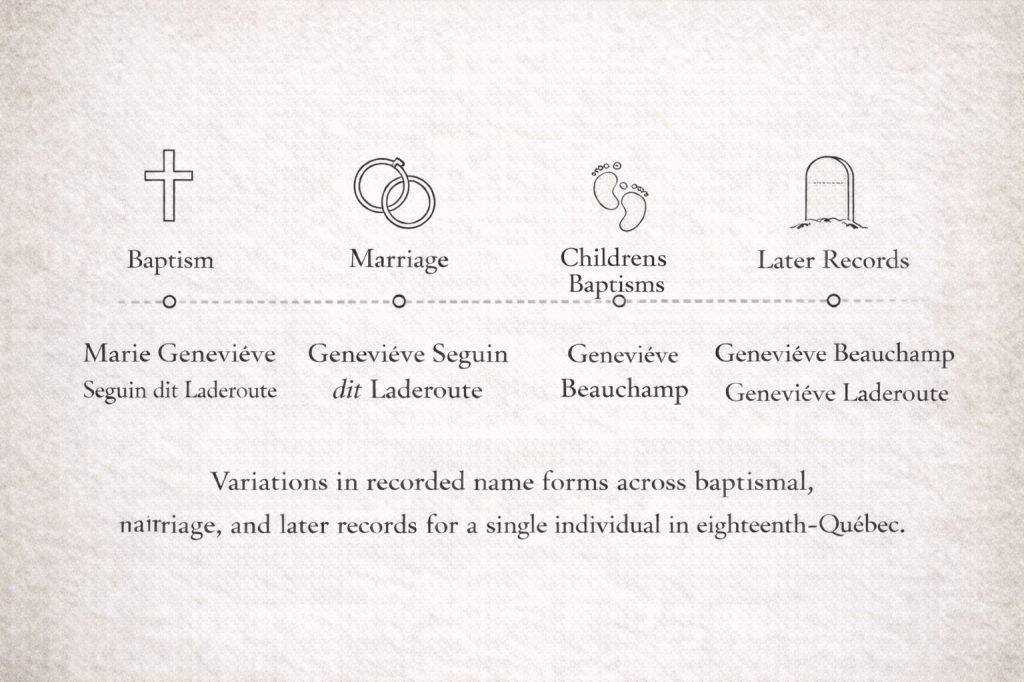
After examining devotional given names and dit surnames separately, it becomes clear that the real challenge for modern researchers lies in how these practices interact across different types of records. A single individual may appear under several legitimate name forms over the course of a lifetime, depending on the context in which the record was created.

The Seguin dit Laderoute family provides a clear example of this phenomenon, particularly in the records of Pierre Seguin dit Laderoute’s daughter, Marie Geneviève Seguin dit Laderoute.


Baptismal Identity

Marie Geneviève Seguin dit Laderoute was baptized in 1712.¹ In her baptismal record, she appears with both a devotional given name and a family surname that includes the dit name. At this stage of life, the record reflects the priorities of the Church: religious naming conventions and parental identity.

The baptismal name establishes her place within the family, but it does not define how she will necessarily appear in later records.


Marriage Records and Name Selection

When Marie Geneviève married Jean Beauchamp in 1731, her name appears in a notarial marriage record that identifies her as Geneviève Seguin dit Laderoute.² In this context, the emphasis shifts. The notary’s concern is legal identity and family affiliation rather than devotional completeness.

The omission of “Marie” in this record does not indicate a different person. Instead, it reflects the common practice of using the second given name as the practical identifier in adulthood.


Later Records and Variability

In later records associated with Marie Geneviève—whether related to the baptisms of her children, the marriages of those children, or notarial acts involving the family—her name may appear in additional forms. She may be recorded as Geneviève Seguin, Geneviève Laderoute, or Geneviève Beauchamp, depending on the type of record and the habits of the clerk.³

Each of these forms is historically valid. None represents a change in identity. Rather, each reflects a different aspect of her life: birth family, married status, or legal context.


Why Modern Systems Struggle

Modern genealogical systems tend to treat names as fixed identifiers. When applied to French-Canadian records, this assumption often leads to confusion. A woman such as Marie Geneviève Seguin dit Laderoute may be divided into multiple profiles because her name appears differently in different records, or incorrectly merged with another individual who shares a similar name.

In reality, the records themselves are consistent once their conventions are understood. It is the modern expectation of uniformity that creates the apparent conflict.


Reading Records Across a Lifetime

Understanding how names functioned in New France requires reading records across an individual’s entire life rather than in isolation. Baptismal, marriage, burial, and notarial records each served different purposes and therefore emphasized different aspects of identity.

For Marie Geneviève Seguin dit Laderoute, the variation in name forms across records reflects continuity rather than contradiction. Place, chronology, family relationships, and associates provide the connective tissue that confirms identity when names alone appear unstable.


Preparing for the Final Post

This examination of one individual demonstrates how devotional given names, dit surnames, and clerical habit combine to produce legitimate variation in the historical record. The challenge for researchers is not to force consistency where none existed, but to recognize patterns that reflect historical practice.

The final post in this series will step back from this specific family and offer practical guidance on how to approach French-Canadian records more generally, drawing on the examples already discussed.


Notes

  1. Québec, Canada, Vital and Church Records (Drouin Collection), baptism of Marie Geneviève Seguin dit Laderoute, 1712.
  2. Québec, Canada, Notarial Records, marriage contract of Jean Beauchamp and Geneviève Seguin dit Laderoute, 12 August 1731.
  3. Québec, Canada, Vital and Church Records (Drouin Collection), various baptisms and marriages involving the Beauchamp family, mid-eighteenth century.

What Does “dit Laderoute” Mean?

After grappling with repeated given names such as “Marie,” many researchers encounter a second layer of complexity in French-Canadian records: the appearance of an additional name introduced by the word dit. In the Seguin dit Laderoute family, this additional name—Laderoute—appears consistently across generations and records, raising questions about whether it represents a surname change, a nickname, or a separate family altogether.

In fact, dit names were a common and functional feature of naming practices in New France. Understanding how they were used—and how they were written—is essential for interpreting the records correctly.


The Meaning and Purpose of Dit Names

The French word dit means “called” or “known as.” A dit name functioned as an alias rather than a replacement surname. It could serve several purposes: distinguishing individuals with the same surname, identifying a particular branch of a family, reflecting military service, or referencing a place or personal characteristic.¹

Importantly, the presence of a dit name did not erase the original surname. Both names could be used independently or together, depending on context, clerk, or habit.


Pierre Seguin dit Laderoute

In this family, the surname Seguin appears alongside the dit name Laderoute beginning with Pierre Seguin dit Laderoute and continuing among his children. Pierre did not “become” a Laderoute; rather, he belonged to the Seguin family and was also known as Laderoute.

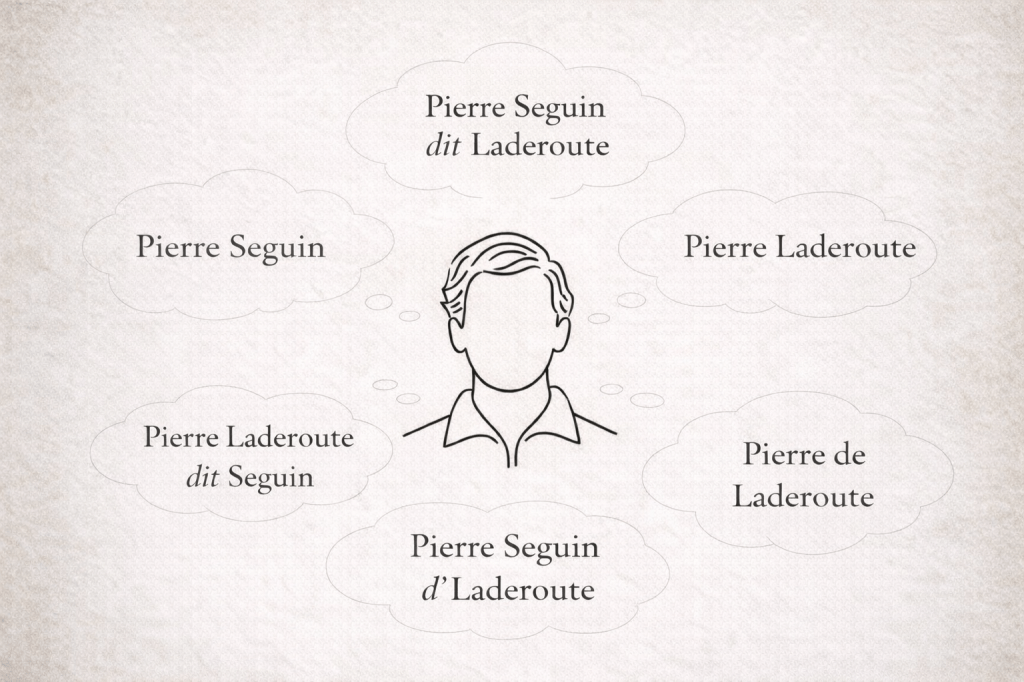
Across parish and notarial records, Pierre may be identified as Pierre Seguin, Pierre Laderoute, or Pierre Seguin dit Laderoute. Each of these forms refers to the same individual. The choice of name reflects the habits of the priest or notary who created the record, not a change in identity.


Variations in the Written Form of Dit Names

Modern researchers often encounter dit names written in several different forms and may assume that these variations reflect different meanings. In eighteenth-century Québec, this assumption is misleading.

The word dit may appear written in full, abbreviated, or contracted, including forms such as dit, d’, de, or occasionally alias.² These variations reflect clerical preference and writing speed rather than any distinction in function or status.

For example, entries recorded as Seguin dit Laderoute, Seguin d’Laderoute, or Seguin de Laderoute all convey the same meaning: Seguin, called Laderoute. The contracted form d’ is particularly common in notarial records and should not be interpreted as a marker of nobility, geographic origin, or surname change.


Dit Names Across Generations

The use of dit names was often inherited, though not always consistently. Some children retained the dit name, some used only the original surname, and others alternated between the two across their lifetimes. In the Seguin dit Laderoute family, Pierre’s children appear with varying forms of the surname, sometimes emphasizing “Seguin,” sometimes “Laderoute,” and sometimes both.

This variability does not indicate separate families or lines. Instead, it reflects a flexible naming system in which multiple identifiers could coexist without conflict.


Dit Names and Women’s Records

For women, dit names introduce additional complexity. A woman might appear under her baptismal surname, her dit name, her husband’s surname, or a combination of these forms depending on the type of record. In the Seguin dit Laderoute family, the presence or absence of “Laderoute” in later records does not signal a change in family affiliation.

As with given names, variation in surname form should be understood as a feature of the record-keeping system rather than evidence of multiple individuals.


Reading Dit Names in Context

The presence of a dit name signals that a record belongs to a naming system different from the modern one. Rather than attempting to standardize or correct these names, researchers benefit most from recording them as they appear and evaluating identity through corroborating evidence such as place, chronology, and family relationships.

The Seguin dit Laderoute family provides a clear example of how dit names functioned as flexible identifiers within a stable community. Recognizing this flexibility is essential for avoiding false divisions and misinterpretations in French-Canadian genealogical research.

In the next post, the focus will shift from naming systems themselves to the records that preserve them, and to how a single individual can legitimately appear under multiple name forms across baptisms, marriages, burials, and notarial documents.


Notes

  1. René Jetté, Dictionnaire généalogique des familles du Québec (Montréal: Les Presses de l’Université de Montréal, 1983), introduction; Yves Landry, Les noms de famille en Nouvelle-France (Montréal: Septentrion, 1992).
  2. Québec, Canada, Notarial Records, 1637–1935; parish registers of the Montreal and Lanaudière regions, eighteenth century, passim.

Why Everyone Is Named Marie

One of the first things modern researchers notice when working with French-Canadian records is the repetition of given names. In the Seguin dit Laderoute family, this is immediately apparent: nearly every daughter of Pierre Seguin dit Laderoute carries the given name “Marie.” At first glance, this can appear to be an error, a copying problem, or evidence that multiple individuals have been conflated. In reality, it reflects a deeply rooted religious naming practice rather than personal preference or family tradition.


Devotional Given Names in Catholic Québec

In New France, naming practices were shaped by Catholic theology and devotional culture. Children were commonly given the names of saints or religious figures at baptism, particularly those of the Holy Family. As a result, “Marie” appears frequently as a given name for girls, while “Joseph” and “Jean” appear frequently for boys.¹

These names were bestowed as acts of devotion rather than as practical identifiers. Consequently, the first given name recorded at baptism was not necessarily the name used in daily life.


The Seguin dit Laderoute Daughters

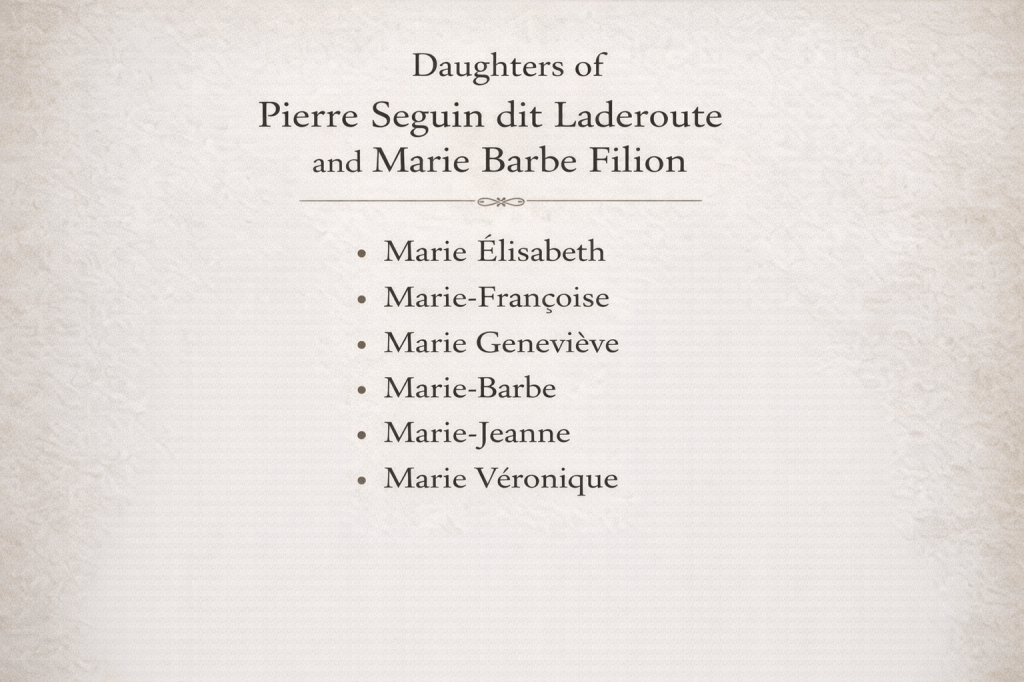
Pierre Seguin dit Laderoute and his wife Marie Barbe Filion had several daughters whose baptismal names begin with “Marie,” including Marie Élisabeth, Marie Françoise, Marie Geneviève, Marie Barbe, Marie Jeanne, and Marie Véronique.²

Despite sharing the same initial given name, these women were not distinguished in daily life by “Marie.” Instead, they were known by their second given names—Élisabeth, Françoise, Geneviève, Barbe, Jeanne, or Véronique. Parish priests, notaries, and later clerks might record either form, depending on context and habit.

This practice explains why the same individual may appear under different given names across records. A woman baptized as Marie Geneviève might later be recorded simply as Geneviève, Marie, or Geneviève Marie, without any intention of identifying a different person.


Hyphenation and Modern Assumptions

Modern readers often notice that some given names appear hyphenated while others do not, and may assume that this distinction reflects how the names were used or understood at the time. In eighteenth-century Québec, this assumption is misleading.

In the original parish registers, multiple given names were typically written without hyphens. Spacing, capitalization, and order varied, even within the same register. Hyphenation became more common in later transcriptions, printed genealogical works, and modern databases, reflecting editorial standardization rather than historical practice.³

As a result, forms such as “Marie-Françoise” and “Marie Françoise” usually represent the same name. The presence or absence of a hyphen should not be read as evidence of which name was used in daily life, nor as an indicator of formality or importance.


Why This Causes Confusion for Modern Researchers

Modern record systems and databases tend to treat the first given name as the primary identifier. When applied to French-Canadian records, this assumption often leads to errors. Individuals may be split into multiple profiles or merged incorrectly based solely on variations in given-name order, spelling, or hyphenation.

In families such as the Seguin dit Laderoute family, where several siblings share the same devotional name, relying on “Marie” as an identifying feature is particularly unreliable. Place, date, family relationships, and associates provide far more dependable evidence of identity.


Not Limited to Women

Although “Marie” is most visible among women, the same devotional practice applied to men. Men frequently carried “Marie” as one of their given names, just as women sometimes carried “Joseph” or “Josephte.” These combinations were expressions of devotion and carried no implication of clerical error or gender confusion.⁴

This practice becomes especially important when tracing later generations, where men such as François Marie Beauchamp appear in records with or without the devotional component of their given name.


Reading the Records as They Were Created

The repetition of “Marie” among the Seguin dit Laderoute daughters is not an anomaly requiring correction. It reflects a naming system that served religious and cultural purposes rather than modern administrative ones. The challenge for researchers lies not in fixing the records, but in learning to interpret them on their own terms.

In the next post, the focus will shift from given names to surnames and to the use of dit names such as “Laderoute,” which introduce an additional layer of complexity to the same family.


Notes

  1. Allan Greer, The People of New France (Toronto: University of Toronto Press, 1997), 63–66.
  2. Québec, Canada, Vital and Church Records (Drouin Collection), baptisms of the children of Pierre Seguin dit Laderoute and Marie Barbe Filion, various parishes.
  3. René Jetté, Dictionnaire généalogique des familles du Québec (Montréal: Les Presses de l’Université de Montréal, 1983), introduction.
  4. Ibid.

The Seguin dit Laderoute Family: An Introduction

Before examining the naming practices that often complicate French-Canadian genealogical research, it is useful to clearly establish the family at the center of the discussion. This post introduces the Seguin dit Laderoute family of Québec, a well-documented family whose records provide a strong foundation for understanding later naming patterns and research challenges.

Later posts will explore why the records for this family can appear confusing to modern researchers. Here, the focus is simply on identifying the family and situating them in place and time.

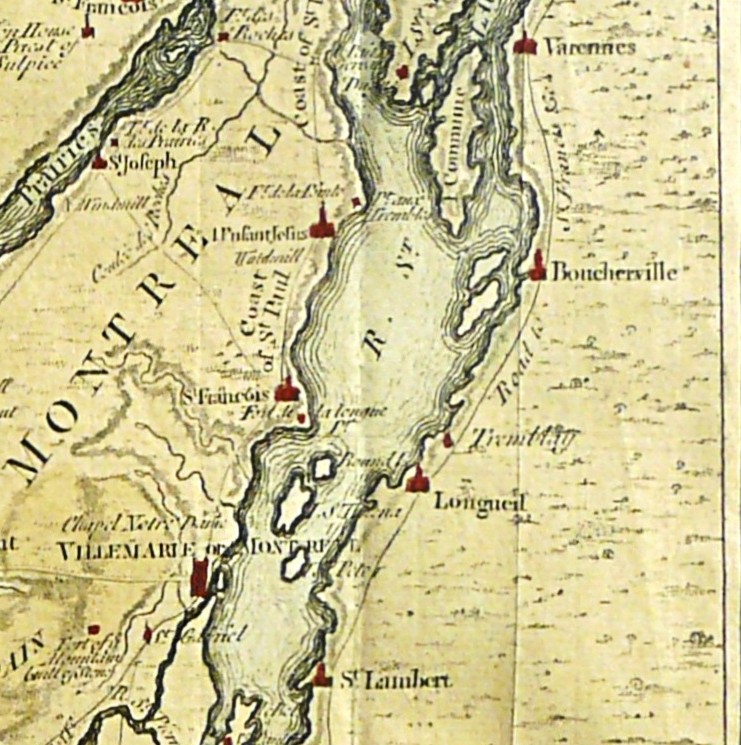
Part of a map showing Boucherville in 1761.

Pierre Seguin dit Laderoute

Pierre Seguin dit Laderoute was born on 24 August 1682 in Boucherville, Québec, and was baptized the same day.¹ He was the son of François Sequin dit Laderoute and Jeanne Françoise Petit, both natives of France who settled in New France during the seventeenth century.²

Pierre’s baptism on the same day as his birth reflects common practice in New France during the late seventeenth century. Catholic teaching emphasized the necessity of baptism, and infant mortality rates were high. As a result, newborns were often baptized within hours of birth, particularly in established parishes such as Boucherville. Same-day baptism was customary rather than exceptional, and does not indicate an emergency or unusual circumstance in this context.³

Pierre died on 9 November 1760 and was buried at Saint-Henri-de-Mascouche.⁴ His life spanned a period of rapid population growth in the colony, and his movements remained largely within what is now the greater Montreal and Lanaudière regions.

The use of the dit name “Laderoute” appears consistently in records associated with Pierre and his immediate family. At this stage, it is sufficient to note that “Seguin” and “Laderoute” refer to the same family line and are not competing surnames.


Marriage and Household

Pierre married Marie Barbe Filion on 4 February 1704 at Boucherville.⁵ Their marriage occurred shortly before the death of Pierre’s father later that same year, a sequence that is well documented in parish records.⁶

Following their marriage, Pierre and Marie Barbe established a household that appears across multiple parishes over time, including Boucherville, Île Jésus, Lachenaie, and Mascouche. These shifts reflect normal settlement patterns within the colony rather than relocation to distant regions.


Children of Pierre Seguin dit Laderoute and Marie Barbe Filion

Pierre and Marie Barbe Filion had several children, many of whom survived to adulthood and married locally. Their known children include:

  • Marie Élisabeth Seguin dit Laderoute, born in 1704, who later married Michel Beauchamp⁷
  • Marie-Françoise Seguin dit Laderoute, born in 1704⁸
  • Antoine Joseph Seguin dit Laderoute, born and died in 1711⁹
  • Marie Geneviève Seguin dit Laderoute, born in 1712, who later married Jean Beauchamp¹⁰
  • Marie-Barbe Seguin dit Laderoute, born in 1714¹¹
  • Marie-Jeanne Seguin dit Laderoute, born in 1718 and died in 1749¹²
  • Marie Véronique Seguin dit Laderoute, born in 1720¹³

At first glance, the repetition of given names and the consistent appearance of “dit Laderoute” may appear unusual. These features are not anomalies, but reflect common practices in French-Canadian Catholic families of this period.


A Family Well Documented in the Records

The Seguin dit Laderoute family appears frequently in baptismal, marriage, burial, and notarial records. Their documentation is neither sparse nor contradictory. On the contrary, the volume of surviving records makes this family particularly useful for illustrating how naming practices—rather than missing evidence—can complicate interpretation.

Several of Pierre’s children married into other established local families, including the Beauchamp family, creating overlapping name patterns that persist into subsequent generations.


Setting the Stage

As research progressed, it became clear that this single family illustrates many of the challenges encountered in French-Canadian genealogy: repeated devotional given names, inherited dit names, and inconsistent name usage across different types of records.

This post serves as an introduction to the family itself. Subsequent posts will examine these naming practices in detail, beginning with the widespread use of devotional given names such as “Marie,” and why those names do not always identify individuals in the way modern researchers expect.


Notes

  1. Québec, Canada, Vital and Church Records (Drouin Collection), baptism of Pierre Seguin dit Laderoute, Boucherville, 1682.
  2. Québec, Canada, Vital and Church Records (Drouin Collection), marriage and burial records of François Sequin dit Laderoute and Jeanne Françoise Petit.
  3. Allan Greer, The People of New France (Toronto: University of Toronto Press, 1997), 64–65; see also parish baptismal registers for Boucherville in the 1680s.
  4. Québec, Canada, Vital and Church Records (Drouin Collection), burial of Pierre Seguin dit Laderoute, Saint-Henri-de-Mascouche, 1760.
  5. Québec, Canada, Vital and Church Records (Drouin Collection), marriage of Pierre Seguin dit Laderoute and Marie Barbe Filion, Boucherville, 1704.
  6. Ibid.; burial of François Sequin dit Laderoute, Montréal, 1704.
    7–13. Québec, Canada, Vital and Church Records (Drouin Collection), baptisms and burials of the children of Pierre Seguin dit Laderoute and Marie Barbe Filion, various parishes.

John Rivers (1828–1902)

For many years, my second great-grandfather John Rivers was one of the most stubborn brick walls in my family tree. I knew when and where he lived as an adult, but his early life was completely undocumented. He appeared in Michigan in the early 1860s, married, and raised a large family—but nothing in U.S. records clearly revealed who he had been before crossing the border from Canada.

It took DNA evidence, careful work with French-Canadian church records, and a great deal of patience to finally reconstruct his origins.

A Man Who Appeared in Michigan

John Rivers was born in Quebec, Canada, in the late 1820s. Over the years, U.S. records reported his birth anywhere from 1824 to 1830, a common problem for 19th-century immigrants whose ages were often estimated. What was consistent was that he was Canadian-born.

In many U.S. census records, he was described specifically as “French Canadian.” That detail mattered: it pointed not just to Canada, but to French-speaking Quebec.

Long before DNA entered the picture, I found another clue. When I was a child, I discovered a handwritten note tucked into an old family Bible, written by my paternal grandmother, stating that John Rivers was born in Quebec. At the time, I had no way to verify it. Sadly, that slip of paper has since been lost. But years later, when I began working with census records, I realized something important: what my grandmother had written matched what the census takers had recorded decades earlier.

Two independent sources—one familial, one official—were quietly telling the same story.

By 1860, John had crossed into the United States. In 1862, he married Frances Jane Munson in Michigan. They settled in Saginaw County, where John worked and farmed while raising a large family.

Between 1863 and 1887, Frances gave birth to at least twelve children. Like many rural Michigan families of the period, they also experienced tragedy: two daughters born in 1868 and 1869 died in infancy, and a son, Franklin, born in 1874, died at age six.

Census records place John and Frances in Taymouth Township and later in Albee Township, part of the agricultural and lumber economy of mid-Michigan. By 1900, John was still living in Taymouth, surrounded by adult children beginning families of their own.

John died on 21 November 1902 in Taymouth Township, Saginaw County, Michigan, from broncho-pneumonia. He was buried two days later in Taymouth Township Cemetery. His Michigan death certificate, however, leaves both parents’ names blank.

Family Stories Without Proof

Two family stories followed John Rivers through the generations. One said he had come to Michigan as a Jesuit priest or with one. Another claimed he was part Native American.

These stories were preserved in family memory, but no documentation has yet been found to confirm either one. What has been discovered is that several of John’s ancestors and close relatives in Quebec were affiliated with the Jesuit order, which may explain how the priest story entered the family narrative—even if John himself was not a priest. The Native American claim, however, has not been supported by records or DNA.

The DNA Breakthrough

The real breakthrough came through genetic genealogy.

I tested in all the major DNA databases and had a male double first cousin test as well, giving us a broader pool of shared matches. His autosomal DNA produced connections I did not inherit by chance. Using results from Ancestry, 23andMe, and FamilyTreeDNA, I began building trees for our shared matches.

Again and again, the same French-Canadian families appeared.

Eventually, those matches converged on one Quebec couple:
Jean-Baptiste Larivière and Rose Dufault.

That gave me a working hypothesis. The next step was to find records.

How the “Dit” Name Led Me Down the Wrong Path

Early in the research, I found a baptism for Jean Beaudoin dit Larivière in 1824. It looked promising:

  • Jean → John
  • Larivière → Rivers
  • The timing was close

What confused me was the “dit” name. In French-Canadian records, a dit name is an alternate surname used by a branch of a family. I initially misunderstood it and thought this might be my ancestor.

Once DNA evidence was added, it became clear that this child belonged to a different family line and was not my John Rivers. That realization kept me searching.

The Right Jean

That search led me to a different baptism — this time simply Jean Larivière.

Original French (as written in the register)
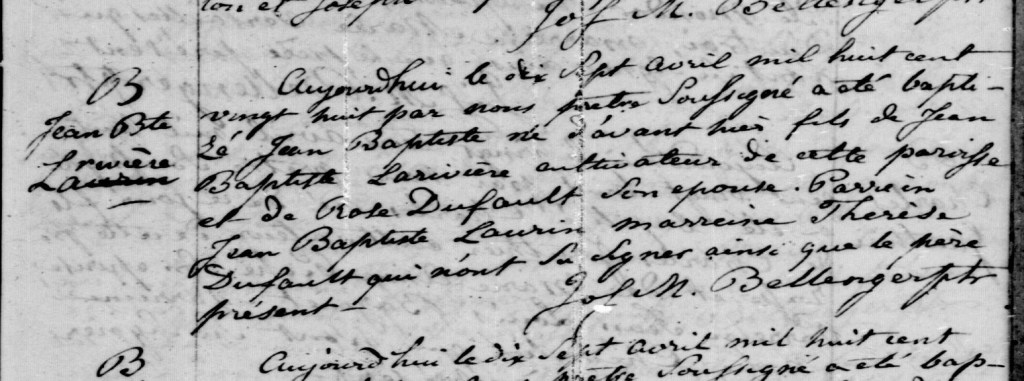
Aujourd’huy le dix sept avril mil huit cent vingt huit par nous prêtre soussigné a été baptisé Jean Baptiste né d’avant hier fils de Jean Baptiste Larivière cultivateur de cette paroisse et de Rose Dufault son épouse. Parrain Jean Baptiste Laurin marraine Thérèse Dufault qui n’ont su signer ainsi que le père présent. – J. M. Bellenger ptre

English Translation
“Today, the seventeenth of April eighteen hundred twenty-eight, by us the undersigned priest, was baptized Jean Baptiste, born the day before yesterday, son of Jean Baptiste Larivière, farmer of this parish, and of Rose Dufault his wife.
Godfather Jean Baptiste Laurin, godmother Thérèse Dufault, who did not know how to sign, as well as the father who was present. – J. M. Bellenger, priest.”

He was baptized on 17 April 1828 at Saint-Paul-de-Joliette, Quebec, born two days earlier on 15 April 1828, the son of Jean-Baptiste Larivière and Rose Dufault — the very couple identified by the DNA evidence.

The name fit.
The date fit.
And now, so did the DNA.

After adding Jean-Baptiste Larivière and Rose Dufault to my tree, DNA matches began appearing through ThruLines and shared match groups for their children, grandchildren, and extended family. While each match still needs individual verification, the genetic evidence lines up with the documentary trail.

There is no single record stating outright that “John Rivers of Michigan is Jean Larivière of Quebec.” His U.S. death certificate does not name his parents. But in genealogy, proof is built through converging evidence—and here, the church records, migration pattern, census data, family memory, and DNA all point to the same conclusion.

No Longer a Brick Wall

John Rivers is no longer a mystery man who appeared out of nowhere in Michigan. He was born Jean Larivière in Joliette, Quebec, in 1828, the son of Jean-Baptiste Larivière and Rose Dufault, part of a deep French-Canadian family whose lines extend back many generations.

His journey—from Quebec parish registers to Michigan farmland, from a French surname to an English one—was hidden for nearly two centuries. It was DNA, combined with traditional genealogy, that finally brought his story back into the family.

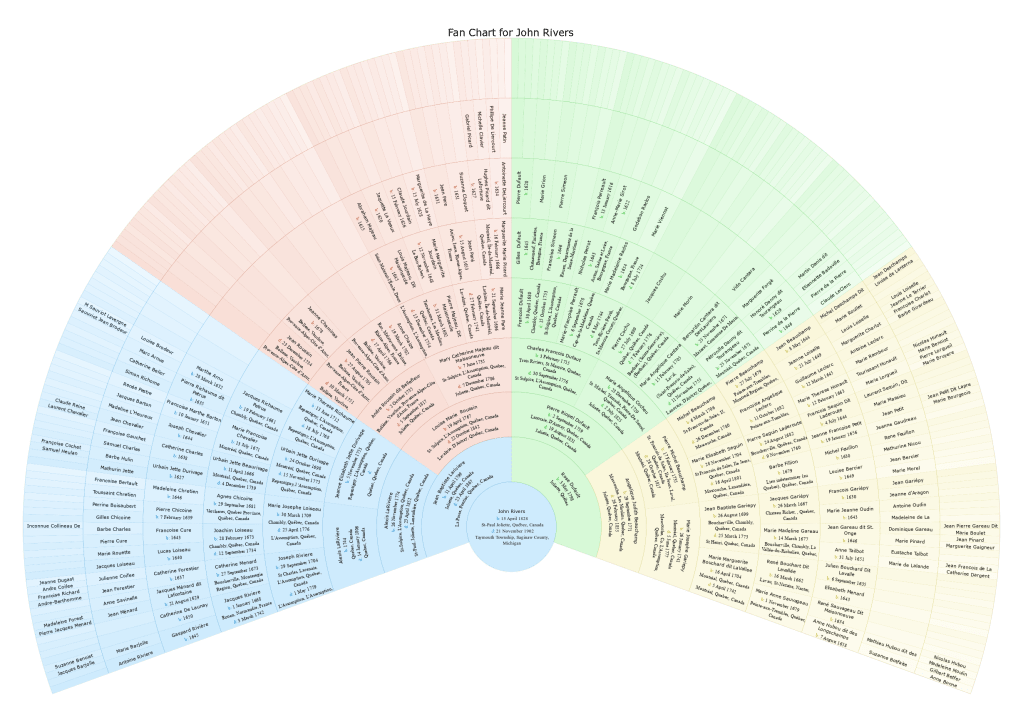
Fan chart showing the French-Canadian ancestry of John Rivers (Jean Larivière), reconstructed through DNA and Quebec parish records.