Rosa Susan (“Rosie”) Smith Revisited: What the Records Reveal Years Later

Looking Back at an Earlier Story

When I first wrote about my 2× great-grandmother Rosa Susan “Rosie” Smith in 2018, the outline of her life was already clear: a childhood in Pennsylvania and Michigan, a long marriage to William Doonan, years spent in northern Ontario, and a life that stretched into the early 1950s. What remained unclear then were the brief, uncomfortable gaps — especially Rosie’s short-lived first marriage to Thomas Osborn and the compressed timing of her remarriage to William Doonan.
In the years since, additional records, closer reading of familiar sources, and the availability of autosomal DNA evidence have allowed some of those gaps to be examined more carefully.

Re-examining the Marriage to Thomas Osborn

Rosie married Thomas Osborn on 17 February 1882 in Bay County, Michigan, when she was just sixteen years old.¹ The marriage was solemnized by Justice of the Peace Nathaniel Enman and witnessed by Charles Horsford and Mary Ann Leary.² It was formally recorded on 27 April 1882.

Marriage record of Thomas Osborn and Rosie Smith marriage.

At the time of the earlier post, it was unclear whether this marriage ended through divorce or death. A subsequent review of the complete 1880 federal census for Beaver Township and Kawkawlin Township — examined page by page — failed to locate Thomas Osborn in either community.³ No additional census, land, probate, or newspaper records have been identified that place him in Rosie’s orbit before or after the marriage.

The record, taken as a whole, suggests a marriage that existed briefly and left no lasting documentary footprint beyond the register itself.

A Compressed Timeline, Clarified

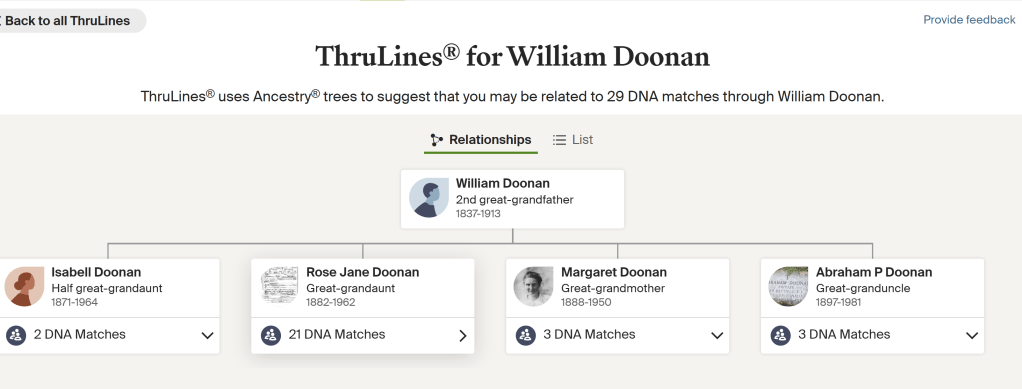
Rosie’s daughter, Rosa Jane Doonan, was born on 22 August 1882 — less than seven months after the Osborn marriage and several months before Rosie’s marriage to William Doonan on 11 November 1882.⁴ The timeline, while long visible, takes on sharper focus when examined alongside later evidence.

Marriage record of William Doonan and Rosie Smith

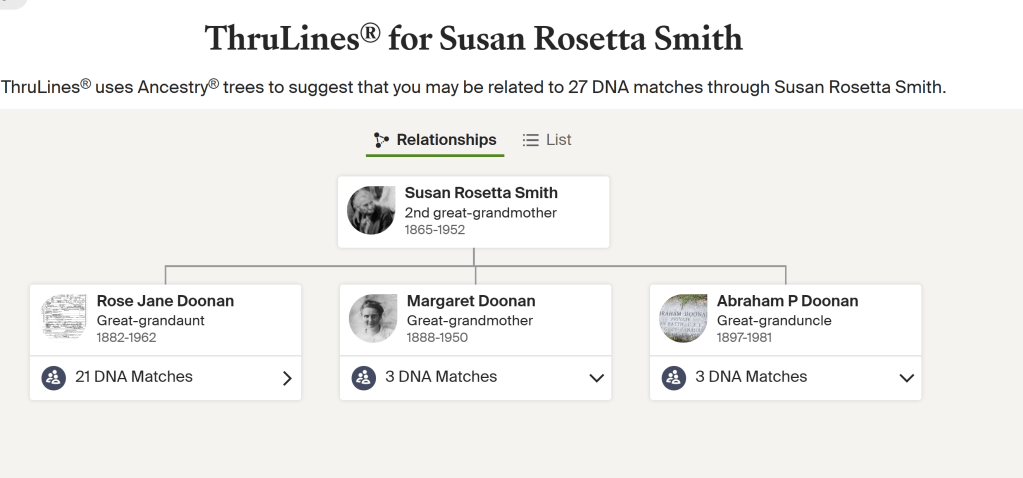
Modern autosomal DNA results now provide important clarification. Multiple DNA matches descending through independent children of Rosa Jane consistently align with William Doonan’s family.⁵ This pattern strongly supports William Doonan as Rosa Jane’s biological father and shows no comparable genetic connection to Thomas Osborn.

What once appeared as an unresolved question in the paper record is now better understood through the combination of documentation and DNA.
What the Witnesses — and Their Absence — Suggest

The Osborn marriage was witnessed by two community members who do not appear to have been relatives of either the bride or groom. No Osborn or Smith family members were listed as witnesses. Combined with Osborn’s absence from local census records, the marriage appears to have been formally executed but socially thin — a legally valid union that did not establish a shared household or lasting family connection.

This does not explain why the marriage occurred, but it helps explain why it disappeared so completely from the documentary record.

What Hasn’t Changed

What has not changed since the earlier post is the broader shape of Rosie’s life. Her long marriage to William Doonan, the birth and loss of children, the move to northern Ontario in 1908, and her later years as “Grandma Ball” within the extended family remain exactly as they were first understood.

If anything, the additional research sharpens rather than softens that picture. Rosie’s brief marriage to Thomas Osborn now appears as a momentary interruption rather than a defining chapter — a small but telling episode in a life otherwise shaped by endurance, adaptation, and persistence.

Conclusion

Family history rarely unfolds neatly. What can be known at one moment often changes as new records surface and new tools become available. Rosie’s story is no exception. The outlines were always there, but time and patience have filled in some of the finer lines.

This later look at Rosie’s life does not replace the earlier telling. Instead, it reflects the ongoing nature of historical research — the understanding that some answers arrive only years after the first questions are asked.


Sources

  1. Bay County, Michigan, Marriage Register, Thomas Osborn and Rosie Smith, 17 February 1882.
  2. Bay County, Michigan, Marriage Register (officiant and witnesses), same entry.
  3. 1880 U.S. Federal Census, Beaver Township and Kawkawlin Township, Bay County, Michigan.
  4. Michigan Birth Records, Rosa Jane Doonan, 22 August 1882; Bay County, Michigan, Marriage Records, William Doonan and Rosie Smith, 11 November 1882.
  5. AncestryDNA autosomal matches through multiple independent descendant lines of Rosa Jane Doonan.
Emily Rebecca Thompson (c. 1834–1891)

Early Life in Pennsylvania

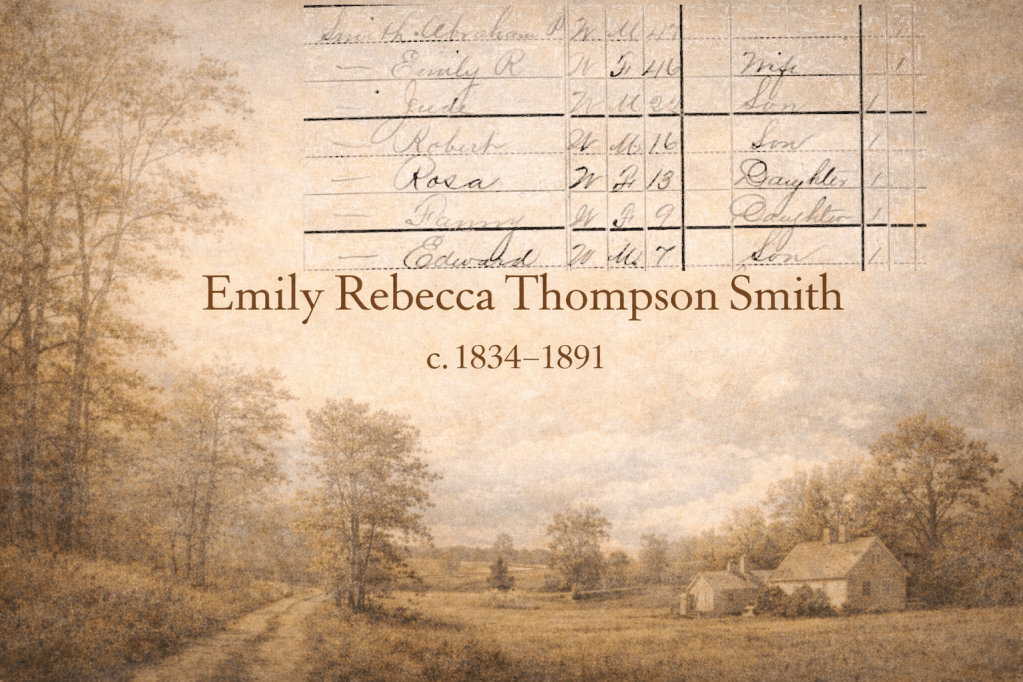
Emily Rebecca Thompson was born about 1834 in Pennsylvania, the daughter of John Thompson and his wife Mary.¹ Her early life is documented indirectly through later census records and family relationships rather than through a surviving birth record, a common circumstance for women born in rural Pennsylvania during this period.

Emily appears consistently in federal census records under the name “Rebecca,” suggesting that Rebecca was the name by which she was most commonly enumerated, while later records and newspapers refer to her as Emily.² This dual usage is not unusual for nineteenth-century women, particularly when a middle name or preferred given name was used interchangeably.

Marriage and Family

Before 1854, Emily married Abraham Possinger Smith, a Pennsylvania native born in 1833.³ The couple established their household in Monroe County, Pennsylvania, where they raised a large family. Their known children include:

  • Frank E. Smith (born 1855)
  • Hannah Smith (born about 1856)
  • Jude Smith (born about 1858)
  • Elmira Smith (born about 1862)
  • Robert Smith (born 6 May 1864)
  • Susan Rosetta Smith (born 1865)
  • Fanny Florence Smith (born 1870)
  • Abraham Edward Smith (born 1872)⁴

The family is enumerated in Tobyhanna Township, Monroe County, Pennsylvania, in both the 1860 and 1870 federal censuses, with Emily recorded as “Rebecca Smith,” wife of Abraham.⁵

Migration to Michigan

Sometime between 1872 and 1880, Emily and Abraham Smith relocated with their family to Michigan, settling in Beaver Township, Bay County. This move reflects a broader pattern of post–Civil War migration from Pennsylvania to the Midwest, particularly among families seeking agricultural or lumber-related opportunities.

The 1880 federal census places Emily, again enumerated as “Rebecca,” in Beaver Township, Bay County, Michigan, where she is listed as a married woman and wife of the household head.⁶

The Tragedy of 1890–1891

Emily’s final years were marked by extraordinary family trauma. On 6 December 1890, her son Jude Smith was shot and killed by his brother, Robert Smith, near Linwood in Bay County.⁷ The killing resulted in Robert’s arrest, trial, and eventual conviction for first-degree murder.

Contemporary newspaper accounts describe Emily as physically frail even before the shooting and report that she took to her bed shortly after Jude’s death. She did not attend her son Jude’s funeral and never saw Robert again following the crime. As Robert’s trial commenced in the spring of 1891, Emily’s condition worsened dramatically.⁸

Death

Emily Rebecca Thompson Smith died on 9 May 1891 in Garfield Township, Bay County, Michigan. Her death was recorded in multiple contemporaneous sources under slightly varying forms of her name.

A Bay County death register lists her as “Emily S. Smith,” married, aged 52 years, with parents John Thompson and Mary, residing in Garfield Township.⁹ The cause of death was recorded as dropsy, a term commonly used at the time for edema associated with chronic illness.

Newspaper coverage published shortly after her death attributed her decline to overwhelming grief following the killing of one son by another. One account stated that she “grieved to death over the killing of a son by another,” reflecting both the emotional tone of the period and the family’s widely known tragedy.¹⁰

Emily’s burial followed soon after her death, and she was survived by her husband Abraham Possinger Smith and several of her children.

Name Variations in the Records

Across her lifetime, Emily appears in records as Rebecca Smith, Emily Smith, and Emily S. Smith. These variations do not indicate multiple individuals but rather reflect common nineteenth-century record-keeping practices, especially for married women. Census enumerators frequently recorded women under a familiar or household name, while newspapers and civil registers often used a formal given name or abbreviated married form.

The consistent convergence of spouse, children, residence, parents’ names, and death date confirms that these records all refer to the same woman.

Conclusion

Emily Rebecca Thompson Smith lived a life shaped by migration, motherhood, and endurance. Like many women of her era, her story must be reconstructed from the records left by institutions rather than from documents created in her own voice. Yet through census records, civil registers, and contemporary reporting, her presence remains clear.

Her death in 1891 closed a chapter defined by family, loss, and resilience—leaving behind a lineage whose history would continue to be shaped by the events she lived through but did not survive.


Sources

  1. Bay County, Michigan, Death Register, 1891, entry for Emily S. Smith.
  2. 1860 U.S. Federal Census, Tobyhanna Township, Monroe County, Pennsylvania.
  3. Michigan county marriage records; Abraham Possinger Smith and Emily Thompson.
  4. Family structure compiled from census and vital records, 1855–1872.
  5. 1870 U.S. Federal Census, Tobyhanna Township, Monroe County, Pennsylvania.
  6. 1880 U.S. Federal Census, Beaver Township, Bay County, Michigan.
  7. Bay City newspapers, December 1890, reports on the killing of Jude Smith.
  8. The Bay City Times, spring 1891, coverage of Robert Smith’s trial.
  9. Bay County, Michigan, Return of Deaths, year ending 1891.
  10. The Bay City Times, May 1891, obituary and death coverage for Mrs. Abraham Smith.

Four Abraham Smiths in One Family Tree

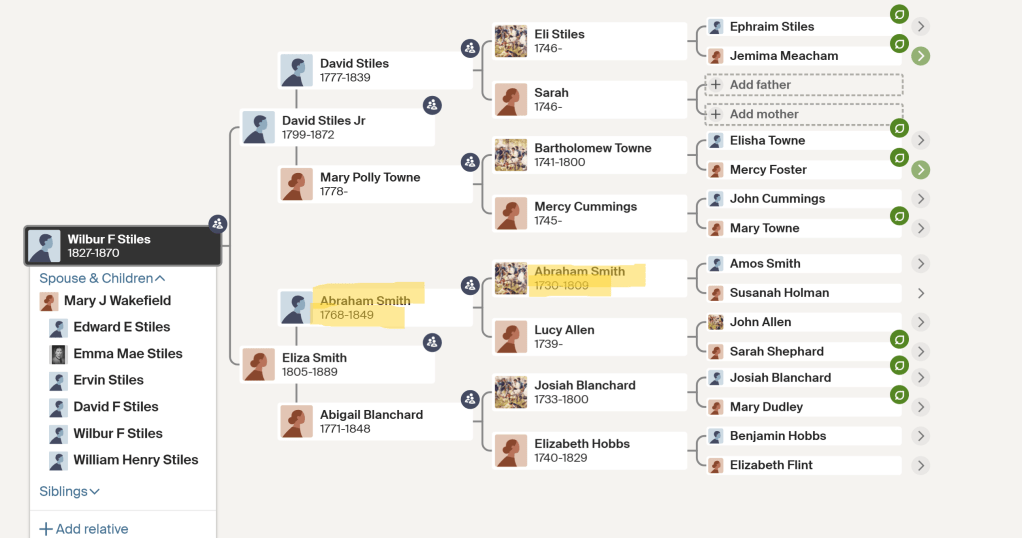
One of the most challenging parts of family history research is sorting out people who share the same name. In my own family tree, I descend from four different men named Abraham Smith. They fall into two father–son pairs, belonging to two entirely separate families. Although their names are identical, their lives unfolded in different places and under very different circumstances.


The Massachusetts–Vermont Abraham Smiths

Abraham Smith (1730–1809)

Abraham Smith was born on 20 September 1730 in Sudbury, Middlesex County, Massachusetts, the son of Amos Smith (1699–1786) and Susanah Holman (1702–1778). He grew up in Sudbury alongside his brothers Jacob, Benjamin, and Jonathan. On 24 July 1763, he married Lucy Allen in Newton, Massachusetts. Lucy had been born in 1739 in Weston, Massachusetts. Their children were born in Massachusetts:

  • Polly Smith, born 20 November 1766
  • Abraham Smith, born 27 October 1768 in Worcester
  • Allen Smith, born 6 April 1770

During the American Revolutionary War, Abraham Smith served in the Vermont militia. His service appears in The State of Vermont: Rolls of the Soldiers in the Revolutionary War 1775–1783, compiled by John E. Goodrich. Abraham Smith is listed on the roll of Captain Gideon Brownson’s Company, on a roster dated 26 February 1776 for the Montreal expedition, placing him in the northern theater of the war. This company was part of the militia forces raised in the Vermont region for operations connected with the occupation of Canada during the early stages of the war.

By 1790, Abraham was living in Tinmouth, Rutland County, Vermont, where he appears in the federal census. He remained there until his death on 4 November 1809, closing a life that spanned from colonial Massachusetts through the Revolutionary War and into the early years of the United States.


Abraham Smith (1768–before 1849)

The second Abraham in this line was born 27 October 1768 in Worcester, Massachusetts, the son of Abraham Smith and Lucy Allen. He married Abigail Blanchard on 9 February 1797 in Sturbridge, Massachusetts. Abigail was born in 1771 and later died in Brookfield, Vermont.

By the early 1800s, this family had settled in Orange County, Vermont, primarily in Brookfield. Their children included:

  • Harriot Louise Smith (1798–1878)
  • Abigail Smith (1800–1879)
  • Amasa Austin Smith (c.1801–1808)
  • Eliza Smith (1805–1889)
  • John Allen Smith (1809–1884)

Through these children, this Smith line later extended westward into Wisconsin and Michigan, particularly through the Fuller, Stiles, and Loomis families. Abraham Smith (1768) died before 10 April 1849 in Orange, Vermont.


The Pennsylvania Abraham Smiths

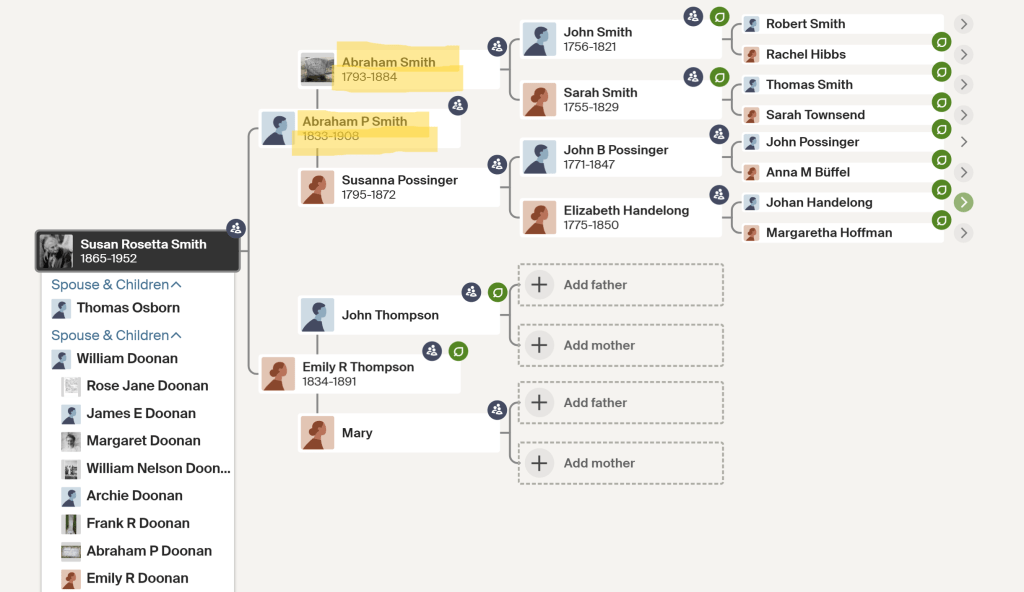
Abraham Smith (1793–c.1884)

A second, unrelated Abraham Smith was born on 29 January 1793, probably in Wrightstown, Bucks County, Pennsylvania. He was the son of John Smith (1756–1821) and Sarah Smith (1755–1829), a family associated with the Wrightstown Monthly Meeting of Friends (Quakers).

Abraham married Susanna Possinger (1795–1872), the daughter of John B. Possinger and Elizabeth Handelong. By 1830, Abraham and Susanna were living in Jackson Township, Monroe County, Pennsylvania, where Abraham appears in census records from 1830 through 1880. This area, in the Pocono region, became the permanent home of this branch of the family.

Their children included:

  • Fannie Smith (1813–1876)
  • Sarah Smith (1815–1900)
  • Catharine Smith (1826–1891)
  • Susan Smith (c.1828–1909)
  • Joseph Possinger Smith (1830–1882)
  • Abraham Possinger Smith (1833–1908)

The repeated use of “Possinger” as a middle name preserved Susanna’s maiden name and helps distinguish this Smith family from others in Pennsylvania.

Susanna died in 1872. Abraham remained in Jackson Township, Monroe County, until his death about 1884. He was buried in Tannersville Union Cemetery in Monroe County.


Abraham Possinger Smith (1833–1908)

The youngest of the four Abraham Smiths was born in May 1833 in Pennsylvania, the son of Abraham Smith and Susanna Possinger. He married Emily Rebecca Thompson before 1854 and later Susan Smith.

Over the course of his life, Abraham Possinger Smith lived in Pennsylvania, Michigan, and Washington State. He died on 29 June 1908 in Shelton, Mason County, Washington. His children included:

  • Frank E. Smith
  • Jude Smith
  • Elmira Smith
  • Robert Smith
  • Susan Rosetta Smith
  • Fanny Florence Smith
  • Abraham Edward Smith

Through this line, descendants spread into Bay County, Michigan, Ontario, Canada, and the Pacific Northwest, giving this Smith branch a wide geographic reach.


Two Names, Two Families

Although all four men bore the name Abraham Smith, the records show they belonged to two completely separate families:

Family LineFatherSon
Massachusetts → VermontAbraham Smith (1730–1809)Abraham Smith (1768–1849)
Pennsylvania → Monroe County → WestAbraham Smith (1793–c.1884)Abraham Possinger Smith (1833–1908)

Their lives overlapped in time but not in place or ancestry. Together, they illustrate how a single name can run through multiple generations and unrelated families, creating confusion that only careful documentation can resolve.

Technically, I have 8 different Abraham Smith’s in my family tree. However, only 4 are direct ancestors – the others are “cousins” or married into the family.

Nancy J Whitney’s mother?

Researching family history can be challenging. Records were destroyed in various natural disasters, records were not kept at all, people changed their names, etc. One source that genealogists tend to like is the census. Why? Because starting in 1850, everyone in the household was enumerated – not just the head of the household. Generally, the enumeration went like this: name of head of household (usually this is the male), then the head of household’s spouse (usually his wife), then their children in descent from oldest to youngest then typically anyone else living in the household (borders, parents, in-laws, etc). Now it’s true, that this wasn’t always the case, but in general, that’s the principle. It’s also true that for the 1850, 1860 and 1870 census you can’t say for any certainty about the relationships of the people in the household because it’s not spelled out that way. Starting in 1880, the relationships were added to the census.

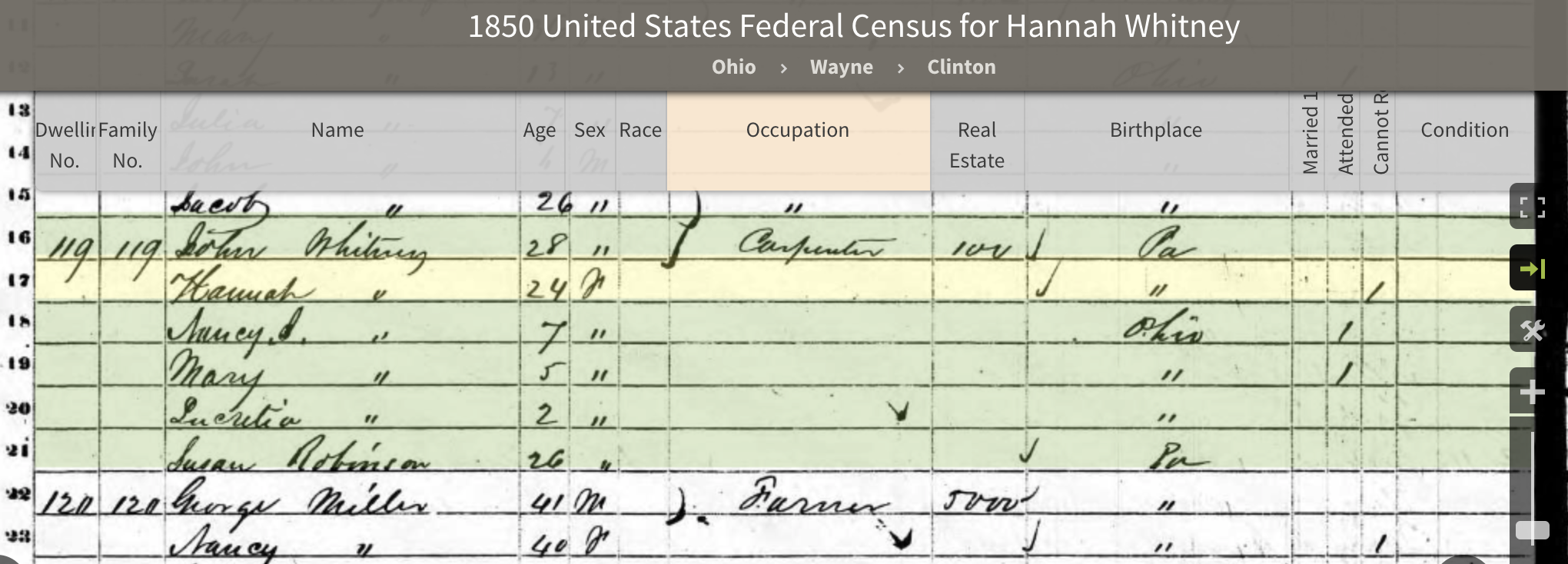
So, imagine for a moment my excitement to find my 2nd great-grandmother Nancy J. Whitney in the 1850 census.

Screen Shot 2018-10-02 at 8.14.27 AM

There she is, age 7 years old (which corresponds with other census records for her age) – the oldest of 3 children. It would appear from this enumeration that she is living with her parents – John Whitney (which is also independently confirmed) and probably Hannah. Hannah is 4 years younger than John – which isn’t unheard of for a husband and wife. Hannah would have been 17 when Nancy was born – again, not unheard of – it’s certainly possible. The last person in the household is Susan Robinson – age 26. This would seem to indicate that Susan is a border – even possibly a sibling to either John or Hannah.

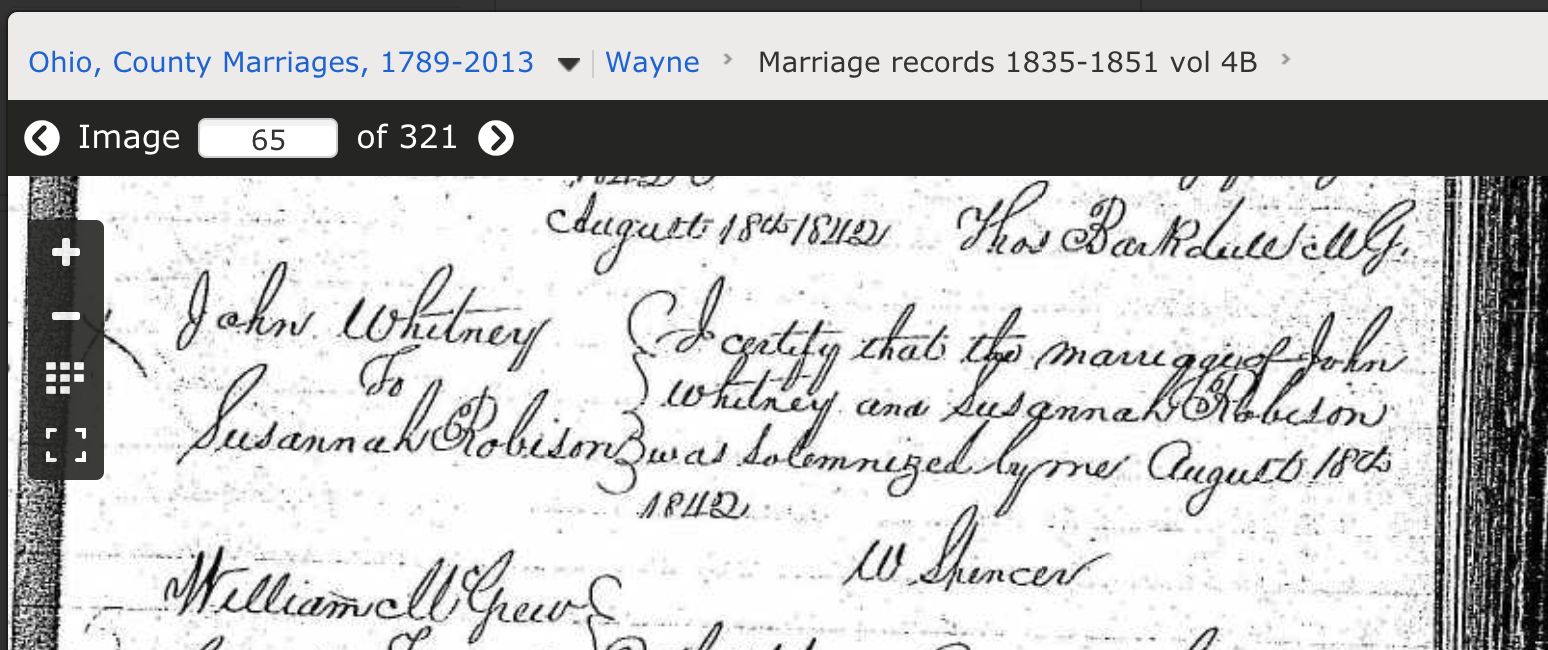
Here’s the rub – neither Hannah nor Susan appear in later censuses with John and Nancy. In fact, this is the only instance that I have of Hannah. I do find a marriage record for John and Susannah Robinson in 1842 (hmmm… Nancy is born in 1843 – coincidence?).

Screen Shot 2018-10-02 at 8.18.51 AM

Since the 1850 census is for Wayne County and this marriage record is also for Wayne County – it stands to reason that these are the same people. So why 8 years after John and Susannah get married, they are enumerated in the same household – but she is listed with her maiden name and appears to not be married to him and John appears to be married to a Hannah?

I have not been able to find a divorce for John and Susannah. I have not found a marriage for John and Hannah. I have not been able to find a death for John, Susannah or Hannah.

So, who is Nancy’s mother?


Rosa Susan “Rosie” Smith

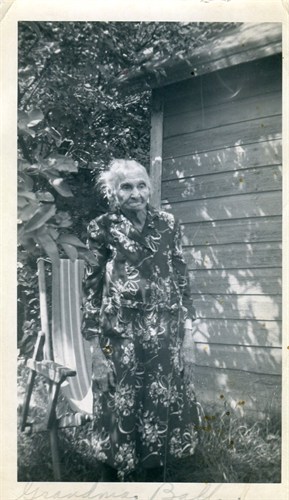
“Grandma Ball” as I had always heard her referred to was born on August 12, 1865 in Pennsylvania, the sixth child of Abraham Possinger Smith and Emily Rebecca Thompson.

Rosa Smith Doonan Ball

Sometime in the 1870’s, Rose moved to Bay County, Michigan with her family. On February 17, 1882, she married Thomas Osborn in Bay County. That marriage didn’t last very long though because just 9 months later, on November 11, 1882 she marries William Doonan. It is not clear what happened to Thomas Osborn – if they divorced or he died. Rosie would remain married to William Doonan until 1913 when he took his own life. Rosie would eventually marry Ernest Alfred Ball on August 26, 1919 in Timiskaming, Ontario, Canada. Ernest would die in 1935 and Rosie would never marry again.

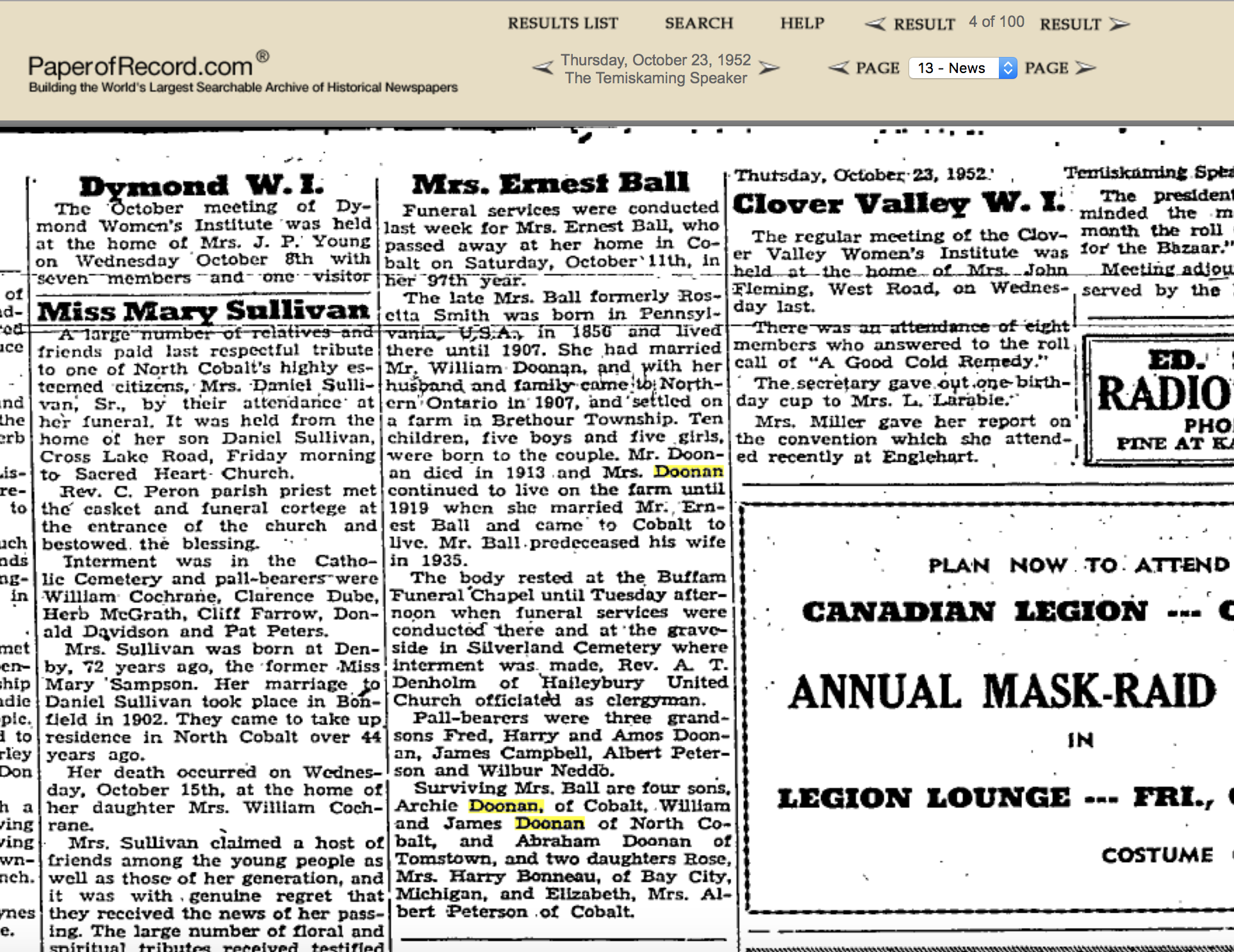
Rosie passed away on October 11, 1952. At some point they changed her birth year by 10, so the newspaper states that she was in her 97th year – when in reality it was her 87th year.

Screen Shot 2018-02-21 at 8.55.29 AM

Screen Shot 2018-02-21 at 8.45.30 AM
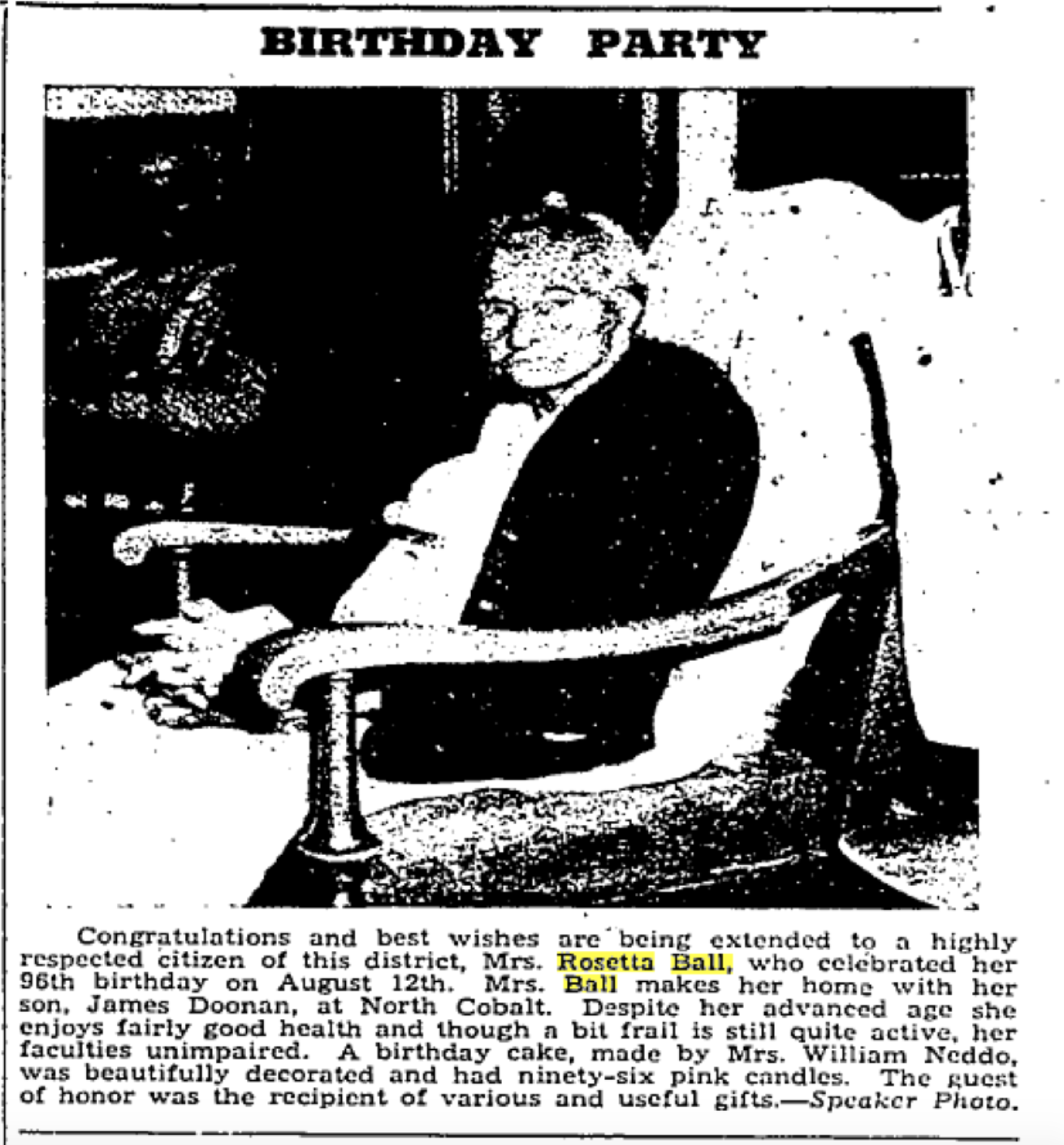
A copy of the article that appeared on the front page of the Temiskaming Speaker on August 21, 1952. This was just 2 months before her death.

The obituary leaves out my great-grandmother, Margaret Doonan who was married to John Phillips at the time and living in Saginaw, Michigan.

Rosie and William Doonan had ten children – but only 8 lived to be adults. Frank died at the age of 5 and Pearl died at the age of 4 months. Both of them are buried in Fraser Township, Bay County, Michigan. Another daughter, Emily, died at the age of 18. The oldest daughter is Rose Jane who was married to Harry Bonnaeau. Rosie and William had 3 sons who served in the Canadian Expeditionary Force during World War I – Archie, Abraham and William Nelson. Archie and Abraham were wounded in the war, but lived through it.

After their youngest daughter died in 1905, William and Rosie moved in 1908 to Pence Township, Temiskaming, Ontario, Canada. I remember once when I was little that my parents (and sister), and my uncle went to Cobalt, Ontario to visit the Doonan relatives. This was probably the late 1970’s early 1980’s. I was too young to really understand who they were though. It wasn’t my dad’s first trip there though – he had gone several times with my grandparents and great-grandma, but it was the last trip he made to see the Canadian relatives.