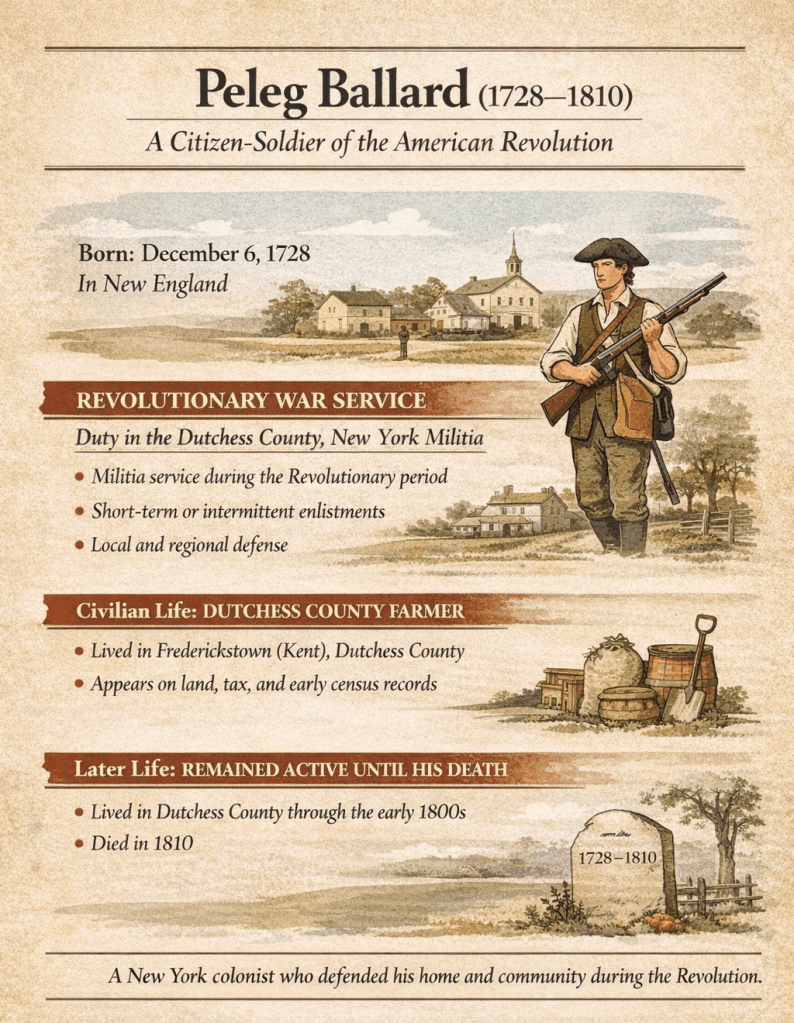
Peleg Ballard (1728–1810)

Revolutionary War service does not always survive in the form of neatly preserved enlistment papers or pension applications. In many cases—particularly in New York and neighboring colonies—service must be reconstructed from militia records, tax lists, land transactions, and postwar civil documentation.¹
The Revolutionary service of Peleg Ballard falls squarely within this category.

Born on 6 December 1728 in New England, Peleg Ballard was an established adult and head of household by the time the American colonies entered open rebellion against British rule. His life during the Revolutionary period places him among the men expected to serve in local militia units while continuing to maintain farms, families, and community obligations.²

Early Life and Residence

Peleg Ballard was born in 1728 and spent his adult life moving between Connecticut and New York, ultimately settling in what became Frederickstown (later Kent), Dutchess County, New York.³ This region was deeply affected by Revolutionary War mobilization, serving as both a supply corridor and a source of militia manpower.

By the 1770s, Ballard was married and raising a family, including his son Jeremiah Ballard, who would later appear as a young man in early New York census records.⁴


Revolutionary War Service

Peleg Ballard is documented as having performed Revolutionary War service, consistent with militia duty from Dutchess County, New York.⁵ His service does not appear in federal pension files, nor is it accompanied by lengthy narrative accounts—circumstances that are typical for militia soldiers whose service consisted of short-term or intermittent duty rather than extended Continental enlistment.

New York militia service during the Revolution was frequently localized, involving defensive actions, regional security, and response to immediate threats rather than participation in major campaigns.⁶ Men such as Ballard often served when called upon and then returned to civilian life, leaving behind only minimal official documentation.

Importantly, the available records support the identification of this Peleg Ballard as a single, consistent individual, with no evidence of another man of the same name in the same locality during the same period.⁷ This allows his military service to be reasonably attributed without the complications that often arise in common-name cases.


Civil Records During and After the War

Peleg Ballard appears in postwar tax lists, land records, and early census schedules, demonstrating his continued residence and civic presence in Dutchess County after the conclusion of the Revolution.⁸ These records establish continuity between the man who served during the war years and the civilian who resumed normal life afterward.

He remained in Frederickstown into the early nineteenth century and died in 1810, having lived through the colonial period, the Revolution, and the formative years of the new republic.⁹


Assessing the Evidence

Peleg Ballard’s Revolutionary War service exemplifies the experience of many New York militia men whose contributions were essential but lightly documented. His service is supported by:

  • his age and residence during the war years,
  • documentary references to militia participation,
  • and the absence of conflicting identities.

While the precise dates and nature of his duty cannot be reconstructed in detail, the surviving evidence supports the conclusion that Peleg Ballard rendered legitimate service during the American Revolution.


Conclusion

Peleg Ballard was not a professional soldier. He was a husband, father, and landholder who answered the call when his community required it. His service, though modestly recorded, places him among the citizen-soldiers who sustained the Revolutionary effort at the local level.

By approaching his story cautiously and grounding it firmly in surviving records, we preserve both historical accuracy and the reality of Revolutionary War service as it was experienced by ordinary men.


Notes

  1. New York Revolutionary War militia record practices and survival rates.
  2. Dutchess County demographic and household patterns, mid-18th century.
  3. Land and residence records, Frederickstown (Kent), Dutchess County, New York.
  4. Early census and family reconstructions for the Ballard household.
  5. New York militia service references for Peleg Ballard.
  6. New York State militia organization during the American Revolution.
  7. Comparative name analysis, Dutchess County, 1770s–1780s.
  8. Postwar tax lists and land records, Dutchess County, New York.
  9. Death and residence records for Peleg Ballard.
Charles Thomas Wickham and Christianna Stouts

From Islington to New York and the Saginaw Valley

Reconstructing the lives of early nineteenth-century immigrants often requires correlating records created in different countries and under varying record-keeping practices. In the case of Charles Thomas Wickham and Christianna Stouts, parish registers, marriage records, passenger lists, Michigan documents, and contemporary newspapers together form a consistent and well-supported narrative. These records identify Charles Thomas Wickham and Christianna Stouts as my third great-grandparents and trace their journey from London to New York and ultimately to the Saginaw Valley of Michigan.


Charles Thomas Wickham: Origins in London

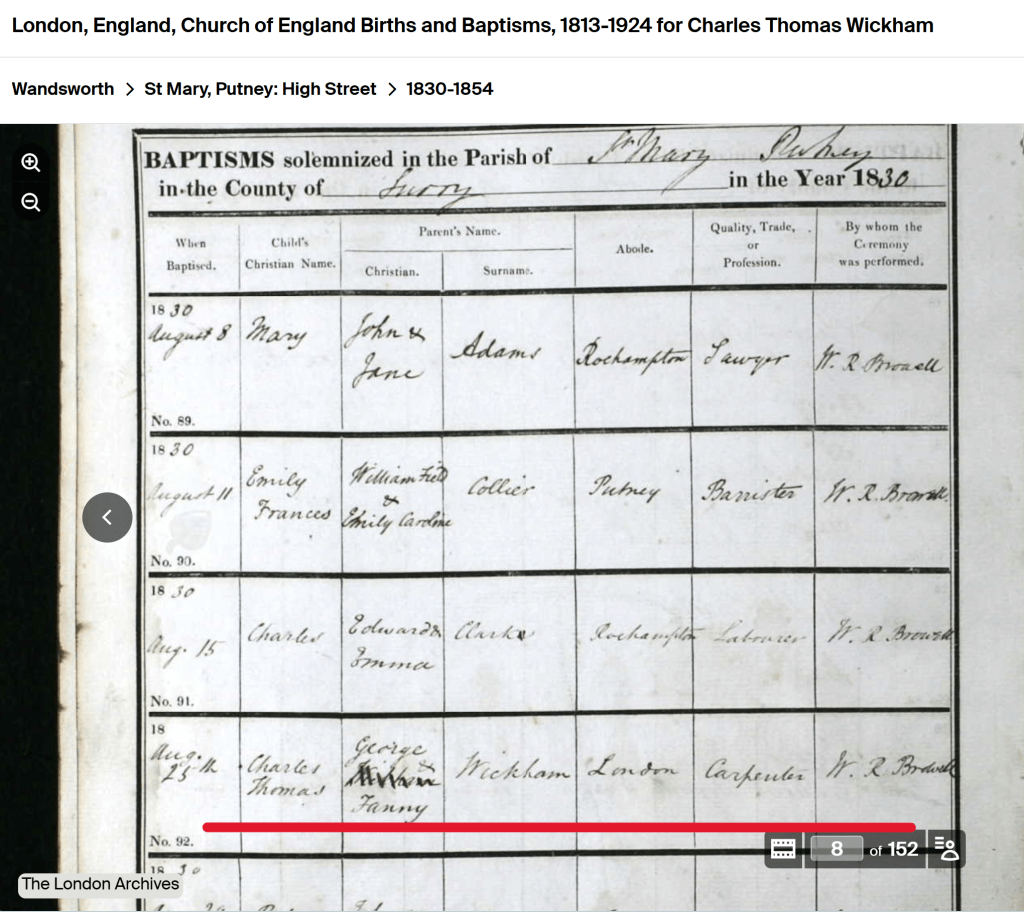
Charles Thomas Wickham was born about 1800 in London, England, the son of George Wickham and Fanny Bonner Farrand.¹ Parish records place the Wickham family in the Islington and Clerkenwell area of Middlesex during the early nineteenth century.

By the 1820s, Charles Thomas Wickham appears in parish records as a husband and father and is identified as a cheese monger and egg dealer, occupations consistent with small-scale food trade in urban London.² This occupational identification helps distinguish him from other men of the same name and provides useful context for his life prior to emigration.


First Marriage: Ann Philippa Evans

On 16 June 1822, Charles Thomas Wickham married Ann Philippa Evans at St Mary, Newington, Surrey.³ Two children were born to this marriage:

  • Charles Henry Wickham, born 6 December 1823
  • Ann Philippa Wickham, baptized 11 August 1825 in Islington³

Ann Philippa Evans Wickham died shortly after the birth of her daughter and was buried on 24 August 1825, leaving Charles a widower with two young children.⁴


Second Marriage: Christianna Stouts

On 1 April 1827, Charles Thomas Wickham married Christianna Stouts at St James, Clerkenwell, Middlesex.⁵ Christianna was born in 1807 and baptized at St Mary’s, Islington, placing her within the same parish network as the Wickham family.⁶

This second marriage produced a growing family during the late 1820s and early 1830s.


Children Born in England

The following children of Charles Thomas Wickham and Christianna Stouts were born in England:

  • John George Wickham, baptized 21 June 1828
  • Reuben Thomas Wickham, baptized 12 April 1831
  • Joseph Wickham, baptized 22 November 1832¹

These dates are later corroborated by American records and obituaries, demonstrating continuity of identity across the family’s migration.


Emigration to the United States

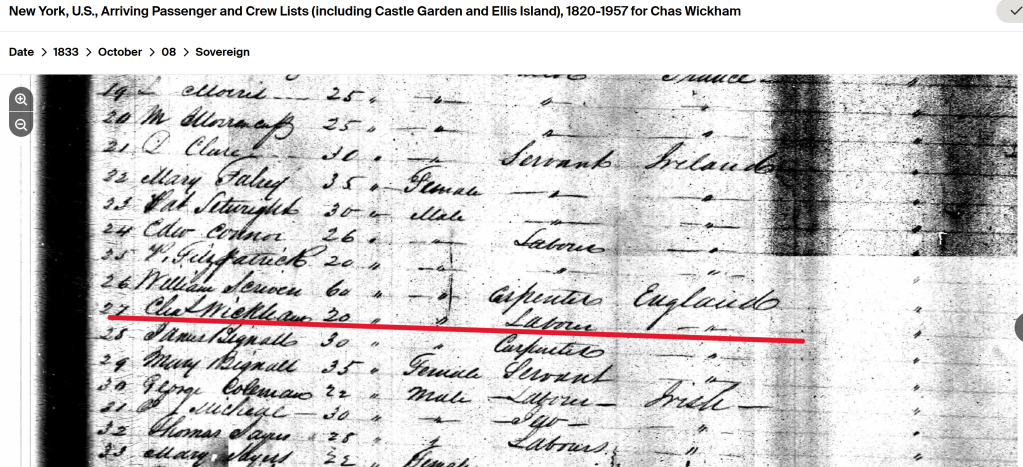
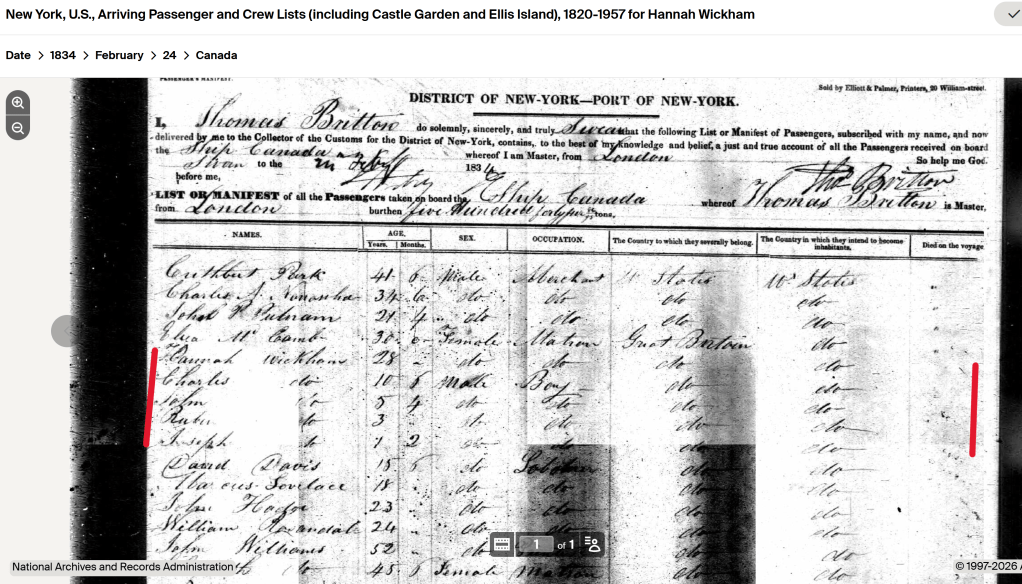
In 1833, Charles Thomas Wickham emigrated to the United States, arriving at New York.⁷ The following year, his wife Christianna, recorded on passenger lists as Hannah Wickham, followed with several children.⁸

Among those listed on the 1834 passenger list was Charles, age ten, whose age corresponds precisely with Charles Henry Wickham, born in December 1823, the son of Charles Thomas Wickham by his first wife, Ann Philippa Evans. None of the younger children of the second marriage would have been of that age, making this identification the only plausible interpretation.

The absence of Charles Henry Wickham’s sister, Ann Philippa Wickham, from American passenger lists suggests that she either died in childhood or remained in England, a common outcome for orphaned children placed with relatives.


“They Lived in the East”

Christianna’s obituary later states that after arriving in America, the family *“lived in the east.”*⁹ This phrase does not identify a specific state. When evaluated against dated and independent records, New York State is the only interpretation supported by evidence:

  • Both Charles and Christianna arrived through New York
  • Their American-born children were born in New York
  • No Massachusetts records have been identified
  • The family’s migration path proceeds logically from New York to Michigan

Move to Michigan and Charles’s Death

In 1840, the Wickham family relocated from New York to Saginaw County, Michigan, then a developing frontier region. According to Christianna’s obituary, Charles Thomas Wickham died only one month after arriving, bringing his American life to an abrupt end.⁹

He was buried in what is now Tittabawassee Township, Saginaw County, Michigan.¹⁰


Christianna Wickham Green: Pioneer Widow

In 1841, Christianna married Edward C. Green in Saginaw County.¹¹ She spent the remainder of her life in Michigan.

Her obituary, published in 1891, provides a detailed narrative of her life, confirming her English birth, marriage to Charles Wickham, emigration to New York, residence in the eastern United States, relocation to Saginaw, Charles’s death shortly after arrival, and her second marriage.⁹


Confirmation from the Next Generation

The obituary of Reuben Thomas Wickham, published in 1903, independently confirms the family narrative. It states that he was born in London, England, came to New York as a small child, and moved to Saginaw in 1840 with his parents, Charles T. and Christina Wickham.¹²


The Unresolved Question of Charles Henry Wickham

While the passenger list establishes that Charles Henry Wickham immigrated to the United States in 1834, his later life has not yet been documented. He does not appear in Michigan records or family obituaries. His absence may reflect an early death, separate residence, or use of a name variation, but no definitive conclusion can be drawn.

Importantly, his presence on the passenger list strengthens the identification of Charles Thomas Wickham by confirming the structure of two marriages and the blending of children from both unions.


Conclusion

Through parish registers, marriage records, passenger lists, Michigan documents, and contemporary newspapers, the lives of Charles Thomas Wickham and Christianna Stouts can be traced with clarity and consistency. The evidence demonstrates a single family moving from London to New York and then to the Saginaw Valley, without contradiction or competing identities.

Together, these records establish Charles Thomas Wickham and Christianna Stouts as my third great-grandparents, preserving their story as part of the broader nineteenth-century immigrant experience.


Footnotes

  1. Parish baptism records for Wickham children, Islington and Clerkenwell, Middlesex, England, 1828–1832.
  2. Parish baptism records noting occupation of Charles Thomas Wickham as cheese monger and egg dealer, Islington and Clerkenwell, Middlesex.
  3. Marriage record of Charles Thomas Wickham and Ann Philippa Evans, St Mary, Newington, Surrey, 16 June 1822; baptism of Ann Philippa Wickham, Islington, 11 August 1825.
  4. Burial record of Ann Philippa Wickham, England, 24 August 1825.
  5. Marriage record of Charles Thomas Wickham and Christianna Stouts, St James, Clerkenwell, Middlesex, 1 April 1827.
  6. Baptism record of Christianna Stouts, St Mary’s, Islington, 1807.
  7. Passenger list, Sovereign, arrival New York, 1833, Charles Wickham.
  8. Passenger list, Canada, arrival New York, February 1834, Hannah Wickham and children.
  9. Obituary of Christianna (Stouts) Green, Saginaw Courier-Herald, 12 March 1891.
  10. Burial record of Charles Thomas Wickham, Freeland area, Saginaw County, Michigan, 1840.
  11. Marriage record of Christianna Wickham and Edward C. Green, Saginaw County, Michigan, 1841.
  12. Obituary of Reuben Thomas Wickham, Saginaw Herald, 27 January 1903.

Revisiting the Parentage of Eleanora “Ella” B. Gibbs

In October 2020, I published a post outlining the evidence I had at the time regarding the parentage of my second great-grandmother, Eleanora “Ella” B. Gibbs, wife of John Wortman. That post laid out the problem clearly: census records placed Eleanora in proximity to multiple Gibbs households in Dryden, Lapeer County, Michigan, but did not explicitly state her relationship to any of them.¹

At the time, the strongest conclusion I could reach — based on marriage, probate, and census evidence — was that Eleanora was the daughter of Lester Gibbs and Mary Conly. However, gaps remained, particularly concerning what became of Lester Gibbs, who appeared to vanish from the records after 1860.

Over the past several years, additional records have come to light. When examined together, they significantly strengthen the original conclusion and clarify why earlier records appeared contradictory.


The Core Question, Revisited

The question has never really been who raised Eleanora, but who her biological father was.

In 2020, the competing possibilities were:

  • Lester Gibbs, who married Mary Conly in 1850
  • Philo Gibbs, with whom Eleanora appears in close proximity in census records

Because nineteenth-century census schedules do not identify relationships, proximity alone could not prove parentage.² What resolves the question is land ownership, guardianship, and inheritance — records that do imply legal relationships.


What We Know Now About Lester Gibbs

Lester Gibbs Did Not Disappear After 1860

Earlier assumptions placed Lester Gibbs’s death near 1860, but new evidence clearly disproves that.

In the 1860 federal census, Lester Gibbs appears in Dryden Township, Lapeer County, Michigan, listed as a farmer with both real and personal estate.³ He was alive, resident, and economically established.

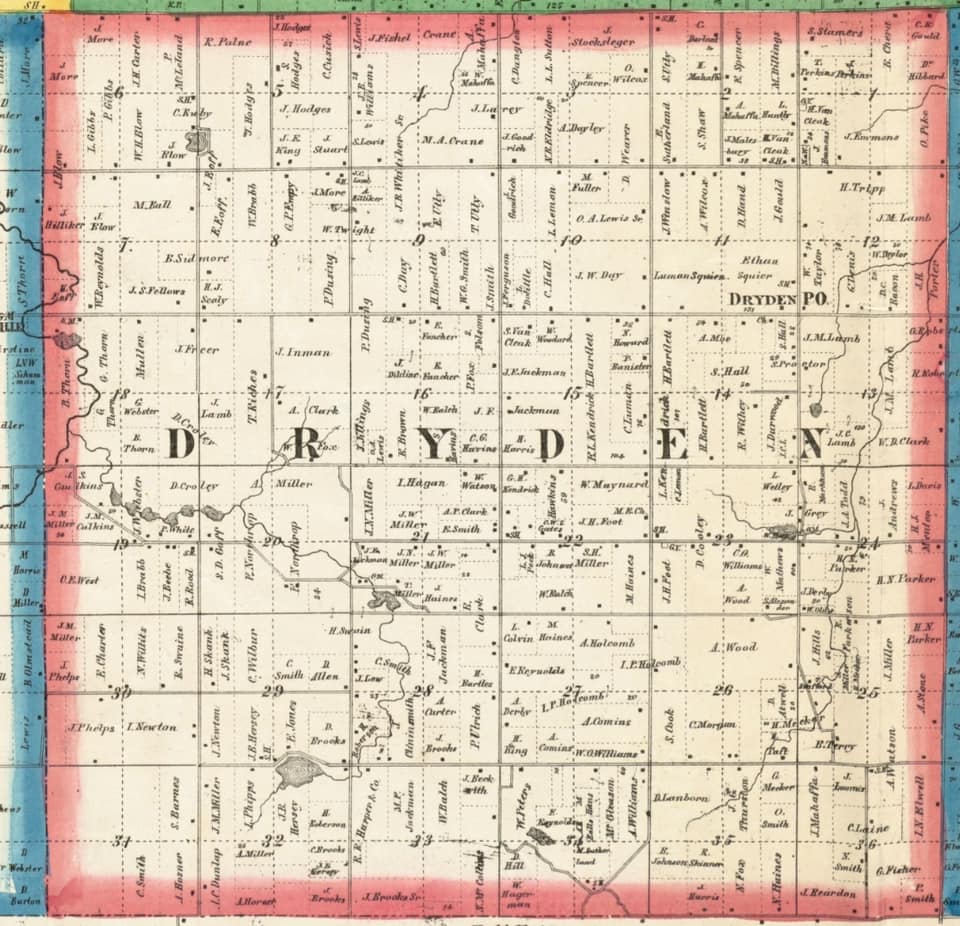
More importantly, an 1863 landowners map of Dryden Township identifies an “L. Gibbs” owning land in close proximity to J. Blow, a man later appearing in court-related records connected to this family.⁴ This confirms that Lester Gibbs was alive and a landholder at least as late as 1863.

1863 Land owernship map of Dryden, Lapeer County, Michigan. L. Gibbs owns land in the upper left corner.

Mary Conly’s Movements Explain the Census Confusion

The apparent absence of Mary Conly from Michigan in 1860 and Eleanora’s later association with other households long contributed to confusion. Those movements now make sense.

Mary Conly married Lester Gibbs in Lapeer County in November 1850.⁵ By 1861, she had remarried in New York to Charles Garner.⁶ The couple was living in New York by the mid-1860s, where Mary appears with Eleanora in the 1865 New York State Census.⁷

Charles Garner enlisted in the Union Army in 1863 and died as a prisoner of war at Salisbury Prison, North Carolina, on 21 December 1864.⁸ Mary was again widowed, this time with multiple minor children.

By 1868, Mary had returned to Lapeer County, Michigan, and married Mortimer Hilliker.⁹ These movements fully explain why Mary and Eleanora are absent from Michigan records during parts of the 1860s and why Eleanora later appears associated with extended family rather than her biological father.


The Most Important Evidence: Inheritance and Guardianship

The decisive records are not census schedules, but court-ordered guardianship and land transactions.

In December 1868, the Lapeer County Circuit Court appointed Mary Hilliker as special guardian of Eleanora (“Ella”) Gibbs, authorizing her to sell the minor child’s interest in real estate.¹⁰ The court approved both the guardianship and the conveyance.

Such proceedings occur only when:

  1. The child inherited property, and
  2. The property-owning parent is deceased

This establishes that Lester Gibbs died between 1863 and December 1868, and that Eleanora was his legal heir.

Philo Gibbs was not the landowner; Lester Gibbs was.


Why There Is No Probate Record for Lester Gibbs

The absence of a probate estate for Lester Gibbs once appeared problematic. In fact, it is consistent with Michigan legal practice of the period.

When a man died intestate leaving only minor heirs and land as the principal asset, courts often handled the matter through guardianship proceedings rather than formal probate administration.¹¹ This allowed the land to be sold for the child’s benefit without opening an estate.

That is precisely what occurred in this case.


What This Means for Eleanora’s Parentage

When all records are considered together:

  • Marriage of Lester Gibbs and Mary Conly (1850)⁵
  • Birth of Eleanora Gibbs (1854)¹²
  • Census evidence of Lester Gibbs alive in 1860³
  • Land ownership by Lester Gibbs in 1863⁴
  • Court-ordered guardianship and inheritance in 1868¹⁰
  • Probate of Mary Hilliker naming Ella Wortman as an heir¹³

…the conclusion is no longer tentative.

Eleanora “Ella” B. Gibbs was the daughter of Lester Gibbs and Mary Conly.


A Final Reflection

This case illustrates a fundamental genealogical principle:
census records suggest relationships; land and court records confirm them.

Six years ago, the evidence pointed in the right direction. Today, it firmly supports that conclusion.


Footnotes

  1. The parentage of Eleanora ‘Ella’ B. Gibbs,” blog post, 27 October 2020.
  2. U.S. Bureau of the Census, Instructions to Enumerators, 1860.
  3. 1860 U.S. Census, Lapeer County, Michigan, Dryden Township, Lester Gibbs household.
  4. Map of Lapeer County, Michigan (1863), Dryden Township landowners, “L. Gibbs.”
  5. Lapeer County, Michigan, Marriage Records, Lester Gibbs and Mary Conly, 12 November 1850.
  6. New York State Marriage Records, Mary Conly and Charles Garner, 1861.
  7. 1865 New York State Census, Cayuga County, Sterling, Mary Garner household.
  8. Compiled Military Service Record, Charles Garner, Union Army; died 21 December 1864, Salisbury Prison, North Carolina.
  9. Lapeer County, Michigan, Marriage Records, Mary Conly and Mortimer Hilliker, 29 March 1868.
  10. Lapeer County, Michigan, Circuit Court Records, Guardianship and deed of Eleanora D. Gibbs, December 1868.
  11. Michigan Probate Law and Practice, mid-nineteenth century (see Michigan Revised Statutes).
  12. Birth information for Eleanora D. Gibbs, as reported in multiple census and marriage records.
  13. Lapeer County, Michigan, Probate Records, Estate of Mary Hilliker, 1872.

Finding Jeremiah Ballard: How Census Records, Land, and DNA Solved a 200-Year-Old Puzzle

For years, one of my most frustrating family mysteries was a simple question:

Who was Jeremiah Ballard?

Jeremiah was born about 1765 in New York and was the father of Horace Ballard, my 4× great-grandfather. But when I went looking for Jeremiah in the 1790 census, he was nowhere to be found. Worse, there were multiple men named Peleg Ballard, and genealogists had tangled their families together.

What follows is how I finally proved that:

  • Jeremiah Ballard was the son of Peleg Ballard (born 1728), and
  • Horace Ballard (born 1799) was Jeremiah’s son

— even without a will, baptism, or birth record.


The Ballard Family in Frederickstown, New York

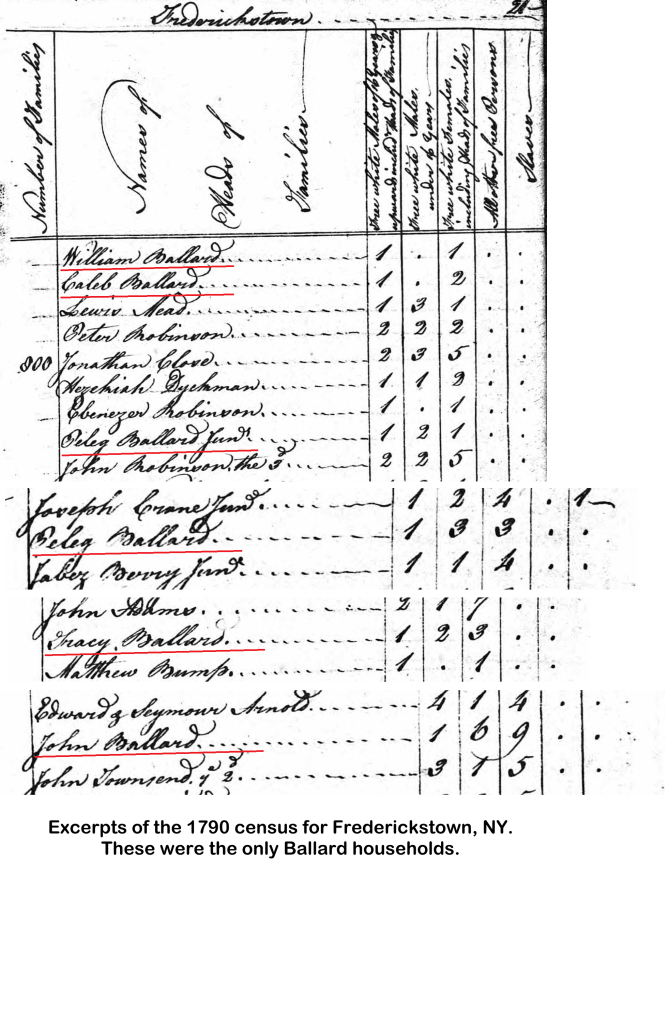
In 1790, the town of Frederickstown, Dutchess County, New York contained a remarkable cluster of Ballards.

The census lists the following heads of household¹:

  • Peleg Ballard
  • Peleg Ballard, Jr.
  • John Ballard
  • Tracy Ballard
  • Caleb Ballard
  • William Ballard

This isn’t random. This is exactly what a father and his adult sons look like when they have divided up family land.

Excerpts of 1790 US Federal Census for Frederickstown, New York showing the Ballard households.
1790 US Federal Census for Frederickstown, New York

Where Was Jeremiah in 1790?

Jeremiah Ballard was born about 1765, so he was 25 years old in 1790. That means he should appear as a head of household.

But he doesn’t.

Looking closely at the census columns, something important emerges:
Every Ballard household has exactly one adult male (16+).

That means Jeremiah is not hiding in any Ballard home.
He must have been living with a non-Ballard household — common for young unmarried men who had not yet received land.

So Jeremiah didn’t vanish.
He just wasn’t a landholder yet.


Jeremiah Appears — Right Where He Belongs

By 1799, Jeremiah begins appearing in the Frederickstown tax lists, and he continues through 1803².

Then the 1800 census reveals the truth.

On the 1800 Frederickstown census page, we see³:

Caleb Ballard
Jeremiah Ballard

listed next to each other.

Census takers walked farm to farm. Neighbors on the page are neighbors in real life. And in rural New York, neighbors are usually family.

Caleb Ballard is a known son of Peleg Ballard.
Jeremiah living next door proves he belongs to the same family.

Excerpt of the 1800 US Federal Census for Frederickstown, New York. Caleb and Jeremiah Ballard are next to each other.

Which Peleg Was Their Father?

There were multiple Peleg Ballards — so which one was the father?

The 1800 census answers that.

Peleg Ballard’s 1800 household shows⁴:

  • One male over 45
  • No younger adult males
1800 Census for Peleg Ballard in Frederickstown, New York.

That fits Peleg born 1728 (age 72 in 1800).
It does not fit Peleg Jr., who would be about 40 and would have sons of his own.

By 1810, Peleg is gone. Only Caleb and Jeremiah remain in Frederickstown⁵.

That is exactly what happens when a father dies and only two sons remain on the land.


Jeremiah’s Household Includes Horace

Jeremiah’s 1800 census household shows³:

  • One adult male (Jeremiah)
  • One adult female (his wife)
  • One male under 10
  • One female under 10

That small boy is the right age to be Horace Ballard, born in 1799.

By 1810, Jeremiah’s household contains multiple sons, including one aged 10–16 — exactly where Horace belongs⁶.

1810 US Census for Frederickstown, New York - Jeremiah Ballard's household.
1810 US Census for Frederickstown, New York – Jeremiah Ballard’s household.

DNA Confirms What the Records Suggest

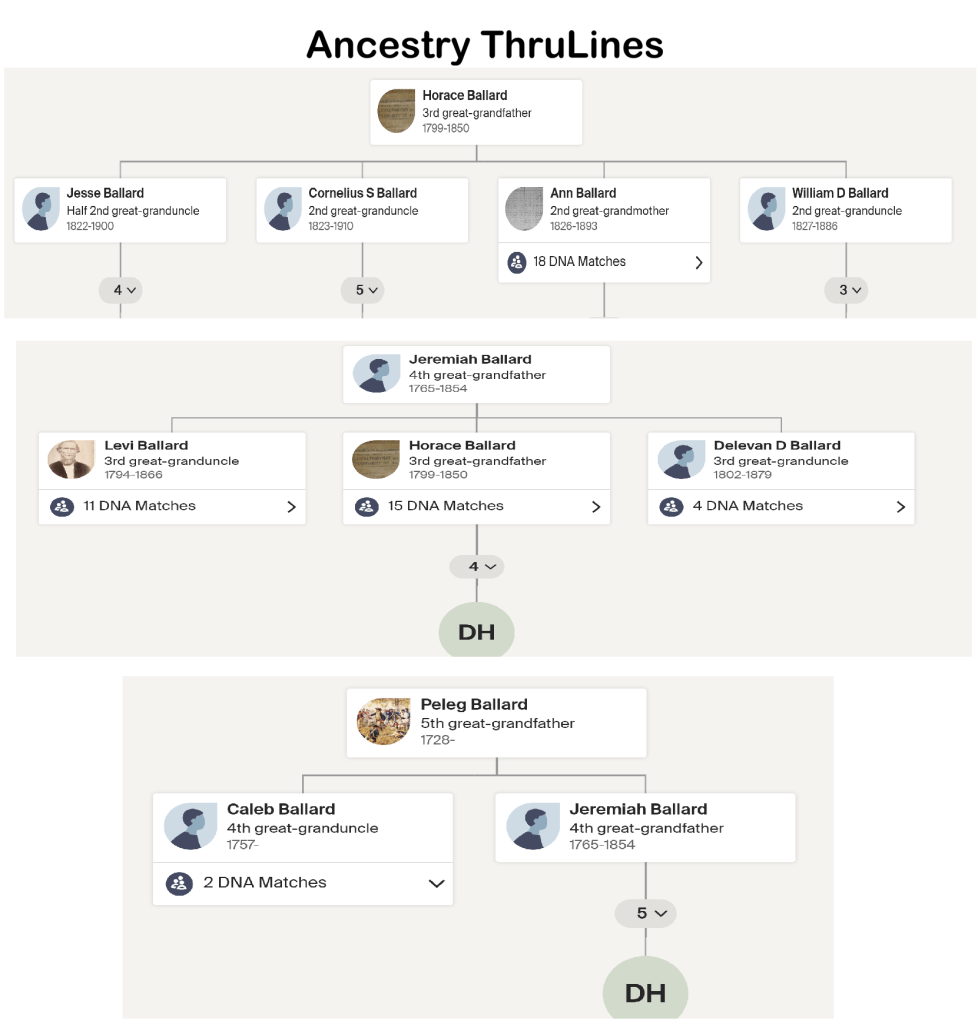
Paper records tell us Jeremiah was Peleg’s son and Horace was Jeremiah’s son.
DNA confirms it.

Multiple descendants of Horace Ballard match descendants of Caleb Ballard and John Ballard (Jeremiah’s brothers), all triangulating back to the Frederickstown Ballard family.

That means Horace does not belong to some other Ballard line.
He belongs here.

Ancestry's ThruLines Suggested Relationships
Ancestry’s ThruLines Suggested Relationships

Why This Matters

There is:

  • No will naming Jeremiah
  • No baptism for Horace
  • No deed saying “my son Jeremiah”

But in early New York, that is normal.

What we do have is something better:

  • Census clusters
  • Tax rolls
  • Land continuity
  • Family geography
  • And DNA

Together they form a solid proof.


Conclusion

Even without a single “smoking gun” document, the evidence shows:

Peleg Ballard (born 1728)
Jeremiah Ballard (born 1765)
Horace Ballard (born 1799)

Sometimes history whispers instead of shouting. You just have to listen long enough.


Sources

  1. 1790 U.S. Census, Frederickstown, Dutchess County, New York
  2. New York Tax Assessment Rolls, Frederickstown, Dutchess County, 1799–1803
  3. 1800 U.S. Census, Frederickstown, Dutchess County, New York
  4. Ibid., Peleg Ballard household
  5. 1810 U.S. Census, Frederickstown, Dutchess County, New York
  6. Ibid., Jeremiah Ballard household
  7. Autosomal DNA triangulation between descendants of Horace Ballard and descendants of Caleb and John Ballard (private test data)

Martin V. Lacy (1833–1904)

Martin V. Lacy was born in September 1833 in Le Ray (often recorded as Leray), Jefferson County, New York. He was the son of Erastus Lacy (1790–1856) and Florilla Billings (1793–1860). Early census and family records place him in Jefferson County during his childhood years, where he lived among several siblings, including Jane, Julia, Milo, and others.¹

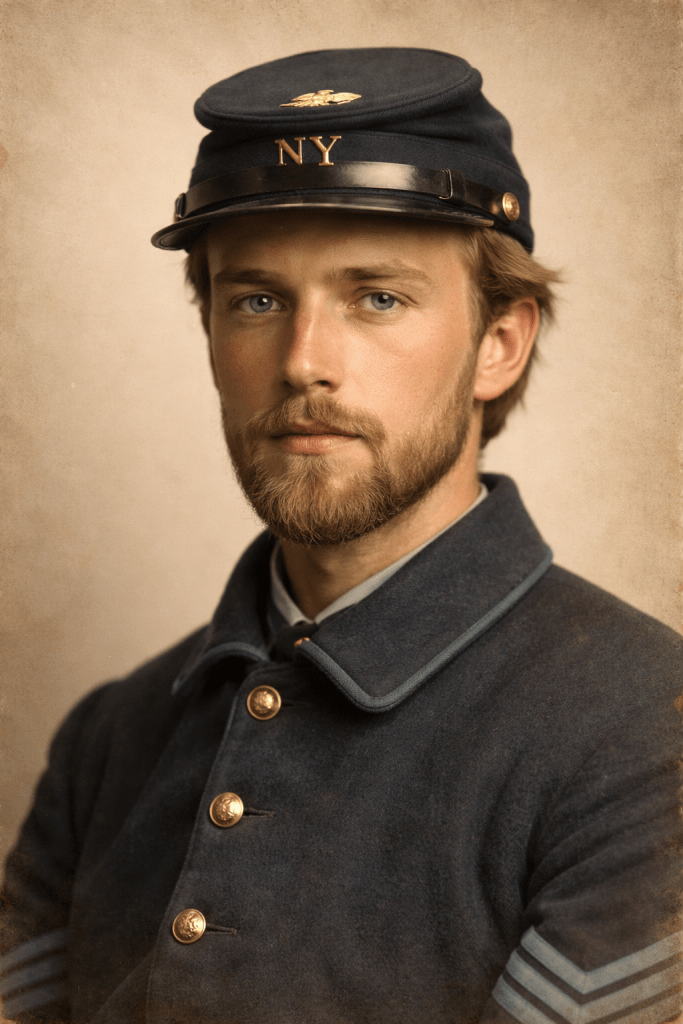
On 28 November 1855, Martin married Henrietta O’Dell (1838–1865) in Genesee County, Michigan.² By 1860, he was residing in Brownville, Jefferson County, New York, where he appeared in the federal census with his occupation listed as farmer.³ A military description recorded in August 1862 described him as having blue eyes, sandy hair, a light complexion, and a height of five feet eleven inches.⁴

Image generated by ChatGPT of Martin Lacy based on his military description.

Martin served in the American Civil War. He enlisted in August 1862 with the 35th New York Infantry, Company I, and later served with the 80th New York Infantry, Company H, during 1863.⁵ Military records place him in Watertown and Albany, New York, during his service, and a residence record dated 1 July 1863 lists him in Fabius, New York.⁶

Martin and Henrietta had several children: Adelbert Lacy, born in November 1859 in Michigan; Helen Mae Lacy, born 3 June 1860 in Brownville, New York; and Fred Lacy, born 12 December 1860 in Michigan.³ Henrietta Lacy died in 1865 in Charles City, Virginia.⁷

On 25 March 1866, Martin married Nancy J. Whitney (1843–1906) in Taymouth Township, Saginaw County, Michigan.⁸ The couple settled in Michigan, where Martin appeared regularly in state and federal census records. Their children included Emma Lacy (born 1866), Alice Lacy (born 1 June 1869 in Montrose, Genesee County), Mary Belle Lacy (born 13 August 1875), and William Henry Lacy (born 26 May 1878).⁹

By 1870, Martin was living in Montrose, Genesee County, Michigan, and by the mid-1870s he had acquired land in Kawkawlin Township, Bay County, Michigan, as documented in federal land records dated 1 August 1874.¹⁰ Census records from 1880 through 1900 consistently place him in Kawkawlin Township, where he was listed as married and head of household.¹¹

Throughout his life, Martin experienced the deaths of numerous family members, including his parents, siblings, and children Fred (1883) and Emma (1897).¹² He remained in Bay County into the early twentieth century.

Martin V. Lacy died on 8 August 1904 in Garfield Township, Bay County, Michigan. His death certificate records the cause of death as cardiac disease.¹³ He was seventy years old at the time of his death.


Sources

  1. U.S. Federal Census, 1860; Brownville, Jefferson County, New York.
  2. Michigan, County Marriage Records, 1822–1940, Genesee County, marriage of Martin V. Lacy and Henrietta O’Dell, 28 November 1855.
  3. U.S. Federal Census, 1860; Brownville, Jefferson County, New York.
  4. New York, Civil War Muster Roll Abstracts, 1861–1900, description dated 20 August 1862.
  5. U.S. Civil War Soldier Records and Profiles; service with 35th New York Infantry, Company I, and 80th New York Infantry, Company H.
  6. New York, U.S., Compiled Census and Census Substitutes Index, 1790–1890.
  7. Michigan, Death Records, 1867–1950; death of Henrietta (O’Dell) Lacy, 1865.
  8. Michigan, County Marriages, 1822–1940; marriage of Martin V. Lacy and Nancy J. Whitney, 25 March 1866.
  9. Michigan, U.S., Birth Records, 1867–1914; Lacy family entries.
  10. U.S. General Land Office Records, 1776–2015; land patent, Kawkawlin Township, Bay County, Michigan, 1 August 1874.
  11. U.S. Federal Census, 1870, 1880, 1900; Michigan State Census, 1884, 1894; Kawkawlin Township, Bay County, Michigan.
  12. Michigan, Death Records and U.S., Find A Grave Index.
  13. Michigan, Death Records, 1867–1950; death certificate of Martin V. Lacy, 8 August 1904.

Nathaniel Foster (1793-1870)

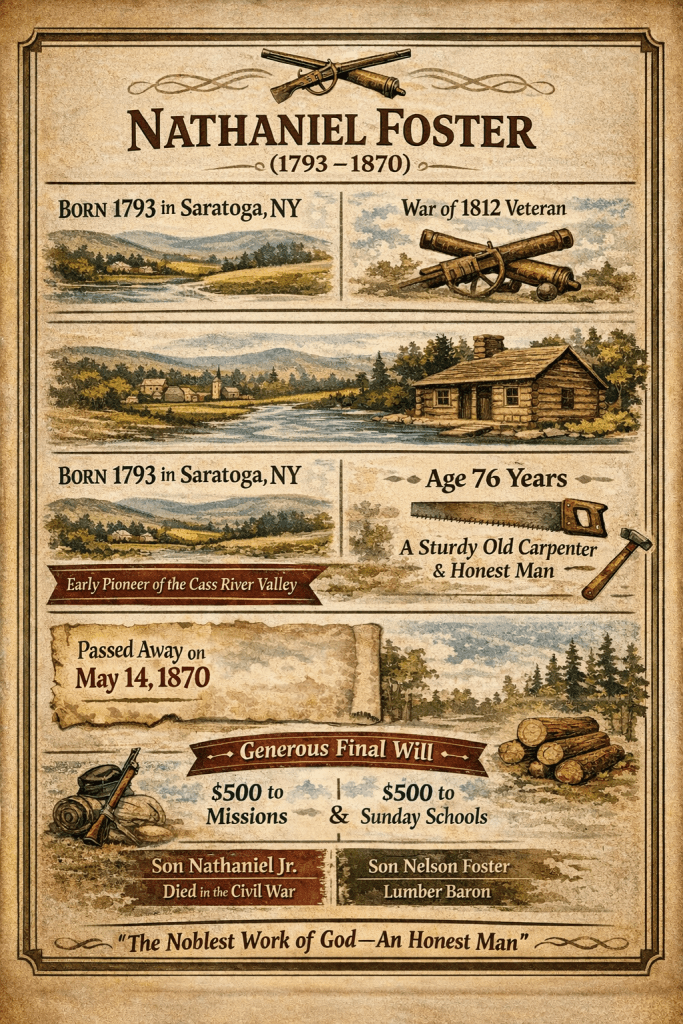
Nathaniel Foster was my 4th great-grandfather — and the more I learn about him, the more I realize how deeply his life was woven into the early fabric of Michigan.

Let’s clear up one thing right away: Nathaniel is not the son of Lemuel Foster and Dolly Davis. Despite what many online trees suggest, their family had twelve children — and none were named Nathaniel. Dolly’s 1849 probate record lists nine surviving children by name, and Nathaniel isn’t among them. He lived until 1870, so if he were her son, he should absolutely appear in that record. He doesn’t. This is one of those cases where the paper trail tells a clearer story than assumptions.

Born in 1793 in Saratoga, New York, Nathaniel served in the War of 1812 as a teenager. He wasn’t a general or a hero in the history books, but he stood up when his country called.

After the war, he married Mary Moore and started a family that would eventually include ten children. In the 1830s, they moved west and settled along the Cass River in Michigan — a true frontier at the time. Nathaniel was one of the earliest settlers in the region, carving out a life in what would become Bridgeport and Midland.

He lived to be 76 years and 10 months old, passing away on May 14, 1870, at the home of his daughter Mrs. Braly in Tittabawassee Township. According to his obituary in the Saginaw Daily Courier, he was remembered as a “sturdy old carpenter,” a “hospitable citizen,” and “the noblest work of God — an honest man.”

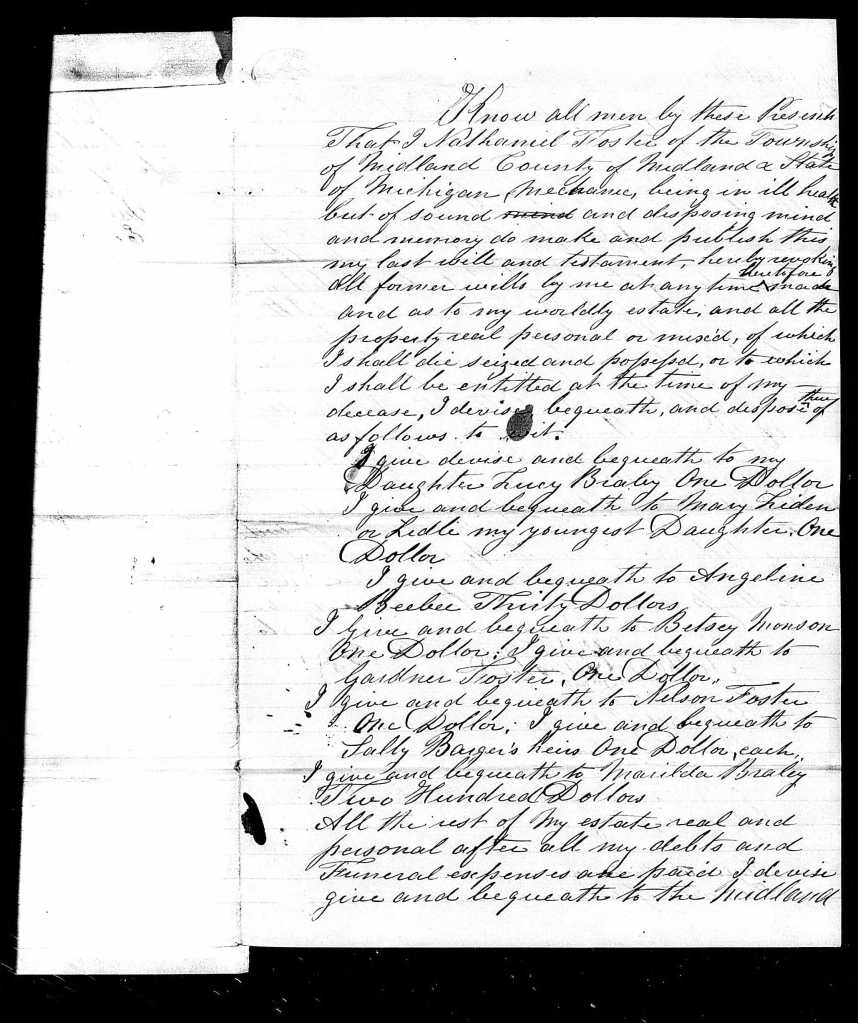
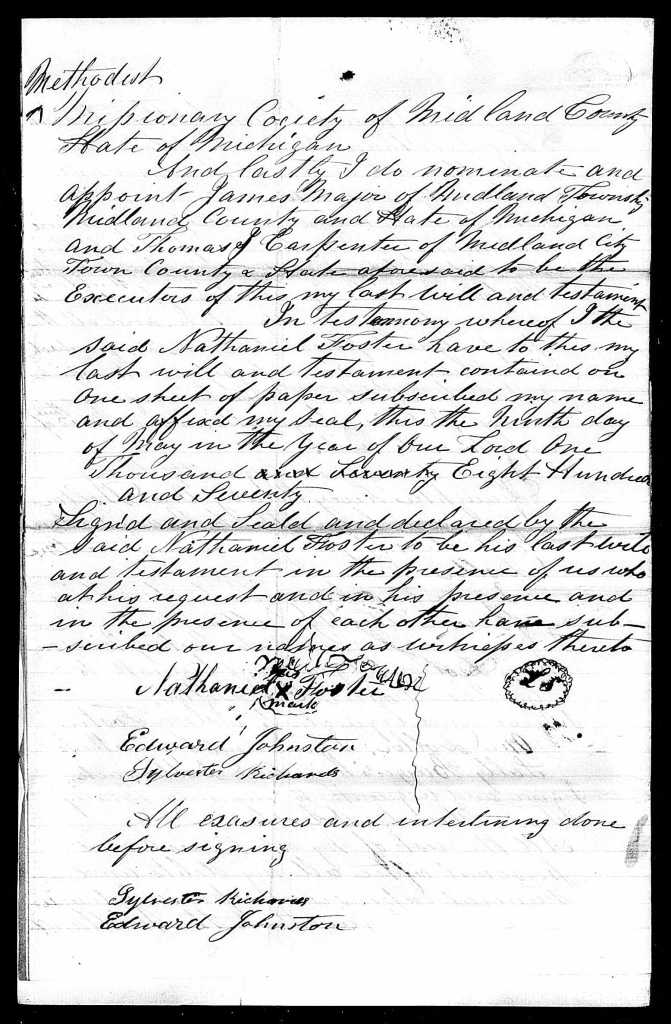
His will, written just days before his death, reflects both practicality and generosity. He left one dollar each to his older children, having “divided to them his living” earlier in life. He gave $200 to his daughter Marietta Braly for her care during his final illness, and donated $500 to missions and another $500 to Sunday schools — a clear reflection of his faith and values.

Page 1 of Nathaniel Foster’s Will
Page 2 of Nathaniel Foster’s Will

Nathaniel’s legacy lives on not just in his descendants, but in the land he helped settle and the stories he passed down. One of his sons, Nelson Foster, became a legendary lumberman in the Saginaw Valley — known for his strength, humor, and skill. Another son, Nathaniel Jr., died fighting for the Union in the Civil War, reportedly shouting “Give me liberty or give me death” as he fell.

These aren’t just names on a family tree. They’re people who lived, worked, fought, and loved — and whose choices shaped the lives of everyone who came after them.