David Stiles (1799–1872) of New Hampshire and Vermont

David Stiles, sometimes recorded as David Styles, was born on 26 August 1799 in Milford, Hillsborough County, New Hampshire, the son of David Stiles and Mary Towne.¹ He spent his early life in New Hampshire but relocated to Vermont as a young adult, where he remained for the rest of his life and where most surviving records documenting his life were created.

Establishment in Vermont

By 1830, David Stiles was living in Brookfield, Orange County, Vermont. In that census, he was enumerated immediately before Abraham Smith, his father-in-law.² Because early census schedules were recorded in geographic order, this proximity strongly supports the identification of David Stiles as the husband of Eliza Smith during this period and places him squarely within the Smith family’s local network.

David continued to reside in central Vermont over the following decades. Although his surname appears with variant spellings in the records, his residence, occupation, and family associations remain consistent.
Marriage to Eliza Smith

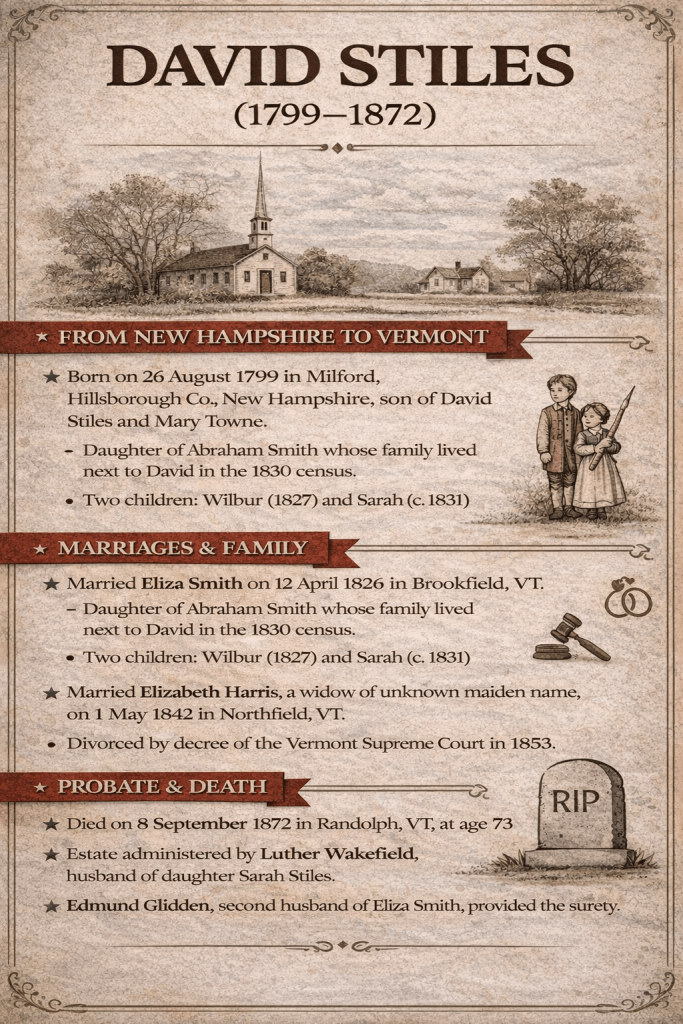
David Stiles married Eliza Smith on 12 April 1826 in Brookfield, Vermont.³ Eliza was the daughter of Abraham Smith. The couple had exactly two children:

  • Wilbur F. Stiles, born 16 March 1827
  • Sarah M. Stiles, born about 1831⁴

No evidence has been found of additional children.

No divorce record has been located for David Stiles and Eliza Smith. However, Eliza clearly left David before 1840. She married Edmund Glidden on 23 March 1840, establishing that her marriage to David had ended by that date.⁵

Edmund Glidden later appears as a surety in probate material associated with David Stiles’s estate. This connection reinforces the conclusion that David Stiles and Eliza Smith were formerly married and shared children, despite the absence of a surviving divorce record.

Marriage to Elizabeth Harris and Divorce

On 1 May 1842, David Stiles married Elizabeth Harris in Northfield, Washington County, Vermont.⁶ The marriage record identifies her as “Mrs. Elizabeth Harris,” indicating that Harris was a married surname and that she had been previously married. Her maiden name has not yet been identified.

This designation helps explain an 1840 census entry in which Elizabeth Harris appears as the named head of household in Northfield, Vermont.⁷ While census schedules of this period typically list male householders, women were sometimes recorded when they controlled or managed the household, were widowed, or were living independently. Her appearance as head of household is therefore consistent with her marital history.

David Stiles and Elizabeth Harris were divorced by decree of the Vermont Supreme Court in April 1853.⁸ Contemporary newspaper notices confirm the divorce and place it firmly within the known timeline of David’s life.

Later Marriages

Following his divorce from Elizabeth Harris, David married Angeline Poole on 29 November 1853 in Northfield.⁹ Angeline died in 1868.

David married for the final time on 7 November 1870 in Williamstown, Vermont, to Melissa E. Davenport.¹⁰ This marriage record identifies the groom as 70 years old, born in New Hampshire, a farmer by occupation, and the son of David Stiles. These details align precisely with David Stiles Jr. (1799–1872) and distinguish him from another, younger Vermont-born man of the same name living in Northfield at the same time.

Census Records and Men of the Same Name

The 1870 census for Northfield, Vermont, contains entries for two men named David Stiles (or Styles).¹¹ One is younger and Vermont-born; the other is older and consistent with a New Hampshire birth in 1799. When age, birthplace, occupation, marital history, and probate evidence are considered together, the older individual can be confidently identified as David Stiles Jr.

The presence of more than one man of the same name in the same town highlights the importance of evaluating census records alongside other documents rather than relying on any single source in isolation.

Death and Probate

David Stiles died on 8 September 1872 in Randolph, Orange County, Vermont, at the age of 73.¹² His death record lists his occupation as farmer and gives the cause of death as consumption. Probate records name Luther Wakefield, husband of David’s daughter Sarah Stiles, as administrator of the estate.¹³ This appointment confirms the established family relationships and links David’s early and later life through consistent documentary evidence.

Conclusion

Although the life of David Stiles presents challenges common to nineteenth-century research—including surname variations, multiple marriages, and contemporaries of the same name—the surviving records form a coherent and well-supported narrative. Census proximity to Abraham Smith, the documented marriage to Eliza Smith and their two children, Eliza’s remarriage by 1840, a court-ordered divorce from Elizabeth Harris, clearly identified later marriages, and probate administration by known relatives together establish the life course of David Stiles Jr. (1799–1872).


Sources

  1. New Hampshire birth records, Milford, Hillsborough County, 1799.
  2. 1830 U.S. census, Brookfield, Orange County, Vermont.
  3. Vermont marriage records, Brookfield, Orange County, 12 April 1826.
  4. Vermont vital and census records for Wilbur F. Stiles and Sarah M. Stiles.
  5. Vermont marriage, Eliza Smith to Edmund Glidden, 23 March 1840 (date preserved through derivative sources).
  6. Vermont marriage records, Northfield, Washington County, 1 May 1842.
  7. 1840 U.S. census, Northfield, Washington County, Vermont.
  8. Vermont Supreme Court divorce notices, April 1853.
  9. Vermont marriage records, Northfield, Washington County, 29 November 1853.
  10. Vermont marriage records, Williamstown, Orange County, 7 November 1870.
  11. 1870 U.S. census, Northfield, Washington County, Vermont.
  12. Vermont death records, Randolph, Orange County, 8 September 1872.
  13. Vermont probate records, Orange County, estate of David Stiles.
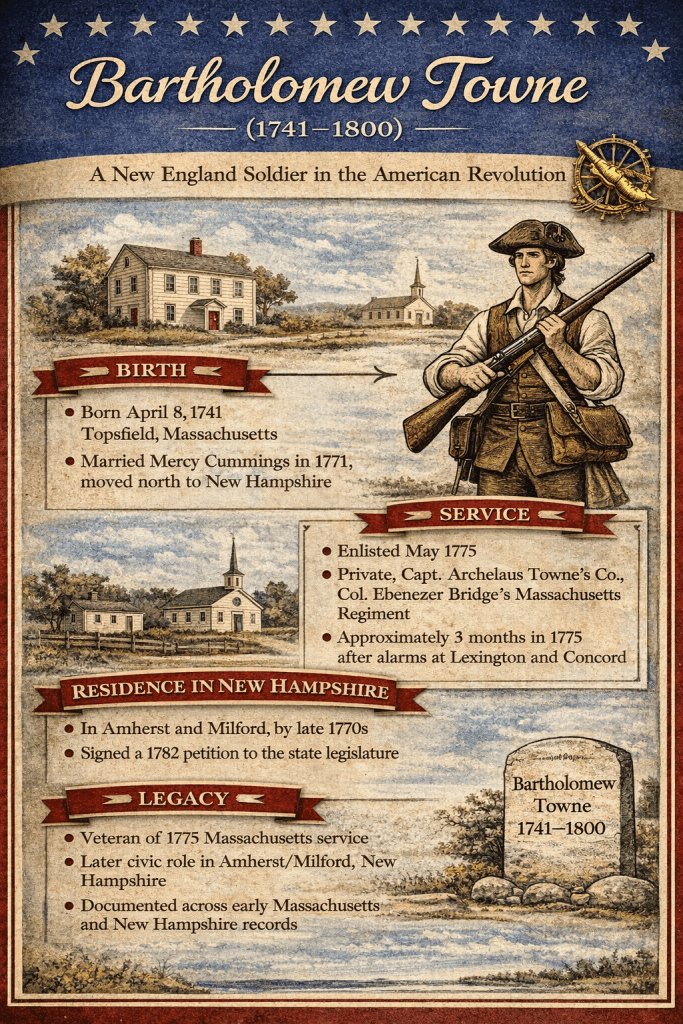
Bartholomew Towne (1741–1800)

Bartholomew Towne’s Revolutionary War service is documented in both Massachusetts and New Hampshire records, placing him among the many New England men whose military and civic lives crossed colonial and early state boundaries. His service appears in compiled Massachusetts rolls from 1775 and later records from New Hampshire, reflecting the fluid movement of families and militia obligations during the war years.¹

Born in Massachusetts and later settled in New Hampshire, Towne’s life illustrates how Revolutionary service was often rooted in local communities while still contributing to the broader Continental effort.


Early Life in Massachusetts

Bartholomew Towne was born on 8 April 1741 in Topsfield, Essex County, Massachusetts, the son of Elisha Towne and Mercy Foster.² He grew up in a well-established Massachusetts family and reached adulthood during the years of mounting political and military tension between the colonies and Great Britain.

On 3 October 1771, he married Mercy Cummings in Andover, Massachusetts.³ Within a few years, the couple relocated northward into what would become Hillsborough County, New Hampshire, part of a broader pattern of late-colonial migration from coastal Massachusetts into interior New England.⁴


Revolutionary War Service

Bartholomew Towne’s military service is documented in Massachusetts Revolutionary War records. He appears as a private in Captain Archelaus Towne’s company, part of Colonel Ebenezer Bridge’s 27th Massachusetts Regiment.⁵ According to the compiled rolls, he enlisted in May 1775 and served approximately three months, with his service recorded on a muster roll dated 1 August 1775.⁶

Additional records show Towne received advance pay and later an order for a bounty coat, a benefit commonly issued to soldiers who met required service terms during the early months of the war.⁷ These details firmly place his service in the critical opening phase of the Revolution, following the alarms of April 1775 and the mobilization of Massachusetts militia forces.

Towne’s service was short-term, a pattern typical of Massachusetts soldiers in 1775, many of whom served limited enlistments before returning home or resuming civilian life.⁸


Residence and Civic Activity in New Hampshire

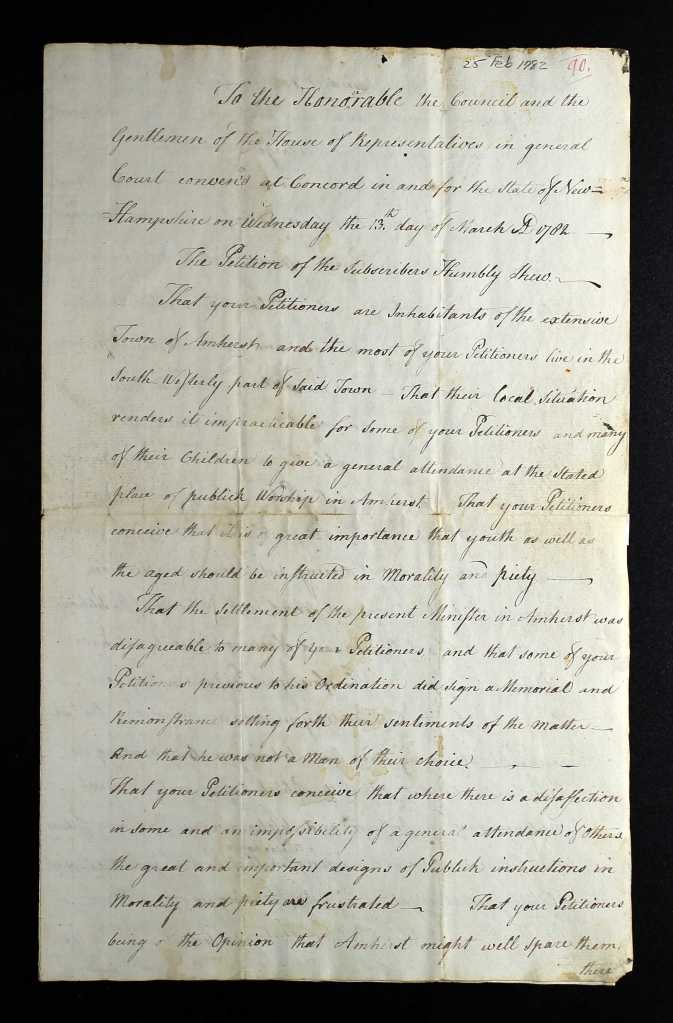
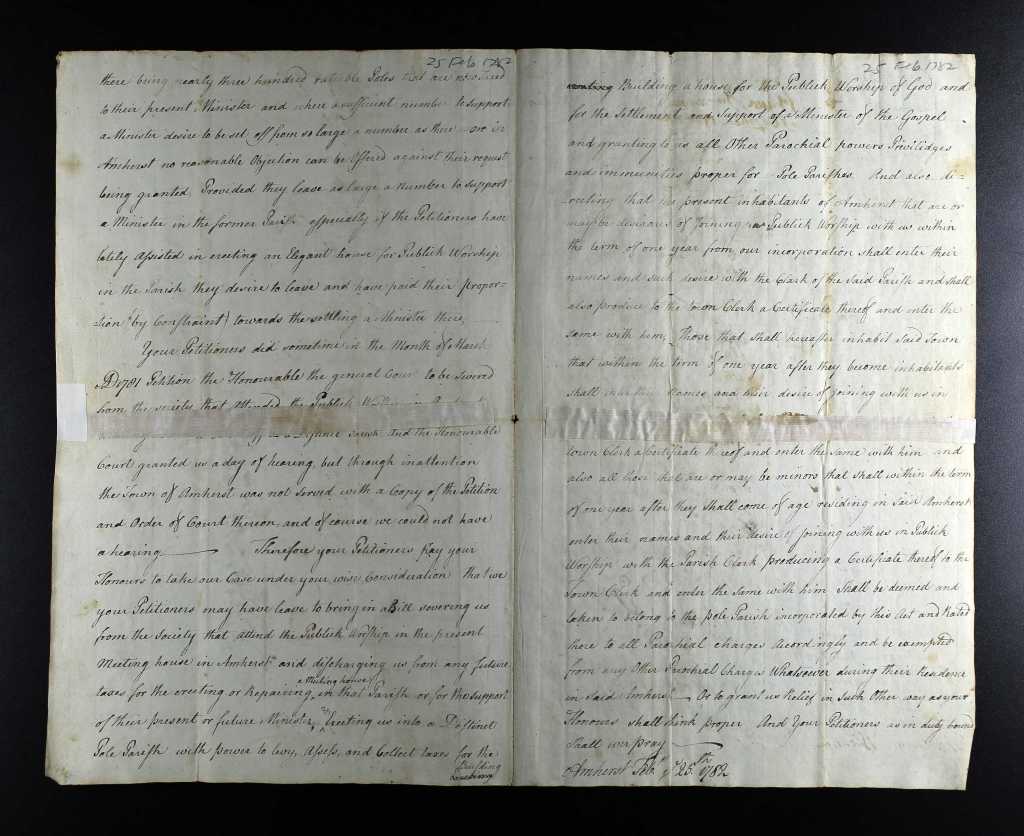
By the late 1770s, Bartholomew Towne was living in Amherst and Milford, Hillsborough County, New Hampshire. His presence there is confirmed not only through vital and census records but also through a surviving 1782 petition addressed to the New Hampshire legislature.⁹

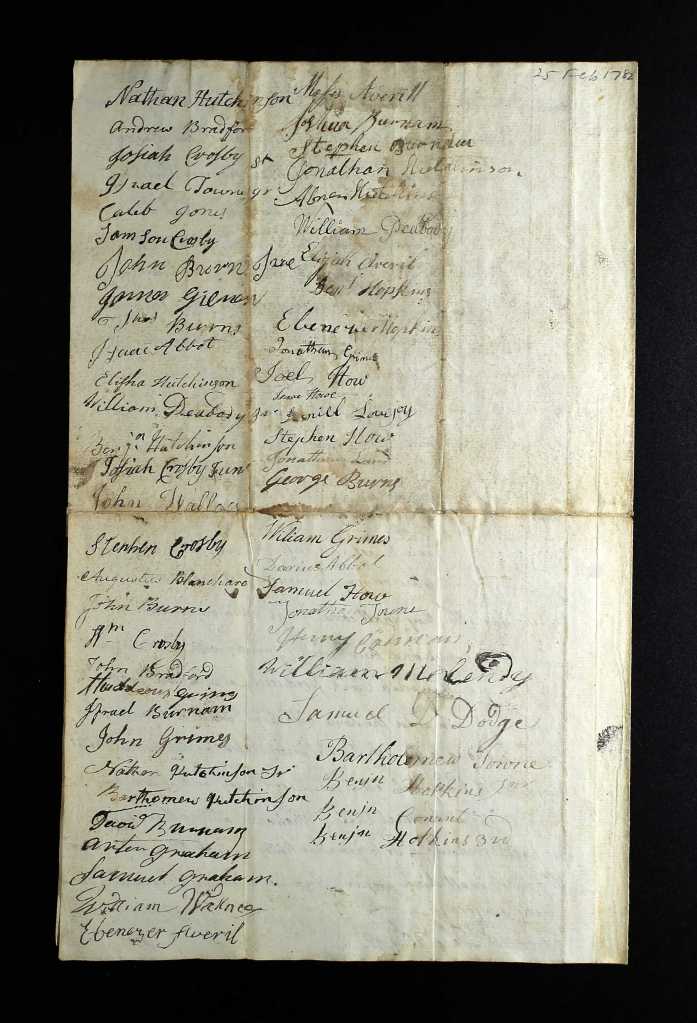
That petition, signed by Towne and other inhabitants, concerned local religious organization and the establishment of public worship in the southern part of Amherst. Towne’s signature appears among the residents advocating for community governance and religious instruction, demonstrating his continued civic engagement after the war.¹⁰

This document places Towne squarely within the post-war civic life of New Hampshire and confirms his identity as the same man who earlier served in Massachusetts military units.


Later Life and Death

Bartholomew Towne appears in the 1790 federal census in Hillsborough County, New Hampshire, confirming his residence and household following the Revolutionary period.¹¹ He died in 1800 in Milford, Hillsborough County, New Hampshire.¹²

His life spanned the colonial era, the Revolutionary War, and the early years of the United States, with both his military service and later civic participation documented in contemporary records.


Assessing the Evidence

Bartholomew Towne’s Revolutionary War service rests on a solid evidentiary foundation. His enlistment and service in 1775 are supported by Massachusetts compiled rolls, including muster and pay records, while his later residence and civic activity in New Hampshire are corroborated by petitions and census data.¹³

The continuity of name, timeframe, and location across these records supports a confident identification without requiring speculative connections or later pension testimony.


Conclusion

Bartholomew Towne was not a long-term Continental soldier, but he was part of the first wave of New England men who answered the call in 1775. His service in a Massachusetts regiment during the opening months of the war, followed by his later civic role in New Hampshire, reflects the lived experience of many Revolutionary participants whose contributions were essential but modestly recorded.

By tracing his life across state lines and grounding his story in contemporary records, we preserve an accurate and meaningful account of his role in the Revolutionary generation.


Notes

  1. Massachusetts Soldiers and Sailors of the Revolutionary War; U.S. Revolutionary War Rolls, 1775–1783.
  2. Topsfield, Massachusetts, town birth records; compiled Massachusetts vital records.
  3. Massachusetts marriage records, Andover, 1771.
  4. Hillsborough County, New Hampshire, settlement patterns and family migration.
  5. Massachusetts Revolutionary War rolls, Capt. Archelaus Towne’s Company, Col. Ebenezer Bridge’s Regiment.
  6. Muster roll dated 1 August 1775, Massachusetts Revolutionary records.
  7. Massachusetts pay and bounty records, 1775.
  8. Massachusetts militia enlistment practices, early Revolutionary period.
  9. New Hampshire legislative petition, 1782, signed by Bartholomew Towne and others Bartholomew Towne on petition.
  10. Petition text and signatures, page 3, identifying Towne among Amherst inhabitants Bartholomew Towne on petition.
  11. 1790 U.S. Federal Census, Hillsborough County, New Hampshire.
  12. New Hampshire death records and compiled family histories.
  13. Correlation of military, civic, and residential records following genealogical proof standards.

Benjamin Byam

Benjamin Byam (1733–1795) lived a life shaped by steady service, devotion to family, and a willingness to step forward when history called. Born in Chelmsford, Massachusetts, on November 29, 1733, he came from early colonial stock. Like many families of that era, the Byams built their lives through practical skill and community responsibility. Benjamin learned the trade of a cooper, crafting the barrels that kept New England’s farms and merchants supplied.

His first experience in military service came long before the Revolution. In 1754, he joined Captain Melvin’s company during the French and Indian War, gaining the discipline and leadership that would later define his role in the fight for independence. By 1760, he had risen to 1st Lieutenant. That same year, he married Mary Keyes, and together they raised nine children — a family line that would spread across New England.

By the spring of 1775, Benjamin was living in Temple, New Hampshire. When word arrived on April 19 that British troops were advancing on Concord, he joined fifty-five of his neighbors who set out at once. Though they reached the scene after the first shots at the North Bridge, they joined the long pursuit of the British back toward Cambridge, marching through the day and into the night. Benjamin remained with the forces encamped there for eight months, supplying his own blanket — one of those small but telling sacrifices made by ordinary men who found themselves doing extraordinary things. He later served again in 1777 during the march toward Bennington.

Benjamin spent his final years in Randolph, Vermont, where he died on November 22, 1795. His life reflects the kind of legacy that endures: a craftsman, a soldier, a father, and a man whose quiet courage helped shape the nation his descendants continue to remember.