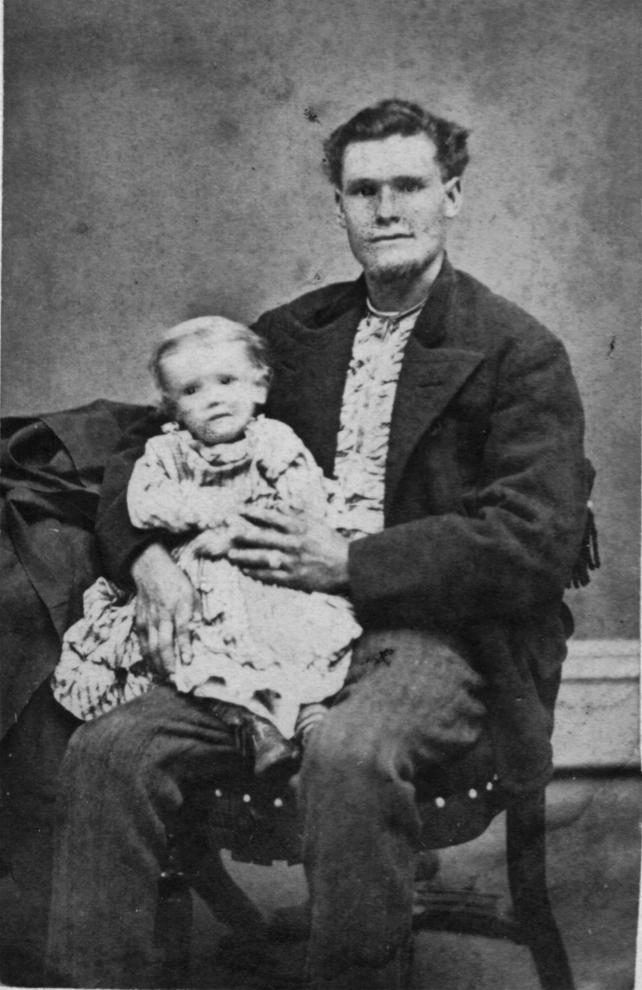
Wesley Weldon (1807–1880)

Early Life and Family

Wesley Weldon was born in 1807 in Glastonbury, Hartford County, Connecticut, the son of Wareham Weldon and Permelia Andrews. His mother died in Glastonbury in 1817, when Wesley was about ten years old.¹

He married Emeline Munson, also a native of Connecticut. By 1830, Wesley was living in Franklin, Delaware County, New York.² Over the following decade, the family moved west. By the early 1830s, they were connected with Michigan, and their daughter Frances Marie Weldon was born about 1833.³

By 1840, Wesley Weldon was residing in Saginaw, Saginaw County, Michigan, placing him among the early settlers of the region.⁴


Settlement in Saginaw County

By 1850, Wesley and his family were living in Bridgeport Township, Saginaw County, where he appeared in the federal census as a farmer.⁶ He continued to be recorded in Bridgeport Township in subsequent census years, including 1860 and 1870, with his post office listed as Bridgeport.⁷
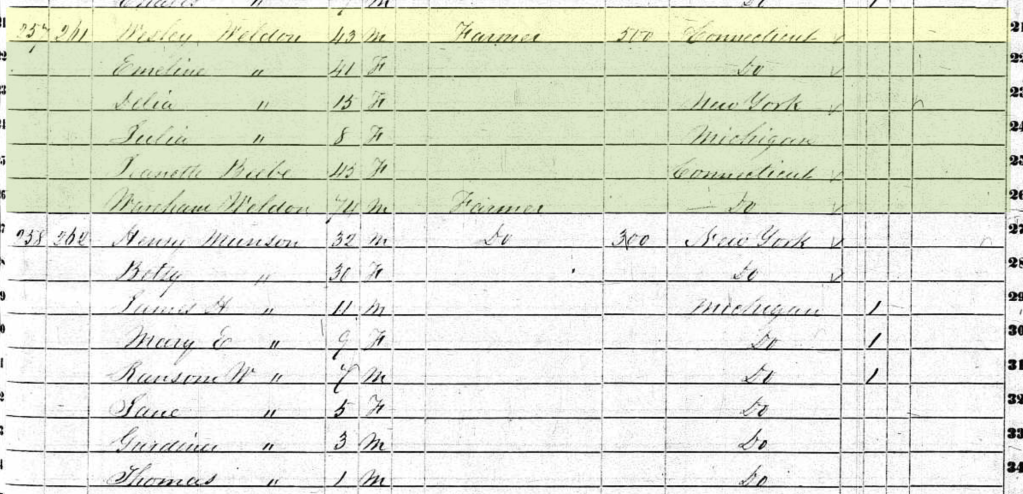
1850 US Census showing Wesley Weldon household
1850 US Census for Bridgeport, Saginaw County, Michigan. Wesley Weldon is enumerated next to his brother-in-law Henry Munson.

One record places him in East Saginaw in January 1862, indicating that he traveled into the city at times, likely for business or personal matters, though no specific purpose is documented.⁸ By 1880, Wesley was again enumerated in Bridgeport Township, listed as a widower.⁹

Wesley and Emeline had at least three daughters who survived to adulthood: Frances Marie, Adelia, and Julia. Frances Marie died in 1872. Emeline Munson Weldon died in Bridgeport Township on 4 March 1876. Wesley did not remarry.¹⁰


Later Years

By the late 1870s, Wesley Weldon was in his early seventies. Contemporary newspapers later described him as an “old resident” of Saginaw County, stating that he had lived in the area for more than forty years.¹¹ His occupation continued to be identified as farming.

Despite residing in Bridgeport Township, records indicate that Wesley traveled into the city of Saginaw, as reflected by the location associated with the events surrounding his death.


Discovery in the Saginaw River

On 1 October 1880, the body of Wesley Weldon was recovered from the Saginaw River within the city of Saginaw.¹¹ Newspaper accounts indicate that family members were present in Saginaw at the time of his identification, but the surviving records do not establish a sequence of events involving a prior disappearance or organized search. The evidence supports only that Weldon was found deceased in the river and subsequently identified.
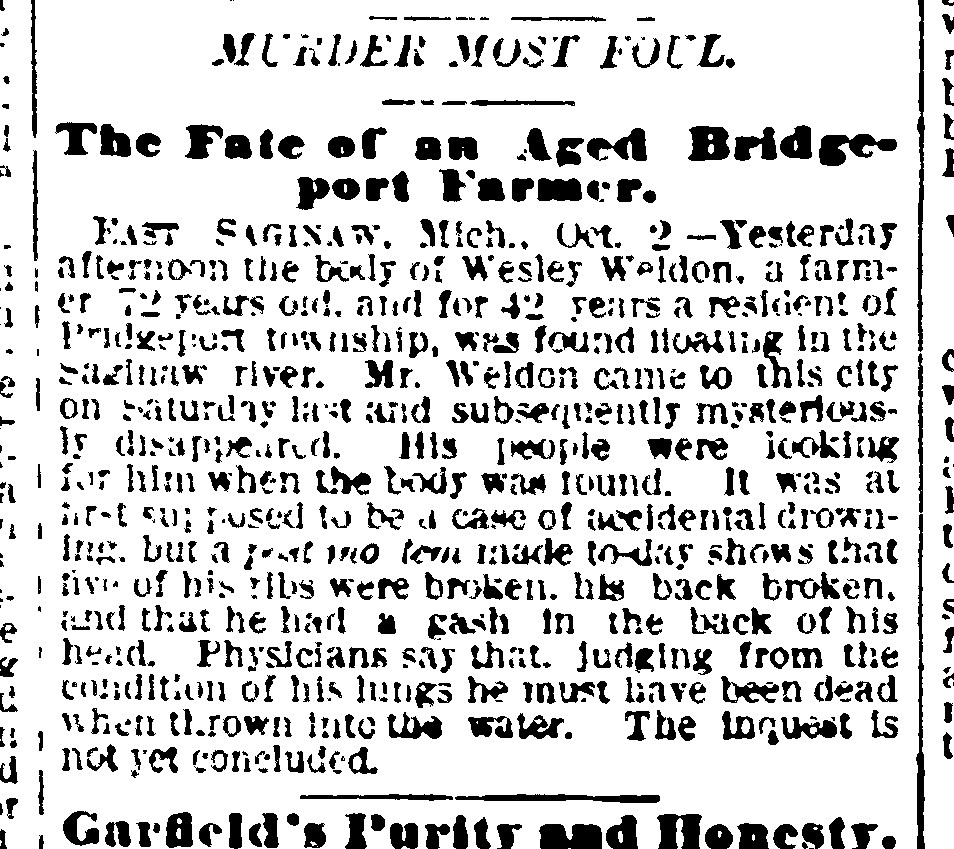
The Detroit News, October 2, 1880

Early newspaper reports described the case as a possible drowning, a preliminary characterization common in river recoveries.¹¹ This assessment was reconsidered following a medical examination.


Coroner’s Inquest and Medical Findings

A coroner’s inquest was held on 2 October 1880. The examining physician documented a contused wound on the back of the head approximately two inches in length, five broken ribs—some fractured into multiple pieces—and a fracture of the spinal column at the middle of the back.¹²

The coroner noted that the head wound showed clotted blood, indicating that it occurred before death. Examination of the lungs led the physician to conclude that Weldon had not breathed after entering the water, and that death occurred prior to the body being placed in the river.¹²

Based on these findings, the initial drowning explanation was rejected. Newspapers subsequently described the case as a homicide.¹³ No suspect was identified, and no further legal proceedings are documented.
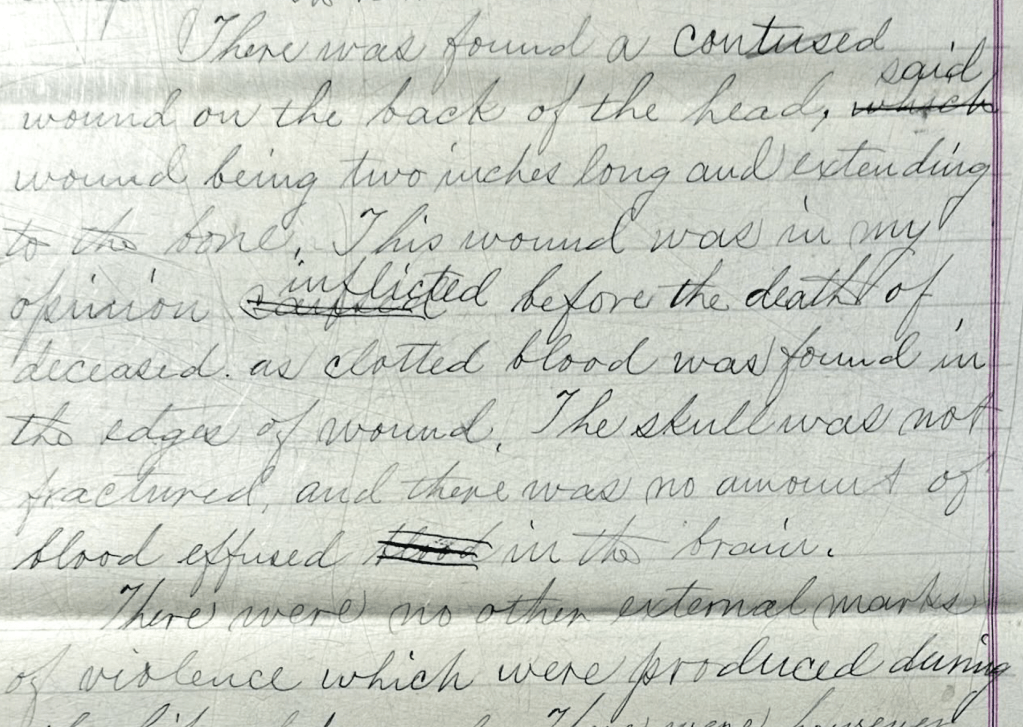
Part of page 1 of Wesley Weldon's Coroner's Inquest.
Part of page 1 of Wesley Weldon’s Coroner’s Inquest. This was found in Record Group 71-131 Saginaw County Clerk records box 8 at Michigan State Archives.

Probate Proceedings

Probate proceedings for Wesley Weldon’s estate were initiated in October 1880 in the Saginaw County Probate Court. Administration was granted, and his surviving daughters were identified as his heirs.¹⁴ The probate records address only the disposition of his estate and do not include discussion of the circumstances of his death.


Conclusion

Wesley Weldon lived most of his adult life in Saginaw County as a farmer and long-term resident of Bridgeport Township. His death in 1880 was determined by medical examination to have occurred prior to his body entering the Saginaw River. Although the evidence ruled out accidental drowning, the death was never resolved, and the identity of the person or persons responsible remains unknown.


Sources

  1. Ancestry profile of Wesley Weldon, citing Glastonbury, Connecticut vital records.
  2. 1830 U.S. Federal Census, Franklin, Delaware County, New York.
  3. Ancestry profile of Wesley Weldon; birth of Frances Marie Weldon.
  4. Ancestry profile of Wesley Weldon; birth of Adelia Weldon.
  5. 1840 U.S. Federal Census, Saginaw, Saginaw County, Michigan.
  6. 1850 U.S. Federal Census, Bridgeport Township, Saginaw County, Michigan.
  7. 1860 and 1870 U.S. Federal Census, Bridgeport Township, Saginaw County, Michigan.
  8. Residence record dated 14 January 1862, East Saginaw, Michigan.
  9. 1880 U.S. Federal Census, Bridgeport Township, Saginaw County, Michigan.
  10. Ancestry profile of Wesley Weldon; deaths of Emeline Munson Weldon and Frances Marie Weldon.
  11. “An Old Farmer Found Drowned,” Detroit Free Press, 1 October 1880.
  12. Coroner’s Inquest for Wesley Weldon, Saginaw County, 2 October 1880.
  13. “A Murder in Saginaw County,” Evening Leader (Pontiac, Michigan), 4 October 1880.
  14. Probate Records of Wesley Weldon, Saginaw County Probate Court, October 1880.
Robert Smith (1864–1947): A Life Shaped by Tragedy

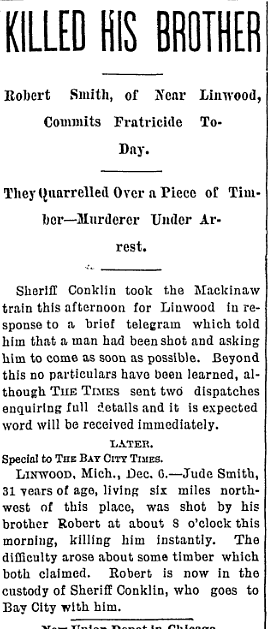
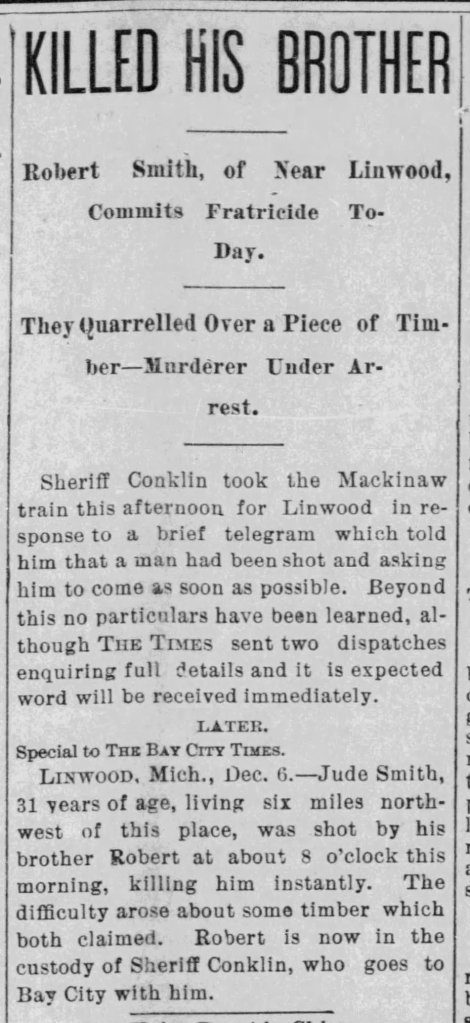
On 6 December 1890, a violent confrontation between two brothers near Linwood in Bay County, Michigan, ended with one man dead and the other facing the gravest criminal charge available under Michigan law. Robert Smith shot and killed his brother, Jude A. Smith, in what newspapers immediately characterized as the culmination of a long-standing family dispute over land and timber.¹ Within days, the case became one of the most closely followed criminal proceedings in Bay County.

The killing of Jude Smith

Early reports placed the shooting in Garfield Township, near Linwood, during an argument concerning ownership and removal of timber. Accounts varied in their details, but the central facts remained consistent: Robert Smith fired a shotgun at close range, killing his brother.² From the earliest coverage through the conclusion of the trial, newspapers referred to the accused almost uniformly as Robert S. Smith.³

The intensity of public interest was evident almost immediately. Smith was arrested, lodged in the Bay County jail, and photographed for inclusion in the local “rogue’s gallery,” an act reported in the press as a matter of routine but revealing the degree to which the case had already entered the public imagination.⁴

The Bay City Times, December 6, 1890.

Pretrial proceedings and public attention

Throughout December 1890 and into early 1891, Bay City newspapers printed frequent updates on the case. These included notices of arraignment, scheduling delays, and speculation regarding the defense strategy.⁵ At various points, reports suggested that Smith might pursue an insanity defense, though these references appear largely in the context of courtroom rumor rather than formal pleadings.⁶

The coverage also reflected the spectacle of the proceedings themselves: crowded courtrooms, lengthy jury selection, and the presence of spectators from Linwood and surrounding communities who were familiar with the Smith family.⁷

Trial and conviction

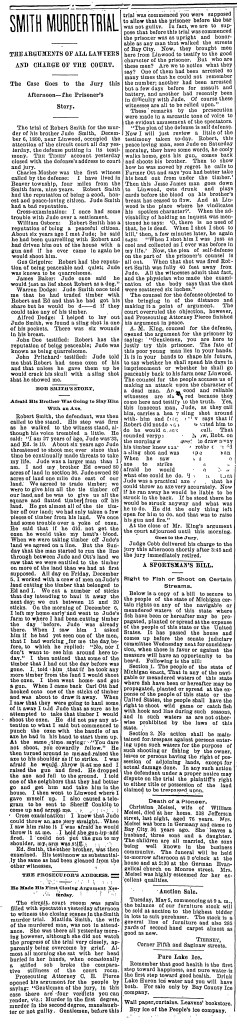
Robert Smith’s trial took place in the spring of 1891. Newspaper accounts summarized testimony from witnesses present at the scene, law enforcement officers, and medical professionals.⁸ Despite arguments advanced by the defense, the jury returned a verdict of guilty of murder in the first degree.⁹

The Bay City Daily Tribune, May 2, 1891.

On 12 May 1891, Smith was sentenced to life imprisonment. Several newspapers printed a statement attributed to him shortly thereafter, in which he denied guilt and attempted to justify his actions as self-defense, framing himself as the victim of prolonged harassment by his brother.¹⁰ The letter provides insight into Smith’s own view of events but does not alter the legal outcome of the case.

Incarceration and release

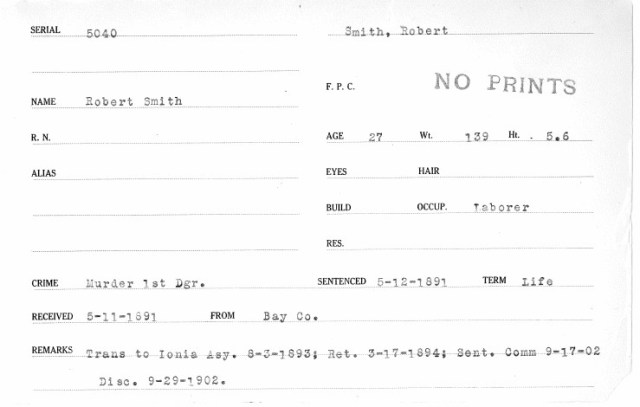
Michigan prison records confirm that Robert Smith was received at the state prison on 11 May 1891 following his conviction in Bay County.¹¹ Although sentenced to life, his incarceration did not remain static. In August 1893, Smith was transferred to the Ionia State Hospital for the Criminally Insane, where he remained for several months before being returned to prison in March 1894.¹²

More than a decade later, his case was reconsidered. In September 1902, Smith was granted a commutation of sentence and formally discharged from custody later that month.¹³ This record is critical, as it establishes that Smith was not imprisoned for life and that his release occurred well before the turn of the century.

Prison card for Robert Smith held at the Michigan Archives

A new life in Washington

Nearly two decades later, Robert Smith appears in Washington State records. On 9 June 1919, a marriage was recorded in Centralia, Lewis County, between Robert T. Smith and Edna Myers.¹⁴ The groom was reported as fifty-five years old, born in Pennsylvania, and entering his second marriage. His occupation was listed as laborer. The record names his father as Abraham T. Smith and gives his mother’s maiden name as Thompson.¹⁵

The use of the middle initial “T” in this record contrasts with the consistent use of “S” in Bay County newspaper coverage. Whether this reflects clerical variation, personal choice, or a deliberate alteration cannot be determined from the surviving records. What can be said is that the Washington marriage record aligns closely with other identifying details associated with the Bay County defendant, including age, birthplace, and parental names.

Death in Tacoma

Robert Smith’s life concluded in Tacoma, Pierce County, Washington. His death certificate records that Robert T. Smith died on 10 February 1947 at the age of eighty-two.¹⁶ His birth date is given as 6 May 1864, with birthplace recorded as Blakerlee, Pennsylvania. At the time of death, he was widowed and retired. He was buried at Oakwood Cemetery in Tacoma.¹⁷

The informant for the death certificate was hospital staff, and several personal details—including parental information—were listed as unobtainable.¹⁸ Nonetheless, the combination of birth date, birthplace, and earlier Washington records strongly suggests continuity between the man who married in Centralia in 1919 and the man who died in Tacoma in 1947.

Minnie, the first wife

The 1919 Washington marriage record explicitly states that it was Robert Smith’s second marriage, confirming the existence of an earlier wife. That woman is known from earlier records as Minnie, though it remains unclear whether this was her legal given name or a familiar nickname. Despite extensive documentation surrounding Robert Smith’s criminal case, imprisonment, and later life, no definitive record has yet been identified that accounts for Minnie’s fate. At present, what became of her remains unknown.

Conclusion

Robert Smith’s life cannot be reduced to a single violent act, yet neither can that act be separated from the years that followed. Convicted of first-degree murder in 1891 and sentenced to life imprisonment, he was later released, relocated across the country, remarried, and lived into old age. The surviving records trace a trajectory from public disgrace to relative obscurity, marked by gaps that resist easy explanation. As with many lives reconstructed from fragmentary sources, some questions remain unanswered—but the outline of the story is now firmly grounded in the historical record.


Notes

  1. Bay City newspapers reporting the killing of Jude A. Smith near Linwood, December 1890.
  2. Contemporary newspaper descriptions of the shooting and its circumstances, December 1890.
  3. Bay City press coverage consistently identifying the accused as Robert S. Smith, 1890–1891.
  4. Newspaper report noting Smith’s photograph taken at the Bay County jail for the rogue’s gallery.
  5. Bay City newspaper reports on arraignment and court scheduling, December 1890–January 1891.
  6. Newspaper references to a possible insanity defense during pretrial proceedings.
  7. Reports describing courtroom crowds and jury selection during early 1891.
  8. Trial testimony summaries published in Bay City newspapers, April–May 1891.
  9. Newspaper accounts of the guilty verdict and sentencing, May 1891.
  10. Published letter attributed to Robert Smith following conviction, May 1891.
  11. Michigan State Prison prisoner index card for Robert Smith, received May 1891.
  12. Prison record noting transfer to Ionia State Hospital and subsequent return.
  13. Prison record documenting commutation and discharge, September 1902.
  14. Lewis County, Washington, marriage record for Robert T. Smith and Edna Myers, 9 June 1919.
  15. Ibid., parental and birthplace information.
  16. Washington State death certificate for Robert T. Smith, Tacoma, 10 February 1947.
  17. Ibid., burial information.
  18. Ibid., informant and missing personal details.

Jude Smith’s legacy

Jude A Smith was born about 1858 in Pennsylvania to parents Abraham Possinger Smith and Emily Rebecca Thompson. Jude is not a direct ancestor – but the brother of my 3rd great-grandmother Rosa Smith.

Jude moved to Bay County Michigan with his family in the 1870’s.  He married Mary Mathilda Lago on October 29, 1887 in Beaver Township, Bay County. Jude and Mathilda had 2 children – Delbert on September 1, 1888 and Almina on May 6, 1890. Tragically, he was murdered by his own brother on December 6, 1890.

Bay City Daily Tribune 1890-12-06-1 clip
Bay City Daily Tribune, December 6, 1890. Page 1

After his murder, Jude’s widow, Mathilda married John F. Streu on July 19, 1891 just a couple of months after her former brother-in-law Robert was convicted of Jude’s murder. She and John would go on to have 3 children of their own – Emma, Carrie and William. John would help raise Jude’s children as in 1900, Delbert and Almina (Mina) were living with him and their mother in Bay Township. However, by 1912, Mathilda marries Horace Rickel in Flint, Michigan.  Mathilda marries a fourth time to Joseph Beech. She dies December 13, 1940 in Midland. I have not yet found evidence of her divorces or record of the last marriage. Her death certificate is the source of the last husband.

So far, I haven’t been able to definitively trace Delbert Smith past the 1900 census. I’m not sure if he moved, died or what.

However, Jude’s daughter Almina – who apparently went by Mina, was married and divorced 3 times. Almina first marries Ralph W. Watson on December 12, 1909 in Saginaw, Michigan. She is living with Ralph and his parents in 1910. They were divorced in Saginaw County on August 8, 1912. It doesn’t indicate who filed for divorce, but the claim of extreme cruelty was the grounds for the divorce.

Screen Shot 2018-03-14 at 11.12.27 AM
Divorce Records of Saginaw County, Michigan.

Almina would marry Elliot Wilson Hart on May 9, 1912 in Essex, Ontario, Canada. – Her son who was named Leroy (Roy) Wilson Hart was born October 1, 1911 in Michigan. So apparently Almina had met Elliot Wilson in early 1911 (or late 1910) and had a fling and eventually convince her second husband to marry her even though she was already married to Ralph. In all likelyhood, Ralph filed for the divorce and made the claim of extreme cruelty since she apparently ran off with another man – having his child and marrying him!

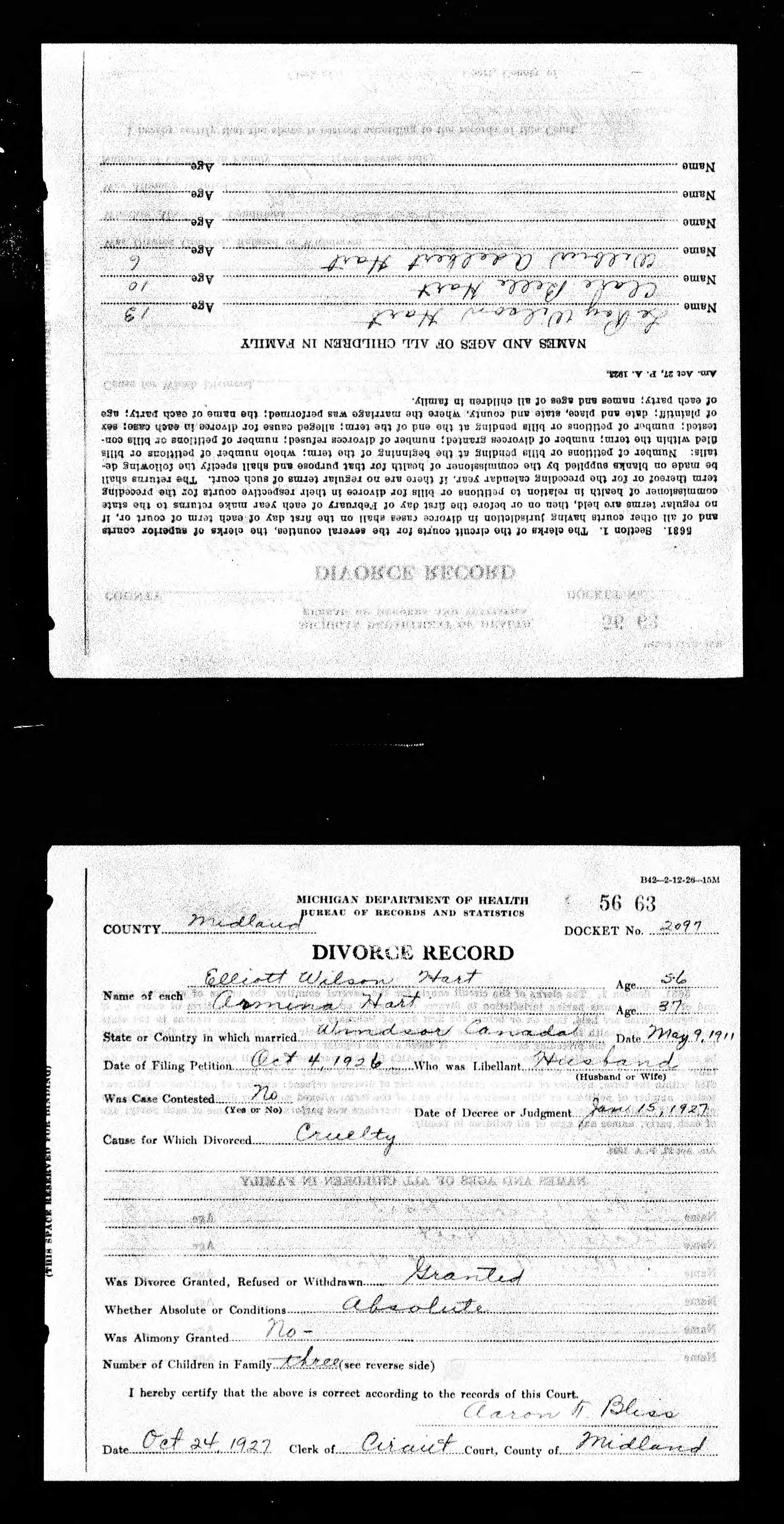
Almina would go on to have 2 other children with Elliot Wilson Hart – Clarabelle born in 1916 and Wilbur Adelbert born in 1918. They lived in Midland, Michigan in 1920. Unfortunately, it didn’t last. Almina and Elliot Wilson were divorced on January 15, 1927 in Midland.

41327_338658-01089
Midland County Michigan Divorce Records.

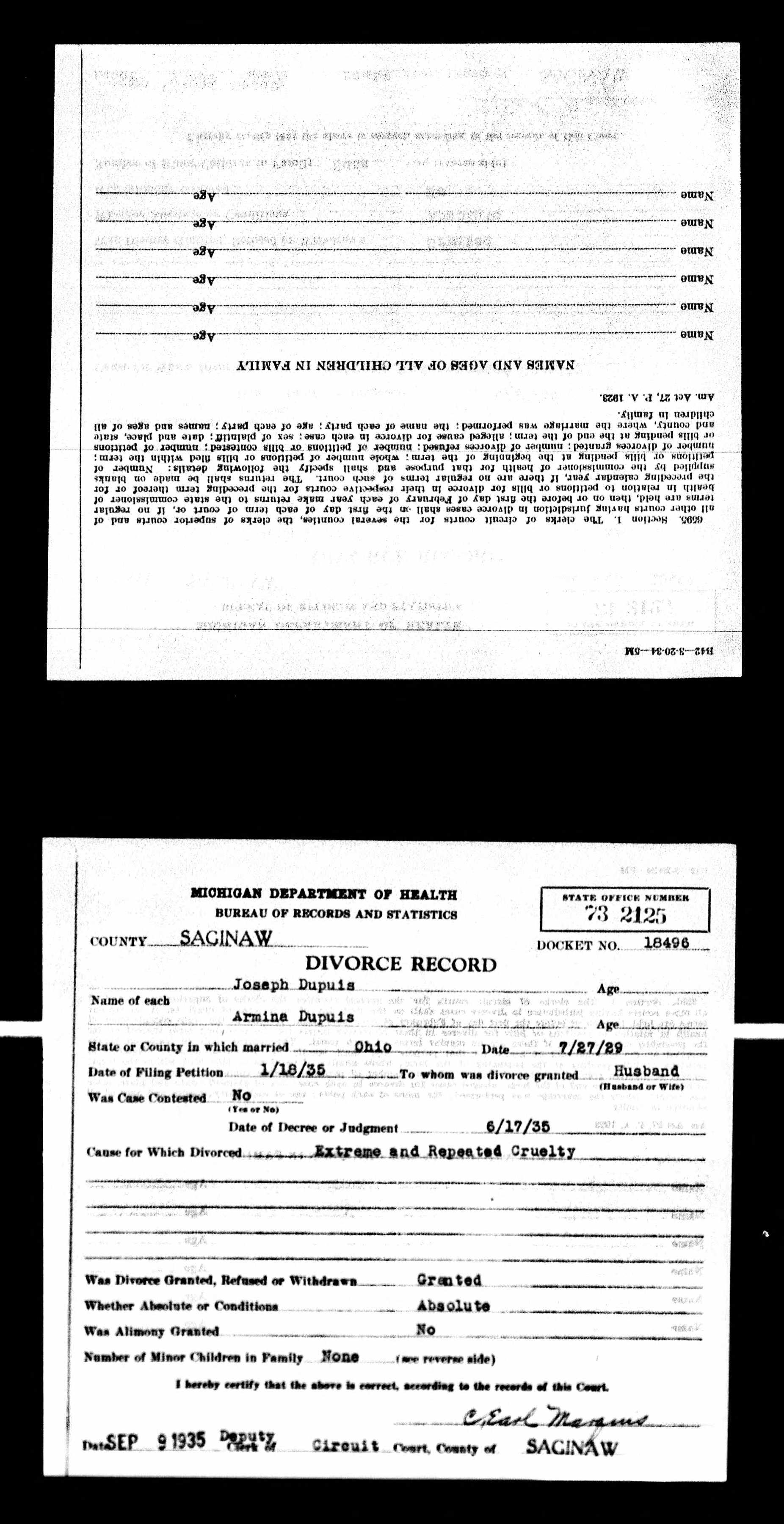
Almina goes on to marry Joseph Dupuis on July 27, 1929 in Lucas County, Ohio. That also ends in divorce on June 17, 1935 in Saginaw, Michigan.

41327_338667-01370
Saginaw County Michigan Divorce Records

Both of the last 2 divorces indicate the husband was the one who filed for the divorce and was claiming cruelty in each case. I have not yet found Almina’s death. That could be because she married a fourth time and died with that name instead. That’s pure speculation based on her record with husbands. It will probably take some courthouse research in order to determine if she did re-marry and when she died as those records are not necessarily available on the internet yet.

John Rivers Jr aka Guy Morrison

John Rivers Jr is not a direct ancestor – but rather a great-grand-uncle. Or maybe not so great and grand… LOL He is the brother of my great-grandfather, Gardner Rivers.

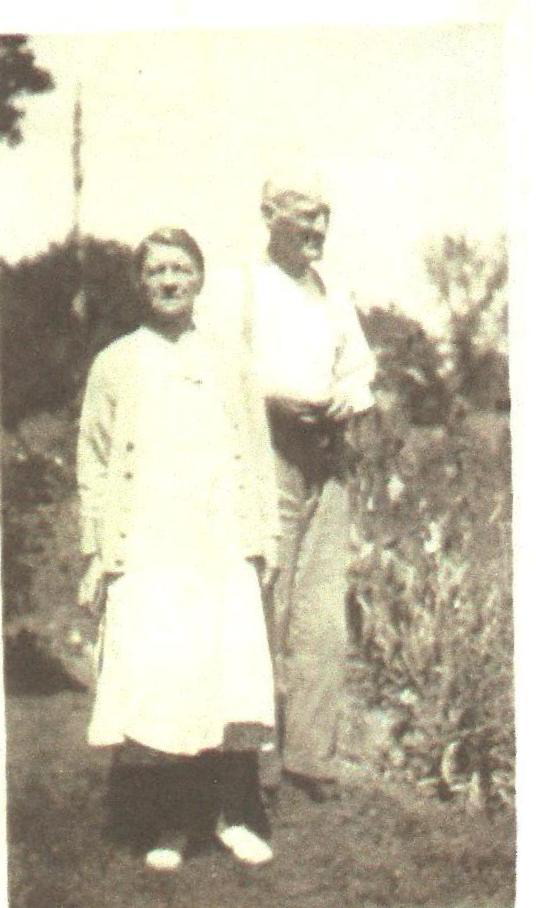
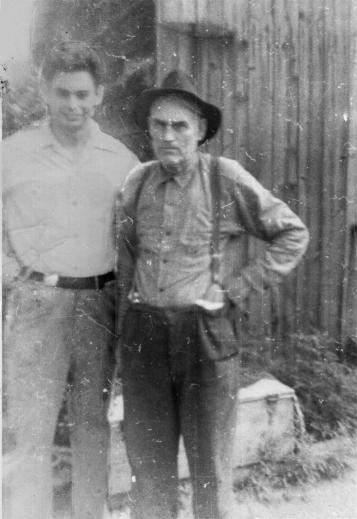
Guy and Katie Morrison
Guy Morrison and his wife Katy

John was born in 1865 and can be found on the census for 1870 and 1880 living with his family in Saginaw County, Michigan. However, after the 1880 census he seemingly disappears from any official record that I can find.

Probably 10-15 years ago now, I had heard from a cousin who had talked to one of the older generation before she passed and this cousin told me that according to her, John Jr had moved to the Petoskey area and changed his name to Guy Morrison. Also that he had married a woman by the name of Katy and they had twin girls. Oh, and the reason why he moved and changed his name? Well, that’s because he had killed someone and was trying to avoid the law.

I searched for years to find proof of this and was coming up short. I could indeed find a Guy Morrison with wife Katy and twin girls (among other children) in the 1900 to 1940 censuses in the Petoskey area. I could not find Guy Morrison before 1900 though. This seemed to fit the family story – but I still couldn’t say yes, this was definitely him. There wasn’t anything really connecting this Guy Morrison to my John Rivers Jr except the timeframe fit. And well, that’s just not enough to say for sure.

Then in 2016, I finally was able to make some progress. About a week after my uncle’s funeral, I had this overwhelming urge to research John Jr again (my uncle was my dad’s brother – and this is his side of the family). So, I started searching again. And again, I was coming up empty. Then I decided to check his “other” name – Guy Morrison. That’s when I hit the jackpot. Suddenly there was this family tree on ancestry.com that was posted by a descendant of Guy Morrison, and the little bit that was posted, seemed to fit. So, on a long-shot I contacted the owner of the tree. I explained that I had this family legend that John Rivers Jr changed his name to Guy Morrison and a bit about his family in the Petoskey area.  I left out the part about the murder as I didn’t want to scare off the contact. This cousin replied and shared that the family legend was true – she had the same legend (including as I would later confirm the part about murder). This cousin then shared with me one of the only pictures she had of Guy Morrison – which is posted above.

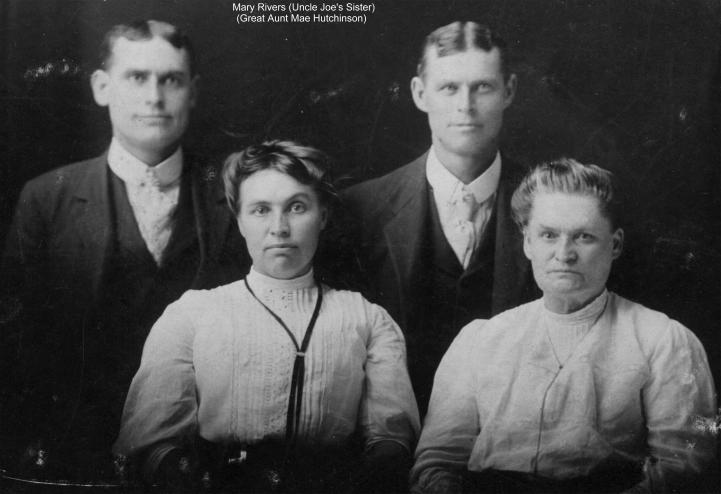
I compared it to some pictures that I had of some of Gardner and his siblings.

Dan, Mary, Burt and Frances Jane Munson Rivers
Mary Rivers, Frances Jane Munson Rivers with Dan and Burt Rivers behind them. (The text is the writing that was found on the back of the picture.)

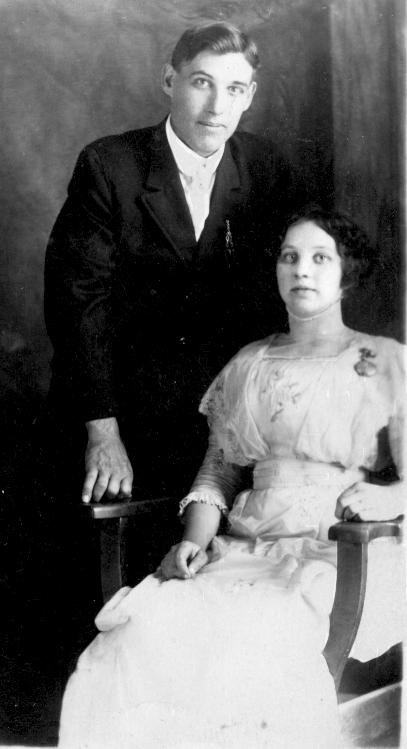
Joseph Rivers and Amelia Painter
Joseph Rivers with wife Amelia Painter Rivers

Thomas Rivers and Gertie Munson
Thomas Rivers with niece Gertrude Munson

Ralph and Gardner Rivers
Gardner Rivers with nephew Ralph Rivers

I concluded that since the story matched up and there was a similarity in the pictures between Guy/John and Gardner, Burt, Daniel (James Daniel) and Joseph – who all would be brothers and even a bit of similarity between Mary and Guy too (as poor as the pictures are), that John Jr was this Guy Morrison. But I would prefer to have a bit better proof. Well, I would eventually get that too – in 2017 I was checking my AncestryDNA matches and who would show up – this cousin who is Guy Morrison’s descendant. Doing some quick checks to make sure that the DNA didn’t come from a different ancestor, gave me the proof that I was really looking for. John Rivers Jr is Guy Morrison.

So, this has got me to wondering, about the murder part of the story. Who did John Jr kill? Why did he kill this person? I spent some time going through the Saginaw newspapers on Genealogybank.com and so far have come up empty. There’s only one murder in the area that seemingly went unsolved – but that was in 1881 and was an infant who was found alongside a road. Now, in 1881, John Jr would have been about 16.

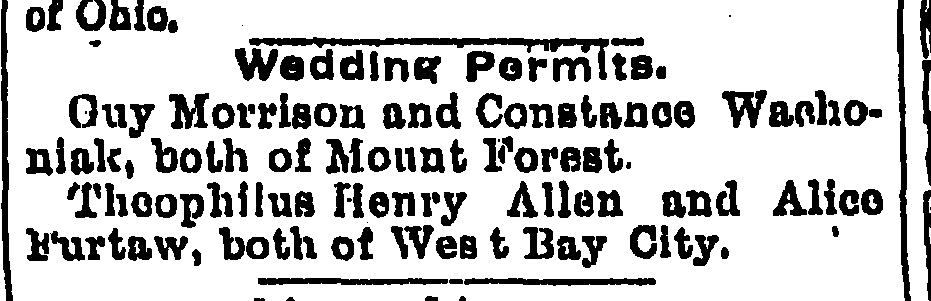
He married (as Guy Morrison) Constance Wachoviak in Mount Forest, Bay County, Michigan in May of 1893. Constance went by the nickname Katy in later records.

Bay_City_Times_1893-05-14_1-2
Bay City Times, May 14, 1893 page 1.

In checking where Mount Forest is – it very well could be that they married on their way to Petoskey area from the Taymouth Township area. So, if the 1881 baby was who John killed, it seems far fetched that he would wait around another 12 years before taking off and changing his name. It just doesn’t make sense.

At this point, I still don’t know who and why John supposedly killed. I would assume the murder went unsolved – or at the very least his name as John Rivers would be associated with the murder as a possible suspect. After all, why else would he change his name and move away to avoid the police? However, I have yet to find any evidence of it. This will require more digging – and I may never find out the details.