Henry Munson (1818–1886)

Early Life and Trade

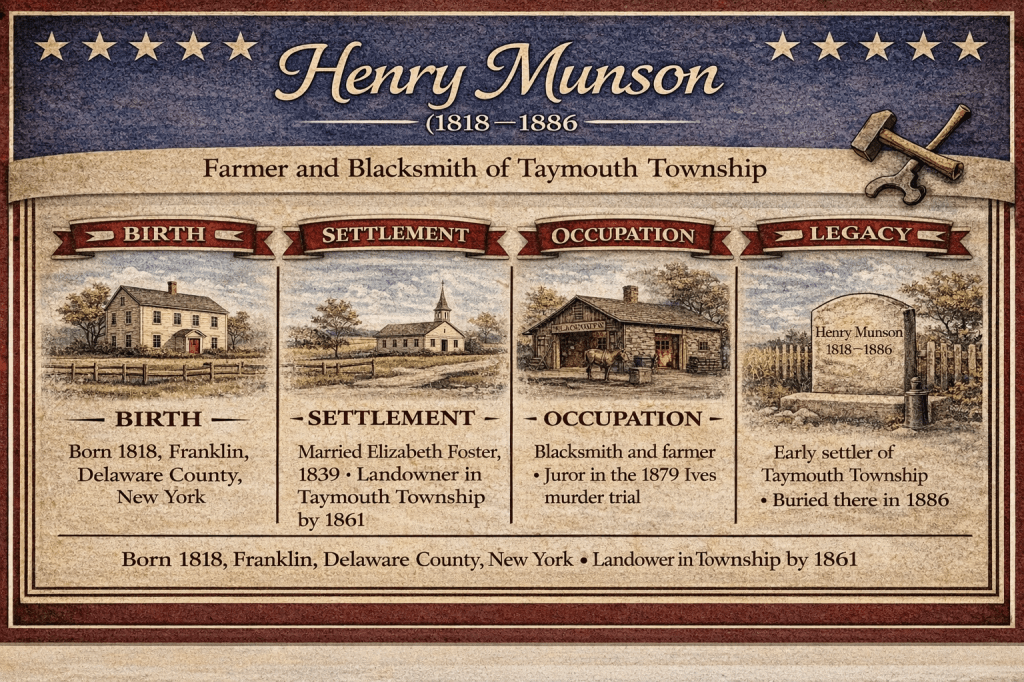
Henry Munson was born 16 June 1818 in Franklin, Delaware County, New York, the son of Daniel Munson and Frances “Fanny” Tolles. According to a biographical sketch published during his lifetime, his father operated a blacksmith shop, and Henry worked there during the winters, learning the trade at a young age.¹ This early training would shape his working life for decades.

At approximately eighteen years of age, Henry left home and traveled west to Fort Defiance, Ohio, where he spent two years engaged in boating and farm labor.¹ This period reflects the common pattern of young men acquiring experience and capital before permanent settlement.

Arrival in Michigan and Marriage

By the late 1830s, Henry had relocated to Saginaw County, Michigan. He was married on 1 June 1839 in Bridgeport to Elizabeth Foster, daughter of Nathaniel and Mary Foster.¹ The marriage marks the beginning of a long association with Bridgeport and Taymouth Townships that would continue for the remainder of his life.

Their first child, James H. Munson, was born in Bridgeport in 1840, followed by Mary Emaline Munson in 1841. Census and vital records indicate that the family remained in Bridgeport through the 1840s and 1850s, during which time Henry balanced farming with blacksmithing.²


Family Growth and Loss

Henry and Elizabeth Munson became the parents of eleven children. Not all survived to adulthood, a reality reflected both in census records and later family documentation. Ransom W. Munson, born in 1843, died in 1853 at the age of nine, reportedly at the Cass River.³ James H. Munson, their eldest son, died in Taymouth Township in 1881 at the age of forty-one.⁴

These losses occurred alongside the steady growth of the family, which included children born in Bridgeport and later in Taymouth Township. The movement of birthplaces within the family mirrors Henry’s gradual transition from Bridgeport into rural Taymouth.


Settlement in Taymouth Township

In the fall of 1861, Henry Munson purchased eighty acres of land in Taymouth Township, Saginaw County, on section 5.¹ This land purchase represents a permanent commitment to the township, coinciding with a period of agricultural expansion in the area during the Civil War era.

Federal census records place Henry in Bridgeport in 1860 and confirm his residence in Taymouth Township by 1870 and 1880.² Over time, his landholdings increased, and by the early 1880s he was reported to own eighty-seven acres.¹


Community Presence and Newspaper Mentions

Henry Munson’s name appears repeatedly in Saginaw County newspapers during the late 1870s, reflecting his continued residence and standing within the community. In 1879, his name was listed among the jurors involved in the murder case arising from the death of Heber K. Ives, in which Allen Barnum was charged.⁵ His appearance in these reports relates specifically to jury proceedings and represents routine civic service rather than personal involvement in the crime itself.

The repeated publication of juror lists across multiple issues explains why Henry’s name appears more than once in connection with the case. Such reporting was typical of nineteenth-century newspapers as trials progressed through examination, jury selection, and court sessions. These references provide valuable confirmation of Henry’s presence and civic participation in Taymouth Township during the period between the 1870 and 1880 federal censuses.


Occupation and Public Identity

Throughout his adult life, Henry Munson was identified as both a farmer and a blacksmith.¹² This dual occupation was common among early settlers and reflects the practical demands of rural Michigan communities, where skilled trades were often combined with agricultural work.

Politically, Henry was identified as a Democrat, a detail included in the 1881 county history.¹ While brief, this note situates him within the civic culture of the township and suggests engagement with local political life.


Later Years and Death

By 1880, Henry Munson was sixty-two years old and residing in Taymouth Township with his family.² The death of his son James in 1881 occurred during this period and would have marked a significant personal loss late in Henry’s life.

Henry Munson died on 12 December 1886 in Taymouth Township at the age of sixty-eight.⁶ He was buried in Taymouth Township Cemetery, where his grave remains among those of other long-standing township residents.


Assessment

Henry Munson’s life is documented across a wide range of contemporary sources, including federal censuses, land records, a published county biography, and local newspapers. Taken together, these records present a clear picture of a skilled tradesman and farmer who followed a well-documented path from New York to Michigan, established landholdings in Taymouth Township, raised a large family, and remained a visible and trusted member of the local community until his death.

The convergence of government records, printed biography, and newspaper accounts makes Henry Munson one of the more thoroughly documented nineteenth-century residents of Taymouth Township and provides a solid foundation for understanding both his life and the broader settlement history of the area.


Sources

  1. History of Saginaw County, Michigan (Chicago: Warner, Beers & Co., 1881), biographical sketch of Henry Munson.
  2. 1850, 1860, 1870, and 1880 U.S. Federal Census, Saginaw County, Michigan.
  3. Michigan death records and family documentation for Ransom W. Munson.
  4. Michigan death records for James H. Munson, Taymouth Township, 1881.
  5. Saginaw Herald (East Saginaw, Michigan), 16 October 1879, reporting the death of Heber K. Ives and related proceedings; Saginaw Courier-Herald, 23 October 1879, “The Ives Murder,” listing jurors, including Henry Munson.
  6. Michigan death and burial records for Henry Munson, Taymouth Township, 1886.
Why the Episcopal Church Held the Answer

One of the most surprising lessons in the story of Elnathan, Lydia, and Fanny Tolles is not about war or DNA or probate. It is about churches.

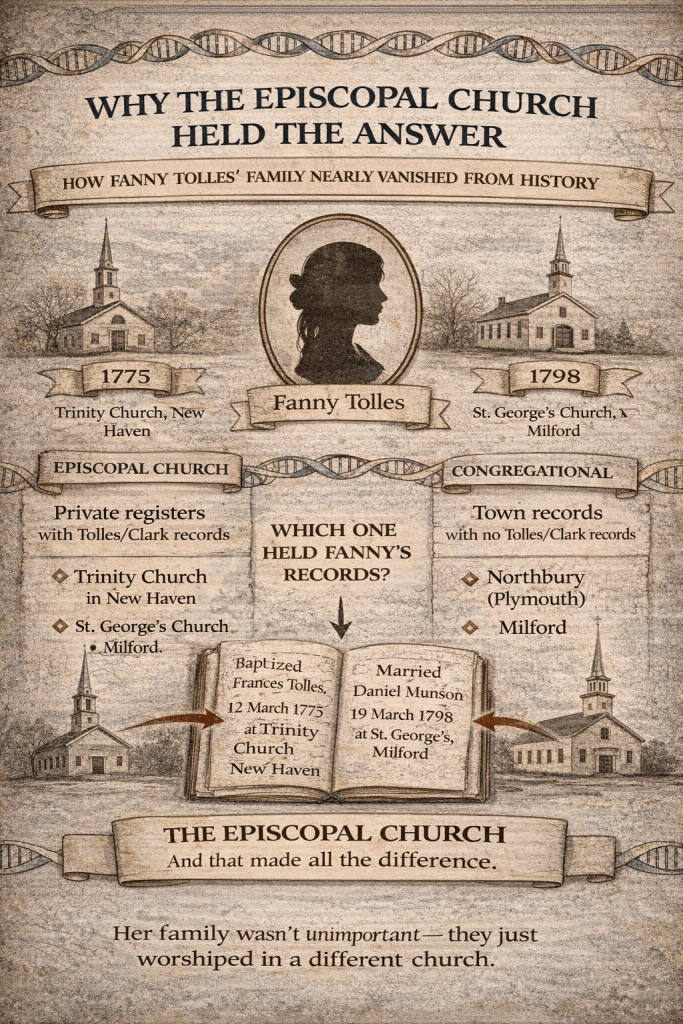
For most people researching early New England families, the default assumption is that the Congregational church holds the records. That works for many families — but not for this one. The Tolles and Clark families belonged to the Episcopal Church, and that single fact explains why Fanny nearly disappeared from history.

Lydia Clark was baptized as an adult at Trinity Church in New Haven in May 1773. Two years later, her daughter Frances was baptized there in March 1775. These were not casual entries. Episcopal parishes kept detailed registers of baptisms, sponsors, and marriages that were entirely separate from the town and Congregational systems.

Meanwhile, in Milford, Daniel Munson was part of the Episcopal world as well. Records from St. George’s Church show him as a subscriber and vestryman in the late 1780s. When Frances married Daniel Munson in 1798, she did so in a community deeply tied to the Episcopal network — and to her Clark relatives.

This is why older genealogists struggled. They searched town records and Congregational church books for Fanny Tolles and found very little. Without Episcopal registers, she looked unattached — a woman with a maiden name but no parents.

Donald Lines Jacobus solved this because he knew where to look. He drew from Trinity Church in New Haven, St. George’s in Milford, and the Plymouth parish records to reconstruct a family that existed almost entirely outside the Congregational system. When those church records were combined with probate law, the picture became clear.

Fanny Tolles did not vanish because her family was unimportant.
She vanished because her family worshiped in the “wrong” church.

And yet, it was those same Episcopal records that preserved her baptism, her name, and her marriage — quietly waiting for someone to connect them.

This is why genealogy is never just about names and dates. It is about institutions, beliefs, and communities — the frameworks that decide which lives are written down and which are forgotten.

For Fanny Tolles, the Episcopal Church kept her story alive long enough for us to finally find it.


Sources

  1. Trinity Church (Episcopal), New Haven, Connecticut, baptismal records, 23 May 1773 (Lydia Clark) and 12 March 1775 (Frances Tolles); abstracted in Donald Lines Jacobus, Families of New Haven, vol. VIII (1932).
  2. St. George’s Church, Milford, Connecticut, vestry and subscription lists, 1786–1788, showing Daniel Munson as a member of the Episcopal Society.
  3. Milford, Connecticut, Marriage Records, 19 March 1798, Daniel Munson and Frances (Fanny) Tolles.
  4. Donald Lines Jacobus, Deacon George Clark(e) of Milford, Connecticut and Some of His Descendants (1949), Clark and Tolles family entries.
  5. Probate of Elnathan and Lydia Tolles, Plymouth (Watertown) District, Litchfield County, Connecticut, 1789–1794.

How DNA Almost Lied to Me

For most of the twentieth century, the question of who Frances “Fanny” Tolles really belonged to was a paper problem. In the twenty-first century, it became a DNA problem.

Like many genealogists, I had hoped DNA would provide the missing proof. If Fanny was truly the daughter of Elnathan and Lydia Tolles, then I should eventually match people who descend from their other children. And one day, I did.

An Ancestry DNA match appeared who traced their lineage back to another child of Elnathan Tolles — not through Fanny, but through a different branch of the Tolles family. According to Ancestry’s tools, we shared 9 centimorgans on one segment, a tiny match, but one that the Shared cM Project says can fall within the range of sixth cousins. That just happens to be exactly the relationship I would have if Fanny were Elnathan’s daughter.

For a moment, it felt like a breakthrough.

But genealogy is never that simple.

As I began building out that match’s family tree — generation by generation — another surname kept appearing: Mix. It was a name I recognized immediately. I already had Mix ancestors in my own tree. So I followed that line back.

And there it was.

The DNA match and I were not connected by just one line. We were connected by two — one through Tolles, and one through Mix. The Mix connection was older and more robust. That meant the small 9 cM segment could easily come from that shared ancestry instead of from Elnathan Tolles.

In other words, the DNA match did not prove what I wanted it to prove.

This is one of the hardest lessons in genetic genealogy: a match can be real, but still be misleading. Small segments, especially those under 10 cM, are easily inherited from distant ancestors and can survive for many generations. When multiple lines connect two people, DNA alone cannot tell you which ancestor supplied the shared segment.

So DNA did not solve the Tolles–Munson question. It simply told me that the two families were tangled together in more than one way.

And that meant I had to go back to something far older — something far more reliable.

I had to go back to the law.

In the next post, I’ll show how a thick, tedious, 66-page probate file did what DNA could not: it quietly but definitively tied Frances “Fanny” Tolles to the parents who raised her.


Sources

  1. AncestryDNA, shared DNA match between the author and a descendant of another child of Elnathan Tolles, showing 9 cM across one segment (author’s private test results).
  2. Shared cM Project 4.0, The DNA Painter, relationship probability tool for centimorgan values, indicating that 9 cM can be consistent with sixth-cousin relationships.
  3. Blaine T. Bettinger, “The Shared cM Project,” The Genetic Genealogist (https://thegeneticgenealogist.com), methodology for interpreting small DNA matches.
  4. International Society of Genetic Genealogy (ISOGG), guidelines on triangulation and multiple ancestral paths affecting DNA interpretation.
  5. Author’s compiled family tree and research notes on the Mix and Tolles families, showing multiple shared ancestral lines.

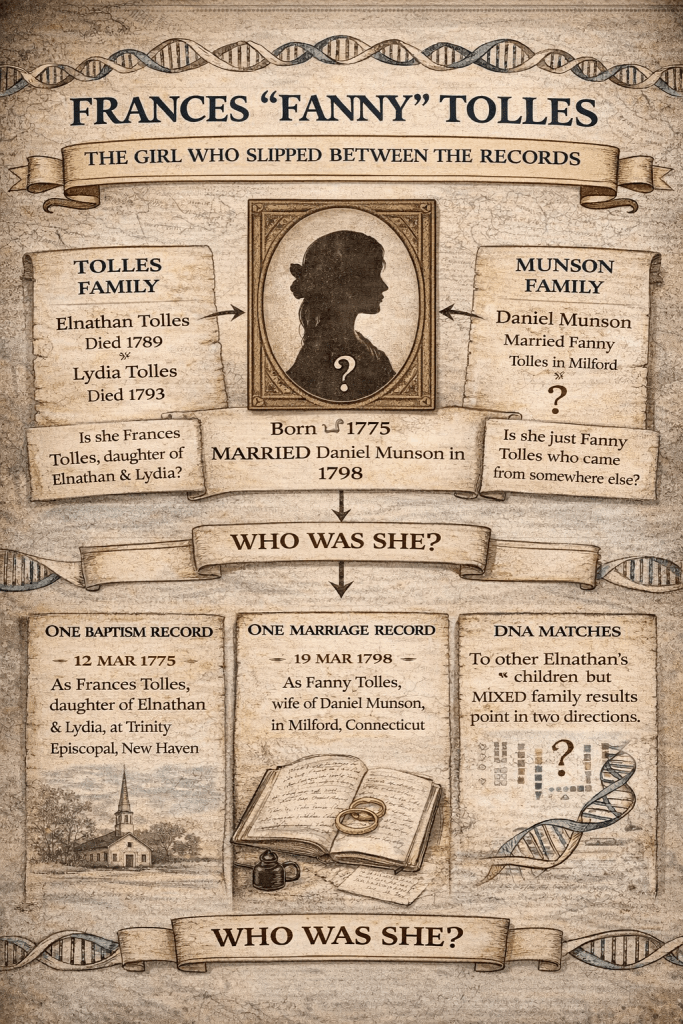
Frances “Fanny” Tolles: The Girl Who Slipped Between the Records

Genealogy often feels like assembling a puzzle — until you discover that one of the most important pieces was never cut to fit. That is what happens with Frances “Fanny” Tolles, the daughter of Elnathan and Lydia Tolles, and the woman who would later become the wife of Daniel Munson.

On paper, Fanny should be easy to find. She was baptized on 12 March 1775, just as the American Revolution was beginning. In the Episcopal records of New Haven she appears as “Frances,” daughter of Elnathan and Lydia Tolles.¹ But after that single entry, she seems to vanish.

Her parents lived in Northbury (later Plymouth), Connecticut, during the war years — a place where church and town records were scattered across jurisdictions and denominations. The Tolles family belonged to the Episcopal Church, not the Congregational churches that recorded most Connecticut vital events. As a result, many of Fanny’s milestones were preserved only in church books, not town ledgers.

Then her family fractured.

Elnathan Tolles died in 1789. Lydia followed in 1793. Their children were still young. Some were placed under guardianship, others went to live with relatives. The probate files confirm their identities as children of Elnathan and Lydia — but they do not track what happened to them afterward.²

This is where Fanny disappears.

By 1798, a Frances (or Fanny) Tolles married Daniel Munson in Milford, Connecticut — a town strongly associated with the Clark family, Fanny’s maternal kin.³ Yet nowhere in the marriage record are her parents named. There is no “daughter of Elnathan” to anchor her identity. She simply appears, gets married, and then moves on.

Later genealogies tried to solve this gap, but not all of them were confident. Early Tolles and Munson researchers knew that Daniel Munson’s wife was named Fanny Tolles, and they knew that Elnathan and Lydia had a daughter named Frances of the right age. But without a clear marriage record naming her parents, some writers hedged, quietly assigning her to Elnathan because she fit — not because a document said so.

That uncertainty lingered for generations.

In modern times, DNA added a new layer. A distant DNA match appeared to descend from another child of Elnathan Tolles, seemingly supporting Fanny’s placement in the family. But further research revealed a second, older connection through the Mix family, meaning the DNA could not be used to prove Fanny’s parentage after all. The evidence was real — but it pointed in two directions.

This is why I have over 64,000 people in my family tree. Not because I like big numbers, but because tiny errors in the 1700s ripple forward into the DNA era.

So who was Fanny Tolles?
Was she truly the daughter of Elnathan and Lydia?
Or was she “assigned” to them because no better answer existed?

To find out, we have to leave church books and DNA charts behind — and turn to something far more powerful: probate law.


Sources

  1. Trinity Church (Episcopal), New Haven, Connecticut, baptismal records, 12 March 1775, Frances Tolles, daughter of Elnathan and Lydia Tolles; abstracted in Donald Lines Jacobus, Families of New Haven, vol. VIII (1932).
  2. Probate of Elnathan and Lydia Tolles, Plymouth (Watertown) District, Litchfield County, Connecticut, 1789–1794, combined estate file, listing their children including Frances.
  3. Milford, Connecticut, Marriage Records, 19 March 1798, Daniel Munson and Frances (Fanny) Tolles; cited in The Munson Record and Milford town records.

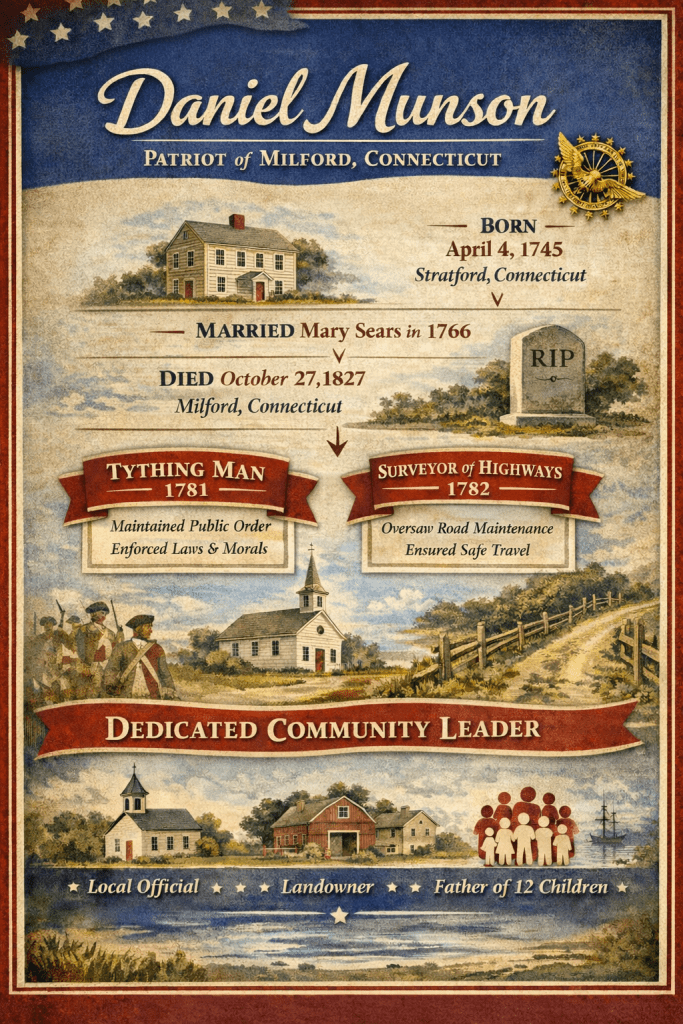
Daniel Munson (1745-1827)

When we think of patriotic service during the American Revolution, it is easy to picture soldiers on the battlefield. Yet independence was secured just as surely by men who stayed home and kept their communities functioning during uncertain and dangerous times. One such patriot was Daniel Munson of Milford, Connecticut.

Born on April 4, 1745, in Stratford, Connecticut, Daniel Munson’s early life was shaped by loss. Orphaned as a small child, he was raised within an extended family that valued responsibility and public duty. As an adult, Daniel settled in Milford, where he married Mary Sears and raised a large family while becoming deeply involved in the civic life of the town.

During the Revolutionary War, Milford’s stability depended on capable local leadership. In 1781 and 1782—critical years as the war drew toward its conclusion—Daniel Munson stepped forward to serve the town in two important civil offices: tything man and surveyor of highways. These were not ceremonial positions. They required time, authority, and a willingness to enforce the laws that kept daily life running smoothly.

As surveyor of highways, Daniel was responsible for overseeing the maintenance of local roads—vital routes used for transporting food, supplies, and militia. In a coastal town like Milford, good roads were essential to both commerce and defense. At the same time, his role as tything man placed him in charge of maintaining public order, enforcing Sabbath laws, and addressing disorderly conduct. In a period marked by shortages, political tension, and social strain, this work helped preserve the moral and civil structure of the community.

Daniel Munson’s patriotism did not end with the war. He remained an active citizen for decades, serving his church, managing land and property, and contributing to Milford’s growth well into the early years of the new republic. He lived to see the nation he helped support take firm root, passing away in Milford on October 27, 1827, at the age of eighty-two.

Today, Daniel Munson’s story reminds us that the Revolution was sustained not only by muskets and marches, but by ordinary citizens who accepted responsibility when their communities needed them most. His recognized patriotic service stands as a testament to the power of civic duty—and to the enduring legacy of those who quietly helped build a nation.

Sources:

Full text of “1637-1887, the Munson record : a genealogical and biographical account of Captain Thomas Munson (a pioneer of Hartford and New Haven) and his descendants”, https://archive.org/stream/16371887munsonre02muns/16371887munsonre02muns_djvu.txt

Full text of “Encyclopedia of Connecticut biography, genealogical-memorial; representative citizens” – Internet Archive, https://archive.org/stream/encyc09unse/encyc09unse_djvu.txt

Daniel Munson, Ancestor No. A082998, Daughters of the American Revolution (DAR) Genealogical Research System, Washington, D.C.; patriotic service credited as tything man (1781) and surveyor of highways (1782), Milford, Connecticut; service sourced to Mullen, Connecticut Town Meeting Records, vol. 1, pp. 575–576.

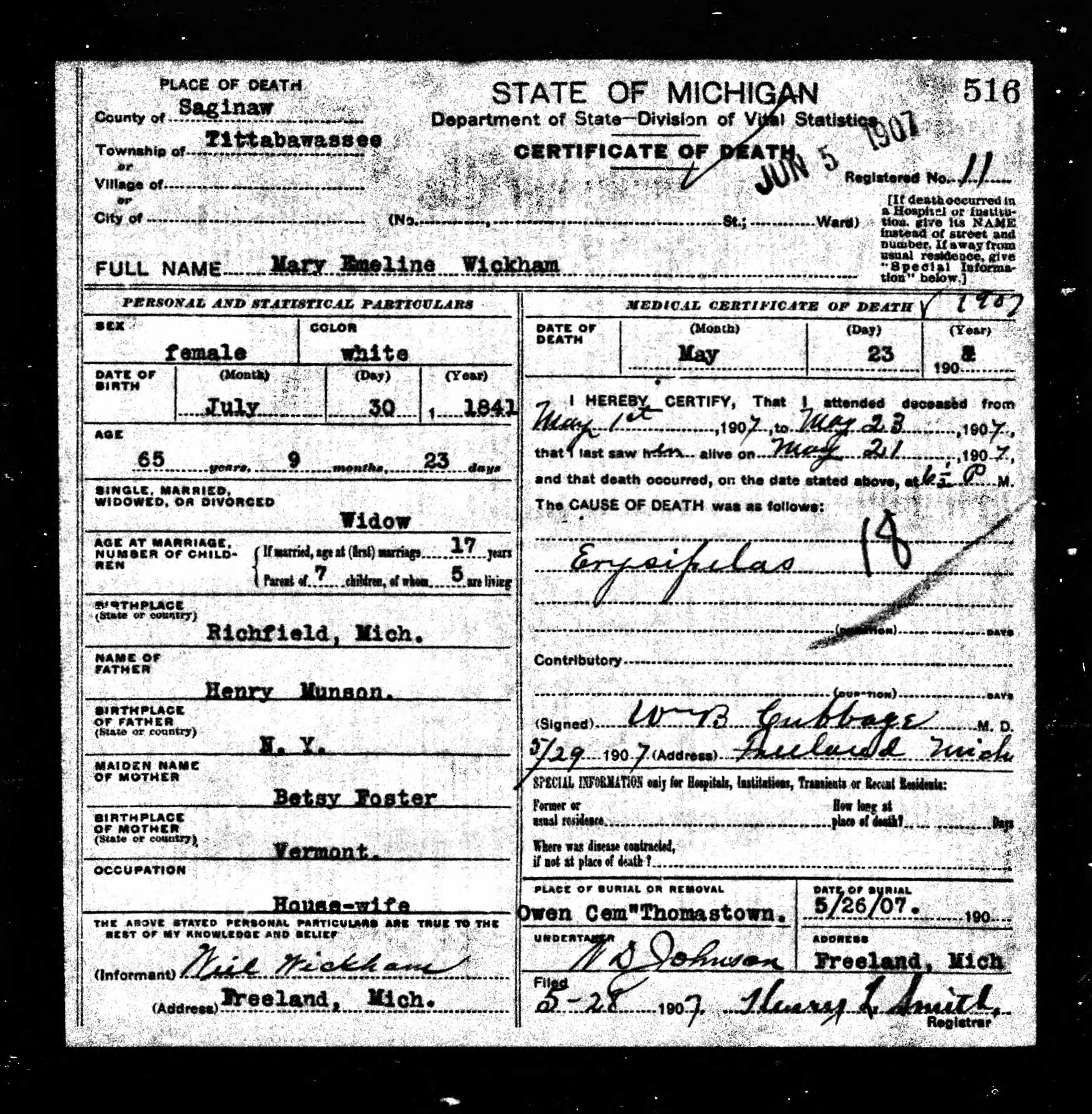
Mary Emeline Munson Wickham

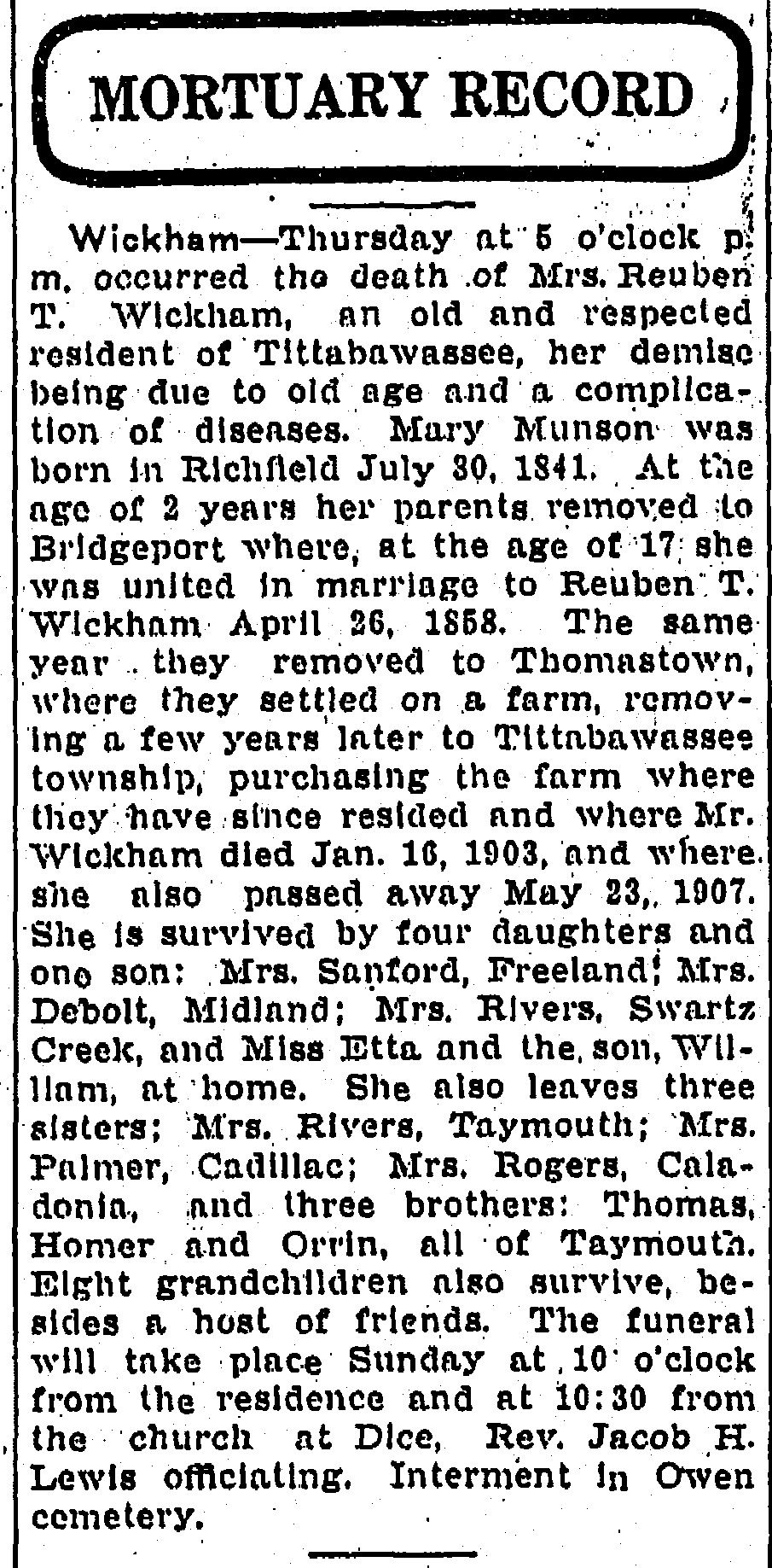
I have often said that my family tree is not tree shaped. Sometimes I’ve described it as a wreath, or as a tumbleweed (hence the name of this blog). Well, Mary Munson was both my 2nd great-grandmother and my 2nd great-grand aunt. Yes, you read that right. She was both my great-grandmother and my great-grand aunt. Her obituary has that tell-tail sign.

Saginaw_News_1907-05-24_12-3
Saginaw News, May 24, 1907, page 12

Yes, she had a daughter “Mrs. Rivers” who lived in Swartz Creek at the time and a sister “Mrs. Rivers” who lived in Taymouth Township. Mrs. Rivers – the daughter – was born Alice Mary Wickham and was married to her first cousin, Gardner Rivers. Mrs. Rivers – the sister – was Frances Jane Munson who was married to John Rivers and they were Gardner’s parents. Keeping it all in the family… lol.

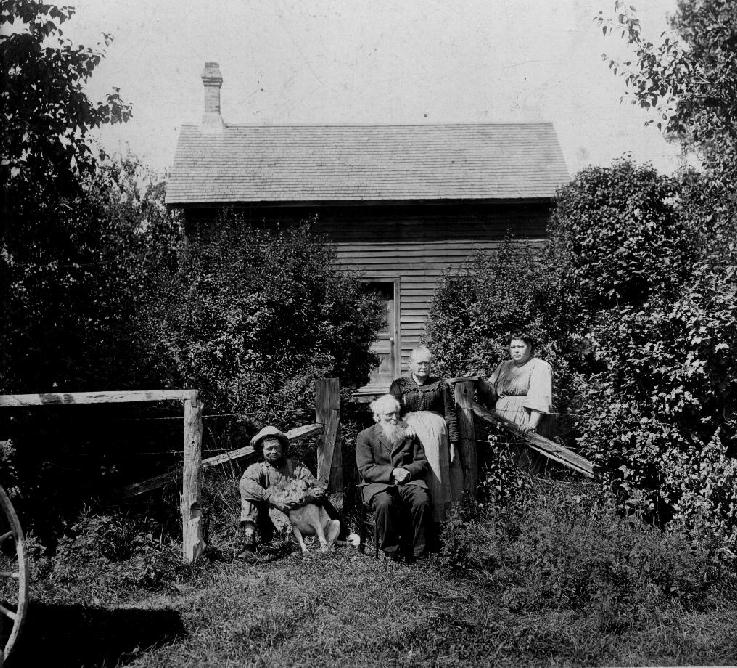
reuben
Ruben Wickham, wife Mary E. Munson Wickham, and children William H. Wickham and Etta Wickham

Mary and Frances Jane were 2 daughters of Henry Munson and his wife Elizabeth “Betsy” Foster. An uncle of Mary and Frances Jane, Gardner W Foster was the first white child born in Saginaw County and is who the village of Fosters is named after.

Mary died May 23, 1907 from Erysipelas. According to Wikipedia, Erysipelas is a skin infection caused by a bacteria. Wikipedia also states:

This disease is most common among the elderly, infants, and children. People with immune deficiency, diabetes, alcoholism, skin ulceration, fungal infections, and impaired lymphatic drainage (e.g., after mastectomy, pelvic surgery, bypass grafting) are also at increased risk.

44471_354650-00716

It is probable that she was diabetic and/or had cardiac issues. Evidence for this comes from her picture, obituary and death certificate. No, none of them directly state this, but it is likely – especially since both issues run in the family – her daughter Alice, grandson and great-grandson all died of heart issues. Her great-grandchildren – my dad and uncle both had diabetes (as do I).

Revolutionary War connections

1f69225b-36df-4706-8d49-15e34373ac5a

In 2014, I joined the Daughters of the American Revolution under my 6th great-grandfather, Benjamin Byam. I did my application through him because he was an already established patriot and I already had most of the documentation needed to prove my descent from him, so it was an easy application to do. In reality, I do have other Revolutionary War Patriots in my ancestry that I could have submitted under – and I’ll probably submit them as supplementals one day.

Benjamin Byam was born November 29, 1733 in Chelmsford, Massachusetts. He had some military service prior to the Revolution, but during the War, he served both in Massachusetts and New Hampshire (where he moved to). Benjamin ended up dying in Randolph, Vermont on November 22, 1795.

Lot Hutchinson, another 6th great-grandfather, was born in Sutton, Massachusetts on August 1, 1741. Lot served as a Sergeant in Captain Abijah Burbank’s company among others during the war, marching from Sutton to Providence, Rhode Island. Lot would eventually move his family from Massachusetts to Braintree, Vermont where he died on March 24, 1818. Lot has not previously been proven a patriot in the DAR database.

Lot’s father-in-law, Moody Morse, my 7th great-grandfather, was born April 1, 1719 in Newbury, Massachusetts. Moody is a proven DAR patriot for performing civil service during the war. Moody died on August 14, 1805 in Sutton, Massachusetts.

Josiah Blanchard was born on December 10, 1733 in Concord, Massachusetts and is another 6th great-grandfather. Josiah is not a currently approved DAR patriot, but he does appear on the muster roll for Cogswell’s Regiment of the Militia in 1778 (part of the 16th Regiment for Massachusetts). He also appears on the rolls for Captain Danforth’s company of Colonel Nixon’s regiment. Josiah died March 18, 1800 in Barre, Vermont.

Abraham Smith (one of several in my tree) was born in 1730 in Subury, Massachusetts and is yet another 6th great-grandfather. He is a DAR approved patriot who served under Captains Brownson, Simonds and Colonels Allen, Warner and Bradley. He died in Tinmouth, Vermont on November 4, 1809.

Bartholomew Towne was a private in Captain Josiah Crosby’s Company of Colonel Moses Nichol’s Regiment of New Hampshire Volunteers. Bartholomew was born April 8, 1741 in Topsfield, Massachusetts and died in 1800 in Milford, New Hampshire. Bartholomew is not currently a DAR approved patriot.

Eli Stiles was born May 22, 1746 in Westfield, Massachusetts. He appears on the rolls as serving under Captain Darby’s company of Colonel Scammel’s registment in New Hampshire. It is not known yet exactly when Eli died. He is not currently an approved DAR patriot.

John T. Wortman was born August 25, 1757 in New Jersey and is a fourth great-grandfather. John is an approved DAR patriot who was a teamster in George Allen’s & Samuel Hunt’s teams.  John died on May 19, 1831 in New Jersey.

John’s father, another John Wortman was born November 16, 1730 in Somerset County, New Jersey. He is a DAR approved patriot for being a Corporal and a Wagon Master during the war. John died on August 25, 1807 in Bedminster, New Jersey.

Daniel Munson was born April 4, 1745 in Stratford, Connecticut and is a fifth great-grandfather. Daniel is an approved DAR patriot for having civil service during the war as he was a surveyor of highways in Milford. Daniel died on October 27, 1827 in Milford, Connecticut.

There are probably others that I just haven’t discovered yet. 9 out of 10 of these ancestors are through my mom’s side of the family. I’m sure there are probably more on dad’s side – I just haven’t discovered them yet.