William Doonan and the Law: Conflict, Confinement, and Community Response

By the late 1880s, William Doonan was living in Bay County, Michigan, with his wife Rosa Susan Smith and their blended family, which included a daughter from William’s previous marriage. Although William does not appear in either the 1880 or 1900 U.S. federal census, local newspapers and state census records document a pattern of conflict that brought him repeatedly to the attention of neighbors, courts, and eventually authorities on both sides of the international border.

The earliest documented incident occurred in May 1889. The Evening Press reported that William Doonan, then residing in Monitor Township, was arrested after allegedly threatening to shoot a neighbor. According to the article, William drew a revolver during a dispute and was taken before a justice for examination.¹ This report establishes that William’s legal troubles began well before the turn of the century and involved firearms rather than minor civil disagreements.
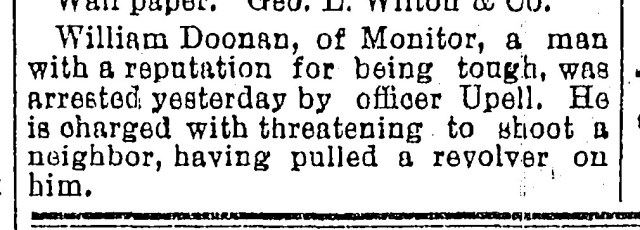
The Evening Press, May 9, 1889, Bay City, Michigan. Page 8

In 1891, William’s name appeared again in the press—this time in connection with a tragedy within his wife’s family. The Bay City Daily Tribune reported on the conviction of Robert Smith for killing his brother Jude Smith, who was also Rosa’s brother. The article states that the gun involved in the homicide was afterward given to William Doonan.² The crime itself belonged solely to Robert Smith, but the transfer of the weapon placed William in possession of a firearm already associated with a notorious and widely reported act of violence. In a small community, such an association would not have gone unnoticed.

More than a decade later, William again surfaced in Bay City newspapers amid renewed conflict. In June 1905, the Bay City Times reported that a complaint had been filed by a neighbor, John Doe, alleging that William approached him with an open knife and made threats. The matter was adjourned rather than immediately resolved.³ A follow-up article published the following month described a contentious courtroom proceeding in which testimony referenced both a knife and a fence rail used as evidence. That report states William was convicted before a justice and that he appealed the decision.⁴ These accounts show William actively entangled in the local court system, though not always with swift or final resolution.
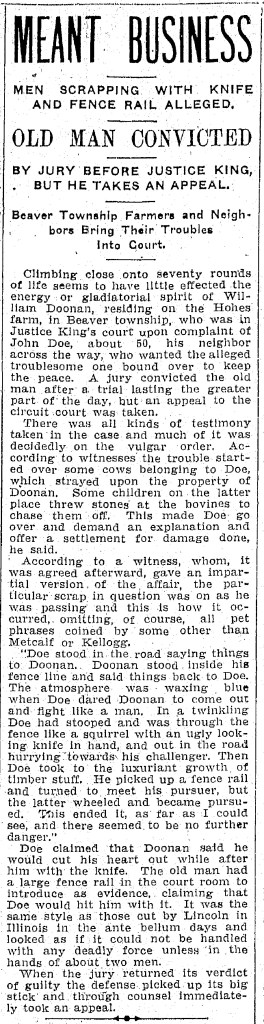
The Bay City Times, June 19, 1905, Page 6

By 1910, William Doonan was no longer appearing in Michigan newspapers. Instead, his name surfaced in Ontario. In May 1910, the North Bay Nugget reported on William in connection with firearm possession, revisiting earlier concerns about weapons and violent associations tied to the Smith family tragedy.⁵ The Temiskaming Speaker published a related account shortly thereafter, further documenting community concern and official attention.⁶ Later that summer, the North Bay Nugget followed up on William’s legal situation, indicating that the matter continued to draw notice weeks after the initial report.⁷
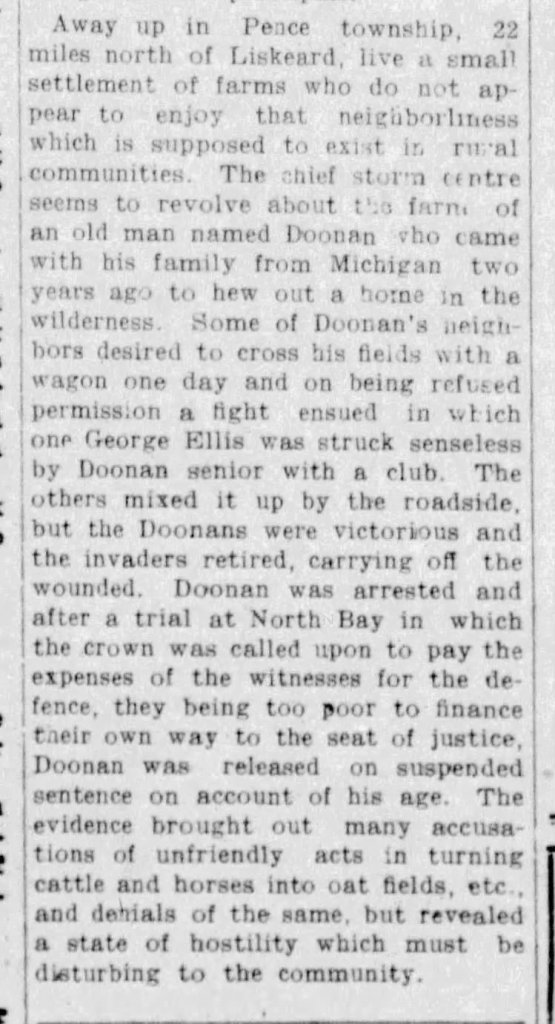
The North Bay Nugget, June 29, 1910, Page 7

These Canadian newspaper reports demonstrate that William’s conflicts did not end with his departure from Michigan. Rather, they followed him across the border, suggesting a continuity of reputation that transcended geography. The repetition of firearm-related concerns—spanning from 1889 in Monitor Township to 1910 in Ontario—forms one of the most consistent threads in the surviving documentary record.

William’s absence from the 1900 U.S. federal census remains unexplained. Whether this reflects deliberate avoidance, temporary relocation, or simple enumerator omission cannot be determined from existing evidence. What can be established is that William Doonan was repeatedly involved in disputes serious enough to attract legal and press attention over a span of more than twenty years.

The broader context of the Smith family violence is essential to understanding how William’s story was perceived by others. Rosa Susan Smith’s brother Jude Smith was killed by another brother, Robert Smith.⁸ While William was not responsible for that homicide, his later possession of the gun used in the crime and his own documented disputes involving weapons ensured that the shadow of that tragedy remained close.

By 1910, William Doonan was a man known to authorities in multiple jurisdictions, his name intertwined with firearms, courtrooms, and unresolved tensions. His story does not resolve neatly—but the records leave little doubt that his reputation was forged as much by conflict as by kinship.


Sources

¹ Evening Press (Bay City, Michigan), 9 May 1889, p. 8.
² Bay City Daily Tribune (Bay City, Michigan), 13 May 1891, p. 4.
³ Bay City Times (Bay City, Michigan), 18 May 1905, p. 1, “Show Him His Heart.”
Bay City Times (Bay City, Michigan), 19 June 1905, p. 6, “Meant Business.”
North Bay Nugget (North Bay, Ontario), 19 May 1910, p. 1.
The Temiskaming Speaker (New Liskeard, Ontario), 20 May 1910, p. 4.
North Bay Nugget (North Bay, Ontario), 29 June 1910, p. 7.
⁸ Nancy Little, “Jude Smith’s Legacy,” The Tumbleweed, 14 March 2018, https://familytumbleweed.blog/2018/03/14/jude-smiths-legacy/.
William Doonan: Origins, Migration, and Family Formation

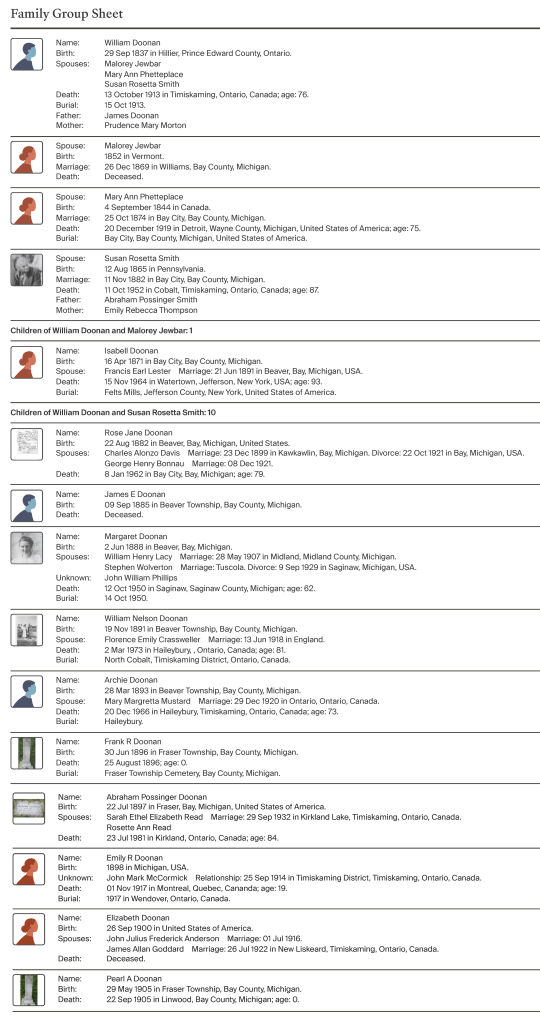
William Doonan was born on 29 September 1837 in Hillier Township, Prince Edward County, Upper Canada, the son of James Doonan and Prudence Mary Morton.¹ His early life unfolded within a large family that soon migrated westward into Hastings County, Ontario, where William appears alongside his parents and siblings in mid-nineteenth-century records.² These early movements reflect the broader patterns of rural settlement and land hunger that shaped many Canadian families of the period.

By the 1860s, William was living independently. In the 1861 census of Canada, he appears in Hungerford Township, Hastings County, identified as a single man and a member of the Church of England.³ Within a few years, he crossed the border into Michigan, joining the steady stream of Canadian migrants drawn to land opportunities in the Saginaw Bay region.

On 4 March 1868, William Doonan entered 80 acres of land in Beaver Township, Bay County, Michigan, under the Homestead Act.⁴ Over the following years, he fulfilled the requirements of residence and improvement, constructing a log house and barn, digging wells, fencing and cultivating acreage, and planting fruit trees.⁵ These records establish him not as a transient laborer but as a settler who invested sustained labor and resources into his farm.

William’s personal life during this period was complex. He married Ann Scott in Bay County on 26 December 1869.⁶ This marriage was short-lived, and no later records place Ann in William’s household. By January 1874, William had married again, this time to Maloney Jewbar.⁷ As with his first marriage, no divorce or death record has been located, but by the early 1880s Maloney no longer appears in records associated with him.

William’s third marriage, to Rosa Susan Smith, marked a turning point in his life. They were married in Bay City, Michigan, on 11 December 1882.⁸ From this point forward, Rosa is consistently identified as William’s wife in census records, newspapers, and later Ontario documents. She was the mother of nearly all of his children and remained with him through the final decades of his life.

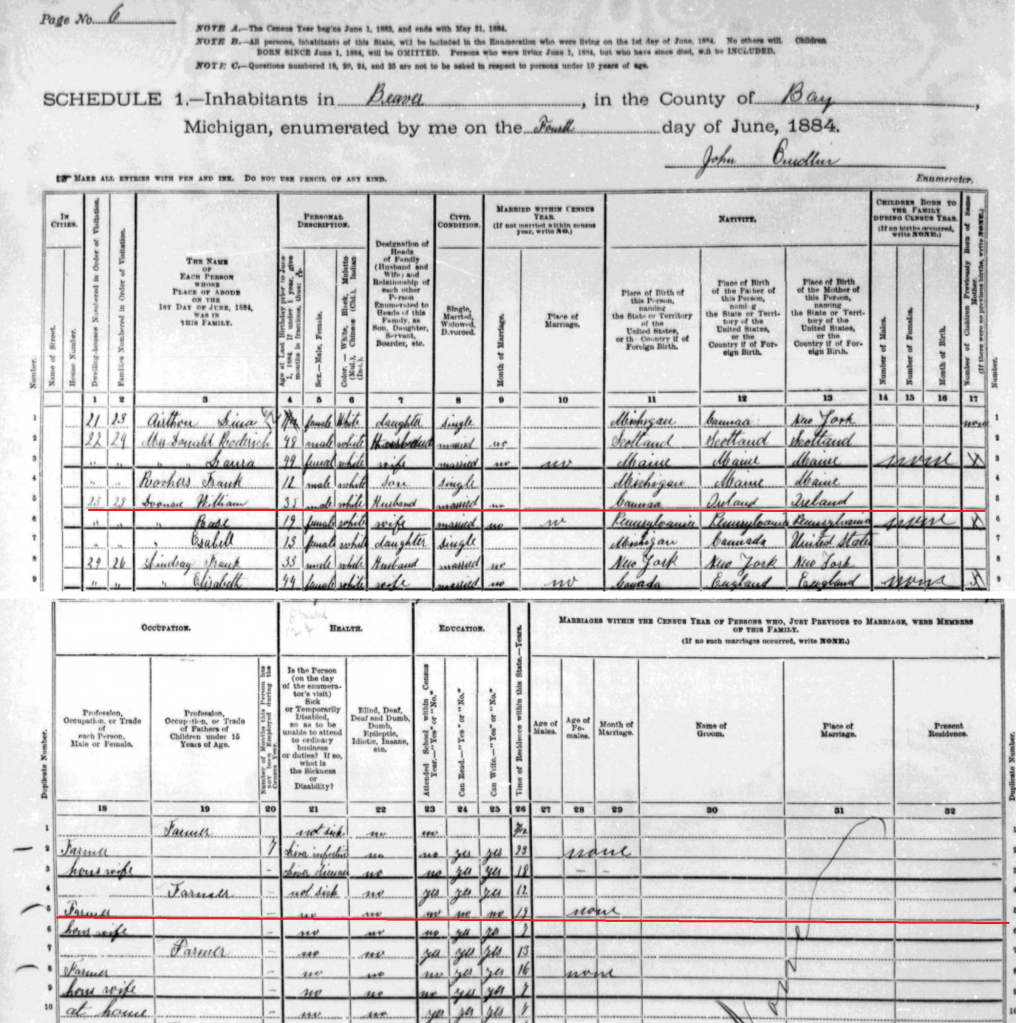
One child, Isabel Doonan, predates William’s marriage to Rosa. Isabel appears in the 1884 Michigan state census within William and Rosa’s household.⁹ Based on her age and the date of William’s marriage to Rosa, Isabel was the child of one of William’s earlier marriages. Her presence in the household reflects the blended family structures that were not uncommon in the nineteenth century.

1884 Michigan State Census. William Doonan is underlined in red.

William and Rosa raised a large family in Bay County, and their household appears repeatedly in Michigan state census records during the 1880s and 1890s.¹⁰ During these years, William supported his family through farming and lumbering, work that was physically demanding and increasingly hazardous as he aged.

Family Group Sheet for William Doonan

William does not appear in the 1880 or 1900 United States federal census. This absence is notable but not inexplicable. During this period, he moved frequently between Michigan and Ontario and appears instead in state and provincial records. At the turn of the twentieth century, his household was also affected by violence within his wife’s family, including the killing of Rosa Susan Smith’s brother Jude Smith by another brother, an event documented elsewhere.¹¹ Contemporary newspaper reporting later indicates that William came into possession of the firearm involved.¹² While no direct evidence links these events to census avoidance, the combination of cross-border movement, legal scrutiny, and rural residence provides a plausible explanation for the family’s absence from federal enumeration.

William’s wider family network also remained close. Census proximity and migration patterns suggest that John Doonan, who appears in nearby Michigan census records during the same period, was likely William’s brother.¹³ Although no single record explicitly states this relationship, the accumulated evidence supports a close familial connection.

By the early twentieth century, William and Rosa left Michigan and returned to Ontario, settling in the Temiskaming District. This final chapter of William Doonan’s life would be marked by increasing hardship, legal entanglements, and declining health—subjects that will be examined in the posts that follow.


Notes

  1. Ontario birth records and compiled family records for William Doonan, Hillier Township, Prince Edward County, Ontario.
  2. 1861 Census of Canada, Hungerford Township, Hastings County, Ontario.
  3. Ibid.
  4. U.S. General Land Office Records, Homestead Entry, Beaver Township, Bay County, Michigan, 4 March 1868.
  5. Homestead proof affidavits, Beaver Township, Bay County, Michigan.
  6. Bay County, Michigan, Marriage Register, 1869, marriage of William Doonan and Ann Scott.
  7. Bay County, Michigan, Marriage Register, 1874, marriage of William Doonan and Maloney Jewbar.
  8. Bay County, Michigan, Marriage Register, 1882, marriage of William Doonan and Rosa Susan Smith.
  9. 1884 Michigan State Census, Beaver Township, Bay County, Michigan.
  10. 1884 and 1894 Michigan State Census records, Beaver Township, Bay County, Michigan.
  11. Nancy Little, “Jude Smith’s Legacy,” The Tumbleweed, 14 March 2018.
  12. North Bay Nugget, May 1910, reporting on firearm possession connected to the Smith family incident.
  13. 1884 and 1894 Michigan State Census records for John Doonan, Bay County, Michigan.

Charles Thomas Wickham and Christianna Stouts

From Islington to New York and the Saginaw Valley

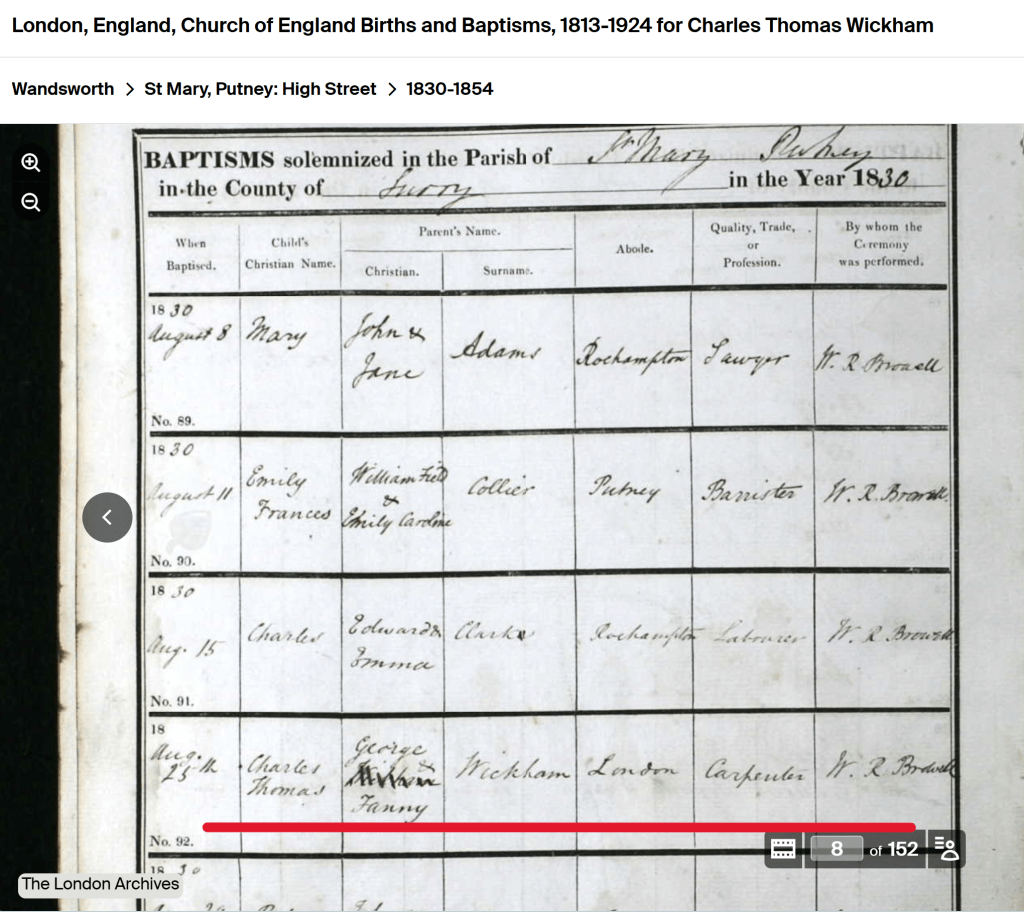
Reconstructing the lives of early nineteenth-century immigrants often requires correlating records created in different countries and under varying record-keeping practices. In the case of Charles Thomas Wickham and Christianna Stouts, parish registers, marriage records, passenger lists, Michigan documents, and contemporary newspapers together form a consistent and well-supported narrative. These records identify Charles Thomas Wickham and Christianna Stouts as my third great-grandparents and trace their journey from London to New York and ultimately to the Saginaw Valley of Michigan.


Charles Thomas Wickham: Origins in London

Charles Thomas Wickham was born about 1800 in London, England, the son of George Wickham and Fanny Bonner Farrand.¹ Parish records place the Wickham family in the Islington and Clerkenwell area of Middlesex during the early nineteenth century.

By the 1820s, Charles Thomas Wickham appears in parish records as a husband and father and is identified as a cheese monger and egg dealer, occupations consistent with small-scale food trade in urban London.² This occupational identification helps distinguish him from other men of the same name and provides useful context for his life prior to emigration.


First Marriage: Ann Philippa Evans

On 16 June 1822, Charles Thomas Wickham married Ann Philippa Evans at St Mary, Newington, Surrey.³ Two children were born to this marriage:

  • Charles Henry Wickham, born 6 December 1823
  • Ann Philippa Wickham, baptized 11 August 1825 in Islington³

Ann Philippa Evans Wickham died shortly after the birth of her daughter and was buried on 24 August 1825, leaving Charles a widower with two young children.⁴


Second Marriage: Christianna Stouts

On 1 April 1827, Charles Thomas Wickham married Christianna Stouts at St James, Clerkenwell, Middlesex.⁵ Christianna was born in 1807 and baptized at St Mary’s, Islington, placing her within the same parish network as the Wickham family.⁶

This second marriage produced a growing family during the late 1820s and early 1830s.


Children Born in England

The following children of Charles Thomas Wickham and Christianna Stouts were born in England:

  • John George Wickham, baptized 21 June 1828
  • Reuben Thomas Wickham, baptized 12 April 1831
  • Joseph Wickham, baptized 22 November 1832¹

These dates are later corroborated by American records and obituaries, demonstrating continuity of identity across the family’s migration.


Emigration to the United States

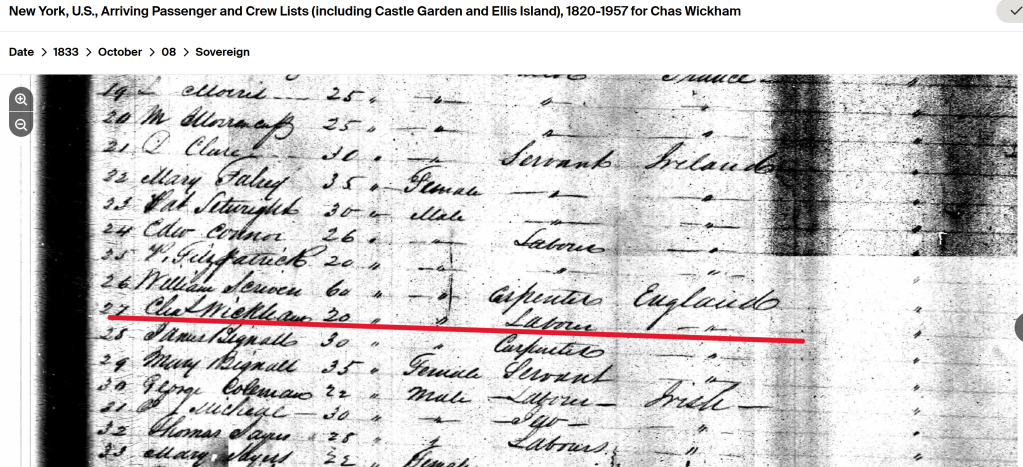
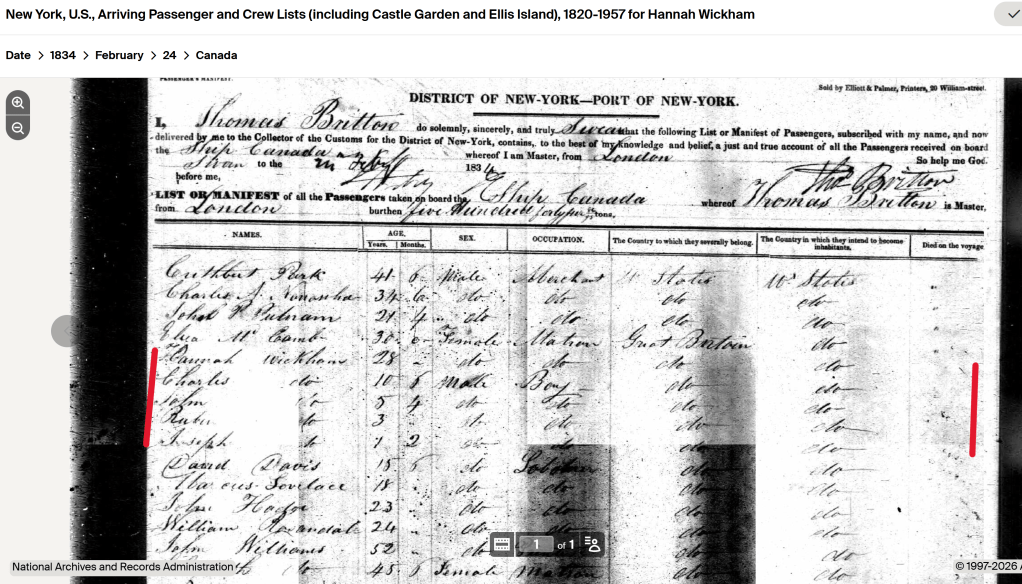
In 1833, Charles Thomas Wickham emigrated to the United States, arriving at New York.⁷ The following year, his wife Christianna, recorded on passenger lists as Hannah Wickham, followed with several children.⁸

Among those listed on the 1834 passenger list was Charles, age ten, whose age corresponds precisely with Charles Henry Wickham, born in December 1823, the son of Charles Thomas Wickham by his first wife, Ann Philippa Evans. None of the younger children of the second marriage would have been of that age, making this identification the only plausible interpretation.

The absence of Charles Henry Wickham’s sister, Ann Philippa Wickham, from American passenger lists suggests that she either died in childhood or remained in England, a common outcome for orphaned children placed with relatives.


“They Lived in the East”

Christianna’s obituary later states that after arriving in America, the family *“lived in the east.”*⁹ This phrase does not identify a specific state. When evaluated against dated and independent records, New York State is the only interpretation supported by evidence:

  • Both Charles and Christianna arrived through New York
  • Their American-born children were born in New York
  • No Massachusetts records have been identified
  • The family’s migration path proceeds logically from New York to Michigan

Move to Michigan and Charles’s Death

In 1840, the Wickham family relocated from New York to Saginaw County, Michigan, then a developing frontier region. According to Christianna’s obituary, Charles Thomas Wickham died only one month after arriving, bringing his American life to an abrupt end.⁹

He was buried in what is now Tittabawassee Township, Saginaw County, Michigan.¹⁰


Christianna Wickham Green: Pioneer Widow

In 1841, Christianna married Edward C. Green in Saginaw County.¹¹ She spent the remainder of her life in Michigan.

Her obituary, published in 1891, provides a detailed narrative of her life, confirming her English birth, marriage to Charles Wickham, emigration to New York, residence in the eastern United States, relocation to Saginaw, Charles’s death shortly after arrival, and her second marriage.⁹


Confirmation from the Next Generation

The obituary of Reuben Thomas Wickham, published in 1903, independently confirms the family narrative. It states that he was born in London, England, came to New York as a small child, and moved to Saginaw in 1840 with his parents, Charles T. and Christina Wickham.¹²


The Unresolved Question of Charles Henry Wickham

While the passenger list establishes that Charles Henry Wickham immigrated to the United States in 1834, his later life has not yet been documented. He does not appear in Michigan records or family obituaries. His absence may reflect an early death, separate residence, or use of a name variation, but no definitive conclusion can be drawn.

Importantly, his presence on the passenger list strengthens the identification of Charles Thomas Wickham by confirming the structure of two marriages and the blending of children from both unions.


Conclusion

Through parish registers, marriage records, passenger lists, Michigan documents, and contemporary newspapers, the lives of Charles Thomas Wickham and Christianna Stouts can be traced with clarity and consistency. The evidence demonstrates a single family moving from London to New York and then to the Saginaw Valley, without contradiction or competing identities.

Together, these records establish Charles Thomas Wickham and Christianna Stouts as my third great-grandparents, preserving their story as part of the broader nineteenth-century immigrant experience.


Footnotes

  1. Parish baptism records for Wickham children, Islington and Clerkenwell, Middlesex, England, 1828–1832.
  2. Parish baptism records noting occupation of Charles Thomas Wickham as cheese monger and egg dealer, Islington and Clerkenwell, Middlesex.
  3. Marriage record of Charles Thomas Wickham and Ann Philippa Evans, St Mary, Newington, Surrey, 16 June 1822; baptism of Ann Philippa Wickham, Islington, 11 August 1825.
  4. Burial record of Ann Philippa Wickham, England, 24 August 1825.
  5. Marriage record of Charles Thomas Wickham and Christianna Stouts, St James, Clerkenwell, Middlesex, 1 April 1827.
  6. Baptism record of Christianna Stouts, St Mary’s, Islington, 1807.
  7. Passenger list, Sovereign, arrival New York, 1833, Charles Wickham.
  8. Passenger list, Canada, arrival New York, February 1834, Hannah Wickham and children.
  9. Obituary of Christianna (Stouts) Green, Saginaw Courier-Herald, 12 March 1891.
  10. Burial record of Charles Thomas Wickham, Freeland area, Saginaw County, Michigan, 1840.
  11. Marriage record of Christianna Wickham and Edward C. Green, Saginaw County, Michigan, 1841.
  12. Obituary of Reuben Thomas Wickham, Saginaw Herald, 27 January 1903.

Revisiting the Parentage of Eleanora “Ella” B. Gibbs

In October 2020, I published a post outlining the evidence I had at the time regarding the parentage of my second great-grandmother, Eleanora “Ella” B. Gibbs, wife of John Wortman. That post laid out the problem clearly: census records placed Eleanora in proximity to multiple Gibbs households in Dryden, Lapeer County, Michigan, but did not explicitly state her relationship to any of them.¹

At the time, the strongest conclusion I could reach — based on marriage, probate, and census evidence — was that Eleanora was the daughter of Lester Gibbs and Mary Conly. However, gaps remained, particularly concerning what became of Lester Gibbs, who appeared to vanish from the records after 1860.

Over the past several years, additional records have come to light. When examined together, they significantly strengthen the original conclusion and clarify why earlier records appeared contradictory.


The Core Question, Revisited

The question has never really been who raised Eleanora, but who her biological father was.

In 2020, the competing possibilities were:

  • Lester Gibbs, who married Mary Conly in 1850
  • Philo Gibbs, with whom Eleanora appears in close proximity in census records

Because nineteenth-century census schedules do not identify relationships, proximity alone could not prove parentage.² What resolves the question is land ownership, guardianship, and inheritance — records that do imply legal relationships.


What We Know Now About Lester Gibbs

Lester Gibbs Did Not Disappear After 1860

Earlier assumptions placed Lester Gibbs’s death near 1860, but new evidence clearly disproves that.

In the 1860 federal census, Lester Gibbs appears in Dryden Township, Lapeer County, Michigan, listed as a farmer with both real and personal estate.³ He was alive, resident, and economically established.

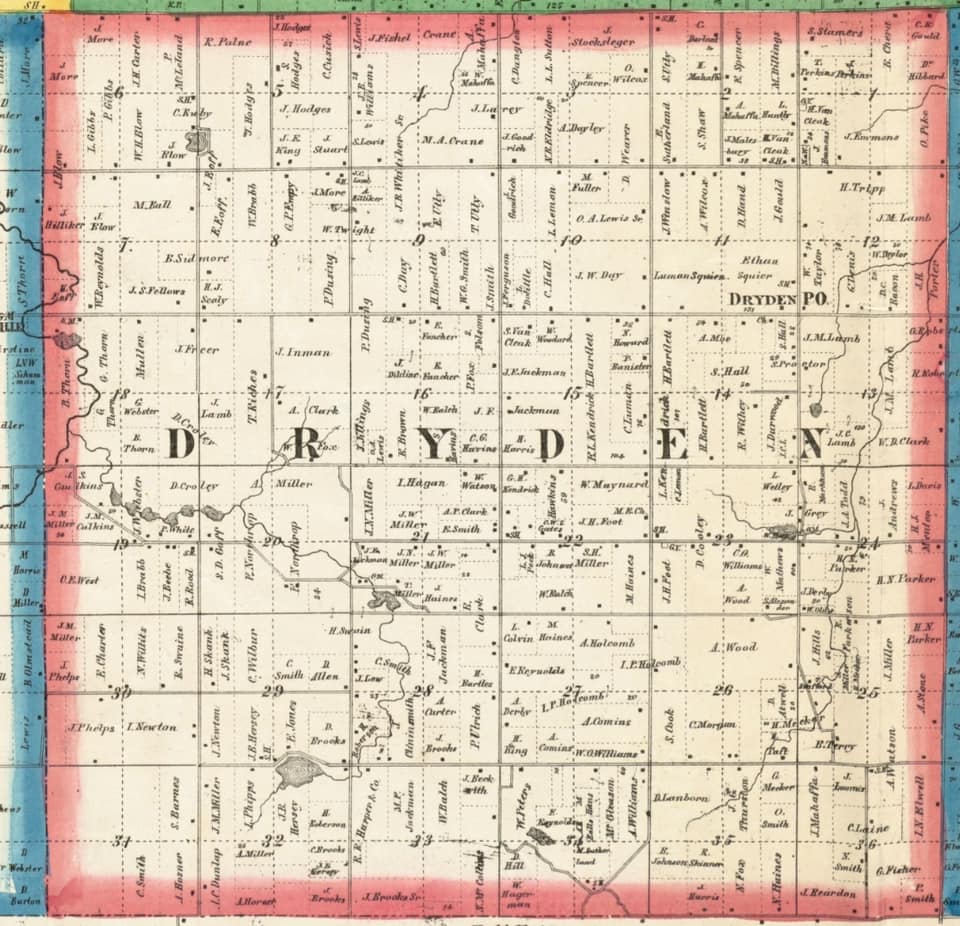
More importantly, an 1863 landowners map of Dryden Township identifies an “L. Gibbs” owning land in close proximity to J. Blow, a man later appearing in court-related records connected to this family.⁴ This confirms that Lester Gibbs was alive and a landholder at least as late as 1863.

1863 Land owernship map of Dryden, Lapeer County, Michigan. L. Gibbs owns land in the upper left corner.

Mary Conly’s Movements Explain the Census Confusion

The apparent absence of Mary Conly from Michigan in 1860 and Eleanora’s later association with other households long contributed to confusion. Those movements now make sense.

Mary Conly married Lester Gibbs in Lapeer County in November 1850.⁵ By 1861, she had remarried in New York to Charles Garner.⁶ The couple was living in New York by the mid-1860s, where Mary appears with Eleanora in the 1865 New York State Census.⁷

Charles Garner enlisted in the Union Army in 1863 and died as a prisoner of war at Salisbury Prison, North Carolina, on 21 December 1864.⁸ Mary was again widowed, this time with multiple minor children.

By 1868, Mary had returned to Lapeer County, Michigan, and married Mortimer Hilliker.⁹ These movements fully explain why Mary and Eleanora are absent from Michigan records during parts of the 1860s and why Eleanora later appears associated with extended family rather than her biological father.


The Most Important Evidence: Inheritance and Guardianship

The decisive records are not census schedules, but court-ordered guardianship and land transactions.

In December 1868, the Lapeer County Circuit Court appointed Mary Hilliker as special guardian of Eleanora (“Ella”) Gibbs, authorizing her to sell the minor child’s interest in real estate.¹⁰ The court approved both the guardianship and the conveyance.

Such proceedings occur only when:

  1. The child inherited property, and
  2. The property-owning parent is deceased

This establishes that Lester Gibbs died between 1863 and December 1868, and that Eleanora was his legal heir.

Philo Gibbs was not the landowner; Lester Gibbs was.


Why There Is No Probate Record for Lester Gibbs

The absence of a probate estate for Lester Gibbs once appeared problematic. In fact, it is consistent with Michigan legal practice of the period.

When a man died intestate leaving only minor heirs and land as the principal asset, courts often handled the matter through guardianship proceedings rather than formal probate administration.¹¹ This allowed the land to be sold for the child’s benefit without opening an estate.

That is precisely what occurred in this case.


What This Means for Eleanora’s Parentage

When all records are considered together:

  • Marriage of Lester Gibbs and Mary Conly (1850)⁵
  • Birth of Eleanora Gibbs (1854)¹²
  • Census evidence of Lester Gibbs alive in 1860³
  • Land ownership by Lester Gibbs in 1863⁴
  • Court-ordered guardianship and inheritance in 1868¹⁰
  • Probate of Mary Hilliker naming Ella Wortman as an heir¹³

…the conclusion is no longer tentative.

Eleanora “Ella” B. Gibbs was the daughter of Lester Gibbs and Mary Conly.


A Final Reflection

This case illustrates a fundamental genealogical principle:
census records suggest relationships; land and court records confirm them.

Six years ago, the evidence pointed in the right direction. Today, it firmly supports that conclusion.


Footnotes

  1. The parentage of Eleanora ‘Ella’ B. Gibbs,” blog post, 27 October 2020.
  2. U.S. Bureau of the Census, Instructions to Enumerators, 1860.
  3. 1860 U.S. Census, Lapeer County, Michigan, Dryden Township, Lester Gibbs household.
  4. Map of Lapeer County, Michigan (1863), Dryden Township landowners, “L. Gibbs.”
  5. Lapeer County, Michigan, Marriage Records, Lester Gibbs and Mary Conly, 12 November 1850.
  6. New York State Marriage Records, Mary Conly and Charles Garner, 1861.
  7. 1865 New York State Census, Cayuga County, Sterling, Mary Garner household.
  8. Compiled Military Service Record, Charles Garner, Union Army; died 21 December 1864, Salisbury Prison, North Carolina.
  9. Lapeer County, Michigan, Marriage Records, Mary Conly and Mortimer Hilliker, 29 March 1868.
  10. Lapeer County, Michigan, Circuit Court Records, Guardianship and deed of Eleanora D. Gibbs, December 1868.
  11. Michigan Probate Law and Practice, mid-nineteenth century (see Michigan Revised Statutes).
  12. Birth information for Eleanora D. Gibbs, as reported in multiple census and marriage records.
  13. Lapeer County, Michigan, Probate Records, Estate of Mary Hilliker, 1872.

When Did John Powell Really Die?

Solving an 1886–1887 Genealogical Mystery with Weather, Newspapers, and Cemetery Records

One of the most frustrating problems in genealogy is when official records and newspapers disagree. That is exactly what happened with John Powell of Pontiac, Michigan — and it took three independent record systems and 19th-century weather data to resolve it.

At first glance, the sources contradict each other:

  • Oakland County’s death register records John Powell’s death as 31 December 1886.
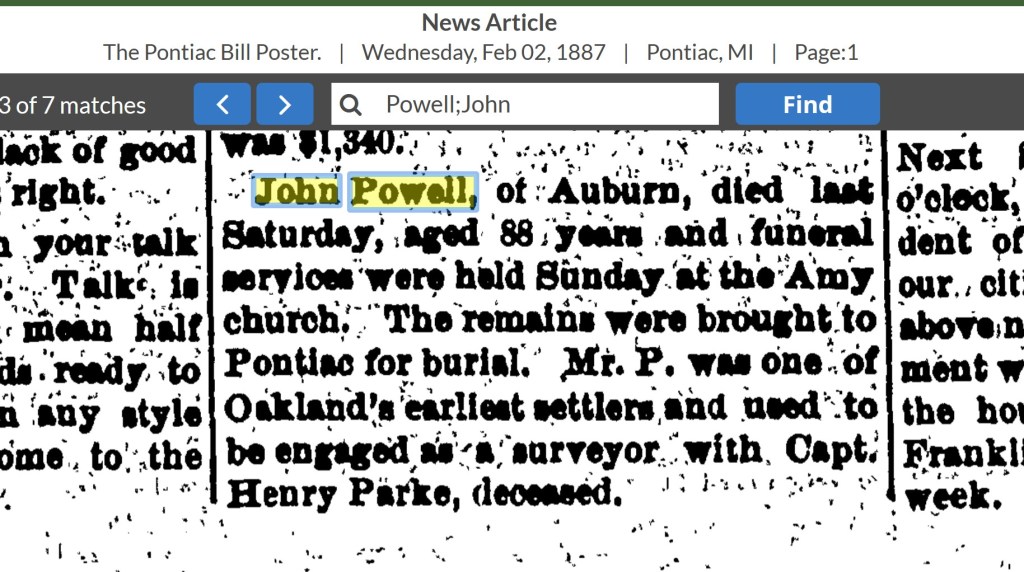
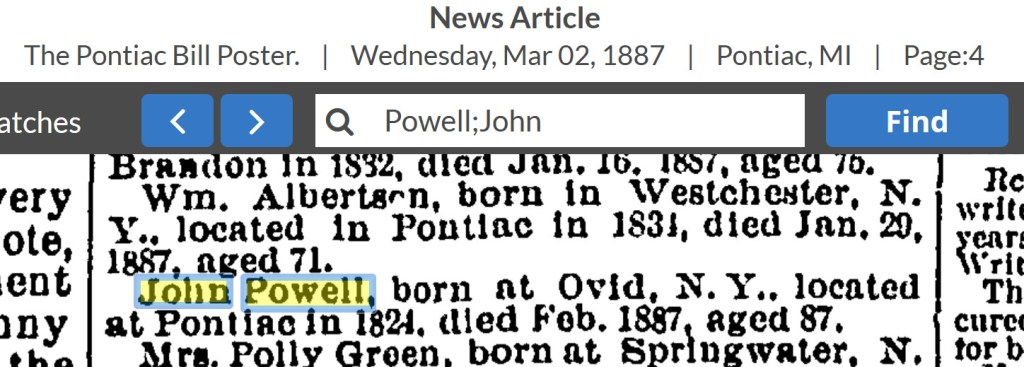
  • Two notices in The Pontiac Bill Poster in early 1887 state that he “died last Saturday” and later say he “died Feb. 1887.”
  • His burial, according to Oak Hill Cemetery in Pontiac, occurred on Saturday, 29 January 1887.

Which date is correct?


The Official Record: December 31, 1886

The Oakland County “Return of Deaths” ledger lists:

John Powell, Pontiac — Dec. 31, 1886 — widower, aged 88 years, 4 months, 4 days, born New York.

This is not an estimate or a heading. The date Dec. 31, 1886 is written directly on John Powell’s line in the register.

More importantly, Oakland County holds no death certificate for him in 1887, meaning the county had already legally recorded his death in 1886. That establishes 31 December 1886 as his legal date of death.

Additionally, no probate record has been found for John Powell. Probate records can sometimes give the date of death.


What the Newspaper Really Reported

The Pontiac Bill Poster of Wednesday, February 2, 1887 states:

“John Powell, of Auburn, died last Saturday; aged 88 years, and funeral services were held Sunday at Amy Church. The remains were brought to Pontiac for burial.”

“Last Saturday” relative to Feb. 2, 1887 equals Saturday, January 29, 1887 — which is exactly the day Oak Hill Cemetery recorded his burial.

The newspaper was therefore describing the burial week, not the legal date of death. Oh, and if you are wondering about Amy Church – apparently Amy is what the locals called Auburn Hills/Auburn Heights at the time. This was most likely a Methodist Church, although so far, I have not been able to confirm this.

The Pontiac Bill Poster article a month later – with incorrect data on death and age is incorrect. Although I suspect the birth information is actually right.

Why Burial Was Delayed: The Ground Was Frozen Solid

Weather records now make the situation unmistakably clear.

Using official U.S. Signal Service observations from Windsor, Ontario (the nearest long-running station to Detroit and Pontiac), we can see when winter locked the ground.

From mid-December 1886, southeast Michigan entered a sustained hard freeze:

DateHighLow
Dec 1432°F24°F
Dec 1525°F6°F
Dec 1614°F7°F
Dec 1727°F−2°F
Dec 2520°F1°F
Dec 2813°F−5°F
Dec 3123°F10°F

From December 14 onward, nighttime temperatures stayed below freezing for more than two weeks. This means:

  • The soil would have been frozen by Christmas
  • Snow fell on frozen ground on Dec. 24 (6 inches) and Dec. 31 (4 inches)
  • The ground never thawed between mid-December and mid-January

On the day John Powell died — December 31, 1886 — conditions were brutal:

  • High 23°F
  • Low 10°F
  • 4 inches of fresh snow

Burial at that time would have required digging through frozen soil beneath heavy snow — something cemeteries avoided whenever possible.


When Burial Became Possible

A major thaw finally arrived in late January 1887:

DateHighLow
Jan 2045°F27°F
Jan 2251°F26°F
Jan 2456°F26°F
Jan 2842°F31°F
Jan 2942°F25°F

This was a ten-day thaw, long enough to soften frozen soil and allow graves to be opened. Oak Hill Cemetery buried John Powell on Saturday, January 29, 1887 — the first realistic opportunity.

Two days later winter returned with six inches of new snow on January 31.

The timing could not be clearer.


Putting It All Together

EventDateEvidence
DeathDec 31, 1886Oakland County death register
Heavy snow & frozen groundDec 31, 188623°F / 10°F, 4″ snow
Sustained thaw beginsJan 20, 1887Weather records
BurialSat Jan 29, 1887Oak Hill Cemetery
FuneralSun Jan 30, 1887Pontiac Bill Poster
Obituary printedFeb 2, 1887Pontiac Bill Poster

The Correct Conclusion

John Powell died in Pontiac on 31 December 1886. He was buried on 29 January 1887 after winter conditions delayed burial for nearly a month.

The newspaper was reporting the burial and funeral, not the legal date of death — which is why the dates appeared to conflict.

In the end, vital records, cemetery logs, newspapers, and even the weather all tell the same story.


Sources

  1. Sources
    1. Oakland County, Michigan — Death Register (1886)
    Oakland County Clerk, Return of Deaths, entry for John Powell, Pontiac, dated 31 December 1886; widower, age 88, born New York.
    (Original handwritten county register; no 1887 death certificate exists for John Powell.)

    2. Oak Hill Cemetery, Pontiac, Michigan — Interment Register
    Oak Hill Cemetery sexton’s record for John Powell, showing burial on 29 January 1887.
    (Information confirmed directly with cemetery staff via phone call 15 January 2026 by the author.)

    3. The Pontiac Bill Poster (Pontiac, Michigan), 2 February 1887
    Obituary notice for John Powell, stating he “died last Saturday” and that “funeral services were held Sunday at Amy Church; the remains were brought to Pontiac for burial.”
    (“Last Saturday” relative to 2 Feb 1887 = 29 Jan 1887.)

    4. The Pontiac Bill Poster, 2 March 1887
    Biographical notice of John Powell, stating he “died Feb. 1887 aged 87.”
    (This later notice is a typo reflecting the burial/funeral month, not the legal death date.)

    5. U.S. Signal Service Weather Records — Windsor Riverside, Ontario (near Detroit & Pontiac)
    National Centers for Environmental Information (NOAA), Global Historical Climatology Network (GHCN-Daily):
    December 1886 daily observations, including 31 Dec 1886: high 23°F, low 10°F, 4 inches of snow, documenting frozen ground and active snowfall
    January 1887 daily observations, including Jan 29, 1887: high 42°F, low 25°F, no snow, documenting the thaw window that allowed burial and Jan 31, 1887: 6 inches of new snow

Finding Jeremiah Ballard: How Census Records, Land, and DNA Solved a 200-Year-Old Puzzle

For years, one of my most frustrating family mysteries was a simple question:

Who was Jeremiah Ballard?

Jeremiah was born about 1765 in New York and was the father of Horace Ballard, my 4× great-grandfather. But when I went looking for Jeremiah in the 1790 census, he was nowhere to be found. Worse, there were multiple men named Peleg Ballard, and genealogists had tangled their families together.

What follows is how I finally proved that:

  • Jeremiah Ballard was the son of Peleg Ballard (born 1728), and
  • Horace Ballard (born 1799) was Jeremiah’s son

— even without a will, baptism, or birth record.


The Ballard Family in Frederickstown, New York

In 1790, the town of Frederickstown, Dutchess County, New York contained a remarkable cluster of Ballards.

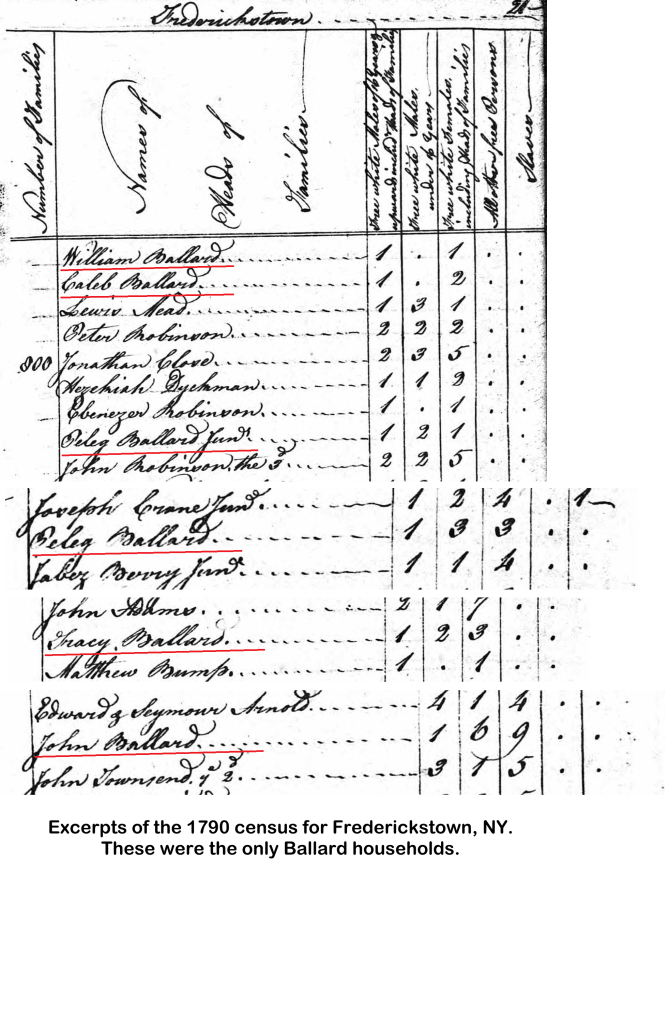
The census lists the following heads of household¹:

  • Peleg Ballard
  • Peleg Ballard, Jr.
  • John Ballard
  • Tracy Ballard
  • Caleb Ballard
  • William Ballard

This isn’t random. This is exactly what a father and his adult sons look like when they have divided up family land.

Excerpts of 1790 US Federal Census for Frederickstown, New York showing the Ballard households.
1790 US Federal Census for Frederickstown, New York

Where Was Jeremiah in 1790?

Jeremiah Ballard was born about 1765, so he was 25 years old in 1790. That means he should appear as a head of household.

But he doesn’t.

Looking closely at the census columns, something important emerges:
Every Ballard household has exactly one adult male (16+).

That means Jeremiah is not hiding in any Ballard home.
He must have been living with a non-Ballard household — common for young unmarried men who had not yet received land.

So Jeremiah didn’t vanish.
He just wasn’t a landholder yet.


Jeremiah Appears — Right Where He Belongs

By 1799, Jeremiah begins appearing in the Frederickstown tax lists, and he continues through 1803².

Then the 1800 census reveals the truth.

On the 1800 Frederickstown census page, we see³:

Caleb Ballard
Jeremiah Ballard

listed next to each other.

Census takers walked farm to farm. Neighbors on the page are neighbors in real life. And in rural New York, neighbors are usually family.

Caleb Ballard is a known son of Peleg Ballard.
Jeremiah living next door proves he belongs to the same family.

Excerpt of the 1800 US Federal Census for Frederickstown, New York. Caleb and Jeremiah Ballard are next to each other.

Which Peleg Was Their Father?

There were multiple Peleg Ballards — so which one was the father?

The 1800 census answers that.

Peleg Ballard’s 1800 household shows⁴:

  • One male over 45
  • No younger adult males
1800 Census for Peleg Ballard in Frederickstown, New York.

That fits Peleg born 1728 (age 72 in 1800).
It does not fit Peleg Jr., who would be about 40 and would have sons of his own.

By 1810, Peleg is gone. Only Caleb and Jeremiah remain in Frederickstown⁵.

That is exactly what happens when a father dies and only two sons remain on the land.


Jeremiah’s Household Includes Horace

Jeremiah’s 1800 census household shows³:

  • One adult male (Jeremiah)
  • One adult female (his wife)
  • One male under 10
  • One female under 10

That small boy is the right age to be Horace Ballard, born in 1799.

By 1810, Jeremiah’s household contains multiple sons, including one aged 10–16 — exactly where Horace belongs⁶.

1810 US Census for Frederickstown, New York - Jeremiah Ballard's household.
1810 US Census for Frederickstown, New York – Jeremiah Ballard’s household.

DNA Confirms What the Records Suggest

Paper records tell us Jeremiah was Peleg’s son and Horace was Jeremiah’s son.
DNA confirms it.

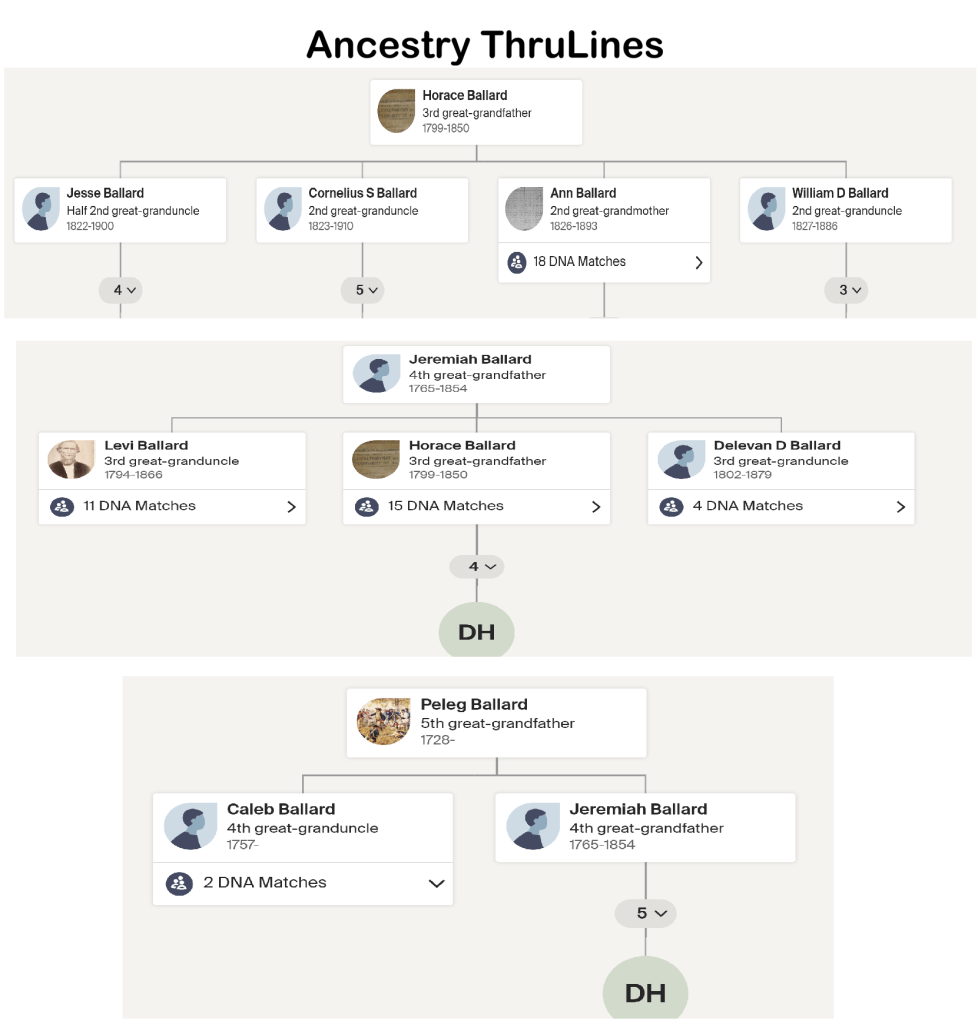
Multiple descendants of Horace Ballard match descendants of Caleb Ballard and John Ballard (Jeremiah’s brothers), all triangulating back to the Frederickstown Ballard family.

That means Horace does not belong to some other Ballard line.
He belongs here.

Ancestry's ThruLines Suggested Relationships
Ancestry’s ThruLines Suggested Relationships

Why This Matters

There is:

  • No will naming Jeremiah
  • No baptism for Horace
  • No deed saying “my son Jeremiah”

But in early New York, that is normal.

What we do have is something better:

  • Census clusters
  • Tax rolls
  • Land continuity
  • Family geography
  • And DNA

Together they form a solid proof.


Conclusion

Even without a single “smoking gun” document, the evidence shows:

Peleg Ballard (born 1728)
Jeremiah Ballard (born 1765)
Horace Ballard (born 1799)

Sometimes history whispers instead of shouting. You just have to listen long enough.


Sources

  1. 1790 U.S. Census, Frederickstown, Dutchess County, New York
  2. New York Tax Assessment Rolls, Frederickstown, Dutchess County, 1799–1803
  3. 1800 U.S. Census, Frederickstown, Dutchess County, New York
  4. Ibid., Peleg Ballard household
  5. 1810 U.S. Census, Frederickstown, Dutchess County, New York
  6. Ibid., Jeremiah Ballard household
  7. Autosomal DNA triangulation between descendants of Horace Ballard and descendants of Caleb and John Ballard (private test data)

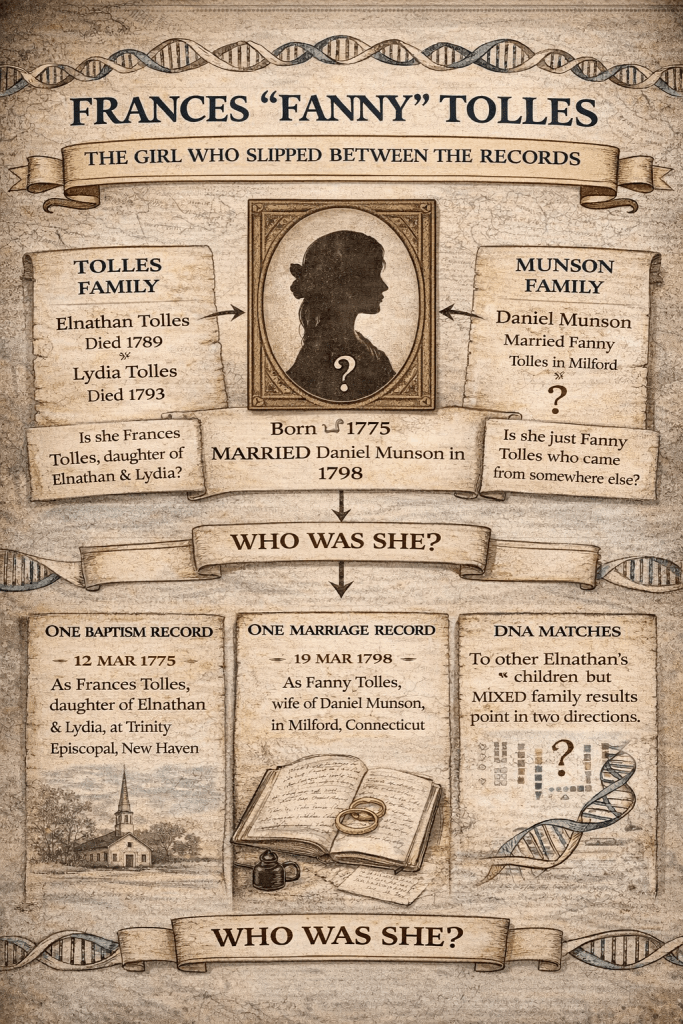
Frances “Fanny” Tolles: The Girl Who Slipped Between the Records

Genealogy often feels like assembling a puzzle — until you discover that one of the most important pieces was never cut to fit. That is what happens with Frances “Fanny” Tolles, the daughter of Elnathan and Lydia Tolles, and the woman who would later become the wife of Daniel Munson.

On paper, Fanny should be easy to find. She was baptized on 12 March 1775, just as the American Revolution was beginning. In the Episcopal records of New Haven she appears as “Frances,” daughter of Elnathan and Lydia Tolles.¹ But after that single entry, she seems to vanish.

Her parents lived in Northbury (later Plymouth), Connecticut, during the war years — a place where church and town records were scattered across jurisdictions and denominations. The Tolles family belonged to the Episcopal Church, not the Congregational churches that recorded most Connecticut vital events. As a result, many of Fanny’s milestones were preserved only in church books, not town ledgers.

Then her family fractured.

Elnathan Tolles died in 1789. Lydia followed in 1793. Their children were still young. Some were placed under guardianship, others went to live with relatives. The probate files confirm their identities as children of Elnathan and Lydia — but they do not track what happened to them afterward.²

This is where Fanny disappears.

By 1798, a Frances (or Fanny) Tolles married Daniel Munson in Milford, Connecticut — a town strongly associated with the Clark family, Fanny’s maternal kin.³ Yet nowhere in the marriage record are her parents named. There is no “daughter of Elnathan” to anchor her identity. She simply appears, gets married, and then moves on.

Later genealogies tried to solve this gap, but not all of them were confident. Early Tolles and Munson researchers knew that Daniel Munson’s wife was named Fanny Tolles, and they knew that Elnathan and Lydia had a daughter named Frances of the right age. But without a clear marriage record naming her parents, some writers hedged, quietly assigning her to Elnathan because she fit — not because a document said so.

That uncertainty lingered for generations.

In modern times, DNA added a new layer. A distant DNA match appeared to descend from another child of Elnathan Tolles, seemingly supporting Fanny’s placement in the family. But further research revealed a second, older connection through the Mix family, meaning the DNA could not be used to prove Fanny’s parentage after all. The evidence was real — but it pointed in two directions.

This is why I have over 64,000 people in my family tree. Not because I like big numbers, but because tiny errors in the 1700s ripple forward into the DNA era.

So who was Fanny Tolles?
Was she truly the daughter of Elnathan and Lydia?
Or was she “assigned” to them because no better answer existed?

To find out, we have to leave church books and DNA charts behind — and turn to something far more powerful: probate law.


Sources

  1. Trinity Church (Episcopal), New Haven, Connecticut, baptismal records, 12 March 1775, Frances Tolles, daughter of Elnathan and Lydia Tolles; abstracted in Donald Lines Jacobus, Families of New Haven, vol. VIII (1932).
  2. Probate of Elnathan and Lydia Tolles, Plymouth (Watertown) District, Litchfield County, Connecticut, 1789–1794, combined estate file, listing their children including Frances.
  3. Milford, Connecticut, Marriage Records, 19 March 1798, Daniel Munson and Frances (Fanny) Tolles; cited in The Munson Record and Milford town records.

John Rivers (1828–1902)

For many years, my second great-grandfather John Rivers was one of the most stubborn brick walls in my family tree. I knew when and where he lived as an adult, but his early life was completely undocumented. He appeared in Michigan in the early 1860s, married, and raised a large family—but nothing in U.S. records clearly revealed who he had been before crossing the border from Canada.

It took DNA evidence, careful work with French-Canadian church records, and a great deal of patience to finally reconstruct his origins.

A Man Who Appeared in Michigan

John Rivers was born in Quebec, Canada, in the late 1820s. Over the years, U.S. records reported his birth anywhere from 1824 to 1830, a common problem for 19th-century immigrants whose ages were often estimated. What was consistent was that he was Canadian-born.

In many U.S. census records, he was described specifically as “French Canadian.” That detail mattered: it pointed not just to Canada, but to French-speaking Quebec.

Long before DNA entered the picture, I found another clue. When I was a child, I discovered a handwritten note tucked into an old family Bible, written by my paternal grandmother, stating that John Rivers was born in Quebec. At the time, I had no way to verify it. Sadly, that slip of paper has since been lost. But years later, when I began working with census records, I realized something important: what my grandmother had written matched what the census takers had recorded decades earlier.

Two independent sources—one familial, one official—were quietly telling the same story.

By 1860, John had crossed into the United States. In 1862, he married Frances Jane Munson in Michigan. They settled in Saginaw County, where John worked and farmed while raising a large family.

Between 1863 and 1887, Frances gave birth to at least twelve children. Like many rural Michigan families of the period, they also experienced tragedy: two daughters born in 1868 and 1869 died in infancy, and a son, Franklin, born in 1874, died at age six.

Census records place John and Frances in Taymouth Township and later in Albee Township, part of the agricultural and lumber economy of mid-Michigan. By 1900, John was still living in Taymouth, surrounded by adult children beginning families of their own.

John died on 21 November 1902 in Taymouth Township, Saginaw County, Michigan, from broncho-pneumonia. He was buried two days later in Taymouth Township Cemetery. His Michigan death certificate, however, leaves both parents’ names blank.

Family Stories Without Proof

Two family stories followed John Rivers through the generations. One said he had come to Michigan as a Jesuit priest or with one. Another claimed he was part Native American.

These stories were preserved in family memory, but no documentation has yet been found to confirm either one. What has been discovered is that several of John’s ancestors and close relatives in Quebec were affiliated with the Jesuit order, which may explain how the priest story entered the family narrative—even if John himself was not a priest. The Native American claim, however, has not been supported by records or DNA.

The DNA Breakthrough

The real breakthrough came through genetic genealogy.

I tested in all the major DNA databases and had a male double first cousin test as well, giving us a broader pool of shared matches. His autosomal DNA produced connections I did not inherit by chance. Using results from Ancestry, 23andMe, and FamilyTreeDNA, I began building trees for our shared matches.

Again and again, the same French-Canadian families appeared.

Eventually, those matches converged on one Quebec couple:
Jean-Baptiste Larivière and Rose Dufault.

That gave me a working hypothesis. The next step was to find records.

How the “Dit” Name Led Me Down the Wrong Path

Early in the research, I found a baptism for Jean Beaudoin dit Larivière in 1824. It looked promising:

  • Jean → John
  • Larivière → Rivers
  • The timing was close

What confused me was the “dit” name. In French-Canadian records, a dit name is an alternate surname used by a branch of a family. I initially misunderstood it and thought this might be my ancestor.

Once DNA evidence was added, it became clear that this child belonged to a different family line and was not my John Rivers. That realization kept me searching.

The Right Jean

That search led me to a different baptism — this time simply Jean Larivière.

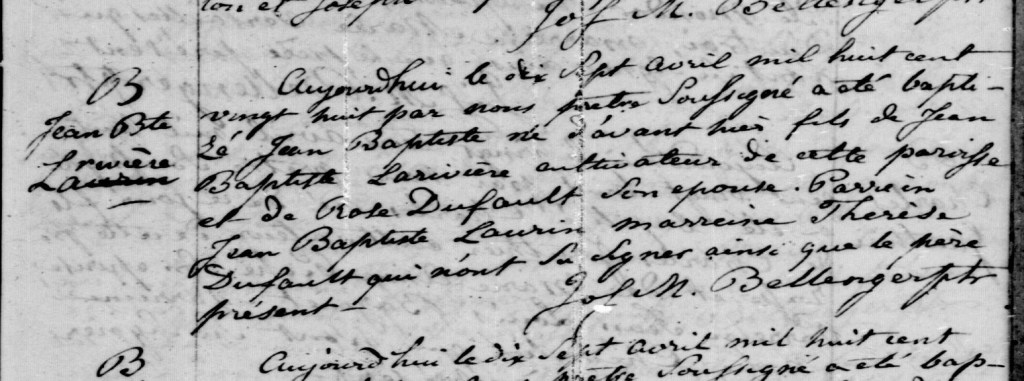
Original French (as written in the register)
Aujourd’huy le dix sept avril mil huit cent vingt huit par nous prêtre soussigné a été baptisé Jean Baptiste né d’avant hier fils de Jean Baptiste Larivière cultivateur de cette paroisse et de Rose Dufault son épouse. Parrain Jean Baptiste Laurin marraine Thérèse Dufault qui n’ont su signer ainsi que le père présent. – J. M. Bellenger ptre

English Translation
“Today, the seventeenth of April eighteen hundred twenty-eight, by us the undersigned priest, was baptized Jean Baptiste, born the day before yesterday, son of Jean Baptiste Larivière, farmer of this parish, and of Rose Dufault his wife.
Godfather Jean Baptiste Laurin, godmother Thérèse Dufault, who did not know how to sign, as well as the father who was present. – J. M. Bellenger, priest.”

He was baptized on 17 April 1828 at Saint-Paul-de-Joliette, Quebec, born two days earlier on 15 April 1828, the son of Jean-Baptiste Larivière and Rose Dufault — the very couple identified by the DNA evidence.

The name fit.
The date fit.
And now, so did the DNA.

After adding Jean-Baptiste Larivière and Rose Dufault to my tree, DNA matches began appearing through ThruLines and shared match groups for their children, grandchildren, and extended family. While each match still needs individual verification, the genetic evidence lines up with the documentary trail.

There is no single record stating outright that “John Rivers of Michigan is Jean Larivière of Quebec.” His U.S. death certificate does not name his parents. But in genealogy, proof is built through converging evidence—and here, the church records, migration pattern, census data, family memory, and DNA all point to the same conclusion.

No Longer a Brick Wall

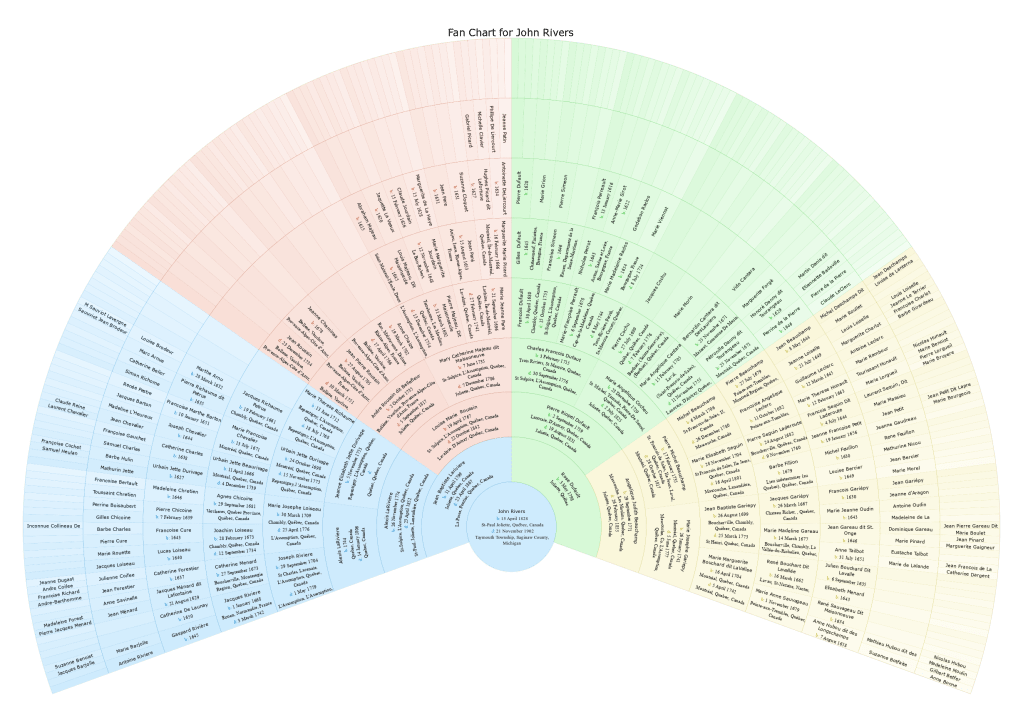
John Rivers is no longer a mystery man who appeared out of nowhere in Michigan. He was born Jean Larivière in Joliette, Quebec, in 1828, the son of Jean-Baptiste Larivière and Rose Dufault, part of a deep French-Canadian family whose lines extend back many generations.

His journey—from Quebec parish registers to Michigan farmland, from a French surname to an English one—was hidden for nearly two centuries. It was DNA, combined with traditional genealogy, that finally brought his story back into the family.

Fan chart showing the French-Canadian ancestry of John Rivers (Jean Larivière), reconstructed through DNA and Quebec parish records.

Four Abraham Smiths in One Family Tree

One of the most challenging parts of family history research is sorting out people who share the same name. In my own family tree, I descend from four different men named Abraham Smith. They fall into two father–son pairs, belonging to two entirely separate families. Although their names are identical, their lives unfolded in different places and under very different circumstances.


The Massachusetts–Vermont Abraham Smiths

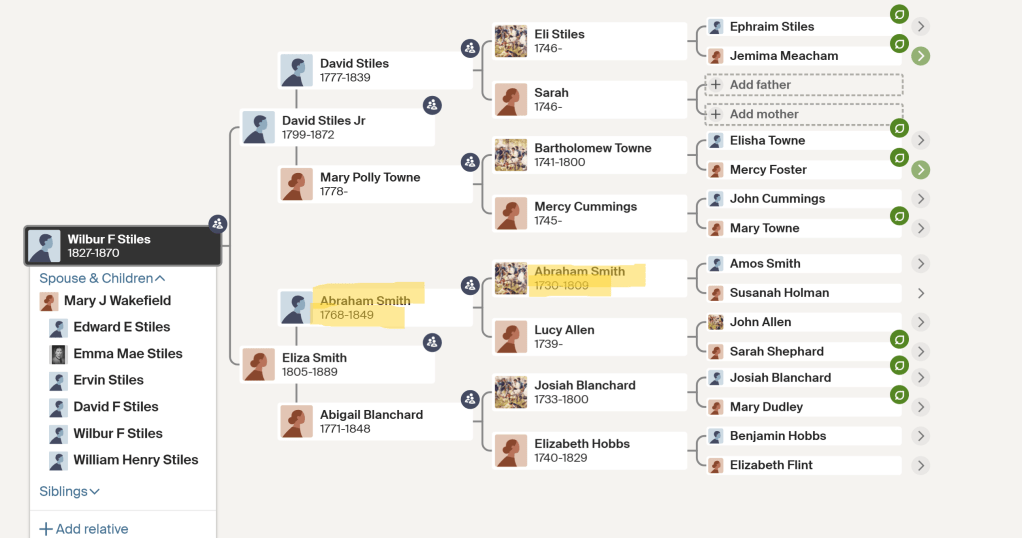
Abraham Smith (1730–1809)

Abraham Smith was born on 20 September 1730 in Sudbury, Middlesex County, Massachusetts, the son of Amos Smith (1699–1786) and Susanah Holman (1702–1778). He grew up in Sudbury alongside his brothers Jacob, Benjamin, and Jonathan. On 24 July 1763, he married Lucy Allen in Newton, Massachusetts. Lucy had been born in 1739 in Weston, Massachusetts. Their children were born in Massachusetts:

  • Polly Smith, born 20 November 1766
  • Abraham Smith, born 27 October 1768 in Worcester
  • Allen Smith, born 6 April 1770

During the American Revolutionary War, Abraham Smith served in the Vermont militia. His service appears in The State of Vermont: Rolls of the Soldiers in the Revolutionary War 1775–1783, compiled by John E. Goodrich. Abraham Smith is listed on the roll of Captain Gideon Brownson’s Company, on a roster dated 26 February 1776 for the Montreal expedition, placing him in the northern theater of the war. This company was part of the militia forces raised in the Vermont region for operations connected with the occupation of Canada during the early stages of the war.

By 1790, Abraham was living in Tinmouth, Rutland County, Vermont, where he appears in the federal census. He remained there until his death on 4 November 1809, closing a life that spanned from colonial Massachusetts through the Revolutionary War and into the early years of the United States.


Abraham Smith (1768–before 1849)

The second Abraham in this line was born 27 October 1768 in Worcester, Massachusetts, the son of Abraham Smith and Lucy Allen. He married Abigail Blanchard on 9 February 1797 in Sturbridge, Massachusetts. Abigail was born in 1771 and later died in Brookfield, Vermont.

By the early 1800s, this family had settled in Orange County, Vermont, primarily in Brookfield. Their children included:

  • Harriot Louise Smith (1798–1878)
  • Abigail Smith (1800–1879)
  • Amasa Austin Smith (c.1801–1808)
  • Eliza Smith (1805–1889)
  • John Allen Smith (1809–1884)

Through these children, this Smith line later extended westward into Wisconsin and Michigan, particularly through the Fuller, Stiles, and Loomis families. Abraham Smith (1768) died before 10 April 1849 in Orange, Vermont.


The Pennsylvania Abraham Smiths

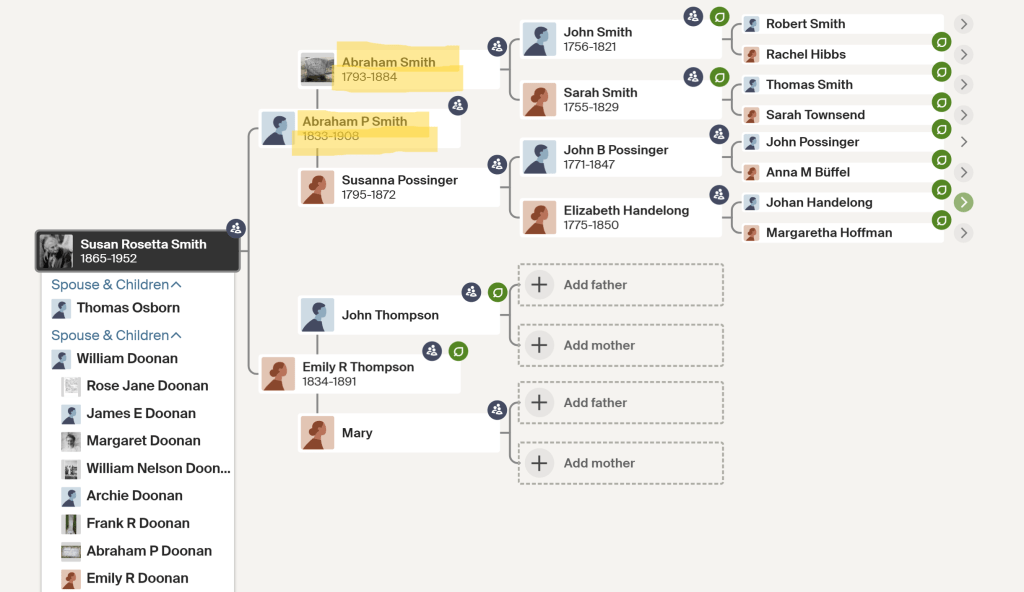
Abraham Smith (1793–c.1884)

A second, unrelated Abraham Smith was born on 29 January 1793, probably in Wrightstown, Bucks County, Pennsylvania. He was the son of John Smith (1756–1821) and Sarah Smith (1755–1829), a family associated with the Wrightstown Monthly Meeting of Friends (Quakers).

Abraham married Susanna Possinger (1795–1872), the daughter of John B. Possinger and Elizabeth Handelong. By 1830, Abraham and Susanna were living in Jackson Township, Monroe County, Pennsylvania, where Abraham appears in census records from 1830 through 1880. This area, in the Pocono region, became the permanent home of this branch of the family.

Their children included:

  • Fannie Smith (1813–1876)
  • Sarah Smith (1815–1900)
  • Catharine Smith (1826–1891)
  • Susan Smith (c.1828–1909)
  • Joseph Possinger Smith (1830–1882)
  • Abraham Possinger Smith (1833–1908)

The repeated use of “Possinger” as a middle name preserved Susanna’s maiden name and helps distinguish this Smith family from others in Pennsylvania.

Susanna died in 1872. Abraham remained in Jackson Township, Monroe County, until his death about 1884. He was buried in Tannersville Union Cemetery in Monroe County.


Abraham Possinger Smith (1833–1908)

The youngest of the four Abraham Smiths was born in May 1833 in Pennsylvania, the son of Abraham Smith and Susanna Possinger. He married Emily Rebecca Thompson before 1854 and later Susan Smith.

Over the course of his life, Abraham Possinger Smith lived in Pennsylvania, Michigan, and Washington State. He died on 29 June 1908 in Shelton, Mason County, Washington. His children included:

  • Frank E. Smith
  • Jude Smith
  • Elmira Smith
  • Robert Smith
  • Susan Rosetta Smith
  • Fanny Florence Smith
  • Abraham Edward Smith

Through this line, descendants spread into Bay County, Michigan, Ontario, Canada, and the Pacific Northwest, giving this Smith branch a wide geographic reach.


Two Names, Two Families

Although all four men bore the name Abraham Smith, the records show they belonged to two completely separate families:

Family LineFatherSon
Massachusetts → VermontAbraham Smith (1730–1809)Abraham Smith (1768–1849)
Pennsylvania → Monroe County → WestAbraham Smith (1793–c.1884)Abraham Possinger Smith (1833–1908)

Their lives overlapped in time but not in place or ancestry. Together, they illustrate how a single name can run through multiple generations and unrelated families, creating confusion that only careful documentation can resolve.

Technically, I have 8 different Abraham Smith’s in my family tree. However, only 4 are direct ancestors – the others are “cousins” or married into the family.

Martin V. Lacy (1833–1904)

Martin V. Lacy was born in September 1833 in Le Ray (often recorded as Leray), Jefferson County, New York. He was the son of Erastus Lacy (1790–1856) and Florilla Billings (1793–1860). Early census and family records place him in Jefferson County during his childhood years, where he lived among several siblings, including Jane, Julia, Milo, and others.¹

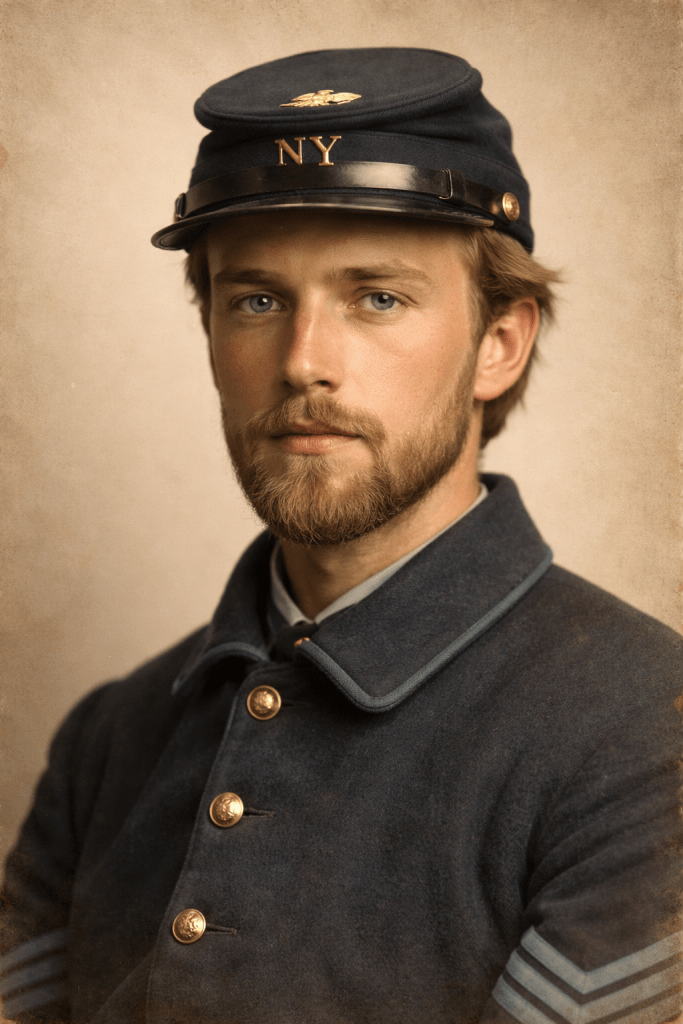
On 28 November 1855, Martin married Henrietta O’Dell (1838–1865) in Genesee County, Michigan.² By 1860, he was residing in Brownville, Jefferson County, New York, where he appeared in the federal census with his occupation listed as farmer.³ A military description recorded in August 1862 described him as having blue eyes, sandy hair, a light complexion, and a height of five feet eleven inches.⁴

Image generated by ChatGPT of Martin Lacy based on his military description.

Martin served in the American Civil War. He enlisted in August 1862 with the 35th New York Infantry, Company I, and later served with the 80th New York Infantry, Company H, during 1863.⁵ Military records place him in Watertown and Albany, New York, during his service, and a residence record dated 1 July 1863 lists him in Fabius, New York.⁶

Martin and Henrietta had several children: Adelbert Lacy, born in November 1859 in Michigan; Helen Mae Lacy, born 3 June 1860 in Brownville, New York; and Fred Lacy, born 12 December 1860 in Michigan.³ Henrietta Lacy died in 1865 in Charles City, Virginia.⁷

On 25 March 1866, Martin married Nancy J. Whitney (1843–1906) in Taymouth Township, Saginaw County, Michigan.⁸ The couple settled in Michigan, where Martin appeared regularly in state and federal census records. Their children included Emma Lacy (born 1866), Alice Lacy (born 1 June 1869 in Montrose, Genesee County), Mary Belle Lacy (born 13 August 1875), and William Henry Lacy (born 26 May 1878).⁹

By 1870, Martin was living in Montrose, Genesee County, Michigan, and by the mid-1870s he had acquired land in Kawkawlin Township, Bay County, Michigan, as documented in federal land records dated 1 August 1874.¹⁰ Census records from 1880 through 1900 consistently place him in Kawkawlin Township, where he was listed as married and head of household.¹¹

Throughout his life, Martin experienced the deaths of numerous family members, including his parents, siblings, and children Fred (1883) and Emma (1897).¹² He remained in Bay County into the early twentieth century.

Martin V. Lacy died on 8 August 1904 in Garfield Township, Bay County, Michigan. His death certificate records the cause of death as cardiac disease.¹³ He was seventy years old at the time of his death.


Sources

  1. U.S. Federal Census, 1860; Brownville, Jefferson County, New York.
  2. Michigan, County Marriage Records, 1822–1940, Genesee County, marriage of Martin V. Lacy and Henrietta O’Dell, 28 November 1855.
  3. U.S. Federal Census, 1860; Brownville, Jefferson County, New York.
  4. New York, Civil War Muster Roll Abstracts, 1861–1900, description dated 20 August 1862.
  5. U.S. Civil War Soldier Records and Profiles; service with 35th New York Infantry, Company I, and 80th New York Infantry, Company H.
  6. New York, U.S., Compiled Census and Census Substitutes Index, 1790–1890.
  7. Michigan, Death Records, 1867–1950; death of Henrietta (O’Dell) Lacy, 1865.
  8. Michigan, County Marriages, 1822–1940; marriage of Martin V. Lacy and Nancy J. Whitney, 25 March 1866.
  9. Michigan, U.S., Birth Records, 1867–1914; Lacy family entries.
  10. U.S. General Land Office Records, 1776–2015; land patent, Kawkawlin Township, Bay County, Michigan, 1 August 1874.
  11. U.S. Federal Census, 1870, 1880, 1900; Michigan State Census, 1884, 1894; Kawkawlin Township, Bay County, Michigan.
  12. Michigan, Death Records and U.S., Find A Grave Index.
  13. Michigan, Death Records, 1867–1950; death certificate of Martin V. Lacy, 8 August 1904.