The Josiah of New Braintree

A Tempting but Unproven Identification

The Josiah Many Trees Attach

A large number of online family trees identify my ancestor, Josiah Willington (husband of Polly Hutchinson), as the son of Josiah Willington and Susanna Stearns. This identification almost always rests on a single individual: the child described in Bond’s History of Watertown as “Josiah of New Braintree,” the only known child of Josiah Willington (b. 1745) and Susanna Stearns, who died in 1766.¹

At first glance, this seems appealing. The name matches. The time period overlaps. And “New Braintree” is geographically plausible within a Massachusetts–Vermont migration pattern. But genealogy is not built on plausibility alone.


What Bond Actually Says

Bond is careful, and his wording matters. He identifies Josiah Willington, born April 4, 1745, son of Thomas Willington and Margaret Stone, who married Susanna Stearns. Susanna died in 1766. Bond then lists one child, identified only as “Josiah of New Braintree.”²

Bond does not provide a birth date for that child, nor a marriage, spouse, children, migration trail, or death record. His entry ends there. This is not unusual in compiled genealogies, but it means the identification stops precisely where many modern trees begin to speculate.


The Age Question and the 1810 Census

The 1810 U.S. census for Braintree, Orange County, Vermont shows Josiah Willington as the sole adult male in his household, aged between 26 and 44.³ This bracket allows for a birth as early as 1766. If the “Josiah of New Braintree” were born in the same year his mother died, he would be 44 years old in 1810, which fits the census category.

Census age brackets establish possibility, not identity.
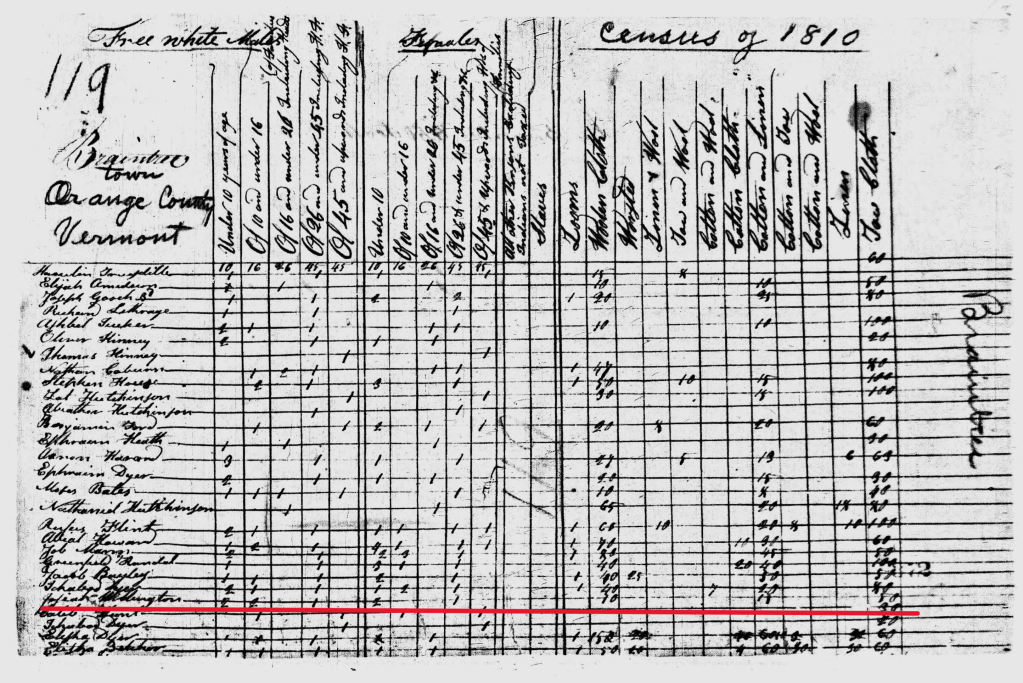
1810 US Federal Census for Braintree, Vermont.
Close-up of Josiah Willington household from the 1810 census.

The Age Gap with Polly Hutchinson

Polly Hutchinson was born in 1782.⁴ If Josiah were born in 1766, he would be approximately sixteen years older than his wife.

Such an age gap is not impossible in late eighteenth-century New England, but it is less typical for a first marriage. Larger gaps are more often associated with widowers, and there is no evidence that Josiah Willington had been previously married before his 1794 marriage to Polly Hutchinson in Worcester.⁵ The age difference does not disprove the theory, but it raises the standard of proof required to support it.


The Hutchinson Cluster in Braintree

The 1810 census page for Braintree is significant for another reason: the Hutchinson family appears on the same enumeration, near Josiah Willington’s household. The households of Lot Hutchinson and Abiathar Hutchinson are recorded in the same sequence as Josiah’s.³ These are not random names. Lot Hutchinson is Polly’s father, and Abiathar Hutchinson is Polly’s brother.⁶

This matters because early federal census schedules were recorded in the order the enumerator visited households, which typically reflects geographic proximity and often reflects kin-based settlement patterns. The Braintree census therefore shows Josiah living within Polly’s family network.

Equally important, there are no other Willington or Wellington households in Braintree in the 1810 census.³ Josiah appears as a single Willington household surrounded not by paternal kin, but by his wife’s family.

This does not prove his parentage, but it does show where his documented family network lies once the record trail becomes clear.


The Temptation to Explain Silence

At this point, it becomes tempting to construct a narrative: Susanna Stearns dies in childbirth or shortly thereafter; Josiah grows up motherless; his father remarries; Josiah becomes estranged from his paternal family; he leaves with no paper trail and reappears years later in Worcester and then Vermont.

This story is emotionally coherent, but genealogy cannot be built on satisfying explanations.

Estrangement is one of the hardest things to prove in eighteenth-century records, but it is rarely completely invisible. Even estranged children often appear in wills, guardianships, land divisions, apprenticeships, or church records. No such record has been found connecting the “Josiah of New Braintree” to the adult Josiah of Worcester and Vermont.

What we have is not evidence of estrangement. It is silence.


The Missing Documentary Bridge

If my Josiah were the son of Josiah and Susanna Stearns, at least one document would reasonably be expected to connect him forward in time: a record naming origin, a removal or church dismissal, a deed, a probate reference, or a Willington kin connection in Vermont.

Instead, the surviving records place him firmly in a different documented pattern: marriage in Worcester in 1794 with both parties “of Worcester,”⁵ residence in Braintree, Vermont by 1810 within the Hutchinson family cluster,³ and probate in Vermont with no references to Massachusetts Willington kin.⁷ No document links him backward to Watertown, Weston, or New Braintree.


Why This Identification Persists

The persistence of this theory in online trees is understandable. Researchers are confronted with multiple Josiah Willingtons in Massachusetts, incomplete birth records, and a conveniently named child whose adulthood is undocumented. Faced with a brick wall, many choose the explanation that makes the puzzle fit.

At present, identifying my ancestor Josiah Willington as the son of Josiah Willington and Susanna Stearns remains possible but unproven. It rests on age compatibility and name alone, without a single document bridging the gap between childhood and adulthood.

Possibility is not proof.


Sources

  1. Henry Bond, Genealogies of the Families and Descendants of the Early Settlers of Watertown, Massachusetts (Boston: Little, Brown and Company, 1860), Wellington section.
  2. Ibid.
  3. 1810 U.S. Census, Braintree, Orange County, Vermont, households including Josiah Willington, Lot Hutchinson, and Abiathar Hutchinson.
  4. Sutton, Massachusetts, vital records, birth of Molly (Polly) Hutchinson, 1782.
  5. Worcester, Massachusetts, marriage records, Josiah Willington and Polly Hutchinson, 6 September 1794.
  6. Perley Derby, The Hutchinson Family: or the Descendants of Barnard Hutchinson of Cowlam, England (Salem, MA: Essex Institute Press, 1870), entries for Lot Hutchinson and his children, including Polly and Abiathar.
  7. Vermont probate records, estate of Josiah Willington, proved 1818.
Following the Trail

Worcester, Vermont, and the Limits of Paper Records

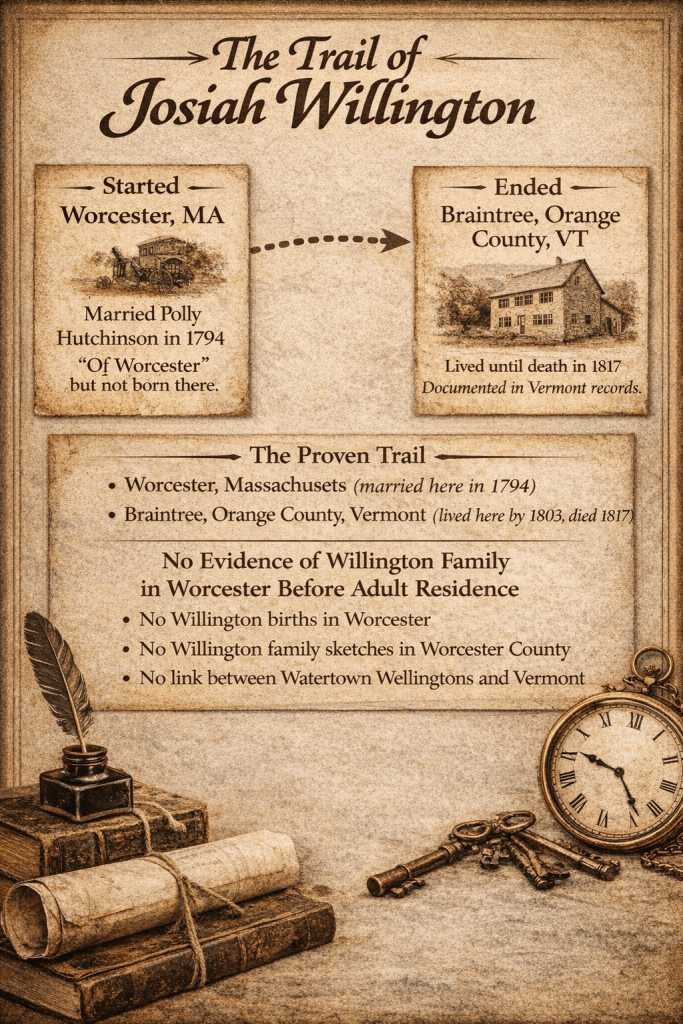
If the name problem explains how false parentage is created, geography explains how those errors persist. In the case of Josiah Willington who married Polly Hutchinson, the surviving records form a narrow but consistent geographic trail. That trail begins in Worcester, Massachusetts, and ends in Braintree, Orange County, Vermont. What lies outside that trail is just as important as what lies within it.


What “of Worcester” Actually Means

The 6 September 1794 marriage record for Josiah Willington and Polly Hutchinson states that both parties were “of Worcester.”¹ In Massachusetts vital records, this phrase identifies legal residence at the time of marriage, not place of birth. It does not imply parentage, childhood residence, or family origin.

This distinction matters. Many compiled genealogies treat “of Worcester” as synonymous with “born in Worcester,” but town clerks did not use the phrase in that way. A person could be “of” a town after residing there only briefly, particularly if employment or marriage brought them in.


Worcester Birth Records and a Meaningful Absence

A review of Worcester town birth records for the eighteenth century reveals no births for individuals with the surname Willington or Wellington.² This is not merely the absence of a Josiah; it is the absence of the surname entirely.

Worcester’s vital records for this period are comparatively robust. Numerous families appear repeatedly, and children born to transient laborers are often recorded. The complete absence of the Willington/Wellington surname strongly suggests that Josiah was not born in Worcester and that his family was not established there at the time of his birth.

Negative evidence of this kind does not identify parents, but it does eliminate Worcester as a likely place of origin.


Polly Hutchinson and Worcester County Context

Polly Hutchinson provides additional context. She was born in 1782 in Sutton, Worcester County, Massachusetts, a town located southeast of Worcester.³ Sutton’s birth records include multiple Hutchinson families but, like Worcester, contain no Willington or Wellington births during the relevant period.⁴

This pattern suggests that Josiah’s presence in Worcester was likely tied to adult residence or employment rather than family origin. It is consistent with a scenario in which Josiah relocated to Worcester County as a young man and met Polly there prior to their marriage.


The Vermont Migration Pattern

By the early nineteenth century, Josiah Willington appears consistently in Vermont records. His children’s births, his appearance in the 1810 federal census, and his probate all place him in Braintree, Orange County, Vermont.⁵

This movement fits a well-documented migration pattern: late eighteenth-century settlers moving from central Massachusetts into Vermont following land openings and post-Revolutionary settlement opportunities. Worcester County was a common staging area for this westward and northward movement, even for individuals who had not been born there.

Crucially, none of the Josiah Willingtons documented in Bond’s History of Watertown are traced into Vermont. Bond’s families remain centered in Middlesex County and adjacent towns, with no documented link to Orange County, Vermont.⁶


Why Watertown-Centered Lineages Struggle to Fit

Attempts to link the Vermont Josiah to the Watertown Willington families rely on circumstantial reasoning: shared given names, approximate ages, and geographic proximity. But proximity alone is not enough.

Worcester lies west of Watertown, and while travel between the two was certainly possible, no record has been found placing any of Bond’s Josiahs in Worcester prior to 1794. Likewise, no record places any Watertown-based Josiah in Vermont in the early nineteenth century.

Without documentation showing movement from Watertown to Worcester and then to Vermont, these connections remain speculative.


What the Records Do Show Consistently

Across all surviving records, the Josiah Willington who married Polly Hutchinson appears only in the following contexts:

Worcester, Massachusetts, at the time of marriage in 1794.¹
Braintree, Orange County, Vermont, from at least 1803 through his death in 1817.⁵
Vermont probate and newspaper notices following his death.⁷

He does not appear in Middlesex County town records as a child, does not appear in Watertown family sketches, and does not appear in Worcester birth records. This narrow geographic footprint argues for caution in assigning parentage.


The Value of Geographic Restraint

One of the most difficult disciplines in genealogical research is restraint: resisting the urge to extend a lineage beyond what the records can support. In this case, geography acts as a boundary. It limits which records can plausibly belong to the same individual and which cannot.

Rather than proving who Josiah Willington’s parents were, the geographic evidence clarifies who they likely were not. That clarification is essential groundwork for any future discovery.


Sources

  1. Worcester, Massachusetts, marriage records, 6 September 1794, Josiah Willington and Polly Hutchinson.
  2. Worcester town birth records, eighteenth century, review showing no entries for Willington or Wellington surnames.
  3. Sutton, Massachusetts, town birth records, 1782, birth of Molly (Polly) Hutchinson.
  4. Sutton, Massachusetts, town birth records, review showing no entries for Willington or Wellington surnames.
  5. Vermont vital records and federal census schedules, Braintree, Orange County, including births of children, 1810 census, and death of Josiah Willington in 1817.
  6. Henry Bond, History of Watertown, Massachusetts (Boston: Little, Brown and Company, 1860), Wellington family sketches.
  7. Vermont Republican and Journal (Windsor), probate notice for Josiah Willington, May 1818.

The Name Trap

Why Multiple Josiah Willingtons Create False Lineages

One of the most persistent sources of error in New England genealogy is the assumption that identical names refer to a single individual. When a name repeats across generations, towns, and families, records that belong to different men are easily—and often incorrectly—merged.

The case of Josiah Willington illustrates this problem clearly. Multiple men of the same name lived in Massachusetts during the eighteenth and early nineteenth centuries, some contemporaneously. These men are documented in respected published sources, yet none can be automatically identified as the Josiah Willington who married Polly Hutchinson in Worcester in 1794 and later settled in Vermont.


The Six Josiah Willingtons in Bond’s History of Watertown

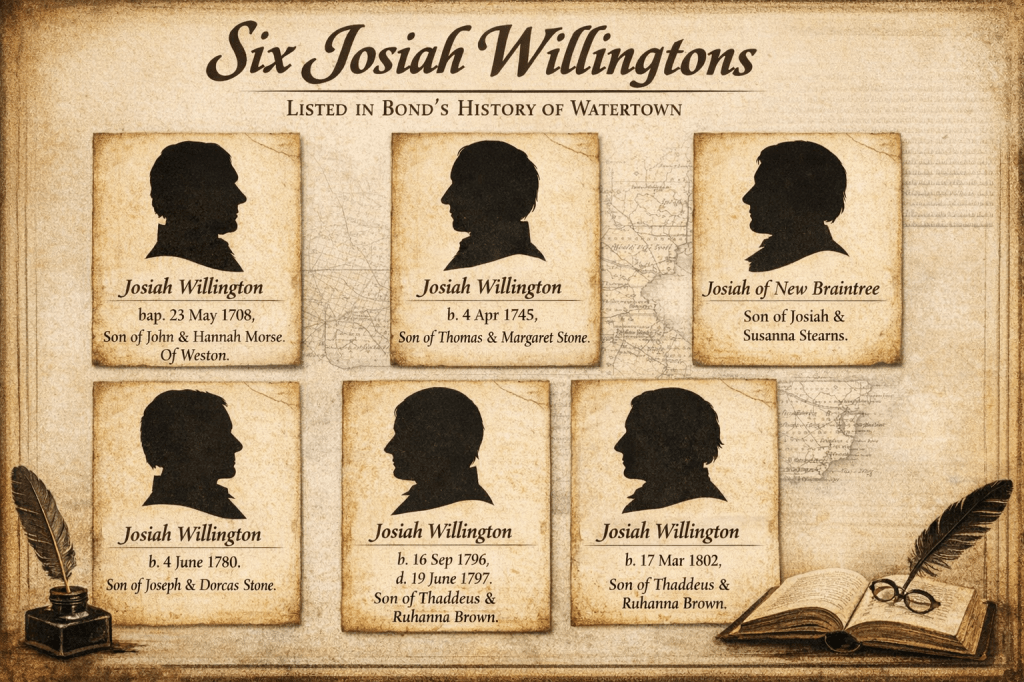
Henry Bond’s History of Watertown, Massachusetts documents six distinct individuals named Josiah Willington across multiple generations of the Wellington family.¹ These entries demonstrate both the frequency of the name and the danger of assuming identity based on name alone.

The six Josiah Willingtons identified by Bond are:

Josiah Willington, baptized 23 May 1708, son of John Willington and Hannah Morse. Bond identifies this Josiah as “of Weston” and records that he married a woman named Mary.²

Josiah Willington, born 4 April 1745, son of Thomas Willington and Margaret Stone. This Josiah married Susanna Stearns, who died in 1766.³

Josiah Willington of New Braintree, identified by Bond as the son of Josiah Willington (born 1745) and Susanna Stearns.⁴

Josiah Willington, born 4 June 1780, son of Joseph Willington and Dorcas Stone.⁵

Josiah Willington, born 16 September 1796 and died 12 June 1797, son of Thaddeus Willington and Ruhanna Brown.⁶

Josiah Willington, born 17 March 1802, also a son of Thaddeus Willington and Ruhanna Brown.⁷

These entries represent six separate individuals appearing in distinct family sketches and generational contexts. Some lived only briefly, others reached adulthood, and several overlapped chronologically with the Josiah Willington who married Polly Hutchinson in 1794.


What Bond Does and Does Not Establish

Bond’s work demonstrates that the name Josiah Willington was reused repeatedly within the extended Wellington family. This repetition alone makes name-based identification unsafe.

At the same time, Bond does not identify a Josiah Willington who married Polly Hutchinson, does not place any Josiah Willington in Worcester, Massachusetts, and does not trace any Josiah Willington to Vermont. Bond’s sketches are centered on Watertown and nearby Middlesex County towns, and they do not extend to Worcester County or later Vermont settlers.

Bond therefore provides important context for name repetition, but it does not establish identity for the Josiah Willington associated with Worcester and Braintree, Vermont.


Documented Marriages Involving Men Named Josiah Willington

Independent of Bond, Massachusetts town records document several marriages involving men named Josiah Willington or Wellington during the same general period:

Josiah Wellington married Susanna Stearns in 1765.³
A Josiah Wellington married Mary Smith in Sudbury in the early 1770s.⁸
Josiah Wellington married Zilpah Delano in Norton in 1772.⁹
Josiah Willington married Polly Hutchinson in Worcester on 6 September 1794.¹⁰

These marriages involve different women, different towns, and different time frames. No record has been found that connects any of these men to one another through remarriage, migration, or parentage.


The Absence of Willington Births in Worcester

The marriage record of 1794 states that Josiah Willington was “of Worcester,” a phrase that denotes legal residence rather than birthplace. A review of Worcester town birth records reveals no births for individuals with the surname Willington or Wellington at all, not merely the absence of a Josiah.¹¹

This absence is significant. Worcester’s vital records for the eighteenth century are comparatively thorough, and many other families are well represented. The lack of any Willington or Wellington births indicates that the family was not established in Worcester during the period when Josiah would have been born.

This evidence supports the conclusion that Josiah was not born in Worcester, but arrived there from another town or county prior to his marriage.


Overlapping Lifespans and Separate Locations

The existence of multiple adult men named Josiah Willington is further supported by overlapping lifespans. Men marrying in the 1760s and 1770s could still have been living in the 1790s, making it unsafe to assume that a later marriage represents the same individual without corroborating evidence.

Geography reinforces this separation. The towns associated with these Josiahs—Watertown, Weston, Sudbury, Norton, and Worcester—span multiple counties. While movement between towns was common, no record has been found that traces a specific Josiah from any of Bond’s Watertown families into Worcester and then onward to Vermont.


Why Name Duplication Matters

In eighteenth-century New England, the reuse of given names across generations was common. Sons were often named for fathers, grandfathers, or uncles, resulting in multiple contemporaries with identical names living within a relatively small geographic area.

In this case, the presence of six documented Josiah Willingtons means that records must be assigned cautiously. Marriages cannot be merged without proof, and parentage cannot be inferred based solely on name similarity. Bond’s documentation confirms name repetition but does not resolve identity for men appearing outside his geographic scope.


Sources

  1. Henry Bond, History of Watertown, Massachusetts (Boston: Little, Brown and Company, 1860), Wellington family sketches.
  2. Ibid., entry for Josiah Willington, baptized 23 May 1708, son of John Willington and Hannah Morse.
  3. Ibid., entry for Josiah Willington, born 4 April 1745, son of Thomas Willington and Margaret Stone; marriage to Susanna Stearns.
  4. Ibid., entry identifying Josiah of New Braintree as son of Josiah Willington (b. 1745) and Susanna Stearns.
  5. Ibid., entry for Josiah Willington, born 4 June 1780, son of Joseph Willington and Dorcas Stone.
  6. Ibid., entry for Josiah Willington, born 16 September 1796, son of Thaddeus Willington and Ruhanna Brown.
  7. Ibid., entry for Josiah Willington, born 17 March 1802, son of Thaddeus Willington and Ruhanna Brown.
  8. Massachusetts town records, Sudbury, marriage of Josiah Wellington and Mary Smith.
  9. Massachusetts town records, Norton, marriage of Josiah Wellington and Zilpah Delano, 1772.
  10. Worcester, Massachusetts, marriage records, 6 September 1794, Josiah Willington and Polly Hutchinson.
  11. Worcester town birth records, eighteenth century, review of births showing no entries for the surnames Willington or Wellington.

Abraham Smith (1768–1849) of Worcester, Massachusetts, and Brookfield, Vermont

From Massachusetts Roots to a Vermont Homestead

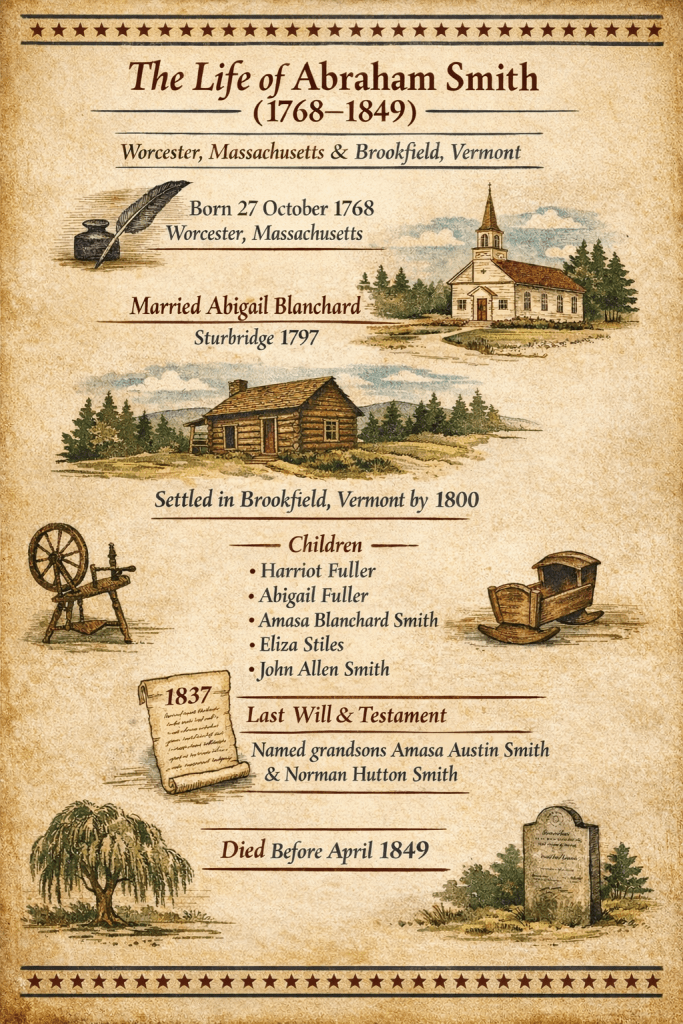
Abraham Smith was born on 27 October 1768 in Worcester, Worcester County, Massachusetts, the son of Abraham Smith and Lucy Allen.¹ He reached adulthood in the years following the American Revolution, a period shaped for him not by military service, but by marriage, migration, and the establishment of a household.

Abraham Smith Jr.’s adult life is well documented through marriage records, census context, probate files, and Vermont vital records, allowing his life and family to be reconstructed with confidence.

Marriage and Early Family Life

On 9 February 1797, Abraham Smith married Abigail Blanchard in Sturbridge, Massachusetts.² Shortly after their marriage, the couple began moving northward, a pattern common among young New England families seeking land and opportunity in the post-Revolutionary period.

Their first known child, Harriot Louise Smith, was born on 18 May 1798 in Cornish, Sullivan County, New Hampshire, suggesting a brief residence there before the family continued on to Vermont.³ By 1800, Abraham and Abigail had settled permanently in Brookfield, Orange County, Vermont, where Abraham appears as a resident in the 1800 federal census.⁴

Children of Abraham and Abigail Smith

Abraham Smith Jr. and Abigail Blanchard Smith were the parents of several children, documented through a combination of vital records and probate evidence. Their children included:

  • Harriot Smith, later Harriot Fuller, wife of Felix Fuller
  • Abigail Smith, later Abigail Fuller, wife of Sylvanus Fuller
  • Amasa Blanchard Smith, born about 1801 and died in 1808
  • Eliza Smith, later Eliza Stiles, wife of David Stiles
  • John Allen Smith, born 20 December 1809⁵

The early death of Amasa Blanchard Smith is recorded in Vermont vital records and explains his absence from later probate documents.⁶

Life in Brookfield, Vermont

From about 1800 until his death, Abraham Smith remained in Brookfield. The birthplaces of his younger children, census records, and probate jurisdiction all confirm Brookfield as his permanent residence. He lived there through the early decades of the nineteenth century, participating in the ordinary rhythms of rural Vermont life.

Abraham’s wife Abigail died in 1848.⁷ Abraham Smith himself died sometime before 10 April 1849, when probate proceedings for his estate were initiated in Orange County, Vermont.⁸

The Will and Probate of Abraham Smith

Abraham Smith wrote his will on 6 March 1837 in Brookfield.⁹ This document, together with the probate papers filed after his death, forms the most important body of evidence for understanding his family structure.

In his will, Abraham named his wife Abigail and his surviving children, identifying his daughters by their married names and explicitly associating them with their husbands. He named Harriot Fuller, Abigail Fuller, and Eliza Stiles, along with his son John Allen Smith.¹⁰

The will also made specific provisions for two grandsons, Amasa Austin Smith and Norman Hutton Smith, both explicitly identified as sons of John Allen Smith.¹¹

Two surviving versions of Abraham Smith’s probate file exist, preserved in different clerk’s books. These records represent parallel copies of the same estate proceedings and are consistent in substance, naming the same heirs, executor, and property interests.¹²

Conclusion

Abraham Smith Jr.’s life reflects the experience of a post-Revolutionary New England settler. Born in Massachusetts, briefly passing through New Hampshire, and ultimately establishing himself in Vermont, he represents a generation shaped by migration, family building, and landholding rather than by war.

Through careful examination of vital records and probate documents, Abraham Smith Jr.’s life and family can be reconstructed with confidence. His will, in particular, provides clear and direct evidence of his children and their marriages, anchoring the family structure firmly in the historical record.


Footnotes

  1. Worcester, Massachusetts, Town Birth Records; Massachusetts Town and Vital Records, 1620–1988 (Ancestry).
  2. Massachusetts Marriages, 1633–1850; Sturbridge marriage records (Ancestry).
  3. New Hampshire Birth Records, 1631–1920 (Ancestry).
  4. 1800 U.S. Federal Census, Brookfield, Orange County, Vermont (Ancestry).
  5. Vermont Vital Records, 1720–1908; Massachusetts and Vermont town records (Ancestry).
  6. Vermont Vital Records, death of Amasa Blanchard Smith, 1808 (Ancestry).
  7. Vermont Vital Records, death of Abigail (Blanchard) Smith, 1848 (Ancestry).
  8. Vermont, Wills and Probate Records, 1749–1999, Orange County, estate of Abraham Smith (d. 1849) (Ancestry).
  9. Will of Abraham Smith, dated 6 March 1837, Brookfield, Vermont.
  10. Ibid., clauses naming daughters Harriot Fuller, Abigail Fuller, and Eliza Stiles, and son John Allen Smith.
  11. Ibid., clauses naming “my grandsons Amasa Austin Smith and Norman Hutton Smith, sons of my son John Allen Smith.”
  12. Vermont probate clerk record books, Randolph District, Orange County.

Abraham Smith (1730–1809) of Sudbury, Massachusetts, and Tinmouth, Vermont

A Man of the Revolutionary Era—But Not a Soldier

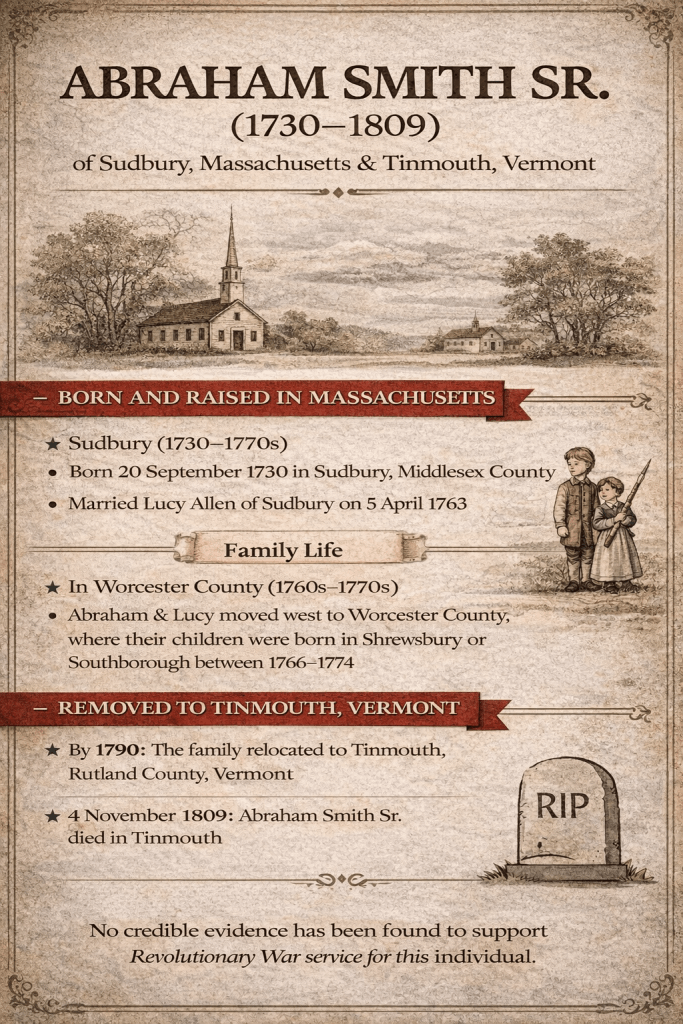
Abraham Smith was born on 20 September 1730 in Sudbury, Middlesex County, Massachusetts, a well-established New England town with extensive surviving eighteenth-century vital records.¹ He married Lucy Allen, and together they raised their family during a period that spanned the colonial era, the American Revolution, and the early years of the United States.²

Abraham’s adult life unfolded during the Revolutionary era, but surviving records do not demonstrate that he participated in the war as a soldier. Instead, the documentary evidence places him firmly in civilian life—raising a family, maintaining a household, and later participating in postwar migration patterns common to New England families.

Family and Household

Abraham Smith and his wife Lucy Allen were the parents of several children, including a son also named Abraham, born in 1768 in Worcester County, Massachusetts.³ This younger Abraham—referred to here as Abraham Smith Jr.—is clearly documented as a separate individual who later settled in Brookfield, Orange County, Vermont, where he left an extensive probate record.⁴

By the outbreak of the Revolutionary War in 1775, Abraham Smith Sr. was forty-five years old and had dependent children still at home. While men of this age sometimes served, many did not, particularly when responsible for sustaining farms and households, a pattern well documented in New England militia demographics.⁵

Move to Vermont

Following the Revolutionary War, Abraham Smith relocated north to Tinmouth in Rutland County, Vermont. This move aligns with a broader postwar migration pattern, as families from Massachusetts and southern New England moved into Vermont towns newly opened to settlement and formalized governance.⁶

Abraham Smith died in Tinmouth on 4 November 1809.⁷ His death is recorded in Vermont vital records, and his probate proceedings further confirm his residence in Tinmouth at the end of his life.⁸

The Question of Revolutionary War Service

Abraham Smith of Tinmouth has long been attributed Revolutionary War service in at least one early DAR lineage record.⁹ That attribution has been repeated in derivative family trees and secondary sources, despite the lack of supporting contemporary evidence.

The DAR Ancestor Database lists numerous men named Abraham Smith who served during the Revolutionary War, across multiple colonies and states, under different commanding officers and with differing life details.¹⁰ Careful comparison of these service profiles shows that none can be conclusively matched to the Abraham Smith born in Sudbury in 1730 and deceased in Tinmouth in 1809.

Critically, Abraham Smith’s probate file contains no references to military service, land bounties, pensions, arrears of pay, or other benefits commonly associated with Revolutionary War veterans or their heirs.¹¹ No pension application or verified service record has been identified that connects him to wartime service.

Resolving the Misattribution

The Revolutionary War service attributed to Abraham Smith of Tinmouth appears to be the result of name conflation. “Smith” is among the most common surnames in eighteenth-century New England, and Abraham was a frequently used given name. Early lineage applications often relied on incomplete records and did not have access to the full range of probate, census-context, and geographic evidence now available.

Subsequent analysis of birth, marriage, residence, probate, and family structure demonstrates that the military service cited in the early DAR record belongs to other men named Abraham Smith, not to the individual who died in Tinmouth in 1809.

Conclusion

Abraham Smith lived through the Revolutionary era, raised a family during a time of upheaval, and participated in the postwar settlement of Vermont. While he was not a Revolutionary War soldier, his life reflects the experience of many New England civilians whose labor, stability, and family networks sustained their communities before, during, and after the war.

Correcting the historical record does not diminish Abraham Smith’s legacy. Rather, it ensures that his story—and the story of Revolutionary War service—is told accurately and supported by evidence.


Footnotes

  1. Sudbury, Massachusetts, town vital records; Massachusetts Town and Vital Records, 1620–1988 (Ancestry).
  2. Marriage and family structure inferred from Massachusetts and Vermont vital records and probate context.
  3. Massachusetts Town Birth Records; Worcester County birth registers (Ancestry).
  4. Vermont, Wills and Probate Records, 1749–1999, Orange County, estate of Abraham Smith (d. 1849) (Ancestry).
  5. Massachusetts militia participation patterns discussed in contemporary town and county studies; absence of service-specific documentation for Abraham Smith.
  6. Vermont settlement and migration patterns following the Revolutionary War; Rutland County land and town histories.
  7. Tinmouth, Rutland County, Vermont, vital records.
  8. Rutland County, Vermont, probate records for Abraham Smith (d. 1809).
  9. DAR Ancestor Database, legacy entry for Abraham Smith, ancestor number A104615.
  10. DAR Ancestor Search results for “Abraham Smith,” multiple entries with divergent service profiles.
  11. Rutland County probate file for Abraham Smith (d. 1809), no military references noted.

Bartholomew Towne (1741–1800)

Bartholomew Towne’s Revolutionary War service is documented in both Massachusetts and New Hampshire records, placing him among the many New England men whose military and civic lives crossed colonial and early state boundaries. His service appears in compiled Massachusetts rolls from 1775 and later records from New Hampshire, reflecting the fluid movement of families and militia obligations during the war years.¹

Born in Massachusetts and later settled in New Hampshire, Towne’s life illustrates how Revolutionary service was often rooted in local communities while still contributing to the broader Continental effort.


Early Life in Massachusetts

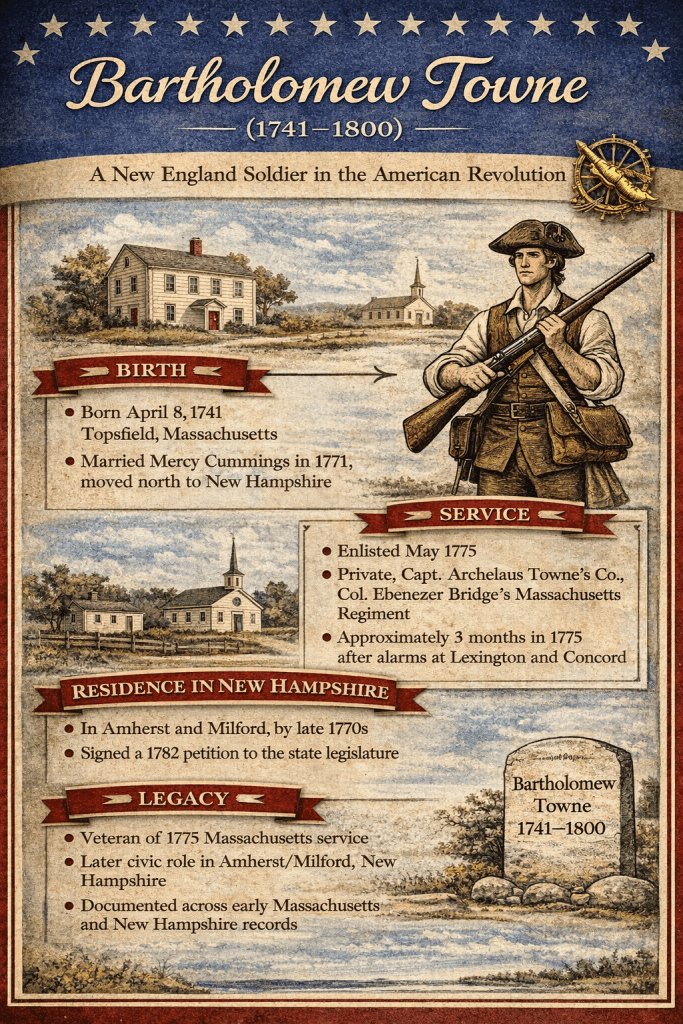
Bartholomew Towne was born on 8 April 1741 in Topsfield, Essex County, Massachusetts, the son of Elisha Towne and Mercy Foster.² He grew up in a well-established Massachusetts family and reached adulthood during the years of mounting political and military tension between the colonies and Great Britain.

On 3 October 1771, he married Mercy Cummings in Andover, Massachusetts.³ Within a few years, the couple relocated northward into what would become Hillsborough County, New Hampshire, part of a broader pattern of late-colonial migration from coastal Massachusetts into interior New England.⁴


Revolutionary War Service

Bartholomew Towne’s military service is documented in Massachusetts Revolutionary War records. He appears as a private in Captain Archelaus Towne’s company, part of Colonel Ebenezer Bridge’s 27th Massachusetts Regiment.⁵ According to the compiled rolls, he enlisted in May 1775 and served approximately three months, with his service recorded on a muster roll dated 1 August 1775.⁶

Additional records show Towne received advance pay and later an order for a bounty coat, a benefit commonly issued to soldiers who met required service terms during the early months of the war.⁷ These details firmly place his service in the critical opening phase of the Revolution, following the alarms of April 1775 and the mobilization of Massachusetts militia forces.

Towne’s service was short-term, a pattern typical of Massachusetts soldiers in 1775, many of whom served limited enlistments before returning home or resuming civilian life.⁸


Residence and Civic Activity in New Hampshire

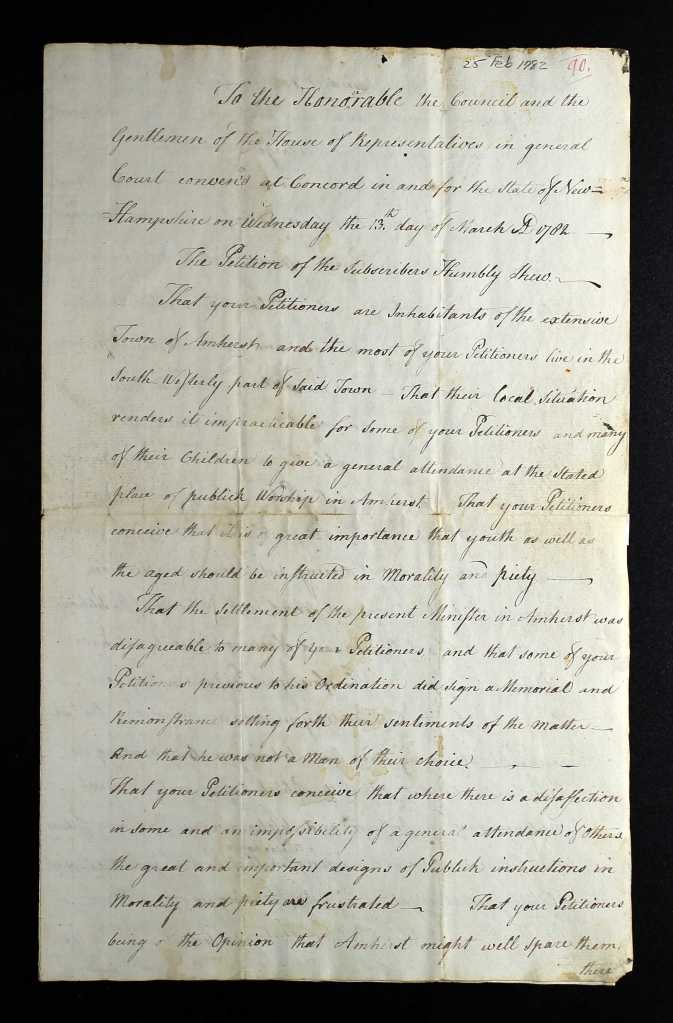
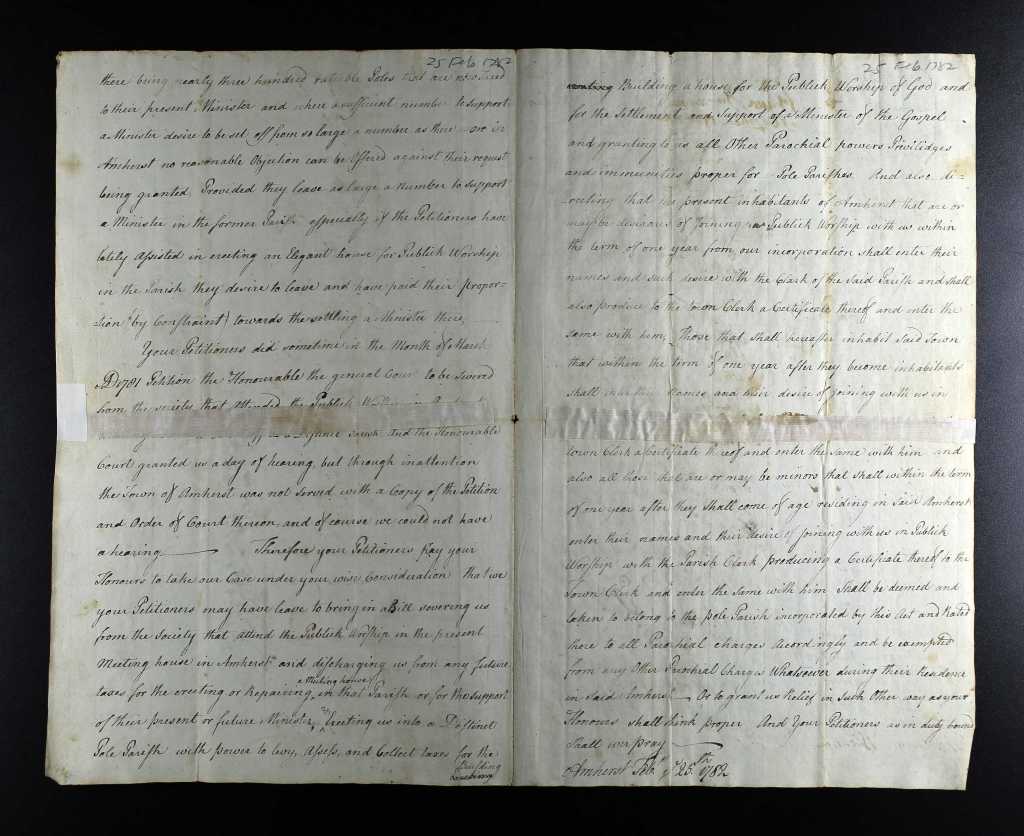
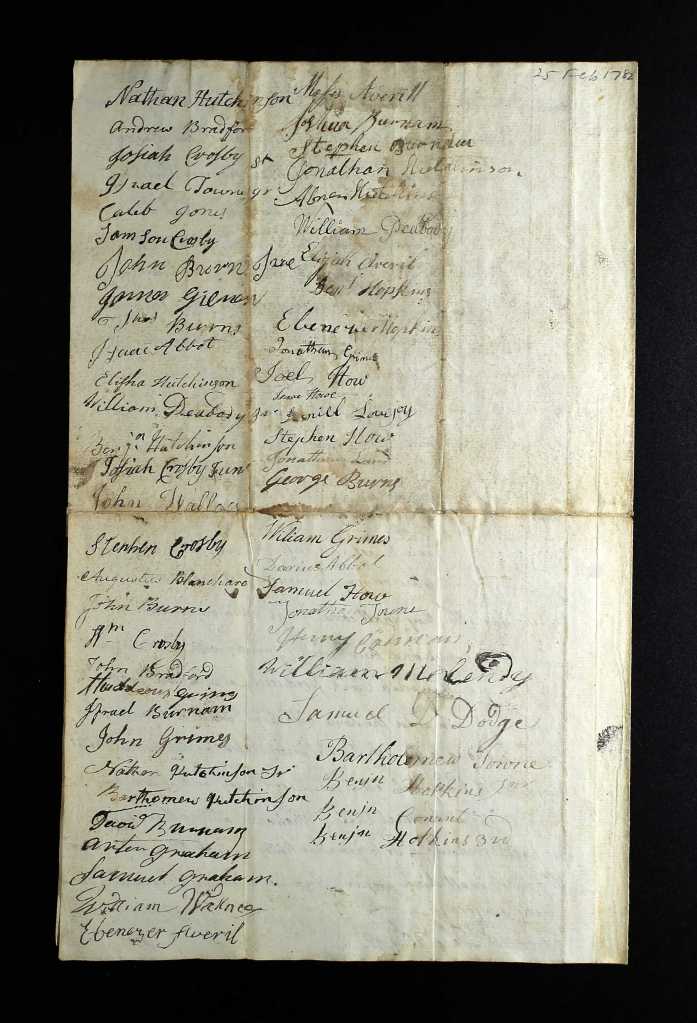
By the late 1770s, Bartholomew Towne was living in Amherst and Milford, Hillsborough County, New Hampshire. His presence there is confirmed not only through vital and census records but also through a surviving 1782 petition addressed to the New Hampshire legislature.⁹

That petition, signed by Towne and other inhabitants, concerned local religious organization and the establishment of public worship in the southern part of Amherst. Towne’s signature appears among the residents advocating for community governance and religious instruction, demonstrating his continued civic engagement after the war.¹⁰

This document places Towne squarely within the post-war civic life of New Hampshire and confirms his identity as the same man who earlier served in Massachusetts military units.


Later Life and Death

Bartholomew Towne appears in the 1790 federal census in Hillsborough County, New Hampshire, confirming his residence and household following the Revolutionary period.¹¹ He died in 1800 in Milford, Hillsborough County, New Hampshire.¹²

His life spanned the colonial era, the Revolutionary War, and the early years of the United States, with both his military service and later civic participation documented in contemporary records.


Assessing the Evidence

Bartholomew Towne’s Revolutionary War service rests on a solid evidentiary foundation. His enlistment and service in 1775 are supported by Massachusetts compiled rolls, including muster and pay records, while his later residence and civic activity in New Hampshire are corroborated by petitions and census data.¹³

The continuity of name, timeframe, and location across these records supports a confident identification without requiring speculative connections or later pension testimony.


Conclusion

Bartholomew Towne was not a long-term Continental soldier, but he was part of the first wave of New England men who answered the call in 1775. His service in a Massachusetts regiment during the opening months of the war, followed by his later civic role in New Hampshire, reflects the lived experience of many Revolutionary participants whose contributions were essential but modestly recorded.

By tracing his life across state lines and grounding his story in contemporary records, we preserve an accurate and meaningful account of his role in the Revolutionary generation.


Notes

  1. Massachusetts Soldiers and Sailors of the Revolutionary War; U.S. Revolutionary War Rolls, 1775–1783.
  2. Topsfield, Massachusetts, town birth records; compiled Massachusetts vital records.
  3. Massachusetts marriage records, Andover, 1771.
  4. Hillsborough County, New Hampshire, settlement patterns and family migration.
  5. Massachusetts Revolutionary War rolls, Capt. Archelaus Towne’s Company, Col. Ebenezer Bridge’s Regiment.
  6. Muster roll dated 1 August 1775, Massachusetts Revolutionary records.
  7. Massachusetts pay and bounty records, 1775.
  8. Massachusetts militia enlistment practices, early Revolutionary period.
  9. New Hampshire legislative petition, 1782, signed by Bartholomew Towne and others Bartholomew Towne on petition.
  10. Petition text and signatures, page 3, identifying Towne among Amherst inhabitants Bartholomew Towne on petition.
  11. 1790 U.S. Federal Census, Hillsborough County, New Hampshire.
  12. New Hampshire death records and compiled family histories.
  13. Correlation of military, civic, and residential records following genealogical proof standards.

Bangs Burgess (1747–1822): A Continental Soldier from Massachusetts

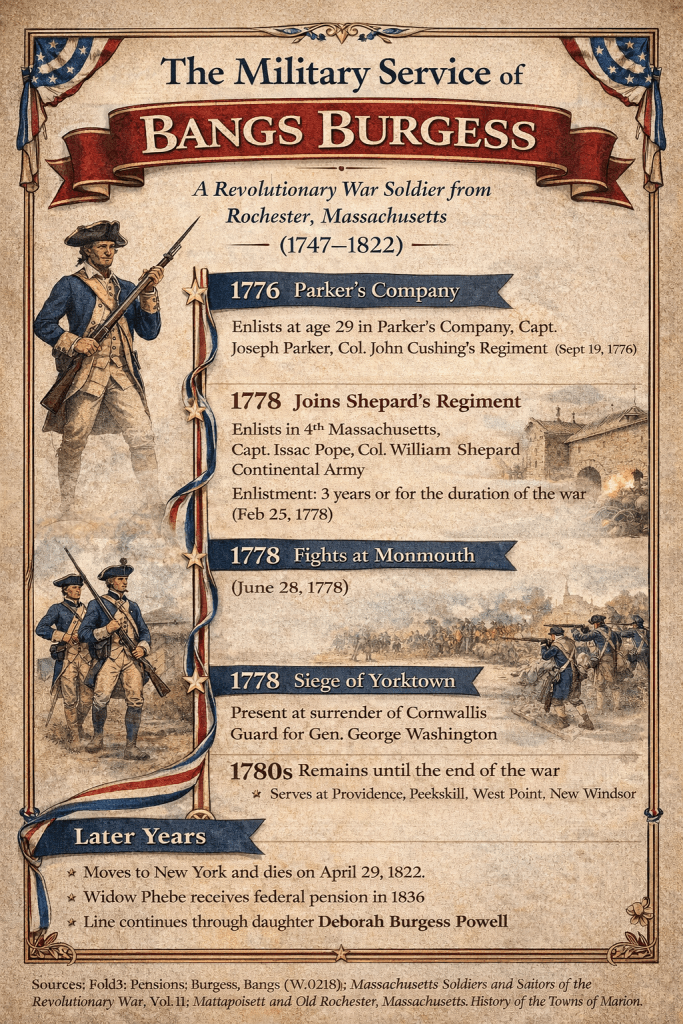
Bangs Burgess of Rochester, Plymouth County, Massachusetts was not a casual volunteer in the American Revolution. He was a long-serving Continental Army private who marched with Massachusetts regiments through some of the war’s defining campaigns — including Monmouth and Yorktown — and remained in service from the middle years of the war through its conclusion.


Family and Early Life

Bangs Burgess was born in 1747 in Rochester, Massachusetts, a community originally part of Old Rochester (encompassing present-day Rochester, Mattapoisett, and Marion). The Burgess family was well established in the region, appearing in early colonial and town histories.¹

Rochester and its neighboring towns contributed men regularly to the war effort, and Bangs was among those who responded when the conflict expanded beyond local militia service into the full Continental mobilization.


Military Enlistments in the Continental Army

First Enlistments (1776–1777)

According to Massachusetts Soldiers & Sailors of the Revolutionary War, Bangs Burgess first enlisted on 19 September 1776 as a private in Captain Joseph Parker’s Company, serving under Colonel John Cushing’s Regiment and stationed, at least initially, at Rhode Island.²

He was later recorded reenlisting for brief service, transitioning into longer commitments as the war progressed.


Extended Service with Shepard’s Regiment

The same source records Burgess next with Captain Isaac Pope’s Company, in Colonel William Shepard’s (4th Massachusetts) Regiment, part of the regular Continental Army:

  • 25 Feb 1778 – Dec 31, 1779: Continental Army pay accounts list Burgess in Shepard’s regiment.³
  • Musters through 1778–1781 place him in the field, with rolls in Phillipsburg, Peekskill, West Point, York Hutts, and New Windsor.⁴
  • A February 1780 muster describes him physically: “age 30 yrs., stature 6 ft. 1 in., complexion light, hair light; residence, Rochester.”⁵

These repeated returns of rolls indicate he was part of the Continental establishment, not just a short-term militia enlistment.


Campaigns and Combat

Battle of Monmouth (June 1778)

In sworn pension testimony later accepted by the U.S. Pension Office, Burgess stated that he was present at the Battle of Monmouth on 28 June 1778 — one of the largest engagements of the war and a key proving ground for the newly trained Continental Army.⁶

This battle demonstrated Washington’s ability to stand with British regulars in open field combat, and Burgess’s presence places him with the main army in the mid-Atlantic theater.


Siege of Yorktown and Cornwallis’s Surrender (1781)

Burgess also testified that he took part in the Siege of Yorktown, Virginia, and was present when British General Lord Cornwallis surrendered in October 1781 — the culminating moment of the Revolutionary War.⁷

His pension record further indicates that he served as part of a detachment detailed as guard for General George Washington, a distinction suggesting he was among the more experienced members of his regiment.⁸

Bangs Burgess Revolutionary War service

Recognition and Pension

Decades after the war, Burgess applied for a federal pension under the Act of 18 March 1818, which provided support for indigent veterans of Revolutionary service. His application was approved, and he was placed on the pension rolls as a veteran of long service in the Continental Army.⁹

The government required detailed proof before granting pensions, and Burgess’s long service, as recorded in both his own testimony and official Continental records, satisfied those requirements.


Later Years and Death

After the Revolution, Burgess moved to New York, first living in Rensselaer County and later in Livonia, Livingston County. He died there on 29 April 1822.¹⁰

Following his death, his widow Phebe (Lillie) Burgess successfully applied for a pension under the Act of 4 July 1836 (Pension File W.20818), ensuring continued federal support and further preserving the documentary record of his service.¹¹


Family and Descendants

Bangs and Phebe Burgess raised a large family. Federal pension correspondence lists their children and identified heirs — including Deborah Burgess, who married John Powell of New York. This documentation forms the genealogical linkage through which many descendants trace their lineage today.¹²


Historical Assessment

Bangs Burgess exemplifies what historians call a career patriot — a man whose wartime service was sustained, documented, and recognized. Unlike many who served only briefly near home or in local militia, he:

🔹 Served multiple enlistments and a long-term Continental contract
🔹 Marched as part of Massachusetts line units
🔹 Saw major actions including Monmouth and Yorktown
🔹 Remained in the army through multiple campaigns and garrisons
🔹 Was later recognized by the federal government with a pension

These facts make him a particularly well-documented example of an enlisted Continental soldier — a story worth telling beyond the genealogical record.


Sources and Citations

  1. Mattapoisett and Old Rochester, Massachusetts: History of the Towns of Rochester, Mattapoisett, and Marion (Boston: Town Histories Pub.).
  2. Massachusetts Soldiers and Sailors of the Revolutionary War, Vol. II, entry “Burges, Bangs, Rochester.”
  3. Ibid., pay accounts, Shepard’s (4th Mass.) Regiment.
  4. Ibid., muster rolls, 1778–1781.
  5. Ibid., February 1780 descriptive muster.
  6. Bangs Burgess pension file, National Archives: NARA M804, War of the Revolution Pension and Bounty Land Warrant Application Files, Burgess, Bangs (W.20818).
  7. Ibid., pension testimony on Yorktown.
  8. Ibid., pension testimony regarding Washington’s guard.
  9. Ibid., pension award documentation.
  10. Fold3 memorial and summary: Burgess, Bangshttps://www.fold3.com/memorial/664325102/burgess-bangs
  11. Ibid., widow’s pension continuation under the Act of 1836.
  12. Ibid., heir verification and family listing in pension correspondence.

Four Abraham Smiths in One Family Tree

One of the most challenging parts of family history research is sorting out people who share the same name. In my own family tree, I descend from four different men named Abraham Smith. They fall into two father–son pairs, belonging to two entirely separate families. Although their names are identical, their lives unfolded in different places and under very different circumstances.


The Massachusetts–Vermont Abraham Smiths

Abraham Smith (1730–1809)

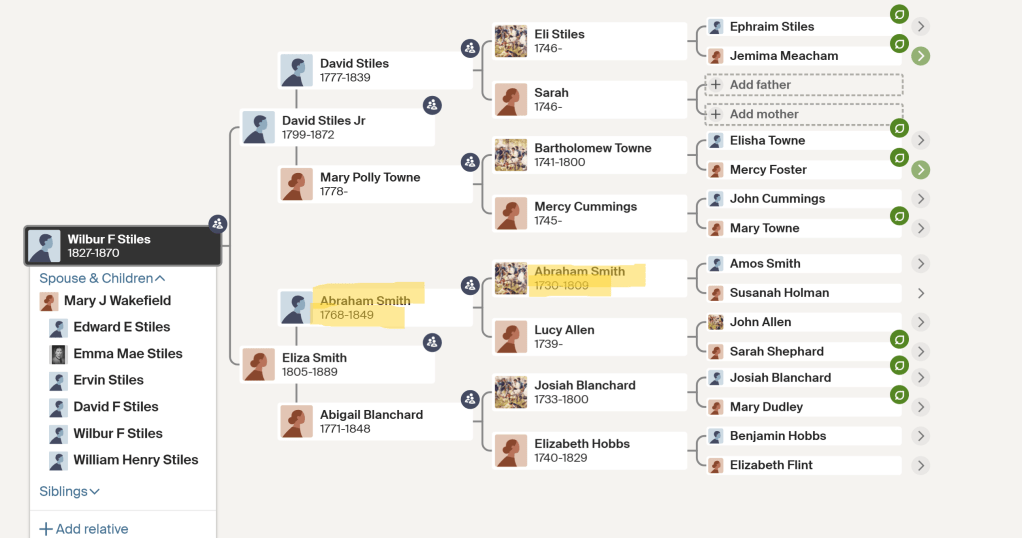
Abraham Smith was born on 20 September 1730 in Sudbury, Middlesex County, Massachusetts, the son of Amos Smith (1699–1786) and Susanah Holman (1702–1778). He grew up in Sudbury alongside his brothers Jacob, Benjamin, and Jonathan. On 24 July 1763, he married Lucy Allen in Newton, Massachusetts. Lucy had been born in 1739 in Weston, Massachusetts. Their children were born in Massachusetts:

  • Polly Smith, born 20 November 1766
  • Abraham Smith, born 27 October 1768 in Worcester
  • Allen Smith, born 6 April 1770

During the American Revolutionary War, Abraham Smith served in the Vermont militia. His service appears in The State of Vermont: Rolls of the Soldiers in the Revolutionary War 1775–1783, compiled by John E. Goodrich. Abraham Smith is listed on the roll of Captain Gideon Brownson’s Company, on a roster dated 26 February 1776 for the Montreal expedition, placing him in the northern theater of the war. This company was part of the militia forces raised in the Vermont region for operations connected with the occupation of Canada during the early stages of the war.

By 1790, Abraham was living in Tinmouth, Rutland County, Vermont, where he appears in the federal census. He remained there until his death on 4 November 1809, closing a life that spanned from colonial Massachusetts through the Revolutionary War and into the early years of the United States.


Abraham Smith (1768–before 1849)

The second Abraham in this line was born 27 October 1768 in Worcester, Massachusetts, the son of Abraham Smith and Lucy Allen. He married Abigail Blanchard on 9 February 1797 in Sturbridge, Massachusetts. Abigail was born in 1771 and later died in Brookfield, Vermont.

By the early 1800s, this family had settled in Orange County, Vermont, primarily in Brookfield. Their children included:

  • Harriot Louise Smith (1798–1878)
  • Abigail Smith (1800–1879)
  • Amasa Austin Smith (c.1801–1808)
  • Eliza Smith (1805–1889)
  • John Allen Smith (1809–1884)

Through these children, this Smith line later extended westward into Wisconsin and Michigan, particularly through the Fuller, Stiles, and Loomis families. Abraham Smith (1768) died before 10 April 1849 in Orange, Vermont.


The Pennsylvania Abraham Smiths

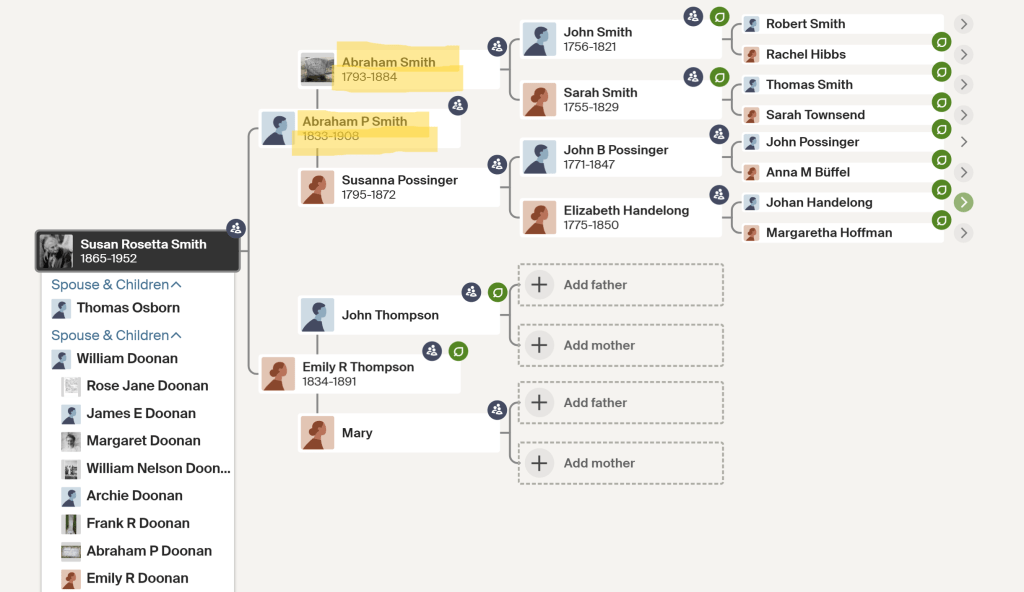
Abraham Smith (1793–c.1884)

A second, unrelated Abraham Smith was born on 29 January 1793, probably in Wrightstown, Bucks County, Pennsylvania. He was the son of John Smith (1756–1821) and Sarah Smith (1755–1829), a family associated with the Wrightstown Monthly Meeting of Friends (Quakers).

Abraham married Susanna Possinger (1795–1872), the daughter of John B. Possinger and Elizabeth Handelong. By 1830, Abraham and Susanna were living in Jackson Township, Monroe County, Pennsylvania, where Abraham appears in census records from 1830 through 1880. This area, in the Pocono region, became the permanent home of this branch of the family.

Their children included:

  • Fannie Smith (1813–1876)
  • Sarah Smith (1815–1900)
  • Catharine Smith (1826–1891)
  • Susan Smith (c.1828–1909)
  • Joseph Possinger Smith (1830–1882)
  • Abraham Possinger Smith (1833–1908)

The repeated use of “Possinger” as a middle name preserved Susanna’s maiden name and helps distinguish this Smith family from others in Pennsylvania.

Susanna died in 1872. Abraham remained in Jackson Township, Monroe County, until his death about 1884. He was buried in Tannersville Union Cemetery in Monroe County.


Abraham Possinger Smith (1833–1908)

The youngest of the four Abraham Smiths was born in May 1833 in Pennsylvania, the son of Abraham Smith and Susanna Possinger. He married Emily Rebecca Thompson before 1854 and later Susan Smith.

Over the course of his life, Abraham Possinger Smith lived in Pennsylvania, Michigan, and Washington State. He died on 29 June 1908 in Shelton, Mason County, Washington. His children included:

  • Frank E. Smith
  • Jude Smith
  • Elmira Smith
  • Robert Smith
  • Susan Rosetta Smith
  • Fanny Florence Smith
  • Abraham Edward Smith

Through this line, descendants spread into Bay County, Michigan, Ontario, Canada, and the Pacific Northwest, giving this Smith branch a wide geographic reach.


Two Names, Two Families

Although all four men bore the name Abraham Smith, the records show they belonged to two completely separate families:

Family LineFatherSon
Massachusetts → VermontAbraham Smith (1730–1809)Abraham Smith (1768–1849)
Pennsylvania → Monroe County → WestAbraham Smith (1793–c.1884)Abraham Possinger Smith (1833–1908)

Their lives overlapped in time but not in place or ancestry. Together, they illustrate how a single name can run through multiple generations and unrelated families, creating confusion that only careful documentation can resolve.

Technically, I have 8 different Abraham Smith’s in my family tree. However, only 4 are direct ancestors – the others are “cousins” or married into the family.

Lot Hutchinson (1741–1818)

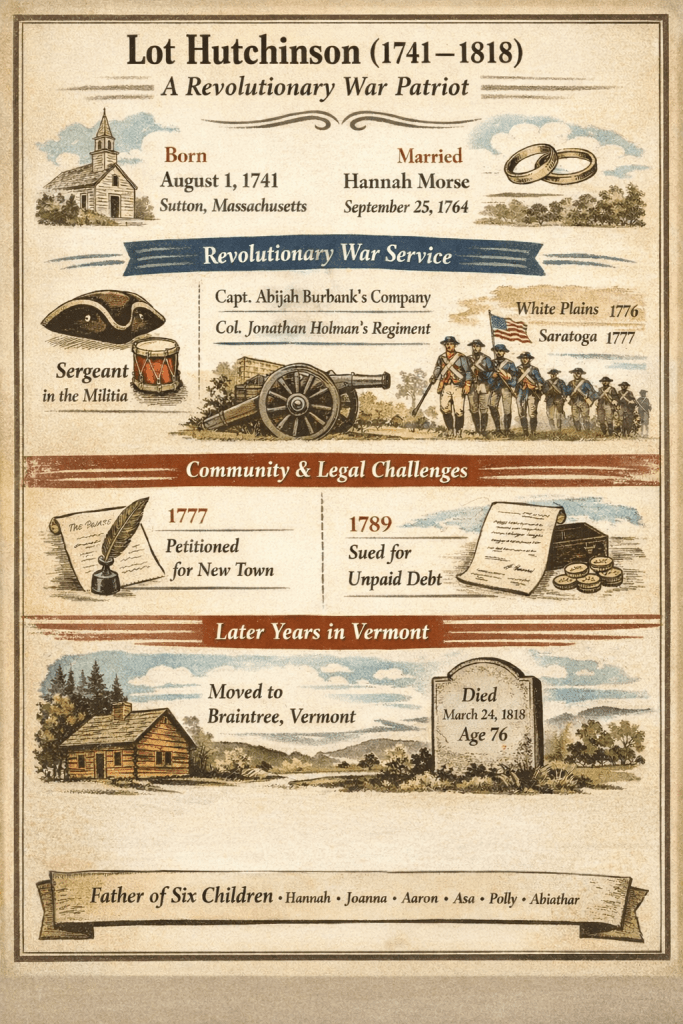
Lot Hutchinson was born on 1 August 1741 in Sutton, Worcester County, Massachusetts, the son of Nathaniel Hutchinson and Joanna Conant.¹ He was baptized in Sutton on 13 September 1741. Raised in a long-established Massachusetts family, Hutchinson came of age during a period of escalating political and military tension that would soon lead to revolution.

On 25 September 1764, he married Hannah Morse in Sutton.² The couple raised six children—Hannah, Joanna, Aaron, Asa, Polly, and Abiathar—whose births are documented in Sutton and Worcester County vital records.³

Revolutionary War Service

Lot Hutchinson’s military service during the American Revolutionary War is documented in multiple contemporary and compiled sources. He served as a sergeant in Captain Abijah Burbank’s company of Colonel Jonathan Holman’s regiment, a Massachusetts militia unit.⁴ His service appears in the Massachusetts Soldiers and Sailors of the Revolutionary War, as well as in Worcester County militia rolls, and is memorialized in his Fold3 military profile.

Holman’s regiment—often referred to in records as the Sutton Regiment—was composed largely of men from central Worcester County. The regiment was called into active service in 1776 during the White Plains campaign and again in 1777, when Massachusetts militia units were mobilized to reinforce the northern army during the Saratoga operations.⁵ These militia call-ups were a vital component of the war effort, supplying experienced local men to support Continental forces during critical campaigns.

Hutchinson’s rank of sergeant indicates that he held a position of responsibility within his company, charged with maintaining order, assisting in drill, and overseeing enlisted men—an important leadership role within the militia structure.

Civic and Community Involvement

Hutchinson’s public engagement extended beyond military service. In 1777, he was among residents of northwestern Sutton who petitioned the Massachusetts General Court for the creation of a separate town.⁶ This petition survives among the legislative records of the Revolutionary period and reflects the continuing civic life of Massachusetts communities even amid wartime disruption.

Post-War Legal and Financial Records

Like many veterans of the Revolutionary era, Hutchinson faced financial challenges in the years following the war. In 1789, he was named as a defendant in a trespass action brought by Solomon Bixby in the Worcester County Court of Common Pleas.⁷ The case involved a mortgage Hutchinson had taken on his land and buildings for £69, which he was unable to repay when the note came due. Bixby, a Sutton native born in 1761, appears in local genealogical and cemetery records, providing additional context for the dispute.⁸

Later Years and Death

By 1800, Lot Hutchinson had relocated to Braintree, Orange County, Vermont, where he spent the remainder of his life. Federal census records place him there in 1800 and 1810. His wife, Hannah (Morse) Hutchinson, died in Braintree on 17 January 1815.⁹

Lot Hutchinson died in Braintree, Vermont, on 24 March 1818, at the age of 76.¹⁰ His life spanned the colonial period, the struggle for independence, and the early decades of the United States—marked by military service, civic participation, and the challenges faced by many Revolutionary War veterans in the new nation.

Sources

  1. Sutton, Massachusetts, Vital Records to 1850, Births, entry for Lot Hutchinson.
  2. Sutton, Massachusetts, Vital Records to 1850, Marriages, entry for Lot Hutchinson and Hannah Morse, 25 September 1764.
  3. Sutton and Worcester County vital records; Family Group Sheet, “Lot Hutchinson,” Rivers–Hickmott Collection.
  4. Massachusetts Soldiers and Sailors of the Revolutionary War, entry for Lot Hutchinson; Worcester County Militia Rolls, Capt. Abijah Burbank’s Company.
  5. Massachusetts Archives Collection, Revolutionary Rolls, 1775–1783; Francis B. Heitman, Historical Register of Officers of the Continental Army.
  6. Massachusetts General Court, Legislative Petitions, 1777 Session, Sutton Northwest District Petition.
  7. Worcester County Court of Common Pleas, 1789 Docket, Bixby v. Hutchinson.
  8. Find a Grave, memorial for Solomon Bixby; Bixby Family Association records.
  9. Vermont Vital Records, Braintree Town Records, Deaths, entry for Hannah Hutchinson, 1815.
  10. Vermont Vital Records, Braintree Town Records, Deaths, entry for Lot Hutchinson, 1818.

Benjamin Byam

Benjamin Byam (1733–1795) lived a life shaped by steady service, devotion to family, and a willingness to step forward when history called. Born in Chelmsford, Massachusetts, on November 29, 1733, he came from early colonial stock. Like many families of that era, the Byams built their lives through practical skill and community responsibility. Benjamin learned the trade of a cooper, crafting the barrels that kept New England’s farms and merchants supplied.

His first experience in military service came long before the Revolution. In 1754, he joined Captain Melvin’s company during the French and Indian War, gaining the discipline and leadership that would later define his role in the fight for independence. By 1760, he had risen to 1st Lieutenant. That same year, he married Mary Keyes, and together they raised nine children — a family line that would spread across New England.

By the spring of 1775, Benjamin was living in Temple, New Hampshire. When word arrived on April 19 that British troops were advancing on Concord, he joined fifty-five of his neighbors who set out at once. Though they reached the scene after the first shots at the North Bridge, they joined the long pursuit of the British back toward Cambridge, marching through the day and into the night. Benjamin remained with the forces encamped there for eight months, supplying his own blanket — one of those small but telling sacrifices made by ordinary men who found themselves doing extraordinary things. He later served again in 1777 during the march toward Bennington.

Benjamin spent his final years in Randolph, Vermont, where he died on November 22, 1795. His life reflects the kind of legacy that endures: a craftsman, a soldier, a father, and a man whose quiet courage helped shape the nation his descendants continue to remember.