
Taymouth Township, located in southeastern Saginaw County, Michigan, appears frequently in nineteenth-century records tied to families who settled along the Flint River and its tributaries. Although the township name is well established by the mid-nineteenth century, its formation, original name, and the evolution of local place names require careful reconstruction using legislative acts, census records, plat maps, and contemporary histories. When read together, these sources provide a clear timeline for the township’s creation and naming, as well as continuity of settlement before and after its organization.¹
Indigenous Presence and Early Land Use
Prior to Euro-American settlement, the Flint River valley in what later became Taymouth Township was home to Chippewa (Ojibwe) communities. Land along the river formed part of the Pe-won-o-go-wink (also rendered Pewanagowink) reservation, meaning “Place of Stones,” a name preserved in later historical accounts and visible on early plat maps.²
Treaties signed in 1819 and 1837 resulted in the loss of most Indigenous lands in the region, despite earlier assurances that certain tracts would remain reserved. By the mid-nineteenth century, only a small community remained near the Flint River, associated with an Indian church and cemetery later connected with Rev. Daniel Wheaton (Che-Me-Gas).³
The Area Before Township Organization
In the 1840 federal census, residents who would later be enumerated in Taymouth Township were listed under Saginaw Township, reflecting the fact that Taymouth had not yet been created as a civil township. Importantly, comparison of the 1840 and 1850 census schedules shows the same individuals—identified by full first and last names—appearing in both enumerations. This continuity demonstrates that the population did not relocate; rather, the civil jurisdiction governing them changed following legislative action.⁴
Creation of Faymouth Township (1842)
Taymouth Township was formally created by an act of the Michigan Legislature approved on 17 February 1842. The statute set off territory from Saginaw Township and established a new township under the name Faymouth. The act defined the township boundaries in detail and specified the location of the first township meeting. The law stated, in part:
“All that part of the county of Saginaw (now a part of the township of Saginaw) included in the following boundaries, viz.: commencing on the east side of Flint river, on the county line between Saginaw and Genesee, at the southeast corner of township ten north, range five east; thence north on said township line to the northeast corner of said township; thence west on said township line to the northwest corner of section four; thence north on section lines to the bank of Cass river; thence down said river to its junction with the Shiawassee river; thence up the Shiawassee river to the county line between Saginaw and Shiawassee; thence east on said county line to the place of beginning; be and the same is hereby set off and organized into a separate township by the name of Faymouth, and the first township meeting shall be held at the house of A. F. Hayden.”⁵
This language confirms that Faymouth was the township’s original legal name and that its boundaries were clearly defined at the time of organization.
The Name Change from Faymouth to Taymouth (1844)
Two years later, the Michigan Legislature enacted a statute changing the township’s name. An act approved in 1844 stated explicitly:
“The name of the township of Faymouth, in the county of Saginaw, is hereby changed to Taymouth; and all acts and proceedings which have been had under the name of Faymouth shall be of the same force and effect as if done under the name of Taymouth.”⁶
By the time of the 1850 federal census, the township appears consistently as Taymouth Township, confirming that the name change had been fully implemented in civil and administrative records.⁷
Villages, Post Offices, and Changing Place Names
During the late nineteenth and early twentieth centuries, several village names appeared within Taymouth Township. Blackmar, located along the Flint River and the Flint & Pere Marquette Railroad, developed into a recognized center of industry and commerce and was acknowledged by the U.S. Post Office Department.⁸
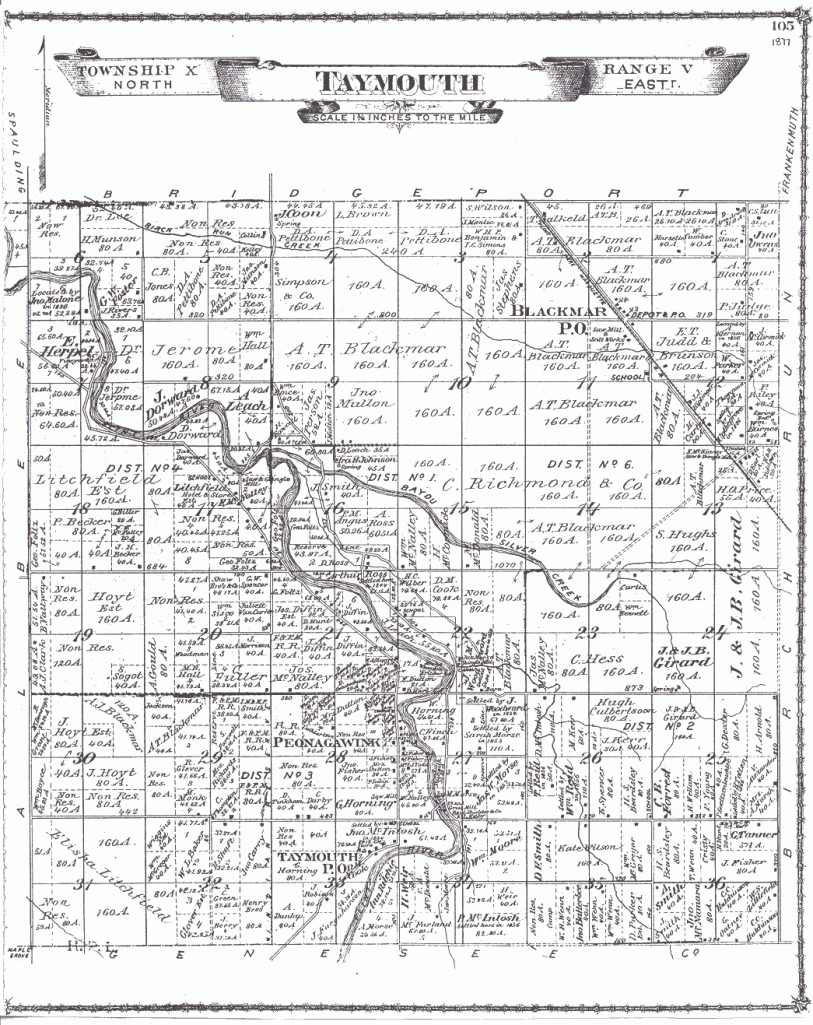
Plat maps reveal additional local place names whose usage changed over time. Morseville appears on the 1916 plat map but is absent by 1920. In its place, the 1920 map labels the same location as Taymouth, suggesting a renaming or re-identification rather than abandonment. Verne, by contrast, appears on multiple maps and does not disappear, indicating greater stability in that place name. Comparison of the 1877, 1916, 1920, and 1955 plat maps highlights how local nomenclature evolved while settlement itself remained continuous.⁹
Land, Agriculture, and Community Development
By the late nineteenth century, Taymouth Township was described as one of the most agriculturally productive areas in Saginaw County. The Flint River and its tributaries supported mills, salt works, and transportation, while fertile soils sustained farming throughout the township.¹⁰ Despite these developments, Taymouth retained a predominantly rural character shaped by its river, its early settlers, and its layered history of Indigenous displacement and resettlement.
Conclusion
The history of Taymouth Township can be traced clearly through legislative acts, census records, and maps. Residents first enumerated in Saginaw Township in 1840 became citizens of Faymouth Township in 1842, and of Taymouth Township following the 1844 name change. The appearance and disappearance of local place names such as Morseville and the persistence of others like Verne reflect changes in labeling rather than population movement. Together, these records provide a precise framework for understanding Taymouth Township’s formation and for accurately interpreting nineteenth-century documents associated with families who lived there.
Sources
- Michael A. Leeson, History of Saginaw County, Michigan (Chicago: Charles C. Chapman & Co., 1881), 917–937.
- Margaret O’Sullivan, “Broken Promises – Stolen Land – But Still a Proud People,” Montrose Museum, Spring 2024.
- Ibid.
- 1840 U.S. Census, Saginaw Township, Saginaw County, Michigan.
- Michigan Legislature, An Act to Organize the Township of Faymouth, approved 17 February 1842.
- Michigan Legislature, An Act Changing the Name of Faymouth Township to Taymouth, 1844.
- 1850 U.S. Census, Taymouth Township, Saginaw County, Michigan.
- Leeson, History of Saginaw County, 922.
- Taymouth Township plat maps, 1877, 1916, 1920, and 1955.
- Leeson, History of Saginaw County, 917–918.

 The Tumbleweed