Lemuel Gibbs (1738–1827)

A Connecticut Soldier in the American Revolution

When researching Revolutionary War service, it is often tempting to expect clear enlistment papers, detailed muster rolls, or pension files that neatly summarize a man’s military career. For many Connecticut soldiers, however, service survives only in fragmentary state records, brief militia references, or scattered town-level documentation.¹

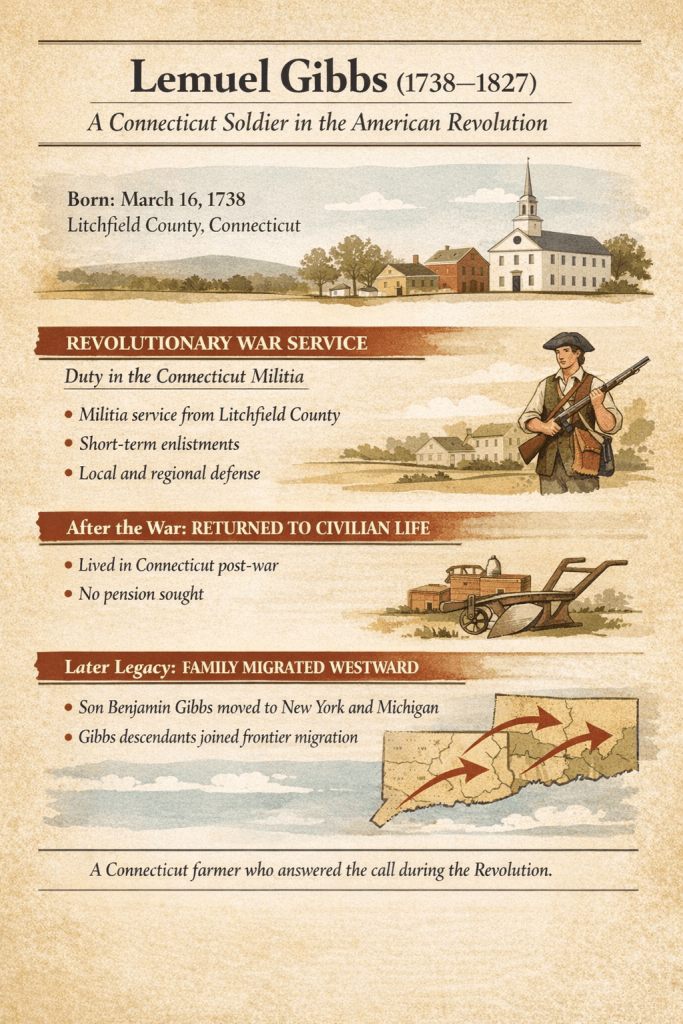
Born on 16 March 1738 in Litchfield County, Connecticut, Lemuel Gibbs lived squarely within the generation called upon to defend the colonies during the American Revolution. His service does not appear in dramatic narratives or extended pension testimony, but it is nonetheless documented in Connecticut military records and consistent with the state’s wartime militia system.²

Early Life and Family Context

Lemuel Gibbs was born into a long-established Connecticut family rooted in Litchfield County prior to the outbreak of hostilities with Great Britain. By the 1770s, he was an adult with family responsibilities, placing him among the many men who balanced military obligations with agricultural and household duties.³

Connecticut relied heavily on short-term militia service, frequently calling men out for brief periods rather than extended enlistments. As a result, many soldiers—particularly those who served locally—left behind only minimal documentation of their wartime participation.⁴


Revolutionary War Service

Lemuel Gibbs appears in Connecticut Revolutionary War military records, specifically within state-level compilations documenting militia service from Litchfield County.⁵ These records establish his participation without providing detailed information regarding unit assignment, length of service, or specific engagements.

This lack of detail is not unusual. Connecticut militia service often consisted of short tours responding to immediate needs such as coastal defense, troop movement, or regional security.⁶ While no surviving record places Gibbs in a named battle or extended campaign, his appearance in official military documentation confirms that he answered the colony’s call.

Equally important, there is no evidence of multiple contemporaneous men of the same name in the same jurisdiction that would cast doubt on the attribution of this service.⁷ The available evidence supports identifying this Lemuel Gibbs as the man referenced in the military records.


After the War

Following the conclusion of the Revolutionary War, Lemuel Gibbs returned to civilian life in Connecticut. He does not appear in federal pension files, a circumstance shared by many militia veterans whose service predated the pension acts or whose short-term duty did not meet later eligibility requirements.⁸

Lemuel Gibbs lived until 3 January 1827, witnessing the early decades of the United States. His descendants later joined the westward movement into New York and Michigan, reflecting broader post-Revolutionary settlement patterns across New England families.⁹


Assessing the Evidence

Lemuel Gibbs’s service illustrates a key principle of Revolutionary War research:
limited records do not equate to nonexistent service.

His documented appearance in Connecticut military records, combined with his age, residence, and lack of conflicting identities, provides a reasonable and supportable conclusion that he served during the American Revolution. His experience mirrors that of countless citizen-soldiers whose contributions were essential but modestly recorded.


Conclusion

Lemuel Gibbs was not a career soldier or public figure. He was a Connecticut man who answered the call of his colony during a time of upheaval. Though the surviving records are sparse, they are sufficient to place him among those who contributed to the Revolutionary effort.

By presenting his story carefully—without embellishment—we preserve both the integrity of the historical record and the memory of an ordinary man whose service helped shape the nation that followed.


Notes

  1. Public Records of the State of Connecticut, Revolutionary War era volumes.
  2. Connecticut military record compilations, Revolutionary period.
  3. Litchfield County vital and town records.
  4. Robert J. Taylor, Connecticut’s Militia System During the American Revolution.
  5. Public Records of the State of Connecticut, vols. 15–16.
  6. Ibid.
  7. Litchfield County tax and town lists, 1770s–1780s.
  8. U.S. Revolutionary War pension legislation and eligibility requirements.
  9. Probate and family records for the Gibbs family.
Revisiting the Parentage of Eleanora “Ella” B. Gibbs

In October 2020, I published a post outlining the evidence I had at the time regarding the parentage of my second great-grandmother, Eleanora “Ella” B. Gibbs, wife of John Wortman. That post laid out the problem clearly: census records placed Eleanora in proximity to multiple Gibbs households in Dryden, Lapeer County, Michigan, but did not explicitly state her relationship to any of them.¹

At the time, the strongest conclusion I could reach — based on marriage, probate, and census evidence — was that Eleanora was the daughter of Lester Gibbs and Mary Conly. However, gaps remained, particularly concerning what became of Lester Gibbs, who appeared to vanish from the records after 1860.

Over the past several years, additional records have come to light. When examined together, they significantly strengthen the original conclusion and clarify why earlier records appeared contradictory.


The Core Question, Revisited

The question has never really been who raised Eleanora, but who her biological father was.

In 2020, the competing possibilities were:

  • Lester Gibbs, who married Mary Conly in 1850
  • Philo Gibbs, with whom Eleanora appears in close proximity in census records

Because nineteenth-century census schedules do not identify relationships, proximity alone could not prove parentage.² What resolves the question is land ownership, guardianship, and inheritance — records that do imply legal relationships.


What We Know Now About Lester Gibbs

Lester Gibbs Did Not Disappear After 1860

Earlier assumptions placed Lester Gibbs’s death near 1860, but new evidence clearly disproves that.

In the 1860 federal census, Lester Gibbs appears in Dryden Township, Lapeer County, Michigan, listed as a farmer with both real and personal estate.³ He was alive, resident, and economically established.

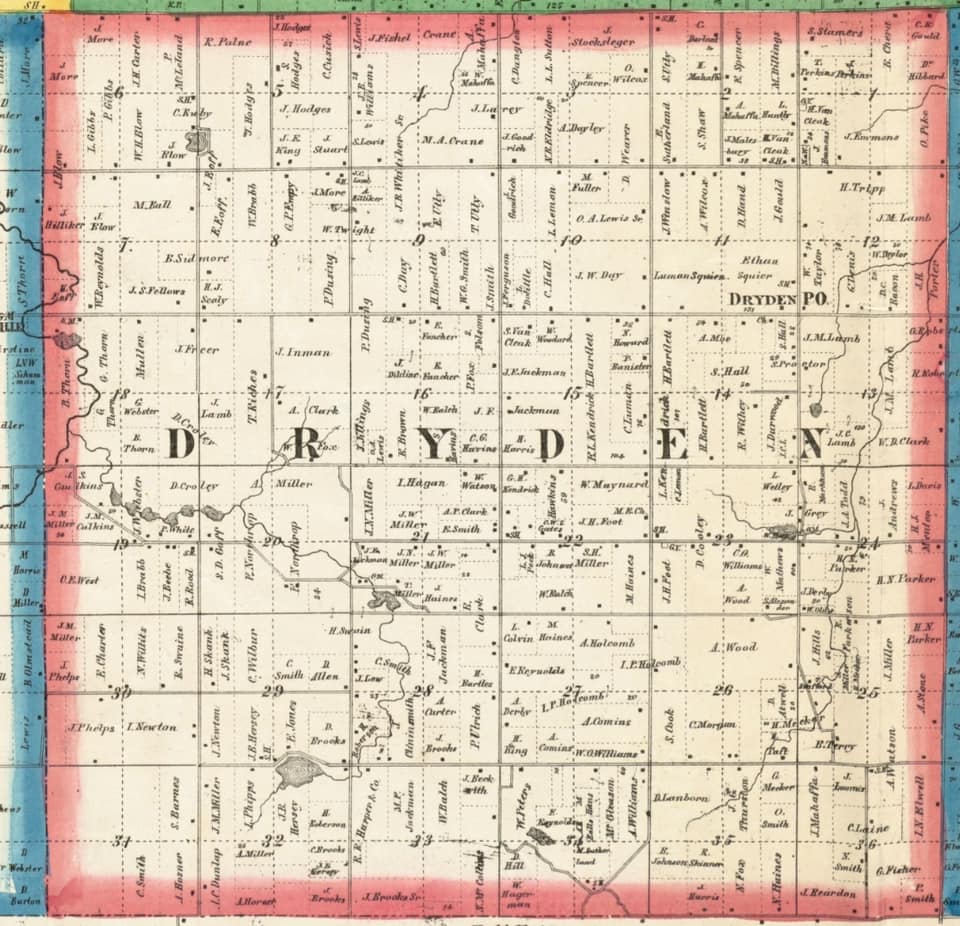
More importantly, an 1863 landowners map of Dryden Township identifies an “L. Gibbs” owning land in close proximity to J. Blow, a man later appearing in court-related records connected to this family.⁴ This confirms that Lester Gibbs was alive and a landholder at least as late as 1863.

1863 Land owernship map of Dryden, Lapeer County, Michigan. L. Gibbs owns land in the upper left corner.

Mary Conly’s Movements Explain the Census Confusion

The apparent absence of Mary Conly from Michigan in 1860 and Eleanora’s later association with other households long contributed to confusion. Those movements now make sense.

Mary Conly married Lester Gibbs in Lapeer County in November 1850.⁵ By 1861, she had remarried in New York to Charles Garner.⁶ The couple was living in New York by the mid-1860s, where Mary appears with Eleanora in the 1865 New York State Census.⁷

Charles Garner enlisted in the Union Army in 1863 and died as a prisoner of war at Salisbury Prison, North Carolina, on 21 December 1864.⁸ Mary was again widowed, this time with multiple minor children.

By 1868, Mary had returned to Lapeer County, Michigan, and married Mortimer Hilliker.⁹ These movements fully explain why Mary and Eleanora are absent from Michigan records during parts of the 1860s and why Eleanora later appears associated with extended family rather than her biological father.


The Most Important Evidence: Inheritance and Guardianship

The decisive records are not census schedules, but court-ordered guardianship and land transactions.

In December 1868, the Lapeer County Circuit Court appointed Mary Hilliker as special guardian of Eleanora (“Ella”) Gibbs, authorizing her to sell the minor child’s interest in real estate.¹⁰ The court approved both the guardianship and the conveyance.

Such proceedings occur only when:

  1. The child inherited property, and
  2. The property-owning parent is deceased

This establishes that Lester Gibbs died between 1863 and December 1868, and that Eleanora was his legal heir.

Philo Gibbs was not the landowner; Lester Gibbs was.


Why There Is No Probate Record for Lester Gibbs

The absence of a probate estate for Lester Gibbs once appeared problematic. In fact, it is consistent with Michigan legal practice of the period.

When a man died intestate leaving only minor heirs and land as the principal asset, courts often handled the matter through guardianship proceedings rather than formal probate administration.¹¹ This allowed the land to be sold for the child’s benefit without opening an estate.

That is precisely what occurred in this case.


What This Means for Eleanora’s Parentage

When all records are considered together:

  • Marriage of Lester Gibbs and Mary Conly (1850)⁵
  • Birth of Eleanora Gibbs (1854)¹²
  • Census evidence of Lester Gibbs alive in 1860³
  • Land ownership by Lester Gibbs in 1863⁴
  • Court-ordered guardianship and inheritance in 1868¹⁰
  • Probate of Mary Hilliker naming Ella Wortman as an heir¹³

…the conclusion is no longer tentative.

Eleanora “Ella” B. Gibbs was the daughter of Lester Gibbs and Mary Conly.


A Final Reflection

This case illustrates a fundamental genealogical principle:
census records suggest relationships; land and court records confirm them.

Six years ago, the evidence pointed in the right direction. Today, it firmly supports that conclusion.


Footnotes

  1. The parentage of Eleanora ‘Ella’ B. Gibbs,” blog post, 27 October 2020.
  2. U.S. Bureau of the Census, Instructions to Enumerators, 1860.
  3. 1860 U.S. Census, Lapeer County, Michigan, Dryden Township, Lester Gibbs household.
  4. Map of Lapeer County, Michigan (1863), Dryden Township landowners, “L. Gibbs.”
  5. Lapeer County, Michigan, Marriage Records, Lester Gibbs and Mary Conly, 12 November 1850.
  6. New York State Marriage Records, Mary Conly and Charles Garner, 1861.
  7. 1865 New York State Census, Cayuga County, Sterling, Mary Garner household.
  8. Compiled Military Service Record, Charles Garner, Union Army; died 21 December 1864, Salisbury Prison, North Carolina.
  9. Lapeer County, Michigan, Marriage Records, Mary Conly and Mortimer Hilliker, 29 March 1868.
  10. Lapeer County, Michigan, Circuit Court Records, Guardianship and deed of Eleanora D. Gibbs, December 1868.
  11. Michigan Probate Law and Practice, mid-nineteenth century (see Michigan Revised Statutes).
  12. Birth information for Eleanora D. Gibbs, as reported in multiple census and marriage records.
  13. Lapeer County, Michigan, Probate Records, Estate of Mary Hilliker, 1872.

The parentage of Eleanora “Ella” B Gibbs

Like most women in genealogical research, my second great-grandmother, Eleanora B Gibbs, has been a tough one to trace. Knowing her name from her marriage to my second great-grandfather, John Wortman, and my great-grandmother, Anna Wortman Hickmott, was just the beginning of the mystery. Also, from census records, it was apparent that she lived in the Dryden area in Lapeer County Michigan. Those 2 facts still were not enough to definitively say who her parents were.

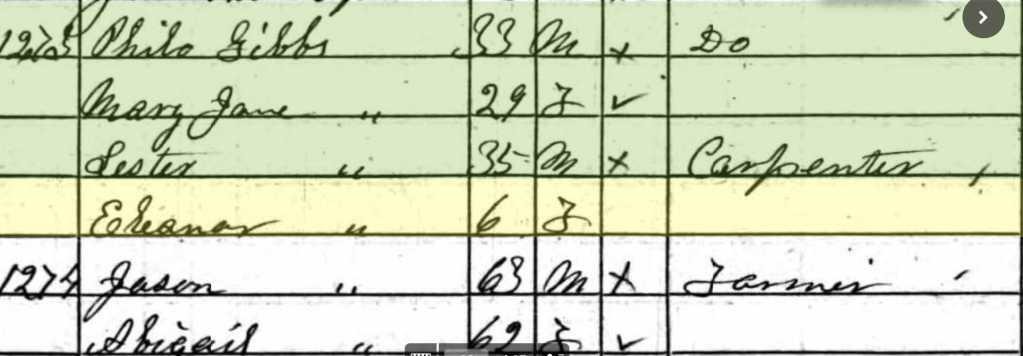
Eleanora was born in 1854, so theoretically, she should be in the 1860 and probably the 1870 census with her parents. This is where the confusion starts. In 1860, she can be found living in Dryden with Philo, Mary Jane and Lester Gibbs next door to a Jason and Abigail Gibbs.

1860 Federal Census, Dryden, Lapeer County, Michigan. Page 172.

Eleanora’s placement in the list suggests that she is Lester’s child, although the 1860 census does not indicate family relationships, and she could possibly be Philo’s daughter.

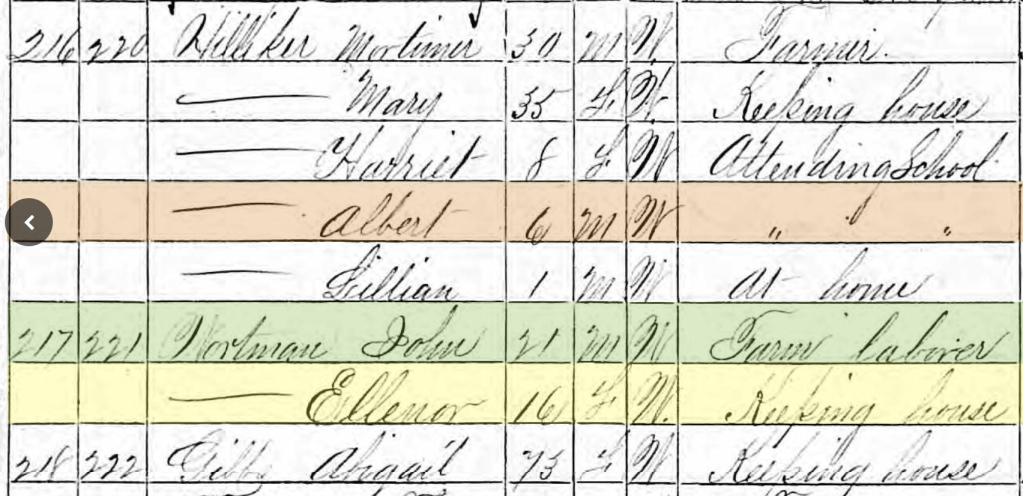
In 1870, Eleanora is married to her husband, John Wortman. The interesting tidbit here though is that John and Eleanora are listed between Mortimer Hillaker’s household and Abigail Gibbs house. Eleanora is living near relatives.

1870 Federal Census, Dryden, Lapeer County, Michigan. Page 26.

Lester disappears after the 1860 census. I have not been able to find any death record for him much less any other record for him after 1860. However, I did find a marriage record for Lester Gibbs in 1850. He marries Mary Conly on November 12, 1850 in Lapeer County. Given that Mary is not in the same household in 1860, it is certainly possible that she died or they divorced. While I have not found a divorce record, I have found additional marriages for Mary Conly – in 1861 to Charles Garner in New York and in 1868 to Mortimer Hillaker in Lapeer County, Michigan.

The obvious question here is how do I know that the marriage in 1861 in New York is her when both before and after that date, she’s living in Lapeer County, Michigan? Well, it’s thanks to her will. In the probate record from 1872 Lapeer County, Michigan, her will is included. She names her husband, Mortimer Hillaker and 2 children: Albert Garner and Harriet Garner. She charges her husband Mortimer to take care of Albert and Harriet until they turn 21 or are married. This would indicate that Albert and Harriet are minors. Records for both Albert and Harriet indicate this is true – Albert was born in 1864 in New York and Harriet in 1863 in New York. Harriet’s marriage record in Michigan names Charles Garner and Mary Conly as her parents. Charles dies in the Civil War.

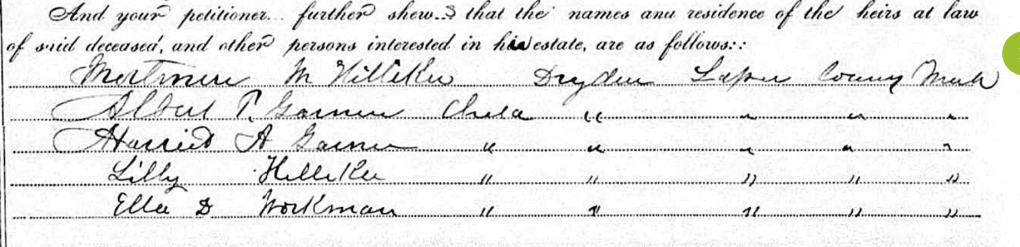
So, Mary Conly was married 3 times – Lester Gibbs, Charles Garner and Mortimer Hillaker. Her probate record goes on to indicate that her legal heirs are Mortimer Hillaker, Harriet Garner, Albert Garner, Lillie Hillaker and Ella Workman (a variation of Wortman). Lillie is her daughter with Mortimer. Ella is Eleanora Gibbs who in some other independent records is also known as Ella.

Part of the Account Papers in the Probate record for Mary Hillaker dated April 6, 1872.

This means that Eleanora Gibbs parents were Lester Gibbs and Mary Conly.