
One of the most surprising lessons in the story of Elnathan, Lydia, and Fanny Tolles is not about war or DNA or probate. It is about churches.
For most people researching early New England families, the default assumption is that the Congregational church holds the records. That works for many families — but not for this one. The Tolles and Clark families belonged to the Episcopal Church, and that single fact explains why Fanny nearly disappeared from history.
Lydia Clark was baptized as an adult at Trinity Church in New Haven in May 1773. Two years later, her daughter Frances was baptized there in March 1775. These were not casual entries. Episcopal parishes kept detailed registers of baptisms, sponsors, and marriages that were entirely separate from the town and Congregational systems.
Meanwhile, in Milford, Daniel Munson was part of the Episcopal world as well. Records from St. George’s Church show him as a subscriber and vestryman in the late 1780s. When Frances married Daniel Munson in 1798, she did so in a community deeply tied to the Episcopal network — and to her Clark relatives.
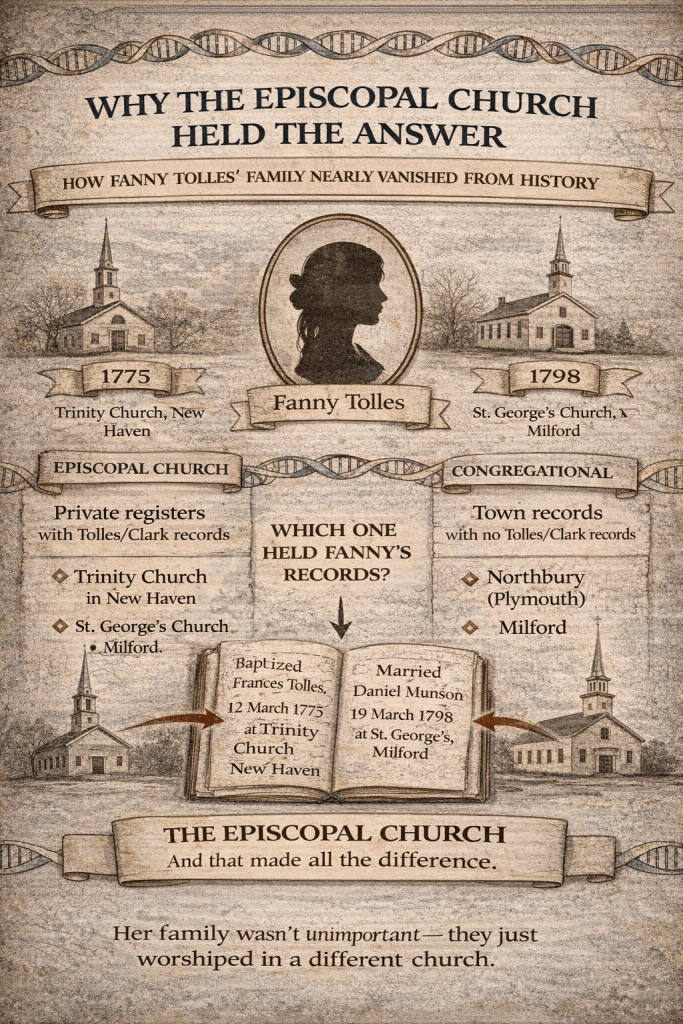
This is why older genealogists struggled. They searched town records and Congregational church books for Fanny Tolles and found very little. Without Episcopal registers, she looked unattached — a woman with a maiden name but no parents.
Donald Lines Jacobus solved this because he knew where to look. He drew from Trinity Church in New Haven, St. George’s in Milford, and the Plymouth parish records to reconstruct a family that existed almost entirely outside the Congregational system. When those church records were combined with probate law, the picture became clear.
Fanny Tolles did not vanish because her family was unimportant.
She vanished because her family worshiped in the “wrong” church.
And yet, it was those same Episcopal records that preserved her baptism, her name, and her marriage — quietly waiting for someone to connect them.
This is why genealogy is never just about names and dates. It is about institutions, beliefs, and communities — the frameworks that decide which lives are written down and which are forgotten.
For Fanny Tolles, the Episcopal Church kept her story alive long enough for us to finally find it.
Sources
- Trinity Church (Episcopal), New Haven, Connecticut, baptismal records, 23 May 1773 (Lydia Clark) and 12 March 1775 (Frances Tolles); abstracted in Donald Lines Jacobus, Families of New Haven, vol. VIII (1932).
- St. George’s Church, Milford, Connecticut, vestry and subscription lists, 1786–1788, showing Daniel Munson as a member of the Episcopal Society.
- Milford, Connecticut, Marriage Records, 19 March 1798, Daniel Munson and Frances (Fanny) Tolles.
- Donald Lines Jacobus, Deacon George Clark(e) of Milford, Connecticut and Some of His Descendants (1949), Clark and Tolles family entries.
- Probate of Elnathan and Lydia Tolles, Plymouth (Watertown) District, Litchfield County, Connecticut, 1789–1794.
 The Tumbleweed