Rosa Susan (“Rosie”) Smith Revisited: What the Records Reveal Years Later

Looking Back at an Earlier Story

When I first wrote about my 2× great-grandmother Rosa Susan “Rosie” Smith in 2018, the outline of her life was already clear: a childhood in Pennsylvania and Michigan, a long marriage to William Doonan, years spent in northern Ontario, and a life that stretched into the early 1950s. What remained unclear then were the brief, uncomfortable gaps — especially Rosie’s short-lived first marriage to Thomas Osborn and the compressed timing of her remarriage to William Doonan.
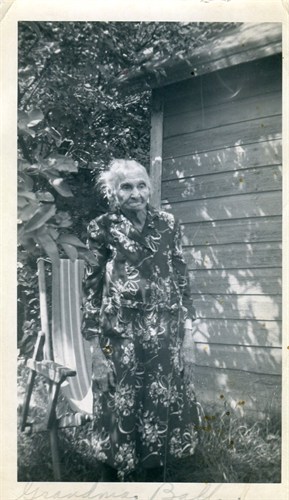
In the years since, additional records, closer reading of familiar sources, and the availability of autosomal DNA evidence have allowed some of those gaps to be examined more carefully.

Re-examining the Marriage to Thomas Osborn

Rosie married Thomas Osborn on 17 February 1882 in Bay County, Michigan, when she was just sixteen years old.¹ The marriage was solemnized by Justice of the Peace Nathaniel Enman and witnessed by Charles Horsford and Mary Ann Leary.² It was formally recorded on 27 April 1882.

Marriage record of Thomas Osborn and Rosie Smith marriage.

At the time of the earlier post, it was unclear whether this marriage ended through divorce or death. A subsequent review of the complete 1880 federal census for Beaver Township and Kawkawlin Township — examined page by page — failed to locate Thomas Osborn in either community.³ No additional census, land, probate, or newspaper records have been identified that place him in Rosie’s orbit before or after the marriage.

The record, taken as a whole, suggests a marriage that existed briefly and left no lasting documentary footprint beyond the register itself.

A Compressed Timeline, Clarified

Rosie’s daughter, Rosa Jane Doonan, was born on 22 August 1882 — less than seven months after the Osborn marriage and several months before Rosie’s marriage to William Doonan on 11 November 1882.⁴ The timeline, while long visible, takes on sharper focus when examined alongside later evidence.

Marriage record of William Doonan and Rosie Smith

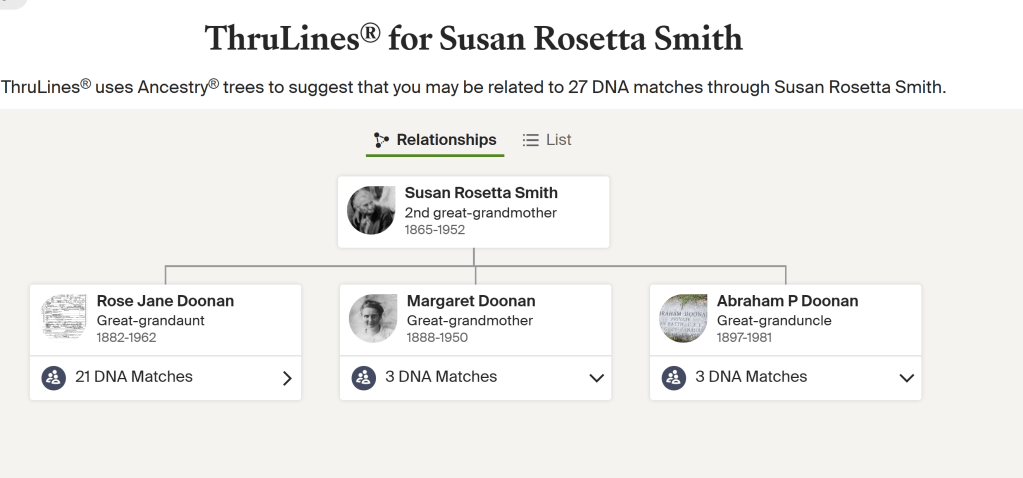
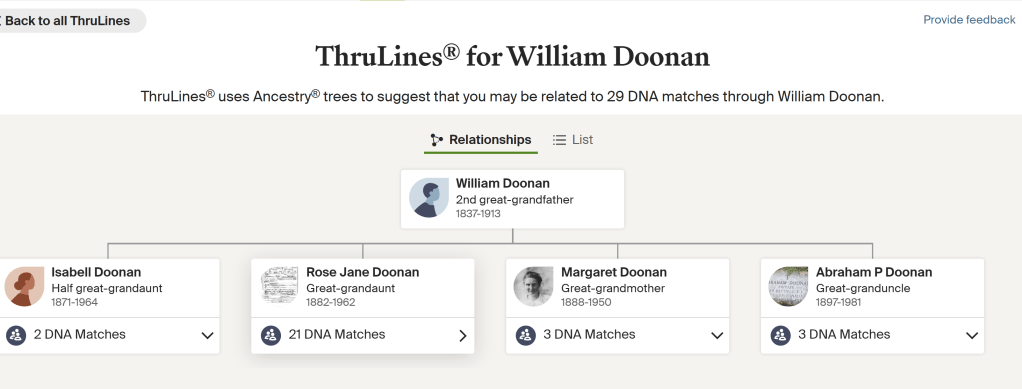
Modern autosomal DNA results now provide important clarification. Multiple DNA matches descending through independent children of Rosa Jane consistently align with William Doonan’s family.⁵ This pattern strongly supports William Doonan as Rosa Jane’s biological father and shows no comparable genetic connection to Thomas Osborn.

What once appeared as an unresolved question in the paper record is now better understood through the combination of documentation and DNA.
What the Witnesses — and Their Absence — Suggest

The Osborn marriage was witnessed by two community members who do not appear to have been relatives of either the bride or groom. No Osborn or Smith family members were listed as witnesses. Combined with Osborn’s absence from local census records, the marriage appears to have been formally executed but socially thin — a legally valid union that did not establish a shared household or lasting family connection.

This does not explain why the marriage occurred, but it helps explain why it disappeared so completely from the documentary record.

What Hasn’t Changed

What has not changed since the earlier post is the broader shape of Rosie’s life. Her long marriage to William Doonan, the birth and loss of children, the move to northern Ontario in 1908, and her later years as “Grandma Ball” within the extended family remain exactly as they were first understood.

If anything, the additional research sharpens rather than softens that picture. Rosie’s brief marriage to Thomas Osborn now appears as a momentary interruption rather than a defining chapter — a small but telling episode in a life otherwise shaped by endurance, adaptation, and persistence.

Conclusion

Family history rarely unfolds neatly. What can be known at one moment often changes as new records surface and new tools become available. Rosie’s story is no exception. The outlines were always there, but time and patience have filled in some of the finer lines.

This later look at Rosie’s life does not replace the earlier telling. Instead, it reflects the ongoing nature of historical research — the understanding that some answers arrive only years after the first questions are asked.


Sources

  1. Bay County, Michigan, Marriage Register, Thomas Osborn and Rosie Smith, 17 February 1882.
  2. Bay County, Michigan, Marriage Register (officiant and witnesses), same entry.
  3. 1880 U.S. Federal Census, Beaver Township and Kawkawlin Township, Bay County, Michigan.
  4. Michigan Birth Records, Rosa Jane Doonan, 22 August 1882; Bay County, Michigan, Marriage Records, William Doonan and Rosie Smith, 11 November 1882.
  5. AncestryDNA autosomal matches through multiple independent descendant lines of Rosa Jane Doonan.
William Doonan: Decline, Illness, and a Troubled End

By the time William Doonan relocated his family to the Temiskaming district of northern Ontario, he was no longer a young man. Newspaper accounts place the family’s move from Michigan to Pense Township by about 1908, when William—described repeatedly as elderly—set about clearing land and establishing a farm in an isolated settlement north of New Liskeard.¹ This move explains his absence from later United States records and marks the final geographic shift of his life.

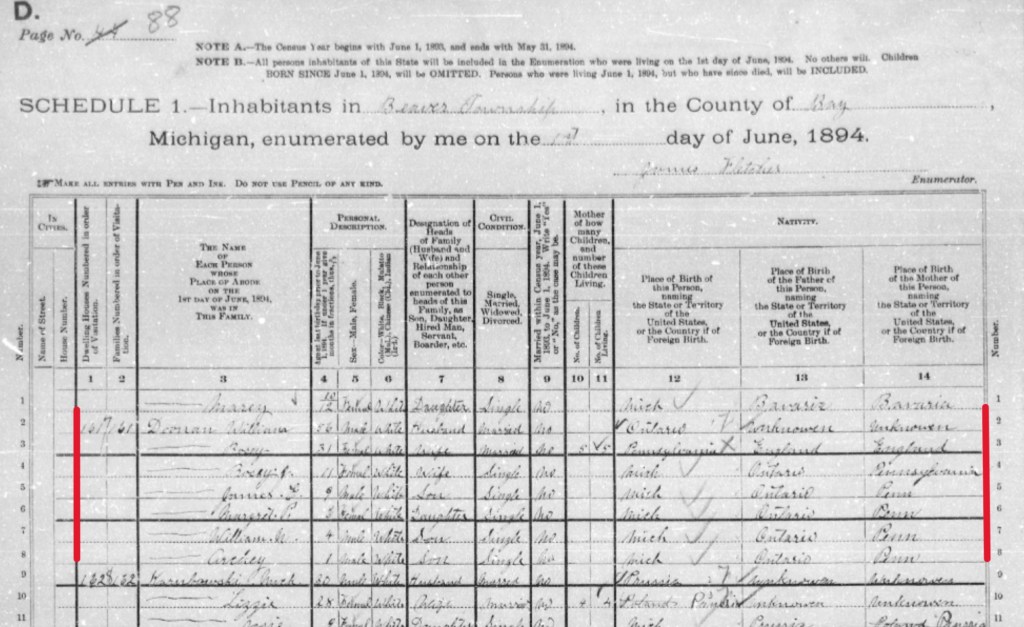
Michigan state census records show that by 1894 William and Rosa Susan Smith were raising a growing family together, firmly established in Bay County.² Those records reflect a household that expanded steadily through the 1880s and 1890s, before economic pressure, family conflict, and William’s advancing age appear to have pushed the family toward a more marginal existence.

1894 Michigan State Census for Beaver Township, Bay County.

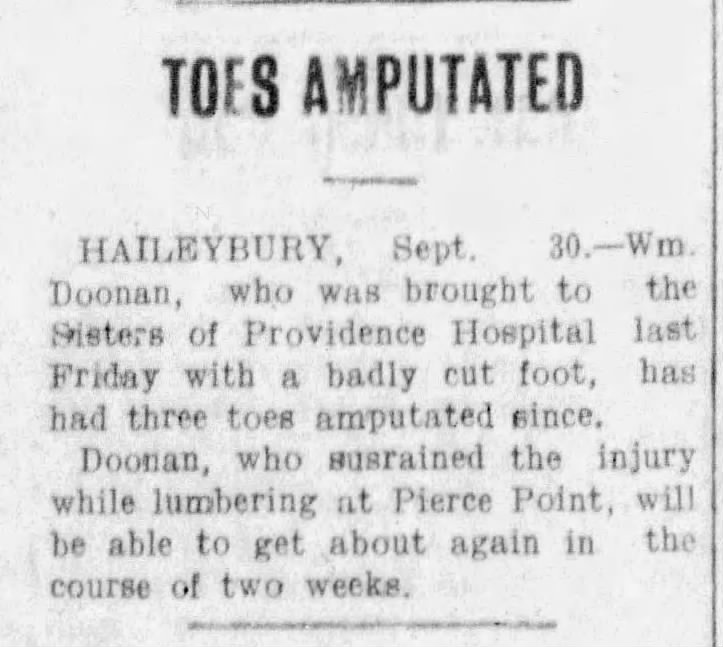
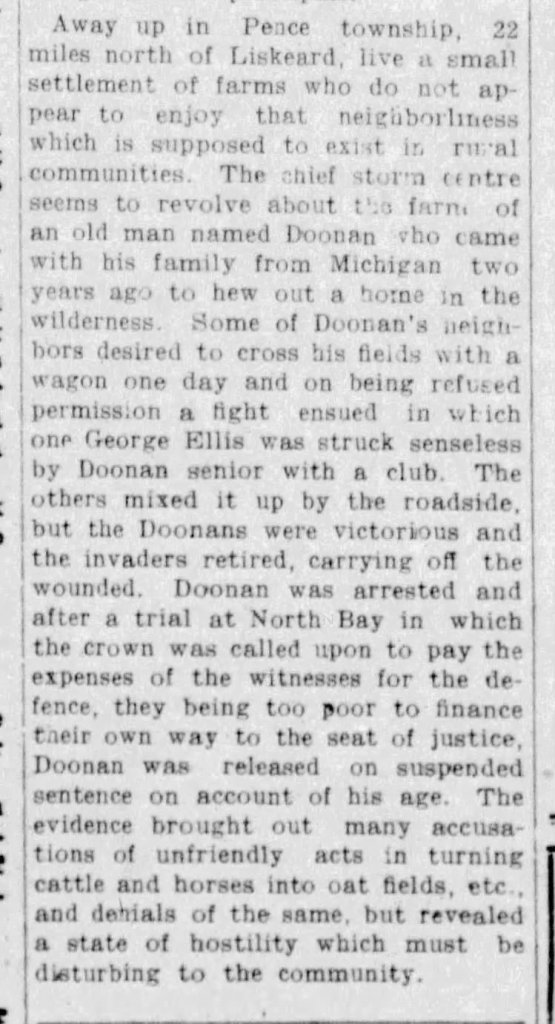
Life in Pense Township proved difficult. A June 1910 newspaper account described the settlement as one marked by deep hostility among neighbors, with William Doonan’s farm identified as the center of repeated disputes.³ One incident escalated into violence when neighbors attempted to cross his fields with a wagon and were refused permission. A fight followed in which George Ellis was struck unconscious by William Doonan, described in the article as “Doonan senior.” William was arrested and tried at North Bay, though the court was compelled to cover witness expenses because the family lacked the means to do so. He was ultimately released on a suspended sentence due to his age.⁴

These reports are notable not simply for the violence described, but for what they reveal about William’s condition. The articles consistently emphasize his age, poverty, and the fragile social position of the family. They also record a pattern of accusations and counter-accusations involving livestock, property damage, and threats—suggesting a man under strain in a community where tolerance was wearing thin.⁵

The North Bay Nugget, September 30, 1913, Page 2.

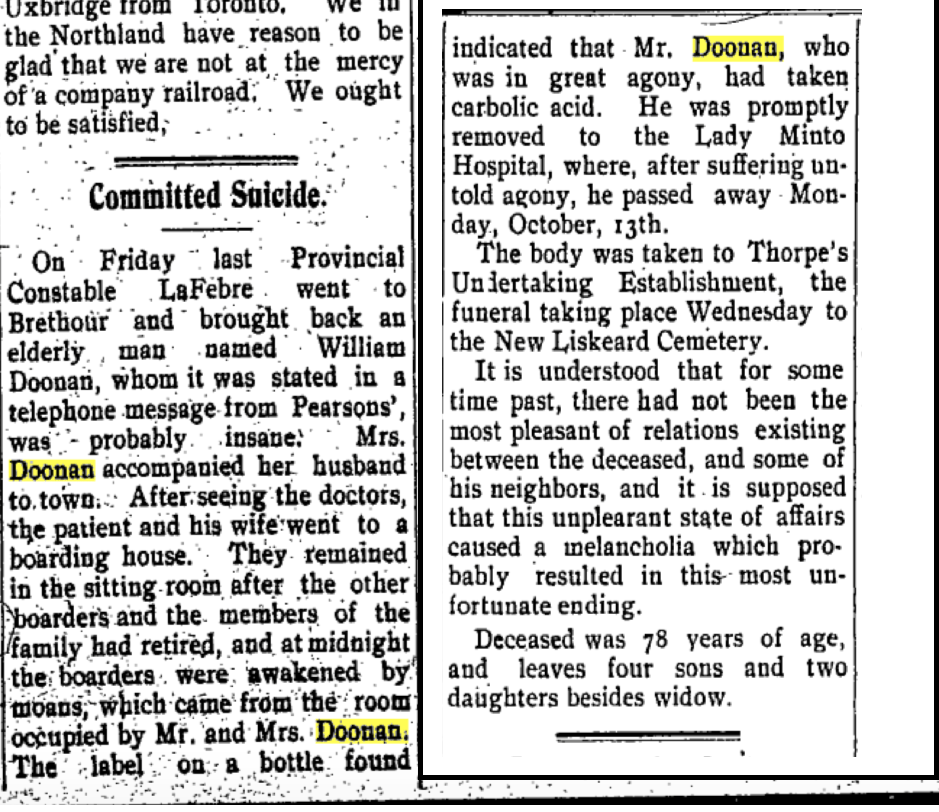
By 1913, William’s health had clearly deteriorated. Newspaper accounts from the Temiskaming district reported his death by suicide, following a period of illness and mental decline.⁶ The articles avoid sensational language, but the circumstances described point to a man worn down by years of conflict, physical decline, and isolation. His death occurred at Lady Minto Hospital, bringing his long and troubled life to an end far from the Michigan communities where he had spent most of his adulthood.⁷

The Temiskaming Speaker, October 17, 1913 Page 1 – bottom of one column and top of next column.

William Doonan’s story is not preserved through orderly civil records or consistent census appearances. Instead, it survives through fragments: state censuses, court proceedings, and the sometimes-blunt language of small-town newspapers. Together, those sources document a life shaped by instability, conflict, and hardship—one that cannot be understood through a single record type alone.

In the end, William Doonan did not disappear from the historical record. He faded out of one jurisdiction and reappeared in another, carrying with him the same struggles that had marked his earlier years. His death closed a chapter defined not by prosperity or permanence, but by endurance in the face of circumstances that steadily narrowed his options.


Sources

¹ North Bay Nugget (North Bay, Ontario), 29 June 1910, p. 7.
² 1884 Michigan State Census, Bay County; 1894 Michigan State Census, Bay County.
³ North Bay Nugget (North Bay, Ontario), 29 June 1910, p. 7.
⁴ Ibid.
⁵ Ibid.
The Temiskaming Speaker (New Liskeard, Ontario), October 1913.
⁷ Ontario death registration, Temiskaming District, 1913.

William Doonan and the Law: Conflict, Confinement, and Community Response

By the late 1880s, William Doonan was living in Bay County, Michigan, with his wife Rosa Susan Smith and their blended family, which included a daughter from William’s previous marriage. Although William does not appear in either the 1880 or 1900 U.S. federal census, local newspapers and state census records document a pattern of conflict that brought him repeatedly to the attention of neighbors, courts, and eventually authorities on both sides of the international border.

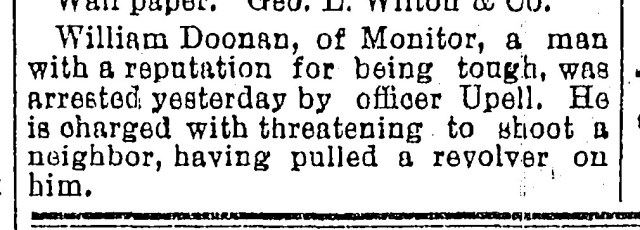
The earliest documented incident occurred in May 1889. The Evening Press reported that William Doonan, then residing in Monitor Township, was arrested after allegedly threatening to shoot a neighbor. According to the article, William drew a revolver during a dispute and was taken before a justice for examination.¹ This report establishes that William’s legal troubles began well before the turn of the century and involved firearms rather than minor civil disagreements.

The Evening Press, May 9, 1889, Bay City, Michigan. Page 8

In 1891, William’s name appeared again in the press—this time in connection with a tragedy within his wife’s family. The Bay City Daily Tribune reported on the conviction of Robert Smith for killing his brother Jude Smith, who was also Rosa’s brother. The article states that the gun involved in the homicide was afterward given to William Doonan.² The crime itself belonged solely to Robert Smith, but the transfer of the weapon placed William in possession of a firearm already associated with a notorious and widely reported act of violence. In a small community, such an association would not have gone unnoticed.

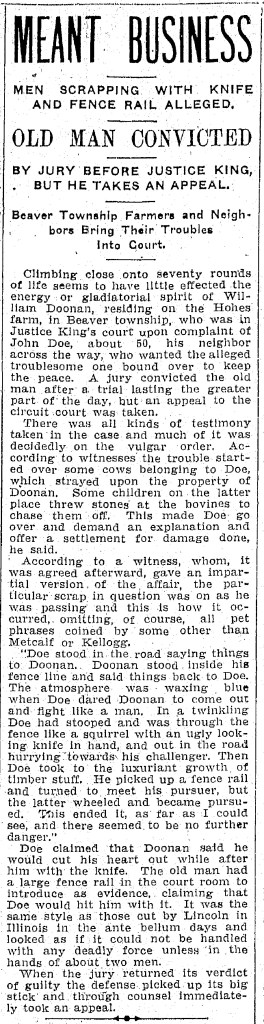
More than a decade later, William again surfaced in Bay City newspapers amid renewed conflict. In June 1905, the Bay City Times reported that a complaint had been filed by a neighbor, John Doe, alleging that William approached him with an open knife and made threats. The matter was adjourned rather than immediately resolved.³ A follow-up article published the following month described a contentious courtroom proceeding in which testimony referenced both a knife and a fence rail used as evidence. That report states William was convicted before a justice and that he appealed the decision.⁴ These accounts show William actively entangled in the local court system, though not always with swift or final resolution.

The Bay City Times, June 19, 1905, Page 6

By 1910, William Doonan was no longer appearing in Michigan newspapers. Instead, his name surfaced in Ontario. In May 1910, the North Bay Nugget reported on William in connection with firearm possession, revisiting earlier concerns about weapons and violent associations tied to the Smith family tragedy.⁵ The Temiskaming Speaker published a related account shortly thereafter, further documenting community concern and official attention.⁶ Later that summer, the North Bay Nugget followed up on William’s legal situation, indicating that the matter continued to draw notice weeks after the initial report.⁷

The North Bay Nugget, June 29, 1910, Page 7

These Canadian newspaper reports demonstrate that William’s conflicts did not end with his departure from Michigan. Rather, they followed him across the border, suggesting a continuity of reputation that transcended geography. The repetition of firearm-related concerns—spanning from 1889 in Monitor Township to 1910 in Ontario—forms one of the most consistent threads in the surviving documentary record.

William’s absence from the 1900 U.S. federal census remains unexplained. Whether this reflects deliberate avoidance, temporary relocation, or simple enumerator omission cannot be determined from existing evidence. What can be established is that William Doonan was repeatedly involved in disputes serious enough to attract legal and press attention over a span of more than twenty years.

The broader context of the Smith family violence is essential to understanding how William’s story was perceived by others. Rosa Susan Smith’s brother Jude Smith was killed by another brother, Robert Smith.⁸ While William was not responsible for that homicide, his later possession of the gun used in the crime and his own documented disputes involving weapons ensured that the shadow of that tragedy remained close.

By 1910, William Doonan was a man known to authorities in multiple jurisdictions, his name intertwined with firearms, courtrooms, and unresolved tensions. His story does not resolve neatly—but the records leave little doubt that his reputation was forged as much by conflict as by kinship.


Sources

¹ Evening Press (Bay City, Michigan), 9 May 1889, p. 8.
² Bay City Daily Tribune (Bay City, Michigan), 13 May 1891, p. 4.
³ Bay City Times (Bay City, Michigan), 18 May 1905, p. 1, “Show Him His Heart.”
Bay City Times (Bay City, Michigan), 19 June 1905, p. 6, “Meant Business.”
North Bay Nugget (North Bay, Ontario), 19 May 1910, p. 1.
The Temiskaming Speaker (New Liskeard, Ontario), 20 May 1910, p. 4.
North Bay Nugget (North Bay, Ontario), 29 June 1910, p. 7.
⁸ Nancy Little, “Jude Smith’s Legacy,” The Tumbleweed, 14 March 2018, https://familytumbleweed.blog/2018/03/14/jude-smiths-legacy/.

William Doonan: Origins, Migration, and Family Formation

William Doonan was born on 29 September 1837 in Hillier Township, Prince Edward County, Upper Canada, the son of James Doonan and Prudence Mary Morton.¹ His early life unfolded within a large family that soon migrated westward into Hastings County, Ontario, where William appears alongside his parents and siblings in mid-nineteenth-century records.² These early movements reflect the broader patterns of rural settlement and land hunger that shaped many Canadian families of the period.

By the 1860s, William was living independently. In the 1861 census of Canada, he appears in Hungerford Township, Hastings County, identified as a single man and a member of the Church of England.³ Within a few years, he crossed the border into Michigan, joining the steady stream of Canadian migrants drawn to land opportunities in the Saginaw Bay region.

On 4 March 1868, William Doonan entered 80 acres of land in Beaver Township, Bay County, Michigan, under the Homestead Act.⁴ Over the following years, he fulfilled the requirements of residence and improvement, constructing a log house and barn, digging wells, fencing and cultivating acreage, and planting fruit trees.⁵ These records establish him not as a transient laborer but as a settler who invested sustained labor and resources into his farm.

William’s personal life during this period was complex. He married Ann Scott in Bay County on 26 December 1869.⁶ This marriage was short-lived, and no later records place Ann in William’s household. By January 1874, William had married again, this time to Maloney Jewbar.⁷ As with his first marriage, no divorce or death record has been located, but by the early 1880s Maloney no longer appears in records associated with him.

William’s third marriage, to Rosa Susan Smith, marked a turning point in his life. They were married in Bay City, Michigan, on 11 December 1882.⁸ From this point forward, Rosa is consistently identified as William’s wife in census records, newspapers, and later Ontario documents. She was the mother of nearly all of his children and remained with him through the final decades of his life.

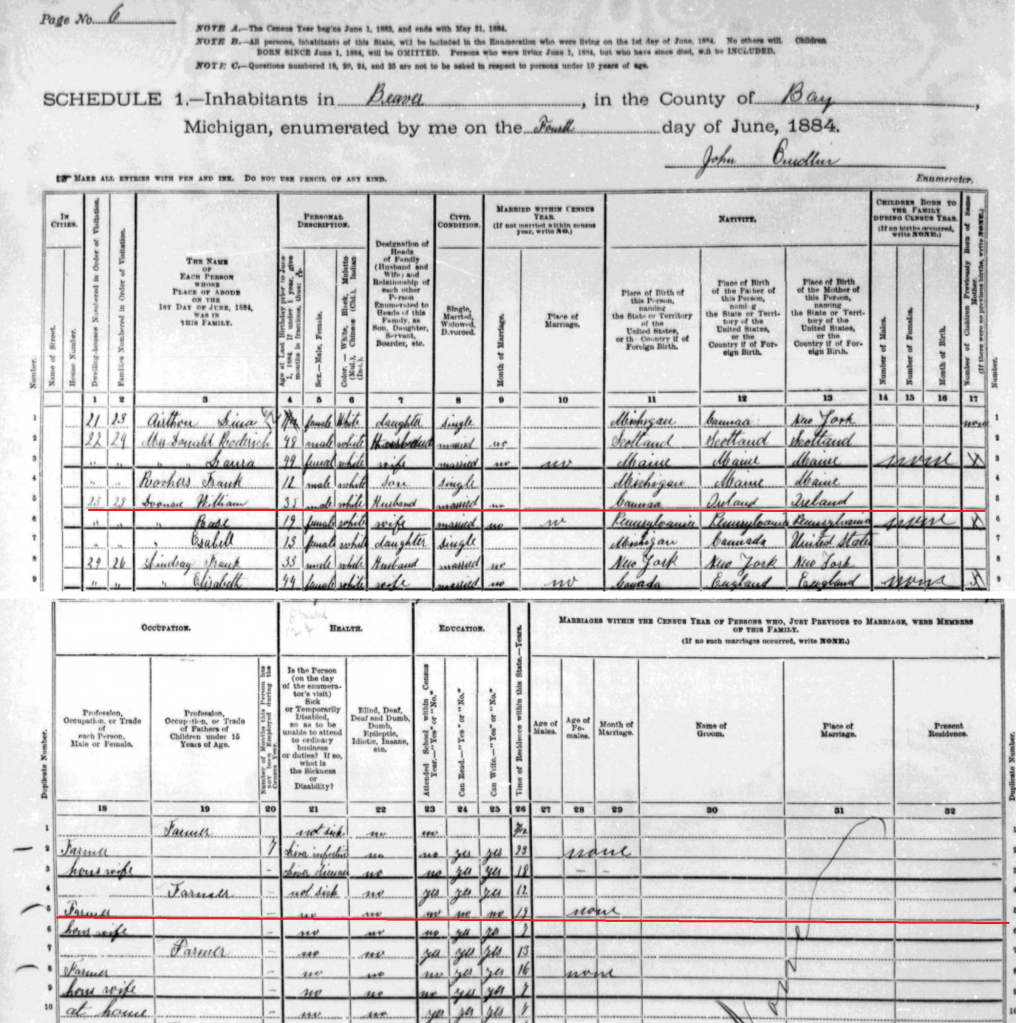
One child, Isabel Doonan, predates William’s marriage to Rosa. Isabel appears in the 1884 Michigan state census within William and Rosa’s household.⁹ Based on her age and the date of William’s marriage to Rosa, Isabel was the child of one of William’s earlier marriages. Her presence in the household reflects the blended family structures that were not uncommon in the nineteenth century.

1884 Michigan State Census. William Doonan is underlined in red.

William and Rosa raised a large family in Bay County, and their household appears repeatedly in Michigan state census records during the 1880s and 1890s.¹⁰ During these years, William supported his family through farming and lumbering, work that was physically demanding and increasingly hazardous as he aged.

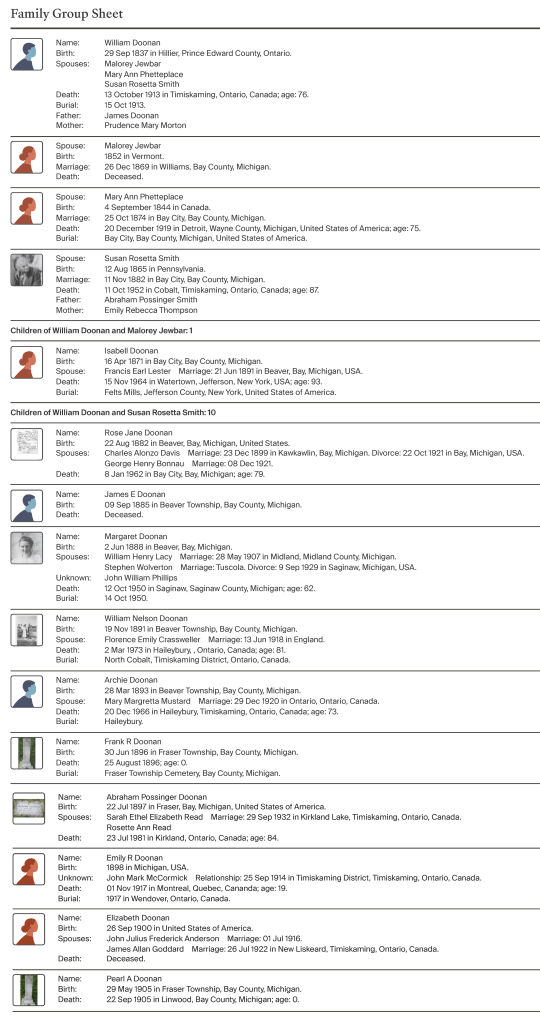
Family Group Sheet for William Doonan

William does not appear in the 1880 or 1900 United States federal census. This absence is notable but not inexplicable. During this period, he moved frequently between Michigan and Ontario and appears instead in state and provincial records. At the turn of the twentieth century, his household was also affected by violence within his wife’s family, including the killing of Rosa Susan Smith’s brother Jude Smith by another brother, an event documented elsewhere.¹¹ Contemporary newspaper reporting later indicates that William came into possession of the firearm involved.¹² While no direct evidence links these events to census avoidance, the combination of cross-border movement, legal scrutiny, and rural residence provides a plausible explanation for the family’s absence from federal enumeration.

William’s wider family network also remained close. Census proximity and migration patterns suggest that John Doonan, who appears in nearby Michigan census records during the same period, was likely William’s brother.¹³ Although no single record explicitly states this relationship, the accumulated evidence supports a close familial connection.

By the early twentieth century, William and Rosa left Michigan and returned to Ontario, settling in the Temiskaming District. This final chapter of William Doonan’s life would be marked by increasing hardship, legal entanglements, and declining health—subjects that will be examined in the posts that follow.


Notes

  1. Ontario birth records and compiled family records for William Doonan, Hillier Township, Prince Edward County, Ontario.
  2. 1861 Census of Canada, Hungerford Township, Hastings County, Ontario.
  3. Ibid.
  4. U.S. General Land Office Records, Homestead Entry, Beaver Township, Bay County, Michigan, 4 March 1868.
  5. Homestead proof affidavits, Beaver Township, Bay County, Michigan.
  6. Bay County, Michigan, Marriage Register, 1869, marriage of William Doonan and Ann Scott.
  7. Bay County, Michigan, Marriage Register, 1874, marriage of William Doonan and Maloney Jewbar.
  8. Bay County, Michigan, Marriage Register, 1882, marriage of William Doonan and Rosa Susan Smith.
  9. 1884 Michigan State Census, Beaver Township, Bay County, Michigan.
  10. 1884 and 1894 Michigan State Census records, Beaver Township, Bay County, Michigan.
  11. Nancy Little, “Jude Smith’s Legacy,” The Tumbleweed, 14 March 2018.
  12. North Bay Nugget, May 1910, reporting on firearm possession connected to the Smith family incident.
  13. 1884 and 1894 Michigan State Census records for John Doonan, Bay County, Michigan.

My Irish Connection

James Doonan was born in Ireland around 1796-1799. He was married to Prudence who was a bit younger – born in 1811 in Ireland. Due to the destruction of records over the years in Ireland, I cannot say who their parents are with any certainty. James and Prudence immigrated to Canada by 1835 as their first known son was born in Canada in 1835. James and Prudence would ultimately have 10 children (that are known): John born February 7, 1835; Elizabeth born April 10, 1836; William born September 29, 1837; James born April 13, 1839, Armour born December 29, 1841; David born April 20, 1843, Edward born November 20, 1844; Alexander born May 8, 1846, Johnston born March 19, 1848 and Sarah Ann born June 2, 1851. William is my second great-grandfather, making James and Prudence my 3x great-grandparents.

Several years ago, I had hired a researcher to try to find out more about the ancestors of James and Prudence. The report that was generated lacked documentary evidence, but supposed that James parents were William Donan and Jane Glenn. It also supposed that Prudence’s maiden name was Morton and her parents were James Morton and Margaret Johnson. I really don’t know if this is true or not. In 2012 I made a trip to Northern Ireland – to Belfast – to do research and found there were no records to support or deny these claims.

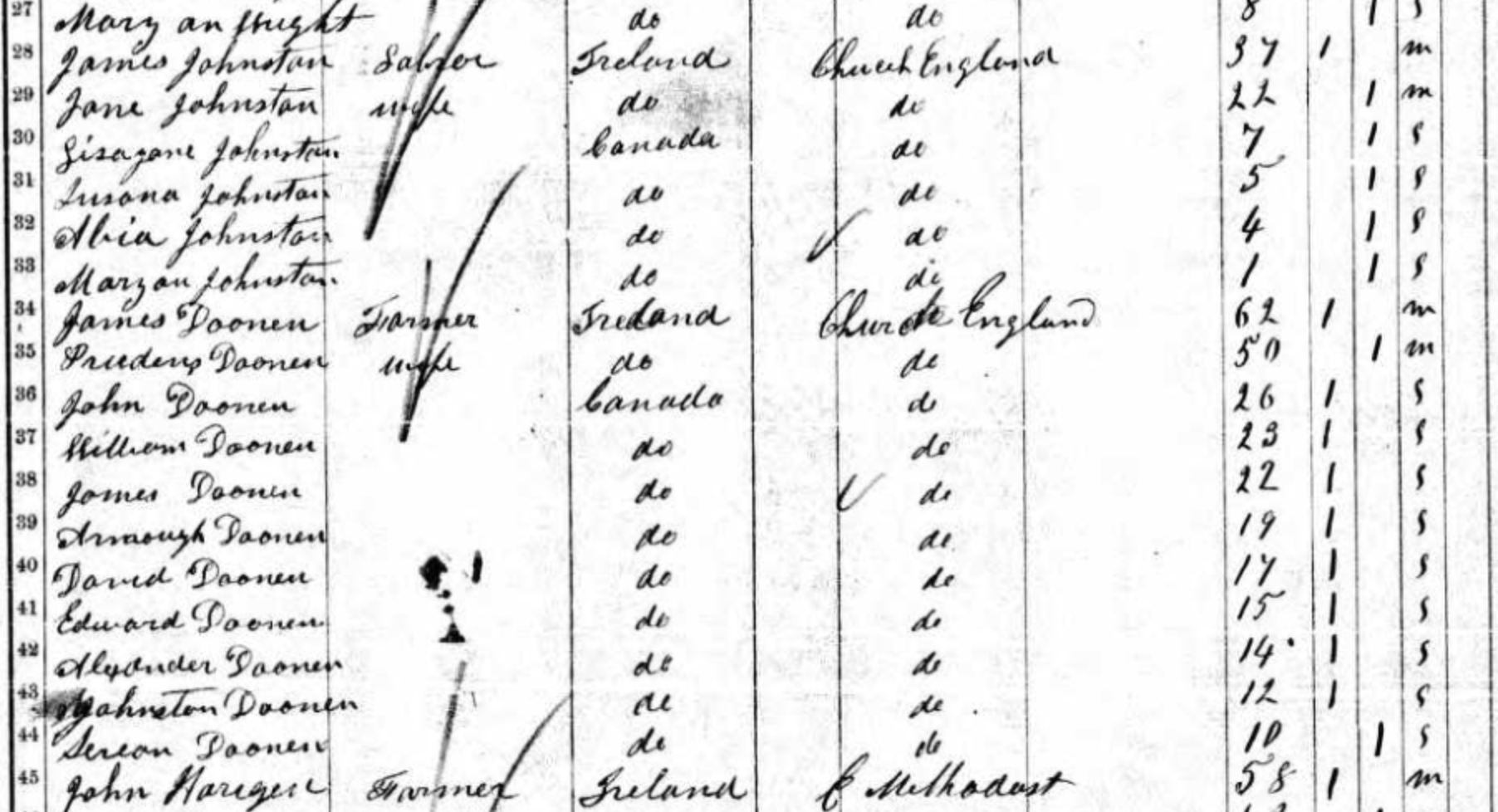
I talked to another researcher who claimed that Prudence’s maiden name was Johnston – like her last son’s given name. It’s not unusual for a son to be named after the mother’s family – sometimes using the surname as a given name for the child. Then there is this curiosity from the 1861 Census of Canada:

Screen Shot 2018-03-16 at 9.08.09 AM
1861 Canada Census, Hungerford Township, Hastings County, Canada West (aka Ontario).

There’s the Doonan family living seemingly next door to a Johnston family whose parents were born in Ireland. Prudence is 13 years older than James Johnston here which means they could possibly be siblings. It would not be unusual for siblings to immigrate to a new area and live next to each other. So, there certainly seems to be evidence supporting the Johnston surname – although quite honestly it’s not proof either.

Most of the Doonan’s remained in Canada, but John and William moved to Michigan sometime in the 1860’s. John would immigrate to Bay county and die in 1900 in Roscommon and William came to Bay City where he was married 4 times (most likely divorced 3 of those 4 times – but no divorce records are found, nor death information for 3 of the 4 wives).

John Doonan was married on April 10, 1861 in Bruce, Ontario to Eliza Jane Walker. Two of their 10 children were born in Canada. William J. born 1861 in Canada, Prudence E. born October 28, 1863 in Canada. Then they moved to Michigan where Francis was born in 1865, Elizabeth born 18 May 1868, Eliza Jane born 1870, David born June 21, 1874, Sarah A born 1876, Ruth born March 14, 1879, Amanda born July 1882 and Charles born November 14, 1884. Coincidentally, after John’s death, Eliza Jane would re-marry in 1903 in Higgins Township, Roscommon, Michigan to Samuel Johnston who was born about 1846 in Canada. At this time it is unknown if Samuel Johnston has any connection to that Johnston family from the 1861 census.

William and his fourth wife, Rosa Smith, would have 10 children – 8 of whom lived to be adults as far as I can tell. Frank, born  June 30, 1896 and Pearl born May 25, 1905 are both buried in Fraser Township Cemetery in Bay County. Sometime between 1905 and 1910 (probably 1908) William moved with his wife, 4 sons and 2 of 4 of his daughters back to Canada. The two daughters who stayed in Michigan were married – Rose Jane Doonan born August 22, 1882 was married to Alonzo Davis, and my great-grandmother, Margaret born on June 2, 1888 was married to William Henry Lacy in 1907. William would ultimately commit suicide on October 13, 1913 in New Liskeard. Rosa would re-marry in 1918 to Ernest Ball. William and Rosa’s sons, James, William Nelson, Archie and Abraham Possinger would all serve during World War I in the Canadian Expeditionary Force.

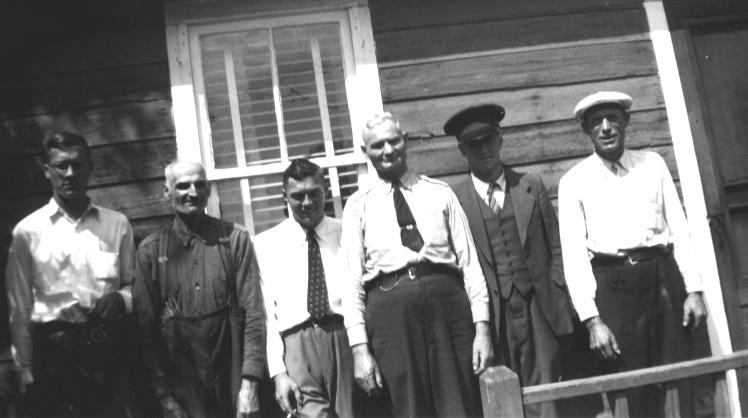
Howard Rivers, William Doonan, Alvin Rivers, Archie Doonan
Howard Rivers, William Doonan, Alvin Rivers, Archie Doonan and 2 other Doonan relatives (not sure of their names). Picture taken on a trip of Howard and Alvin with their mother to visit the Doonan cousins in Cobalt, Ontario Canada in the 1950’s or early 1960’s.

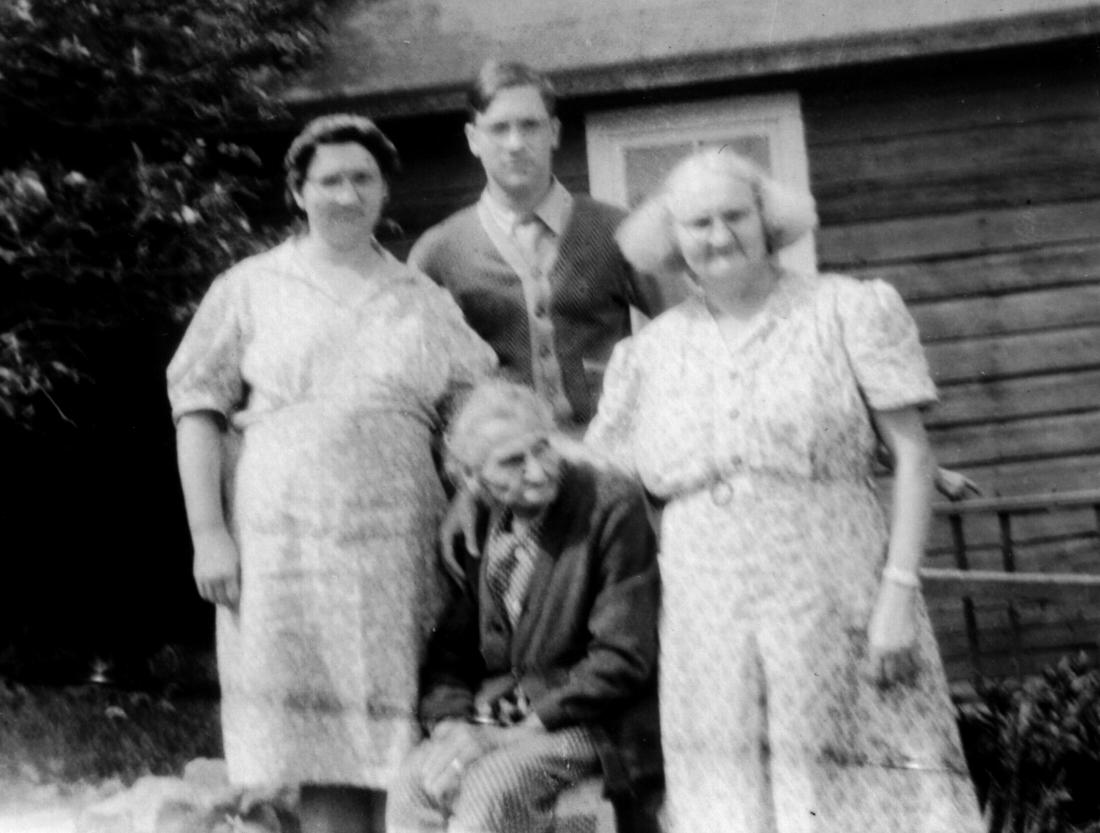
(Ellizabeth) Sabria Lacy, Howard Rivers, Margaret Doonan, R
4 Generations: Rosa Smith Doonan Ball, Margaret Doonan Lacy Phillips, Elizabeth Sabria Lacy Rivers and Howard Rivers. Picture taken in Colbalt, Ontario, Canada probably summer 1952.

Rosa Susan “Rosie” Smith

“Grandma Ball” as I had always heard her referred to was born on August 12, 1865 in Pennsylvania, the sixth child of Abraham Possinger Smith and Emily Rebecca Thompson.

Rosa Smith Doonan Ball

Sometime in the 1870’s, Rose moved to Bay County, Michigan with her family. On February 17, 1882, she married Thomas Osborn in Bay County. That marriage didn’t last very long though because just 9 months later, on November 11, 1882 she marries William Doonan. It is not clear what happened to Thomas Osborn – if they divorced or he died. Rosie would remain married to William Doonan until 1913 when he took his own life. Rosie would eventually marry Ernest Alfred Ball on August 26, 1919 in Timiskaming, Ontario, Canada. Ernest would die in 1935 and Rosie would never marry again.

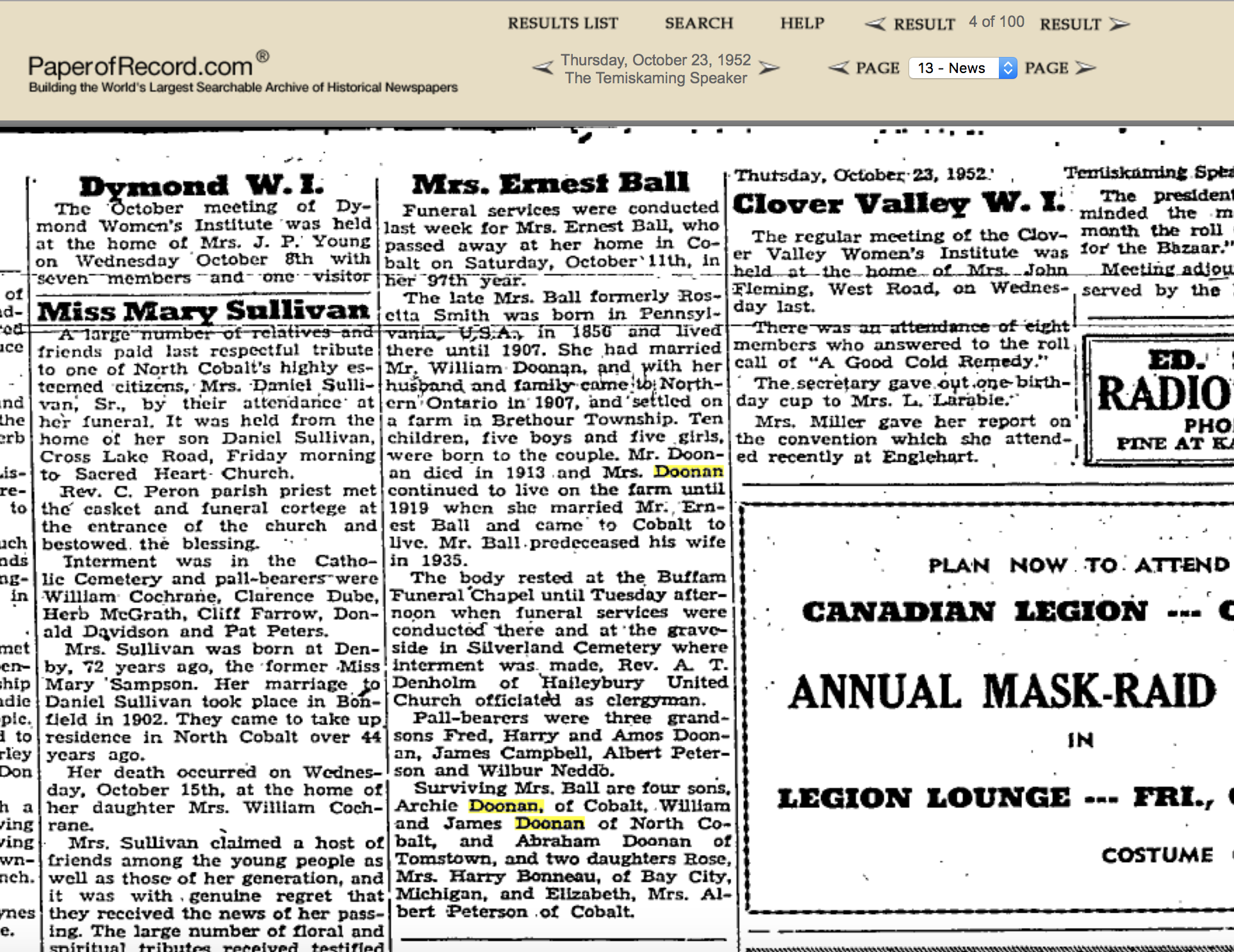
Rosie passed away on October 11, 1952. At some point they changed her birth year by 10, so the newspaper states that she was in her 97th year – when in reality it was her 87th year.

Screen Shot 2018-02-21 at 8.55.29 AM

Screen Shot 2018-02-21 at 8.45.30 AM
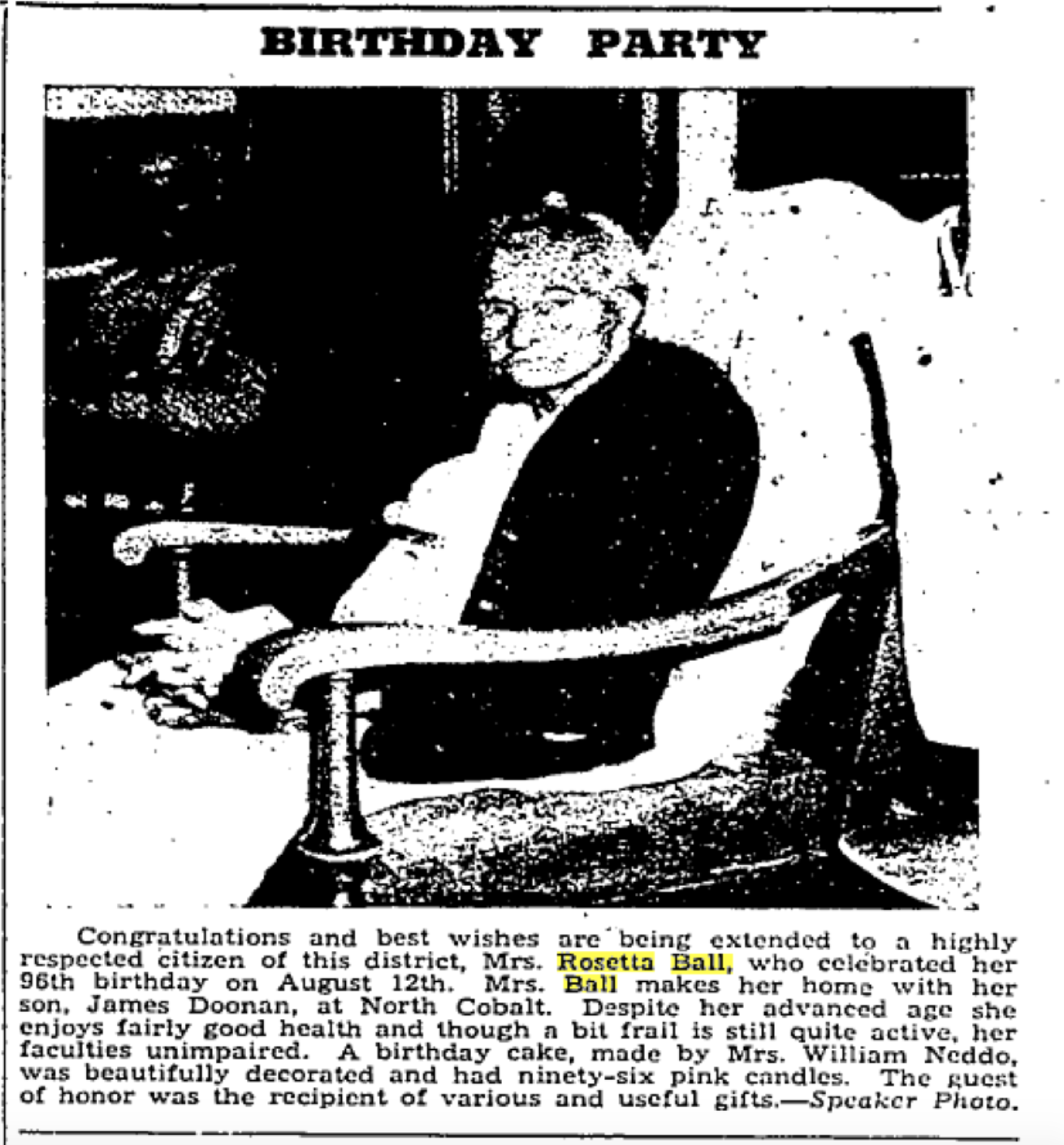
A copy of the article that appeared on the front page of the Temiskaming Speaker on August 21, 1952. This was just 2 months before her death.

The obituary leaves out my great-grandmother, Margaret Doonan who was married to John Phillips at the time and living in Saginaw, Michigan.

Rosie and William Doonan had ten children – but only 8 lived to be adults. Frank died at the age of 5 and Pearl died at the age of 4 months. Both of them are buried in Fraser Township, Bay County, Michigan. Another daughter, Emily, died at the age of 18. The oldest daughter is Rose Jane who was married to Harry Bonnaeau. Rosie and William had 3 sons who served in the Canadian Expeditionary Force during World War I – Archie, Abraham and William Nelson. Archie and Abraham were wounded in the war, but lived through it.

After their youngest daughter died in 1905, William and Rosie moved in 1908 to Pence Township, Temiskaming, Ontario, Canada. I remember once when I was little that my parents (and sister), and my uncle went to Cobalt, Ontario to visit the Doonan relatives. This was probably the late 1970’s early 1980’s. I was too young to really understand who they were though. It wasn’t my dad’s first trip there though – he had gone several times with my grandparents and great-grandma, but it was the last trip he made to see the Canadian relatives.