When History Stops Being Abstract: Discovering a Family Connection to Ethan Allen

When I was in history class in school, I was bored.
Not because history wasn’t important, but because it felt distant. The people we studied were names on a page—interesting, perhaps, but disconnected from my own life. I remember thinking that history might feel very different if I were actually related to someone we were learning about.

One group that did stand out to me even then was the Green Mountain Boys. Their exploits during the early days of the American Revolution felt bolder and less conventional than the orderly narratives found in textbooks. I remember thinking it would be fascinating to be connected to someone like that.

Years later, through genealogical research, I discovered that I am.

Through documented colonial records, I am a third cousin, eight times removed from Ethan Allen, the outspoken leader of the Green Mountain Boys. While he is not a direct ancestor, he is part of my extended family network, connected through well-documented seventeenth-century New England families.

Who Was Ethan Allen?

Ethan Allen was born on 10 January 1738 in Litchfield, Connecticut, the son of Joseph Allen and Mary Baker.¹ He grew up on the Connecticut frontier and later became closely associated with the territory that would become Vermont. Allen was largely self-educated, deeply independent, and known for his forceful personality—traits that shaped both his leadership and his reputation.
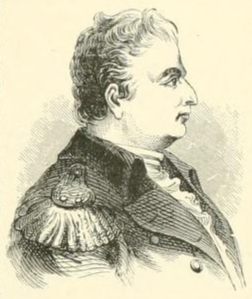
General Ethan Allen
Ethan Allen. Nineteenth-century engraving. Public domain. Image via ReusableArt.com.

Allen is best remembered for his role in the capture of Fort Ticonderoga in May 1775. Leading a force of Green Mountain Boys, along with Benedict Arnold, Allen surprised the small British garrison and secured the fort with little resistance.² The artillery seized at Ticonderoga later proved critical in forcing British troops to evacuate Boston.³

Beyond that single event, Allen remained a controversial figure. He was never formally commissioned as an officer in the Continental Army and frequently clashed with authorities. He was captured by British forces during an ill-fated invasion of Quebec in 1775 and spent more than two years as a prisoner of war.⁴ After his release, Allen continued to advocate fiercely for Vermont’s independence, resisting efforts by both New York and the Continental Congress to assert control over the region.⁵

Allen’s legacy is complex: he was a revolutionary hero to some, a political irritant to others, and a man whose independence often placed him at odds with the very cause he supported.

The Genealogical Connection

The relationship between Ethan Allen and myself is supported by original town, church, and probate records from Massachusetts and Connecticut that document both lines back to a shared seventeenth-century couple.

Ethan Allen’s maternal ancestry traces through Mercy Wright of Deerfield, Massachusetts, the daughter of Judah Wright and Mercy Burt. Mercy Burt was the daughter of Henry Burt and Eulalia March, early settlers of Springfield, Massachusetts. Both Henry Burt and his wife Eulalia are well documented in Springfield town records, church registers, and probate material, and it is through their children that multiple New England family lines descend.⁶

My own lineage also descends from this same couple—Henry Burt and Eulalia March—but through a different child, Dorcas Burt, who married John Stiles. Dorcas appears repeatedly in Springfield and Windsor records, and her descendants are documented across Massachusetts, Connecticut, New Hampshire, and Vermont through successive generations.⁷

Because both Ethan Allen and I descend from Henry Burt and Eulalia March through different children and across multiple generations, we share them as common ancestors. This places us within a distant but clearly documented kinship network rooted in early colonial New England, established through original records rather than family tradition or assumption.

Why a Distant Relationship Still Matters

I am not claiming Ethan Allen as a direct ancestor, nor suggesting that a distant cousin relationship confers historical importance. What it does provide is context.

The Green Mountain Boys no longer feel like anonymous figures acting in isolation. They were men operating within the same colonial communities, family networks, and record-keeping systems as my own ancestors—networks shaped just as much by women as by men. Without women like Eulalia March, Mercy Burt, and Mercy Wright, none of these lines would exist to be traced today.

The American Revolution did not happen in abstraction—it unfolded among families whose lives intersected in ways we can still trace through the records they left behind.

For me, that realization transformed history from something remote into something tangible. It closed a circle that began in a classroom years ago, when history felt dull simply because it felt disconnected.

Sometimes history doesn’t become interesting because it changes—but because our relationship to it does.


Notes

  1. Vital Records of Litchfield, Connecticut, 1721–1850 (Hartford: Connecticut Society of Colonial Wars, 1907), 23.
  2. Ethan Allen, A Narrative of Colonel Ethan Allen’s Captivity (Philadelphia: Robert Bell, 1779), 11–15.
  3. Robert Middlekauff, The Glorious Cause: The American Revolution, 1763–1789 (New York: Oxford University Press, 1982), 284–286.
  4. Allen, Narrative of Captivity, 49–112.
  5. Charles A. Jellison, Ethan Allen: Frontier Rebel (Syracuse, NY: Syracuse University Press, 1969), 201–245.
  6. Vital Records of Springfield, Massachusetts, to the Year 1850, vol. 1 (Springfield, MA: Springfield Printing and Binding Co., 1923), Burt entries; Hampden County, Massachusetts, Probate Records, estate of Henry Burt (1662).
  7. Vital Records of Windsor, Connecticut, to the Year 1850 (Hartford: Connecticut Society of Colonial Wars, 1904); Vital Records of Westfield, Massachusetts, to the Year 1850 (Boston: New England Historic Genealogical Society, 1904).
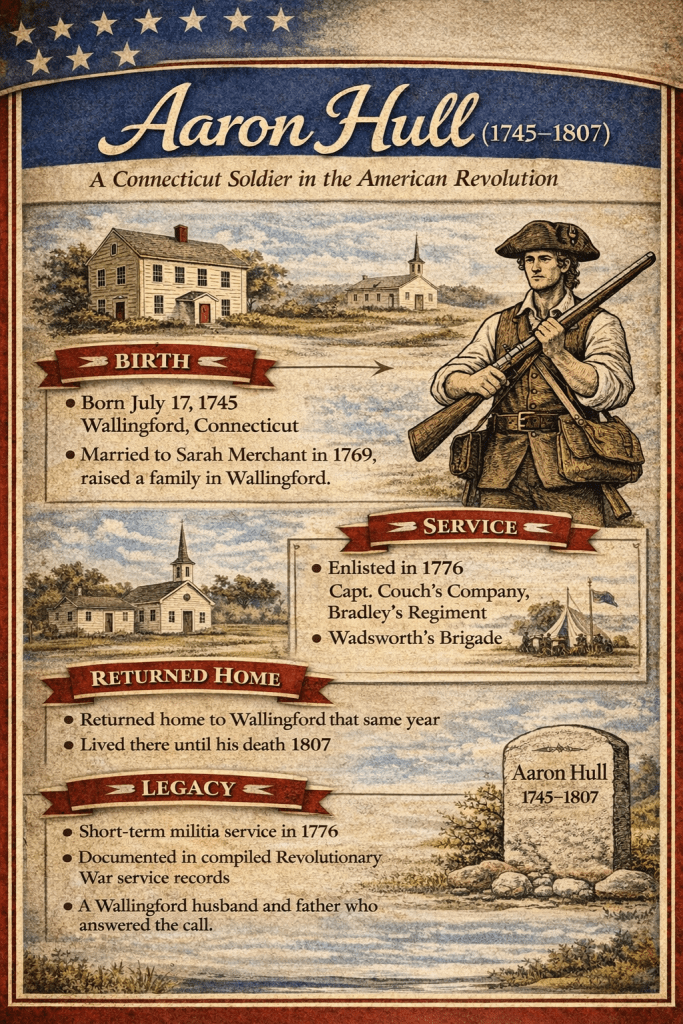
Aaron Hull (1745–1807)

Revolutionary War service is often imagined as long enlistments, dramatic campaigns, and later pension testimony. In reality, many Connecticut men served for brief periods in the early years of the conflict, answering calls before returning home to their families and farms. The military service of Aaron Hull fits that pattern and is supported by compiled federal military records.¹

Born and buried in Wallingford, Connecticut, Aaron Hull spent nearly his entire life within the same community. His Revolutionary War service, though short in duration, is firmly documented and securely attributable to him—making his case a relatively straightforward identification among Connecticut patriots.²


Early Life in Wallingford

Aaron Hull was born 17 July 1745 in Wallingford, New Haven County, Connecticut, the son of John Hull and Mary Andrews.³ He lost his father in 1755, when Aaron was still a child.⁴

On 16 November 1769, Aaron married Sarah Merchant in Wallingford.⁵ Over the next decade the couple began raising a family. Their children’s births span the years immediately before, during, and after the Revolution, placing Aaron among the many married householders who balanced wartime obligations with domestic life.⁶


Revolutionary War Service

Aaron Hull’s Revolutionary War service appears in compiled federal service records derived from original muster and pay rolls.⁷ Those records indicate that he enlisted in 1776 in Captain John Couch’s company, within Colonel David Wooster’s/Wadsworth-associated Connecticut organization commonly referenced as Bradley’s Regiment (or battalion) in some compiled abstracts.⁸

His service was short-term and he was discharged the same year. Short enlistments of this kind were common for Connecticut men in 1776, particularly in service connected to local defense, regional mobilization, and short campaigns.⁹

A separate lineage-society abstract (compiled from earlier record sources) also reports Aaron Hull’s 1776 enlistment in Captain Couch’s company, Bradley’s battalion, Wadsworth’s brigade, with discharge the same year and identifying him as born in Wallingford, Connecticut.¹⁰ While such membership-era abstracts are not substitutes for original records, the agreement between the abstract and the compiled service record strengthens confidence in the interpretation and identification of the soldier.¹¹


Civilian Life During and After the War

After his wartime service, Aaron Hull returned to civilian life in Wallingford and the nearby Meriden area. The continued births of his children in Connecticut through 1780 reflect a stable household during the postwar years.¹²

Federal census schedules place him in Wallingford in both 1790 and 1800, confirming continuity of residence.¹³ Unlike some veterans who moved westward after the Revolution, Aaron Hull appears to have remained rooted in the same Connecticut community where he was born.

Aaron Hull died on 22 September 1807 in Wallingford; his wife Sarah Merchant Hull died the same day.¹⁴ Local burial information associates the family with the Meriden/Wallingford area, consistent with their long-term residence.¹⁵


Assessing the Evidence

Aaron Hull’s service is supported by a strong combination of sources: compiled federal military records that identify the soldier’s unit and year of enlistment, and civilian records that consistently place the same man in Wallingford before and after the war.

The absence of a pension file does not weaken the case. Many men with short service in 1776 never applied for pensions, and eligibility rules changed over time. Aaron Hull’s documented service fits well within the category of Revolutionary participants whose contribution was real, essential, and only briefly recorded.


Conclusion

Aaron Hull was not a professional soldier and did not leave behind a personal narrative of wartime experience. He was a Wallingford husband and father who served when called in 1776 and returned home to raise his family. His documented service provides a reliable link to the Revolutionary generation and reflects the ordinary, short-term duty on which the war effort frequently depended.

By presenting his story as the records allow—without embellishment—we preserve both historical accuracy and respect for the man himself.


Notes

  1. National Archives, Compiled Service Records of Soldiers Who Served in the American Army During the Revolutionary War (Record Group 93), publication M881; accessed via Fold3.
  2. Correlation of military and civilian records for Aaron Hull of Wallingford, Connecticut (birth, marriage, residence, death).
  3. Wallingford, Connecticut, birth records (Barbour Collection and/or church abstracts), as indexed on Ancestry.
  4. Wallingford, Connecticut, death record or town record entry for John Hull (d. 1755), as indexed on Ancestry.
  5. Wallingford, Connecticut, marriage records (Barbour Collection), marriage of Aaron Hull and Sarah Merchant, 1769, as indexed on Ancestry.
  6. Wallingford/Meriden, Connecticut, town birth records for the Hull children (Barbour Collection and related abstracts), as indexed on Ancestry.
  7. NARA, Compiled Service Records (RG 93), Aaron Hull service entry; accessed via Fold3.
  8. Compiled service abstract referencing Capt. John Couch’s Company and Bradley’s Regiment/Battalion within Wadsworth’s brigade framework; accessed via Fold3.
  9. General context: Connecticut enlistment practices and short-term service patterns in 1776.
  10. Daughters of the American Revolution lineage entry summarizing Aaron Hull’s service in Capt. Couch’s company, Bradley’s battalion, Wadsworth’s brigade, 1776; compiled publication.
  11. Agreement between lineage-society abstract and compiled federal service record supports identification and service summary.
  12. Connecticut town birth records for children born 1770–1780; indexed on Ancestry.
  13. 1790 and 1800 U.S. Federal Census, Wallingford, New Haven County, Connecticut; images/index on Ancestry.
  14. Wallingford, Connecticut, death record entries for Aaron Hull and Sarah (Merchant) Hull, 1807; indexed on Ancestry.
  15. Connecticut cemetery inscriptions/newspaper notices and local burial references (Meriden/Wallingford area); indexed collections on Ancestry.

Lemuel Gibbs (1738–1827)

A Connecticut Soldier in the American Revolution

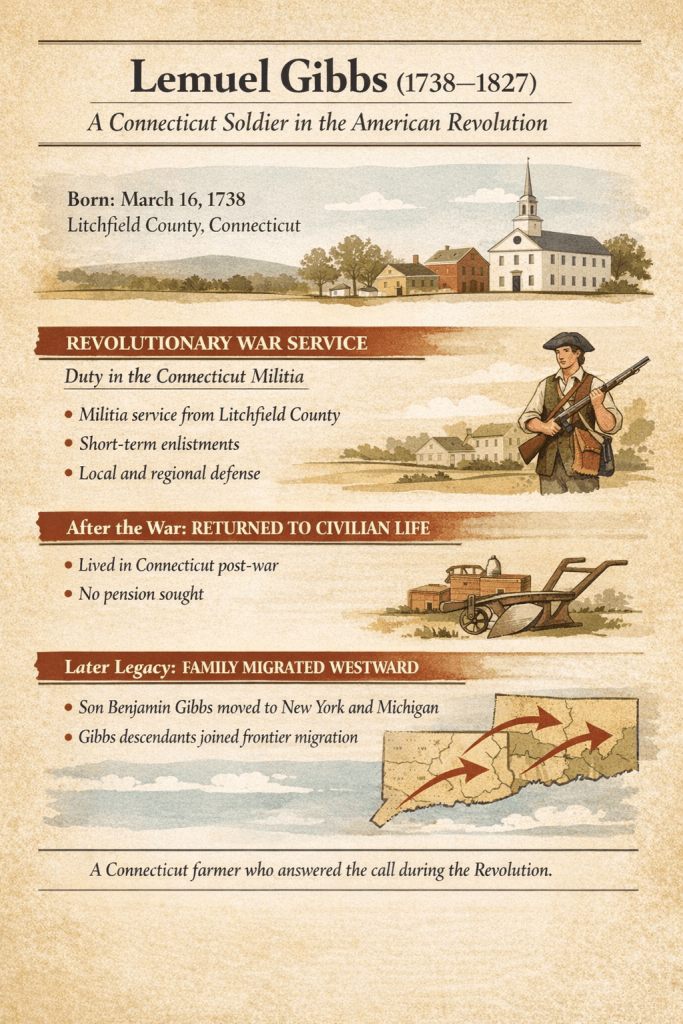
When researching Revolutionary War service, it is often tempting to expect clear enlistment papers, detailed muster rolls, or pension files that neatly summarize a man’s military career. For many Connecticut soldiers, however, service survives only in fragmentary state records, brief militia references, or scattered town-level documentation.¹

Born on 16 March 1738 in Litchfield County, Connecticut, Lemuel Gibbs lived squarely within the generation called upon to defend the colonies during the American Revolution. His service does not appear in dramatic narratives or extended pension testimony, but it is nonetheless documented in Connecticut military records and consistent with the state’s wartime militia system.²


Early Life and Family Context

Lemuel Gibbs was born into a long-established Connecticut family rooted in Litchfield County prior to the outbreak of hostilities with Great Britain. By the 1770s, he was an adult with family responsibilities, placing him among the many men who balanced military obligations with agricultural and household duties.³

Connecticut relied heavily on short-term militia service, frequently calling men out for brief periods rather than extended enlistments. As a result, many soldiers—particularly those who served locally—left behind only minimal documentation of their wartime participation.⁴


Revolutionary War Service

Lemuel Gibbs appears in Connecticut Revolutionary War military records, specifically within state-level compilations documenting militia service from Litchfield County.⁵ These records establish his participation without providing detailed information regarding unit assignment, length of service, or specific engagements.

This lack of detail is not unusual. Connecticut militia service often consisted of short tours responding to immediate needs such as coastal defense, troop movement, or regional security.⁶ While no surviving record places Gibbs in a named battle or extended campaign, his appearance in official military documentation confirms that he answered the colony’s call.

Equally important, there is no evidence of multiple contemporaneous men of the same name in the same jurisdiction that would cast doubt on the attribution of this service.⁷ The available evidence supports identifying this Lemuel Gibbs as the man referenced in the military records.


After the War

Following the conclusion of the Revolutionary War, Lemuel Gibbs returned to civilian life in Connecticut. He does not appear in federal pension files, a circumstance shared by many militia veterans whose service predated the pension acts or whose short-term duty did not meet later eligibility requirements.⁸

Lemuel Gibbs lived until 3 January 1827, witnessing the early decades of the United States. His descendants later joined the westward movement into New York and Michigan, reflecting broader post-Revolutionary settlement patterns across New England families.⁹


Assessing the Evidence

Lemuel Gibbs’s service illustrates a key principle of Revolutionary War research:
limited records do not equate to nonexistent service.

His documented appearance in Connecticut military records, combined with his age, residence, and lack of conflicting identities, provides a reasonable and supportable conclusion that he served during the American Revolution. His experience mirrors that of countless citizen-soldiers whose contributions were essential but modestly recorded.


Conclusion

Lemuel Gibbs was not a career soldier or public figure. He was a Connecticut man who answered the call of his colony during a time of upheaval. Though the surviving records are sparse, they are sufficient to place him among those who contributed to the Revolutionary effort.

By presenting his story carefully—without embellishment—we preserve both the integrity of the historical record and the memory of an ordinary man whose service helped shape the nation that followed.


Notes

  1. Public Records of the State of Connecticut, Revolutionary War era volumes.
  2. Connecticut military record compilations, Revolutionary period.
  3. Litchfield County vital and town records.
  4. Robert J. Taylor, Connecticut’s Militia System During the American Revolution.
  5. Public Records of the State of Connecticut, vols. 15–16.
  6. Ibid.
  7. Litchfield County tax and town lists, 1770s–1780s.
  8. U.S. Revolutionary War pension legislation and eligibility requirements.
  9. Probate and family records for the Gibbs family.

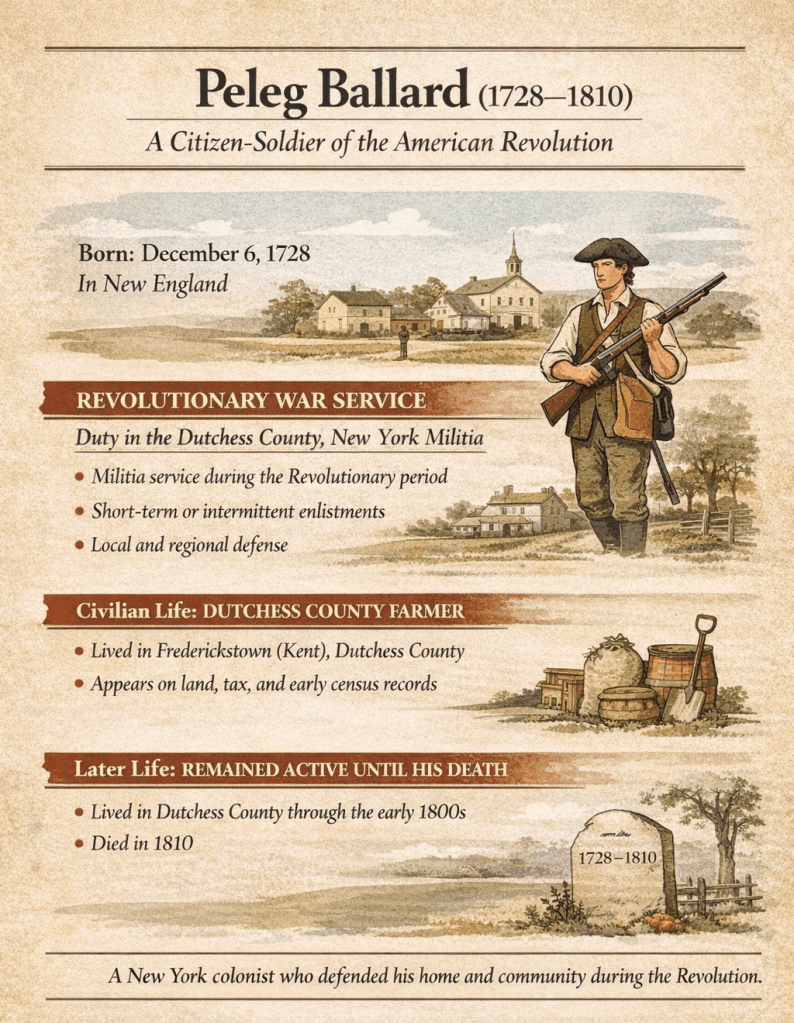
Peleg Ballard (1728–1810)

Revolutionary War service does not always survive in the form of neatly preserved enlistment papers or pension applications. In many cases—particularly in New York and neighboring colonies—service must be reconstructed from militia records, tax lists, land transactions, and postwar civil documentation.¹
The Revolutionary service of Peleg Ballard falls squarely within this category.

Born on 6 December 1728 in New England, Peleg Ballard was an established adult and head of household by the time the American colonies entered open rebellion against British rule. His life during the Revolutionary period places him among the men expected to serve in local militia units while continuing to maintain farms, families, and community obligations.²


Early Life and Residence

Peleg Ballard was born in 1728 and spent his adult life moving between Connecticut and New York, ultimately settling in what became Frederickstown (later Kent), Dutchess County, New York.³ This region was deeply affected by Revolutionary War mobilization, serving as both a supply corridor and a source of militia manpower.

By the 1770s, Ballard was married and raising a family, including his son Jeremiah Ballard, who would later appear as a young man in early New York census records.⁴


Revolutionary War Service

Peleg Ballard is documented as having performed Revolutionary War service, consistent with militia duty from Dutchess County, New York.⁵ His service does not appear in federal pension files, nor is it accompanied by lengthy narrative accounts—circumstances that are typical for militia soldiers whose service consisted of short-term or intermittent duty rather than extended Continental enlistment.

New York militia service during the Revolution was frequently localized, involving defensive actions, regional security, and response to immediate threats rather than participation in major campaigns.⁶ Men such as Ballard often served when called upon and then returned to civilian life, leaving behind only minimal official documentation.

Importantly, the available records support the identification of this Peleg Ballard as a single, consistent individual, with no evidence of another man of the same name in the same locality during the same period.⁷ This allows his military service to be reasonably attributed without the complications that often arise in common-name cases.


Civil Records During and After the War

Peleg Ballard appears in postwar tax lists, land records, and early census schedules, demonstrating his continued residence and civic presence in Dutchess County after the conclusion of the Revolution.⁸ These records establish continuity between the man who served during the war years and the civilian who resumed normal life afterward.

He remained in Frederickstown into the early nineteenth century and died in 1810, having lived through the colonial period, the Revolution, and the formative years of the new republic.⁹


Assessing the Evidence

Peleg Ballard’s Revolutionary War service exemplifies the experience of many New York militia men whose contributions were essential but lightly documented. His service is supported by:

  • his age and residence during the war years,
  • documentary references to militia participation,
  • and the absence of conflicting identities.

While the precise dates and nature of his duty cannot be reconstructed in detail, the surviving evidence supports the conclusion that Peleg Ballard rendered legitimate service during the American Revolution.


Conclusion

Peleg Ballard was not a professional soldier. He was a husband, father, and landholder who answered the call when his community required it. His service, though modestly recorded, places him among the citizen-soldiers who sustained the Revolutionary effort at the local level.

By approaching his story cautiously and grounding it firmly in surviving records, we preserve both historical accuracy and the reality of Revolutionary War service as it was experienced by ordinary men.


Notes

  1. New York Revolutionary War militia record practices and survival rates.
  2. Dutchess County demographic and household patterns, mid-18th century.
  3. Land and residence records, Frederickstown (Kent), Dutchess County, New York.
  4. Early census and family reconstructions for the Ballard household.
  5. New York militia service references for Peleg Ballard.
  6. New York State militia organization during the American Revolution.
  7. Comparative name analysis, Dutchess County, 1770s–1780s.
  8. Postwar tax lists and land records, Dutchess County, New York.
  9. Death and residence records for Peleg Ballard.

Finding Jeremiah Ballard: How Census Records, Land, and DNA Solved a 200-Year-Old Puzzle

For years, one of my most frustrating family mysteries was a simple question:

Who was Jeremiah Ballard?

Jeremiah was born about 1765 in New York and was the father of Horace Ballard, my 4× great-grandfather. But when I went looking for Jeremiah in the 1790 census, he was nowhere to be found. Worse, there were multiple men named Peleg Ballard, and genealogists had tangled their families together.

What follows is how I finally proved that:

  • Jeremiah Ballard was the son of Peleg Ballard (born 1728), and
  • Horace Ballard (born 1799) was Jeremiah’s son

— even without a will, baptism, or birth record.


The Ballard Family in Frederickstown, New York

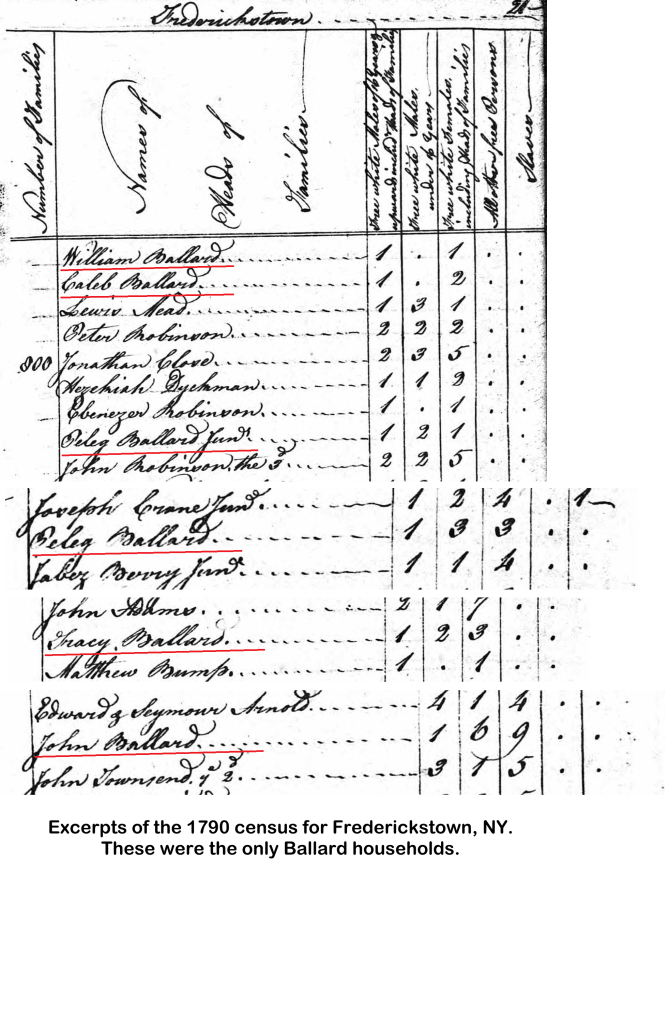
In 1790, the town of Frederickstown, Dutchess County, New York contained a remarkable cluster of Ballards.

The census lists the following heads of household¹:

  • Peleg Ballard
  • Peleg Ballard, Jr.
  • John Ballard
  • Tracy Ballard
  • Caleb Ballard
  • William Ballard

This isn’t random. This is exactly what a father and his adult sons look like when they have divided up family land.

Excerpts of 1790 US Federal Census for Frederickstown, New York showing the Ballard households.
1790 US Federal Census for Frederickstown, New York

Where Was Jeremiah in 1790?

Jeremiah Ballard was born about 1765, so he was 25 years old in 1790. That means he should appear as a head of household.

But he doesn’t.

Looking closely at the census columns, something important emerges:
Every Ballard household has exactly one adult male (16+).

That means Jeremiah is not hiding in any Ballard home.
He must have been living with a non-Ballard household — common for young unmarried men who had not yet received land.

So Jeremiah didn’t vanish.
He just wasn’t a landholder yet.


Jeremiah Appears — Right Where He Belongs

By 1799, Jeremiah begins appearing in the Frederickstown tax lists, and he continues through 1803².

Then the 1800 census reveals the truth.

On the 1800 Frederickstown census page, we see³:

Caleb Ballard
Jeremiah Ballard

listed next to each other.

Census takers walked farm to farm. Neighbors on the page are neighbors in real life. And in rural New York, neighbors are usually family.

Caleb Ballard is a known son of Peleg Ballard.
Jeremiah living next door proves he belongs to the same family.

Excerpt of the 1800 US Federal Census for Frederickstown, New York. Caleb and Jeremiah Ballard are next to each other.

Which Peleg Was Their Father?

There were multiple Peleg Ballards — so which one was the father?

The 1800 census answers that.

Peleg Ballard’s 1800 household shows⁴:

  • One male over 45
  • No younger adult males
1800 Census for Peleg Ballard in Frederickstown, New York.

That fits Peleg born 1728 (age 72 in 1800).
It does not fit Peleg Jr., who would be about 40 and would have sons of his own.

By 1810, Peleg is gone. Only Caleb and Jeremiah remain in Frederickstown⁵.

That is exactly what happens when a father dies and only two sons remain on the land.


Jeremiah’s Household Includes Horace

Jeremiah’s 1800 census household shows³:

  • One adult male (Jeremiah)
  • One adult female (his wife)
  • One male under 10
  • One female under 10

That small boy is the right age to be Horace Ballard, born in 1799.

By 1810, Jeremiah’s household contains multiple sons, including one aged 10–16 — exactly where Horace belongs⁶.

1810 US Census for Frederickstown, New York - Jeremiah Ballard's household.
1810 US Census for Frederickstown, New York – Jeremiah Ballard’s household.

DNA Confirms What the Records Suggest

Paper records tell us Jeremiah was Peleg’s son and Horace was Jeremiah’s son.
DNA confirms it.

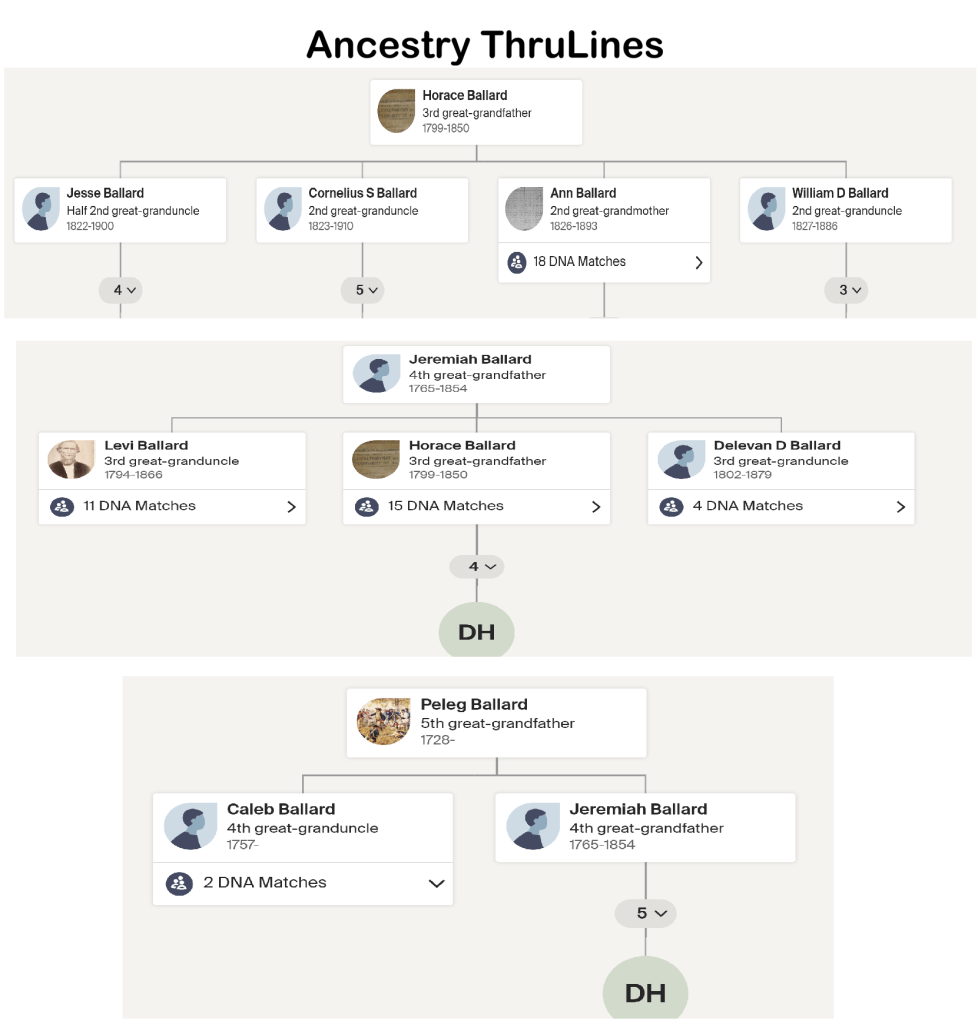
Multiple descendants of Horace Ballard match descendants of Caleb Ballard and John Ballard (Jeremiah’s brothers), all triangulating back to the Frederickstown Ballard family.

That means Horace does not belong to some other Ballard line.
He belongs here.

Ancestry's ThruLines Suggested Relationships
Ancestry’s ThruLines Suggested Relationships

Why This Matters

There is:

  • No will naming Jeremiah
  • No baptism for Horace
  • No deed saying “my son Jeremiah”

But in early New York, that is normal.

What we do have is something better:

  • Census clusters
  • Tax rolls
  • Land continuity
  • Family geography
  • And DNA

Together they form a solid proof.


Conclusion

Even without a single “smoking gun” document, the evidence shows:

Peleg Ballard (born 1728)
Jeremiah Ballard (born 1765)
Horace Ballard (born 1799)

Sometimes history whispers instead of shouting. You just have to listen long enough.


Sources

  1. 1790 U.S. Census, Frederickstown, Dutchess County, New York
  2. New York Tax Assessment Rolls, Frederickstown, Dutchess County, 1799–1803
  3. 1800 U.S. Census, Frederickstown, Dutchess County, New York
  4. Ibid., Peleg Ballard household
  5. 1810 U.S. Census, Frederickstown, Dutchess County, New York
  6. Ibid., Jeremiah Ballard household
  7. Autosomal DNA triangulation between descendants of Horace Ballard and descendants of Caleb and John Ballard (private test data)

Why the Episcopal Church Held the Answer

One of the most surprising lessons in the story of Elnathan, Lydia, and Fanny Tolles is not about war or DNA or probate. It is about churches.

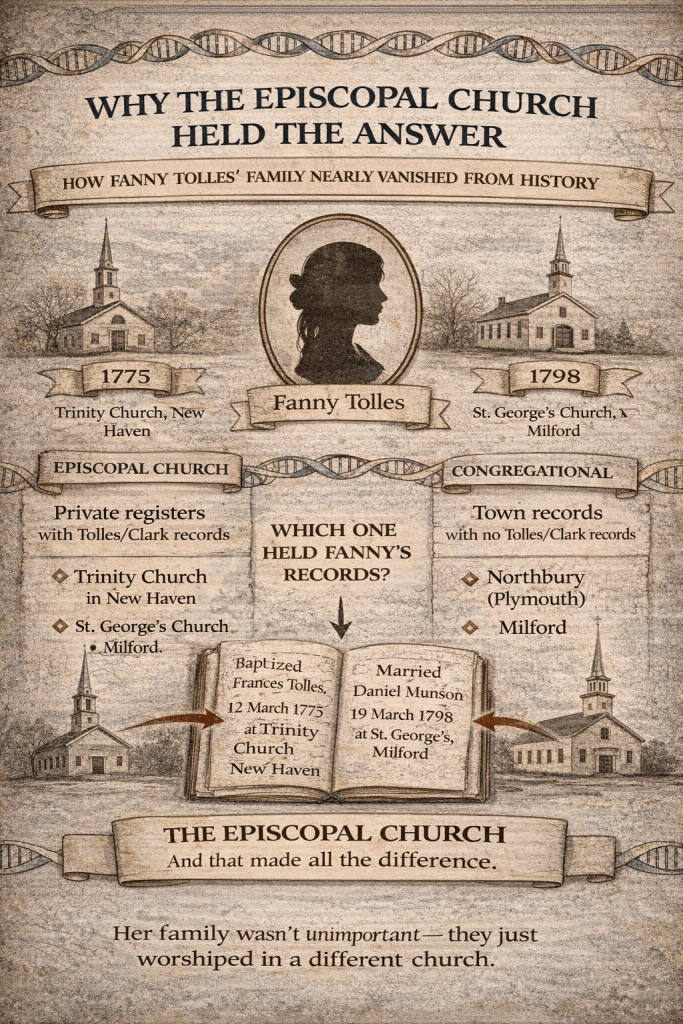
For most people researching early New England families, the default assumption is that the Congregational church holds the records. That works for many families — but not for this one. The Tolles and Clark families belonged to the Episcopal Church, and that single fact explains why Fanny nearly disappeared from history.

Lydia Clark was baptized as an adult at Trinity Church in New Haven in May 1773. Two years later, her daughter Frances was baptized there in March 1775. These were not casual entries. Episcopal parishes kept detailed registers of baptisms, sponsors, and marriages that were entirely separate from the town and Congregational systems.

Meanwhile, in Milford, Daniel Munson was part of the Episcopal world as well. Records from St. George’s Church show him as a subscriber and vestryman in the late 1780s. When Frances married Daniel Munson in 1798, she did so in a community deeply tied to the Episcopal network — and to her Clark relatives.

This is why older genealogists struggled. They searched town records and Congregational church books for Fanny Tolles and found very little. Without Episcopal registers, she looked unattached — a woman with a maiden name but no parents.

Donald Lines Jacobus solved this because he knew where to look. He drew from Trinity Church in New Haven, St. George’s in Milford, and the Plymouth parish records to reconstruct a family that existed almost entirely outside the Congregational system. When those church records were combined with probate law, the picture became clear.

Fanny Tolles did not vanish because her family was unimportant.
She vanished because her family worshiped in the “wrong” church.

And yet, it was those same Episcopal records that preserved her baptism, her name, and her marriage — quietly waiting for someone to connect them.

This is why genealogy is never just about names and dates. It is about institutions, beliefs, and communities — the frameworks that decide which lives are written down and which are forgotten.

For Fanny Tolles, the Episcopal Church kept her story alive long enough for us to finally find it.


Sources

  1. Trinity Church (Episcopal), New Haven, Connecticut, baptismal records, 23 May 1773 (Lydia Clark) and 12 March 1775 (Frances Tolles); abstracted in Donald Lines Jacobus, Families of New Haven, vol. VIII (1932).
  2. St. George’s Church, Milford, Connecticut, vestry and subscription lists, 1786–1788, showing Daniel Munson as a member of the Episcopal Society.
  3. Milford, Connecticut, Marriage Records, 19 March 1798, Daniel Munson and Frances (Fanny) Tolles.
  4. Donald Lines Jacobus, Deacon George Clark(e) of Milford, Connecticut and Some of His Descendants (1949), Clark and Tolles family entries.
  5. Probate of Elnathan and Lydia Tolles, Plymouth (Watertown) District, Litchfield County, Connecticut, 1789–1794.

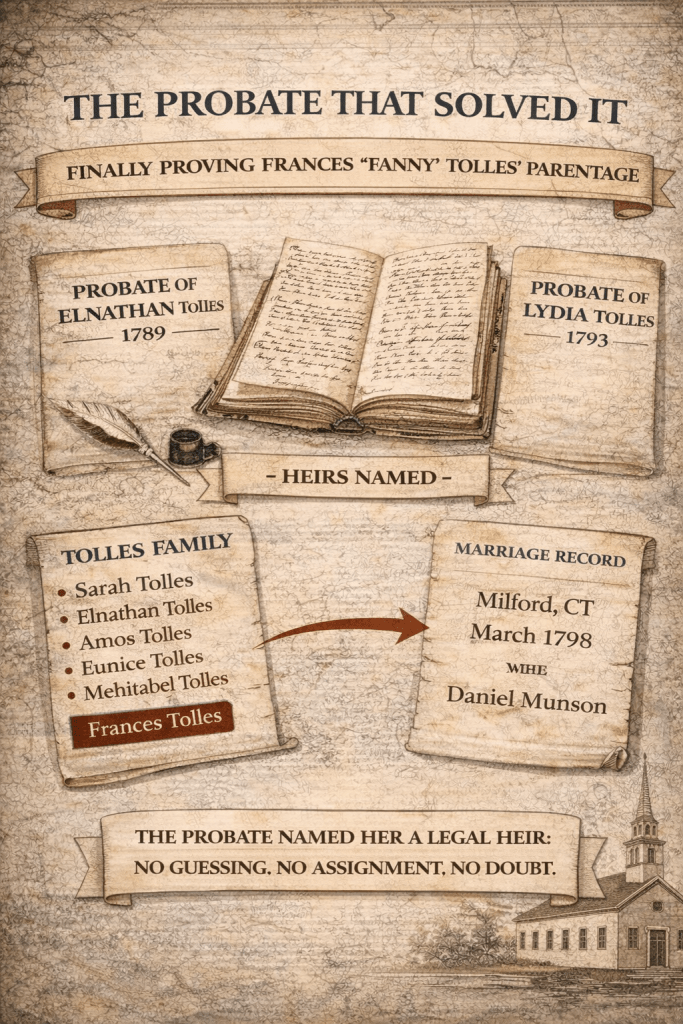
The Probate That Solved It

If DNA can mislead, probate records rarely do.

After years of uncertainty about Frances “Fanny” Tolles, the answer did not come from genetic matches or online trees. It came from something far more old-fashioned: a thick, handwritten court file created after the deaths of her parents.

When Elnathan Tolles died in 1789, he left behind a widow, Lydia, and six children. Lydia died in 1793, and their estates were administered together. The combined probate file for Elnathan and Lydia runs more than sixty pages, filled with inventories, accounts, and distributions. It is not easy reading — but it is extraordinarily valuable.

Buried in that paperwork is the simple truth genealogists search for:
the names of their children as legal heirs.

Among those heirs is Frances Tolles.

That single fact matters more than any later genealogy or DNA match. Probate law in eighteenth-century Connecticut was precise. Only legitimate children or legally recognized heirs were entitled to a share of an estate. Frances was not a guess, a rumor, or an assignment. She was acknowledged by the court as the daughter of Elnathan and Lydia Tolles.

The probate does not tell us whom Frances married. It does not say “wife of Daniel Munson.” But it does tell us something just as important: Frances Tolles lived to adulthood and inherited as Elnathan’s child.

That eliminates all of the uncertainty that once surrounded her. There was not one Frances Tolles who belonged to Elnathan and another who married Daniel Munson. There was only one Frances — born in 1775, raised in the Tolles household, and alive when her parents’ estates were settled.

When that legal fact is combined with the Episcopal church records that show Frances (“Fanny”) Tolles marrying Daniel Munson in Milford in 1798, the identity becomes clear. The girl baptized in New Haven, the heir named in probate, and the bride in Milford are the same person.

This is how real genealogical proof is built. Not from a single perfect document, but from the way independent records fit together without contradiction.

DNA raised the question.
The probate answered it.

In the next and final post of this series, I’ll show why the Episcopal Church — not town records or DNA — was the quiet key that held this whole story together.


Sources

  1. Probate of Elnathan Tolles (1789) and Probate of Lydia Tolles (1793), Plymouth (Watertown) District, Litchfield County, Connecticut, combined estate file (66 pages), naming Frances Tolles among the heirs.
  2. Donald Lines Jacobus, Families of New Haven, vol. VIII (1932), Tolles family, listing Frances baptized 12 March 1775 and identifying her as “Fanny” who married Daniel Munson.
  3. Milford, Connecticut, Marriage Records, 19 March 1798, Daniel Munson and Frances (Fanny) Tolles.

How DNA Almost Lied to Me

For most of the twentieth century, the question of who Frances “Fanny” Tolles really belonged to was a paper problem. In the twenty-first century, it became a DNA problem.

Like many genealogists, I had hoped DNA would provide the missing proof. If Fanny was truly the daughter of Elnathan and Lydia Tolles, then I should eventually match people who descend from their other children. And one day, I did.

An Ancestry DNA match appeared who traced their lineage back to another child of Elnathan Tolles — not through Fanny, but through a different branch of the Tolles family. According to Ancestry’s tools, we shared 9 centimorgans on one segment, a tiny match, but one that the Shared cM Project says can fall within the range of sixth cousins. That just happens to be exactly the relationship I would have if Fanny were Elnathan’s daughter.

For a moment, it felt like a breakthrough.

But genealogy is never that simple.

As I began building out that match’s family tree — generation by generation — another surname kept appearing: Mix. It was a name I recognized immediately. I already had Mix ancestors in my own tree. So I followed that line back.

And there it was.

The DNA match and I were not connected by just one line. We were connected by two — one through Tolles, and one through Mix. The Mix connection was older and more robust. That meant the small 9 cM segment could easily come from that shared ancestry instead of from Elnathan Tolles.

In other words, the DNA match did not prove what I wanted it to prove.

This is one of the hardest lessons in genetic genealogy: a match can be real, but still be misleading. Small segments, especially those under 10 cM, are easily inherited from distant ancestors and can survive for many generations. When multiple lines connect two people, DNA alone cannot tell you which ancestor supplied the shared segment.

So DNA did not solve the Tolles–Munson question. It simply told me that the two families were tangled together in more than one way.

And that meant I had to go back to something far older — something far more reliable.

I had to go back to the law.

In the next post, I’ll show how a thick, tedious, 66-page probate file did what DNA could not: it quietly but definitively tied Frances “Fanny” Tolles to the parents who raised her.


Sources

  1. AncestryDNA, shared DNA match between the author and a descendant of another child of Elnathan Tolles, showing 9 cM across one segment (author’s private test results).
  2. Shared cM Project 4.0, The DNA Painter, relationship probability tool for centimorgan values, indicating that 9 cM can be consistent with sixth-cousin relationships.
  3. Blaine T. Bettinger, “The Shared cM Project,” The Genetic Genealogist (https://thegeneticgenealogist.com), methodology for interpreting small DNA matches.
  4. International Society of Genetic Genealogy (ISOGG), guidelines on triangulation and multiple ancestral paths affecting DNA interpretation.
  5. Author’s compiled family tree and research notes on the Mix and Tolles families, showing multiple shared ancestral lines.

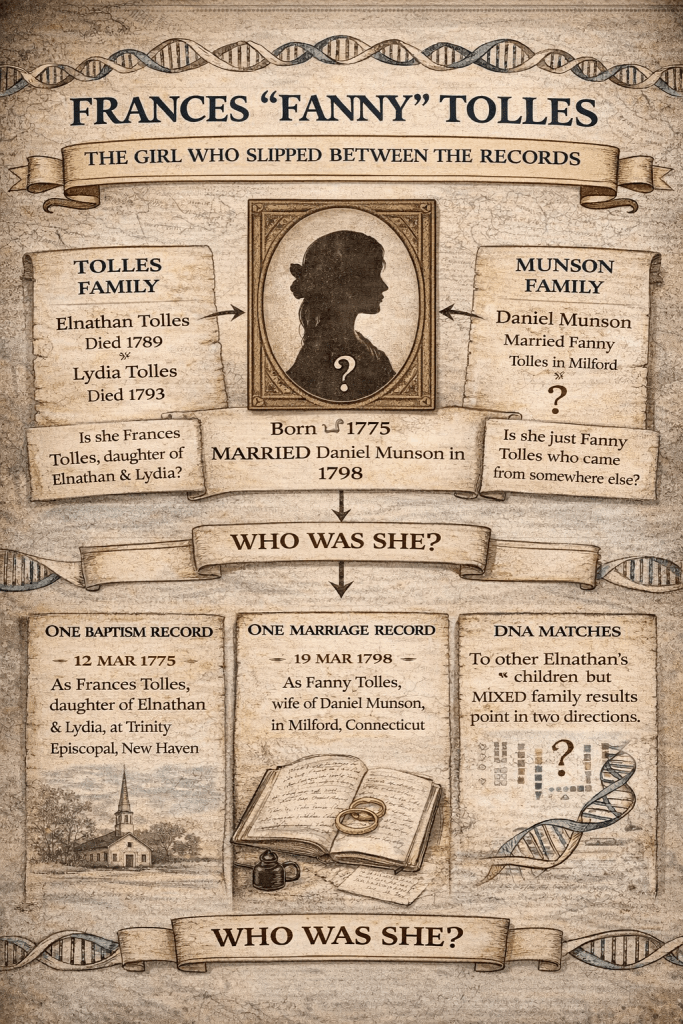
Frances “Fanny” Tolles: The Girl Who Slipped Between the Records

Genealogy often feels like assembling a puzzle — until you discover that one of the most important pieces was never cut to fit. That is what happens with Frances “Fanny” Tolles, the daughter of Elnathan and Lydia Tolles, and the woman who would later become the wife of Daniel Munson.

On paper, Fanny should be easy to find. She was baptized on 12 March 1775, just as the American Revolution was beginning. In the Episcopal records of New Haven she appears as “Frances,” daughter of Elnathan and Lydia Tolles.¹ But after that single entry, she seems to vanish.

Her parents lived in Northbury (later Plymouth), Connecticut, during the war years — a place where church and town records were scattered across jurisdictions and denominations. The Tolles family belonged to the Episcopal Church, not the Congregational churches that recorded most Connecticut vital events. As a result, many of Fanny’s milestones were preserved only in church books, not town ledgers.

Then her family fractured.

Elnathan Tolles died in 1789. Lydia followed in 1793. Their children were still young. Some were placed under guardianship, others went to live with relatives. The probate files confirm their identities as children of Elnathan and Lydia — but they do not track what happened to them afterward.²

This is where Fanny disappears.

By 1798, a Frances (or Fanny) Tolles married Daniel Munson in Milford, Connecticut — a town strongly associated with the Clark family, Fanny’s maternal kin.³ Yet nowhere in the marriage record are her parents named. There is no “daughter of Elnathan” to anchor her identity. She simply appears, gets married, and then moves on.

Later genealogies tried to solve this gap, but not all of them were confident. Early Tolles and Munson researchers knew that Daniel Munson’s wife was named Fanny Tolles, and they knew that Elnathan and Lydia had a daughter named Frances of the right age. But without a clear marriage record naming her parents, some writers hedged, quietly assigning her to Elnathan because she fit — not because a document said so.

That uncertainty lingered for generations.

In modern times, DNA added a new layer. A distant DNA match appeared to descend from another child of Elnathan Tolles, seemingly supporting Fanny’s placement in the family. But further research revealed a second, older connection through the Mix family, meaning the DNA could not be used to prove Fanny’s parentage after all. The evidence was real — but it pointed in two directions.

This is why I have over 64,000 people in my family tree. Not because I like big numbers, but because tiny errors in the 1700s ripple forward into the DNA era.

So who was Fanny Tolles?
Was she truly the daughter of Elnathan and Lydia?
Or was she “assigned” to them because no better answer existed?

To find out, we have to leave church books and DNA charts behind — and turn to something far more powerful: probate law.


Sources

  1. Trinity Church (Episcopal), New Haven, Connecticut, baptismal records, 12 March 1775, Frances Tolles, daughter of Elnathan and Lydia Tolles; abstracted in Donald Lines Jacobus, Families of New Haven, vol. VIII (1932).
  2. Probate of Elnathan and Lydia Tolles, Plymouth (Watertown) District, Litchfield County, Connecticut, 1789–1794, combined estate file, listing their children including Frances.
  3. Milford, Connecticut, Marriage Records, 19 March 1798, Daniel Munson and Frances (Fanny) Tolles; cited in The Munson Record and Milford town records.

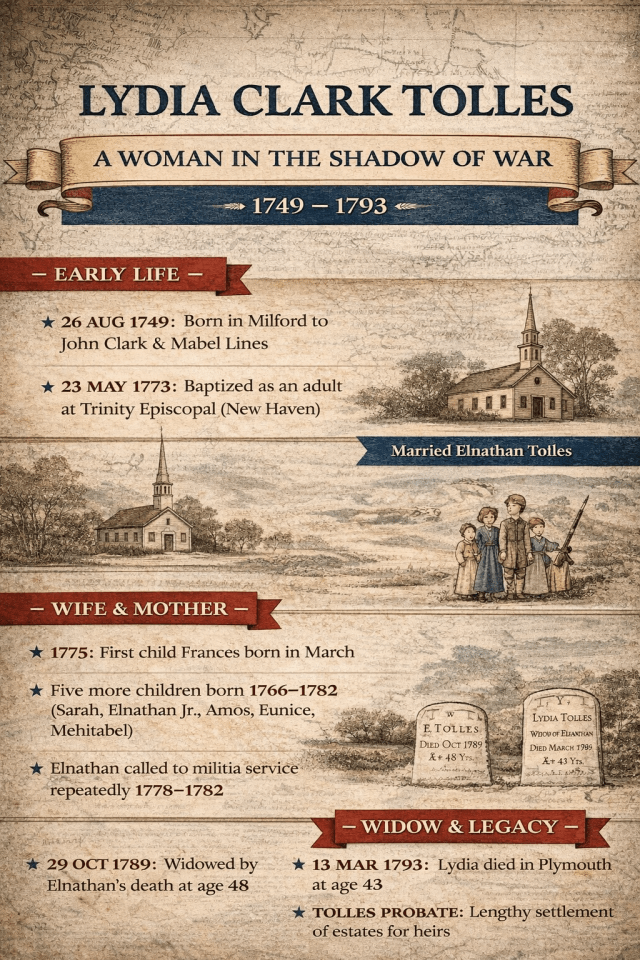
Lydia Clark Tolles (1749–1793): A Woman in the Shadow of War

When the American Revolution is told through the lives of men, it becomes a story of enlistments, campaigns, and patriotism. When it is told through the lives of women, it becomes something very different: endurance, uncertainty, and survival. Lydia Clark Tolles, the wife of Elnathan Tolles, lived her entire adult life inside that second story.

Lydia was born on 26 August 1749, the daughter of John Clark and Mabel Lines, members of one of the oldest and most prominent families in the Milford–New Haven area of Connecticut. Through her parents, Lydia was connected to a wide web of kin, land, and church ties that would quietly shape the course of her life.¹

On 23 May 1773, Lydia was baptized as an adult at Trinity Church in New Haven, an Episcopal parish. Adult baptisms were not unusual, but they often coincided with marriage or a conscious decision to join a particular congregation. Within a short time, Lydia married Elnathan Tolles, and the two established their household in the Northbury parish of Waterbury (later Plymouth), an upland farming community not far from New Haven.¹ ²

Within two years, the world around them changed. In March 1775, Lydia gave birth to her first daughter, Frances, just as colonial New England was sliding into war. Over the next decade, Lydia would give birth to at least five more children: Sarah, Elnathan, Amos, Eunice, and Mehitabel

While Lydia was raising young children, her husband was repeatedly called into military service. Connecticut records place Elnathan Tolles on militia duty in 1778, 1779, 1780, 1781, and 1782, meaning Lydia often ran their household without him during the most difficult years of the war.⁴

The war ended, but stability did not follow. Elnathan died on 29 October 1789, leaving Lydia a widow with six children. Four years later, on 13 March 1793, Lydia herself died in Plymouth at only 42 years of age. Their estates were handled together in a lengthy probate process that documented their surviving children and the property they left behind.⁵

Lydia left no diary and no personal letters. What survives instead are church entries, baptisms, militia lists, and probate records. Taken together, they show a woman who endured war, childbirth, widowhood, and early death — yet still raised a family that would carry this Connecticut story westward into the new nation.

In the next post, I’ll turn to Lydia’s daughter Frances “Fanny” Tolles, whose life and identity became one of the most complicated and revealing puzzles in this family’s history.


Sources

Probate of Elnathan and Lydia Tolles, Plymouth (Watertown) District, Litchfield County, Connecticut, 1789–1794, combined estate file (66 pages), showing Lydia as administratrix and naming their children as heirs.he most complicated and revealing puzzles in this family’s story.

Donald Lines Jacobus, Deacon George Clark(e) of Milford, Connecticut and Some of His Descendants (New Haven: Tuttle, Morehouse & Taylor, 1949), entry for Lydia Clark, wife of Elnathan Tolles.

Donald Lines Jacobus, Families of New Haven, vol. VIII (New Haven: Tuttle, Morehouse & Taylor, 1932), Tolles family, “Elnathan & Lydia (Clark) Tolles.”

Trinity Church (Episcopal), New Haven, Connecticut, baptismal records, Frances Tolles, 12 March 1775, as abstracted in Families of New Haven.

Connecticut Revolutionary War Military Lists, 1775–1783; and U.S. Compiled Revolutionary War Military Service Records, entries for Elnathan Tolles.