Why the Episcopal Church Held the Answer

One of the most surprising lessons in the story of Elnathan, Lydia, and Fanny Tolles is not about war or DNA or probate. It is about churches.

For most people researching early New England families, the default assumption is that the Congregational church holds the records. That works for many families — but not for this one. The Tolles and Clark families belonged to the Episcopal Church, and that single fact explains why Fanny nearly disappeared from history.

Lydia Clark was baptized as an adult at Trinity Church in New Haven in May 1773. Two years later, her daughter Frances was baptized there in March 1775. These were not casual entries. Episcopal parishes kept detailed registers of baptisms, sponsors, and marriages that were entirely separate from the town and Congregational systems.

Meanwhile, in Milford, Daniel Munson was part of the Episcopal world as well. Records from St. George’s Church show him as a subscriber and vestryman in the late 1780s. When Frances married Daniel Munson in 1798, she did so in a community deeply tied to the Episcopal network — and to her Clark relatives.
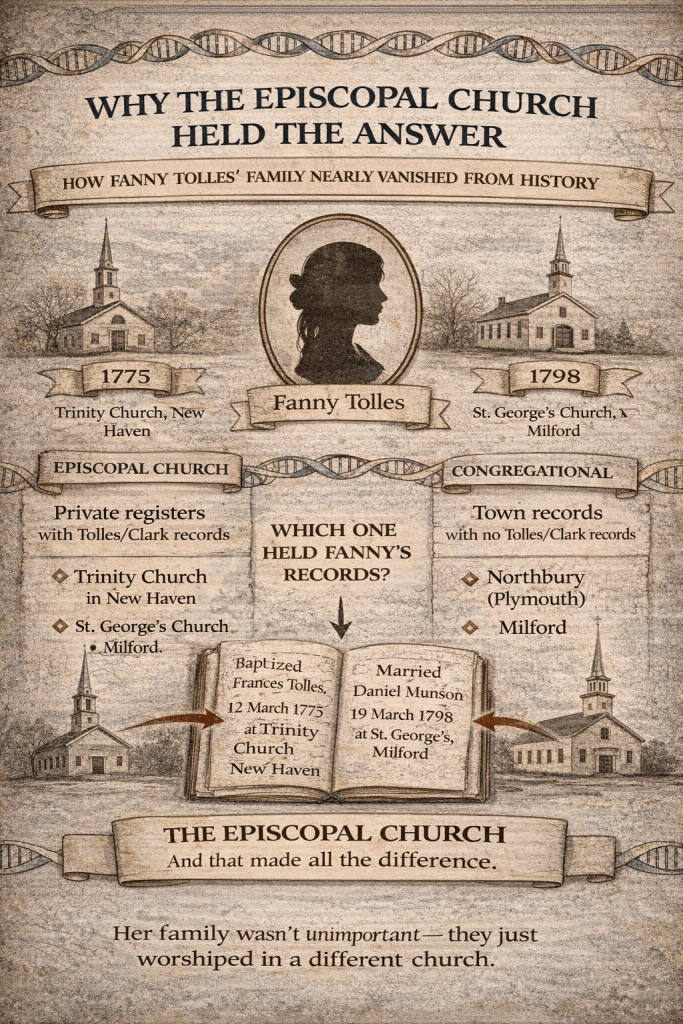
This is why older genealogists struggled. They searched town records and Congregational church books for Fanny Tolles and found very little. Without Episcopal registers, she looked unattached — a woman with a maiden name but no parents.

Donald Lines Jacobus solved this because he knew where to look. He drew from Trinity Church in New Haven, St. George’s in Milford, and the Plymouth parish records to reconstruct a family that existed almost entirely outside the Congregational system. When those church records were combined with probate law, the picture became clear.

Fanny Tolles did not vanish because her family was unimportant.
She vanished because her family worshiped in the “wrong” church.

And yet, it was those same Episcopal records that preserved her baptism, her name, and her marriage — quietly waiting for someone to connect them.

This is why genealogy is never just about names and dates. It is about institutions, beliefs, and communities — the frameworks that decide which lives are written down and which are forgotten.

For Fanny Tolles, the Episcopal Church kept her story alive long enough for us to finally find it.


Sources

  1. Trinity Church (Episcopal), New Haven, Connecticut, baptismal records, 23 May 1773 (Lydia Clark) and 12 March 1775 (Frances Tolles); abstracted in Donald Lines Jacobus, Families of New Haven, vol. VIII (1932).
  2. St. George’s Church, Milford, Connecticut, vestry and subscription lists, 1786–1788, showing Daniel Munson as a member of the Episcopal Society.
  3. Milford, Connecticut, Marriage Records, 19 March 1798, Daniel Munson and Frances (Fanny) Tolles.
  4. Donald Lines Jacobus, Deacon George Clark(e) of Milford, Connecticut and Some of His Descendants (1949), Clark and Tolles family entries.
  5. Probate of Elnathan and Lydia Tolles, Plymouth (Watertown) District, Litchfield County, Connecticut, 1789–1794.
Lydia Clark Tolles (1749–1793): A Woman in the Shadow of War

When the American Revolution is told through the lives of men, it becomes a story of enlistments, campaigns, and patriotism. When it is told through the lives of women, it becomes something very different: endurance, uncertainty, and survival. Lydia Clark Tolles, the wife of Elnathan Tolles, lived her entire adult life inside that second story.

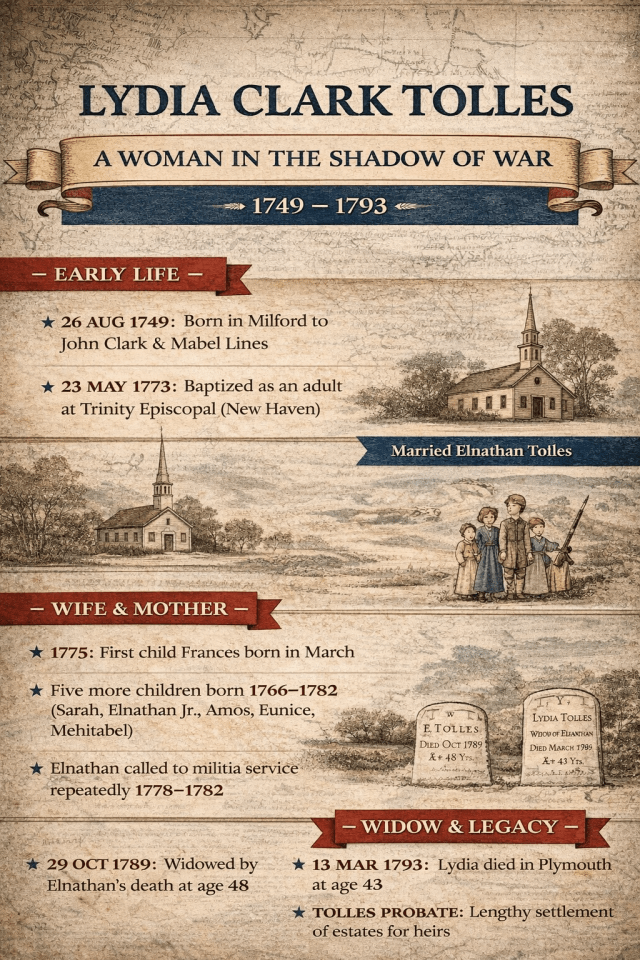
Lydia was born on 26 August 1749, the daughter of John Clark and Mabel Lines, members of one of the oldest and most prominent families in the Milford–New Haven area of Connecticut. Through her parents, Lydia was connected to a wide web of kin, land, and church ties that would quietly shape the course of her life.¹

On 23 May 1773, Lydia was baptized as an adult at Trinity Church in New Haven, an Episcopal parish. Adult baptisms were not unusual, but they often coincided with marriage or a conscious decision to join a particular congregation. Within a short time, Lydia married Elnathan Tolles, and the two established their household in the Northbury parish of Waterbury (later Plymouth), an upland farming community not far from New Haven.¹ ²

Within two years, the world around them changed. In March 1775, Lydia gave birth to her first daughter, Frances, just as colonial New England was sliding into war. Over the next decade, Lydia would give birth to at least five more children: Sarah, Elnathan, Amos, Eunice, and Mehitabel

While Lydia was raising young children, her husband was repeatedly called into military service. Connecticut records place Elnathan Tolles on militia duty in 1778, 1779, 1780, 1781, and 1782, meaning Lydia often ran their household without him during the most difficult years of the war.⁴

The war ended, but stability did not follow. Elnathan died on 29 October 1789, leaving Lydia a widow with six children. Four years later, on 13 March 1793, Lydia herself died in Plymouth at only 42 years of age. Their estates were handled together in a lengthy probate process that documented their surviving children and the property they left behind.⁵

Lydia left no diary and no personal letters. What survives instead are church entries, baptisms, militia lists, and probate records. Taken together, they show a woman who endured war, childbirth, widowhood, and early death — yet still raised a family that would carry this Connecticut story westward into the new nation.

In the next post, I’ll turn to Lydia’s daughter Frances “Fanny” Tolles, whose life and identity became one of the most complicated and revealing puzzles in this family’s history.


Sources

Probate of Elnathan and Lydia Tolles, Plymouth (Watertown) District, Litchfield County, Connecticut, 1789–1794, combined estate file (66 pages), showing Lydia as administratrix and naming their children as heirs.he most complicated and revealing puzzles in this family’s story.

Donald Lines Jacobus, Deacon George Clark(e) of Milford, Connecticut and Some of His Descendants (New Haven: Tuttle, Morehouse & Taylor, 1949), entry for Lydia Clark, wife of Elnathan Tolles.

Donald Lines Jacobus, Families of New Haven, vol. VIII (New Haven: Tuttle, Morehouse & Taylor, 1932), Tolles family, “Elnathan & Lydia (Clark) Tolles.”

Trinity Church (Episcopal), New Haven, Connecticut, baptismal records, Frances Tolles, 12 March 1775, as abstracted in Families of New Haven.

Connecticut Revolutionary War Military Lists, 1775–1783; and U.S. Compiled Revolutionary War Military Service Records, entries for Elnathan Tolles.