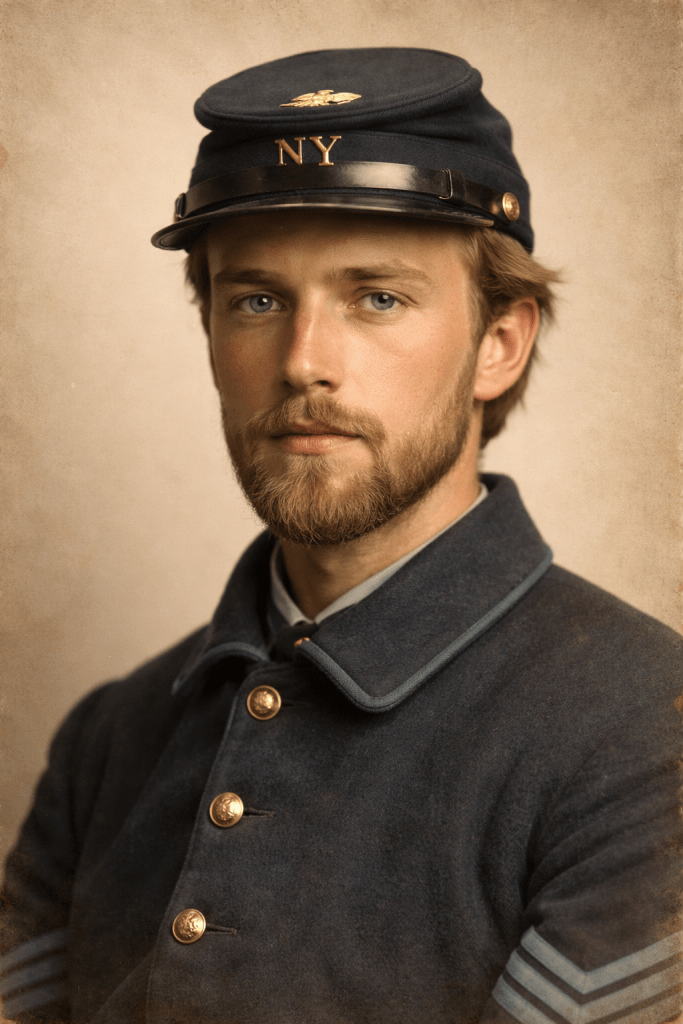
George Lawhead, George Loyd, and the Photograph That Proved His Identity

By the time George Washington Lawhead’s Civil War pension file reached its final size—nearly three inches thick—it was no longer simply a record of military service and disability. It had become an investigation into identity itself. The central question was deceptively simple: was George Lawhead the same man as George Loyd?

For years, the Bureau of Pensions treated that question cautiously, reopening it repeatedly as new claims, affidavits, and correspondence arrived. What ultimately resolved the matter was not a census record, a marriage license, or even George’s own statements, but a single photograph.
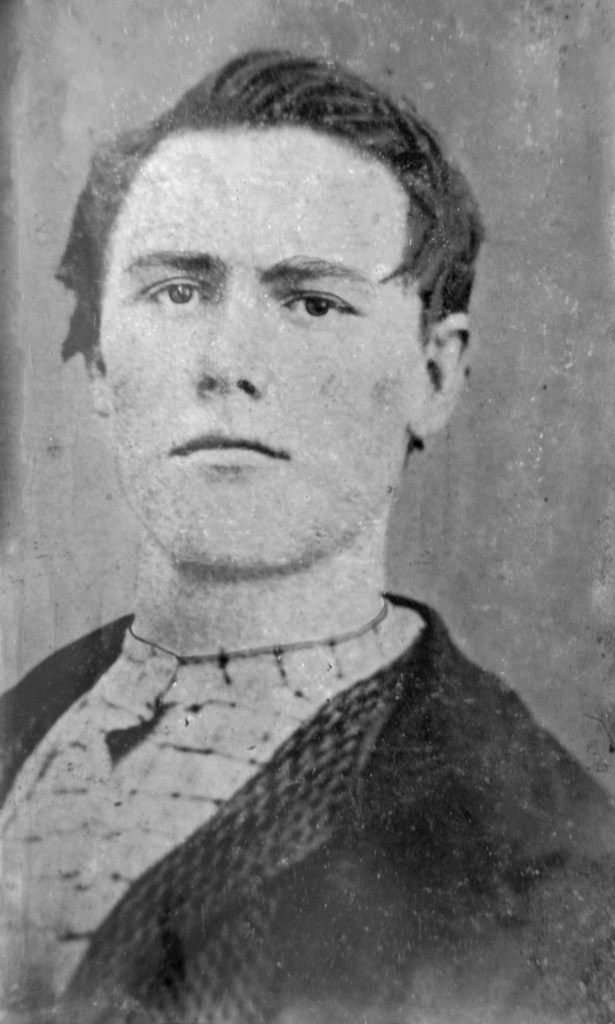
George Lawhead Civil War Pension Photo

Mary King and the Name “George Loyd”

When Mary King married George in 1865, she believed his name to be George Loyd.¹ She used that name consistently in later correspondence and pension filings, including applications she submitted while George was still alive.

This discrepancy could not be ignored. Pension law required certainty of identity, and the appearance of two different surnames raised the possibility that Mary’s husband and the veteran whose service records existed might not be the same individual. Rather than dismissing her claims outright, the Bureau undertook a prolonged inquiry.

Investigators gathered affidavits, compared timelines, and examined whether the names Loyd and Lawhead represented two separate men or one man using more than one name.


Post-War Name Usage and the Uncle Theory

Within the pension file is a recurring explanation for George’s inconsistent use of surnames. According to testimony and examiner notes, George was believed to have come to Michigan with an uncle following the deaths of his parents. The relationship was reportedly strained.
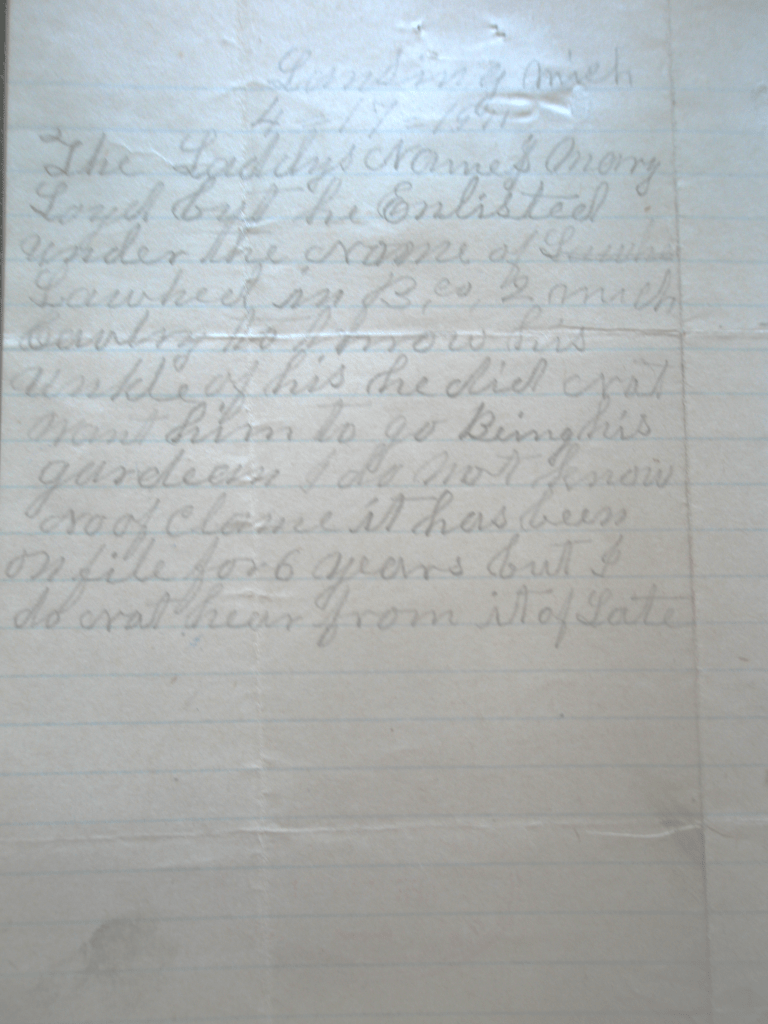
Note written by Mary King found in George Lawhead’s Civil War pension file.

It was suggested—never proven, but treated as plausible—that George enlisted in the Civil War in part to escape that situation and later continued using a different surname in civilian life to avoid contact with his uncle.² Pension officials recorded this explanation explicitly as a theory, not as established fact.

They also noted a practical consideration: Lawhead, when spoken indistinctly, could easily be heard as Loyd. No evidence was found that George legally changed his name or attempted to conceal his identity for fraudulent purposes.


Why Paper Records Were Not Enough

On paper alone, the case remained uncertain. Census records varied. Marriage records conflicted. Informants changed over time. Some records gave George’s birthplace as Ohio, others as Pennsylvania or New York. His reported age fluctuated by several years.

Each document could be explained individually, but taken together they failed to provide certainty. Pension officials needed evidence that could transcend clerical error, memory lapses, and inconsistent reporting.

They found that evidence in a photograph.


The Discharge Photograph

Among the materials submitted during the pension investigation was a photograph taken in Jackson, Michigan at the time of George’s discharge from the army. The image had been preserved for decades and was introduced as part of Mary King’s claim.

Rather than accepting it at face value, pension examiners used the photograph actively. It was shown independently to multiple witnesses, including George’s sister, Margaret A. Dutcher, and a former wartime comrade.³
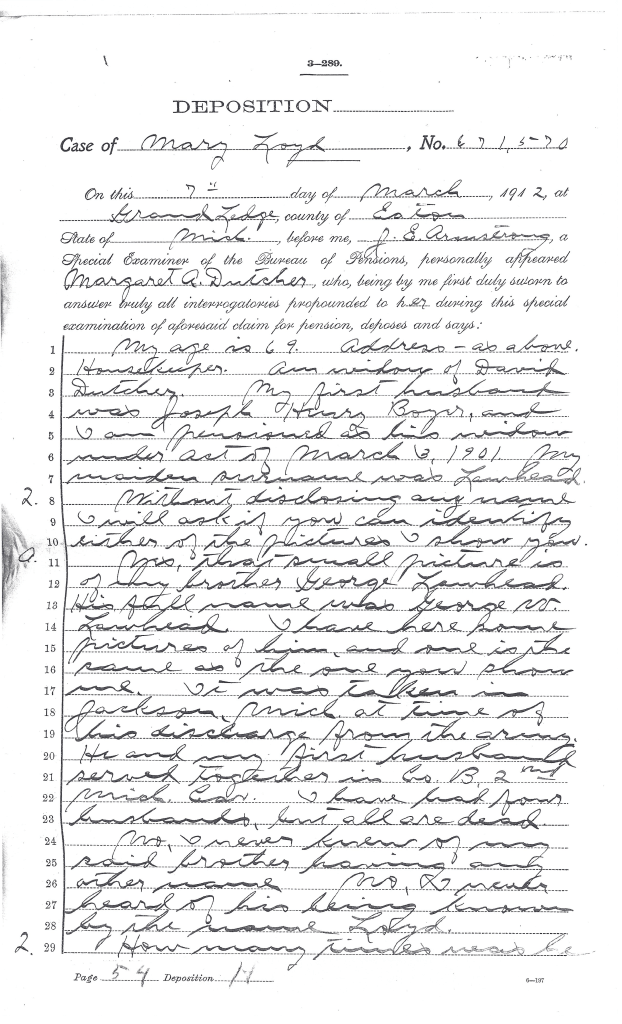
First page of Margaret Lawhead Dutcher’s deposition

Both identified the man in the photograph as George Washington Lawhead. Their identifications were made separately and without prompting. Each confirmed not only the likeness, but also the circumstances under which the photograph had been taken.

This identification became the turning point in the investigation.


How the Bureau Reached Its Conclusion

With the photograph confirmed by two independent witnesses who knew George under different circumstances, the Bureau of Pensions concluded that George Loyd and George Washington Lawhead were the same individual.

This determination rested not on a single document, but on the convergence of evidence: consistent military service, overlapping residences, family testimony, and visual identification. From that point forward, the question of identity was treated as resolved.

All subsequent pension decisions, including rulings on lawful widowhood and eligibility, were based on this conclusion.


Why the Photograph Mattered More Than Documents

In the late nineteenth and early twentieth centuries, identity documentation was often fluid. People moved frequently, names were spelled phonetically, and informants were commonly neighbors, spouses, or officials with incomplete knowledge.

The photograph cut through those limitations. It connected the man known personally to family members and fellow soldiers with the veteran described in military records. In doing so, it accomplished what no single written document could.

Without that image, Mary King’s claims may have failed permanently. With it, the Bureau was able to reconstruct George Lawhead’s life across decades of inconsistent records.


Conclusion

The question of whether George Lawhead and George Loyd were the same man was not resolved quickly or casually. It took years of investigation, repeated applications, and careful evaluation of evidence. In the end, the decisive proof was visual rather than written.

That photograph anchored George Washington Lawhead in the historical record and allowed pension officials to proceed with judgments that would shape the fate of multiple families long after his death.


Sources

  1. Pension affidavits and correspondence filed by Mary King.
  2. Bureau of Pensions examiner notes regarding surname usage and family testimony.
  3. Deposition of Margaret A. Dutcher and corroborating testimony of a wartime comrade identifying the discharge photograph.
George Washington Lawhead (1845–1905): A Life Reconstructed from Records

George Washington Lawhead was born on 10 February 1845 in Westfield Township, in what later became Morrow County, Ohio.¹ He was the son of James Lawhead and Temperance Gilson. His childhood was brief and unsettled. James died in 1846, when George was just over a year old, and Temperance followed in 1851, leaving her children orphaned while still young.²

By 1860, George was living in Michigan, a move that placed him among relatives and, eventually, on the path to military service.³ The details of his early years survive only in fragments, but later records suggest a childhood shaped by loss, movement, and dependency on extended family.

George Lawhead tin-type portrait found in his Civil War pension file.

Civil War Service

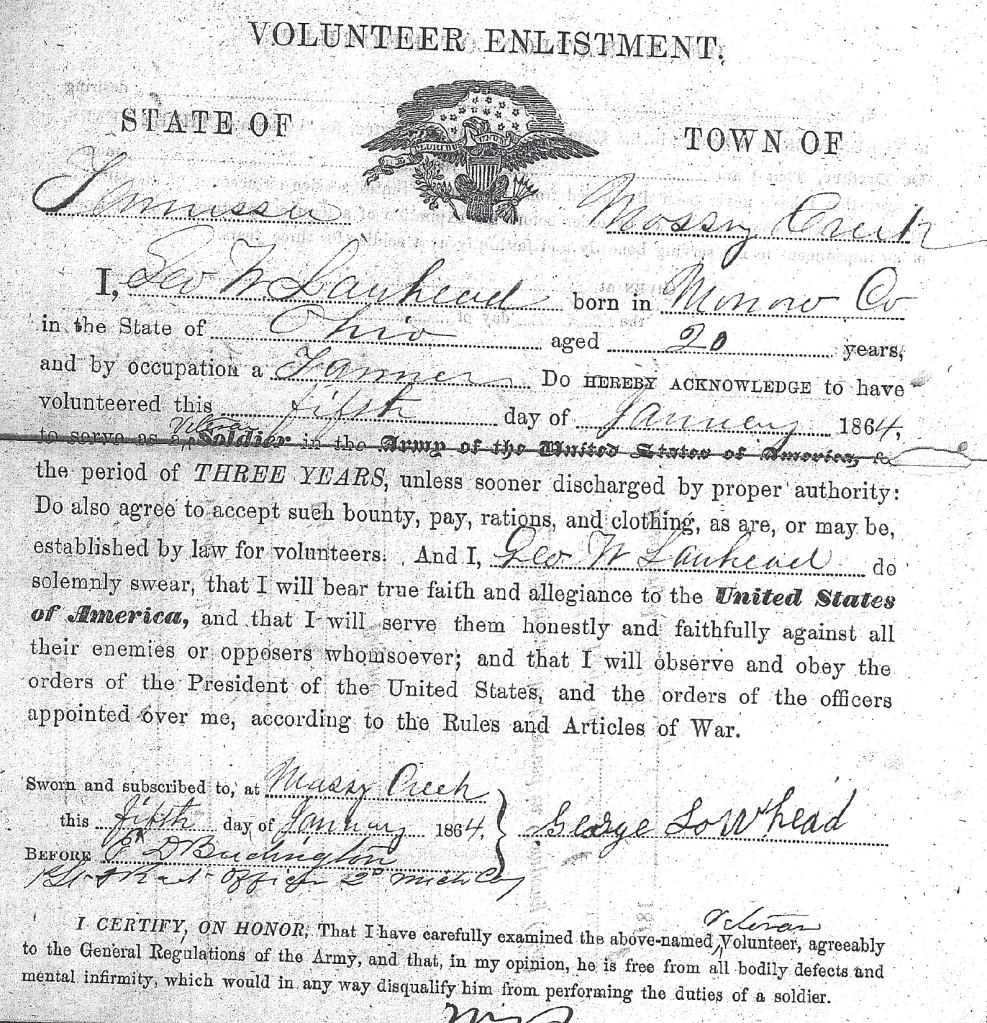
George enlisted in the Union Army on 9 September 1861 at Charlotte, Michigan.⁴ He served as a private in Company B of the 2nd Michigan Volunteer Cavalry, a regiment that spent much of the war in the Western Theater.

Partial page of re-enlistment of George Lawhead. He re-enlisted in 1864 for another 3 years.

His service records document extended periods of duty and movement, including assignments associated with the regimental train and service in Tennessee.⁵ Like many cavalrymen, George endured long rides, exposure, and physical strain—conditions that would later be reflected in repeated pension medical examinations.

A photograph taken in Jackson, Michigan at the time of his discharge from service would later become one of the most important documents connected to his life, though its significance would not be fully realized until many years later.


Marriage to Mary King and Early Family Life

After the war, George married Mary King on 16 October 1865 in Eaton County, Michigan.⁶ They had two children together:

  • James Loyd Lawhead, born 28 February 1867
  • Charles Loyd Lawhead, born 4 April 1869

The marriage did not endure. George left Mary while she was pregnant with their second child and moved east into Saginaw County. No divorce was ever obtained. Mary would spend much of her adult life raising their children under difficult circumstances, a situation later documented extensively in federal pension records.


Marriage to Emma Mae Stiles and Children

On 31 January 1869, George married Emma Mae Stiles in Albee Township, Saginaw County, Michigan.⁷ This marriage produced three children:

  • Margaret Jane Lawhead, born 2 July 1872
  • Renaldo Lawhead, born 16 August 1877, who died in infancy on 14 October 1877
  • Effie M. Lawhead, born 26 July 1879

Emma Mae Stiles died in April 1886. Her death marked the only point at which George Washington Lawhead was legally widowed. His earlier marriage to Mary King had ended through abandonment rather than death or divorce, a distinction that would later carry significant legal consequences.


Later Marriages and Life in Michigan

George married Helen Vorhees on 17 August 1884 in Saginaw County, Michigan.⁸ The surviving record of this marriage is brief, and little documentation remains regarding their life together.

By the early 1890s, George was living with Henrietta Savage. Census records, land transactions, and newspaper notices place him in Eaton, Iosco, Saginaw, Crawford, and Charlevoix counties over the course of his adult life.⁹ Real estate notices published in Saginaw County newspapers show both purchases and sales, suggesting frequent movement rather than long-term stability.¹⁰


Henrietta Savage and Children

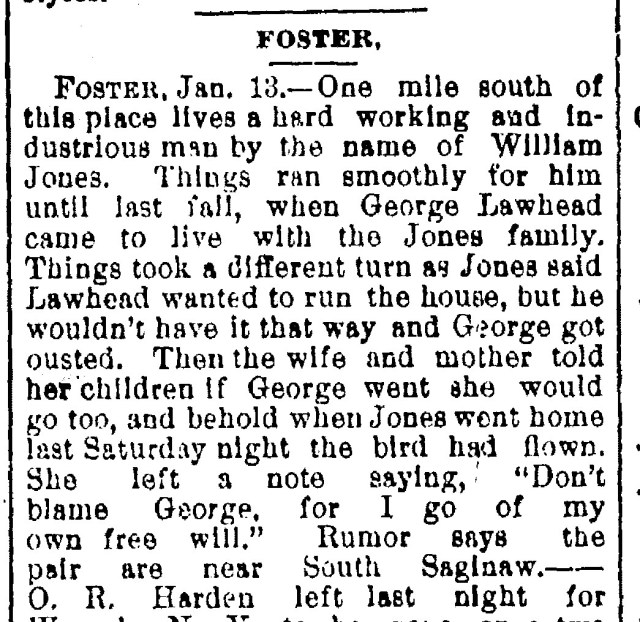
Henrietta Savage was legally married to another man when she became involved with George Lawhead. In January 1892, a local newspaper reported that she had left her husband and children to go with George.¹¹ The matter was public and later became part of the documentary record surrounding George’s pension.

The Saginaw News, January 1892

George and Henrietta had two daughters together:

  • Ethel Mildred Lawhead, born 24 October 1892 in Frederic, Crawford County, Michigan
  • Jessie Leuella Lawhead, born 22 April 1896 in East Jordan, Charlevoix County, Michigan

George lived with and supported Henrietta and their children for several years, forming the final family unit of his life.


Illness and Decline

By 1890, George’s health had begun to fail. Pension records and medical examinations document chronic sciatica, lumbago, rheumatism, kidney disease, impaired eyesight, and increasing difficulty with mobility.¹² Over the next fifteen years, he filed repeated requests for increases to his invalid pension as his condition worsened.

These medical records provide a rare longitudinal view of a Civil War veteran’s decline, tracing the progression from working laborer to physical dependency.


Death and Burial

George Washington Lawhead died on 20 January 1905 in East Jordan, Charlevoix County, Michigan, from heart disease.¹³ He was buried two days later in East Jordan Cemetery. Contemporary newspaper accounts note the participation of members of the Grand Army of the Republic in his funeral.¹⁴

Even after his burial, questions surrounding his marriages, identity, and family obligations remained unresolved, setting the stage for years of investigation and competing pension claims.


Conclusion

George Washington Lawhead’s life cannot be understood through a single record or a simple narrative. It survives instead through census entries, military documents, marriage records, newspaper notices, and—most notably—a Civil War pension file of extraordinary size.

This post traces the outline of his life: orphaned child, young soldier, husband, father, and aging veteran. The deeper questions—of identity, legality, and how the federal government ultimately judged his family—are stories of their own, explored in later posts.


Sources

  1. Family and census records indicating birth in Westfield Township, Ohio.
  2. Probate and death records for James Lawhead and Temperance Gilson.
  3. 1860 U.S. Federal Census, Roxand Township, Eaton County, Michigan.
  4. Compiled Service Records, Company B, 2nd Michigan Cavalry.
  5. Ibid.
  6. Eaton County, Michigan, marriage records, 16 October 1865.
  7. Saginaw County, Michigan, marriage records, 31 January 1869.
  8. Saginaw County marriage records, 17 August 1884.
  9. U.S. Federal Census records, 1870–1900.
  10. Saginaw Herald, real estate notices, 1878 and 1881.
  11. Grand Rapids Herald, January 1892.
  12. Invalid pension medical examinations, 1890–1904.
  13. Michigan death record, East Jordan, 1905.
  14. Charlevoix County Herald, January 1905.

Martin V. Lacy (1833–1904)

Martin V. Lacy was born in September 1833 in Le Ray (often recorded as Leray), Jefferson County, New York. He was the son of Erastus Lacy (1790–1856) and Florilla Billings (1793–1860). Early census and family records place him in Jefferson County during his childhood years, where he lived among several siblings, including Jane, Julia, Milo, and others.¹

On 28 November 1855, Martin married Henrietta O’Dell (1838–1865) in Genesee County, Michigan.² By 1860, he was residing in Brownville, Jefferson County, New York, where he appeared in the federal census with his occupation listed as farmer.³ A military description recorded in August 1862 described him as having blue eyes, sandy hair, a light complexion, and a height of five feet eleven inches.⁴

Image generated by ChatGPT of Martin Lacy based on his military description.

Martin served in the American Civil War. He enlisted in August 1862 with the 35th New York Infantry, Company I, and later served with the 80th New York Infantry, Company H, during 1863.⁵ Military records place him in Watertown and Albany, New York, during his service, and a residence record dated 1 July 1863 lists him in Fabius, New York.⁶

Martin and Henrietta had several children: Adelbert Lacy, born in November 1859 in Michigan; Helen Mae Lacy, born 3 June 1860 in Brownville, New York; and Fred Lacy, born 12 December 1860 in Michigan.³ Henrietta Lacy died in 1865 in Charles City, Virginia.⁷

On 25 March 1866, Martin married Nancy J. Whitney (1843–1906) in Taymouth Township, Saginaw County, Michigan.⁸ The couple settled in Michigan, where Martin appeared regularly in state and federal census records. Their children included Emma Lacy (born 1866), Alice Lacy (born 1 June 1869 in Montrose, Genesee County), Mary Belle Lacy (born 13 August 1875), and William Henry Lacy (born 26 May 1878).⁹

By 1870, Martin was living in Montrose, Genesee County, Michigan, and by the mid-1870s he had acquired land in Kawkawlin Township, Bay County, Michigan, as documented in federal land records dated 1 August 1874.¹⁰ Census records from 1880 through 1900 consistently place him in Kawkawlin Township, where he was listed as married and head of household.¹¹

Throughout his life, Martin experienced the deaths of numerous family members, including his parents, siblings, and children Fred (1883) and Emma (1897).¹² He remained in Bay County into the early twentieth century.

Martin V. Lacy died on 8 August 1904 in Garfield Township, Bay County, Michigan. His death certificate records the cause of death as cardiac disease.¹³ He was seventy years old at the time of his death.


Sources

  1. U.S. Federal Census, 1860; Brownville, Jefferson County, New York.
  2. Michigan, County Marriage Records, 1822–1940, Genesee County, marriage of Martin V. Lacy and Henrietta O’Dell, 28 November 1855.
  3. U.S. Federal Census, 1860; Brownville, Jefferson County, New York.
  4. New York, Civil War Muster Roll Abstracts, 1861–1900, description dated 20 August 1862.
  5. U.S. Civil War Soldier Records and Profiles; service with 35th New York Infantry, Company I, and 80th New York Infantry, Company H.
  6. New York, U.S., Compiled Census and Census Substitutes Index, 1790–1890.
  7. Michigan, Death Records, 1867–1950; death of Henrietta (O’Dell) Lacy, 1865.
  8. Michigan, County Marriages, 1822–1940; marriage of Martin V. Lacy and Nancy J. Whitney, 25 March 1866.
  9. Michigan, U.S., Birth Records, 1867–1914; Lacy family entries.
  10. U.S. General Land Office Records, 1776–2015; land patent, Kawkawlin Township, Bay County, Michigan, 1 August 1874.
  11. U.S. Federal Census, 1870, 1880, 1900; Michigan State Census, 1884, 1894; Kawkawlin Township, Bay County, Michigan.
  12. Michigan, Death Records and U.S., Find A Grave Index.
  13. Michigan, Death Records, 1867–1950; death certificate of Martin V. Lacy, 8 August 1904.