
One of the first things modern researchers notice when working with French-Canadian records is the repetition of given names. In the Seguin dit Laderoute family, this is immediately apparent: nearly every daughter of Pierre Seguin dit Laderoute carries the given name “Marie.” At first glance, this can appear to be an error, a copying problem, or evidence that multiple individuals have been conflated. In reality, it reflects a deeply rooted religious naming practice rather than personal preference or family tradition.
Devotional Given Names in Catholic Québec
In New France, naming practices were shaped by Catholic theology and devotional culture. Children were commonly given the names of saints or religious figures at baptism, particularly those of the Holy Family. As a result, “Marie” appears frequently as a given name for girls, while “Joseph” and “Jean” appear frequently for boys.¹
These names were bestowed as acts of devotion rather than as practical identifiers. Consequently, the first given name recorded at baptism was not necessarily the name used in daily life.
The Seguin dit Laderoute Daughters
Pierre Seguin dit Laderoute and his wife Marie Barbe Filion had several daughters whose baptismal names begin with “Marie,” including Marie Élisabeth, Marie Françoise, Marie Geneviève, Marie Barbe, Marie Jeanne, and Marie Véronique.²
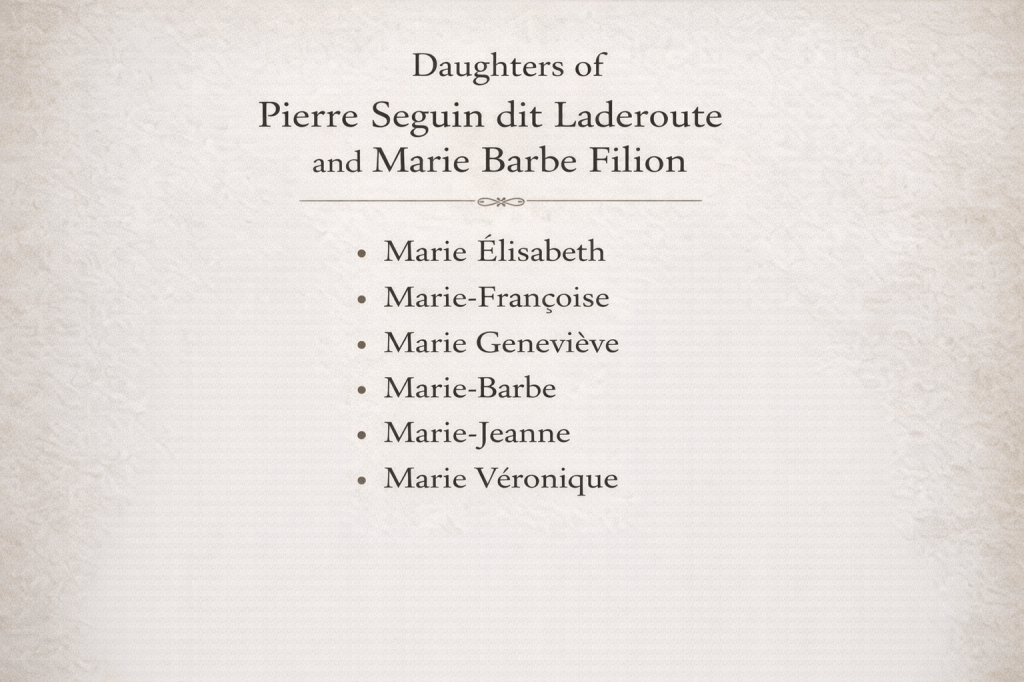
Despite sharing the same initial given name, these women were not distinguished in daily life by “Marie.” Instead, they were known by their second given names—Élisabeth, Françoise, Geneviève, Barbe, Jeanne, or Véronique. Parish priests, notaries, and later clerks might record either form, depending on context and habit.
This practice explains why the same individual may appear under different given names across records. A woman baptized as Marie Geneviève might later be recorded simply as Geneviève, Marie, or Geneviève Marie, without any intention of identifying a different person.
Hyphenation and Modern Assumptions
Modern readers often notice that some given names appear hyphenated while others do not, and may assume that this distinction reflects how the names were used or understood at the time. In eighteenth-century Québec, this assumption is misleading.
In the original parish registers, multiple given names were typically written without hyphens. Spacing, capitalization, and order varied, even within the same register. Hyphenation became more common in later transcriptions, printed genealogical works, and modern databases, reflecting editorial standardization rather than historical practice.³
As a result, forms such as “Marie-Françoise” and “Marie Françoise” usually represent the same name. The presence or absence of a hyphen should not be read as evidence of which name was used in daily life, nor as an indicator of formality or importance.
Why This Causes Confusion for Modern Researchers
Modern record systems and databases tend to treat the first given name as the primary identifier. When applied to French-Canadian records, this assumption often leads to errors. Individuals may be split into multiple profiles or merged incorrectly based solely on variations in given-name order, spelling, or hyphenation.
In families such as the Seguin dit Laderoute family, where several siblings share the same devotional name, relying on “Marie” as an identifying feature is particularly unreliable. Place, date, family relationships, and associates provide far more dependable evidence of identity.
Not Limited to Women
Although “Marie” is most visible among women, the same devotional practice applied to men. Men frequently carried “Marie” as one of their given names, just as women sometimes carried “Joseph” or “Josephte.” These combinations were expressions of devotion and carried no implication of clerical error or gender confusion.⁴
This practice becomes especially important when tracing later generations, where men such as François Marie Beauchamp appear in records with or without the devotional component of their given name.
Reading the Records as They Were Created
The repetition of “Marie” among the Seguin dit Laderoute daughters is not an anomaly requiring correction. It reflects a naming system that served religious and cultural purposes rather than modern administrative ones. The challenge for researchers lies not in fixing the records, but in learning to interpret them on their own terms.
In the next post, the focus will shift from given names to surnames and to the use of dit names such as “Laderoute,” which introduce an additional layer of complexity to the same family.
Notes
- Allan Greer, The People of New France (Toronto: University of Toronto Press, 1997), 63–66.
- Québec, Canada, Vital and Church Records (Drouin Collection), baptisms of the children of Pierre Seguin dit Laderoute and Marie Barbe Filion, various parishes.
- René Jetté, Dictionnaire généalogique des familles du Québec (Montréal: Les Presses de l’Université de Montréal, 1983), introduction.
- Ibid.
 The Tumbleweed