Lydia Clark Tolles (1749–1793): A Woman in the Shadow of War

When the American Revolution is told through the lives of men, it becomes a story of enlistments, campaigns, and patriotism. When it is told through the lives of women, it becomes something very different: endurance, uncertainty, and survival. Lydia Clark Tolles, the wife of Elnathan Tolles, lived her entire adult life inside that second story.
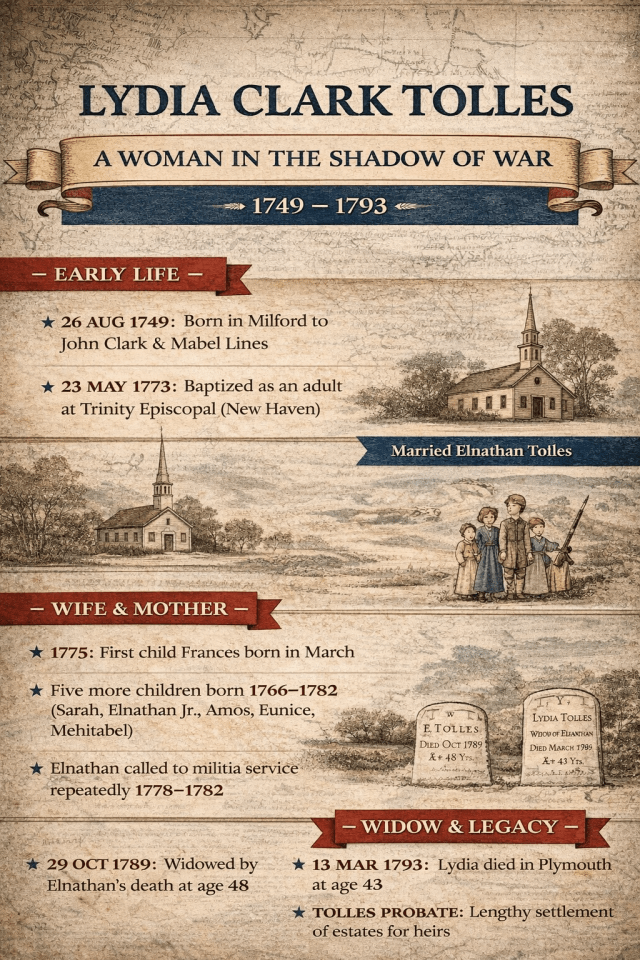
Lydia was born on 26 August 1749, the daughter of John Clark and Mabel Lines, members of one of the oldest and most prominent families in the Milford–New Haven area of Connecticut. Through her parents, Lydia was connected to a wide web of kin, land, and church ties that would quietly shape the course of her life.¹

On 23 May 1773, Lydia was baptized as an adult at Trinity Church in New Haven, an Episcopal parish. Adult baptisms were not unusual, but they often coincided with marriage or a conscious decision to join a particular congregation. Within a short time, Lydia married Elnathan Tolles, and the two established their household in the Northbury parish of Waterbury (later Plymouth), an upland farming community not far from New Haven.¹ ²

Within two years, the world around them changed. In March 1775, Lydia gave birth to her first daughter, Frances, just as colonial New England was sliding into war. Over the next decade, Lydia would give birth to at least five more children: Sarah, Elnathan, Amos, Eunice, and Mehitabel

While Lydia was raising young children, her husband was repeatedly called into military service. Connecticut records place Elnathan Tolles on militia duty in 1778, 1779, 1780, 1781, and 1782, meaning Lydia often ran their household without him during the most difficult years of the war.⁴

The war ended, but stability did not follow. Elnathan died on 29 October 1789, leaving Lydia a widow with six children. Four years later, on 13 March 1793, Lydia herself died in Plymouth at only 42 years of age. Their estates were handled together in a lengthy probate process that documented their surviving children and the property they left behind.⁵

Lydia left no diary and no personal letters. What survives instead are church entries, baptisms, militia lists, and probate records. Taken together, they show a woman who endured war, childbirth, widowhood, and early death — yet still raised a family that would carry this Connecticut story westward into the new nation.

In the next post, I’ll turn to Lydia’s daughter Frances “Fanny” Tolles, whose life and identity became one of the most complicated and revealing puzzles in this family’s history.


Sources

Probate of Elnathan and Lydia Tolles, Plymouth (Watertown) District, Litchfield County, Connecticut, 1789–1794, combined estate file (66 pages), showing Lydia as administratrix and naming their children as heirs.he most complicated and revealing puzzles in this family’s story.

Donald Lines Jacobus, Deacon George Clark(e) of Milford, Connecticut and Some of His Descendants (New Haven: Tuttle, Morehouse & Taylor, 1949), entry for Lydia Clark, wife of Elnathan Tolles.

Donald Lines Jacobus, Families of New Haven, vol. VIII (New Haven: Tuttle, Morehouse & Taylor, 1932), Tolles family, “Elnathan & Lydia (Clark) Tolles.”

Trinity Church (Episcopal), New Haven, Connecticut, baptismal records, Frances Tolles, 12 March 1775, as abstracted in Families of New Haven.

Connecticut Revolutionary War Military Lists, 1775–1783; and U.S. Compiled Revolutionary War Military Service Records, entries for Elnathan Tolles.
Elnathan Tolles (1741–1789): A Connecticut Man in Revolutionary Times

When we think about the American Revolution, it is easy to imagine famous generals, fiery pamphlets, and dramatic battles. But for most families, the Revolution was something far quieter and far harder: years of uncertainty, absence, and strain that unfolded in ordinary towns and farmsteads. One of those ordinary men was my fifth great-grandfather, Elnathan Tolles.

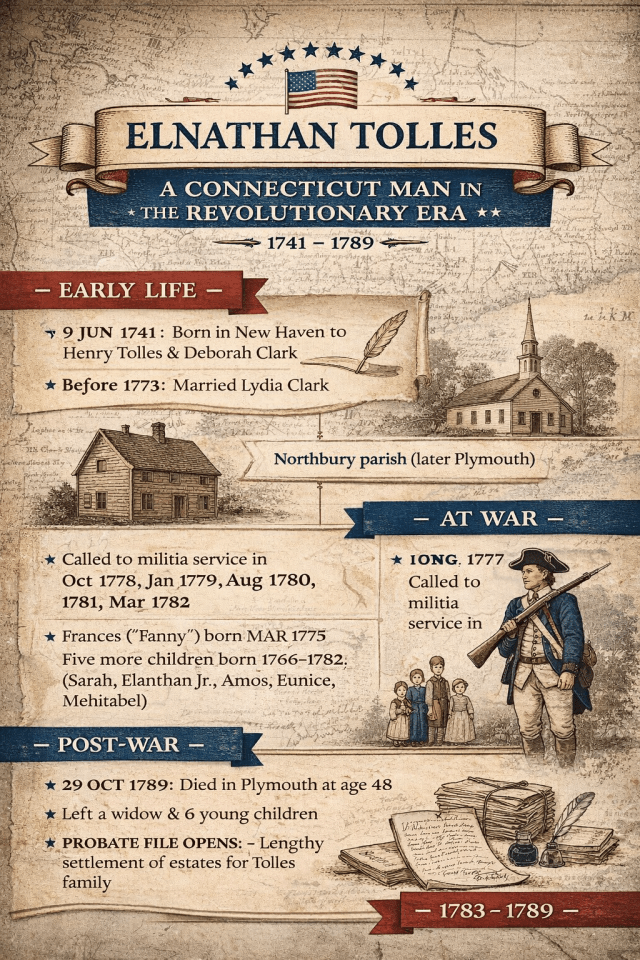
Elnathan was born on 9 June 1741 in New Haven, Connecticut, the son of Henry Tolles and Deborah Clark. He grew up in a family that had already been in New England for several generations. His grandfather and great-grandfather had come from England in the mid-1600s, and by the time Elnathan was born, the Tolles family was firmly rooted in the New Haven Colony.¹ ²

Before 1773, Elnathan married Lydia Clark, a member of another long-established Connecticut family. Lydia was baptized as an adult at Trinity Church in New Haven on 23 May 1773, which strongly suggests their affiliation with the Episcopal Church rather than the Congregational churches that dominated the region.¹ ³

By the early 1770s, Elnathan and Lydia were living in the Northbury parish of Waterbury, a farming community that would later become the town of Plymouth. It was here, in the middle of the Revolutionary era, that their children were born and their family took shape.³

Elnathan’s military service reflects the pattern of a Connecticut militiaman rather than a long-term Continental soldier. Surviving records place him in service in October 1778, January 1779, August 1780, sometime in 1781, and again in March 1782. These repeated call-ups indicate participation in short-term militia service, responding to regional threats and alarms as they arose.⁴

While Elnathan was repeatedly absent, Lydia was raising a growing family. Their daughter Frances (“Fanny”) was born in March 1775, only weeks before the war began. Five more children followed during and immediately after the conflict: Sarah, Elnathan, Amos, Eunice, and Mehitabel

Elnathan did not live long after independence. He died on 29 October 1789, at the age of 48, only two years after the United States adopted its Constitution. His widow Lydia survived him for just four more years. Their combined estate would be administered and divided in a lengthy probate process that documented their property and confirmed their surviving children.⁵

Elnathan Tolles left no letters, no memoirs, and no heroic battlefield stories. What remains are church records, militia lists, and probate files — the quiet paperwork of a man who lived, worked, served, and died during the founding generation of the United States.

In the posts that follow, I will turn to the women of his household, beginning with Lydia Clark Tolles, and then to their daughter Fanny, whose identity became one of the most complicated genealogical puzzles in this family’s history.


Sources

  1. Donald Lines Jacobus, Deacon George Clark(e) of Milford, Connecticut and Some of His Descendants (New Haven: Tuttle, Morehouse & Taylor, 1949), entry for Lydia Clark, wife of Elnathan Tolles.
  2. William Marshall Tolles & Alyce Jane (Tolles) Morrow, Tolles in America (Baltimore: Gateway Press, 1997), Tolles family genealogy, including Henry Tolles, Deborah Clark, and their son Elnathan.
  3. Donald Lines Jacobus, Families of New Haven, vol. VIII (New Haven: Tuttle, Morehouse & Taylor, 1932), Tolles family, “Elnathan & Lydia (Clark) Tolles.”
  4. Connecticut Revolutionary War Military Lists, 1775–1783; and U.S. Compiled Revolutionary War Military Service Records, entries for Elnathan Tolles showing militia service from 1778–1782.
  5. Probate of Elnathan Tolles (1789) and Probate of Lydia Tolles (1793), Plymouth (Watertown) District, Litchfield County, Connecticut; combined estate file, naming their children and documenting the division of property.

Four Abraham Smiths in One Family Tree

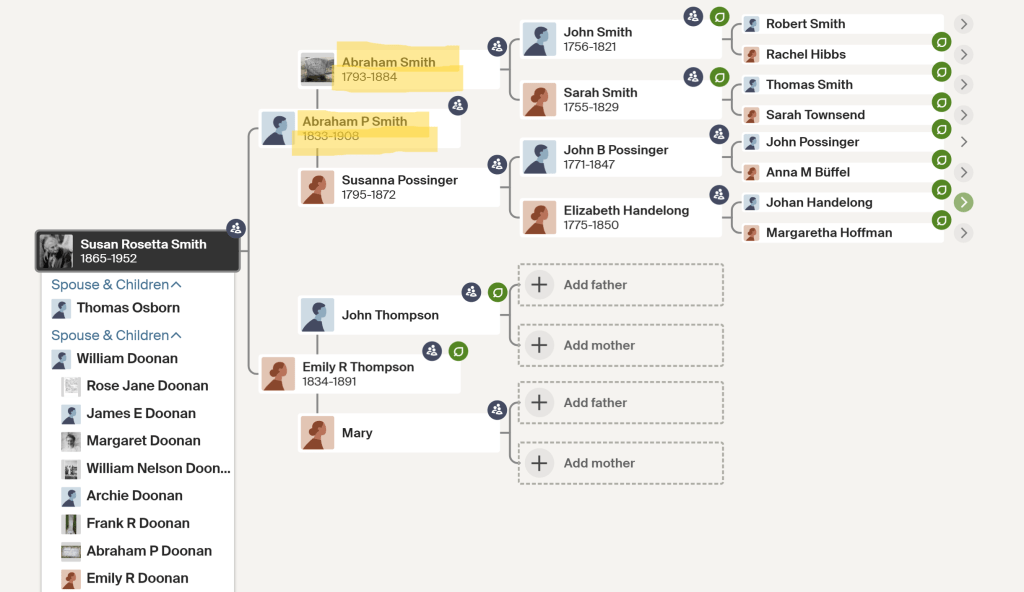
One of the most challenging parts of family history research is sorting out people who share the same name. In my own family tree, I descend from four different men named Abraham Smith. They fall into two father–son pairs, belonging to two entirely separate families. Although their names are identical, their lives unfolded in different places and under very different circumstances.


The Massachusetts–Vermont Abraham Smiths

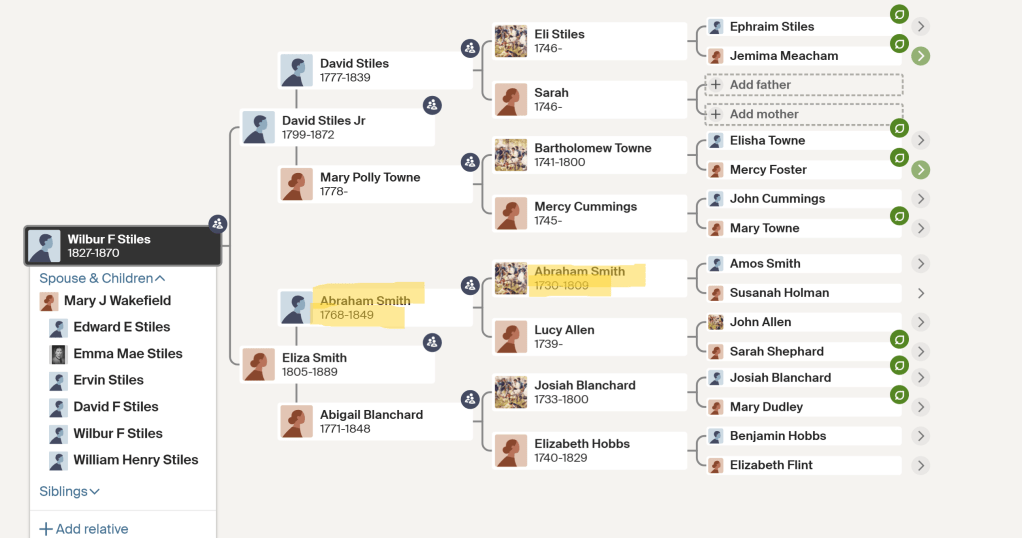
Abraham Smith (1730–1809)

Abraham Smith was born on 20 September 1730 in Sudbury, Middlesex County, Massachusetts, the son of Amos Smith (1699–1786) and Susanah Holman (1702–1778). He grew up in Sudbury alongside his brothers Jacob, Benjamin, and Jonathan. On 24 July 1763, he married Lucy Allen in Newton, Massachusetts. Lucy had been born in 1739 in Weston, Massachusetts. Their children were born in Massachusetts:

  • Polly Smith, born 20 November 1766
  • Abraham Smith, born 27 October 1768 in Worcester
  • Allen Smith, born 6 April 1770

During the American Revolutionary War, Abraham Smith served in the Vermont militia. His service appears in The State of Vermont: Rolls of the Soldiers in the Revolutionary War 1775–1783, compiled by John E. Goodrich. Abraham Smith is listed on the roll of Captain Gideon Brownson’s Company, on a roster dated 26 February 1776 for the Montreal expedition, placing him in the northern theater of the war. This company was part of the militia forces raised in the Vermont region for operations connected with the occupation of Canada during the early stages of the war.

By 1790, Abraham was living in Tinmouth, Rutland County, Vermont, where he appears in the federal census. He remained there until his death on 4 November 1809, closing a life that spanned from colonial Massachusetts through the Revolutionary War and into the early years of the United States.


Abraham Smith (1768–before 1849)

The second Abraham in this line was born 27 October 1768 in Worcester, Massachusetts, the son of Abraham Smith and Lucy Allen. He married Abigail Blanchard on 9 February 1797 in Sturbridge, Massachusetts. Abigail was born in 1771 and later died in Brookfield, Vermont.

By the early 1800s, this family had settled in Orange County, Vermont, primarily in Brookfield. Their children included:

  • Harriot Louise Smith (1798–1878)
  • Abigail Smith (1800–1879)
  • Amasa Austin Smith (c.1801–1808)
  • Eliza Smith (1805–1889)
  • John Allen Smith (1809–1884)

Through these children, this Smith line later extended westward into Wisconsin and Michigan, particularly through the Fuller, Stiles, and Loomis families. Abraham Smith (1768) died before 10 April 1849 in Orange, Vermont.


The Pennsylvania Abraham Smiths

Abraham Smith (1793–c.1884)

A second, unrelated Abraham Smith was born on 29 January 1793, probably in Wrightstown, Bucks County, Pennsylvania. He was the son of John Smith (1756–1821) and Sarah Smith (1755–1829), a family associated with the Wrightstown Monthly Meeting of Friends (Quakers).

Abraham married Susanna Possinger (1795–1872), the daughter of John B. Possinger and Elizabeth Handelong. By 1830, Abraham and Susanna were living in Jackson Township, Monroe County, Pennsylvania, where Abraham appears in census records from 1830 through 1880. This area, in the Pocono region, became the permanent home of this branch of the family.

Their children included:

  • Fannie Smith (1813–1876)
  • Sarah Smith (1815–1900)
  • Catharine Smith (1826–1891)
  • Susan Smith (c.1828–1909)
  • Joseph Possinger Smith (1830–1882)
  • Abraham Possinger Smith (1833–1908)

The repeated use of “Possinger” as a middle name preserved Susanna’s maiden name and helps distinguish this Smith family from others in Pennsylvania.

Susanna died in 1872. Abraham remained in Jackson Township, Monroe County, until his death about 1884. He was buried in Tannersville Union Cemetery in Monroe County.


Abraham Possinger Smith (1833–1908)

The youngest of the four Abraham Smiths was born in May 1833 in Pennsylvania, the son of Abraham Smith and Susanna Possinger. He married Emily Rebecca Thompson before 1854 and later Susan Smith.

Over the course of his life, Abraham Possinger Smith lived in Pennsylvania, Michigan, and Washington State. He died on 29 June 1908 in Shelton, Mason County, Washington. His children included:

  • Frank E. Smith
  • Jude Smith
  • Elmira Smith
  • Robert Smith
  • Susan Rosetta Smith
  • Fanny Florence Smith
  • Abraham Edward Smith

Through this line, descendants spread into Bay County, Michigan, Ontario, Canada, and the Pacific Northwest, giving this Smith branch a wide geographic reach.


Two Names, Two Families

Although all four men bore the name Abraham Smith, the records show they belonged to two completely separate families:

Family LineFatherSon
Massachusetts → VermontAbraham Smith (1730–1809)Abraham Smith (1768–1849)
Pennsylvania → Monroe County → WestAbraham Smith (1793–c.1884)Abraham Possinger Smith (1833–1908)

Their lives overlapped in time but not in place or ancestry. Together, they illustrate how a single name can run through multiple generations and unrelated families, creating confusion that only careful documentation can resolve.

Technically, I have 8 different Abraham Smith’s in my family tree. However, only 4 are direct ancestors – the others are “cousins” or married into the family.

Lot Hutchinson (1741–1818)

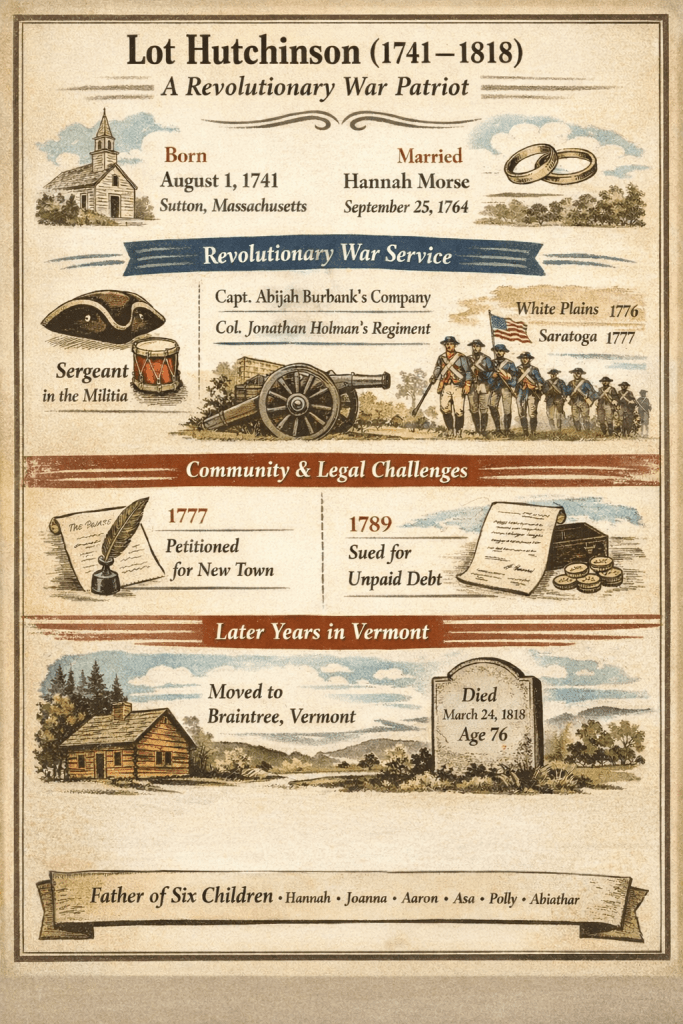
Lot Hutchinson was born on 1 August 1741 in Sutton, Worcester County, Massachusetts, the son of Nathaniel Hutchinson and Joanna Conant.¹ He was baptized in Sutton on 13 September 1741. Raised in a long-established Massachusetts family, Hutchinson came of age during a period of escalating political and military tension that would soon lead to revolution.

On 25 September 1764, he married Hannah Morse in Sutton.² The couple raised six children—Hannah, Joanna, Aaron, Asa, Polly, and Abiathar—whose births are documented in Sutton and Worcester County vital records.³

Revolutionary War Service

Lot Hutchinson’s military service during the American Revolutionary War is documented in multiple contemporary and compiled sources. He served as a sergeant in Captain Abijah Burbank’s company of Colonel Jonathan Holman’s regiment, a Massachusetts militia unit.⁴ His service appears in the Massachusetts Soldiers and Sailors of the Revolutionary War, as well as in Worcester County militia rolls, and is memorialized in his Fold3 military profile.

Holman’s regiment—often referred to in records as the Sutton Regiment—was composed largely of men from central Worcester County. The regiment was called into active service in 1776 during the White Plains campaign and again in 1777, when Massachusetts militia units were mobilized to reinforce the northern army during the Saratoga operations.⁵ These militia call-ups were a vital component of the war effort, supplying experienced local men to support Continental forces during critical campaigns.

Hutchinson’s rank of sergeant indicates that he held a position of responsibility within his company, charged with maintaining order, assisting in drill, and overseeing enlisted men—an important leadership role within the militia structure.

Civic and Community Involvement

Hutchinson’s public engagement extended beyond military service. In 1777, he was among residents of northwestern Sutton who petitioned the Massachusetts General Court for the creation of a separate town.⁶ This petition survives among the legislative records of the Revolutionary period and reflects the continuing civic life of Massachusetts communities even amid wartime disruption.

Post-War Legal and Financial Records

Like many veterans of the Revolutionary era, Hutchinson faced financial challenges in the years following the war. In 1789, he was named as a defendant in a trespass action brought by Solomon Bixby in the Worcester County Court of Common Pleas.⁷ The case involved a mortgage Hutchinson had taken on his land and buildings for £69, which he was unable to repay when the note came due. Bixby, a Sutton native born in 1761, appears in local genealogical and cemetery records, providing additional context for the dispute.⁸

Later Years and Death

By 1800, Lot Hutchinson had relocated to Braintree, Orange County, Vermont, where he spent the remainder of his life. Federal census records place him there in 1800 and 1810. His wife, Hannah (Morse) Hutchinson, died in Braintree on 17 January 1815.⁹

Lot Hutchinson died in Braintree, Vermont, on 24 March 1818, at the age of 76.¹⁰ His life spanned the colonial period, the struggle for independence, and the early decades of the United States—marked by military service, civic participation, and the challenges faced by many Revolutionary War veterans in the new nation.

Sources

  1. Sutton, Massachusetts, Vital Records to 1850, Births, entry for Lot Hutchinson.
  2. Sutton, Massachusetts, Vital Records to 1850, Marriages, entry for Lot Hutchinson and Hannah Morse, 25 September 1764.
  3. Sutton and Worcester County vital records; Family Group Sheet, “Lot Hutchinson,” Rivers–Hickmott Collection.
  4. Massachusetts Soldiers and Sailors of the Revolutionary War, entry for Lot Hutchinson; Worcester County Militia Rolls, Capt. Abijah Burbank’s Company.
  5. Massachusetts Archives Collection, Revolutionary Rolls, 1775–1783; Francis B. Heitman, Historical Register of Officers of the Continental Army.
  6. Massachusetts General Court, Legislative Petitions, 1777 Session, Sutton Northwest District Petition.
  7. Worcester County Court of Common Pleas, 1789 Docket, Bixby v. Hutchinson.
  8. Find a Grave, memorial for Solomon Bixby; Bixby Family Association records.
  9. Vermont Vital Records, Braintree Town Records, Deaths, entry for Hannah Hutchinson, 1815.
  10. Vermont Vital Records, Braintree Town Records, Deaths, entry for Lot Hutchinson, 1818.

Daniel Munson (1745-1827)

When we think of patriotic service during the American Revolution, it is easy to picture soldiers on the battlefield. Yet independence was secured just as surely by men who stayed home and kept their communities functioning during uncertain and dangerous times. One such patriot was Daniel Munson of Milford, Connecticut.

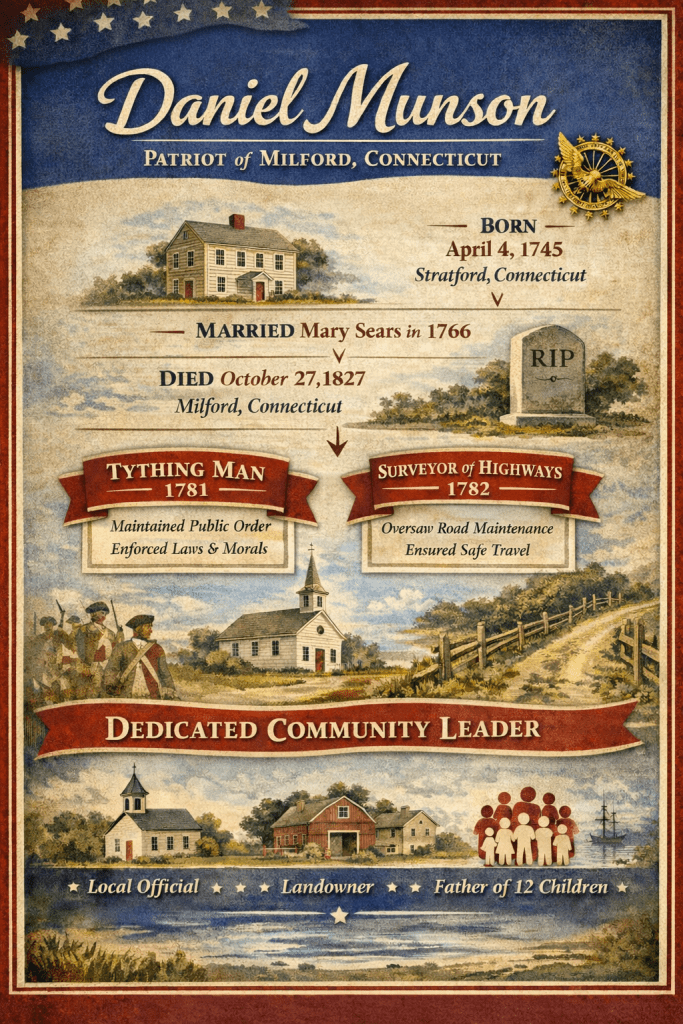
Born on April 4, 1745, in Stratford, Connecticut, Daniel Munson’s early life was shaped by loss. Orphaned as a small child, he was raised within an extended family that valued responsibility and public duty. As an adult, Daniel settled in Milford, where he married Mary Sears and raised a large family while becoming deeply involved in the civic life of the town.

During the Revolutionary War, Milford’s stability depended on capable local leadership. In 1781 and 1782—critical years as the war drew toward its conclusion—Daniel Munson stepped forward to serve the town in two important civil offices: tything man and surveyor of highways. These were not ceremonial positions. They required time, authority, and a willingness to enforce the laws that kept daily life running smoothly.

As surveyor of highways, Daniel was responsible for overseeing the maintenance of local roads—vital routes used for transporting food, supplies, and militia. In a coastal town like Milford, good roads were essential to both commerce and defense. At the same time, his role as tything man placed him in charge of maintaining public order, enforcing Sabbath laws, and addressing disorderly conduct. In a period marked by shortages, political tension, and social strain, this work helped preserve the moral and civil structure of the community.

Daniel Munson’s patriotism did not end with the war. He remained an active citizen for decades, serving his church, managing land and property, and contributing to Milford’s growth well into the early years of the new republic. He lived to see the nation he helped support take firm root, passing away in Milford on October 27, 1827, at the age of eighty-two.

Today, Daniel Munson’s story reminds us that the Revolution was sustained not only by muskets and marches, but by ordinary citizens who accepted responsibility when their communities needed them most. His recognized patriotic service stands as a testament to the power of civic duty—and to the enduring legacy of those who quietly helped build a nation.

Sources:

Full text of “1637-1887, the Munson record : a genealogical and biographical account of Captain Thomas Munson (a pioneer of Hartford and New Haven) and his descendants”, https://archive.org/stream/16371887munsonre02muns/16371887munsonre02muns_djvu.txt

Full text of “Encyclopedia of Connecticut biography, genealogical-memorial; representative citizens” – Internet Archive, https://archive.org/stream/encyc09unse/encyc09unse_djvu.txt

Daniel Munson, Ancestor No. A082998, Daughters of the American Revolution (DAR) Genealogical Research System, Washington, D.C.; patriotic service credited as tything man (1781) and surveyor of highways (1782), Milford, Connecticut; service sourced to Mullen, Connecticut Town Meeting Records, vol. 1, pp. 575–576.

John T. Wortman: A Teamster’s Journey Through the Revolutionary War

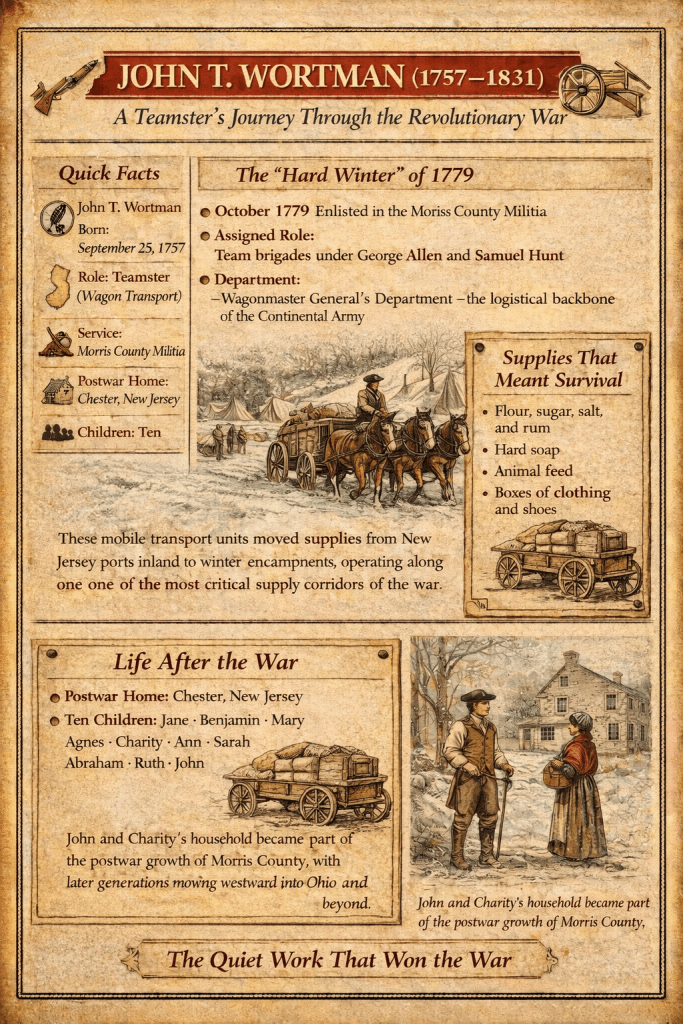
When we talk about Revolutionary War service, we often picture soldiers on the battlefield or officers directing maneuvers. But for many men in New Jersey, the war was fought on the roads — muddy, frozen, rutted roads that carried the lifeblood of Washington’s army. Few stories illustrate this better than that of John T. Wortman, born in Morristown on September 25, 1757, and later known in the records as the teamster who helped keep the Continental Army alive during its darkest winters [1]. His life offers a window into the logistical backbone of the Revolution, a side of the war we rarely talk about but absolutely should.

John Jr. grew up in a world already shaped by the long Dutch presence in New Jersey. His father, John Wortman Sr., remained rooted in Somerset County, but John Jr. came of age farther north, in the developing communities of Morris County. That shift in geography — a short distance on a modern map — made all the difference in the kind of service he would eventually render. While his father’s life revolved around Bedminster, John Jr.’s world centered on Morristown, Roxbury, and Chester, places that would become synonymous with the Continental Army’s winter encampments and supply struggles [1][6]. This geographic divide is one of the most important clues for genealogists trying to distinguish the two men.

Enlistment During the “Hard Winter”

By the fall of 1779, the war had entered one of its most desperate phases. The army was preparing for what would become the infamous “Hard Winter” at Morristown, a season so severe that even seasoned soldiers later recalled it with dread. It was in this moment that John Jr. enlisted in the Morris County Militia [1]. His role was not that of a traditional infantryman. Instead, he joined the specialized team brigades — the mobile transport units that hauled food, clothing, equipment, and forage across New Jersey’s interior.

These brigades, led by George Allen and Samuel Hunt, operated under the broader umbrella of the Wagonmaster General’s Department, the logistical backbone of the Continental Army [1][10]. Their work was relentless. Supplies arrived by water at Lamberton, a small but strategically vital port just south of Trenton, where sea‑going vessels could unload their cargo. From there, men like John Jr. took over, guiding heavily loaded wagons northward through the state’s most important military corridor [1]. This corridor — stretching from Lamberton to Morristown and then into the Hudson Highlands — was one of the most strategically important supply routes of the entire war.

What John Jr. Carried — and Why It Mattered

The pension testimony preserved by his widow, Charity Messler, paints a vivid picture of what this work entailed. John Jr. hauled:

  • Flour, sugar, salt, rum
  • Hard soap and animal feed
  • Boxes of clothing and shoes

These weren’t abstract “supplies”; they were the difference between endurance and collapse for the men stationed at Morristown, New Windsor, Pompton, Tappan, and even West Point [1]. Each load he carried represented a small but essential piece of the army’s survival. This is the kind of detail that helps us understand the daily realities of Revolutionary logistics in a way that battlefield reports never could.

The roads he traveled were not the smooth turnpikes of later centuries. They were often little more than dirt tracks, churned into deep mud by rain or frozen into jagged ridges by winter storms. Driving a wagon through such conditions required strength, patience, and a deep familiarity with the landscape. John Jr. had all three.

The Condict Papers: Witnesses Who Remembered Him

One of the most valuable pieces of evidence for his service comes from the Lewis Condict Papers, a collection of notes taken between 1833 and 1837 from pension applicants and their neighbors. In these papers, witnesses such as William Todd confirmed John Jr.’s enlistment in October 1779 and his work as a teamster in the Allen and Hunt brigades [12]. These testimonies, combined with Charity’s pension application (W100), firmly anchor him in Morris County and distinguish him from his father, whose service belonged to Somerset County [1][6].

This kind of corroboration is gold for anyone doing serious genealogical reconstruction, especially when dealing with repeated names across multiple counties.

Life After the War

After the war, John Jr. settled permanently in Chester, where he and Charity raised a large family of ten children — Jane, Benjamin, Mary, Agnes, Charity, Ann, Sarah, Abraham, Ruth, and John [1]. Their household became part of the post‑war growth of Morris County, and later generations would carry the family westward into Ohio and beyond.

His death on May 19, 1831, closed the chapter on a life defined not by battlefield heroics but by the unglamorous, indispensable labor that kept an army functioning [1]. His story reminds us that the Revolution was not only fought with muskets and bayonets, but with wagons, wheels, and the steady determination of ordinary men who understood that their work mattered.

Sources

  1. John T. Wortman (1757–1831) | WikiTreehttps://www.wikitree.com/wiki/Wortman-6
  2. Workman Family History Americanahttps://freepages.rootsweb.com/~n3kp/genealogy/workman_hist (freepages.rootsweb.com in Bing)
  3. Collections of the New York Historical Society – Internet Archive
  4. Centennial History of Somerset County, NJ – Genealogy Trails
  5. WorkmanFamily.org – Wortman Genealogy
  6. A Rare Opportunity – National Society Sons of the American Revolution
  7. Somerset County Historical Quarterly – Internet Archive
  8. WikiTree G2G: Revolutionary War Ancestors
  9. Essex County Rev War Project – Plainfield Public Library
  10. Geertjie (Messler) Wortman | WikiTreehttps://www.wikitree.com/wiki/Messler-2
  11. New Jersey Historical Society Proceedings, Vol. 9 (1924) – Internet Archive
  12. Lewis Condict Papers, 1833–1837 | New Jersey Historical Society
  13. Clarke County Historical Association Proceedings, Vol. 17

The Revolutionary War Service of Eli Stiles

Eli Stiles (1746–?) entered the Revolutionary War from Hollis, New Hampshire, though he was born in Westfield, Massachusetts, and spent his early adulthood in the Berkshires. His service appears across New Hampshire war rolls, Massachusetts legislative records, and the Naval Documents of the American Revolution.

1775: Arnold’s Expedition to Quebec

Stiles’ first enlistment began on May 14, 1775, when he joined Captain John Worthley’s Company in Colonel Edmund Phinney’s Regiment (Fold3 Military Records; Worcester, History of Hollis). That autumn, he was one of four Hollis men who volunteered for Benedict Arnold’s march to Quebec. The expedition is well documented for its failed logistics and the severe conditions along the Kennebec River. Stiles survived both the march and the failed assault on December 31, 1775 (Worcester).

1776: Sergeant Stiles in the Northern Department

By 1776, Stiles had risen to the rank of Sergeant. The Naval Documents of the American Revolution record his formal “examination” on September 16, 1776, identifying him as “Serjt Stiles” aboard the Royal Savage. He had been sent to reconnoiter British positions at St. John’s, where he counted tents, observed troop movements, and reported the presence of British-allied Native forces traveling in birch canoes (Naval Documents, Vol. 6).

1777–1778: Eight-Month Enlistment and the Hollis–Littleton Quota Dispute

In early 1777, Stiles enlisted for an eight-month Continental term (Fold3; Worcester). This enlistment triggered a jurisdictional dispute: although he lived in Hollis, NH, he had accepted a bounty from Littleton, MA. Both towns attempted to count him toward their required quotas.

The matter reached the Massachusetts House of Representatives on January 31, 1778, which ruled that Stiles was an inhabitant of Hollis and must be credited to New Hampshire. Littleton’s bounty money was ordered returned (Massachusetts House Resolve, Jan. 31, 1778).

During this same period, Hollis records show that its soldiers—including Stiles—were serving with the New Hampshire Brigade during the winter encampment of 1777–1778. The town sent clothing and supplies to its men at Valley Forge in January 1778 (Worcester, History of Hollis).

1780–1782: “For the War” Enlistment

In 1780, Stiles reenlisted “for the war,” joining the long-term Continental establishment (Fold3; Register Report). New Hampshire war rolls from 1780–1782 occasionally list him as “absent” or “deserted,” but importantly add the notation “returned to his duty,” a common pattern among soldiers who left temporarily during periods of hardship (NH War Rolls; Worcester).

His continued presence in the army is confirmed by a 1782 sworn deposition from sutler Joel Abbot, who testified that he saw “Eli Stiles… many times this last summer” serving in the Continental Army and noted that Stiles had enlisted “for the town of Hollis during the war” (Deposition of Joel Abbot, Nov. 1782).

By the close of the conflict, the Hollis Selectmen described him as “a soldier who has done Singular Exploits” (Worcester).

Post-War

After the war, Stiles remained in New Hampshire until 1806, when he moved to Northfield, Vermont (Register Report; Stiles, Stiles Family in America).

Sources

  • Fold3 Military Records: Service entries for Eli Stiles.
  • Worcester, Samuel T. History of the Town of Hollis, New Hampshire (1879).
  • Naval Documents of the American Revolution, Vol. 6: “Examination of Serjt Stiles,” Sept. 16, 1776.
  • Deposition of Joel Abbot, Hollis, NH (Nov. 1782).
  • Stiles, Henry Reed. The Stiles Family in America (1895).
  • Massachusetts House of Representatives, Resolve concerning Eli Stiles (Jan. 31, 1778).

Benjamin Byam

Benjamin Byam (1733–1795) lived a life shaped by steady service, devotion to family, and a willingness to step forward when history called. Born in Chelmsford, Massachusetts, on November 29, 1733, he came from early colonial stock. Like many families of that era, the Byams built their lives through practical skill and community responsibility. Benjamin learned the trade of a cooper, crafting the barrels that kept New England’s farms and merchants supplied.

His first experience in military service came long before the Revolution. In 1754, he joined Captain Melvin’s company during the French and Indian War, gaining the discipline and leadership that would later define his role in the fight for independence. By 1760, he had risen to 1st Lieutenant. That same year, he married Mary Keyes, and together they raised nine children — a family line that would spread across New England.

By the spring of 1775, Benjamin was living in Temple, New Hampshire. When word arrived on April 19 that British troops were advancing on Concord, he joined fifty-five of his neighbors who set out at once. Though they reached the scene after the first shots at the North Bridge, they joined the long pursuit of the British back toward Cambridge, marching through the day and into the night. Benjamin remained with the forces encamped there for eight months, supplying his own blanket — one of those small but telling sacrifices made by ordinary men who found themselves doing extraordinary things. He later served again in 1777 during the march toward Bennington.

Benjamin spent his final years in Randolph, Vermont, where he died on November 22, 1795. His life reflects the kind of legacy that endures: a craftsman, a soldier, a father, and a man whose quiet courage helped shape the nation his descendants continue to remember.

The parentage of Eleanora “Ella” B Gibbs

Like most women in genealogical research, my second great-grandmother, Eleanora B Gibbs, has been a tough one to trace. Knowing her name from her marriage to my second great-grandfather, John Wortman, and my great-grandmother, Anna Wortman Hickmott, was just the beginning of the mystery. Also, from census records, it was apparent that she lived in the Dryden area in Lapeer County Michigan. Those 2 facts still were not enough to definitively say who her parents were.

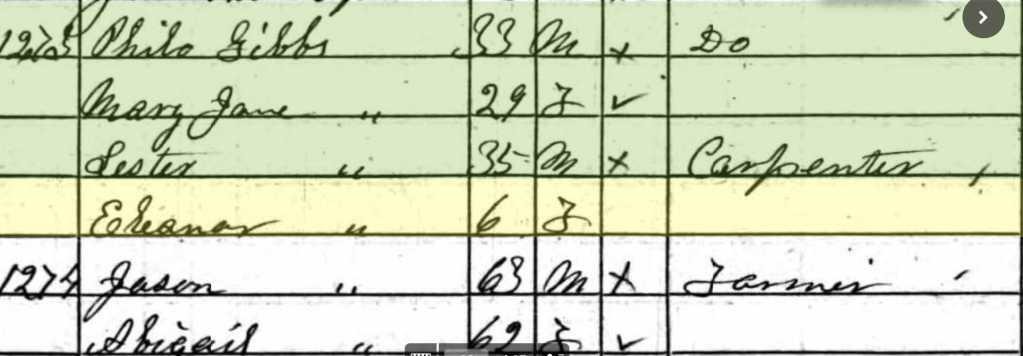
Eleanora was born in 1854, so theoretically, she should be in the 1860 and probably the 1870 census with her parents. This is where the confusion starts. In 1860, she can be found living in Dryden with Philo, Mary Jane and Lester Gibbs next door to a Jason and Abigail Gibbs.

1860 Federal Census, Dryden, Lapeer County, Michigan. Page 172.

Eleanora’s placement in the list suggests that she is Lester’s child, although the 1860 census does not indicate family relationships, and she could possibly be Philo’s daughter.

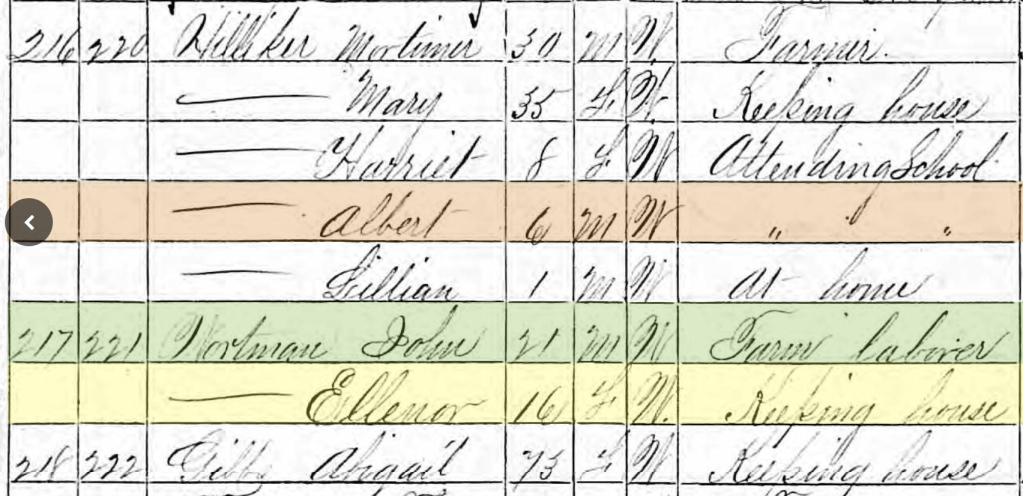
In 1870, Eleanora is married to her husband, John Wortman. The interesting tidbit here though is that John and Eleanora are listed between Mortimer Hillaker’s household and Abigail Gibbs house. Eleanora is living near relatives.

1870 Federal Census, Dryden, Lapeer County, Michigan. Page 26.

Lester disappears after the 1860 census. I have not been able to find any death record for him much less any other record for him after 1860. However, I did find a marriage record for Lester Gibbs in 1850. He marries Mary Conly on November 12, 1850 in Lapeer County. Given that Mary is not in the same household in 1860, it is certainly possible that she died or they divorced. While I have not found a divorce record, I have found additional marriages for Mary Conly – in 1861 to Charles Garner in New York and in 1868 to Mortimer Hillaker in Lapeer County, Michigan.

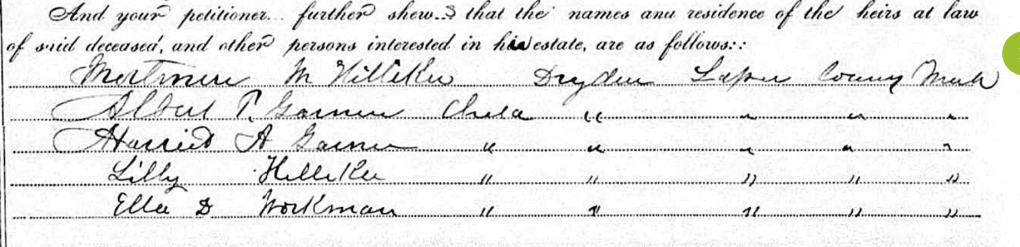
The obvious question here is how do I know that the marriage in 1861 in New York is her when both before and after that date, she’s living in Lapeer County, Michigan? Well, it’s thanks to her will. In the probate record from 1872 Lapeer County, Michigan, her will is included. She names her husband, Mortimer Hillaker and 2 children: Albert Garner and Harriet Garner. She charges her husband Mortimer to take care of Albert and Harriet until they turn 21 or are married. This would indicate that Albert and Harriet are minors. Records for both Albert and Harriet indicate this is true – Albert was born in 1864 in New York and Harriet in 1863 in New York. Harriet’s marriage record in Michigan names Charles Garner and Mary Conly as her parents. Charles dies in the Civil War.

So, Mary Conly was married 3 times – Lester Gibbs, Charles Garner and Mortimer Hillaker. Her probate record goes on to indicate that her legal heirs are Mortimer Hillaker, Harriet Garner, Albert Garner, Lillie Hillaker and Ella Workman (a variation of Wortman). Lillie is her daughter with Mortimer. Ella is Eleanora Gibbs who in some other independent records is also known as Ella.

Part of the Account Papers in the Probate record for Mary Hillaker dated April 6, 1872.

This means that Eleanora Gibbs parents were Lester Gibbs and Mary Conly.

Revolutionary War connections

1f69225b-36df-4706-8d49-15e34373ac5a

In 2014, I joined the Daughters of the American Revolution under my 6th great-grandfather, Benjamin Byam. I did my application through him because he was an already established patriot and I already had most of the documentation needed to prove my descent from him, so it was an easy application to do. In reality, I do have other Revolutionary War Patriots in my ancestry that I could have submitted under – and I’ll probably submit them as supplementals one day.

Benjamin Byam was born November 29, 1733 in Chelmsford, Massachusetts. He had some military service prior to the Revolution, but during the War, he served both in Massachusetts and New Hampshire (where he moved to). Benjamin ended up dying in Randolph, Vermont on November 22, 1795.

Lot Hutchinson, another 6th great-grandfather, was born in Sutton, Massachusetts on August 1, 1741. Lot served as a Sergeant in Captain Abijah Burbank’s company among others during the war, marching from Sutton to Providence, Rhode Island. Lot would eventually move his family from Massachusetts to Braintree, Vermont where he died on March 24, 1818. Lot has not previously been proven a patriot in the DAR database.

Lot’s father-in-law, Moody Morse, my 7th great-grandfather, was born April 1, 1719 in Newbury, Massachusetts. Moody is a proven DAR patriot for performing civil service during the war. Moody died on August 14, 1805 in Sutton, Massachusetts.

Josiah Blanchard was born on December 10, 1733 in Concord, Massachusetts and is another 6th great-grandfather. Josiah is not a currently approved DAR patriot, but he does appear on the muster roll for Cogswell’s Regiment of the Militia in 1778 (part of the 16th Regiment for Massachusetts). He also appears on the rolls for Captain Danforth’s company of Colonel Nixon’s regiment. Josiah died March 18, 1800 in Barre, Vermont.

Abraham Smith (one of several in my tree) was born in 1730 in Subury, Massachusetts and is yet another 6th great-grandfather. He is a DAR approved patriot who served under Captains Brownson, Simonds and Colonels Allen, Warner and Bradley. He died in Tinmouth, Vermont on November 4, 1809.

Bartholomew Towne was a private in Captain Josiah Crosby’s Company of Colonel Moses Nichol’s Regiment of New Hampshire Volunteers. Bartholomew was born April 8, 1741 in Topsfield, Massachusetts and died in 1800 in Milford, New Hampshire. Bartholomew is not currently a DAR approved patriot.

Eli Stiles was born May 22, 1746 in Westfield, Massachusetts. He appears on the rolls as serving under Captain Darby’s company of Colonel Scammel’s registment in New Hampshire. It is not known yet exactly when Eli died. He is not currently an approved DAR patriot.

John T. Wortman was born August 25, 1757 in New Jersey and is a fourth great-grandfather. John is an approved DAR patriot who was a teamster in George Allen’s & Samuel Hunt’s teams.  John died on May 19, 1831 in New Jersey.

John’s father, another John Wortman was born November 16, 1730 in Somerset County, New Jersey. He is a DAR approved patriot for being a Corporal and a Wagon Master during the war. John died on August 25, 1807 in Bedminster, New Jersey.

Daniel Munson was born April 4, 1745 in Stratford, Connecticut and is a fifth great-grandfather. Daniel is an approved DAR patriot for having civil service during the war as he was a surveyor of highways in Milford. Daniel died on October 27, 1827 in Milford, Connecticut.

There are probably others that I just haven’t discovered yet. 9 out of 10 of these ancestors are through my mom’s side of the family. I’m sure there are probably more on dad’s side – I just haven’t discovered them yet.