I have been researching my family history since 1999 in my spare time. I have made several trips to local repositories in Michigan, Ohio, Pennsylvania, Vermont, New Hampshire, Massachusetts and Connecticut to do research in addition to using online resources. I even did a trip to Northern Ireland to try to find my Irish roots. I have attended conferences for RootsTech, National Genealogical Society, Federation of Genealogical Societies and Association of Professional Genealogists. Additionally, I have completed the Boston University certificate program for genealogical research as well as the Intermediate Genealogy Research classes at the Genealogical Research Institute of Pittsburg and at the Institute of Genealogy and Historical Research. I love doing genealogy research.
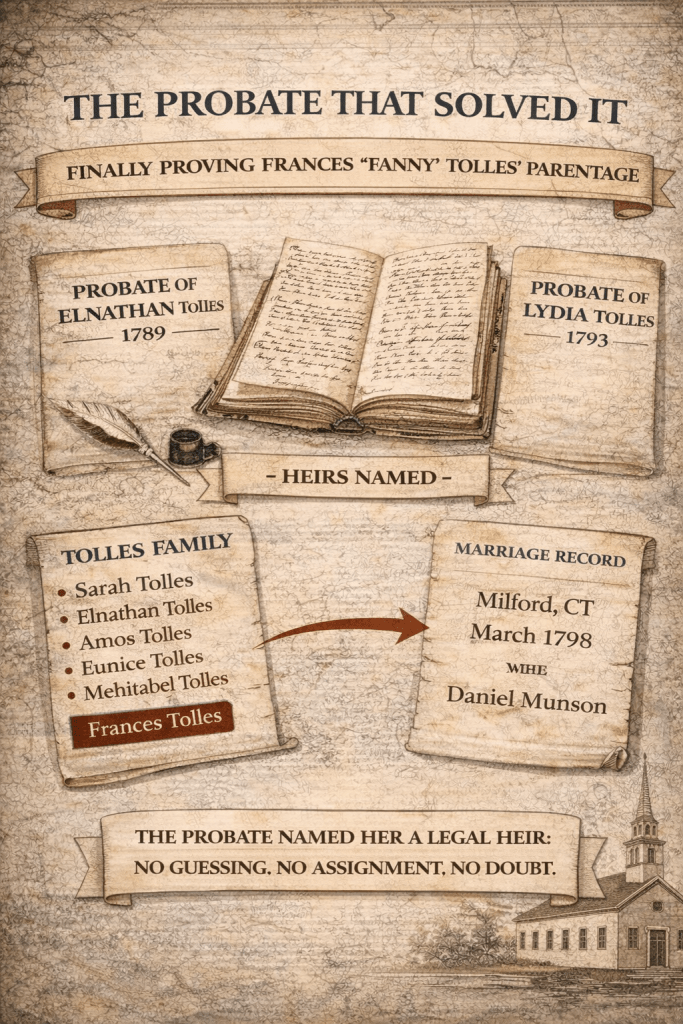
After years of uncertainty about Frances “Fanny” Tolles, the answer did not come from genetic matches or online trees. It came from something far more old-fashioned: a thick, handwritten court file created after the deaths of her parents.
When Elnathan Tolles died in 1789, he left behind a widow, Lydia, and six children. Lydia died in 1793, and their estates were administered together. The combined probate file for Elnathan and Lydia runs more than sixty pages, filled with inventories, accounts, and distributions. It is not easy reading — but it is extraordinarily valuable.
Buried in that paperwork is the simple truth genealogists search for: the names of their children as legal heirs.
Among those heirs is Frances Tolles.
That single fact matters more than any later genealogy or DNA match. Probate law in eighteenth-century Connecticut was precise. Only legitimate children or legally recognized heirs were entitled to a share of an estate. Frances was not a guess, a rumor, or an assignment. She was acknowledged by the court as the daughter of Elnathan and Lydia Tolles.
The probate does not tell us whom Frances married. It does not say “wife of Daniel Munson.” But it does tell us something just as important: Frances Tolles lived to adulthood and inherited as Elnathan’s child.
That eliminates all of the uncertainty that once surrounded her. There was not one Frances Tolles who belonged to Elnathan and another who married Daniel Munson. There was only one Frances — born in 1775, raised in the Tolles household, and alive when her parents’ estates were settled.
When that legal fact is combined with the Episcopal church records that show Frances (“Fanny”) Tolles marrying Daniel Munson in Milford in 1798, the identity becomes clear. The girl baptized in New Haven, the heir named in probate, and the bride in Milford are the same person.
This is how real genealogical proof is built. Not from a single perfect document, but from the way independent records fit together without contradiction.
DNA raised the question. The probate answered it.
In the next and final post of this series, I’ll show why the Episcopal Church — not town records or DNA — was the quiet key that held this whole story together.
Sources
Probate of Elnathan Tolles (1789) and Probate of Lydia Tolles (1793), Plymouth (Watertown) District, Litchfield County, Connecticut, combined estate file (66 pages), naming Frances Tolles among the heirs.
Donald Lines Jacobus, Families of New Haven, vol. VIII (1932), Tolles family, listing Frances baptized 12 March 1775 and identifying her as “Fanny” who married Daniel Munson.
Milford, Connecticut, Marriage Records, 19 March 1798, Daniel Munson and Frances (Fanny) Tolles.
For most of the twentieth century, the question of who Frances “Fanny” Tolles really belonged to was a paper problem. In the twenty-first century, it became a DNA problem.
Like many genealogists, I had hoped DNA would provide the missing proof. If Fanny was truly the daughter of Elnathan and Lydia Tolles, then I should eventually match people who descend from their other children. And one day, I did.
An Ancestry DNA match appeared who traced their lineage back to another child of Elnathan Tolles — not through Fanny, but through a different branch of the Tolles family. According to Ancestry’s tools, we shared 9 centimorgans on one segment, a tiny match, but one that the Shared cM Project says can fall within the range of sixth cousins. That just happens to be exactly the relationship I would have if Fanny were Elnathan’s daughter.
For a moment, it felt like a breakthrough.
But genealogy is never that simple.
As I began building out that match’s family tree — generation by generation — another surname kept appearing: Mix. It was a name I recognized immediately. I already had Mix ancestors in my own tree. So I followed that line back.
And there it was.
The DNA match and I were not connected by just one line. We were connected by two — one through Tolles, and one through Mix. The Mix connection was older and more robust. That meant the small 9 cM segment could easily come from that shared ancestry instead of from Elnathan Tolles.
In other words, the DNA match did not prove what I wanted it to prove.
This is one of the hardest lessons in genetic genealogy: a match can be real, but still be misleading. Small segments, especially those under 10 cM, are easily inherited from distant ancestors and can survive for many generations. When multiple lines connect two people, DNA alone cannot tell you which ancestor supplied the shared segment.
So DNA did not solve the Tolles–Munson question. It simply told me that the two families were tangled together in more than one way.
And that meant I had to go back to something far older — something far more reliable.
I had to go back to the law.
In the next post, I’ll show how a thick, tedious, 66-page probate file did what DNA could not: it quietly but definitively tied Frances “Fanny” Tolles to the parents who raised her.
Sources
AncestryDNA, shared DNA match between the author and a descendant of another child of Elnathan Tolles, showing 9 cM across one segment (author’s private test results).
Shared cM Project 4.0, The DNA Painter, relationship probability tool for centimorgan values, indicating that 9 cM can be consistent with sixth-cousin relationships.
Blaine T. Bettinger, “The Shared cM Project,” The Genetic Genealogist (https://thegeneticgenealogist.com), methodology for interpreting small DNA matches.
International Society of Genetic Genealogy (ISOGG), guidelines on triangulation and multiple ancestral paths affecting DNA interpretation.
Author’s compiled family tree and research notes on the Mix and Tolles families, showing multiple shared ancestral lines.
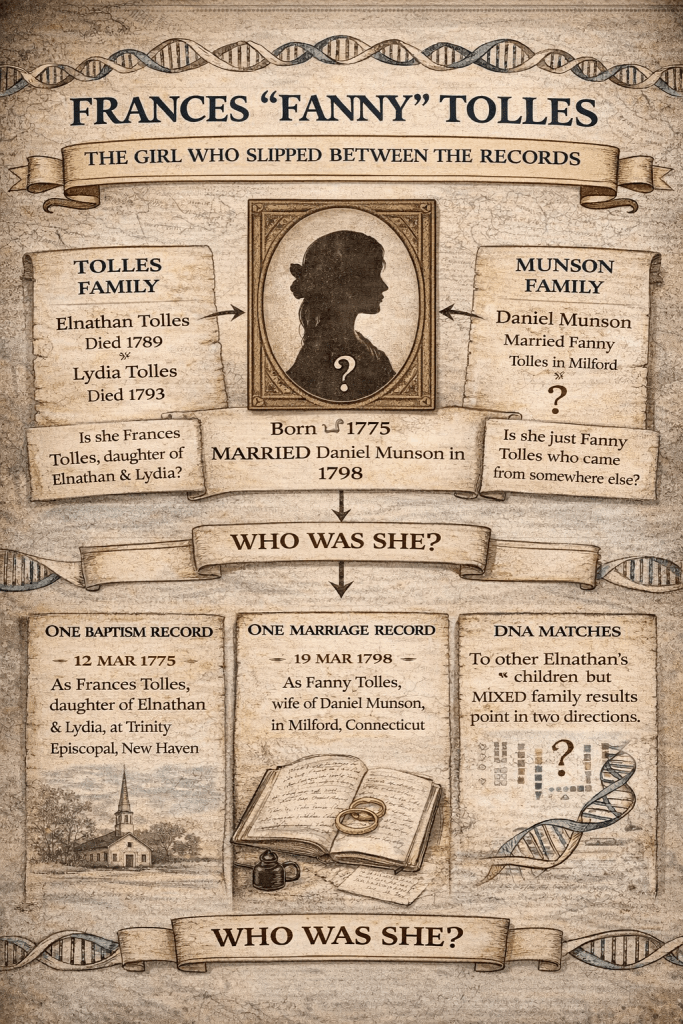
Genealogy often feels like assembling a puzzle — until you discover that one of the most important pieces was never cut to fit. That is what happens with Frances “Fanny” Tolles, the daughter of Elnathan and Lydia Tolles, and the woman who would later become the wife of Daniel Munson.
On paper, Fanny should be easy to find. She was baptized on 12 March 1775, just as the American Revolution was beginning. In the Episcopal records of New Haven she appears as “Frances,” daughter of Elnathan and Lydia Tolles.¹ But after that single entry, she seems to vanish.
Her parents lived in Northbury (later Plymouth), Connecticut, during the war years — a place where church and town records were scattered across jurisdictions and denominations. The Tolles family belonged to the Episcopal Church, not the Congregational churches that recorded most Connecticut vital events. As a result, many of Fanny’s milestones were preserved only in church books, not town ledgers.
Then her family fractured.
Elnathan Tolles died in 1789. Lydia followed in 1793. Their children were still young. Some were placed under guardianship, others went to live with relatives. The probate files confirm their identities as children of Elnathan and Lydia — but they do not track what happened to them afterward.²
This is where Fanny disappears.
By 1798, a Frances (or Fanny) Tolles married Daniel Munson in Milford, Connecticut — a town strongly associated with the Clark family, Fanny’s maternal kin.³ Yet nowhere in the marriage record are her parents named. There is no “daughter of Elnathan” to anchor her identity. She simply appears, gets married, and then moves on.
Later genealogies tried to solve this gap, but not all of them were confident. Early Tolles and Munson researchers knew that Daniel Munson’s wife was named Fanny Tolles, and they knew that Elnathan and Lydia had a daughter named Frances of the right age. But without a clear marriage record naming her parents, some writers hedged, quietly assigning her to Elnathan because she fit — not because a document said so.
That uncertainty lingered for generations.
In modern times, DNA added a new layer. A distant DNA match appeared to descend from another child of Elnathan Tolles, seemingly supporting Fanny’s placement in the family. But further research revealed a second, older connection through the Mix family, meaning the DNA could not be used to prove Fanny’s parentage after all. The evidence was real — but it pointed in two directions.
This is why I have over 64,000 people in my family tree. Not because I like big numbers, but because tiny errors in the 1700s ripple forward into the DNA era.
So who was Fanny Tolles? Was she truly the daughter of Elnathan and Lydia? Or was she “assigned” to them because no better answer existed?
To find out, we have to leave church books and DNA charts behind — and turn to something far more powerful: probate law.
Sources
Trinity Church (Episcopal), New Haven, Connecticut, baptismal records, 12 March 1775, Frances Tolles, daughter of Elnathan and Lydia Tolles; abstracted in Donald Lines Jacobus, Families of New Haven, vol. VIII (1932).
Probate of Elnathan and Lydia Tolles, Plymouth (Watertown) District, Litchfield County, Connecticut, 1789–1794, combined estate file, listing their children including Frances.
Milford, Connecticut, Marriage Records, 19 March 1798, Daniel Munson and Frances (Fanny) Tolles; cited in The Munson Record and Milford town records.
When the American Revolution is told through the lives of men, it becomes a story of enlistments, campaigns, and patriotism. When it is told through the lives of women, it becomes something very different: endurance, uncertainty, and survival. Lydia Clark Tolles, the wife of Elnathan Tolles, lived her entire adult life inside that second story.
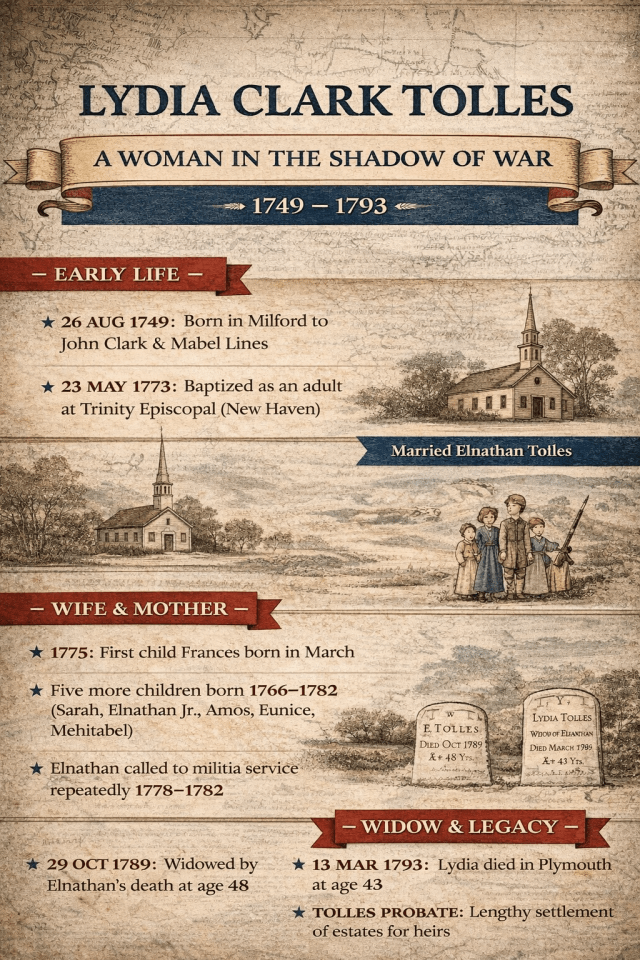
Lydia was born on 26 August 1749, the daughter of John Clark and Mabel Lines, members of one of the oldest and most prominent families in the Milford–New Haven area of Connecticut. Through her parents, Lydia was connected to a wide web of kin, land, and church ties that would quietly shape the course of her life.¹
On 23 May 1773, Lydia was baptized as an adult at Trinity Church in New Haven, an Episcopal parish. Adult baptisms were not unusual, but they often coincided with marriage or a conscious decision to join a particular congregation. Within a short time, Lydia married Elnathan Tolles, and the two established their household in the Northbury parish of Waterbury (later Plymouth), an upland farming community not far from New Haven.¹ ²
Within two years, the world around them changed. In March 1775, Lydia gave birth to her first daughter, Frances, just as colonial New England was sliding into war. Over the next decade, Lydia would give birth to at least five more children: Sarah, Elnathan, Amos, Eunice, and Mehitabel.³
While Lydia was raising young children, her husband was repeatedly called into military service. Connecticut records place Elnathan Tolles on militia duty in 1778, 1779, 1780, 1781, and 1782, meaning Lydia often ran their household without him during the most difficult years of the war.⁴
The war ended, but stability did not follow. Elnathan died on 29 October 1789, leaving Lydia a widow with six children. Four years later, on 13 March 1793, Lydia herself died in Plymouth at only 42 years of age. Their estates were handled together in a lengthy probate process that documented their surviving children and the property they left behind.⁵
Lydia left no diary and no personal letters. What survives instead are church entries, baptisms, militia lists, and probate records. Taken together, they show a woman who endured war, childbirth, widowhood, and early death — yet still raised a family that would carry this Connecticut story westward into the new nation.
In the next post, I’ll turn to Lydia’s daughter Frances “Fanny” Tolles, whose life and identity became one of the most complicated and revealing puzzles in this family’s history.
Sources
Probate of Elnathan and Lydia Tolles, Plymouth (Watertown) District, Litchfield County, Connecticut, 1789–1794, combined estate file (66 pages), showing Lydia as administratrix and naming their children as heirs.he most complicated and revealing puzzles in this family’s story.
Donald Lines Jacobus, Deacon George Clark(e) of Milford, Connecticut and Some of His Descendants (New Haven: Tuttle, Morehouse & Taylor, 1949), entry for Lydia Clark, wife of Elnathan Tolles.
Donald Lines Jacobus, Families of New Haven, vol. VIII (New Haven: Tuttle, Morehouse & Taylor, 1932), Tolles family, “Elnathan & Lydia (Clark) Tolles.”
Trinity Church (Episcopal), New Haven, Connecticut, baptismal records, Frances Tolles, 12 March 1775, as abstracted in Families of New Haven.
Connecticut Revolutionary War Military Lists, 1775–1783; and U.S. Compiled Revolutionary War Military Service Records, entries for Elnathan Tolles.
When we think about the American Revolution, it is easy to imagine famous generals, fiery pamphlets, and dramatic battles. But for most families, the Revolution was something far quieter and far harder: years of uncertainty, absence, and strain that unfolded in ordinary towns and farmsteads. One of those ordinary men was my fifth great-grandfather, Elnathan Tolles.
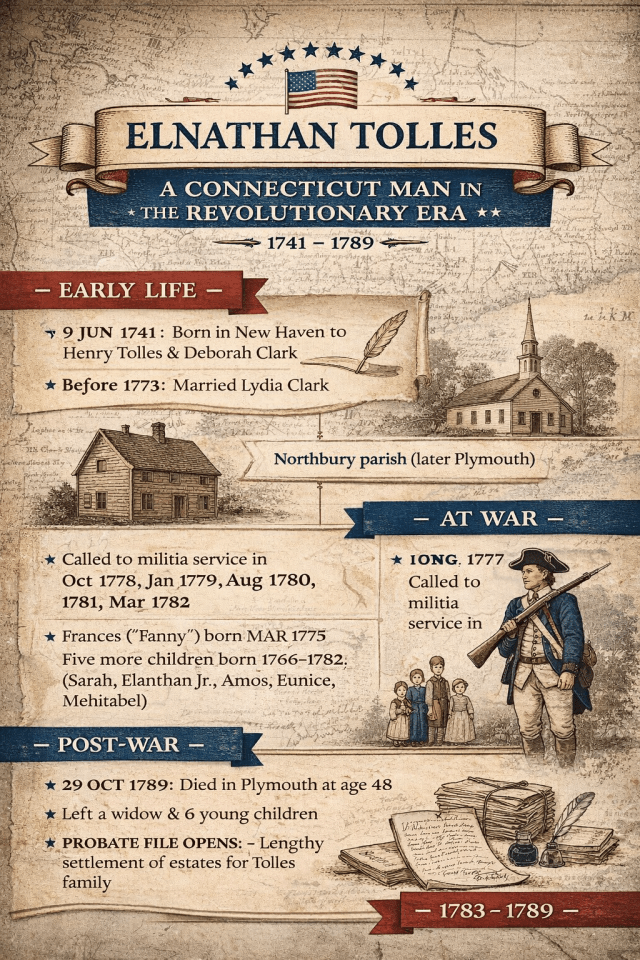
Elnathan was born on 9 June 1741 in New Haven, Connecticut, the son of Henry Tolles and Deborah Clark. He grew up in a family that had already been in New England for several generations. His grandfather and great-grandfather had come from England in the mid-1600s, and by the time Elnathan was born, the Tolles family was firmly rooted in the New Haven Colony.¹ ²
Before 1773, Elnathan married Lydia Clark, a member of another long-established Connecticut family. Lydia was baptized as an adult at Trinity Church in New Haven on 23 May 1773, which strongly suggests their affiliation with the Episcopal Church rather than the Congregational churches that dominated the region.¹ ³
By the early 1770s, Elnathan and Lydia were living in the Northbury parish of Waterbury, a farming community that would later become the town of Plymouth. It was here, in the middle of the Revolutionary era, that their children were born and their family took shape.³
Elnathan’s military service reflects the pattern of a Connecticut militiaman rather than a long-term Continental soldier. Surviving records place him in service in October 1778, January 1779, August 1780, sometime in 1781, and again in March 1782. These repeated call-ups indicate participation in short-term militia service, responding to regional threats and alarms as they arose.⁴
While Elnathan was repeatedly absent, Lydia was raising a growing family. Their daughter Frances (“Fanny”) was born in March 1775, only weeks before the war began. Five more children followed during and immediately after the conflict: Sarah, Elnathan, Amos, Eunice, and Mehitabel.³
Elnathan did not live long after independence. He died on 29 October 1789, at the age of 48, only two years after the United States adopted its Constitution. His widow Lydia survived him for just four more years. Their combined estate would be administered and divided in a lengthy probate process that documented their property and confirmed their surviving children.⁵
Elnathan Tolles left no letters, no memoirs, and no heroic battlefield stories. What remains are church records, militia lists, and probate files — the quiet paperwork of a man who lived, worked, served, and died during the founding generation of the United States.
In the posts that follow, I will turn to the women of his household, beginning with Lydia Clark Tolles, and then to their daughter Fanny, whose identity became one of the most complicated genealogical puzzles in this family’s history.
Sources
Donald Lines Jacobus, Deacon George Clark(e) of Milford, Connecticut and Some of His Descendants (New Haven: Tuttle, Morehouse & Taylor, 1949), entry for Lydia Clark, wife of Elnathan Tolles.
William Marshall Tolles & Alyce Jane (Tolles) Morrow, Tolles in America (Baltimore: Gateway Press, 1997), Tolles family genealogy, including Henry Tolles, Deborah Clark, and their son Elnathan.
Donald Lines Jacobus, Families of New Haven, vol. VIII (New Haven: Tuttle, Morehouse & Taylor, 1932), Tolles family, “Elnathan & Lydia (Clark) Tolles.”
Connecticut Revolutionary War Military Lists, 1775–1783; and U.S. Compiled Revolutionary War Military Service Records, entries for Elnathan Tolles showing militia service from 1778–1782.
Probate of Elnathan Tolles (1789) and Probate of Lydia Tolles (1793), Plymouth (Watertown) District, Litchfield County, Connecticut; combined estate file, naming their children and documenting the division of property.
For many years, my second great-grandfather John Rivers was one of the most stubborn brick walls in my family tree. I knew when and where he lived as an adult, but his early life was completely undocumented. He appeared in Michigan in the early 1860s, married, and raised a large family—but nothing in U.S. records clearly revealed who he had been before crossing the border from Canada.
It took DNA evidence, careful work with French-Canadian church records, and a great deal of patience to finally reconstruct his origins.
A Man Who Appeared in Michigan
John Rivers was born in Quebec, Canada, in the late 1820s. Over the years, U.S. records reported his birth anywhere from 1824 to 1830, a common problem for 19th-century immigrants whose ages were often estimated. What was consistent was that he was Canadian-born.
In many U.S. census records, he was described specifically as “French Canadian.” That detail mattered: it pointed not just to Canada, but to French-speaking Quebec.
Long before DNA entered the picture, I found another clue. When I was a child, I discovered a handwritten note tucked into an old family Bible, written by my paternal grandmother, stating that John Rivers was born in Quebec. At the time, I had no way to verify it. Sadly, that slip of paper has since been lost. But years later, when I began working with census records, I realized something important: what my grandmother had written matched what the census takers had recorded decades earlier.
Two independent sources—one familial, one official—were quietly telling the same story.
By 1860, John had crossed into the United States. In 1862, he married Frances Jane Munson in Michigan. They settled in Saginaw County, where John worked and farmed while raising a large family.
Between 1863 and 1887, Frances gave birth to at least twelve children. Like many rural Michigan families of the period, they also experienced tragedy: two daughters born in 1868 and 1869 died in infancy, and a son, Franklin, born in 1874, died at age six.
Census records place John and Frances in Taymouth Township and later in Albee Township, part of the agricultural and lumber economy of mid-Michigan. By 1900, John was still living in Taymouth, surrounded by adult children beginning families of their own.
John died on 21 November 1902 in Taymouth Township, Saginaw County, Michigan, from broncho-pneumonia. He was buried two days later in Taymouth Township Cemetery. His Michigan death certificate, however, leaves both parents’ names blank.
Family Stories Without Proof
Two family stories followed John Rivers through the generations. One said he had come to Michigan as a Jesuit priest or with one. Another claimed he was part Native American.
These stories were preserved in family memory, but no documentation has yet been found to confirm either one. What has been discovered is that several of John’s ancestors and close relatives in Quebec were affiliated with the Jesuit order, which may explain how the priest story entered the family narrative—even if John himself was not a priest. The Native American claim, however, has not been supported by records or DNA.
The DNA Breakthrough
The real breakthrough came through genetic genealogy.
I tested in all the major DNA databases and had a male double first cousin test as well, giving us a broader pool of shared matches. His autosomal DNA produced connections I did not inherit by chance. Using results from Ancestry, 23andMe, and FamilyTreeDNA, I began building trees for our shared matches.
Again and again, the same French-Canadian families appeared.
Eventually, those matches converged on one Quebec couple: Jean-Baptiste Larivière and Rose Dufault.
That gave me a working hypothesis. The next step was to find records.
How the “Dit” Name Led Me Down the Wrong Path
Early in the research, I found a baptism for Jean Beaudoin dit Larivière in 1824. It looked promising:
Jean → John
Larivière → Rivers
The timing was close
What confused me was the “dit” name. In French-Canadian records, a dit name is an alternate surname used by a branch of a family. I initially misunderstood it and thought this might be my ancestor.
Once DNA evidence was added, it became clear that this child belonged to a different family line and was not my John Rivers. That realization kept me searching.
The Right Jean
That search led me to a different baptism — this time simply Jean Larivière.
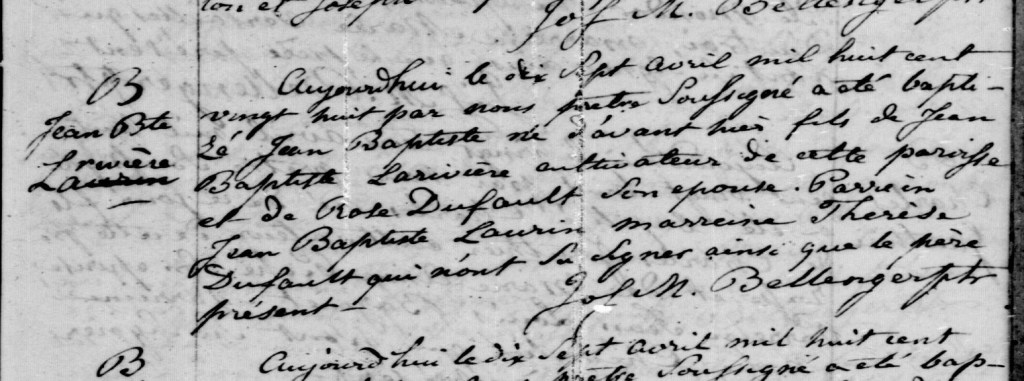
Original French (as written in the register) Aujourd’huy le dix sept avril mil huit cent vingt huit par nous prêtre soussigné a été baptisé Jean Baptiste né d’avant hier fils de Jean Baptiste Larivière cultivateur de cette paroisse et de Rose Dufault son épouse. Parrain Jean Baptiste Laurin marraine Thérèse Dufault qui n’ont su signer ainsi que le père présent. – J. M. Bellenger ptre
English Translation “Today, the seventeenth of April eighteen hundred twenty-eight, by us the undersigned priest, was baptized Jean Baptiste, born the day before yesterday, son of Jean Baptiste Larivière, farmer of this parish, and of Rose Dufault his wife. Godfather Jean Baptiste Laurin, godmother Thérèse Dufault, who did not know how to sign, as well as the father who was present. – J. M. Bellenger, priest.”
He was baptized on 17 April 1828 at Saint-Paul-de-Joliette, Quebec, born two days earlier on 15 April 1828, the son of Jean-Baptiste Larivière and Rose Dufault — the very couple identified by the DNA evidence.
The name fit. The date fit. And now, so did the DNA.
After adding Jean-Baptiste Larivière and Rose Dufault to my tree, DNA matches began appearing through ThruLines and shared match groups for their children, grandchildren, and extended family. While each match still needs individual verification, the genetic evidence lines up with the documentary trail.
There is no single record stating outright that “John Rivers of Michigan is Jean Larivière of Quebec.” His U.S. death certificate does not name his parents. But in genealogy, proof is built through converging evidence—and here, the church records, migration pattern, census data, family memory, and DNA all point to the same conclusion.
No Longer a Brick Wall
John Rivers is no longer a mystery man who appeared out of nowhere in Michigan. He was born Jean Larivière in Joliette, Quebec, in 1828, the son of Jean-Baptiste Larivière and Rose Dufault, part of a deep French-Canadian family whose lines extend back many generations.
His journey—from Quebec parish registers to Michigan farmland, from a French surname to an English one—was hidden for nearly two centuries. It was DNA, combined with traditional genealogy, that finally brought his story back into the family.
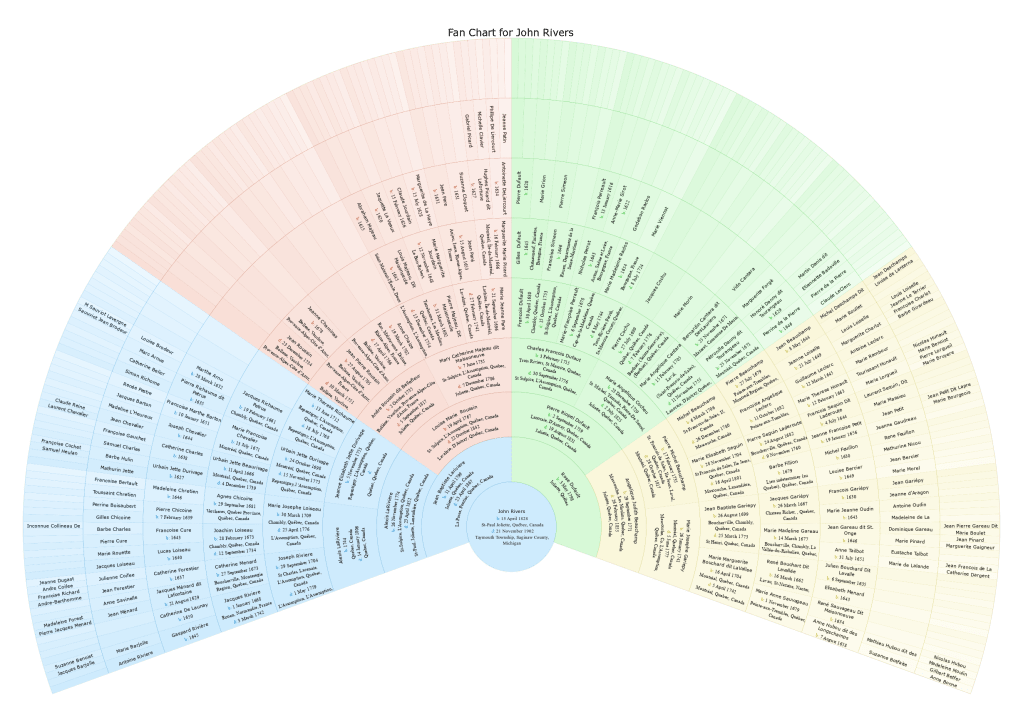
Fan chart showing the French-Canadian ancestry of John Rivers (Jean Larivière), reconstructed through DNA and Quebec parish records.
One of the most challenging parts of family history research is sorting out people who share the same name. In my own family tree, I descend from four different men named Abraham Smith. They fall into two father–son pairs, belonging to two entirely separate families. Although their names are identical, their lives unfolded in different places and under very different circumstances.
The Massachusetts–Vermont Abraham Smiths
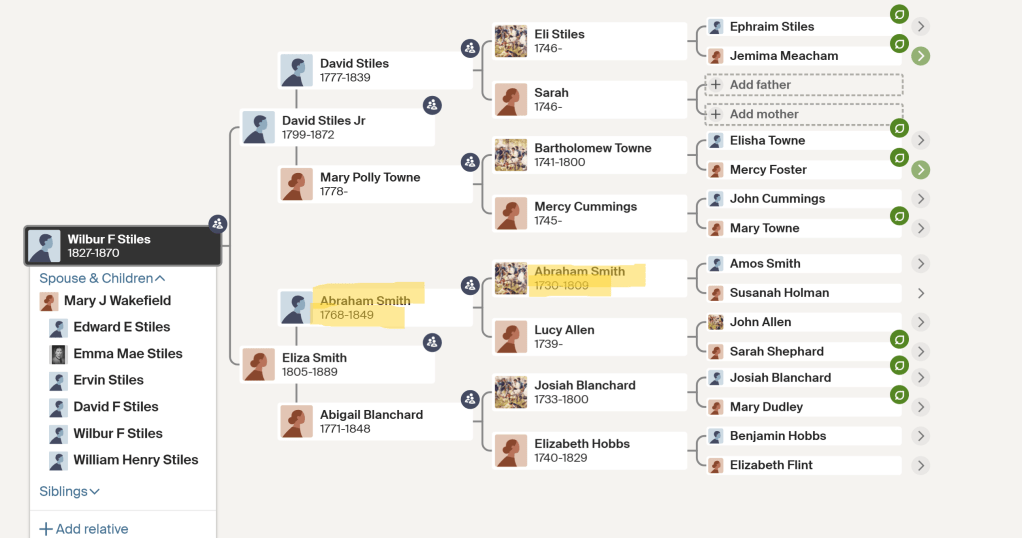
Abraham Smith (1730–1809)
Abraham Smith was born on 20 September 1730 in Sudbury, Middlesex County, Massachusetts, the son of Amos Smith (1699–1786) and Susanah Holman (1702–1778). He grew up in Sudbury alongside his brothers Jacob, Benjamin, and Jonathan. On 24 July 1763, he married Lucy Allen in Newton, Massachusetts. Lucy had been born in 1739 in Weston, Massachusetts. Their children were born in Massachusetts:
Polly Smith, born 20 November 1766
Abraham Smith, born 27 October 1768 in Worcester
Allen Smith, born 6 April 1770
During the American Revolutionary War, Abraham Smith served in the Vermont militia. His service appears in The State of Vermont: Rolls of the Soldiers in the Revolutionary War 1775–1783, compiled by John E. Goodrich. Abraham Smith is listed on the roll of Captain Gideon Brownson’s Company, on a roster dated 26 February 1776 for the Montreal expedition, placing him in the northern theater of the war. This company was part of the militia forces raised in the Vermont region for operations connected with the occupation of Canada during the early stages of the war.
By 1790, Abraham was living in Tinmouth, Rutland County, Vermont, where he appears in the federal census. He remained there until his death on 4 November 1809, closing a life that spanned from colonial Massachusetts through the Revolutionary War and into the early years of the United States.
Abraham Smith (1768–before 1849)
The second Abraham in this line was born 27 October 1768 in Worcester, Massachusetts, the son of Abraham Smith and Lucy Allen. He married Abigail Blanchard on 9 February 1797 in Sturbridge, Massachusetts. Abigail was born in 1771 and later died in Brookfield, Vermont.
By the early 1800s, this family had settled in Orange County, Vermont, primarily in Brookfield. Their children included:
Harriot Louise Smith (1798–1878)
Abigail Smith (1800–1879)
Amasa Austin Smith (c.1801–1808)
Eliza Smith (1805–1889)
John Allen Smith (1809–1884)
Through these children, this Smith line later extended westward into Wisconsin and Michigan, particularly through the Fuller, Stiles, and Loomis families. Abraham Smith (1768) died before 10 April 1849 in Orange, Vermont.
The Pennsylvania Abraham Smiths
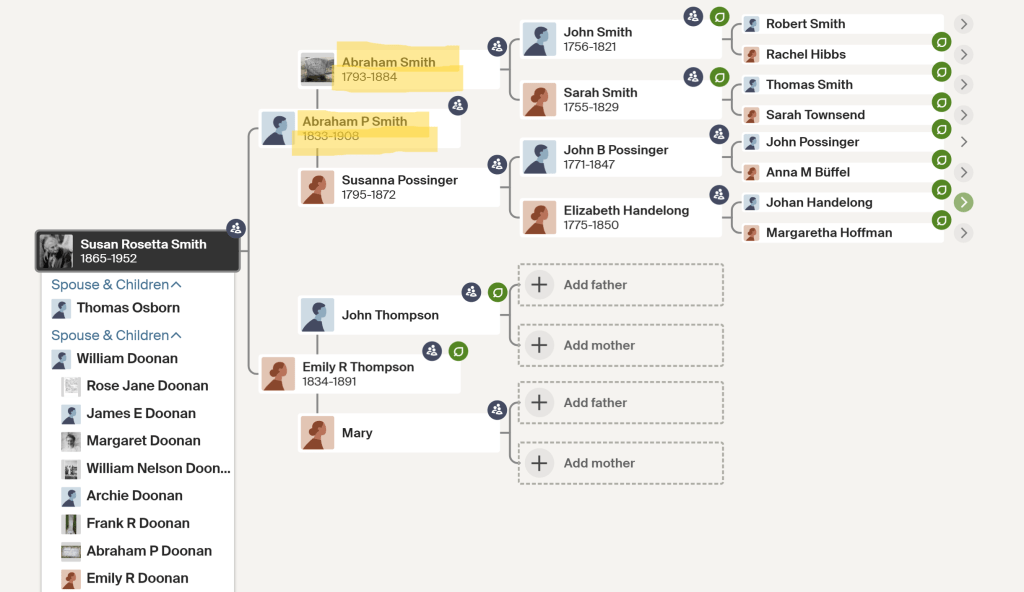
Abraham Smith (1793–c.1884)
A second, unrelated Abraham Smith was born on 29 January 1793, probably in Wrightstown, Bucks County, Pennsylvania. He was the son of John Smith (1756–1821) and Sarah Smith (1755–1829), a family associated with the Wrightstown Monthly Meeting of Friends (Quakers).
Abraham married Susanna Possinger (1795–1872), the daughter of John B. Possinger and Elizabeth Handelong. By 1830, Abraham and Susanna were living in Jackson Township, Monroe County, Pennsylvania, where Abraham appears in census records from 1830 through 1880. This area, in the Pocono region, became the permanent home of this branch of the family.
Their children included:
Fannie Smith (1813–1876)
Sarah Smith (1815–1900)
Catharine Smith (1826–1891)
Susan Smith (c.1828–1909)
Joseph Possinger Smith (1830–1882)
Abraham Possinger Smith (1833–1908)
The repeated use of “Possinger” as a middle name preserved Susanna’s maiden name and helps distinguish this Smith family from others in Pennsylvania.
Susanna died in 1872. Abraham remained in Jackson Township, Monroe County, until his death about 1884. He was buried in Tannersville Union Cemetery in Monroe County.
Abraham Possinger Smith (1833–1908)
The youngest of the four Abraham Smiths was born in May 1833 in Pennsylvania, the son of Abraham Smith and Susanna Possinger. He married Emily Rebecca Thompson before 1854 and later Susan Smith.
Over the course of his life, Abraham Possinger Smith lived in Pennsylvania, Michigan, and Washington State. He died on 29 June 1908 in Shelton, Mason County, Washington. His children included:
Frank E. Smith
Jude Smith
Elmira Smith
Robert Smith
Susan Rosetta Smith
Fanny Florence Smith
Abraham Edward Smith
Through this line, descendants spread into Bay County, Michigan, Ontario, Canada, and the Pacific Northwest, giving this Smith branch a wide geographic reach.
Two Names, Two Families
Although all four men bore the name Abraham Smith, the records show they belonged to two completely separate families:
Family Line
Father
Son
Massachusetts → Vermont
Abraham Smith (1730–1809)
Abraham Smith (1768–1849)
Pennsylvania → Monroe County → West
Abraham Smith (1793–c.1884)
Abraham Possinger Smith (1833–1908)
Their lives overlapped in time but not in place or ancestry. Together, they illustrate how a single name can run through multiple generations and unrelated families, creating confusion that only careful documentation can resolve.
Technically, I have 8 different Abraham Smith’s in my family tree. However, only 4 are direct ancestors – the others are “cousins” or married into the family.
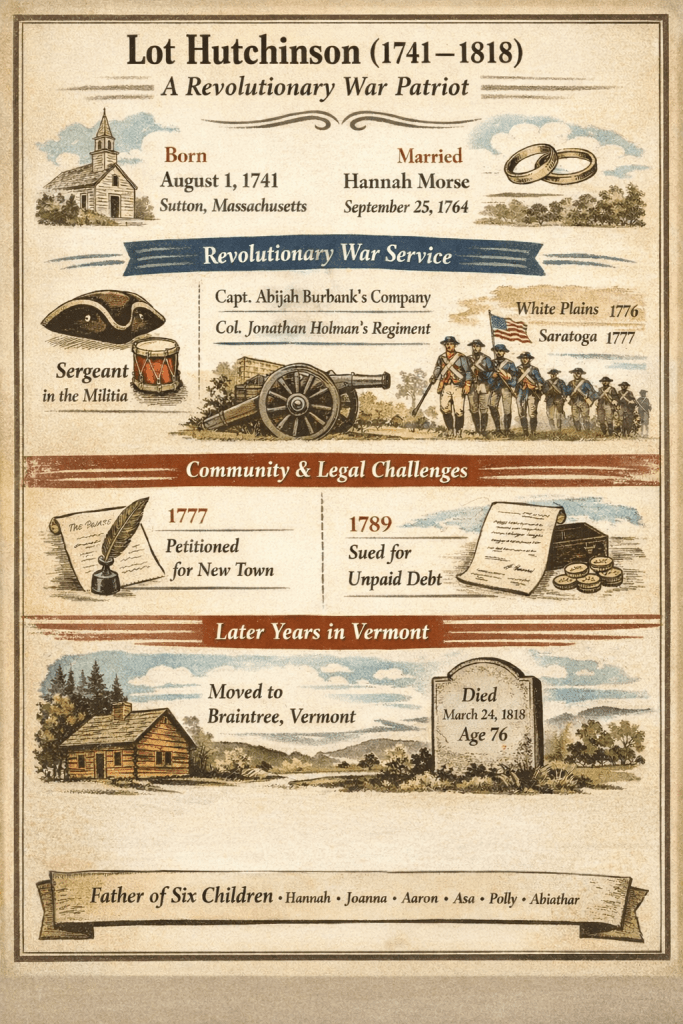
Lot Hutchinson was born on 1 August 1741 in Sutton, Worcester County, Massachusetts, the son of Nathaniel Hutchinson and Joanna Conant.¹ He was baptized in Sutton on 13 September 1741. Raised in a long-established Massachusetts family, Hutchinson came of age during a period of escalating political and military tension that would soon lead to revolution.
On 25 September 1764, he married Hannah Morse in Sutton.² The couple raised six children—Hannah, Joanna, Aaron, Asa, Polly, and Abiathar—whose births are documented in Sutton and Worcester County vital records.³
Revolutionary War Service
Lot Hutchinson’s military service during the American Revolutionary War is documented in multiple contemporary and compiled sources. He served as a sergeant in Captain Abijah Burbank’s company of Colonel Jonathan Holman’s regiment, a Massachusetts militia unit.⁴ His service appears in the Massachusetts Soldiers and Sailors of the Revolutionary War, as well as in Worcester County militia rolls, and is memorialized in his Fold3 military profile.
Holman’s regiment—often referred to in records as the Sutton Regiment—was composed largely of men from central Worcester County. The regiment was called into active service in 1776 during the White Plains campaign and again in 1777, when Massachusetts militia units were mobilized to reinforce the northern army during the Saratoga operations.⁵ These militia call-ups were a vital component of the war effort, supplying experienced local men to support Continental forces during critical campaigns.
Hutchinson’s rank of sergeant indicates that he held a position of responsibility within his company, charged with maintaining order, assisting in drill, and overseeing enlisted men—an important leadership role within the militia structure.
Civic and Community Involvement
Hutchinson’s public engagement extended beyond military service. In 1777, he was among residents of northwestern Sutton who petitioned the Massachusetts General Court for the creation of a separate town.⁶ This petition survives among the legislative records of the Revolutionary period and reflects the continuing civic life of Massachusetts communities even amid wartime disruption.
Post-War Legal and Financial Records
Like many veterans of the Revolutionary era, Hutchinson faced financial challenges in the years following the war. In 1789, he was named as a defendant in a trespass action brought by Solomon Bixby in the Worcester County Court of Common Pleas.⁷ The case involved a mortgage Hutchinson had taken on his land and buildings for £69, which he was unable to repay when the note came due. Bixby, a Sutton native born in 1761, appears in local genealogical and cemetery records, providing additional context for the dispute.⁸
Later Years and Death
By 1800, Lot Hutchinson had relocated to Braintree, Orange County, Vermont, where he spent the remainder of his life. Federal census records place him there in 1800 and 1810. His wife, Hannah (Morse) Hutchinson, died in Braintree on 17 January 1815.⁹
Lot Hutchinson died in Braintree, Vermont, on 24 March 1818, at the age of 76.¹⁰ His life spanned the colonial period, the struggle for independence, and the early decades of the United States—marked by military service, civic participation, and the challenges faced by many Revolutionary War veterans in the new nation.
Sources
Sutton, Massachusetts, Vital Records to 1850, Births, entry for Lot Hutchinson.
Sutton, Massachusetts, Vital Records to 1850, Marriages, entry for Lot Hutchinson and Hannah Morse, 25 September 1764.
Sutton and Worcester County vital records; Family Group Sheet, “Lot Hutchinson,” Rivers–Hickmott Collection.
Massachusetts Soldiers and Sailors of the Revolutionary War, entry for Lot Hutchinson; Worcester County Militia Rolls, Capt. Abijah Burbank’s Company.
Massachusetts Archives Collection, Revolutionary Rolls, 1775–1783; Francis B. Heitman, Historical Register of Officers of the Continental Army.
Massachusetts General Court, Legislative Petitions, 1777 Session, Sutton Northwest District Petition.
Worcester County Court of Common Pleas, 1789 Docket, Bixby v. Hutchinson.
Find a Grave, memorial for Solomon Bixby; Bixby Family Association records.
Vermont Vital Records, Braintree Town Records, Deaths, entry for Hannah Hutchinson, 1815.
Vermont Vital Records, Braintree Town Records, Deaths, entry for Lot Hutchinson, 1818.
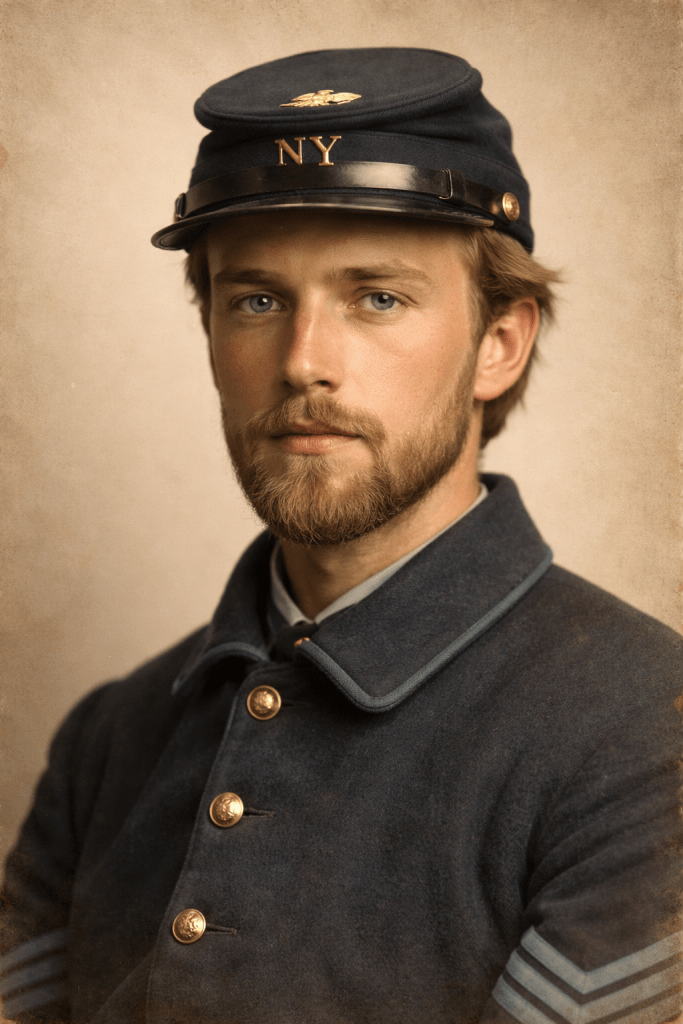
Martin V. Lacy was born in September 1833 in Le Ray (often recorded as Leray), Jefferson County, New York. He was the son of Erastus Lacy (1790–1856) and Florilla Billings (1793–1860). Early census and family records place him in Jefferson County during his childhood years, where he lived among several siblings, including Jane, Julia, Milo, and others.¹
On 28 November 1855, Martin married Henrietta O’Dell (1838–1865) in Genesee County, Michigan.² By 1860, he was residing in Brownville, Jefferson County, New York, where he appeared in the federal census with his occupation listed as farmer.³ A military description recorded in August 1862 described him as having blue eyes, sandy hair, a light complexion, and a height of five feet eleven inches.⁴
Image generated by ChatGPT of Martin Lacy based on his military description.
Martin served in the American Civil War. He enlisted in August 1862 with the 35th New York Infantry, Company I, and later served with the 80th New York Infantry, Company H, during 1863.⁵ Military records place him in Watertown and Albany, New York, during his service, and a residence record dated 1 July 1863 lists him in Fabius, New York.⁶
Martin and Henrietta had several children: Adelbert Lacy, born in November 1859 in Michigan; Helen Mae Lacy, born 3 June 1860 in Brownville, New York; and Fred Lacy, born 12 December 1860 in Michigan.³ Henrietta Lacy died in 1865 in Charles City, Virginia.⁷
On 25 March 1866, Martin married Nancy J. Whitney (1843–1906) in Taymouth Township, Saginaw County, Michigan.⁸ The couple settled in Michigan, where Martin appeared regularly in state and federal census records. Their children included Emma Lacy (born 1866), Alice Lacy (born 1 June 1869 in Montrose, Genesee County), Mary Belle Lacy (born 13 August 1875), and William Henry Lacy (born 26 May 1878).⁹
By 1870, Martin was living in Montrose, Genesee County, Michigan, and by the mid-1870s he had acquired land in Kawkawlin Township, Bay County, Michigan, as documented in federal land records dated 1 August 1874.¹⁰ Census records from 1880 through 1900 consistently place him in Kawkawlin Township, where he was listed as married and head of household.¹¹
Throughout his life, Martin experienced the deaths of numerous family members, including his parents, siblings, and children Fred (1883) and Emma (1897).¹² He remained in Bay County into the early twentieth century.
Martin V. Lacy died on 8 August 1904 in Garfield Township, Bay County, Michigan. His death certificate records the cause of death as cardiac disease.¹³ He was seventy years old at the time of his death.
Sources
U.S. Federal Census, 1860; Brownville, Jefferson County, New York.
Michigan, County Marriage Records, 1822–1940, Genesee County, marriage of Martin V. Lacy and Henrietta O’Dell, 28 November 1855.
U.S. Federal Census, 1860; Brownville, Jefferson County, New York.
New York, Civil War Muster Roll Abstracts, 1861–1900, description dated 20 August 1862.
U.S. Civil War Soldier Records and Profiles; service with 35th New York Infantry, Company I, and 80th New York Infantry, Company H.
New York, U.S., Compiled Census and Census Substitutes Index, 1790–1890.
Michigan, Death Records, 1867–1950; death of Henrietta (O’Dell) Lacy, 1865.
Michigan, County Marriages, 1822–1940; marriage of Martin V. Lacy and Nancy J. Whitney, 25 March 1866.
Michigan, U.S., Birth Records, 1867–1914; Lacy family entries.
U.S. General Land Office Records, 1776–2015; land patent, Kawkawlin Township, Bay County, Michigan, 1 August 1874.
U.S. Federal Census, 1870, 1880, 1900; Michigan State Census, 1884, 1894; Kawkawlin Township, Bay County, Michigan.
Michigan, Death Records and U.S., Find A Grave Index.
Michigan, Death Records, 1867–1950; death certificate of Martin V. Lacy, 8 August 1904.
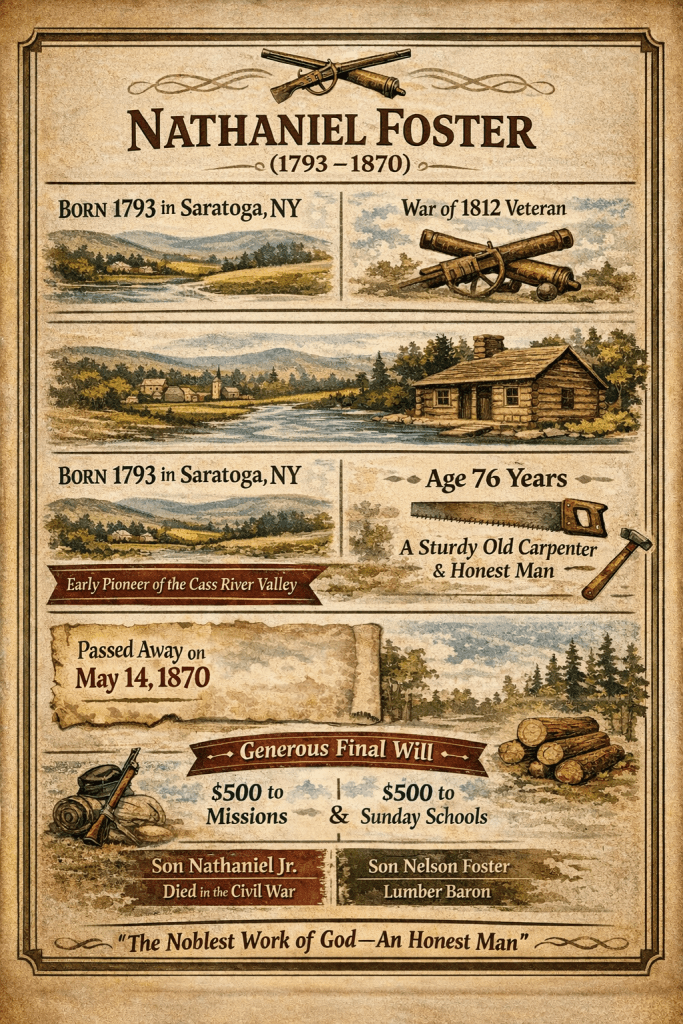
Nathaniel Foster was my 4th great-grandfather — and the more I learn about him, the more I realize how deeply his life was woven into the early fabric of Michigan.
Let’s clear up one thing right away: Nathaniel is not the son of Lemuel Foster and Dolly Davis. Despite what many online trees suggest, their family had twelve children — and none were named Nathaniel. Dolly’s 1849 probate record lists nine surviving children by name, and Nathaniel isn’t among them. He lived until 1870, so if he were her son, he should absolutely appear in that record. He doesn’t. This is one of those cases where the paper trail tells a clearer story than assumptions.
Born in 1793 in Saratoga, New York, Nathaniel served in the War of 1812 as a teenager. He wasn’t a general or a hero in the history books, but he stood up when his country called.
After the war, he married Mary Moore and started a family that would eventually include ten children. In the 1830s, they moved west and settled along the Cass River in Michigan — a true frontier at the time. Nathaniel was one of the earliest settlers in the region, carving out a life in what would become Bridgeport and Midland.
He lived to be 76 years and 10 months old, passing away on May 14, 1870, at the home of his daughter Mrs. Braly in Tittabawassee Township. According to his obituary in the Saginaw Daily Courier, he was remembered as a “sturdy old carpenter,” a “hospitable citizen,” and “the noblest work of God — an honest man.”
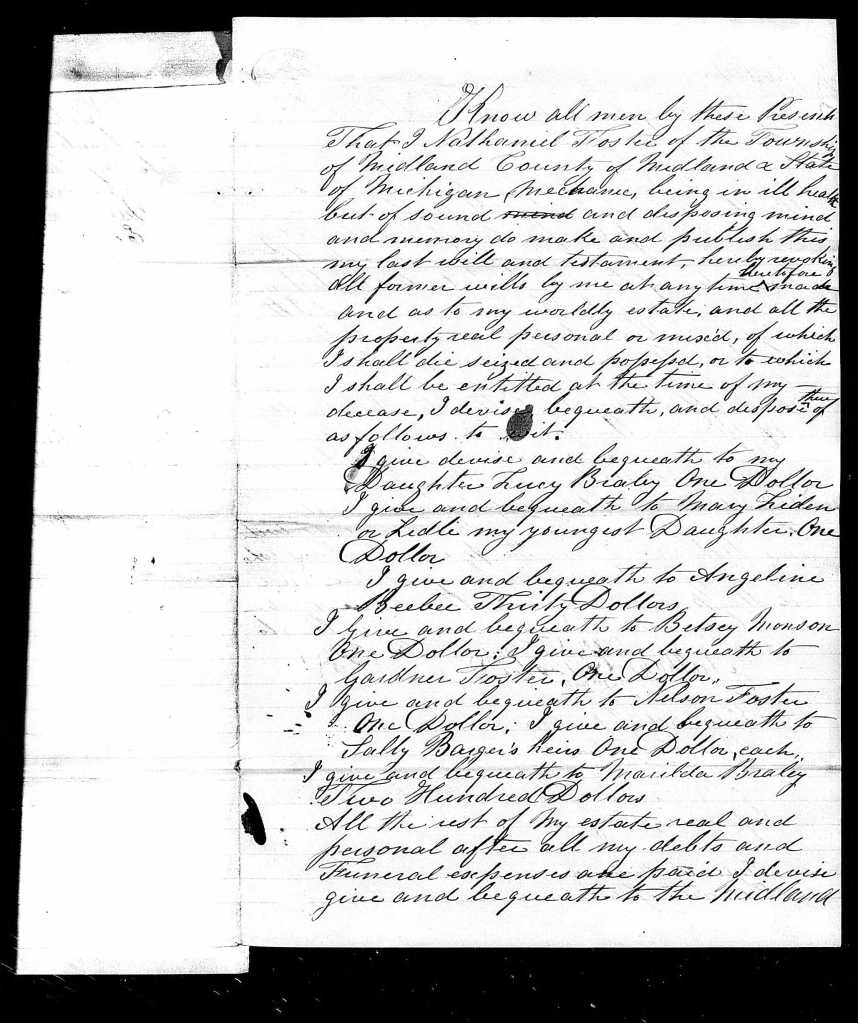
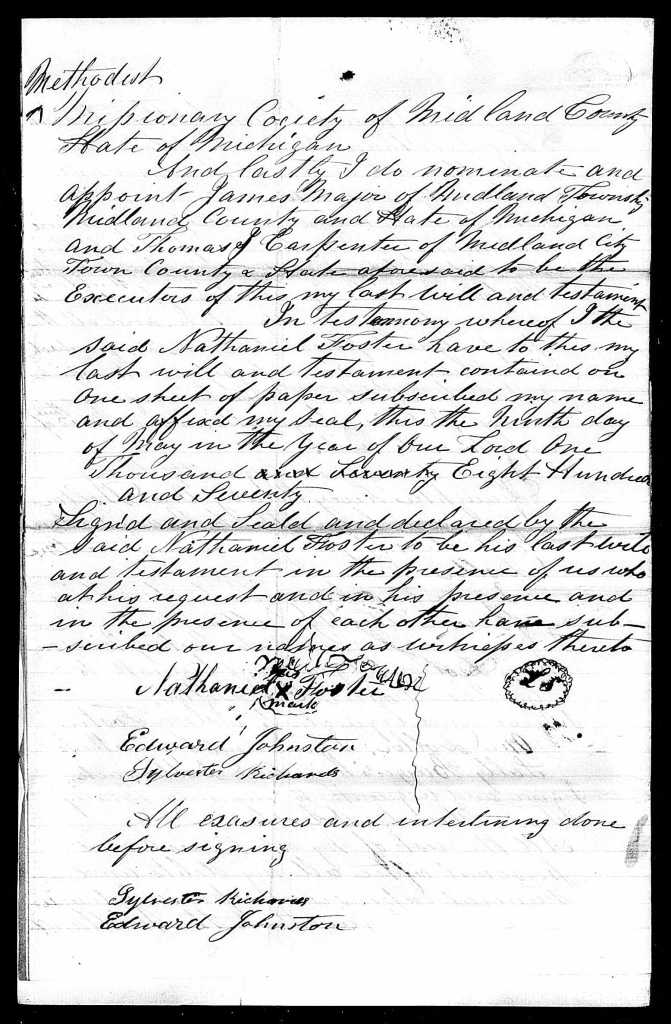
His will, written just days before his death, reflects both practicality and generosity. He left one dollar each to his older children, having “divided to them his living” earlier in life. He gave $200 to his daughter Marietta Braly for her care during his final illness, and donated $500 to missions and another $500 to Sunday schools — a clear reflection of his faith and values.
Page 1 of Nathaniel Foster’s WillPage 2 of Nathaniel Foster’s Will
Nathaniel’s legacy lives on not just in his descendants, but in the land he helped settle and the stories he passed down. One of his sons, Nelson Foster, became a legendary lumberman in the Saginaw Valley — known for his strength, humor, and skill. Another son, Nathaniel Jr., died fighting for the Union in the Civil War, reportedly shouting “Give me liberty or give me death” as he fell.
These aren’t just names on a family tree. They’re people who lived, worked, fought, and loved — and whose choices shaped the lives of everyone who came after them.


 The Tumbleweed