Robert Smith (1864–1947): A Life Shaped by Tragedy

On 6 December 1890, a violent confrontation between two brothers near Linwood in Bay County, Michigan, ended with one man dead and the other facing the gravest criminal charge available under Michigan law. Robert Smith shot and killed his brother, Jude A. Smith, in what newspapers immediately characterized as the culmination of a long-standing family dispute over land and timber.¹ Within days, the case became one of the most closely followed criminal proceedings in Bay County.

The killing of Jude Smith

Early reports placed the shooting in Garfield Township, near Linwood, during an argument concerning ownership and removal of timber. Accounts varied in their details, but the central facts remained consistent: Robert Smith fired a shotgun at close range, killing his brother.² From the earliest coverage through the conclusion of the trial, newspapers referred to the accused almost uniformly as Robert S. Smith.³

The intensity of public interest was evident almost immediately. Smith was arrested, lodged in the Bay County jail, and photographed for inclusion in the local “rogue’s gallery,” an act reported in the press as a matter of routine but revealing the degree to which the case had already entered the public imagination.⁴
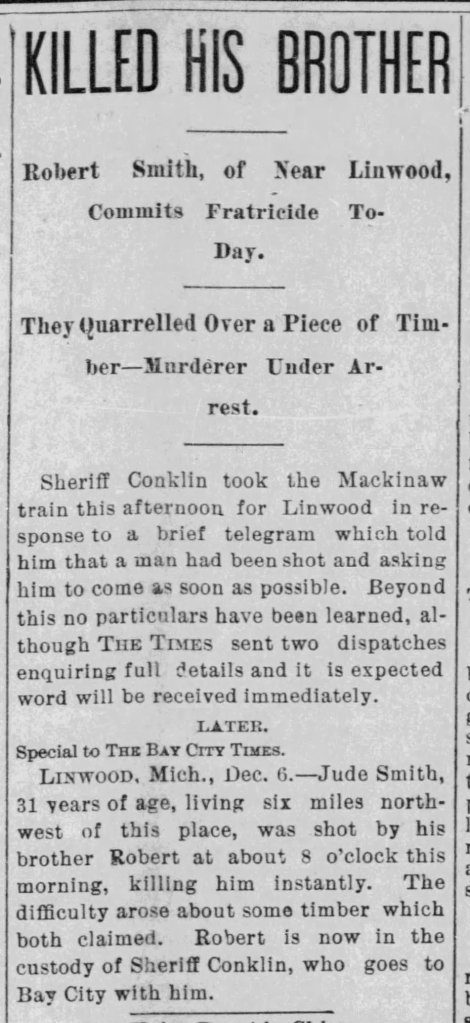
The Bay City Times, December 6, 1890.

Pretrial proceedings and public attention

Throughout December 1890 and into early 1891, Bay City newspapers printed frequent updates on the case. These included notices of arraignment, scheduling delays, and speculation regarding the defense strategy.⁵ At various points, reports suggested that Smith might pursue an insanity defense, though these references appear largely in the context of courtroom rumor rather than formal pleadings.⁶

The coverage also reflected the spectacle of the proceedings themselves: crowded courtrooms, lengthy jury selection, and the presence of spectators from Linwood and surrounding communities who were familiar with the Smith family.⁷

Trial and conviction

Robert Smith’s trial took place in the spring of 1891. Newspaper accounts summarized testimony from witnesses present at the scene, law enforcement officers, and medical professionals.⁸ Despite arguments advanced by the defense, the jury returned a verdict of guilty of murder in the first degree.⁹
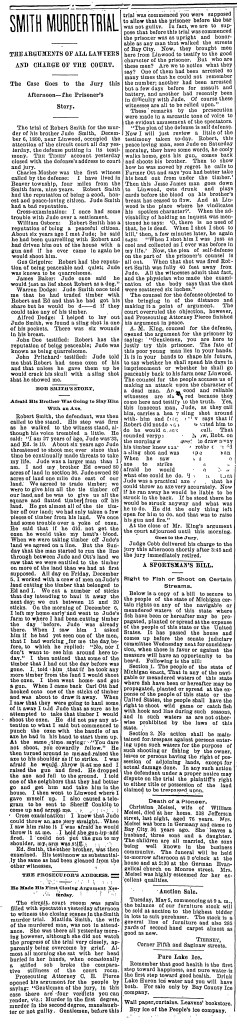
The Bay City Daily Tribune, May 2, 1891.

On 12 May 1891, Smith was sentenced to life imprisonment. Several newspapers printed a statement attributed to him shortly thereafter, in which he denied guilt and attempted to justify his actions as self-defense, framing himself as the victim of prolonged harassment by his brother.¹⁰ The letter provides insight into Smith’s own view of events but does not alter the legal outcome of the case.

Incarceration and release

Michigan prison records confirm that Robert Smith was received at the state prison on 11 May 1891 following his conviction in Bay County.¹¹ Although sentenced to life, his incarceration did not remain static. In August 1893, Smith was transferred to the Ionia State Hospital for the Criminally Insane, where he remained for several months before being returned to prison in March 1894.¹²

More than a decade later, his case was reconsidered. In September 1902, Smith was granted a commutation of sentence and formally discharged from custody later that month.¹³ This record is critical, as it establishes that Smith was not imprisoned for life and that his release occurred well before the turn of the century.
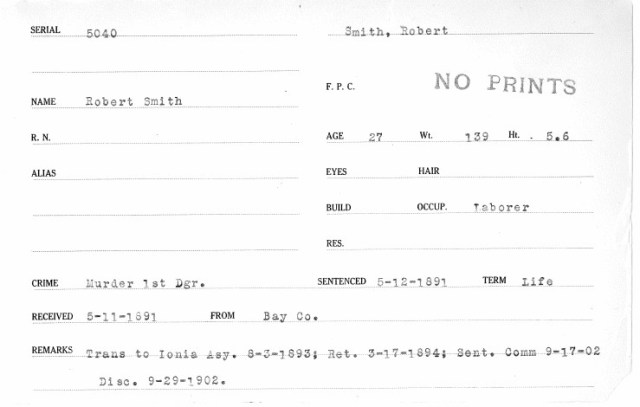
Prison card for Robert Smith held at the Michigan Archives

A new life in Washington

Nearly two decades later, Robert Smith appears in Washington State records. On 9 June 1919, a marriage was recorded in Centralia, Lewis County, between Robert T. Smith and Edna Myers.¹⁴ The groom was reported as fifty-five years old, born in Pennsylvania, and entering his second marriage. His occupation was listed as laborer. The record names his father as Abraham T. Smith and gives his mother’s maiden name as Thompson.¹⁵

The use of the middle initial “T” in this record contrasts with the consistent use of “S” in Bay County newspaper coverage. Whether this reflects clerical variation, personal choice, or a deliberate alteration cannot be determined from the surviving records. What can be said is that the Washington marriage record aligns closely with other identifying details associated with the Bay County defendant, including age, birthplace, and parental names.

Death in Tacoma

Robert Smith’s life concluded in Tacoma, Pierce County, Washington. His death certificate records that Robert T. Smith died on 10 February 1947 at the age of eighty-two.¹⁶ His birth date is given as 6 May 1864, with birthplace recorded as Blakerlee, Pennsylvania. At the time of death, he was widowed and retired. He was buried at Oakwood Cemetery in Tacoma.¹⁷

The informant for the death certificate was hospital staff, and several personal details—including parental information—were listed as unobtainable.¹⁸ Nonetheless, the combination of birth date, birthplace, and earlier Washington records strongly suggests continuity between the man who married in Centralia in 1919 and the man who died in Tacoma in 1947.

Minnie, the first wife

The 1919 Washington marriage record explicitly states that it was Robert Smith’s second marriage, confirming the existence of an earlier wife. That woman is known from earlier records as Minnie, though it remains unclear whether this was her legal given name or a familiar nickname. Despite extensive documentation surrounding Robert Smith’s criminal case, imprisonment, and later life, no definitive record has yet been identified that accounts for Minnie’s fate. At present, what became of her remains unknown.

Conclusion

Robert Smith’s life cannot be reduced to a single violent act, yet neither can that act be separated from the years that followed. Convicted of first-degree murder in 1891 and sentenced to life imprisonment, he was later released, relocated across the country, remarried, and lived into old age. The surviving records trace a trajectory from public disgrace to relative obscurity, marked by gaps that resist easy explanation. As with many lives reconstructed from fragmentary sources, some questions remain unanswered—but the outline of the story is now firmly grounded in the historical record.


Notes

  1. Bay City newspapers reporting the killing of Jude A. Smith near Linwood, December 1890.
  2. Contemporary newspaper descriptions of the shooting and its circumstances, December 1890.
  3. Bay City press coverage consistently identifying the accused as Robert S. Smith, 1890–1891.
  4. Newspaper report noting Smith’s photograph taken at the Bay County jail for the rogue’s gallery.
  5. Bay City newspaper reports on arraignment and court scheduling, December 1890–January 1891.
  6. Newspaper references to a possible insanity defense during pretrial proceedings.
  7. Reports describing courtroom crowds and jury selection during early 1891.
  8. Trial testimony summaries published in Bay City newspapers, April–May 1891.
  9. Newspaper accounts of the guilty verdict and sentencing, May 1891.
  10. Published letter attributed to Robert Smith following conviction, May 1891.
  11. Michigan State Prison prisoner index card for Robert Smith, received May 1891.
  12. Prison record noting transfer to Ionia State Hospital and subsequent return.
  13. Prison record documenting commutation and discharge, September 1902.
  14. Lewis County, Washington, marriage record for Robert T. Smith and Edna Myers, 9 June 1919.
  15. Ibid., parental and birthplace information.
  16. Washington State death certificate for Robert T. Smith, Tacoma, 10 February 1947.
  17. Ibid., burial information.
  18. Ibid., informant and missing personal details.
William Doonan: Decline, Illness, and a Troubled End

By the time William Doonan relocated his family to the Temiskaming district of northern Ontario, he was no longer a young man. Newspaper accounts place the family’s move from Michigan to Pense Township by about 1908, when William—described repeatedly as elderly—set about clearing land and establishing a farm in an isolated settlement north of New Liskeard.¹ This move explains his absence from later United States records and marks the final geographic shift of his life.

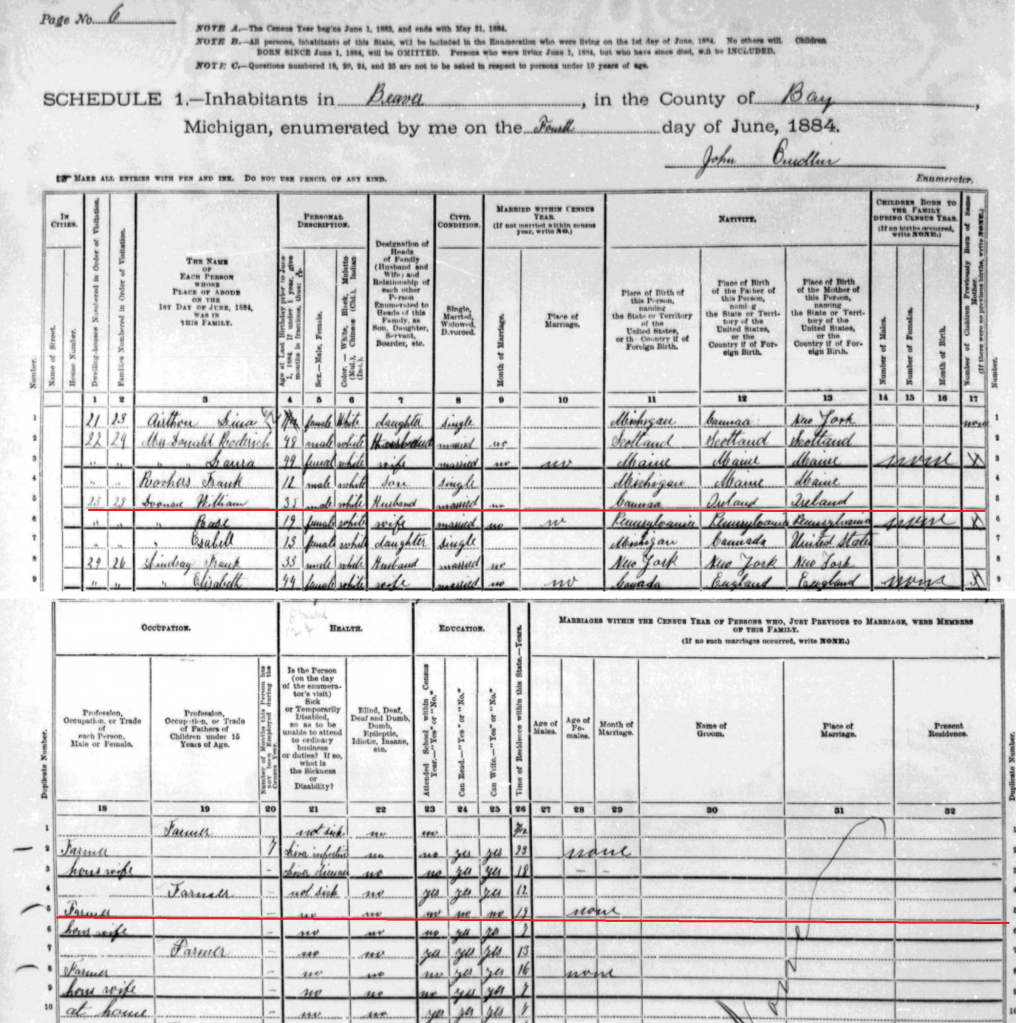
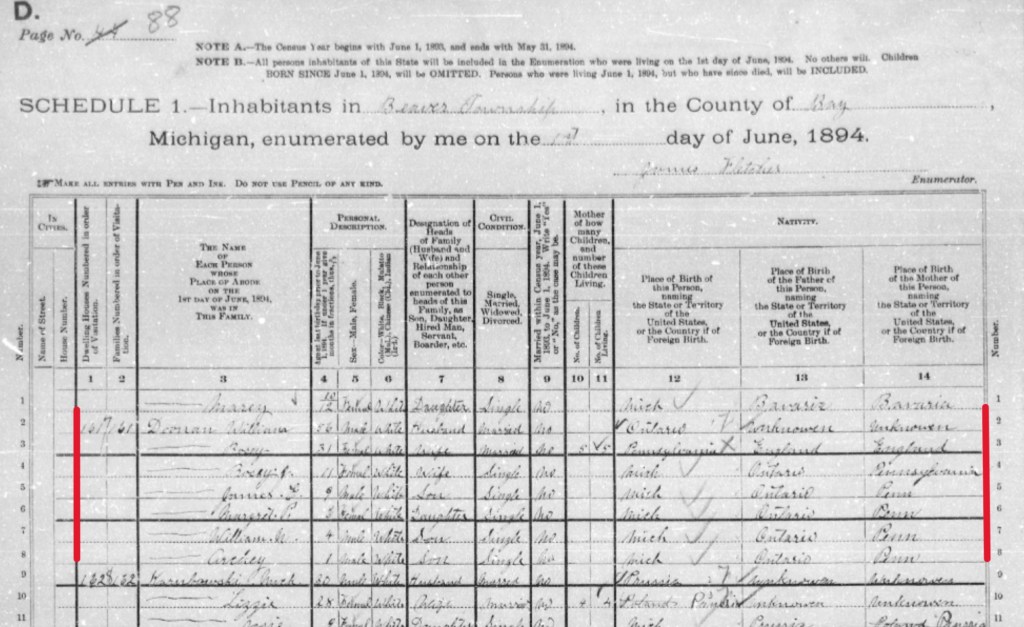
Michigan state census records show that by 1894 William and Rosa Susan Smith were raising a growing family together, firmly established in Bay County.² Those records reflect a household that expanded steadily through the 1880s and 1890s, before economic pressure, family conflict, and William’s advancing age appear to have pushed the family toward a more marginal existence.

1894 Michigan State Census for Beaver Township, Bay County.

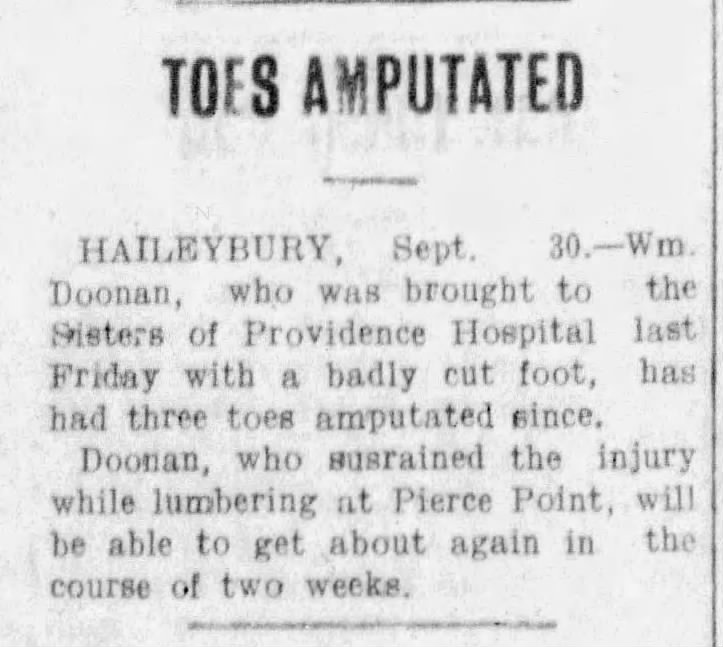
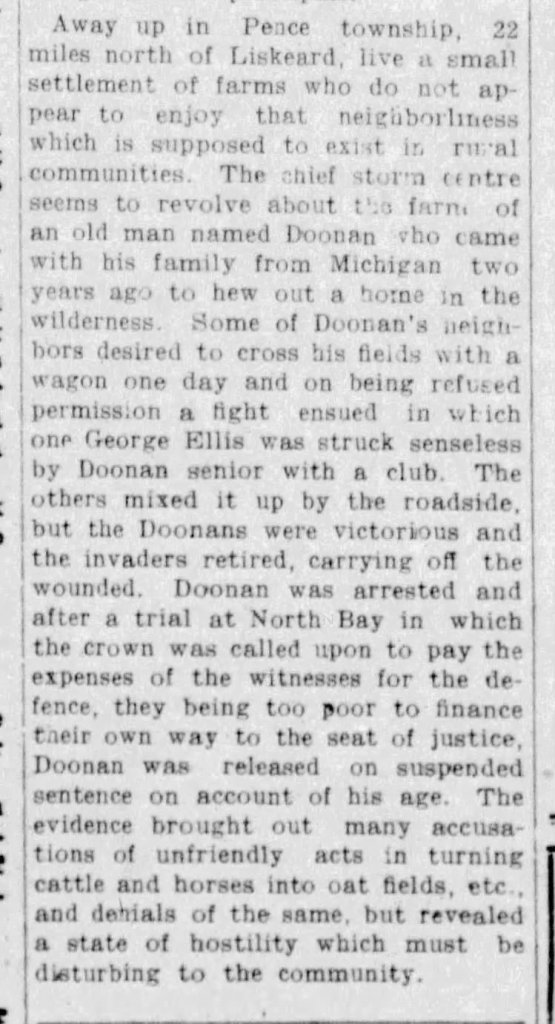
Life in Pense Township proved difficult. A June 1910 newspaper account described the settlement as one marked by deep hostility among neighbors, with William Doonan’s farm identified as the center of repeated disputes.³ One incident escalated into violence when neighbors attempted to cross his fields with a wagon and were refused permission. A fight followed in which George Ellis was struck unconscious by William Doonan, described in the article as “Doonan senior.” William was arrested and tried at North Bay, though the court was compelled to cover witness expenses because the family lacked the means to do so. He was ultimately released on a suspended sentence due to his age.⁴

These reports are notable not simply for the violence described, but for what they reveal about William’s condition. The articles consistently emphasize his age, poverty, and the fragile social position of the family. They also record a pattern of accusations and counter-accusations involving livestock, property damage, and threats—suggesting a man under strain in a community where tolerance was wearing thin.⁵

The North Bay Nugget, September 30, 1913, Page 2.

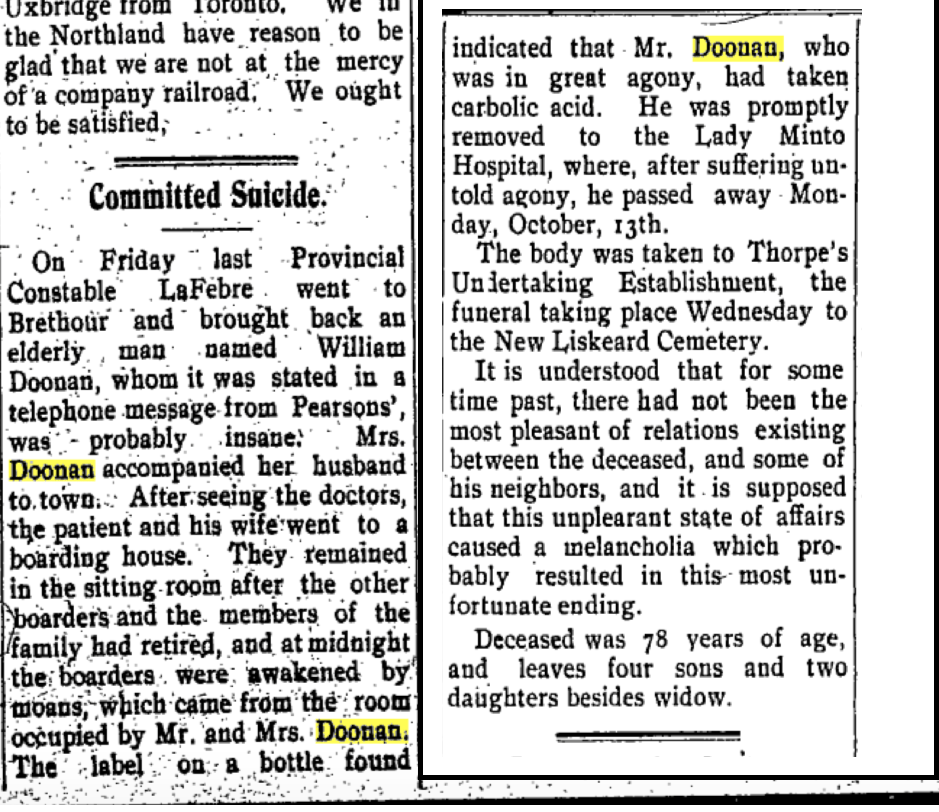
By 1913, William’s health had clearly deteriorated. Newspaper accounts from the Temiskaming district reported his death by suicide, following a period of illness and mental decline.⁶ The articles avoid sensational language, but the circumstances described point to a man worn down by years of conflict, physical decline, and isolation. His death occurred at Lady Minto Hospital, bringing his long and troubled life to an end far from the Michigan communities where he had spent most of his adulthood.⁷

The Temiskaming Speaker, October 17, 1913 Page 1 – bottom of one column and top of next column.

William Doonan’s story is not preserved through orderly civil records or consistent census appearances. Instead, it survives through fragments: state censuses, court proceedings, and the sometimes-blunt language of small-town newspapers. Together, those sources document a life shaped by instability, conflict, and hardship—one that cannot be understood through a single record type alone.

In the end, William Doonan did not disappear from the historical record. He faded out of one jurisdiction and reappeared in another, carrying with him the same struggles that had marked his earlier years. His death closed a chapter defined not by prosperity or permanence, but by endurance in the face of circumstances that steadily narrowed his options.


Sources

¹ North Bay Nugget (North Bay, Ontario), 29 June 1910, p. 7.
² 1884 Michigan State Census, Bay County; 1894 Michigan State Census, Bay County.
³ North Bay Nugget (North Bay, Ontario), 29 June 1910, p. 7.
⁴ Ibid.
⁵ Ibid.
The Temiskaming Speaker (New Liskeard, Ontario), October 1913.
⁷ Ontario death registration, Temiskaming District, 1913.

William Doonan and the Law: Conflict, Confinement, and Community Response

By the late 1880s, William Doonan was living in Bay County, Michigan, with his wife Rosa Susan Smith and their blended family, which included a daughter from William’s previous marriage. Although William does not appear in either the 1880 or 1900 U.S. federal census, local newspapers and state census records document a pattern of conflict that brought him repeatedly to the attention of neighbors, courts, and eventually authorities on both sides of the international border.

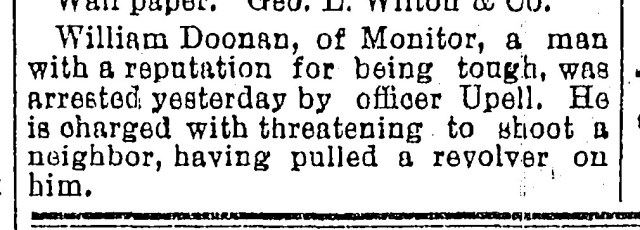
The earliest documented incident occurred in May 1889. The Evening Press reported that William Doonan, then residing in Monitor Township, was arrested after allegedly threatening to shoot a neighbor. According to the article, William drew a revolver during a dispute and was taken before a justice for examination.¹ This report establishes that William’s legal troubles began well before the turn of the century and involved firearms rather than minor civil disagreements.

The Evening Press, May 9, 1889, Bay City, Michigan. Page 8

In 1891, William’s name appeared again in the press—this time in connection with a tragedy within his wife’s family. The Bay City Daily Tribune reported on the conviction of Robert Smith for killing his brother Jude Smith, who was also Rosa’s brother. The article states that the gun involved in the homicide was afterward given to William Doonan.² The crime itself belonged solely to Robert Smith, but the transfer of the weapon placed William in possession of a firearm already associated with a notorious and widely reported act of violence. In a small community, such an association would not have gone unnoticed.

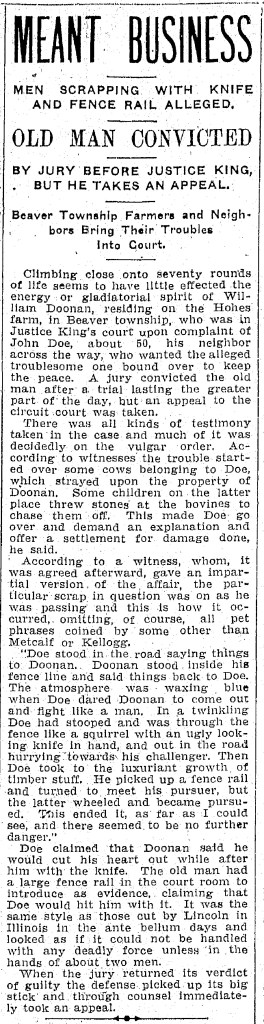
More than a decade later, William again surfaced in Bay City newspapers amid renewed conflict. In June 1905, the Bay City Times reported that a complaint had been filed by a neighbor, John Doe, alleging that William approached him with an open knife and made threats. The matter was adjourned rather than immediately resolved.³ A follow-up article published the following month described a contentious courtroom proceeding in which testimony referenced both a knife and a fence rail used as evidence. That report states William was convicted before a justice and that he appealed the decision.⁴ These accounts show William actively entangled in the local court system, though not always with swift or final resolution.

The Bay City Times, June 19, 1905, Page 6

By 1910, William Doonan was no longer appearing in Michigan newspapers. Instead, his name surfaced in Ontario. In May 1910, the North Bay Nugget reported on William in connection with firearm possession, revisiting earlier concerns about weapons and violent associations tied to the Smith family tragedy.⁵ The Temiskaming Speaker published a related account shortly thereafter, further documenting community concern and official attention.⁶ Later that summer, the North Bay Nugget followed up on William’s legal situation, indicating that the matter continued to draw notice weeks after the initial report.⁷

The North Bay Nugget, June 29, 1910, Page 7

These Canadian newspaper reports demonstrate that William’s conflicts did not end with his departure from Michigan. Rather, they followed him across the border, suggesting a continuity of reputation that transcended geography. The repetition of firearm-related concerns—spanning from 1889 in Monitor Township to 1910 in Ontario—forms one of the most consistent threads in the surviving documentary record.

William’s absence from the 1900 U.S. federal census remains unexplained. Whether this reflects deliberate avoidance, temporary relocation, or simple enumerator omission cannot be determined from existing evidence. What can be established is that William Doonan was repeatedly involved in disputes serious enough to attract legal and press attention over a span of more than twenty years.

The broader context of the Smith family violence is essential to understanding how William’s story was perceived by others. Rosa Susan Smith’s brother Jude Smith was killed by another brother, Robert Smith.⁸ While William was not responsible for that homicide, his later possession of the gun used in the crime and his own documented disputes involving weapons ensured that the shadow of that tragedy remained close.

By 1910, William Doonan was a man known to authorities in multiple jurisdictions, his name intertwined with firearms, courtrooms, and unresolved tensions. His story does not resolve neatly—but the records leave little doubt that his reputation was forged as much by conflict as by kinship.


Sources

¹ Evening Press (Bay City, Michigan), 9 May 1889, p. 8.
² Bay City Daily Tribune (Bay City, Michigan), 13 May 1891, p. 4.
³ Bay City Times (Bay City, Michigan), 18 May 1905, p. 1, “Show Him His Heart.”
Bay City Times (Bay City, Michigan), 19 June 1905, p. 6, “Meant Business.”
North Bay Nugget (North Bay, Ontario), 19 May 1910, p. 1.
The Temiskaming Speaker (New Liskeard, Ontario), 20 May 1910, p. 4.
North Bay Nugget (North Bay, Ontario), 29 June 1910, p. 7.
⁸ Nancy Little, “Jude Smith’s Legacy,” The Tumbleweed, 14 March 2018, https://familytumbleweed.blog/2018/03/14/jude-smiths-legacy/.

William Doonan: Origins, Migration, and Family Formation

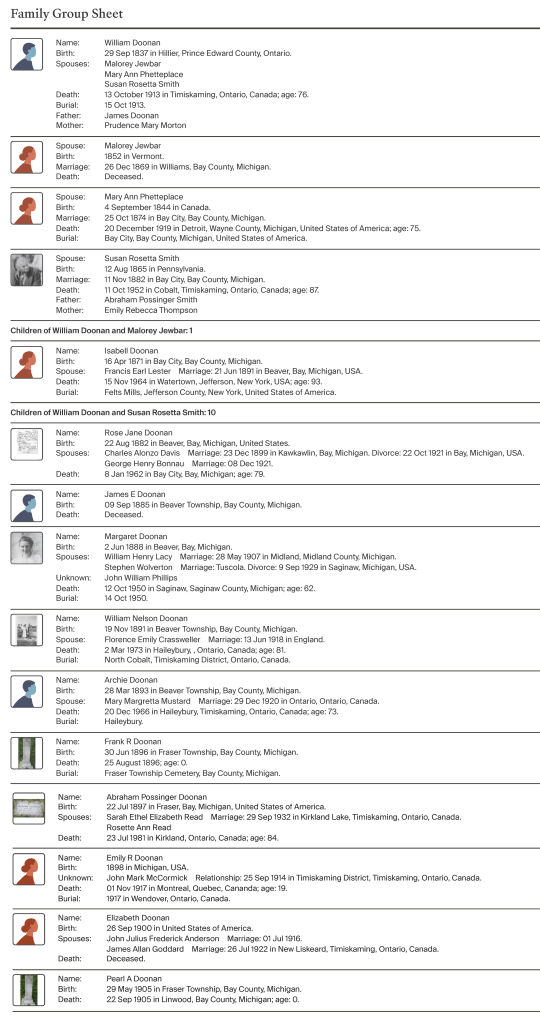
William Doonan was born on 29 September 1837 in Hillier Township, Prince Edward County, Upper Canada, the son of James Doonan and Prudence Mary Morton.¹ His early life unfolded within a large family that soon migrated westward into Hastings County, Ontario, where William appears alongside his parents and siblings in mid-nineteenth-century records.² These early movements reflect the broader patterns of rural settlement and land hunger that shaped many Canadian families of the period.

By the 1860s, William was living independently. In the 1861 census of Canada, he appears in Hungerford Township, Hastings County, identified as a single man and a member of the Church of England.³ Within a few years, he crossed the border into Michigan, joining the steady stream of Canadian migrants drawn to land opportunities in the Saginaw Bay region.

On 4 March 1868, William Doonan entered 80 acres of land in Beaver Township, Bay County, Michigan, under the Homestead Act.⁴ Over the following years, he fulfilled the requirements of residence and improvement, constructing a log house and barn, digging wells, fencing and cultivating acreage, and planting fruit trees.⁵ These records establish him not as a transient laborer but as a settler who invested sustained labor and resources into his farm.

William’s personal life during this period was complex. He married Ann Scott in Bay County on 26 December 1869.⁶ This marriage was short-lived, and no later records place Ann in William’s household. By January 1874, William had married again, this time to Maloney Jewbar.⁷ As with his first marriage, no divorce or death record has been located, but by the early 1880s Maloney no longer appears in records associated with him.

William’s third marriage, to Rosa Susan Smith, marked a turning point in his life. They were married in Bay City, Michigan, on 11 December 1882.⁸ From this point forward, Rosa is consistently identified as William’s wife in census records, newspapers, and later Ontario documents. She was the mother of nearly all of his children and remained with him through the final decades of his life.

One child, Isabel Doonan, predates William’s marriage to Rosa. Isabel appears in the 1884 Michigan state census within William and Rosa’s household.⁹ Based on her age and the date of William’s marriage to Rosa, Isabel was the child of one of William’s earlier marriages. Her presence in the household reflects the blended family structures that were not uncommon in the nineteenth century.

1884 Michigan State Census. William Doonan is underlined in red.

William and Rosa raised a large family in Bay County, and their household appears repeatedly in Michigan state census records during the 1880s and 1890s.¹⁰ During these years, William supported his family through farming and lumbering, work that was physically demanding and increasingly hazardous as he aged.

Family Group Sheet for William Doonan

William does not appear in the 1880 or 1900 United States federal census. This absence is notable but not inexplicable. During this period, he moved frequently between Michigan and Ontario and appears instead in state and provincial records. At the turn of the twentieth century, his household was also affected by violence within his wife’s family, including the killing of Rosa Susan Smith’s brother Jude Smith by another brother, an event documented elsewhere.¹¹ Contemporary newspaper reporting later indicates that William came into possession of the firearm involved.¹² While no direct evidence links these events to census avoidance, the combination of cross-border movement, legal scrutiny, and rural residence provides a plausible explanation for the family’s absence from federal enumeration.

William’s wider family network also remained close. Census proximity and migration patterns suggest that John Doonan, who appears in nearby Michigan census records during the same period, was likely William’s brother.¹³ Although no single record explicitly states this relationship, the accumulated evidence supports a close familial connection.

By the early twentieth century, William and Rosa left Michigan and returned to Ontario, settling in the Temiskaming District. This final chapter of William Doonan’s life would be marked by increasing hardship, legal entanglements, and declining health—subjects that will be examined in the posts that follow.


Notes

  1. Ontario birth records and compiled family records for William Doonan, Hillier Township, Prince Edward County, Ontario.
  2. 1861 Census of Canada, Hungerford Township, Hastings County, Ontario.
  3. Ibid.
  4. U.S. General Land Office Records, Homestead Entry, Beaver Township, Bay County, Michigan, 4 March 1868.
  5. Homestead proof affidavits, Beaver Township, Bay County, Michigan.
  6. Bay County, Michigan, Marriage Register, 1869, marriage of William Doonan and Ann Scott.
  7. Bay County, Michigan, Marriage Register, 1874, marriage of William Doonan and Maloney Jewbar.
  8. Bay County, Michigan, Marriage Register, 1882, marriage of William Doonan and Rosa Susan Smith.
  9. 1884 Michigan State Census, Beaver Township, Bay County, Michigan.
  10. 1884 and 1894 Michigan State Census records, Beaver Township, Bay County, Michigan.
  11. Nancy Little, “Jude Smith’s Legacy,” The Tumbleweed, 14 March 2018.
  12. North Bay Nugget, May 1910, reporting on firearm possession connected to the Smith family incident.
  13. 1884 and 1894 Michigan State Census records for John Doonan, Bay County, Michigan.

Charles Thomas Wickham and Christianna Stouts

From Islington to New York and the Saginaw Valley

Reconstructing the lives of early nineteenth-century immigrants often requires correlating records created in different countries and under varying record-keeping practices. In the case of Charles Thomas Wickham and Christianna Stouts, parish registers, marriage records, passenger lists, Michigan documents, and contemporary newspapers together form a consistent and well-supported narrative. These records identify Charles Thomas Wickham and Christianna Stouts as my third great-grandparents and trace their journey from London to New York and ultimately to the Saginaw Valley of Michigan.


Charles Thomas Wickham: Origins in London

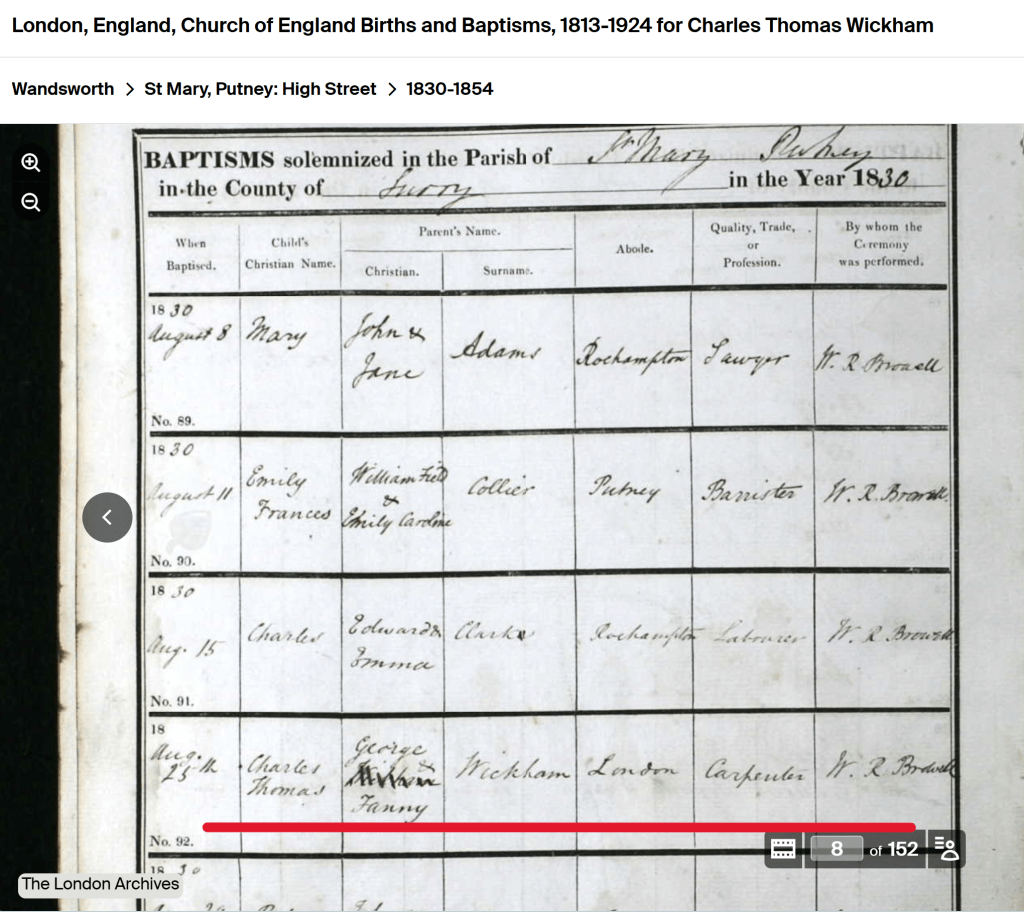
Charles Thomas Wickham was born about 1800 in London, England, the son of George Wickham and Fanny Bonner Farrand.¹ Parish records place the Wickham family in the Islington and Clerkenwell area of Middlesex during the early nineteenth century.

By the 1820s, Charles Thomas Wickham appears in parish records as a husband and father and is identified as a cheese monger and egg dealer, occupations consistent with small-scale food trade in urban London.² This occupational identification helps distinguish him from other men of the same name and provides useful context for his life prior to emigration.


First Marriage: Ann Philippa Evans

On 16 June 1822, Charles Thomas Wickham married Ann Philippa Evans at St Mary, Newington, Surrey.³ Two children were born to this marriage:

  • Charles Henry Wickham, born 6 December 1823
  • Ann Philippa Wickham, baptized 11 August 1825 in Islington³

Ann Philippa Evans Wickham died shortly after the birth of her daughter and was buried on 24 August 1825, leaving Charles a widower with two young children.⁴


Second Marriage: Christianna Stouts

On 1 April 1827, Charles Thomas Wickham married Christianna Stouts at St James, Clerkenwell, Middlesex.⁵ Christianna was born in 1807 and baptized at St Mary’s, Islington, placing her within the same parish network as the Wickham family.⁶

This second marriage produced a growing family during the late 1820s and early 1830s.


Children Born in England

The following children of Charles Thomas Wickham and Christianna Stouts were born in England:

  • John George Wickham, baptized 21 June 1828
  • Reuben Thomas Wickham, baptized 12 April 1831
  • Joseph Wickham, baptized 22 November 1832¹

These dates are later corroborated by American records and obituaries, demonstrating continuity of identity across the family’s migration.


Emigration to the United States

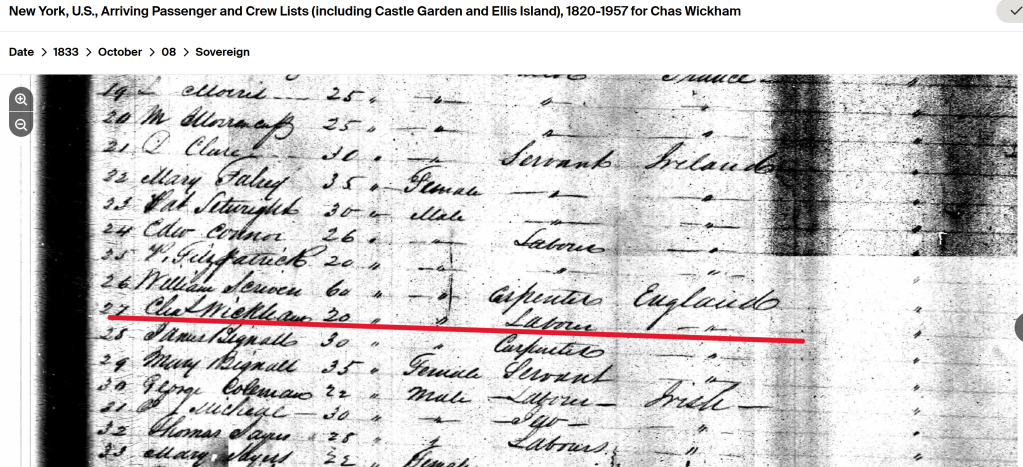
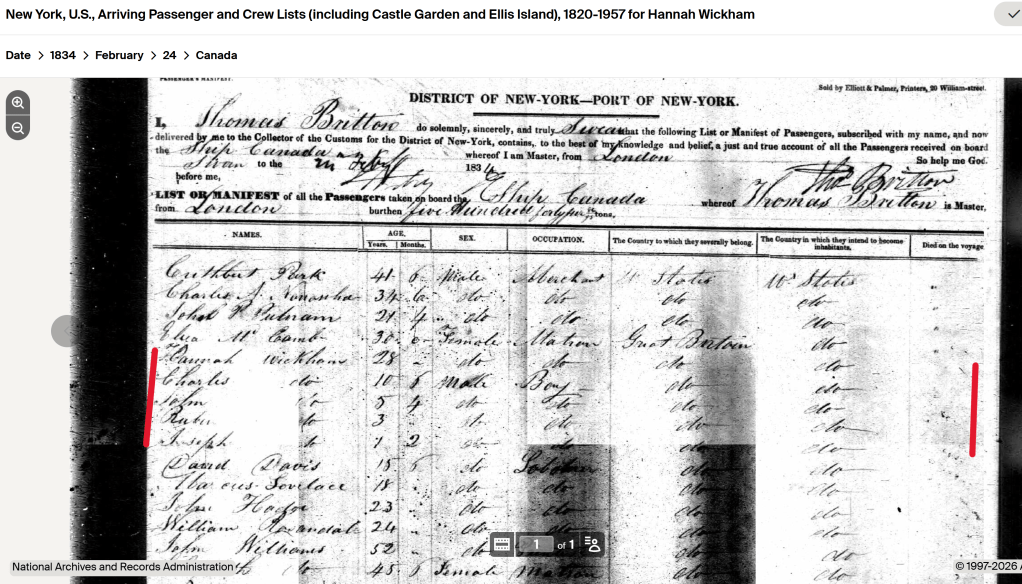
In 1833, Charles Thomas Wickham emigrated to the United States, arriving at New York.⁷ The following year, his wife Christianna, recorded on passenger lists as Hannah Wickham, followed with several children.⁸

Among those listed on the 1834 passenger list was Charles, age ten, whose age corresponds precisely with Charles Henry Wickham, born in December 1823, the son of Charles Thomas Wickham by his first wife, Ann Philippa Evans. None of the younger children of the second marriage would have been of that age, making this identification the only plausible interpretation.

The absence of Charles Henry Wickham’s sister, Ann Philippa Wickham, from American passenger lists suggests that she either died in childhood or remained in England, a common outcome for orphaned children placed with relatives.


“They Lived in the East”

Christianna’s obituary later states that after arriving in America, the family *“lived in the east.”*⁹ This phrase does not identify a specific state. When evaluated against dated and independent records, New York State is the only interpretation supported by evidence:

  • Both Charles and Christianna arrived through New York
  • Their American-born children were born in New York
  • No Massachusetts records have been identified
  • The family’s migration path proceeds logically from New York to Michigan

Move to Michigan and Charles’s Death

In 1840, the Wickham family relocated from New York to Saginaw County, Michigan, then a developing frontier region. According to Christianna’s obituary, Charles Thomas Wickham died only one month after arriving, bringing his American life to an abrupt end.⁹

He was buried in what is now Tittabawassee Township, Saginaw County, Michigan.¹⁰


Christianna Wickham Green: Pioneer Widow

In 1841, Christianna married Edward C. Green in Saginaw County.¹¹ She spent the remainder of her life in Michigan.

Her obituary, published in 1891, provides a detailed narrative of her life, confirming her English birth, marriage to Charles Wickham, emigration to New York, residence in the eastern United States, relocation to Saginaw, Charles’s death shortly after arrival, and her second marriage.⁹


Confirmation from the Next Generation

The obituary of Reuben Thomas Wickham, published in 1903, independently confirms the family narrative. It states that he was born in London, England, came to New York as a small child, and moved to Saginaw in 1840 with his parents, Charles T. and Christina Wickham.¹²


The Unresolved Question of Charles Henry Wickham

While the passenger list establishes that Charles Henry Wickham immigrated to the United States in 1834, his later life has not yet been documented. He does not appear in Michigan records or family obituaries. His absence may reflect an early death, separate residence, or use of a name variation, but no definitive conclusion can be drawn.

Importantly, his presence on the passenger list strengthens the identification of Charles Thomas Wickham by confirming the structure of two marriages and the blending of children from both unions.


Conclusion

Through parish registers, marriage records, passenger lists, Michigan documents, and contemporary newspapers, the lives of Charles Thomas Wickham and Christianna Stouts can be traced with clarity and consistency. The evidence demonstrates a single family moving from London to New York and then to the Saginaw Valley, without contradiction or competing identities.

Together, these records establish Charles Thomas Wickham and Christianna Stouts as my third great-grandparents, preserving their story as part of the broader nineteenth-century immigrant experience.


Footnotes

  1. Parish baptism records for Wickham children, Islington and Clerkenwell, Middlesex, England, 1828–1832.
  2. Parish baptism records noting occupation of Charles Thomas Wickham as cheese monger and egg dealer, Islington and Clerkenwell, Middlesex.
  3. Marriage record of Charles Thomas Wickham and Ann Philippa Evans, St Mary, Newington, Surrey, 16 June 1822; baptism of Ann Philippa Wickham, Islington, 11 August 1825.
  4. Burial record of Ann Philippa Wickham, England, 24 August 1825.
  5. Marriage record of Charles Thomas Wickham and Christianna Stouts, St James, Clerkenwell, Middlesex, 1 April 1827.
  6. Baptism record of Christianna Stouts, St Mary’s, Islington, 1807.
  7. Passenger list, Sovereign, arrival New York, 1833, Charles Wickham.
  8. Passenger list, Canada, arrival New York, February 1834, Hannah Wickham and children.
  9. Obituary of Christianna (Stouts) Green, Saginaw Courier-Herald, 12 March 1891.
  10. Burial record of Charles Thomas Wickham, Freeland area, Saginaw County, Michigan, 1840.
  11. Marriage record of Christianna Wickham and Edward C. Green, Saginaw County, Michigan, 1841.
  12. Obituary of Reuben Thomas Wickham, Saginaw Herald, 27 January 1903.

Revisiting the Parentage of Eleanora “Ella” B. Gibbs

In October 2020, I published a post outlining the evidence I had at the time regarding the parentage of my second great-grandmother, Eleanora “Ella” B. Gibbs, wife of John Wortman. That post laid out the problem clearly: census records placed Eleanora in proximity to multiple Gibbs households in Dryden, Lapeer County, Michigan, but did not explicitly state her relationship to any of them.¹

At the time, the strongest conclusion I could reach — based on marriage, probate, and census evidence — was that Eleanora was the daughter of Lester Gibbs and Mary Conly. However, gaps remained, particularly concerning what became of Lester Gibbs, who appeared to vanish from the records after 1860.

Over the past several years, additional records have come to light. When examined together, they significantly strengthen the original conclusion and clarify why earlier records appeared contradictory.


The Core Question, Revisited

The question has never really been who raised Eleanora, but who her biological father was.

In 2020, the competing possibilities were:

  • Lester Gibbs, who married Mary Conly in 1850
  • Philo Gibbs, with whom Eleanora appears in close proximity in census records

Because nineteenth-century census schedules do not identify relationships, proximity alone could not prove parentage.² What resolves the question is land ownership, guardianship, and inheritance — records that do imply legal relationships.


What We Know Now About Lester Gibbs

Lester Gibbs Did Not Disappear After 1860

Earlier assumptions placed Lester Gibbs’s death near 1860, but new evidence clearly disproves that.

In the 1860 federal census, Lester Gibbs appears in Dryden Township, Lapeer County, Michigan, listed as a farmer with both real and personal estate.³ He was alive, resident, and economically established.

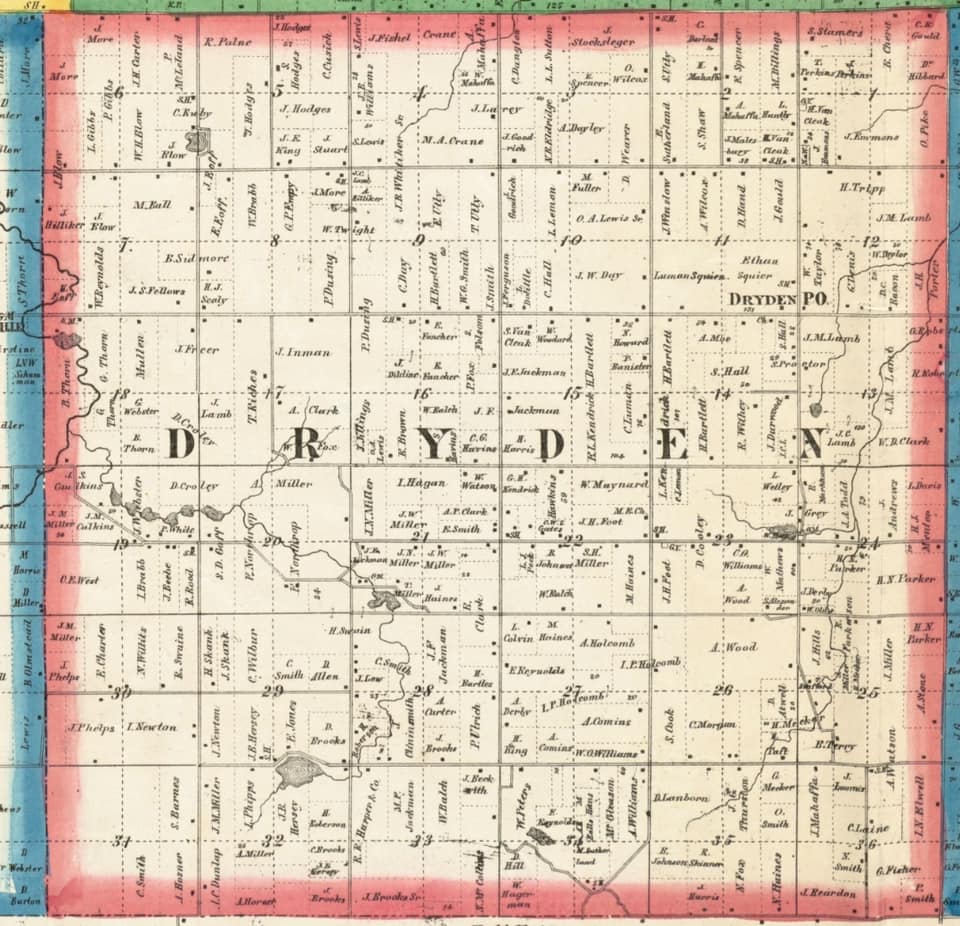
More importantly, an 1863 landowners map of Dryden Township identifies an “L. Gibbs” owning land in close proximity to J. Blow, a man later appearing in court-related records connected to this family.⁴ This confirms that Lester Gibbs was alive and a landholder at least as late as 1863.

1863 Land owernship map of Dryden, Lapeer County, Michigan. L. Gibbs owns land in the upper left corner.

Mary Conly’s Movements Explain the Census Confusion

The apparent absence of Mary Conly from Michigan in 1860 and Eleanora’s later association with other households long contributed to confusion. Those movements now make sense.

Mary Conly married Lester Gibbs in Lapeer County in November 1850.⁵ By 1861, she had remarried in New York to Charles Garner.⁶ The couple was living in New York by the mid-1860s, where Mary appears with Eleanora in the 1865 New York State Census.⁷

Charles Garner enlisted in the Union Army in 1863 and died as a prisoner of war at Salisbury Prison, North Carolina, on 21 December 1864.⁸ Mary was again widowed, this time with multiple minor children.

By 1868, Mary had returned to Lapeer County, Michigan, and married Mortimer Hilliker.⁹ These movements fully explain why Mary and Eleanora are absent from Michigan records during parts of the 1860s and why Eleanora later appears associated with extended family rather than her biological father.


The Most Important Evidence: Inheritance and Guardianship

The decisive records are not census schedules, but court-ordered guardianship and land transactions.

In December 1868, the Lapeer County Circuit Court appointed Mary Hilliker as special guardian of Eleanora (“Ella”) Gibbs, authorizing her to sell the minor child’s interest in real estate.¹⁰ The court approved both the guardianship and the conveyance.

Such proceedings occur only when:

  1. The child inherited property, and
  2. The property-owning parent is deceased

This establishes that Lester Gibbs died between 1863 and December 1868, and that Eleanora was his legal heir.

Philo Gibbs was not the landowner; Lester Gibbs was.


Why There Is No Probate Record for Lester Gibbs

The absence of a probate estate for Lester Gibbs once appeared problematic. In fact, it is consistent with Michigan legal practice of the period.

When a man died intestate leaving only minor heirs and land as the principal asset, courts often handled the matter through guardianship proceedings rather than formal probate administration.¹¹ This allowed the land to be sold for the child’s benefit without opening an estate.

That is precisely what occurred in this case.


What This Means for Eleanora’s Parentage

When all records are considered together:

  • Marriage of Lester Gibbs and Mary Conly (1850)⁵
  • Birth of Eleanora Gibbs (1854)¹²
  • Census evidence of Lester Gibbs alive in 1860³
  • Land ownership by Lester Gibbs in 1863⁴
  • Court-ordered guardianship and inheritance in 1868¹⁰
  • Probate of Mary Hilliker naming Ella Wortman as an heir¹³

…the conclusion is no longer tentative.

Eleanora “Ella” B. Gibbs was the daughter of Lester Gibbs and Mary Conly.


A Final Reflection

This case illustrates a fundamental genealogical principle:
census records suggest relationships; land and court records confirm them.

Six years ago, the evidence pointed in the right direction. Today, it firmly supports that conclusion.


Footnotes

  1. The parentage of Eleanora ‘Ella’ B. Gibbs,” blog post, 27 October 2020.
  2. U.S. Bureau of the Census, Instructions to Enumerators, 1860.
  3. 1860 U.S. Census, Lapeer County, Michigan, Dryden Township, Lester Gibbs household.
  4. Map of Lapeer County, Michigan (1863), Dryden Township landowners, “L. Gibbs.”
  5. Lapeer County, Michigan, Marriage Records, Lester Gibbs and Mary Conly, 12 November 1850.
  6. New York State Marriage Records, Mary Conly and Charles Garner, 1861.
  7. 1865 New York State Census, Cayuga County, Sterling, Mary Garner household.
  8. Compiled Military Service Record, Charles Garner, Union Army; died 21 December 1864, Salisbury Prison, North Carolina.
  9. Lapeer County, Michigan, Marriage Records, Mary Conly and Mortimer Hilliker, 29 March 1868.
  10. Lapeer County, Michigan, Circuit Court Records, Guardianship and deed of Eleanora D. Gibbs, December 1868.
  11. Michigan Probate Law and Practice, mid-nineteenth century (see Michigan Revised Statutes).
  12. Birth information for Eleanora D. Gibbs, as reported in multiple census and marriage records.
  13. Lapeer County, Michigan, Probate Records, Estate of Mary Hilliker, 1872.

When Did John Powell Really Die?

Solving an 1886–1887 Genealogical Mystery with Weather, Newspapers, and Cemetery Records

One of the most frustrating problems in genealogy is when official records and newspapers disagree. That is exactly what happened with John Powell of Pontiac, Michigan — and it took three independent record systems and 19th-century weather data to resolve it.

At first glance, the sources contradict each other:

  • Oakland County’s death register records John Powell’s death as 31 December 1886.
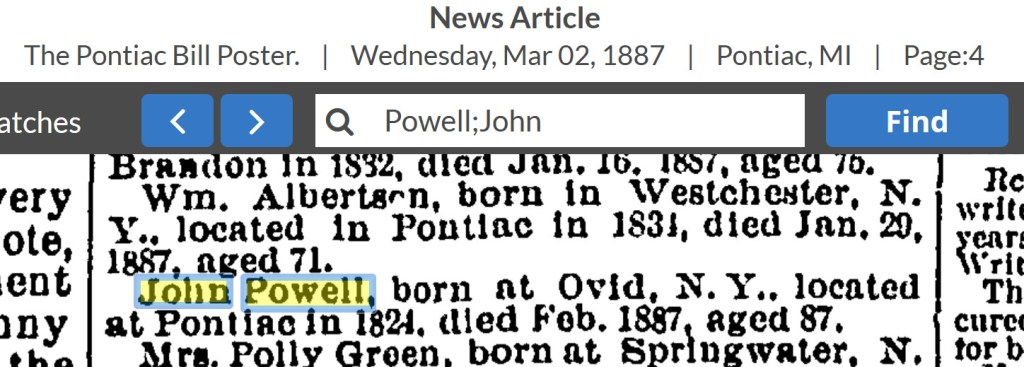
  • Two notices in The Pontiac Bill Poster in early 1887 state that he “died last Saturday” and later say he “died Feb. 1887.”
  • His burial, according to Oak Hill Cemetery in Pontiac, occurred on Saturday, 29 January 1887.

Which date is correct?


The Official Record: December 31, 1886

The Oakland County “Return of Deaths” ledger lists:

John Powell, Pontiac — Dec. 31, 1886 — widower, aged 88 years, 4 months, 4 days, born New York.

This is not an estimate or a heading. The date Dec. 31, 1886 is written directly on John Powell’s line in the register.

More importantly, Oakland County holds no death certificate for him in 1887, meaning the county had already legally recorded his death in 1886. That establishes 31 December 1886 as his legal date of death.

Additionally, no probate record has been found for John Powell. Probate records can sometimes give the date of death.


What the Newspaper Really Reported

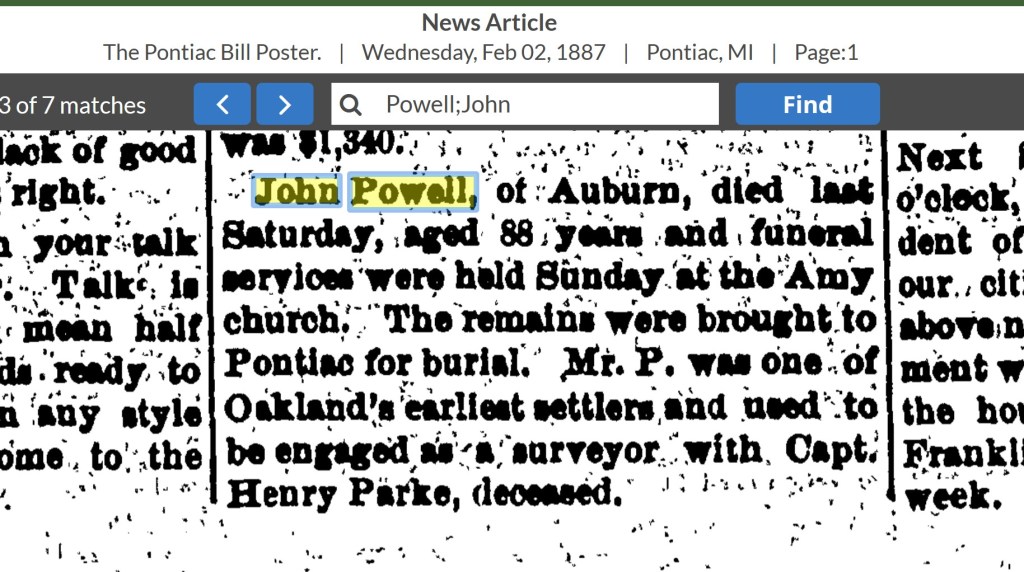
The Pontiac Bill Poster of Wednesday, February 2, 1887 states:

“John Powell, of Auburn, died last Saturday; aged 88 years, and funeral services were held Sunday at Amy Church. The remains were brought to Pontiac for burial.”

“Last Saturday” relative to Feb. 2, 1887 equals Saturday, January 29, 1887 — which is exactly the day Oak Hill Cemetery recorded his burial.

The newspaper was therefore describing the burial week, not the legal date of death. Oh, and if you are wondering about Amy Church – apparently Amy is what the locals called Auburn Hills/Auburn Heights at the time. This was most likely a Methodist Church, although so far, I have not been able to confirm this.

The Pontiac Bill Poster article a month later – with incorrect data on death and age is incorrect. Although I suspect the birth information is actually right.

Why Burial Was Delayed: The Ground Was Frozen Solid

Weather records now make the situation unmistakably clear.

Using official U.S. Signal Service observations from Windsor, Ontario (the nearest long-running station to Detroit and Pontiac), we can see when winter locked the ground.

From mid-December 1886, southeast Michigan entered a sustained hard freeze:

DateHighLow
Dec 1432°F24°F
Dec 1525°F6°F
Dec 1614°F7°F
Dec 1727°F−2°F
Dec 2520°F1°F
Dec 2813°F−5°F
Dec 3123°F10°F

From December 14 onward, nighttime temperatures stayed below freezing for more than two weeks. This means:

  • The soil would have been frozen by Christmas
  • Snow fell on frozen ground on Dec. 24 (6 inches) and Dec. 31 (4 inches)
  • The ground never thawed between mid-December and mid-January

On the day John Powell died — December 31, 1886 — conditions were brutal:

  • High 23°F
  • Low 10°F
  • 4 inches of fresh snow

Burial at that time would have required digging through frozen soil beneath heavy snow — something cemeteries avoided whenever possible.


When Burial Became Possible

A major thaw finally arrived in late January 1887:

DateHighLow
Jan 2045°F27°F
Jan 2251°F26°F
Jan 2456°F26°F
Jan 2842°F31°F
Jan 2942°F25°F

This was a ten-day thaw, long enough to soften frozen soil and allow graves to be opened. Oak Hill Cemetery buried John Powell on Saturday, January 29, 1887 — the first realistic opportunity.

Two days later winter returned with six inches of new snow on January 31.

The timing could not be clearer.


Putting It All Together

EventDateEvidence
DeathDec 31, 1886Oakland County death register
Heavy snow & frozen groundDec 31, 188623°F / 10°F, 4″ snow
Sustained thaw beginsJan 20, 1887Weather records
BurialSat Jan 29, 1887Oak Hill Cemetery
FuneralSun Jan 30, 1887Pontiac Bill Poster
Obituary printedFeb 2, 1887Pontiac Bill Poster

The Correct Conclusion

John Powell died in Pontiac on 31 December 1886. He was buried on 29 January 1887 after winter conditions delayed burial for nearly a month.

The newspaper was reporting the burial and funeral, not the legal date of death — which is why the dates appeared to conflict.

In the end, vital records, cemetery logs, newspapers, and even the weather all tell the same story.


Sources

  1. Sources
    1. Oakland County, Michigan — Death Register (1886)
    Oakland County Clerk, Return of Deaths, entry for John Powell, Pontiac, dated 31 December 1886; widower, age 88, born New York.
    (Original handwritten county register; no 1887 death certificate exists for John Powell.)

    2. Oak Hill Cemetery, Pontiac, Michigan — Interment Register
    Oak Hill Cemetery sexton’s record for John Powell, showing burial on 29 January 1887.
    (Information confirmed directly with cemetery staff via phone call 15 January 2026 by the author.)

    3. The Pontiac Bill Poster (Pontiac, Michigan), 2 February 1887
    Obituary notice for John Powell, stating he “died last Saturday” and that “funeral services were held Sunday at Amy Church; the remains were brought to Pontiac for burial.”
    (“Last Saturday” relative to 2 Feb 1887 = 29 Jan 1887.)

    4. The Pontiac Bill Poster, 2 March 1887
    Biographical notice of John Powell, stating he “died Feb. 1887 aged 87.”
    (This later notice is a typo reflecting the burial/funeral month, not the legal death date.)

    5. U.S. Signal Service Weather Records — Windsor Riverside, Ontario (near Detroit & Pontiac)
    National Centers for Environmental Information (NOAA), Global Historical Climatology Network (GHCN-Daily):
    December 1886 daily observations, including 31 Dec 1886: high 23°F, low 10°F, 4 inches of snow, documenting frozen ground and active snowfall
    January 1887 daily observations, including Jan 29, 1887: high 42°F, low 25°F, no snow, documenting the thaw window that allowed burial and Jan 31, 1887: 6 inches of new snow

Bangs Burgess (1747–1822): A Continental Soldier from Massachusetts

Bangs Burgess of Rochester, Plymouth County, Massachusetts was not a casual volunteer in the American Revolution. He was a long-serving Continental Army private who marched with Massachusetts regiments through some of the war’s defining campaigns — including Monmouth and Yorktown — and remained in service from the middle years of the war through its conclusion.


Family and Early Life

Bangs Burgess was born in 1747 in Rochester, Massachusetts, a community originally part of Old Rochester (encompassing present-day Rochester, Mattapoisett, and Marion). The Burgess family was well established in the region, appearing in early colonial and town histories.¹

Rochester and its neighboring towns contributed men regularly to the war effort, and Bangs was among those who responded when the conflict expanded beyond local militia service into the full Continental mobilization.


Military Enlistments in the Continental Army

First Enlistments (1776–1777)

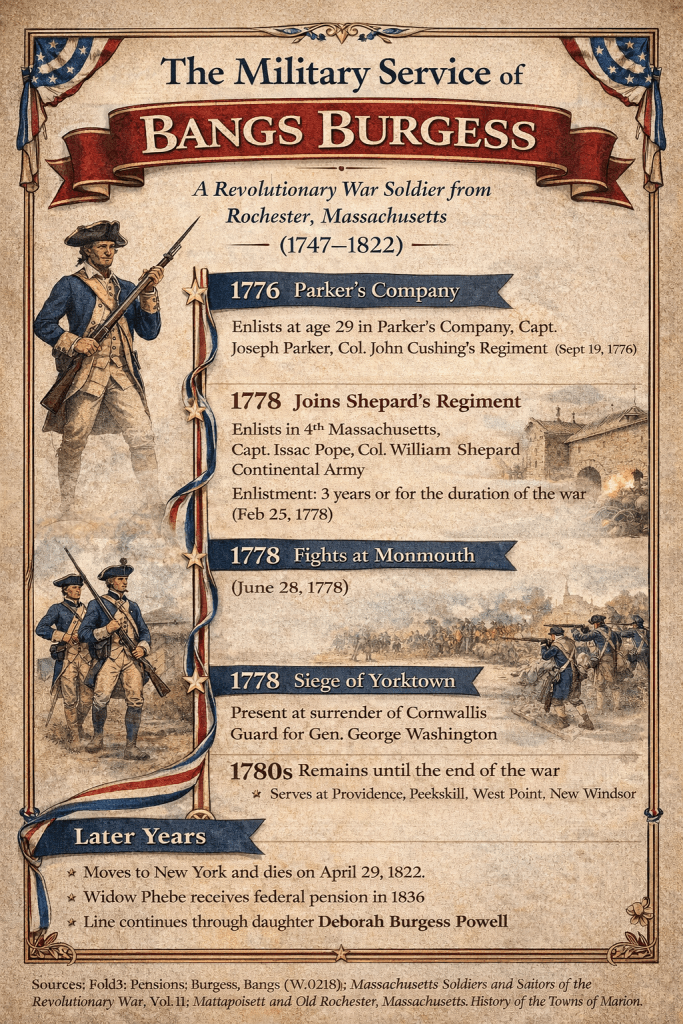
According to Massachusetts Soldiers & Sailors of the Revolutionary War, Bangs Burgess first enlisted on 19 September 1776 as a private in Captain Joseph Parker’s Company, serving under Colonel John Cushing’s Regiment and stationed, at least initially, at Rhode Island.²

He was later recorded reenlisting for brief service, transitioning into longer commitments as the war progressed.


Extended Service with Shepard’s Regiment

The same source records Burgess next with Captain Isaac Pope’s Company, in Colonel William Shepard’s (4th Massachusetts) Regiment, part of the regular Continental Army:

  • 25 Feb 1778 – Dec 31, 1779: Continental Army pay accounts list Burgess in Shepard’s regiment.³
  • Musters through 1778–1781 place him in the field, with rolls in Phillipsburg, Peekskill, West Point, York Hutts, and New Windsor.⁴
  • A February 1780 muster describes him physically: “age 30 yrs., stature 6 ft. 1 in., complexion light, hair light; residence, Rochester.”⁵

These repeated returns of rolls indicate he was part of the Continental establishment, not just a short-term militia enlistment.


Campaigns and Combat

Battle of Monmouth (June 1778)

In sworn pension testimony later accepted by the U.S. Pension Office, Burgess stated that he was present at the Battle of Monmouth on 28 June 1778 — one of the largest engagements of the war and a key proving ground for the newly trained Continental Army.⁶

This battle demonstrated Washington’s ability to stand with British regulars in open field combat, and Burgess’s presence places him with the main army in the mid-Atlantic theater.


Siege of Yorktown and Cornwallis’s Surrender (1781)

Burgess also testified that he took part in the Siege of Yorktown, Virginia, and was present when British General Lord Cornwallis surrendered in October 1781 — the culminating moment of the Revolutionary War.⁷

His pension record further indicates that he served as part of a detachment detailed as guard for General George Washington, a distinction suggesting he was among the more experienced members of his regiment.⁸

Bangs Burgess Revolutionary War service

Recognition and Pension

Decades after the war, Burgess applied for a federal pension under the Act of 18 March 1818, which provided support for indigent veterans of Revolutionary service. His application was approved, and he was placed on the pension rolls as a veteran of long service in the Continental Army.⁹

The government required detailed proof before granting pensions, and Burgess’s long service, as recorded in both his own testimony and official Continental records, satisfied those requirements.


Later Years and Death

After the Revolution, Burgess moved to New York, first living in Rensselaer County and later in Livonia, Livingston County. He died there on 29 April 1822.¹⁰

Following his death, his widow Phebe (Lillie) Burgess successfully applied for a pension under the Act of 4 July 1836 (Pension File W.20818), ensuring continued federal support and further preserving the documentary record of his service.¹¹


Family and Descendants

Bangs and Phebe Burgess raised a large family. Federal pension correspondence lists their children and identified heirs — including Deborah Burgess, who married John Powell of New York. This documentation forms the genealogical linkage through which many descendants trace their lineage today.¹²


Historical Assessment

Bangs Burgess exemplifies what historians call a career patriot — a man whose wartime service was sustained, documented, and recognized. Unlike many who served only briefly near home or in local militia, he:

🔹 Served multiple enlistments and a long-term Continental contract
🔹 Marched as part of Massachusetts line units
🔹 Saw major actions including Monmouth and Yorktown
🔹 Remained in the army through multiple campaigns and garrisons
🔹 Was later recognized by the federal government with a pension

These facts make him a particularly well-documented example of an enlisted Continental soldier — a story worth telling beyond the genealogical record.


Sources and Citations

  1. Mattapoisett and Old Rochester, Massachusetts: History of the Towns of Rochester, Mattapoisett, and Marion (Boston: Town Histories Pub.).
  2. Massachusetts Soldiers and Sailors of the Revolutionary War, Vol. II, entry “Burges, Bangs, Rochester.”
  3. Ibid., pay accounts, Shepard’s (4th Mass.) Regiment.
  4. Ibid., muster rolls, 1778–1781.
  5. Ibid., February 1780 descriptive muster.
  6. Bangs Burgess pension file, National Archives: NARA M804, War of the Revolution Pension and Bounty Land Warrant Application Files, Burgess, Bangs (W.20818).
  7. Ibid., pension testimony on Yorktown.
  8. Ibid., pension testimony regarding Washington’s guard.
  9. Ibid., pension award documentation.
  10. Fold3 memorial and summary: Burgess, Bangshttps://www.fold3.com/memorial/664325102/burgess-bangs
  11. Ibid., widow’s pension continuation under the Act of 1836.
  12. Ibid., heir verification and family listing in pension correspondence.

Finding Jeremiah Ballard: How Census Records, Land, and DNA Solved a 200-Year-Old Puzzle

For years, one of my most frustrating family mysteries was a simple question:

Who was Jeremiah Ballard?

Jeremiah was born about 1765 in New York and was the father of Horace Ballard, my 4× great-grandfather. But when I went looking for Jeremiah in the 1790 census, he was nowhere to be found. Worse, there were multiple men named Peleg Ballard, and genealogists had tangled their families together.

What follows is how I finally proved that:

  • Jeremiah Ballard was the son of Peleg Ballard (born 1728), and
  • Horace Ballard (born 1799) was Jeremiah’s son

— even without a will, baptism, or birth record.


The Ballard Family in Frederickstown, New York

In 1790, the town of Frederickstown, Dutchess County, New York contained a remarkable cluster of Ballards.

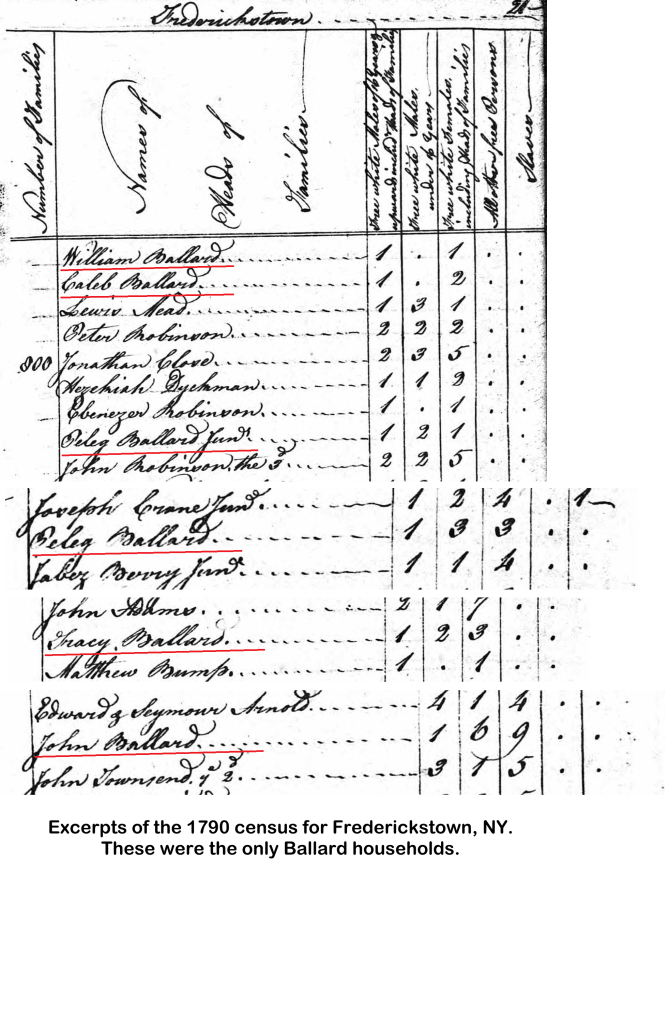
The census lists the following heads of household¹:

  • Peleg Ballard
  • Peleg Ballard, Jr.
  • John Ballard
  • Tracy Ballard
  • Caleb Ballard
  • William Ballard

This isn’t random. This is exactly what a father and his adult sons look like when they have divided up family land.

Excerpts of 1790 US Federal Census for Frederickstown, New York showing the Ballard households.
1790 US Federal Census for Frederickstown, New York

Where Was Jeremiah in 1790?

Jeremiah Ballard was born about 1765, so he was 25 years old in 1790. That means he should appear as a head of household.

But he doesn’t.

Looking closely at the census columns, something important emerges:
Every Ballard household has exactly one adult male (16+).

That means Jeremiah is not hiding in any Ballard home.
He must have been living with a non-Ballard household — common for young unmarried men who had not yet received land.

So Jeremiah didn’t vanish.
He just wasn’t a landholder yet.


Jeremiah Appears — Right Where He Belongs

By 1799, Jeremiah begins appearing in the Frederickstown tax lists, and he continues through 1803².

Then the 1800 census reveals the truth.

On the 1800 Frederickstown census page, we see³:

Caleb Ballard
Jeremiah Ballard

listed next to each other.

Census takers walked farm to farm. Neighbors on the page are neighbors in real life. And in rural New York, neighbors are usually family.

Caleb Ballard is a known son of Peleg Ballard.
Jeremiah living next door proves he belongs to the same family.

Excerpt of the 1800 US Federal Census for Frederickstown, New York. Caleb and Jeremiah Ballard are next to each other.

Which Peleg Was Their Father?

There were multiple Peleg Ballards — so which one was the father?

The 1800 census answers that.

Peleg Ballard’s 1800 household shows⁴:

  • One male over 45
  • No younger adult males
1800 Census for Peleg Ballard in Frederickstown, New York.

That fits Peleg born 1728 (age 72 in 1800).
It does not fit Peleg Jr., who would be about 40 and would have sons of his own.

By 1810, Peleg is gone. Only Caleb and Jeremiah remain in Frederickstown⁵.

That is exactly what happens when a father dies and only two sons remain on the land.


Jeremiah’s Household Includes Horace

Jeremiah’s 1800 census household shows³:

  • One adult male (Jeremiah)
  • One adult female (his wife)
  • One male under 10
  • One female under 10

That small boy is the right age to be Horace Ballard, born in 1799.

By 1810, Jeremiah’s household contains multiple sons, including one aged 10–16 — exactly where Horace belongs⁶.

1810 US Census for Frederickstown, New York - Jeremiah Ballard's household.
1810 US Census for Frederickstown, New York – Jeremiah Ballard’s household.

DNA Confirms What the Records Suggest

Paper records tell us Jeremiah was Peleg’s son and Horace was Jeremiah’s son.
DNA confirms it.

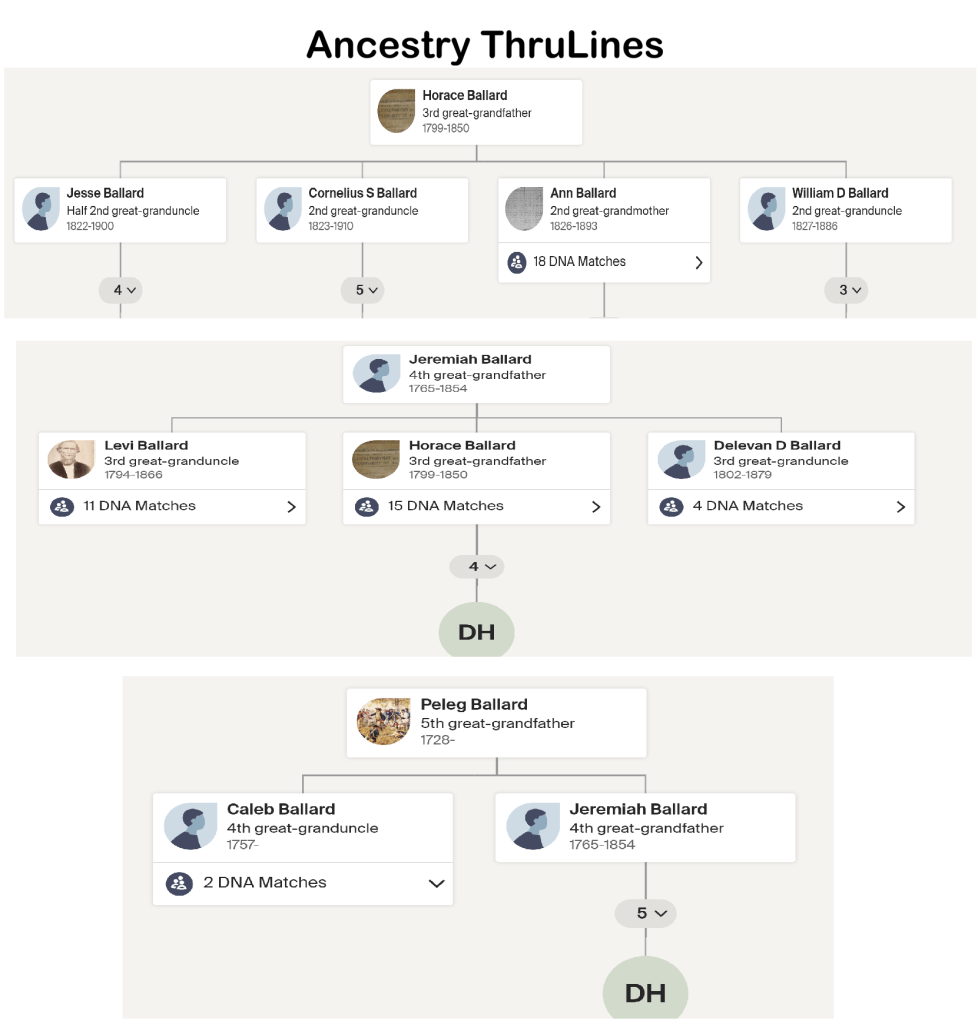
Multiple descendants of Horace Ballard match descendants of Caleb Ballard and John Ballard (Jeremiah’s brothers), all triangulating back to the Frederickstown Ballard family.

That means Horace does not belong to some other Ballard line.
He belongs here.

Ancestry's ThruLines Suggested Relationships
Ancestry’s ThruLines Suggested Relationships

Why This Matters

There is:

  • No will naming Jeremiah
  • No baptism for Horace
  • No deed saying “my son Jeremiah”

But in early New York, that is normal.

What we do have is something better:

  • Census clusters
  • Tax rolls
  • Land continuity
  • Family geography
  • And DNA

Together they form a solid proof.


Conclusion

Even without a single “smoking gun” document, the evidence shows:

Peleg Ballard (born 1728)
Jeremiah Ballard (born 1765)
Horace Ballard (born 1799)

Sometimes history whispers instead of shouting. You just have to listen long enough.


Sources

  1. 1790 U.S. Census, Frederickstown, Dutchess County, New York
  2. New York Tax Assessment Rolls, Frederickstown, Dutchess County, 1799–1803
  3. 1800 U.S. Census, Frederickstown, Dutchess County, New York
  4. Ibid., Peleg Ballard household
  5. 1810 U.S. Census, Frederickstown, Dutchess County, New York
  6. Ibid., Jeremiah Ballard household
  7. Autosomal DNA triangulation between descendants of Horace Ballard and descendants of Caleb and John Ballard (private test data)

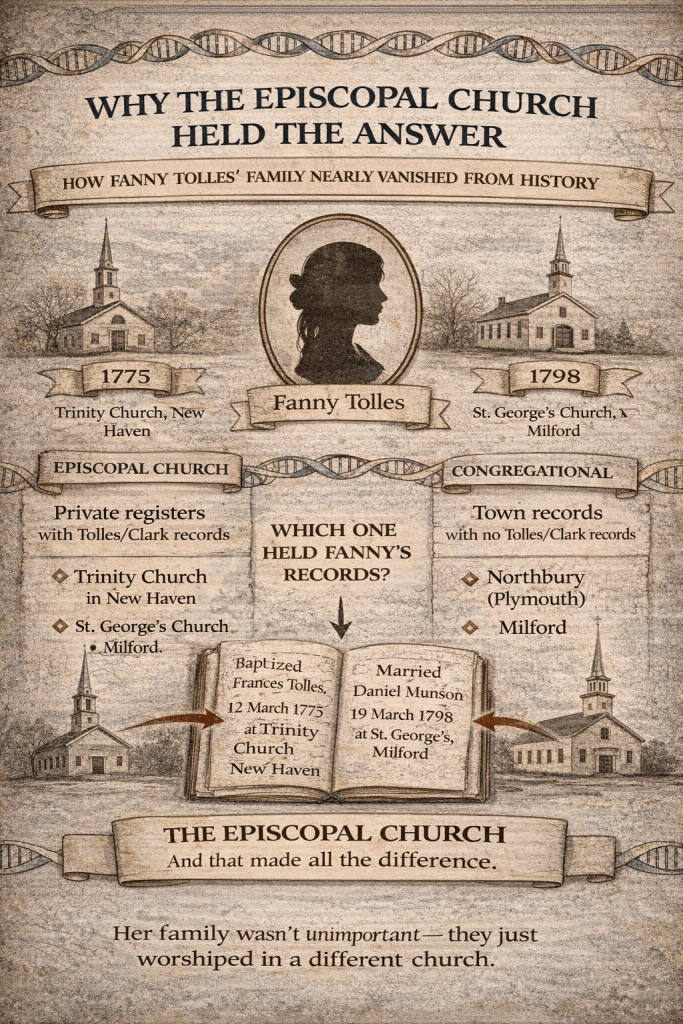
Why the Episcopal Church Held the Answer

One of the most surprising lessons in the story of Elnathan, Lydia, and Fanny Tolles is not about war or DNA or probate. It is about churches.

For most people researching early New England families, the default assumption is that the Congregational church holds the records. That works for many families — but not for this one. The Tolles and Clark families belonged to the Episcopal Church, and that single fact explains why Fanny nearly disappeared from history.

Lydia Clark was baptized as an adult at Trinity Church in New Haven in May 1773. Two years later, her daughter Frances was baptized there in March 1775. These were not casual entries. Episcopal parishes kept detailed registers of baptisms, sponsors, and marriages that were entirely separate from the town and Congregational systems.

Meanwhile, in Milford, Daniel Munson was part of the Episcopal world as well. Records from St. George’s Church show him as a subscriber and vestryman in the late 1780s. When Frances married Daniel Munson in 1798, she did so in a community deeply tied to the Episcopal network — and to her Clark relatives.

This is why older genealogists struggled. They searched town records and Congregational church books for Fanny Tolles and found very little. Without Episcopal registers, she looked unattached — a woman with a maiden name but no parents.

Donald Lines Jacobus solved this because he knew where to look. He drew from Trinity Church in New Haven, St. George’s in Milford, and the Plymouth parish records to reconstruct a family that existed almost entirely outside the Congregational system. When those church records were combined with probate law, the picture became clear.

Fanny Tolles did not vanish because her family was unimportant.
She vanished because her family worshiped in the “wrong” church.

And yet, it was those same Episcopal records that preserved her baptism, her name, and her marriage — quietly waiting for someone to connect them.

This is why genealogy is never just about names and dates. It is about institutions, beliefs, and communities — the frameworks that decide which lives are written down and which are forgotten.

For Fanny Tolles, the Episcopal Church kept her story alive long enough for us to finally find it.


Sources

  1. Trinity Church (Episcopal), New Haven, Connecticut, baptismal records, 23 May 1773 (Lydia Clark) and 12 March 1775 (Frances Tolles); abstracted in Donald Lines Jacobus, Families of New Haven, vol. VIII (1932).
  2. St. George’s Church, Milford, Connecticut, vestry and subscription lists, 1786–1788, showing Daniel Munson as a member of the Episcopal Society.
  3. Milford, Connecticut, Marriage Records, 19 March 1798, Daniel Munson and Frances (Fanny) Tolles.
  4. Donald Lines Jacobus, Deacon George Clark(e) of Milford, Connecticut and Some of His Descendants (1949), Clark and Tolles family entries.
  5. Probate of Elnathan and Lydia Tolles, Plymouth (Watertown) District, Litchfield County, Connecticut, 1789–1794.