Gardner T. Rivers (1872–1945)

Early Life in Southern Saginaw County

Gardner T. Rivers was born on 16 April 1872 in Michigan, the son of John Rivers and Frances Jane Munson. He grew up in southern Saginaw County, in an area that included Albee Township, Taymouth Township, Bridgeport Township, Foster, Burt, and surrounding rural communities.¹ He was raised alongside several siblings, including Franklin, Burt Eugene, James Daniel, Mary Jane, Rose, and Joseph Edward Rivers.²

Gardner appears with his parents in the 1880 federal census in Albee Township, Saginaw County, where he was eight years old.³ Like many farming families in the region, the Rivers family moved within nearby townships rather than relocating long distances, remaining tied to the same general area throughout Gardner’s childhood.
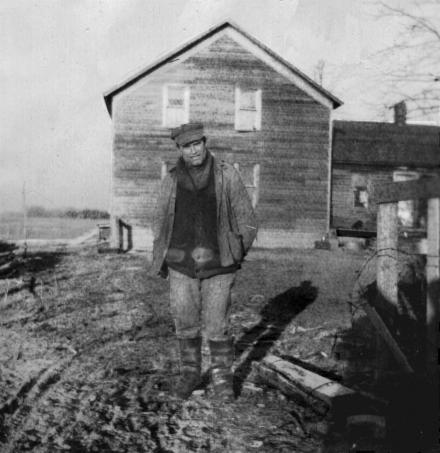
Gardner Rivers on the farm

Marriage and Family

On 13 June 1897, Gardner married Alice Mary Wickham in Freeland, Saginaw County.⁴ Alice was the daughter of Wickham and Munson families long established in the same part of the county. Alice’s mother, Emmaline Munson, was the sister of Gardner’s mother, Frances Jane Munson (known as Jane).⁵

Gardner and Alice had nine children between 1898 and 1913.⁶ Their children were born in Taymouth Township and nearby locations including St. Charles, Gaines Township, and Burt, reflecting brief periods of residence elsewhere before the family returned to Taymouth Township.
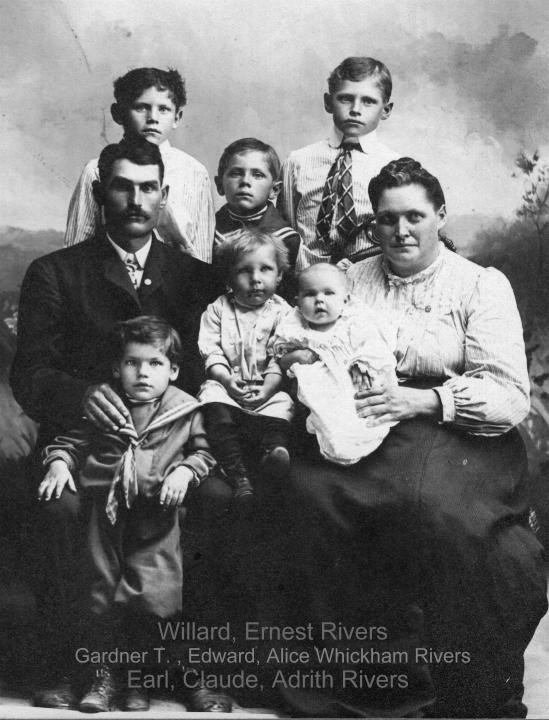
Gardner Rivers & family

Farming in Taymouth Township

Gardner Rivers was a farmer throughout his adult life. He is recorded as a farmer in the 1920, 1930, and 1940 federal censuses, all enumerated in Taymouth Township, Saginaw County.⁷ No records indicate that he pursued a different primary occupation.

Land ownership and residence in Taymouth Township are also documented in county plat maps. Gardner appears as “G. Rivers” on the 1916 Taymouth Township plat map and again on the 1920 plat map, placing him in the Burt area of the township during this period.⁸ These maps confirm his presence as a landholder in Taymouth Township in the years immediately before and after World War I, consistent with census records showing him farming in the same locality.
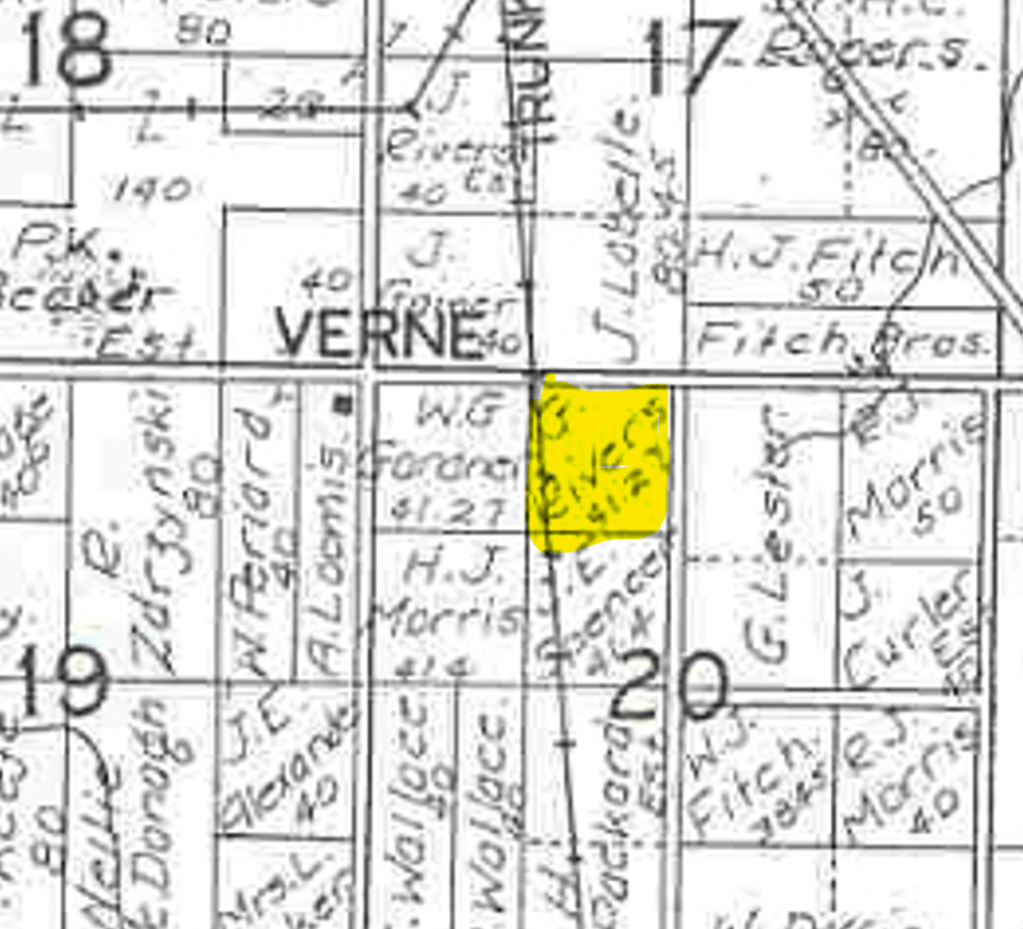
Part of the 1920 Plat Map for Taymouth Township. Highlighted is Gardner Rivers.

The 1910 Census Surname Error

The 1910 federal census is the only known record in which Gardner Rivers and his family were enumerated under the surname Munson rather than Rivers.⁹ The household composition, ages, birthplaces, and children align exactly with Gardner and Alice’s known family.

All other records before and after 1910—including censuses, vital records, newspapers, plat maps, and burial records—use the surname Rivers.¹⁰ The 1910 entry is therefore best understood as an isolated census error rather than a reflection of name usage by the family.

Later Years

By 1920, Gardner and Alice were living in Taymouth Township with several of their children still at home, and Gardner continued farming.¹¹ Census records from 1930 and 1940 show Gardner still residing in the township and engaged in farming into his late sixties.¹²

The family experienced significant losses during the 1930s, including the deaths of sons Ernest John Rivers in 1933 and Earl G. Rivers in 1935.¹³ Despite these losses, Gardner remained in Taymouth Township through the end of his life.
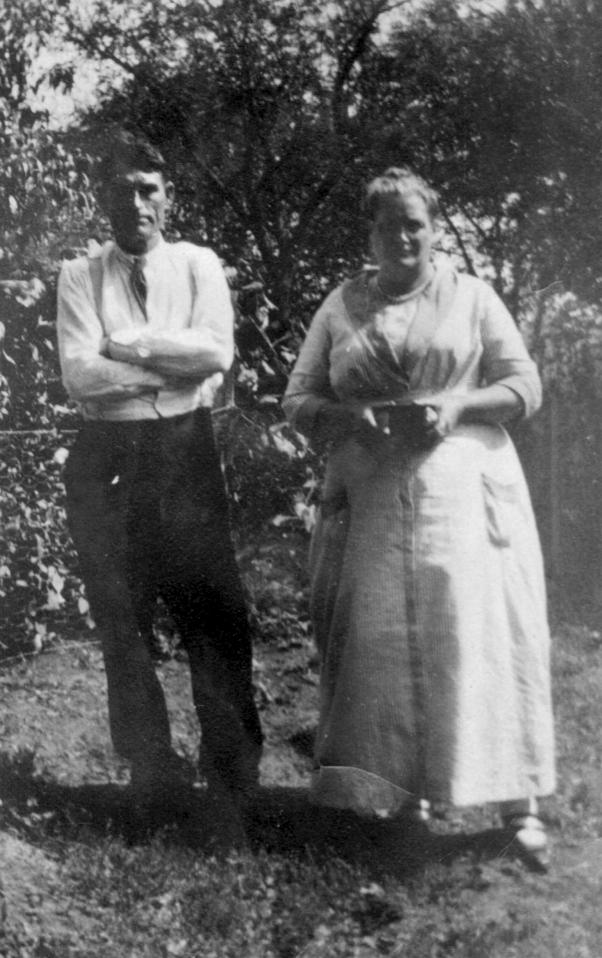
Gardner and Alice Munson Rivers

Death and Burial

Gardner T. Rivers died on 13 January 1945 in Taymouth Township, Saginaw County, Michigan, at the age of seventy-two.¹⁴ His Michigan death certificate lists coronary occlusion as the immediate cause of death, with coronary thrombosis noted as a contributing condition.¹⁵ He was buried on 14 January 1945 at Cook Cemetery in Taymouth Township.¹⁶ Alice Mary Rivers died later the same year.
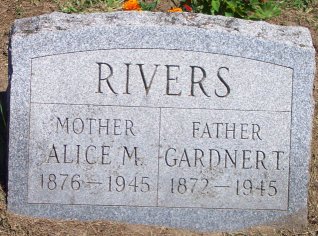
Headstone of Gardner Rivers and Alice Munson Rivers

Footnotes

  1. Michigan birth records; 1880 U.S. Federal Census, Albee Township, Saginaw County, Michigan.
  2. Ibid.; Michigan birth and death records for Rivers children.
  3. 1880 U.S. Federal Census, Albee Township, Saginaw County, Michigan.
  4. Michigan Marriage Records, Saginaw County, 13 June 1897.
  5. Michigan vital records; Munson family documentation.
  6. Michigan birth records, 1898–1913.
  7. 1920, 1930, and 1940 U.S. Federal Censuses, Taymouth Township, Saginaw County, Michigan.
  8. Plat Book of Saginaw County, Michigan, Taymouth Township (1916); Plat Book of Saginaw County, Michigan, Taymouth Township (1920).
  9. 1910 U.S. Federal Census, Taymouth Township, Saginaw County, Michigan.
  10. 1880, 1920, 1930, and 1940 U.S. Federal Censuses; Michigan vital records; plat maps; cemetery records.
  11. 1920 U.S. Federal Census, Taymouth Township, Saginaw County, Michigan.
  12. 1930 and 1940 U.S. Federal Censuses, Taymouth Township, Saginaw County, Michigan.
  13. Michigan death records for Ernest John Rivers (1933) and Earl G. Rivers (1935).
  14. Michigan Death Records, Gardner T. Rivers, 13 January 1945.
  15. Ibid.
  16. Cook Cemetery burial records, Taymouth Township, Michigan
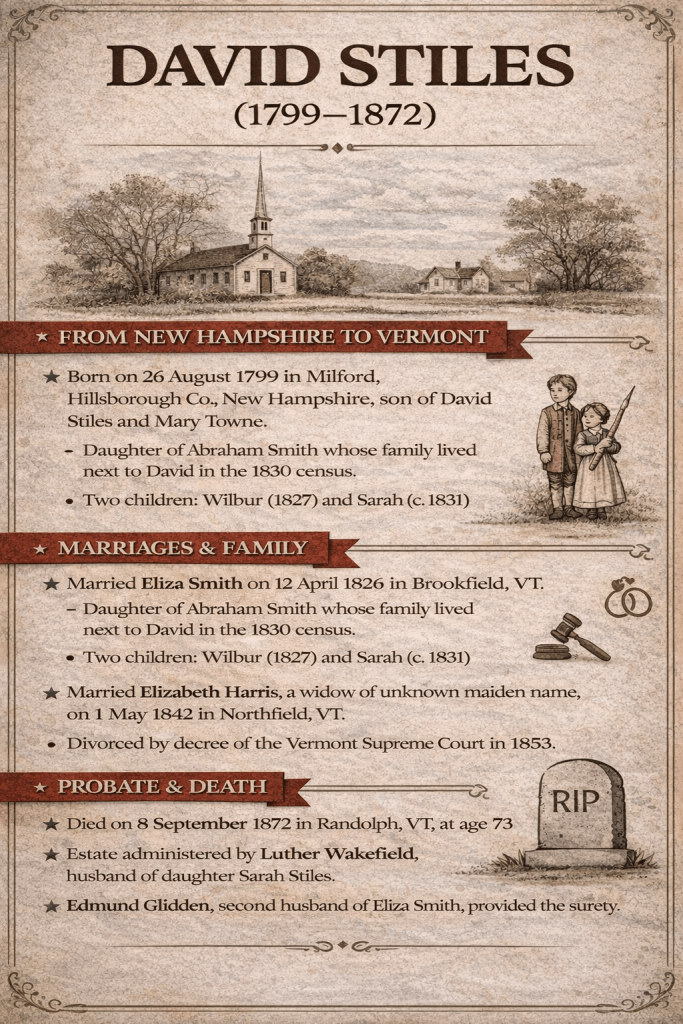
David Stiles (1799–1872) of New Hampshire and Vermont

David Stiles, sometimes recorded as David Styles, was born on 26 August 1799 in Milford, Hillsborough County, New Hampshire, the son of David Stiles and Mary Towne.¹ He spent his early life in New Hampshire but relocated to Vermont as a young adult, where he remained for the rest of his life and where most surviving records documenting his life were created.

Establishment in Vermont

By 1830, David Stiles was living in Brookfield, Orange County, Vermont. In that census, he was enumerated immediately before Abraham Smith, his father-in-law.² Because early census schedules were recorded in geographic order, this proximity strongly supports the identification of David Stiles as the husband of Eliza Smith during this period and places him squarely within the Smith family’s local network.

David continued to reside in central Vermont over the following decades. Although his surname appears with variant spellings in the records, his residence, occupation, and family associations remain consistent.

Marriage to Eliza Smith

David Stiles married Eliza Smith on 12 April 1826 in Brookfield, Vermont.³ Eliza was the daughter of Abraham Smith. The couple had exactly two children:

  • Wilbur F. Stiles, born 16 March 1827
  • Sarah M. Stiles, born about 1831⁴

No evidence has been found of additional children.

No divorce record has been located for David Stiles and Eliza Smith. However, Eliza clearly left David before 1840. She married Edmund Glidden on 23 March 1840, establishing that her marriage to David had ended by that date.⁵

Edmund Glidden later appears as a surety in probate material associated with David Stiles’s estate. This connection reinforces the conclusion that David Stiles and Eliza Smith were formerly married and shared children, despite the absence of a surviving divorce record.

Marriage to Elizabeth Harris and Divorce

On 1 May 1842, David Stiles married Elizabeth Harris in Northfield, Washington County, Vermont.⁶ The marriage record identifies her as “Mrs. Elizabeth Harris,” indicating that Harris was a married surname and that she had been previously married. Her maiden name has not yet been identified.

This designation helps explain an 1840 census entry in which Elizabeth Harris appears as the named head of household in Northfield, Vermont.⁷ While census schedules of this period typically list male householders, women were sometimes recorded when they controlled or managed the household, were widowed, or were living independently. Her appearance as head of household is therefore consistent with her marital history.

David Stiles and Elizabeth Harris were divorced by decree of the Vermont Supreme Court in April 1853.⁸ Contemporary newspaper notices confirm the divorce and place it firmly within the known timeline of David’s life.

Later Marriages

Following his divorce from Elizabeth Harris, David married Angeline Poole on 29 November 1853 in Northfield.⁹ Angeline died in 1868.

David married for the final time on 7 November 1870 in Williamstown, Vermont, to Melissa E. Davenport.¹⁰ This marriage record identifies the groom as 70 years old, born in New Hampshire, a farmer by occupation, and the son of David Stiles. These details align precisely with David Stiles Jr. (1799–1872) and distinguish him from another, younger Vermont-born man of the same name living in Northfield at the same time.

Census Records and Men of the Same Name

The 1870 census for Northfield, Vermont, contains entries for two men named David Stiles (or Styles).¹¹ One is younger and Vermont-born; the other is older and consistent with a New Hampshire birth in 1799. When age, birthplace, occupation, marital history, and probate evidence are considered together, the older individual can be confidently identified as David Stiles Jr.

The presence of more than one man of the same name in the same town highlights the importance of evaluating census records alongside other documents rather than relying on any single source in isolation.

Death and Probate

David Stiles died on 8 September 1872 in Randolph, Orange County, Vermont, at the age of 73.¹² His death record lists his occupation as farmer and gives the cause of death as consumption. Probate records name Luther Wakefield, husband of David’s daughter Sarah Stiles, as administrator of the estate.¹³ This appointment confirms the established family relationships and links David’s early and later life through consistent documentary evidence.

Conclusion

Although the life of David Stiles presents challenges common to nineteenth-century research—including surname variations, multiple marriages, and contemporaries of the same name—the surviving records form a coherent and well-supported narrative. Census proximity to Abraham Smith, the documented marriage to Eliza Smith and their two children, Eliza’s remarriage by 1840, a court-ordered divorce from Elizabeth Harris, clearly identified later marriages, and probate administration by known relatives together establish the life course of David Stiles Jr. (1799–1872).


Sources

  1. New Hampshire birth records, Milford, Hillsborough County, 1799.
  2. 1830 U.S. census, Brookfield, Orange County, Vermont.
  3. Vermont marriage records, Brookfield, Orange County, 12 April 1826.
  4. Vermont vital and census records for Wilbur F. Stiles and Sarah M. Stiles.
  5. Vermont marriage, Eliza Smith to Edmund Glidden, 23 March 1840 (date preserved through derivative sources).
  6. Vermont marriage records, Northfield, Washington County, 1 May 1842.
  7. 1840 U.S. census, Northfield, Washington County, Vermont.
  8. Vermont Supreme Court divorce notices, April 1853.
  9. Vermont marriage records, Northfield, Washington County, 29 November 1853.
  10. Vermont marriage records, Williamstown, Orange County, 7 November 1870.
  11. 1870 U.S. census, Northfield, Washington County, Vermont.
  12. Vermont death records, Randolph, Orange County, 8 September 1872.
  13. Vermont probate records, Orange County, estate of David Stiles.

William Henry Lacy (1878–1924)

Early life in Bay County

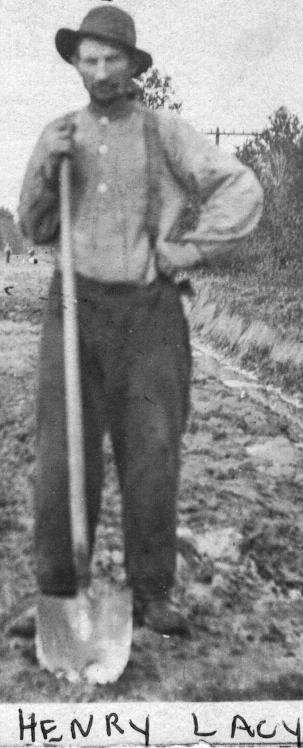
William Henry Lacy was born on 26 May 1878 in Michigan, the son of Martin V. Lacy and Nancy J. Whitney.¹ His childhood unfolded in Bay County, where he appears with his parents in the 1880 federal census and again in the 1884 and 1894 Michigan state censuses in Kawkawlin Township.²³⁴ These records place William within a rural farming community shaped by agriculture and seasonal labor along the Saginaw Bay watershed.

William Henry Lacy

Loss marked his early years. Several older half-siblings died before William reached adulthood, and family deaths continued through his youth. His father, Martin V. Lacy, died in 1904 in Garfield Township, Bay County.¹ Two years later, William lost both his mother, Nancy J. Whitney Lacy, and his sister Alice, who died shortly before their mother in Charles City, Virginia.¹ By his late twenties, William was already the surviving member of a significantly reduced immediate family.

Marriage and establishing a household

On 28 May 1907, William married Margaret Doonan in Midland, Michigan.⁵ Margaret, born in Bay County in 1888, was the daughter of William Doonan and Susan Rosetta Smith.¹ Their marriage coincided with William’s transition from his childhood household into building a family of his own.

Early records identify William as a farmer, consistent with his upbringing and the agricultural economy of Garfield Township and surrounding areas. Farming during this period often required supplemental wage labor, and many men combined agricultural work with trades or seasonal employment as opportunities arose.

Children, work, and repeated loss

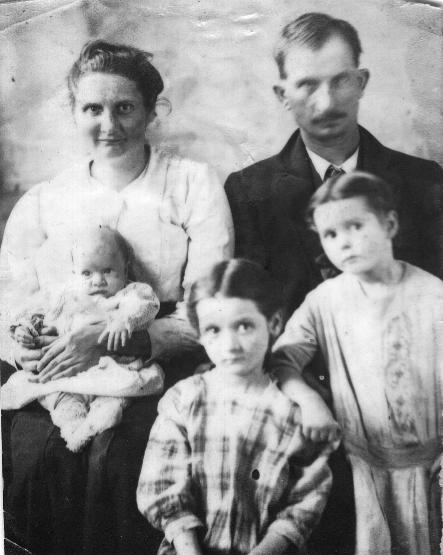
Between 1908 and 1920, William and Margaret had eight children. The surviving records reveal a family life marked by both continuity and repeated tragedy.

Their first child, Milo W. Lacy, was born and died on the same day in February 1908.⁶ Elizabeth Sabria Lacy was born in January 1909.⁷ In February 1910, Ira Gerald Lacy was born, but he died later that same year.⁸ These early losses occurred while the family was still living in Bay County.

By the 1910s, William had moved his family to Saginaw. Census records, city directories, and his death certificate list his occupation as carpenter, indicating a shift toward skilled wage labor.⁹¹⁰ Carpentry placed William within Saginaw’s expanding residential and industrial economy, offering steadier employment than farming alone.

Eva Lucushia Lacy was born in 1911.¹¹ Howard Guy Lacy followed in 1912 but died in March 1916 at the age of three.¹² Cora Mae Lacy was born later that same year.¹³ Dorothy Helen Lacy was born in December 1917 and died on her first birthday in 1918, during a period when childhood illness and infectious disease were common causes of death.¹⁴

The death certificates for these children record causes such as pneumonia and infantile illness, clinical language that conveys little of the cumulative emotional toll on the family.¹⁵ By the end of the decade, William and Margaret had buried five of their eight children.

Margaret “Maggie” Doonan, William Henry Lacy, Cora Lacy, Eva Lacy, Elizabeth Sabria Lacy.

Later years in Saginaw

Despite these losses, William continued to work and support his household. City directory entries between 1917 and 1923 show the family living at multiple addresses in Saginaw, including North Washington Avenue, South Jefferson Avenue, Williamson Street, and West Genesee.¹⁰ These moves reflect the realities of working-class life in an industrial city, where housing was often tied to employment and financial conditions.

William registered for the World War I draft in 1918, providing confirmation of his birth date, residence, employer, and physical description.¹⁶ Although he was not called into service, the registration places him within the broader national context of the period.

In February 1920, the couple’s youngest child, Martin Van Buren Lacy, was born in Saginaw.¹⁷ The 1920 federal census shows William living with Margaret and their surviving children, still working as a carpenter.⁸

Death and burial

William Henry Lacy died suddenly on 7 July 1924 at the age of 46. His Michigan death certificate lists myocarditis as the cause of death.¹ Contemporary newspaper accounts report that he died at his home at the corner of Williamson and Bradley streets and emphasize the unexpected nature of his passing.²

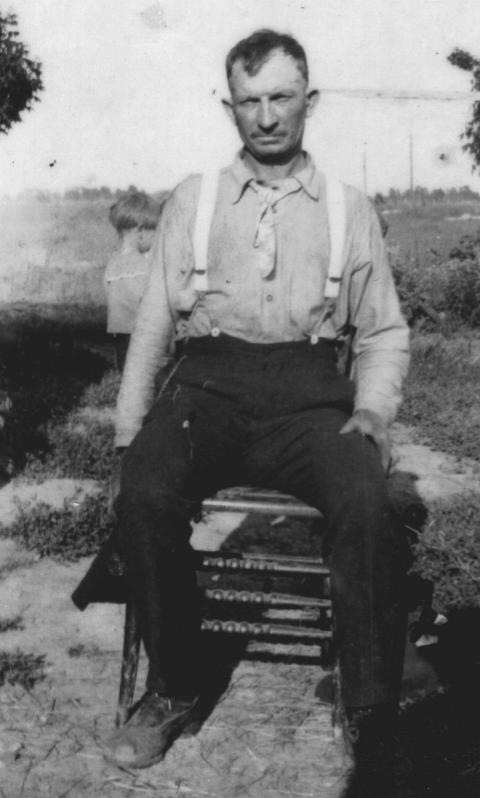
William Henry Lacy

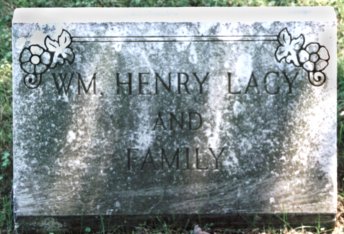
He was buried on 8 July 1924 in Taymouth Township Cemetery, Saginaw County.¹ His headstone bears the inscription “Wm Henry Lacy and family,” a phrase that quietly reflects both his role as a husband and father and the shared losses experienced by the family he left behind.¹⁸

Remembering William Henry Lacy

William Henry Lacy did not leave personal papers or written reflections. What remains are records: censuses, civil registrations, city directories, draft cards, and headstones. Taken together, they describe a man who worked with his hands, adapted from farming to carpentry, and endured repeated personal loss while continuing to provide for his family.

For those who know him only through documents, his life can appear compressed into dates and causes of death. But for the relatives who remembered him—and for later generations—William Henry Lacy was more than a name on a stone. He was a working man whose life unfolded quietly within the communities of Bay County and Saginaw, Michigan.


Sources

  1. Michigan Department of Health, Certificate of Death for William Henry Lacy, 7 July 1924, Saginaw, Saginaw County, Michigan.
  2. Obituary of William H. Lacy, Saginaw-area newspaper, July 1924.
  3. 1880 U.S. Federal Census, Kawkawlin Township, Bay County, Michigan.
  4. 1884 Michigan State Census, Kawkawlin Township, Bay County, Michigan.
  5. 1894 Michigan State Census, Kawkawlin Township, Bay County, Michigan.
  6. Michigan Marriage Record, Midland County, Michigan, 28 May 1907.
  7. Michigan Birth and Death Records, Garfield Township, Bay County, Michigan, 1908, Milo W. Lacy.
  8. Michigan Birth and Death Records, Garfield Township, Bay County, Michigan, 1910, Ira Gerald Lacy.
  9. 1910 U.S. Federal Census, Garfield Township, Bay County, Michigan.
  10. U.S. City Directories, Saginaw, Michigan, 1917–1923.
  11. Michigan Birth Record, 1911, Eva Lucushia Lacy.
  12. Michigan Birth and Death Records, Saginaw, Michigan, Howard Guy Lacy, 1912–1916.
  13. Michigan Birth Record, Saginaw, Michigan, 1916, Cora Mae Lacy.
  14. Michigan Birth and Death Records, Saginaw, Michigan, Dorothy Helen Lacy, 1917–1918.
  15. Michigan Death Records for children of William Henry Lacy and Margaret Doonan.
  16. World War I Draft Registration Card, William Henry Lacy, Saginaw, Michigan, 1918.
  17. Michigan Birth Record, Saginaw, Michigan, 1920, Martin Van Buren Lacy.
  18. Taymouth Township Cemetery records and headstone inscription for “Wm Henry Lacy and family.”

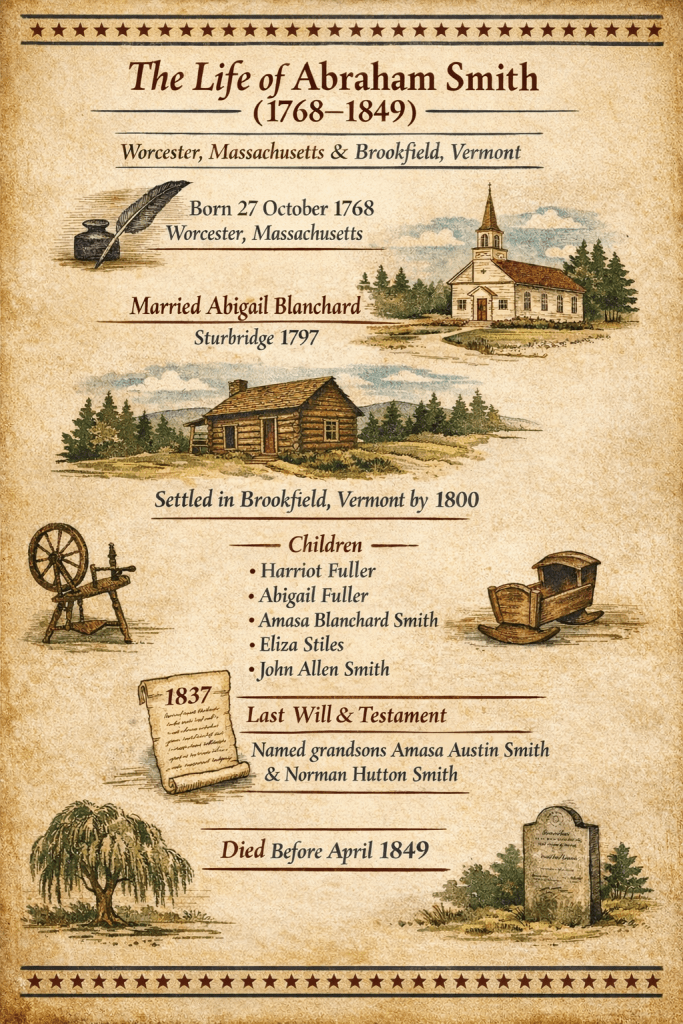
Abraham Smith (1768–1849) of Worcester, Massachusetts, and Brookfield, Vermont

From Massachusetts Roots to a Vermont Homestead

Abraham Smith was born on 27 October 1768 in Worcester, Worcester County, Massachusetts, the son of Abraham Smith and Lucy Allen.¹ He reached adulthood in the years following the American Revolution, a period shaped for him not by military service, but by marriage, migration, and the establishment of a household.

Abraham Smith Jr.’s adult life is well documented through marriage records, census context, probate files, and Vermont vital records, allowing his life and family to be reconstructed with confidence.

Marriage and Early Family Life

On 9 February 1797, Abraham Smith married Abigail Blanchard in Sturbridge, Massachusetts.² Shortly after their marriage, the couple began moving northward, a pattern common among young New England families seeking land and opportunity in the post-Revolutionary period.

Their first known child, Harriot Louise Smith, was born on 18 May 1798 in Cornish, Sullivan County, New Hampshire, suggesting a brief residence there before the family continued on to Vermont.³ By 1800, Abraham and Abigail had settled permanently in Brookfield, Orange County, Vermont, where Abraham appears as a resident in the 1800 federal census.⁴

Children of Abraham and Abigail Smith

Abraham Smith Jr. and Abigail Blanchard Smith were the parents of several children, documented through a combination of vital records and probate evidence. Their children included:

  • Harriot Smith, later Harriot Fuller, wife of Felix Fuller
  • Abigail Smith, later Abigail Fuller, wife of Sylvanus Fuller
  • Amasa Blanchard Smith, born about 1801 and died in 1808
  • Eliza Smith, later Eliza Stiles, wife of David Stiles
  • John Allen Smith, born 20 December 1809⁵

The early death of Amasa Blanchard Smith is recorded in Vermont vital records and explains his absence from later probate documents.⁶

Life in Brookfield, Vermont

From about 1800 until his death, Abraham Smith remained in Brookfield. The birthplaces of his younger children, census records, and probate jurisdiction all confirm Brookfield as his permanent residence. He lived there through the early decades of the nineteenth century, participating in the ordinary rhythms of rural Vermont life.

Abraham’s wife Abigail died in 1848.⁷ Abraham Smith himself died sometime before 10 April 1849, when probate proceedings for his estate were initiated in Orange County, Vermont.⁸

The Will and Probate of Abraham Smith

Abraham Smith wrote his will on 6 March 1837 in Brookfield.⁹ This document, together with the probate papers filed after his death, forms the most important body of evidence for understanding his family structure.

In his will, Abraham named his wife Abigail and his surviving children, identifying his daughters by their married names and explicitly associating them with their husbands. He named Harriot Fuller, Abigail Fuller, and Eliza Stiles, along with his son John Allen Smith.¹⁰

The will also made specific provisions for two grandsons, Amasa Austin Smith and Norman Hutton Smith, both explicitly identified as sons of John Allen Smith.¹¹

Two surviving versions of Abraham Smith’s probate file exist, preserved in different clerk’s books. These records represent parallel copies of the same estate proceedings and are consistent in substance, naming the same heirs, executor, and property interests.¹²

Conclusion

Abraham Smith Jr.’s life reflects the experience of a post-Revolutionary New England settler. Born in Massachusetts, briefly passing through New Hampshire, and ultimately establishing himself in Vermont, he represents a generation shaped by migration, family building, and landholding rather than by war.

Through careful examination of vital records and probate documents, Abraham Smith Jr.’s life and family can be reconstructed with confidence. His will, in particular, provides clear and direct evidence of his children and their marriages, anchoring the family structure firmly in the historical record.


Footnotes

  1. Worcester, Massachusetts, Town Birth Records; Massachusetts Town and Vital Records, 1620–1988 (Ancestry).
  2. Massachusetts Marriages, 1633–1850; Sturbridge marriage records (Ancestry).
  3. New Hampshire Birth Records, 1631–1920 (Ancestry).
  4. 1800 U.S. Federal Census, Brookfield, Orange County, Vermont (Ancestry).
  5. Vermont Vital Records, 1720–1908; Massachusetts and Vermont town records (Ancestry).
  6. Vermont Vital Records, death of Amasa Blanchard Smith, 1808 (Ancestry).
  7. Vermont Vital Records, death of Abigail (Blanchard) Smith, 1848 (Ancestry).
  8. Vermont, Wills and Probate Records, 1749–1999, Orange County, estate of Abraham Smith (d. 1849) (Ancestry).
  9. Will of Abraham Smith, dated 6 March 1837, Brookfield, Vermont.
  10. Ibid., clauses naming daughters Harriot Fuller, Abigail Fuller, and Eliza Stiles, and son John Allen Smith.
  11. Ibid., clauses naming “my grandsons Amasa Austin Smith and Norman Hutton Smith, sons of my son John Allen Smith.”
  12. Vermont probate clerk record books, Randolph District, Orange County.

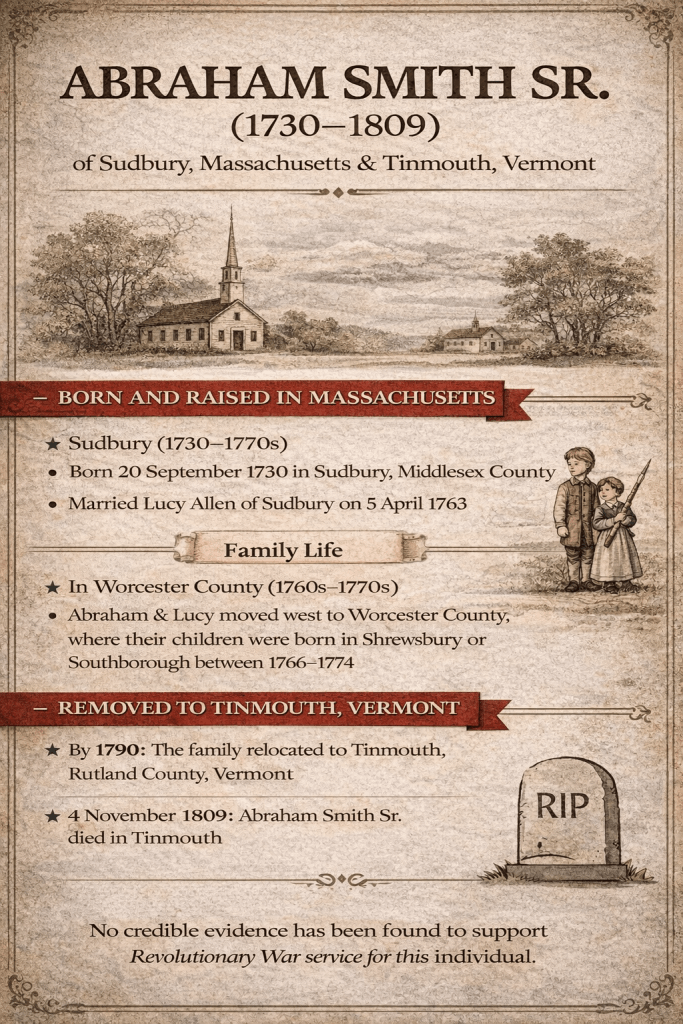
Abraham Smith (1730–1809) of Sudbury, Massachusetts, and Tinmouth, Vermont

A Man of the Revolutionary Era—But Not a Soldier

Abraham Smith was born on 20 September 1730 in Sudbury, Middlesex County, Massachusetts, a well-established New England town with extensive surviving eighteenth-century vital records.¹ He married Lucy Allen, and together they raised their family during a period that spanned the colonial era, the American Revolution, and the early years of the United States.²

Abraham’s adult life unfolded during the Revolutionary era, but surviving records do not demonstrate that he participated in the war as a soldier. Instead, the documentary evidence places him firmly in civilian life—raising a family, maintaining a household, and later participating in postwar migration patterns common to New England families.

Family and Household

Abraham Smith and his wife Lucy Allen were the parents of several children, including a son also named Abraham, born in 1768 in Worcester County, Massachusetts.³ This younger Abraham—referred to here as Abraham Smith Jr.—is clearly documented as a separate individual who later settled in Brookfield, Orange County, Vermont, where he left an extensive probate record.⁴

By the outbreak of the Revolutionary War in 1775, Abraham Smith Sr. was forty-five years old and had dependent children still at home. While men of this age sometimes served, many did not, particularly when responsible for sustaining farms and households, a pattern well documented in New England militia demographics.⁵

Move to Vermont

Following the Revolutionary War, Abraham Smith relocated north to Tinmouth in Rutland County, Vermont. This move aligns with a broader postwar migration pattern, as families from Massachusetts and southern New England moved into Vermont towns newly opened to settlement and formalized governance.⁶

Abraham Smith died in Tinmouth on 4 November 1809.⁷ His death is recorded in Vermont vital records, and his probate proceedings further confirm his residence in Tinmouth at the end of his life.⁸

The Question of Revolutionary War Service

Abraham Smith of Tinmouth has long been attributed Revolutionary War service in at least one early DAR lineage record.⁹ That attribution has been repeated in derivative family trees and secondary sources, despite the lack of supporting contemporary evidence.

The DAR Ancestor Database lists numerous men named Abraham Smith who served during the Revolutionary War, across multiple colonies and states, under different commanding officers and with differing life details.¹⁰ Careful comparison of these service profiles shows that none can be conclusively matched to the Abraham Smith born in Sudbury in 1730 and deceased in Tinmouth in 1809.

Critically, Abraham Smith’s probate file contains no references to military service, land bounties, pensions, arrears of pay, or other benefits commonly associated with Revolutionary War veterans or their heirs.¹¹ No pension application or verified service record has been identified that connects him to wartime service.

Resolving the Misattribution

The Revolutionary War service attributed to Abraham Smith of Tinmouth appears to be the result of name conflation. “Smith” is among the most common surnames in eighteenth-century New England, and Abraham was a frequently used given name. Early lineage applications often relied on incomplete records and did not have access to the full range of probate, census-context, and geographic evidence now available.

Subsequent analysis of birth, marriage, residence, probate, and family structure demonstrates that the military service cited in the early DAR record belongs to other men named Abraham Smith, not to the individual who died in Tinmouth in 1809.

Conclusion

Abraham Smith lived through the Revolutionary era, raised a family during a time of upheaval, and participated in the postwar settlement of Vermont. While he was not a Revolutionary War soldier, his life reflects the experience of many New England civilians whose labor, stability, and family networks sustained their communities before, during, and after the war.

Correcting the historical record does not diminish Abraham Smith’s legacy. Rather, it ensures that his story—and the story of Revolutionary War service—is told accurately and supported by evidence.


Footnotes

  1. Sudbury, Massachusetts, town vital records; Massachusetts Town and Vital Records, 1620–1988 (Ancestry).
  2. Marriage and family structure inferred from Massachusetts and Vermont vital records and probate context.
  3. Massachusetts Town Birth Records; Worcester County birth registers (Ancestry).
  4. Vermont, Wills and Probate Records, 1749–1999, Orange County, estate of Abraham Smith (d. 1849) (Ancestry).
  5. Massachusetts militia participation patterns discussed in contemporary town and county studies; absence of service-specific documentation for Abraham Smith.
  6. Vermont settlement and migration patterns following the Revolutionary War; Rutland County land and town histories.
  7. Tinmouth, Rutland County, Vermont, vital records.
  8. Rutland County, Vermont, probate records for Abraham Smith (d. 1809).
  9. DAR Ancestor Database, legacy entry for Abraham Smith, ancestor number A104615.
  10. DAR Ancestor Search results for “Abraham Smith,” multiple entries with divergent service profiles.
  11. Rutland County probate file for Abraham Smith (d. 1809), no military references noted.

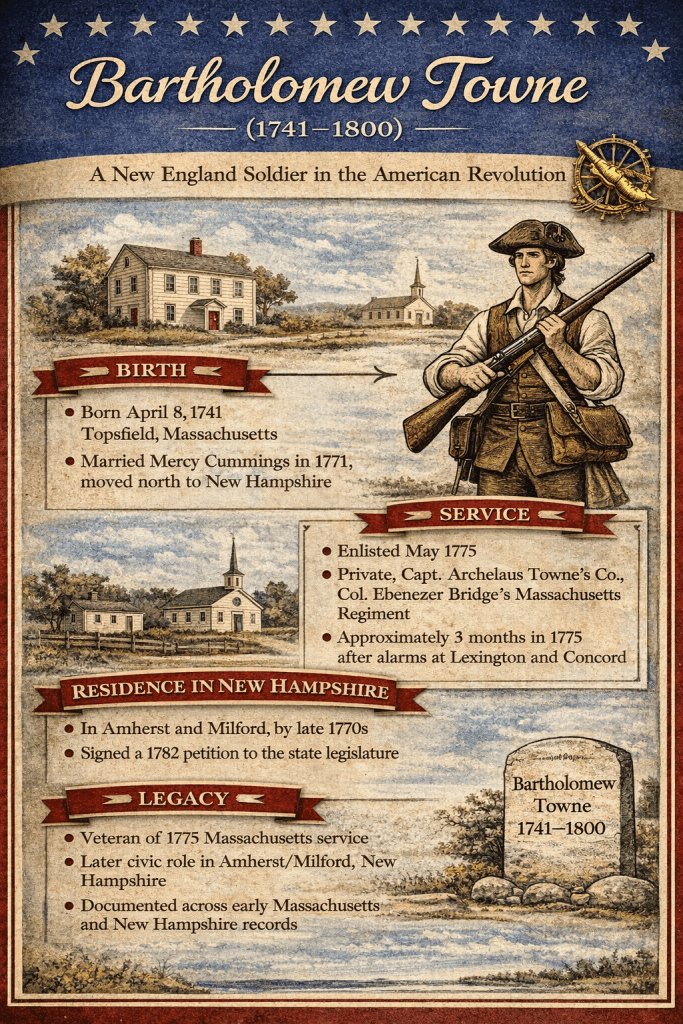
Bartholomew Towne (1741–1800)

Bartholomew Towne’s Revolutionary War service is documented in both Massachusetts and New Hampshire records, placing him among the many New England men whose military and civic lives crossed colonial and early state boundaries. His service appears in compiled Massachusetts rolls from 1775 and later records from New Hampshire, reflecting the fluid movement of families and militia obligations during the war years.¹

Born in Massachusetts and later settled in New Hampshire, Towne’s life illustrates how Revolutionary service was often rooted in local communities while still contributing to the broader Continental effort.


Early Life in Massachusetts

Bartholomew Towne was born on 8 April 1741 in Topsfield, Essex County, Massachusetts, the son of Elisha Towne and Mercy Foster.² He grew up in a well-established Massachusetts family and reached adulthood during the years of mounting political and military tension between the colonies and Great Britain.

On 3 October 1771, he married Mercy Cummings in Andover, Massachusetts.³ Within a few years, the couple relocated northward into what would become Hillsborough County, New Hampshire, part of a broader pattern of late-colonial migration from coastal Massachusetts into interior New England.⁴


Revolutionary War Service

Bartholomew Towne’s military service is documented in Massachusetts Revolutionary War records. He appears as a private in Captain Archelaus Towne’s company, part of Colonel Ebenezer Bridge’s 27th Massachusetts Regiment.⁵ According to the compiled rolls, he enlisted in May 1775 and served approximately three months, with his service recorded on a muster roll dated 1 August 1775.⁶

Additional records show Towne received advance pay and later an order for a bounty coat, a benefit commonly issued to soldiers who met required service terms during the early months of the war.⁷ These details firmly place his service in the critical opening phase of the Revolution, following the alarms of April 1775 and the mobilization of Massachusetts militia forces.

Towne’s service was short-term, a pattern typical of Massachusetts soldiers in 1775, many of whom served limited enlistments before returning home or resuming civilian life.⁸


Residence and Civic Activity in New Hampshire

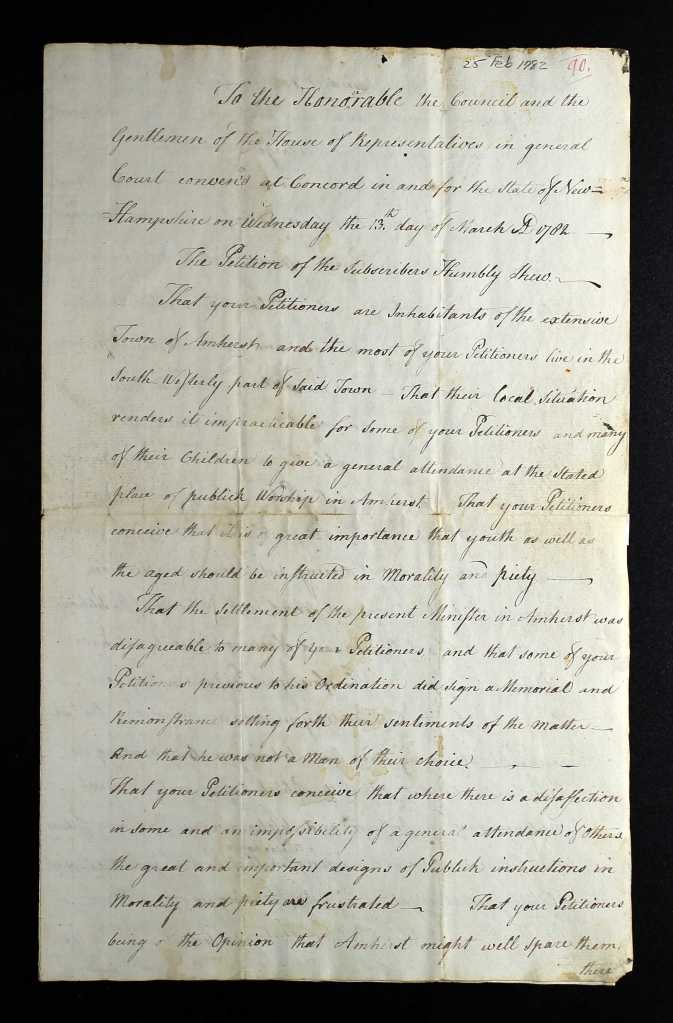
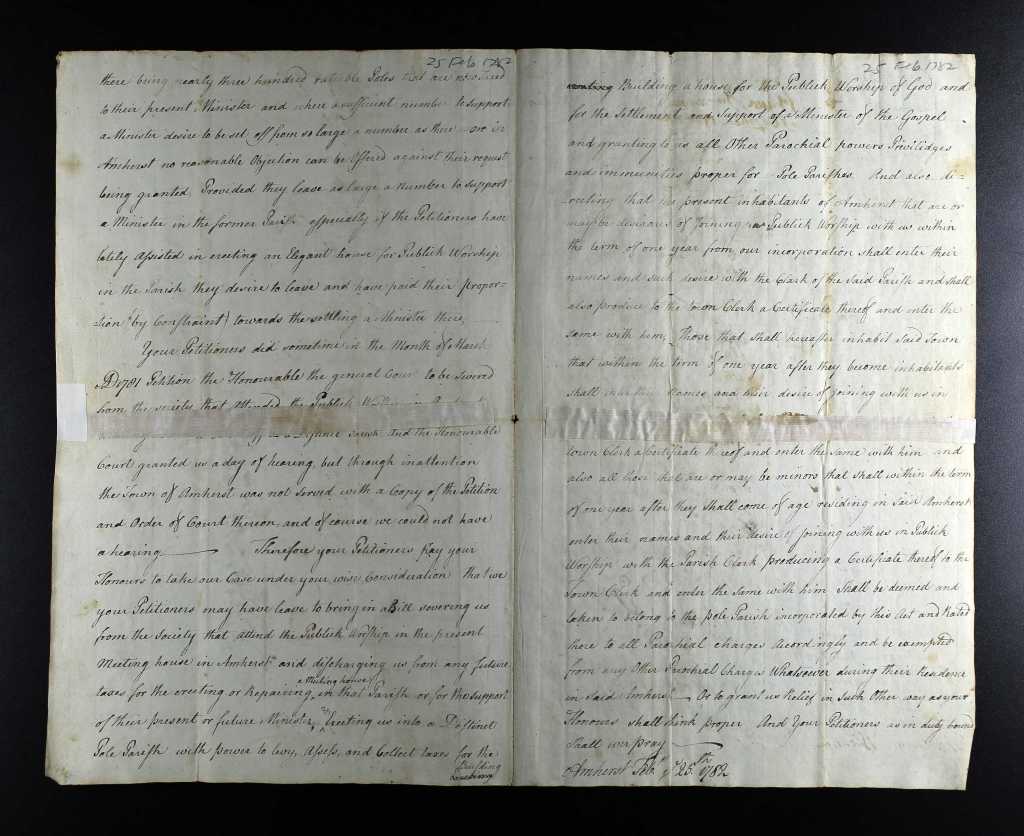
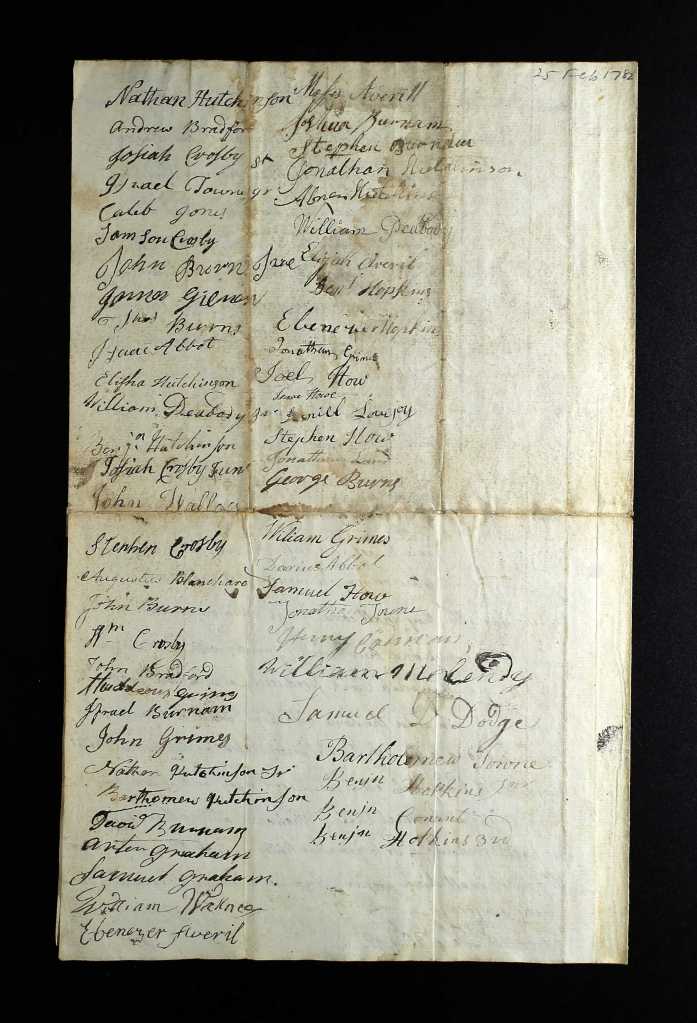
By the late 1770s, Bartholomew Towne was living in Amherst and Milford, Hillsborough County, New Hampshire. His presence there is confirmed not only through vital and census records but also through a surviving 1782 petition addressed to the New Hampshire legislature.⁹

That petition, signed by Towne and other inhabitants, concerned local religious organization and the establishment of public worship in the southern part of Amherst. Towne’s signature appears among the residents advocating for community governance and religious instruction, demonstrating his continued civic engagement after the war.¹⁰

This document places Towne squarely within the post-war civic life of New Hampshire and confirms his identity as the same man who earlier served in Massachusetts military units.


Later Life and Death

Bartholomew Towne appears in the 1790 federal census in Hillsborough County, New Hampshire, confirming his residence and household following the Revolutionary period.¹¹ He died in 1800 in Milford, Hillsborough County, New Hampshire.¹²

His life spanned the colonial era, the Revolutionary War, and the early years of the United States, with both his military service and later civic participation documented in contemporary records.


Assessing the Evidence

Bartholomew Towne’s Revolutionary War service rests on a solid evidentiary foundation. His enlistment and service in 1775 are supported by Massachusetts compiled rolls, including muster and pay records, while his later residence and civic activity in New Hampshire are corroborated by petitions and census data.¹³

The continuity of name, timeframe, and location across these records supports a confident identification without requiring speculative connections or later pension testimony.


Conclusion

Bartholomew Towne was not a long-term Continental soldier, but he was part of the first wave of New England men who answered the call in 1775. His service in a Massachusetts regiment during the opening months of the war, followed by his later civic role in New Hampshire, reflects the lived experience of many Revolutionary participants whose contributions were essential but modestly recorded.

By tracing his life across state lines and grounding his story in contemporary records, we preserve an accurate and meaningful account of his role in the Revolutionary generation.


Notes

  1. Massachusetts Soldiers and Sailors of the Revolutionary War; U.S. Revolutionary War Rolls, 1775–1783.
  2. Topsfield, Massachusetts, town birth records; compiled Massachusetts vital records.
  3. Massachusetts marriage records, Andover, 1771.
  4. Hillsborough County, New Hampshire, settlement patterns and family migration.
  5. Massachusetts Revolutionary War rolls, Capt. Archelaus Towne’s Company, Col. Ebenezer Bridge’s Regiment.
  6. Muster roll dated 1 August 1775, Massachusetts Revolutionary records.
  7. Massachusetts pay and bounty records, 1775.
  8. Massachusetts militia enlistment practices, early Revolutionary period.
  9. New Hampshire legislative petition, 1782, signed by Bartholomew Towne and others Bartholomew Towne on petition.
  10. Petition text and signatures, page 3, identifying Towne among Amherst inhabitants Bartholomew Towne on petition.
  11. 1790 U.S. Federal Census, Hillsborough County, New Hampshire.
  12. New Hampshire death records and compiled family histories.
  13. Correlation of military, civic, and residential records following genealogical proof standards.

Aaron Hull (1745–1807)

Revolutionary War service is often imagined as long enlistments, dramatic campaigns, and later pension testimony. In reality, many Connecticut men served for brief periods in the early years of the conflict, answering calls before returning home to their families and farms. The military service of Aaron Hull fits that pattern and is supported by compiled federal military records.¹

Born and buried in Wallingford, Connecticut, Aaron Hull spent nearly his entire life within the same community. His Revolutionary War service, though short in duration, is firmly documented and securely attributable to him—making his case a relatively straightforward identification among Connecticut patriots.²


Early Life in Wallingford

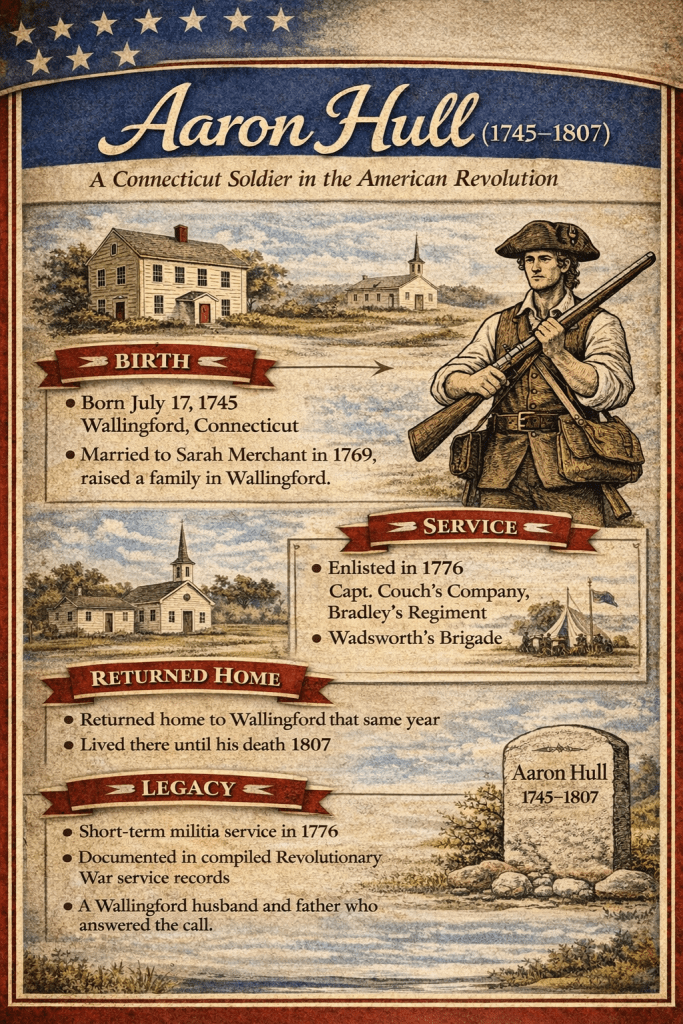
Aaron Hull was born 17 July 1745 in Wallingford, New Haven County, Connecticut, the son of John Hull and Mary Andrews.³ He lost his father in 1755, when Aaron was still a child.⁴

On 16 November 1769, Aaron married Sarah Merchant in Wallingford.⁵ Over the next decade the couple began raising a family. Their children’s births span the years immediately before, during, and after the Revolution, placing Aaron among the many married householders who balanced wartime obligations with domestic life.⁶


Revolutionary War Service

Aaron Hull’s Revolutionary War service appears in compiled federal service records derived from original muster and pay rolls.⁷ Those records indicate that he enlisted in 1776 in Captain John Couch’s company, within Colonel David Wooster’s/Wadsworth-associated Connecticut organization commonly referenced as Bradley’s Regiment (or battalion) in some compiled abstracts.⁸

His service was short-term and he was discharged the same year. Short enlistments of this kind were common for Connecticut men in 1776, particularly in service connected to local defense, regional mobilization, and short campaigns.⁹

A separate lineage-society abstract (compiled from earlier record sources) also reports Aaron Hull’s 1776 enlistment in Captain Couch’s company, Bradley’s battalion, Wadsworth’s brigade, with discharge the same year and identifying him as born in Wallingford, Connecticut.¹⁰ While such membership-era abstracts are not substitutes for original records, the agreement between the abstract and the compiled service record strengthens confidence in the interpretation and identification of the soldier.¹¹


Civilian Life During and After the War

After his wartime service, Aaron Hull returned to civilian life in Wallingford and the nearby Meriden area. The continued births of his children in Connecticut through 1780 reflect a stable household during the postwar years.¹²

Federal census schedules place him in Wallingford in both 1790 and 1800, confirming continuity of residence.¹³ Unlike some veterans who moved westward after the Revolution, Aaron Hull appears to have remained rooted in the same Connecticut community where he was born.

Aaron Hull died on 22 September 1807 in Wallingford; his wife Sarah Merchant Hull died the same day.¹⁴ Local burial information associates the family with the Meriden/Wallingford area, consistent with their long-term residence.¹⁵


Assessing the Evidence

Aaron Hull’s service is supported by a strong combination of sources: compiled federal military records that identify the soldier’s unit and year of enlistment, and civilian records that consistently place the same man in Wallingford before and after the war.

The absence of a pension file does not weaken the case. Many men with short service in 1776 never applied for pensions, and eligibility rules changed over time. Aaron Hull’s documented service fits well within the category of Revolutionary participants whose contribution was real, essential, and only briefly recorded.


Conclusion

Aaron Hull was not a professional soldier and did not leave behind a personal narrative of wartime experience. He was a Wallingford husband and father who served when called in 1776 and returned home to raise his family. His documented service provides a reliable link to the Revolutionary generation and reflects the ordinary, short-term duty on which the war effort frequently depended.

By presenting his story as the records allow—without embellishment—we preserve both historical accuracy and respect for the man himself.


Notes

  1. National Archives, Compiled Service Records of Soldiers Who Served in the American Army During the Revolutionary War (Record Group 93), publication M881; accessed via Fold3.
  2. Correlation of military and civilian records for Aaron Hull of Wallingford, Connecticut (birth, marriage, residence, death).
  3. Wallingford, Connecticut, birth records (Barbour Collection and/or church abstracts), as indexed on Ancestry.
  4. Wallingford, Connecticut, death record or town record entry for John Hull (d. 1755), as indexed on Ancestry.
  5. Wallingford, Connecticut, marriage records (Barbour Collection), marriage of Aaron Hull and Sarah Merchant, 1769, as indexed on Ancestry.
  6. Wallingford/Meriden, Connecticut, town birth records for the Hull children (Barbour Collection and related abstracts), as indexed on Ancestry.
  7. NARA, Compiled Service Records (RG 93), Aaron Hull service entry; accessed via Fold3.
  8. Compiled service abstract referencing Capt. John Couch’s Company and Bradley’s Regiment/Battalion within Wadsworth’s brigade framework; accessed via Fold3.
  9. General context: Connecticut enlistment practices and short-term service patterns in 1776.
  10. Daughters of the American Revolution lineage entry summarizing Aaron Hull’s service in Capt. Couch’s company, Bradley’s battalion, Wadsworth’s brigade, 1776; compiled publication.
  11. Agreement between lineage-society abstract and compiled federal service record supports identification and service summary.
  12. Connecticut town birth records for children born 1770–1780; indexed on Ancestry.
  13. 1790 and 1800 U.S. Federal Census, Wallingford, New Haven County, Connecticut; images/index on Ancestry.
  14. Wallingford, Connecticut, death record entries for Aaron Hull and Sarah (Merchant) Hull, 1807; indexed on Ancestry.
  15. Connecticut cemetery inscriptions/newspaper notices and local burial references (Meriden/Wallingford area); indexed collections on Ancestry.

Lemuel Gibbs (1738–1827)

A Connecticut Soldier in the American Revolution

When researching Revolutionary War service, it is often tempting to expect clear enlistment papers, detailed muster rolls, or pension files that neatly summarize a man’s military career. For many Connecticut soldiers, however, service survives only in fragmentary state records, brief militia references, or scattered town-level documentation.¹

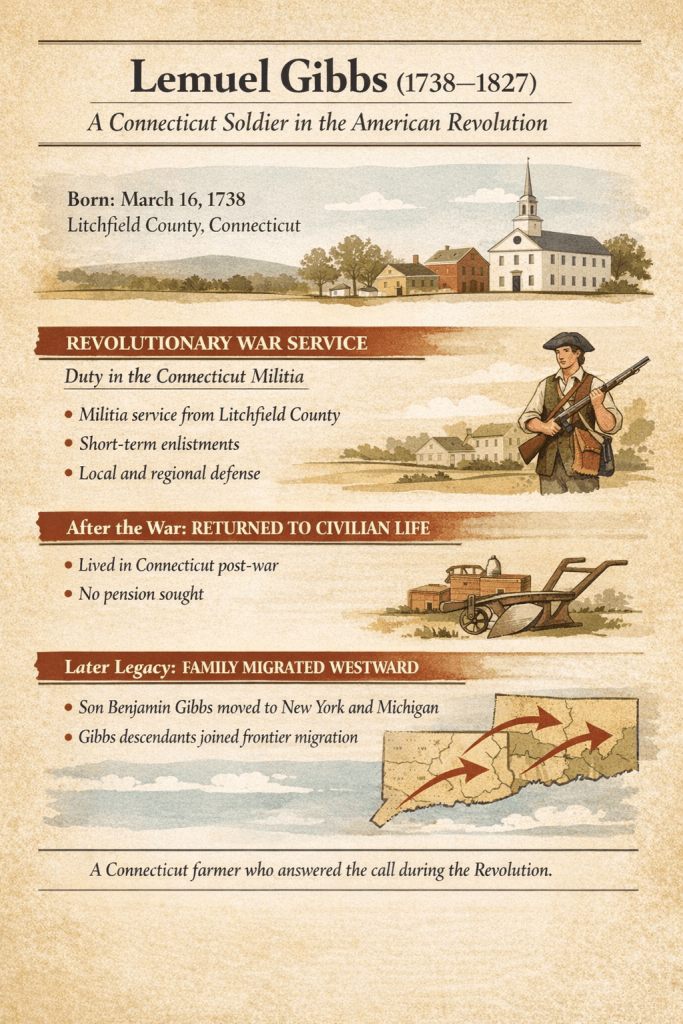
Born on 16 March 1738 in Litchfield County, Connecticut, Lemuel Gibbs lived squarely within the generation called upon to defend the colonies during the American Revolution. His service does not appear in dramatic narratives or extended pension testimony, but it is nonetheless documented in Connecticut military records and consistent with the state’s wartime militia system.²


Early Life and Family Context

Lemuel Gibbs was born into a long-established Connecticut family rooted in Litchfield County prior to the outbreak of hostilities with Great Britain. By the 1770s, he was an adult with family responsibilities, placing him among the many men who balanced military obligations with agricultural and household duties.³

Connecticut relied heavily on short-term militia service, frequently calling men out for brief periods rather than extended enlistments. As a result, many soldiers—particularly those who served locally—left behind only minimal documentation of their wartime participation.⁴


Revolutionary War Service

Lemuel Gibbs appears in Connecticut Revolutionary War military records, specifically within state-level compilations documenting militia service from Litchfield County.⁵ These records establish his participation without providing detailed information regarding unit assignment, length of service, or specific engagements.

This lack of detail is not unusual. Connecticut militia service often consisted of short tours responding to immediate needs such as coastal defense, troop movement, or regional security.⁶ While no surviving record places Gibbs in a named battle or extended campaign, his appearance in official military documentation confirms that he answered the colony’s call.

Equally important, there is no evidence of multiple contemporaneous men of the same name in the same jurisdiction that would cast doubt on the attribution of this service.⁷ The available evidence supports identifying this Lemuel Gibbs as the man referenced in the military records.


After the War

Following the conclusion of the Revolutionary War, Lemuel Gibbs returned to civilian life in Connecticut. He does not appear in federal pension files, a circumstance shared by many militia veterans whose service predated the pension acts or whose short-term duty did not meet later eligibility requirements.⁸

Lemuel Gibbs lived until 3 January 1827, witnessing the early decades of the United States. His descendants later joined the westward movement into New York and Michigan, reflecting broader post-Revolutionary settlement patterns across New England families.⁹


Assessing the Evidence

Lemuel Gibbs’s service illustrates a key principle of Revolutionary War research:
limited records do not equate to nonexistent service.

His documented appearance in Connecticut military records, combined with his age, residence, and lack of conflicting identities, provides a reasonable and supportable conclusion that he served during the American Revolution. His experience mirrors that of countless citizen-soldiers whose contributions were essential but modestly recorded.


Conclusion

Lemuel Gibbs was not a career soldier or public figure. He was a Connecticut man who answered the call of his colony during a time of upheaval. Though the surviving records are sparse, they are sufficient to place him among those who contributed to the Revolutionary effort.

By presenting his story carefully—without embellishment—we preserve both the integrity of the historical record and the memory of an ordinary man whose service helped shape the nation that followed.


Notes

  1. Public Records of the State of Connecticut, Revolutionary War era volumes.
  2. Connecticut military record compilations, Revolutionary period.
  3. Litchfield County vital and town records.
  4. Robert J. Taylor, Connecticut’s Militia System During the American Revolution.
  5. Public Records of the State of Connecticut, vols. 15–16.
  6. Ibid.
  7. Litchfield County tax and town lists, 1770s–1780s.
  8. U.S. Revolutionary War pension legislation and eligibility requirements.
  9. Probate and family records for the Gibbs family.

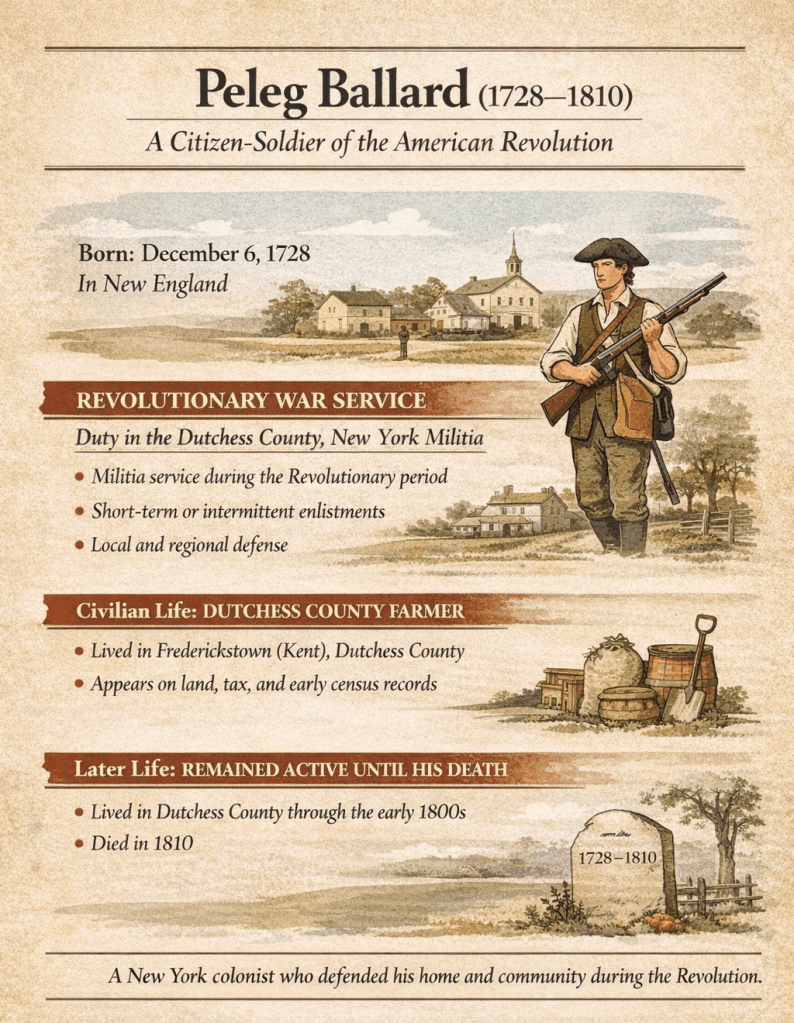
Peleg Ballard (1728–1810)

Revolutionary War service does not always survive in the form of neatly preserved enlistment papers or pension applications. In many cases—particularly in New York and neighboring colonies—service must be reconstructed from militia records, tax lists, land transactions, and postwar civil documentation.¹
The Revolutionary service of Peleg Ballard falls squarely within this category.

Born on 6 December 1728 in New England, Peleg Ballard was an established adult and head of household by the time the American colonies entered open rebellion against British rule. His life during the Revolutionary period places him among the men expected to serve in local militia units while continuing to maintain farms, families, and community obligations.²


Early Life and Residence

Peleg Ballard was born in 1728 and spent his adult life moving between Connecticut and New York, ultimately settling in what became Frederickstown (later Kent), Dutchess County, New York.³ This region was deeply affected by Revolutionary War mobilization, serving as both a supply corridor and a source of militia manpower.

By the 1770s, Ballard was married and raising a family, including his son Jeremiah Ballard, who would later appear as a young man in early New York census records.⁴


Revolutionary War Service

Peleg Ballard is documented as having performed Revolutionary War service, consistent with militia duty from Dutchess County, New York.⁵ His service does not appear in federal pension files, nor is it accompanied by lengthy narrative accounts—circumstances that are typical for militia soldiers whose service consisted of short-term or intermittent duty rather than extended Continental enlistment.

New York militia service during the Revolution was frequently localized, involving defensive actions, regional security, and response to immediate threats rather than participation in major campaigns.⁶ Men such as Ballard often served when called upon and then returned to civilian life, leaving behind only minimal official documentation.

Importantly, the available records support the identification of this Peleg Ballard as a single, consistent individual, with no evidence of another man of the same name in the same locality during the same period.⁷ This allows his military service to be reasonably attributed without the complications that often arise in common-name cases.


Civil Records During and After the War

Peleg Ballard appears in postwar tax lists, land records, and early census schedules, demonstrating his continued residence and civic presence in Dutchess County after the conclusion of the Revolution.⁸ These records establish continuity between the man who served during the war years and the civilian who resumed normal life afterward.

He remained in Frederickstown into the early nineteenth century and died in 1810, having lived through the colonial period, the Revolution, and the formative years of the new republic.⁹


Assessing the Evidence

Peleg Ballard’s Revolutionary War service exemplifies the experience of many New York militia men whose contributions were essential but lightly documented. His service is supported by:

  • his age and residence during the war years,
  • documentary references to militia participation,
  • and the absence of conflicting identities.

While the precise dates and nature of his duty cannot be reconstructed in detail, the surviving evidence supports the conclusion that Peleg Ballard rendered legitimate service during the American Revolution.


Conclusion

Peleg Ballard was not a professional soldier. He was a husband, father, and landholder who answered the call when his community required it. His service, though modestly recorded, places him among the citizen-soldiers who sustained the Revolutionary effort at the local level.

By approaching his story cautiously and grounding it firmly in surviving records, we preserve both historical accuracy and the reality of Revolutionary War service as it was experienced by ordinary men.


Notes

  1. New York Revolutionary War militia record practices and survival rates.
  2. Dutchess County demographic and household patterns, mid-18th century.
  3. Land and residence records, Frederickstown (Kent), Dutchess County, New York.
  4. Early census and family reconstructions for the Ballard household.
  5. New York militia service references for Peleg Ballard.
  6. New York State militia organization during the American Revolution.
  7. Comparative name analysis, Dutchess County, 1770s–1780s.
  8. Postwar tax lists and land records, Dutchess County, New York.
  9. Death and residence records for Peleg Ballard.

Emily Rebecca Thompson (c. 1834–1891)

Early Life in Pennsylvania

Emily Rebecca Thompson was born about 1834 in Pennsylvania, the daughter of John Thompson and his wife Mary.¹ Her early life is documented indirectly through later census records and family relationships rather than through a surviving birth record, a common circumstance for women born in rural Pennsylvania during this period.

Emily appears consistently in federal census records under the name “Rebecca,” suggesting that Rebecca was the name by which she was most commonly enumerated, while later records and newspapers refer to her as Emily.² This dual usage is not unusual for nineteenth-century women, particularly when a middle name or preferred given name was used interchangeably.

Marriage and Family

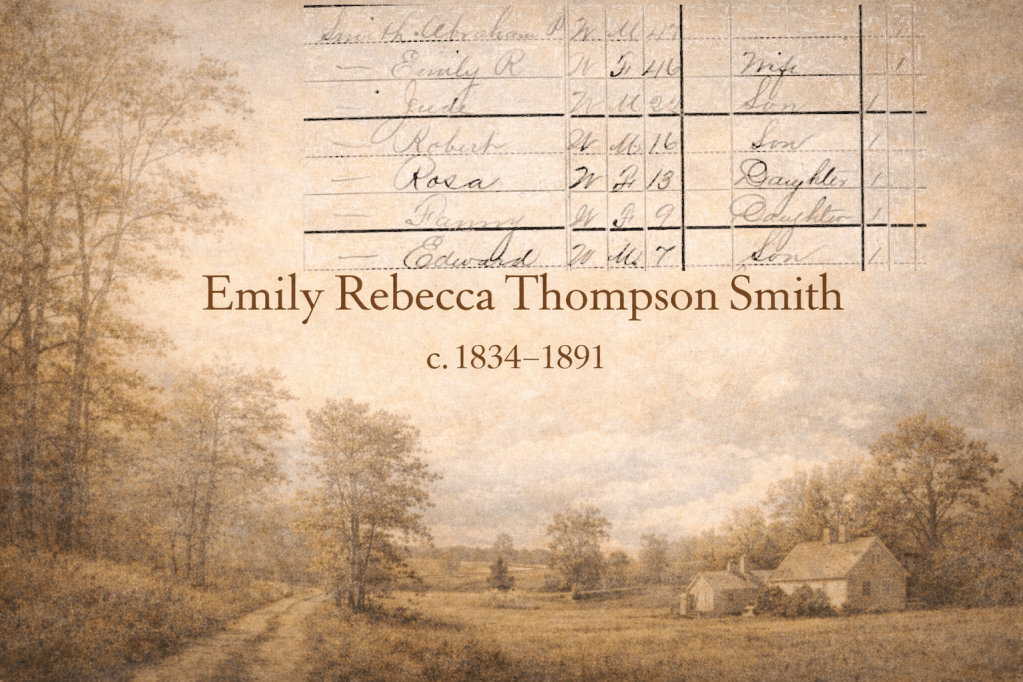
Before 1854, Emily married Abraham Possinger Smith, a Pennsylvania native born in 1833.³ The couple established their household in Monroe County, Pennsylvania, where they raised a large family. Their known children include:

  • Frank E. Smith (born 1855)
  • Hannah Smith (born about 1856)
  • Jude Smith (born about 1858)
  • Elmira Smith (born about 1862)
  • Robert Smith (born 6 May 1864)
  • Susan Rosetta Smith (born 1865)
  • Fanny Florence Smith (born 1870)
  • Abraham Edward Smith (born 1872)⁴

The family is enumerated in Tobyhanna Township, Monroe County, Pennsylvania, in both the 1860 and 1870 federal censuses, with Emily recorded as “Rebecca Smith,” wife of Abraham.⁵

Migration to Michigan

Sometime between 1872 and 1880, Emily and Abraham Smith relocated with their family to Michigan, settling in Beaver Township, Bay County. This move reflects a broader pattern of post–Civil War migration from Pennsylvania to the Midwest, particularly among families seeking agricultural or lumber-related opportunities.

The 1880 federal census places Emily, again enumerated as “Rebecca,” in Beaver Township, Bay County, Michigan, where she is listed as a married woman and wife of the household head.⁶

The Tragedy of 1890–1891

Emily’s final years were marked by extraordinary family trauma. On 6 December 1890, her son Jude Smith was shot and killed by his brother, Robert Smith, near Linwood in Bay County.⁷ The killing resulted in Robert’s arrest, trial, and eventual conviction for first-degree murder.

Contemporary newspaper accounts describe Emily as physically frail even before the shooting and report that she took to her bed shortly after Jude’s death. She did not attend her son Jude’s funeral and never saw Robert again following the crime. As Robert’s trial commenced in the spring of 1891, Emily’s condition worsened dramatically.⁸

Death

Emily Rebecca Thompson Smith died on 9 May 1891 in Garfield Township, Bay County, Michigan. Her death was recorded in multiple contemporaneous sources under slightly varying forms of her name.

A Bay County death register lists her as “Emily S. Smith,” married, aged 52 years, with parents John Thompson and Mary, residing in Garfield Township.⁹ The cause of death was recorded as dropsy, a term commonly used at the time for edema associated with chronic illness.

Newspaper coverage published shortly after her death attributed her decline to overwhelming grief following the killing of one son by another. One account stated that she “grieved to death over the killing of a son by another,” reflecting both the emotional tone of the period and the family’s widely known tragedy.¹⁰

Emily’s burial followed soon after her death, and she was survived by her husband Abraham Possinger Smith and several of her children.

Name Variations in the Records

Across her lifetime, Emily appears in records as Rebecca Smith, Emily Smith, and Emily S. Smith. These variations do not indicate multiple individuals but rather reflect common nineteenth-century record-keeping practices, especially for married women. Census enumerators frequently recorded women under a familiar or household name, while newspapers and civil registers often used a formal given name or abbreviated married form.

The consistent convergence of spouse, children, residence, parents’ names, and death date confirms that these records all refer to the same woman.

Conclusion

Emily Rebecca Thompson Smith lived a life shaped by migration, motherhood, and endurance. Like many women of her era, her story must be reconstructed from the records left by institutions rather than from documents created in her own voice. Yet through census records, civil registers, and contemporary reporting, her presence remains clear.

Her death in 1891 closed a chapter defined by family, loss, and resilience—leaving behind a lineage whose history would continue to be shaped by the events she lived through but did not survive.


Sources

  1. Bay County, Michigan, Death Register, 1891, entry for Emily S. Smith.
  2. 1860 U.S. Federal Census, Tobyhanna Township, Monroe County, Pennsylvania.
  3. Michigan county marriage records; Abraham Possinger Smith and Emily Thompson.
  4. Family structure compiled from census and vital records, 1855–1872.
  5. 1870 U.S. Federal Census, Tobyhanna Township, Monroe County, Pennsylvania.
  6. 1880 U.S. Federal Census, Beaver Township, Bay County, Michigan.
  7. Bay City newspapers, December 1890, reports on the killing of Jude Smith.
  8. The Bay City Times, spring 1891, coverage of Robert Smith’s trial.
  9. Bay County, Michigan, Return of Deaths, year ending 1891.
  10. The Bay City Times, May 1891, obituary and death coverage for Mrs. Abraham Smith.