
The trail began with a brief entry in the American Genealogical-Biographical Index pointing to Revolutionary War rolls for a Matthias Whitney of Connecticut. At first it seemed possible that the record might belong to Matthias Whitney born in 1747, a known resident of Killingly. But once the probate files were examined, it became clear that the real issue was not whether “Matthias Whitney” had service — it was determining which Matthias the record described.
Two probate files — one in 1776 and another in 1800 — proved that more than one man of that name lived in Killingly. A later Revolutionary War pension deposition then introduced a third. When the records are placed in chronological and geographic context, the identities separate cleanly.
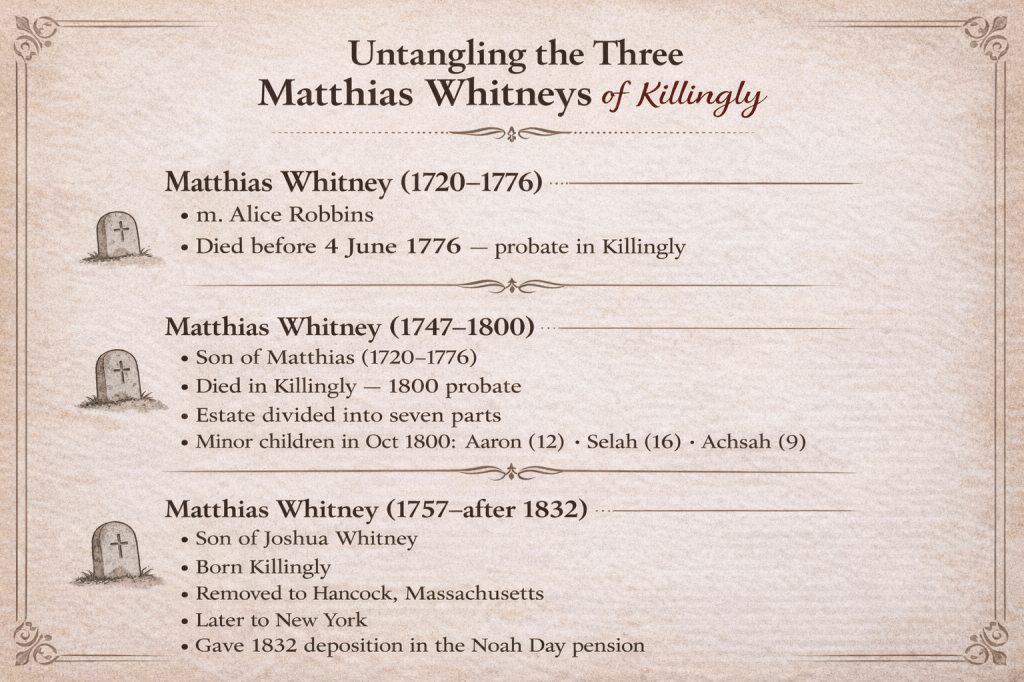
Matthias Whitney (1720–1776)
Matthias Whitney, born 26 May 1720 in Groton, Massachusetts, son of Cornelius and Sarah (Shepard) Whitney, removed to Killingly, Connecticut, where he married Alice Robbins and raised his family.
His estate was probated in the Plainfield probate district in 1776. The file explicitly treats him as deceased and names his widow Alice and their children, including Jonathan.¹ This record fixes the end of his life in Killingly and establishes the first generation of the family there.
Because he was dead by June 1776, no later Revolutionary War record or nineteenth-century deposition can belong to him.
Matthias Whitney (1747–1800)
The second man was his son, Matthias Whitney, born in Killingly on 22 February 1747.
He died in 1800, and his estate was settled in the Plainfield probate district. The distribution is especially valuable because it preserves the birth order of the children:
the widow (not named)
George Whitney, eldest son
Sarah Whitney, eldest daughter
Martha Palmer, second daughter to the deceased
Aaron Whitney, second son
Selah Whitney, fourth daughter
Achsah Whitney, fifth daughter²
This is not simply a list of heirs — it is a ranked family structure.
Separate guardianship records dated October 1800 identify the younger children and give their ages:
Aaron Whitney, aged 12
Selah Whitney, aged 16
Achsah Whitney, aged 9³⁻⁵
These guardianships confirm that the Matthias who died in 1800 left minor children whose legal affairs were handled immediately in the Plainfield probate district. That evidence places his death in Connecticut and shows that his family remained there.
It also directly contradicts the long-repeated statement that this Matthias removed to Hancock, Massachusetts, and later to New York. If he had done so, his estate and his minor children would not be under the jurisdiction of the Plainfield probate court in 1800.
In addition, minor probate records exist for the children, including Aaron, further reinforcing that this family group belongs to the man who died in Connecticut.⁶
The Third Matthias: The Nephew/Cousin
The third man appears in an unexpected place — a deposition in the Revolutionary War pension file of Noah Day dated 1832.
In that statement, Matthias Whitney testified that he:
was born in Killingly, Connecticut
later removed to Hancock, Massachusetts
and afterward moved to New York⁷
This single paragraph explains the migration that Pierce associated with the wrong man.
This Matthias cannot be the 1720 Matthias, who was dead in 1776.
He cannot be the 1747 Matthias, who died in 1800.
He is instead the son of Joshua Whitney — the nephew of the elder Matthias and the cousin of Matthias (1747–1800).
Once he is placed correctly in the family, the geographical pattern makes sense. The deposition confirms that the man who went to Hancock and then to New York was a different Matthias — not the one whose estate was probated in Connecticut in 1800.
Pierce Revisited
Frederick Clifton Pierce correctly showed that multiple men named Matthias Whitney existed in this generation. However, on page 59 he assigned the Hancock, Massachusetts and New York residence to Matthias (1747–1800).⁸
The deposition demonstrates that this migration belongs to the nephew/cousin instead.
In that sense, Pierce preserved an important clue — the movement to Hancock and New York — but attached it to the wrong individual. The probate and guardianship records allow that clue to be reassigned to the correct Matthias.
Conclusion
The records resolve into three distinct men:
Matthias Whitney (1720–1776), the father, who died in Killingly and whose 1776 probate names his widow Alice and their children.¹
Matthias Whitney (1747–1800), the son, who died in Connecticut; his estate was divided among his widow and children in a clearly ordered distribution, and whose minor children — Aaron (12), Selah (16), and Achsah (9) — were placed under guardianship in October 1800.²⁻⁵
Matthias Whitney, the nephew/cousin, born in Killingly, later of Hancock, Massachusetts, and ultimately of New York, who gave a deposition in 1832 and is the best candidate for the Revolutionary War references that began this investigation.⁷
What first appeared to be a single confusing identity becomes, when the records are read together, three separate and well-documented lives.
Sources
- Plainfield (Connecticut) Probate District, estate of Matthias Whitney, 1776.
- Plainfield (Connecticut) Probate District, estate distribution of Matthias Whitney, 1800.
- Plainfield (Connecticut) Probate District, guardianship of Aaron Whitney, October 1800; aged 12.
- Plainfield (Connecticut) Probate District, guardianship of Selah Whitney, October 1800; aged 16.
- Plainfield (Connecticut) Probate District, guardianship of Achsah Whitney, October 1800; aged 9.
- Plainfield (Connecticut) Probate District, minor probate for Aaron Whitney, son of Matthias Whitney, 1800.
- Revolutionary War pension file of Noah Day, deposition of Matthias Whitney, 1832; states he was born in Killingly, removed to Hancock, Massachusetts, and later to New York.
- Frederick Clifton Pierce, The Descendants of John Whitney, Who Came from London, England, to Watertown, Massachusetts, in 1635 (Chicago: Press of W. B. Conkey Company, 1895), 59.
 The Tumbleweed