
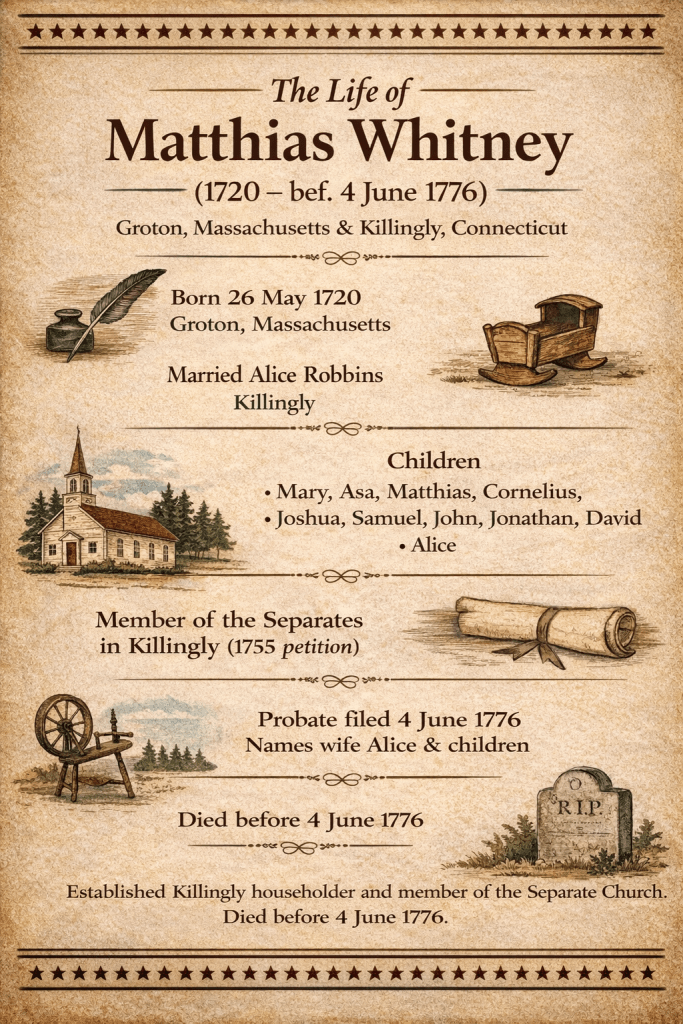
Matthias Whitney, born 26 May 1720 in Groton, Middlesex County, Massachusetts, was the son of Cornelius Whitney and Sarah Shepard.¹ As a young man he removed with his family to Killingly in Windham County, Connecticut, where he spent the remainder of his life and raised a large family.
He married Alice Robbins about 1743, and their children were recorded in the Killingly vital records: Mary (1743), Asa (1744/5), Matthias (1747), Cornelius (1749), Joshua (1751), Alice (1753), Samuel (1757), John (1759), Jonathan (1761), and David (1764).² These entries place the family firmly in Killingly throughout the mid-eighteenth century and establish the structure later confirmed in probate.
A Life in Killingly
Matthias appears in the records of Killingly during the period when the town was expanding and new religious societies were forming. He and his family were associated with the Separate (New Light) congregation at Breakneck Hill, where the baptisms of his children Matthias and Joshua were recorded in the 1740s.³ This affiliation places him among the dissenting families of the town who sought relief from the established Congregational parish.
Land and probate records show that he was an established resident and householder by mid-century. Like many men of his generation in northeastern Connecticut, his life was rooted in family, church, and local community rather than in long-distance migration.
The Probate That Defines the Family
The most important record for Matthias Whitney is the administration of his estate in the Windham District Probate Court.
On 4 June 1776, the court began proceedings for the estate of “Matthias Whitney late of Killingly deceased,” proving that he had died shortly before that date.⁴
The subsequent distribution, ordered in February 1777, names:
- his widow Alice Whitney, and
- his children Asa (eldest son), Matthias (second son), Joshua, Samuel, John, Jonathan, and David, together with his daughters Mary and Alice.⁵
Two sons, Matthias and Cornelius, were noted as having already received their portions during their father’s lifetime.⁶
This single document:
- fixes the time of his death,
- confirms the identity of his wife,
- establishes the full list of his surviving children,
- and preserves their birth order.
It is the record that anchors the entire Whitney family in Killingly.
Death in the Opening Year of the Revolution
Because the estate was opened in June 1776, Matthias died during the first phase of the Revolutionary War, at about fifty-six years of age.
This timing is significant.
Men of his generation who rendered extended military service in Connecticut generally appear in later payrolls, class lists, or pension-related records. Matthias does not. His death in 1776 explains that absence and distinguishes him from younger men of the same name who lived into the post-war period.
Separating Three Men of the Same Name
The Killingly records include three contemporaneous men named Matthias Whitney:
- Matthias Whitney (1720–1776) — the subject of this sketch
- Matthias Whitney (1747–1800) — his son
- Matthias Whitney (1757–1851) — his nephew, son of Joshua Whitney
The probate of 1776 belongs to the elder Matthias and identifies his children, including the younger Matthias. The nephew, born in 1757, lived into the nineteenth century and appears in later records, including Revolutionary War–era testimony for another pension applicant.
Distinguishing these three men is essential in evaluating military and migration records for the Whitney family of Killingly.
Conclusion
Matthias Whitney lived the life of a mid-eighteenth-century New England householder: born in Groton, established in Killingly, active in the Separate church, the father of a large family, and deceased as the American Revolution began.
His 1776 probate not only defines his death and family but also provides the key to separating multiple men of the same name in the same community. Through that record, his identity and place in the Whitney family are securely established.
Sources
- Groton, Massachusetts, vital records, birth of Matthias Whitney, 26 May 1720.
- Killingly, Connecticut, vital records (Barbour Collection), births of children of Matthias and Alice Whitney.
- Breakneck Hill Separate Church records, Killingly, baptisms of children of Matthias Whitney.
- Windham District Probate Court (Plainfield), estate of Matthias Whitney, administration begun 4 June 1776.
- Ibid., distribution to widow and children, February 1777.
- Ibid., notation of advancements to sons Matthias and Cornelius.
 The Tumbleweed