
Vital records are wonderful when they exist, but for many people in the early and mid-nineteenth century they are missing or were never created. In those cases, we are left to reconstruct a life from the records that document a person’s economic activity, legal standing, and family connections.
John Whitney of Wayne County, Ohio, and later Saginaw County, Michigan, is one of those men.
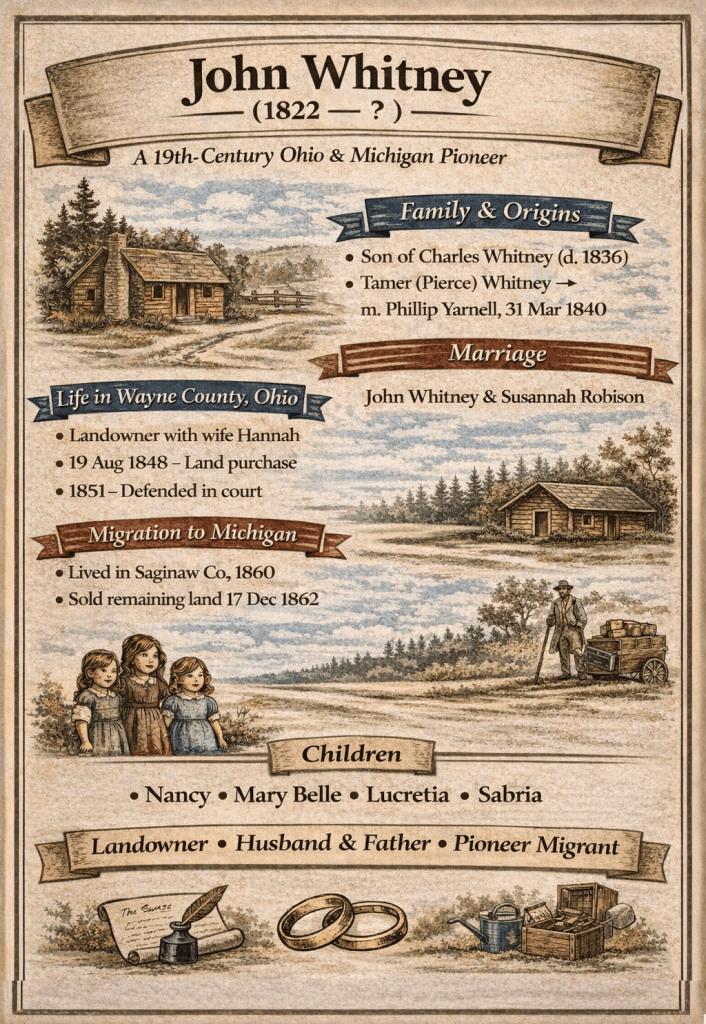
He was the son of Charles Whitney, who died in Wayne County in 1836. A few years later his mother, Tamer (Pierce) Whitney, remarried Phillip Yarnell on 31 March 1840 in Wooster, Wayne County, Ohio.¹ That remarriage becomes critical in identifying John in later records, because when John P. Whitney appears in the June Term 1851 partition case with the Yarnell heirs, it ties the adult man directly to his mother’s second marriage and distinguishes him from any other contemporary John Whitney in the county.²
Early Land Transactions
By the late 1840s John was participating in land transactions in his own name. On 19 August 1848 he purchased land in Wayne County, indicating that he had reached adulthood and was established enough in the community to engage in real property transactions.³
There is one—and only one—marriage record for a John Whitney in Wayne County during this period: John Whitney to Susannah Robison on 18 August 1842.⁴ That record fits the birth of his oldest known child the following year. As discussed in a separate post, later records consistently name a wife called Hannah, creating a conflict that remains unresolved. For the purpose of following John’s life, what matters here is that by mid-century he was a married man and the head of a household.
A Wife Named Hannah
The land records provide the clearest view of John’s economic life and identify the woman who was legally his wife for at least a decade.
On 4 September 1844, recorded 13 June 1845, John Whitney and Hannah his wife sold land in Wayne County.⁵ On 13 September 1853, John P. Whitney and Hannah his wife conveyed land to Cornelius Paugh.⁶ On 18 February 1854, John P. Whitney and Hannah his wife conveyed land to Israel Layton.⁷ In each case Hannah was required to relinquish her right of dower and was examined separately, confirming her legal identity as John’s spouse.
By 17 December 1862, when John sold land again in Wayne County, no wife was named, indicating that by that date he was either widowed or no longer legally married.⁸
The 1850 Household and the 1851 Lawsuit
In 1850 John’s household included three daughters—Nancy, Mary Belle, and Lucretia—all under the age of ten.⁹ This places him firmly in the role of a young father in mid-century Ohio.
A small but vivid glimpse of his daily life appears in the October Term 1851 case of Rinear Beall vs. John Whitney. The summons was served by leaving a copy at John’s residence “with his wife,” confirming that he maintained a fixed home and was still living in Wayne County at that time.¹⁰
Migration to Michigan
By 1860 John had left Ohio and was living in Saginaw County, Michigan, in the household of his siblings. This is a classic example of cluster migration, in which family members move together and re-establish themselves in a new location.
Even after relocating, he retained legal ties to Wayne County until the 1862 sale of his remaining land.⁸ That transaction marks the end of his economic presence in the place where he had grown up.
Following the Records
There is still no located death record for John. No probate file has yet been found for him. The identity of the mother of his children remains unresolved, and the absence of a divorce record or death record for either Susannah or Hannah leaves that question open.
What the surviving records do provide is a way to follow him through his life: a boy in a widowed household after 1836, a young man buying and selling land, a husband whose wife repeatedly appeared beside him in legal transactions, a father of three small daughters, a defendant in a county lawsuit, a migrant moving west with his siblings, and finally a man closing out his last piece of property in the county where he came of age.
The story is not finished, but the outline of his life is now visible.
Sources
- Wayne County, Ohio, Marriage Record, Phillip Yarnell and Tamer Whitney, 31 March 1840.
- Wayne County, Ohio, Court of Common Pleas, Partition Record, June Term 1851.
- Wayne County, Ohio, Deed, John Whitney purchase, 19 August 1848.
- Wayne County, Ohio, Marriage Record, John Whitney and Susannah Robison, 18 August 1842.
- Wayne County, Ohio, Deed Book, John Whitney and Hannah his wife to Youngs and Augustus Case, 4 September 1844, recorded 13 June 1845.
- Wayne County, Ohio, Deed Book, John P. Whitney and Hannah his wife to Cornelius Paugh, 13 September 1853.
- Wayne County, Ohio, Deed Book, John P. Whitney and Hannah his wife to Israel Layton, 18 February 1854.
- Wayne County, Ohio, Deed Book, John P. Whitney to Jonathan Potts, 17 December 1862.
- 1850 U.S. Census, Wayne County, Ohio, population schedule, John Whitney household.
- Wayne County, Ohio, Court of Common Pleas, Rinear Beall vs. John Whitney, October Term 1851.
 The Tumbleweed