
Worcester, Vermont, and the Limits of Paper Records
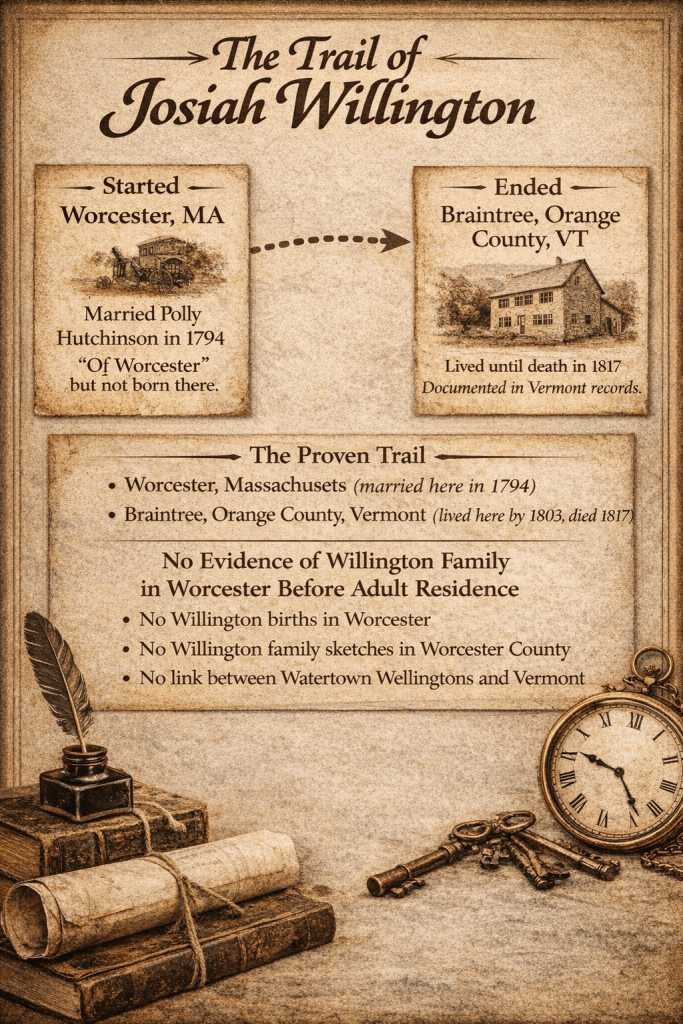
If the name problem explains how false parentage is created, geography explains how those errors persist. In the case of Josiah Willington who married Polly Hutchinson, the surviving records form a narrow but consistent geographic trail. That trail begins in Worcester, Massachusetts, and ends in Braintree, Orange County, Vermont. What lies outside that trail is just as important as what lies within it.
What “of Worcester” Actually Means
The 6 September 1794 marriage record for Josiah Willington and Polly Hutchinson states that both parties were “of Worcester.”¹ In Massachusetts vital records, this phrase identifies legal residence at the time of marriage, not place of birth. It does not imply parentage, childhood residence, or family origin.
This distinction matters. Many compiled genealogies treat “of Worcester” as synonymous with “born in Worcester,” but town clerks did not use the phrase in that way. A person could be “of” a town after residing there only briefly, particularly if employment or marriage brought them in.
Worcester Birth Records and a Meaningful Absence
A review of Worcester town birth records for the eighteenth century reveals no births for individuals with the surname Willington or Wellington.² This is not merely the absence of a Josiah; it is the absence of the surname entirely.
Worcester’s vital records for this period are comparatively robust. Numerous families appear repeatedly, and children born to transient laborers are often recorded. The complete absence of the Willington/Wellington surname strongly suggests that Josiah was not born in Worcester and that his family was not established there at the time of his birth.
Negative evidence of this kind does not identify parents, but it does eliminate Worcester as a likely place of origin.
Polly Hutchinson and Worcester County Context
Polly Hutchinson provides additional context. She was born in 1782 in Sutton, Worcester County, Massachusetts, a town located southeast of Worcester.³ Sutton’s birth records include multiple Hutchinson families but, like Worcester, contain no Willington or Wellington births during the relevant period.⁴
This pattern suggests that Josiah’s presence in Worcester was likely tied to adult residence or employment rather than family origin. It is consistent with a scenario in which Josiah relocated to Worcester County as a young man and met Polly there prior to their marriage.
The Vermont Migration Pattern
By the early nineteenth century, Josiah Willington appears consistently in Vermont records. His children’s births, his appearance in the 1810 federal census, and his probate all place him in Braintree, Orange County, Vermont.⁵
This movement fits a well-documented migration pattern: late eighteenth-century settlers moving from central Massachusetts into Vermont following land openings and post-Revolutionary settlement opportunities. Worcester County was a common staging area for this westward and northward movement, even for individuals who had not been born there.
Crucially, none of the Josiah Willingtons documented in Bond’s History of Watertown are traced into Vermont. Bond’s families remain centered in Middlesex County and adjacent towns, with no documented link to Orange County, Vermont.⁶
Why Watertown-Centered Lineages Struggle to Fit
Attempts to link the Vermont Josiah to the Watertown Willington families rely on circumstantial reasoning: shared given names, approximate ages, and geographic proximity. But proximity alone is not enough.
Worcester lies west of Watertown, and while travel between the two was certainly possible, no record has been found placing any of Bond’s Josiahs in Worcester prior to 1794. Likewise, no record places any Watertown-based Josiah in Vermont in the early nineteenth century.
Without documentation showing movement from Watertown to Worcester and then to Vermont, these connections remain speculative.
What the Records Do Show Consistently
Across all surviving records, the Josiah Willington who married Polly Hutchinson appears only in the following contexts:
Worcester, Massachusetts, at the time of marriage in 1794.¹
Braintree, Orange County, Vermont, from at least 1803 through his death in 1817.⁵
Vermont probate and newspaper notices following his death.⁷
He does not appear in Middlesex County town records as a child, does not appear in Watertown family sketches, and does not appear in Worcester birth records. This narrow geographic footprint argues for caution in assigning parentage.
The Value of Geographic Restraint
One of the most difficult disciplines in genealogical research is restraint: resisting the urge to extend a lineage beyond what the records can support. In this case, geography acts as a boundary. It limits which records can plausibly belong to the same individual and which cannot.
Rather than proving who Josiah Willington’s parents were, the geographic evidence clarifies who they likely were not. That clarification is essential groundwork for any future discovery.
Sources
- Worcester, Massachusetts, marriage records, 6 September 1794, Josiah Willington and Polly Hutchinson.
- Worcester town birth records, eighteenth century, review showing no entries for Willington or Wellington surnames.
- Sutton, Massachusetts, town birth records, 1782, birth of Molly (Polly) Hutchinson.
- Sutton, Massachusetts, town birth records, review showing no entries for Willington or Wellington surnames.
- Vermont vital records and federal census schedules, Braintree, Orange County, including births of children, 1810 census, and death of Josiah Willington in 1817.
- Henry Bond, History of Watertown, Massachusetts (Boston: Little, Brown and Company, 1860), Wellington family sketches.
- Vermont Republican and Journal (Windsor), probate notice for Josiah Willington, May 1818.
 The Tumbleweed