
After examining devotional given names and dit surnames separately, it becomes clear that the real challenge for modern researchers lies in how these practices interact across different types of records. A single individual may appear under several legitimate name forms over the course of a lifetime, depending on the context in which the record was created.
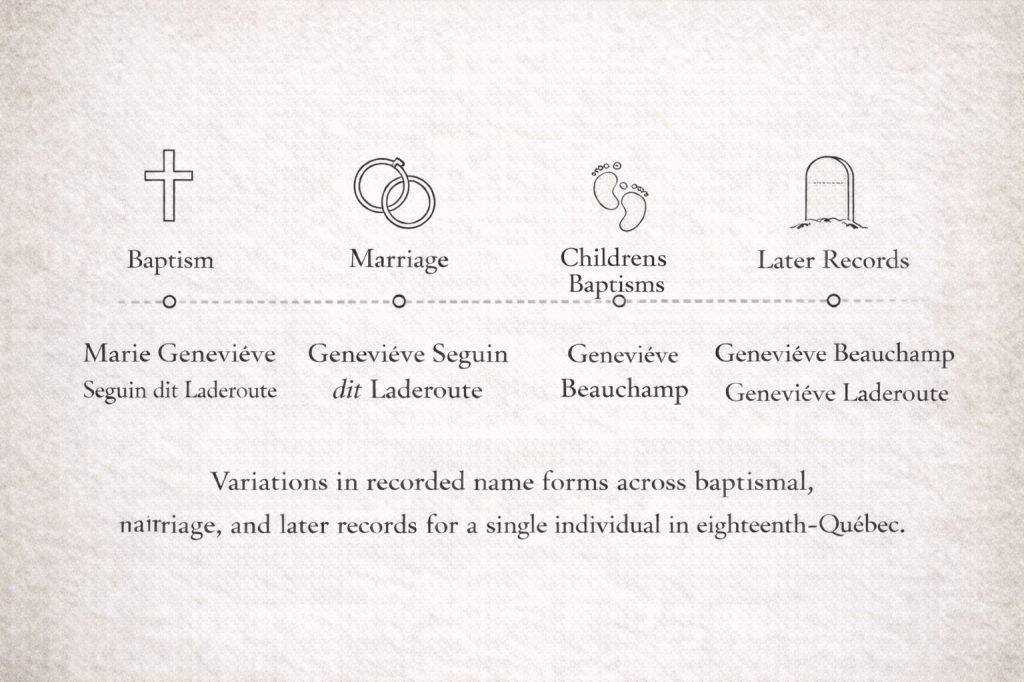
The Seguin dit Laderoute family provides a clear example of this phenomenon, particularly in the records of Pierre Seguin dit Laderoute’s daughter, Marie Geneviève Seguin dit Laderoute.
Baptismal Identity
Marie Geneviève Seguin dit Laderoute was baptized in 1712.¹ In her baptismal record, she appears with both a devotional given name and a family surname that includes the dit name. At this stage of life, the record reflects the priorities of the Church: religious naming conventions and parental identity.
The baptismal name establishes her place within the family, but it does not define how she will necessarily appear in later records.
Marriage Records and Name Selection
When Marie Geneviève married Jean Beauchamp in 1731, her name appears in a notarial marriage record that identifies her as Geneviève Seguin dit Laderoute.² In this context, the emphasis shifts. The notary’s concern is legal identity and family affiliation rather than devotional completeness.
The omission of “Marie” in this record does not indicate a different person. Instead, it reflects the common practice of using the second given name as the practical identifier in adulthood.
Later Records and Variability
In later records associated with Marie Geneviève—whether related to the baptisms of her children, the marriages of those children, or notarial acts involving the family—her name may appear in additional forms. She may be recorded as Geneviève Seguin, Geneviève Laderoute, or Geneviève Beauchamp, depending on the type of record and the habits of the clerk.³
Each of these forms is historically valid. None represents a change in identity. Rather, each reflects a different aspect of her life: birth family, married status, or legal context.
Why Modern Systems Struggle
Modern genealogical systems tend to treat names as fixed identifiers. When applied to French-Canadian records, this assumption often leads to confusion. A woman such as Marie Geneviève Seguin dit Laderoute may be divided into multiple profiles because her name appears differently in different records, or incorrectly merged with another individual who shares a similar name.
In reality, the records themselves are consistent once their conventions are understood. It is the modern expectation of uniformity that creates the apparent conflict.
Reading Records Across a Lifetime
Understanding how names functioned in New France requires reading records across an individual’s entire life rather than in isolation. Baptismal, marriage, burial, and notarial records each served different purposes and therefore emphasized different aspects of identity.
For Marie Geneviève Seguin dit Laderoute, the variation in name forms across records reflects continuity rather than contradiction. Place, chronology, family relationships, and associates provide the connective tissue that confirms identity when names alone appear unstable.
Preparing for the Final Post
This examination of one individual demonstrates how devotional given names, dit surnames, and clerical habit combine to produce legitimate variation in the historical record. The challenge for researchers is not to force consistency where none existed, but to recognize patterns that reflect historical practice.
The final post in this series will step back from this specific family and offer practical guidance on how to approach French-Canadian records more generally, drawing on the examples already discussed.
Notes
- Québec, Canada, Vital and Church Records (Drouin Collection), baptism of Marie Geneviève Seguin dit Laderoute, 1712.
- Québec, Canada, Notarial Records, marriage contract of Jean Beauchamp and Geneviève Seguin dit Laderoute, 12 August 1731.
- Québec, Canada, Vital and Church Records (Drouin Collection), various baptisms and marriages involving the Beauchamp family, mid-eighteenth century.
 The Tumbleweed