
After grappling with repeated given names such as “Marie,” many researchers encounter a second layer of complexity in French-Canadian records: the appearance of an additional name introduced by the word dit. In the Seguin dit Laderoute family, this additional name—Laderoute—appears consistently across generations and records, raising questions about whether it represents a surname change, a nickname, or a separate family altogether.
In fact, dit names were a common and functional feature of naming practices in New France. Understanding how they were used—and how they were written—is essential for interpreting the records correctly.
The Meaning and Purpose of Dit Names
The French word dit means “called” or “known as.” A dit name functioned as an alias rather than a replacement surname. It could serve several purposes: distinguishing individuals with the same surname, identifying a particular branch of a family, reflecting military service, or referencing a place or personal characteristic.¹
Importantly, the presence of a dit name did not erase the original surname. Both names could be used independently or together, depending on context, clerk, or habit.
Pierre Seguin dit Laderoute
In this family, the surname Seguin appears alongside the dit name Laderoute beginning with Pierre Seguin dit Laderoute and continuing among his children. Pierre did not “become” a Laderoute; rather, he belonged to the Seguin family and was also known as Laderoute.
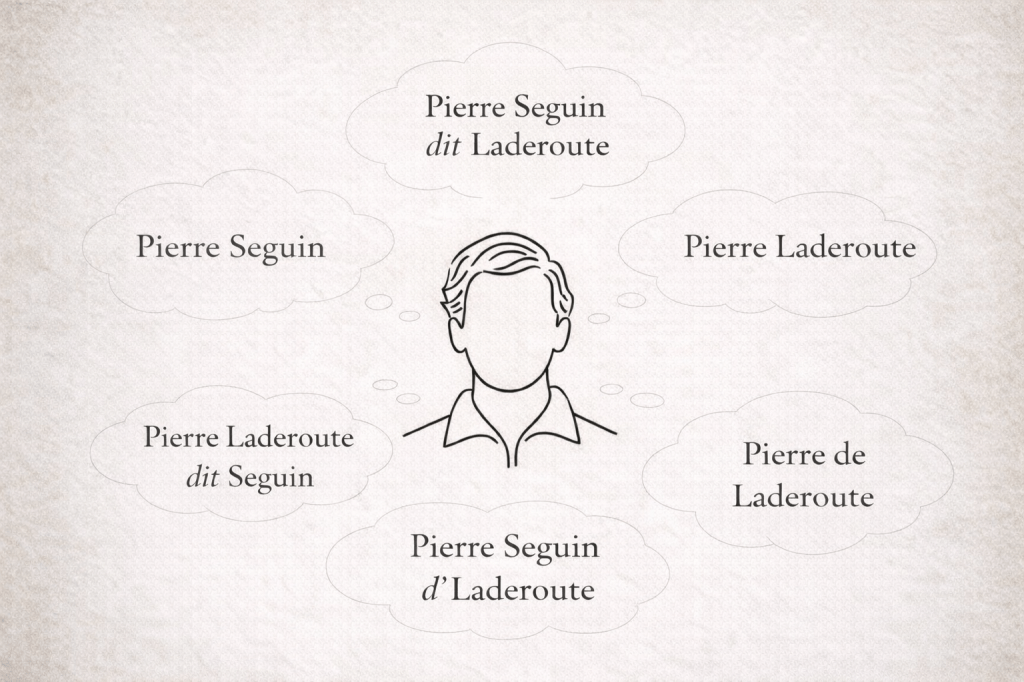
Across parish and notarial records, Pierre may be identified as Pierre Seguin, Pierre Laderoute, or Pierre Seguin dit Laderoute. Each of these forms refers to the same individual. The choice of name reflects the habits of the priest or notary who created the record, not a change in identity.
Variations in the Written Form of Dit Names
Modern researchers often encounter dit names written in several different forms and may assume that these variations reflect different meanings. In eighteenth-century Québec, this assumption is misleading.
The word dit may appear written in full, abbreviated, or contracted, including forms such as dit, d’, de, or occasionally alias.² These variations reflect clerical preference and writing speed rather than any distinction in function or status.
For example, entries recorded as Seguin dit Laderoute, Seguin d’Laderoute, or Seguin de Laderoute all convey the same meaning: Seguin, called Laderoute. The contracted form d’ is particularly common in notarial records and should not be interpreted as a marker of nobility, geographic origin, or surname change.
Dit Names Across Generations
The use of dit names was often inherited, though not always consistently. Some children retained the dit name, some used only the original surname, and others alternated between the two across their lifetimes. In the Seguin dit Laderoute family, Pierre’s children appear with varying forms of the surname, sometimes emphasizing “Seguin,” sometimes “Laderoute,” and sometimes both.
This variability does not indicate separate families or lines. Instead, it reflects a flexible naming system in which multiple identifiers could coexist without conflict.
Dit Names and Women’s Records
For women, dit names introduce additional complexity. A woman might appear under her baptismal surname, her dit name, her husband’s surname, or a combination of these forms depending on the type of record. In the Seguin dit Laderoute family, the presence or absence of “Laderoute” in later records does not signal a change in family affiliation.
As with given names, variation in surname form should be understood as a feature of the record-keeping system rather than evidence of multiple individuals.
Reading Dit Names in Context
The presence of a dit name signals that a record belongs to a naming system different from the modern one. Rather than attempting to standardize or correct these names, researchers benefit most from recording them as they appear and evaluating identity through corroborating evidence such as place, chronology, and family relationships.
The Seguin dit Laderoute family provides a clear example of how dit names functioned as flexible identifiers within a stable community. Recognizing this flexibility is essential for avoiding false divisions and misinterpretations in French-Canadian genealogical research.
In the next post, the focus will shift from naming systems themselves to the records that preserve them, and to how a single individual can legitimately appear under multiple name forms across baptisms, marriages, burials, and notarial documents.
Notes
- René Jetté, Dictionnaire généalogique des familles du Québec (Montréal: Les Presses de l’Université de Montréal, 1983), introduction; Yves Landry, Les noms de famille en Nouvelle-France (Montréal: Septentrion, 1992).
- Québec, Canada, Notarial Records, 1637–1935; parish registers of the Montreal and Lanaudière regions, eighteenth century, passim.
 The Tumbleweed