
Before examining the naming practices that often complicate French-Canadian genealogical research, it is useful to clearly establish the family at the center of the discussion. This post introduces the Seguin dit Laderoute family of Québec, a well-documented family whose records provide a strong foundation for understanding later naming patterns and research challenges.
Later posts will explore why the records for this family can appear confusing to modern researchers. Here, the focus is simply on identifying the family and situating them in place and time.
Pierre Seguin dit Laderoute
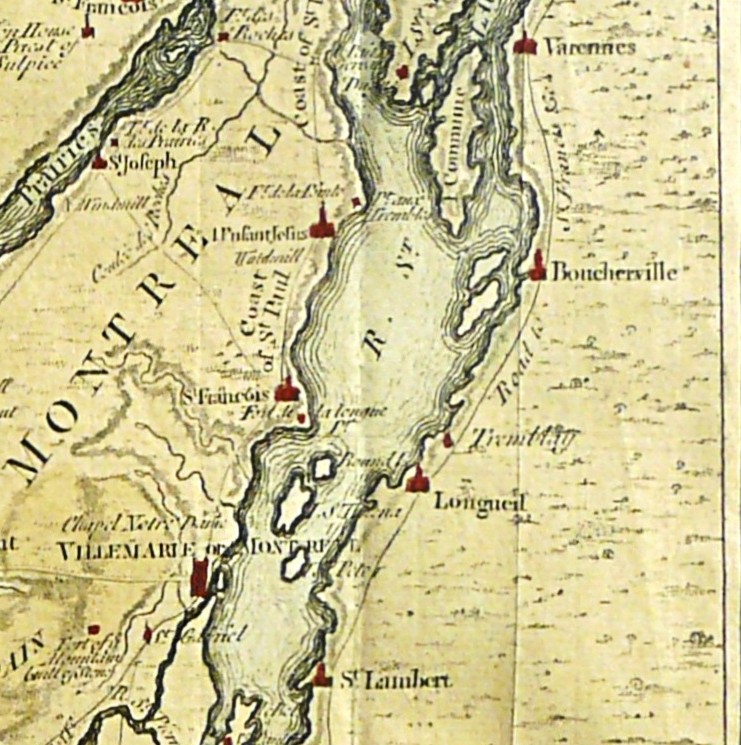
Pierre Seguin dit Laderoute was born on 24 August 1682 in Boucherville, Québec, and was baptized the same day.¹ He was the son of François Sequin dit Laderoute and Jeanne Françoise Petit, both natives of France who settled in New France during the seventeenth century.²
Pierre’s baptism on the same day as his birth reflects common practice in New France during the late seventeenth century. Catholic teaching emphasized the necessity of baptism, and infant mortality rates were high. As a result, newborns were often baptized within hours of birth, particularly in established parishes such as Boucherville. Same-day baptism was customary rather than exceptional, and does not indicate an emergency or unusual circumstance in this context.³
Pierre died on 9 November 1760 and was buried at Saint-Henri-de-Mascouche.⁴ His life spanned a period of rapid population growth in the colony, and his movements remained largely within what is now the greater Montreal and Lanaudière regions.
The use of the dit name “Laderoute” appears consistently in records associated with Pierre and his immediate family. At this stage, it is sufficient to note that “Seguin” and “Laderoute” refer to the same family line and are not competing surnames.
Marriage and Household
Pierre married Marie Barbe Filion on 4 February 1704 at Boucherville.⁵ Their marriage occurred shortly before the death of Pierre’s father later that same year, a sequence that is well documented in parish records.⁶
Following their marriage, Pierre and Marie Barbe established a household that appears across multiple parishes over time, including Boucherville, Île Jésus, Lachenaie, and Mascouche. These shifts reflect normal settlement patterns within the colony rather than relocation to distant regions.
Children of Pierre Seguin dit Laderoute and Marie Barbe Filion
Pierre and Marie Barbe Filion had several children, many of whom survived to adulthood and married locally. Their known children include:
- Marie Élisabeth Seguin dit Laderoute, born in 1704, who later married Michel Beauchamp⁷
- Marie-Françoise Seguin dit Laderoute, born in 1704⁸
- Antoine Joseph Seguin dit Laderoute, born and died in 1711⁹
- Marie Geneviève Seguin dit Laderoute, born in 1712, who later married Jean Beauchamp¹⁰
- Marie-Barbe Seguin dit Laderoute, born in 1714¹¹
- Marie-Jeanne Seguin dit Laderoute, born in 1718 and died in 1749¹²
- Marie Véronique Seguin dit Laderoute, born in 1720¹³
At first glance, the repetition of given names and the consistent appearance of “dit Laderoute” may appear unusual. These features are not anomalies, but reflect common practices in French-Canadian Catholic families of this period.
A Family Well Documented in the Records
The Seguin dit Laderoute family appears frequently in baptismal, marriage, burial, and notarial records. Their documentation is neither sparse nor contradictory. On the contrary, the volume of surviving records makes this family particularly useful for illustrating how naming practices—rather than missing evidence—can complicate interpretation.
Several of Pierre’s children married into other established local families, including the Beauchamp family, creating overlapping name patterns that persist into subsequent generations.
Setting the Stage
As research progressed, it became clear that this single family illustrates many of the challenges encountered in French-Canadian genealogy: repeated devotional given names, inherited dit names, and inconsistent name usage across different types of records.
This post serves as an introduction to the family itself. Subsequent posts will examine these naming practices in detail, beginning with the widespread use of devotional given names such as “Marie,” and why those names do not always identify individuals in the way modern researchers expect.
Notes
- Québec, Canada, Vital and Church Records (Drouin Collection), baptism of Pierre Seguin dit Laderoute, Boucherville, 1682.
- Québec, Canada, Vital and Church Records (Drouin Collection), marriage and burial records of François Sequin dit Laderoute and Jeanne Françoise Petit.
- Allan Greer, The People of New France (Toronto: University of Toronto Press, 1997), 64–65; see also parish baptismal registers for Boucherville in the 1680s.
- Québec, Canada, Vital and Church Records (Drouin Collection), burial of Pierre Seguin dit Laderoute, Saint-Henri-de-Mascouche, 1760.
- Québec, Canada, Vital and Church Records (Drouin Collection), marriage of Pierre Seguin dit Laderoute and Marie Barbe Filion, Boucherville, 1704.
- Ibid.; burial of François Sequin dit Laderoute, Montréal, 1704.
7–13. Québec, Canada, Vital and Church Records (Drouin Collection), baptisms and burials of the children of Pierre Seguin dit Laderoute and Marie Barbe Filion, various parishes.
 The Tumbleweed