
Early Life and Trade
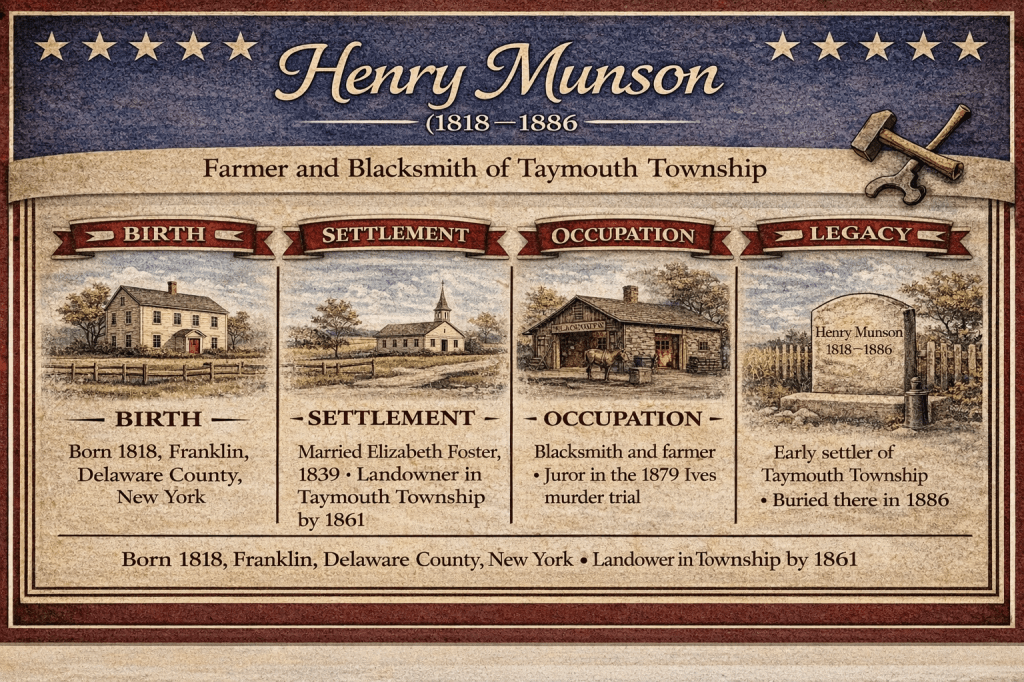
Henry Munson was born 16 June 1818 in Franklin, Delaware County, New York, the son of Daniel Munson and Frances “Fanny” Tolles. According to a biographical sketch published during his lifetime, his father operated a blacksmith shop, and Henry worked there during the winters, learning the trade at a young age.¹ This early training would shape his working life for decades.
At approximately eighteen years of age, Henry left home and traveled west to Fort Defiance, Ohio, where he spent two years engaged in boating and farm labor.¹ This period reflects the common pattern of young men acquiring experience and capital before permanent settlement.
Arrival in Michigan and Marriage
By the late 1830s, Henry had relocated to Saginaw County, Michigan. He was married on 1 June 1839 in Bridgeport to Elizabeth Foster, daughter of Nathaniel and Mary Foster.¹ The marriage marks the beginning of a long association with Bridgeport and Taymouth Townships that would continue for the remainder of his life.
Their first child, James H. Munson, was born in Bridgeport in 1840, followed by Mary Emaline Munson in 1841. Census and vital records indicate that the family remained in Bridgeport through the 1840s and 1850s, during which time Henry balanced farming with blacksmithing.²
Family Growth and Loss
Henry and Elizabeth Munson became the parents of eleven children. Not all survived to adulthood, a reality reflected both in census records and later family documentation. Ransom W. Munson, born in 1843, died in 1853 at the age of nine, reportedly at the Cass River.³ James H. Munson, their eldest son, died in Taymouth Township in 1881 at the age of forty-one.⁴
These losses occurred alongside the steady growth of the family, which included children born in Bridgeport and later in Taymouth Township. The movement of birthplaces within the family mirrors Henry’s gradual transition from Bridgeport into rural Taymouth.
Settlement in Taymouth Township
In the fall of 1861, Henry Munson purchased eighty acres of land in Taymouth Township, Saginaw County, on section 5.¹ This land purchase represents a permanent commitment to the township, coinciding with a period of agricultural expansion in the area during the Civil War era.
Federal census records place Henry in Bridgeport in 1860 and confirm his residence in Taymouth Township by 1870 and 1880.² Over time, his landholdings increased, and by the early 1880s he was reported to own eighty-seven acres.¹
Community Presence and Newspaper Mentions
Henry Munson’s name appears repeatedly in Saginaw County newspapers during the late 1870s, reflecting his continued residence and standing within the community. In 1879, his name was listed among the jurors involved in the murder case arising from the death of Heber K. Ives, in which Allen Barnum was charged.⁵ His appearance in these reports relates specifically to jury proceedings and represents routine civic service rather than personal involvement in the crime itself.
The repeated publication of juror lists across multiple issues explains why Henry’s name appears more than once in connection with the case. Such reporting was typical of nineteenth-century newspapers as trials progressed through examination, jury selection, and court sessions. These references provide valuable confirmation of Henry’s presence and civic participation in Taymouth Township during the period between the 1870 and 1880 federal censuses.
Occupation and Public Identity
Throughout his adult life, Henry Munson was identified as both a farmer and a blacksmith.¹² This dual occupation was common among early settlers and reflects the practical demands of rural Michigan communities, where skilled trades were often combined with agricultural work.
Politically, Henry was identified as a Democrat, a detail included in the 1881 county history.¹ While brief, this note situates him within the civic culture of the township and suggests engagement with local political life.
Later Years and Death
By 1880, Henry Munson was sixty-two years old and residing in Taymouth Township with his family.² The death of his son James in 1881 occurred during this period and would have marked a significant personal loss late in Henry’s life.
Henry Munson died on 12 December 1886 in Taymouth Township at the age of sixty-eight.⁶ He was buried in Taymouth Township Cemetery, where his grave remains among those of other long-standing township residents.
Assessment
Henry Munson’s life is documented across a wide range of contemporary sources, including federal censuses, land records, a published county biography, and local newspapers. Taken together, these records present a clear picture of a skilled tradesman and farmer who followed a well-documented path from New York to Michigan, established landholdings in Taymouth Township, raised a large family, and remained a visible and trusted member of the local community until his death.
The convergence of government records, printed biography, and newspaper accounts makes Henry Munson one of the more thoroughly documented nineteenth-century residents of Taymouth Township and provides a solid foundation for understanding both his life and the broader settlement history of the area.
Sources
- History of Saginaw County, Michigan (Chicago: Warner, Beers & Co., 1881), biographical sketch of Henry Munson.
- 1850, 1860, 1870, and 1880 U.S. Federal Census, Saginaw County, Michigan.
- Michigan death records and family documentation for Ransom W. Munson.
- Michigan death records for James H. Munson, Taymouth Township, 1881.
- Saginaw Herald (East Saginaw, Michigan), 16 October 1879, reporting the death of Heber K. Ives and related proceedings; Saginaw Courier-Herald, 23 October 1879, “The Ives Murder,” listing jurors, including Henry Munson.
- Michigan death and burial records for Henry Munson, Taymouth Township, 1886.
 The Tumbleweed