
Anyone who researches nineteenth-century families eventually encounters the same problem: the records do not agree. Birthplaces shift. Ages fluctuate. Census entries contradict one another. The question is not whether conflicts exist, but how they can be evaluated responsibly.
George Washington Lawhead provides an unusually well-documented case study. Across census records, military documents, marriage records, and his death certificate, his place and year of birth vary repeatedly. Rather than choosing a single record and discarding the rest, this post examines how those conflicts can be weighed and resolved.
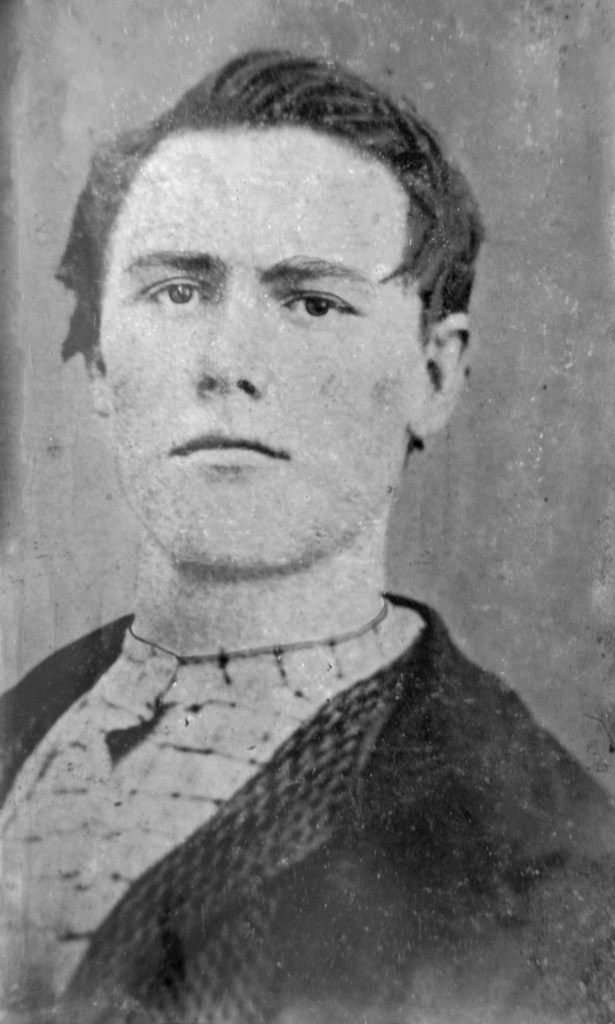
The Competing Birthplaces
Records associated with George Lawhead list three different states as his birthplace:
- Ohio
- New York
- Pennsylvania
Ohio appears most frequently, including in the 1850, 1860, and 1880 federal censuses.¹ New York appears once, in the 1870 census.² Pennsylvania appears in the 1900 census and on George’s death certificate.³
When evaluating these conflicts, the first question is not which record is newest or most detailed, but who supplied the information and how close that informant was to the event being recorded.
Census Records and Enumerator Error
The 1850 and 1860 censuses place George in households headed by relatives, listing his birthplace as Ohio. These entries were created while George was still a child or young adult and likely relied on information provided by family members with direct knowledge of his birth.
The 1870 census, which lists his birthplace as New York, presents a different problem. That same census page incorrectly lists New York as the birthplace of George’s mother-in-law, who is known from other records to have been born in Vermont. The surrounding entries show a strong pattern of Michigan and New York birthplaces, suggesting enumerator habit rather than individual accuracy. In this context, the New York entry is best treated as an error rather than a competing claim.
Pennsylvania and Late-Life Informants
The 1900 census and George’s 1905 death certificate both give his birthplace as Pennsylvania. In each case, George himself was unlikely to have been the informant.
The 1900 census information was almost certainly supplied by Henrietta Savage, with whom George was living at the time. The death certificate lists the undertaker as the informant, who would have obtained his information secondhand, most likely from Henrietta.⁴
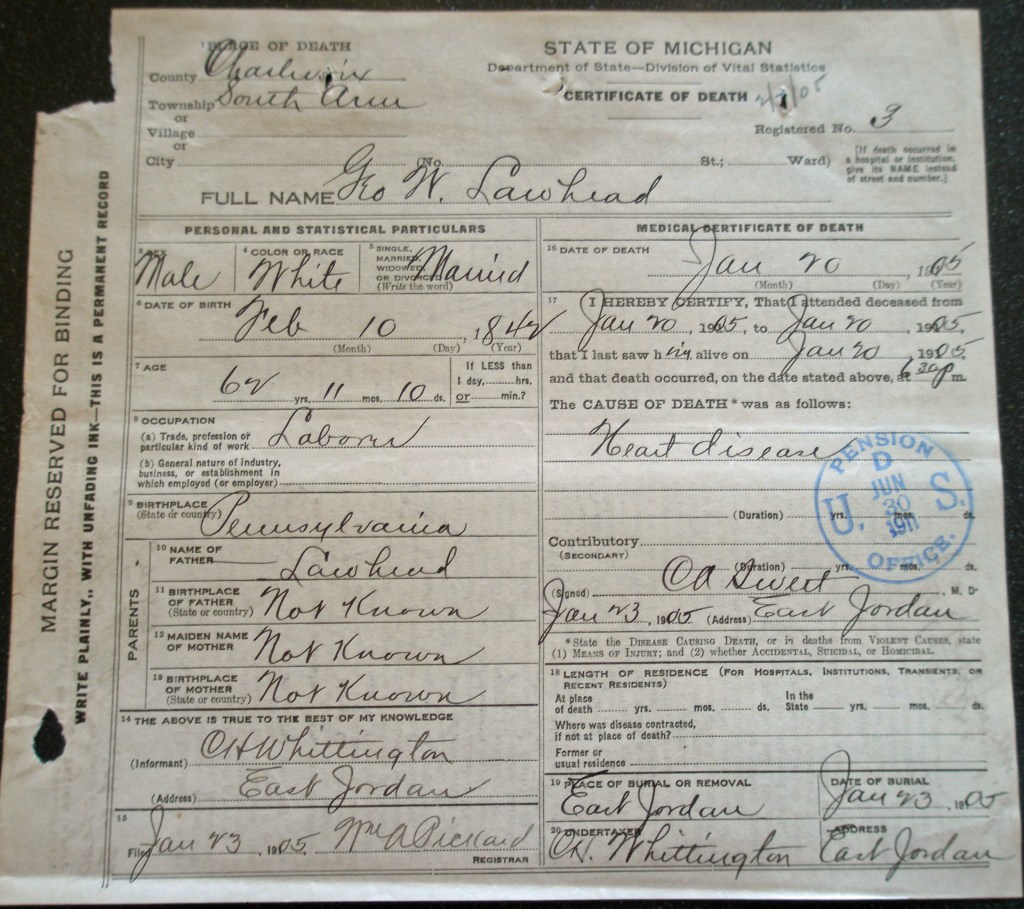
These records were created decades after George’s birth and depend on memory rather than firsthand knowledge. They also conflict with the majority of earlier records, making them less reliable for determining birthplace.
County Confusion: Morrow vs. Monroe
Several records narrow George’s birthplace further, naming Westfield Township and alternately identifying the county as Morrow or Monroe. This apparent contradiction dissolves when examined historically.
Morrow County, Ohio, did not exist at the time of George’s birth. It was formed in 1848 from portions of Delaware, Marion, Knox, and Richland counties. Westfield Township later became part of Morrow County, but would have belonged to Delaware County at the time of George’s birth in 1845.
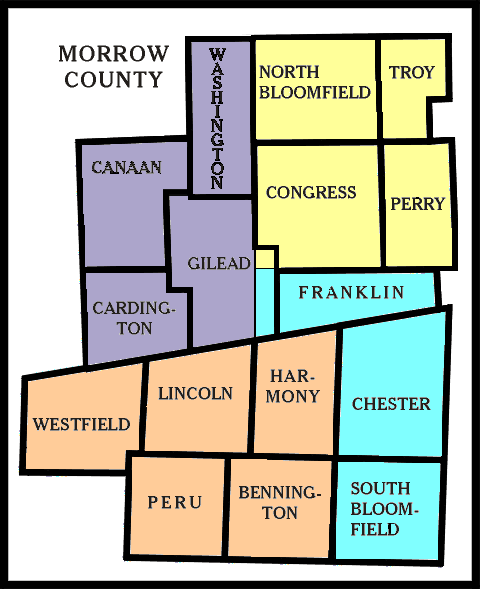
Monroe County, Ohio, does exist, but has no Westfield Township. The similarity in pronunciation between Morrow and Monroe provides a plausible explanation for the inconsistency. When combined with the presence of Lawhead family records, burials, and probate documents in what became Morrow County, Westfield Township in central Ohio emerges as the most consistent location.
The Question of the Birth Year
George’s reported birth year varies among 1842, 1843, 1845, and occasionally 1846. The date itself, February 10, remains consistent across multiple records.
The earliest census records support an 1845 birth year. Later records, including enlistment papers and some marriage records, imply an earlier birth year that would have made George legally eligible to enlist at age eighteen in 1861.
Age inflation among underage Civil War enlistees was common and well documented. Once a false age entered the record, it often persisted, especially in documents created close in time to military service. In George’s case, the later reappearance of an earlier birth year can be explained by proximity to his enlistment and the continued reuse of that information in subsequent records.
When all records are considered together, 1845 is supported by the greatest number of independent sources, including early census records and family documentation.
Weighing the Evidence
Resolving conflicting records requires pattern recognition rather than certainty from a single source. In George Lawhead’s case:
- Ohio appears as his birthplace in the majority of records
- Early records agree more consistently than late ones
- Errors cluster by document type rather than randomly
- Informant knowledge declines over time
Taken together, the evidence supports a conclusion that George Washington Lawhead was born on 10 February 1845 in Westfield Township, in what later became Morrow County, Ohio.
This conclusion does not require discarding conflicting records. Instead, it acknowledges them, explains them, and assigns them appropriate weight.
Conclusion
Conflicting records are not obstacles to genealogical research; they are evidence themselves. They reveal who was asked, who answered, and how information moved through families and institutions over time.
George Lawhead’s records demonstrate why no single document should be treated as definitive in isolation. By examining context, informants, timing, and patterns, it is possible to reach a conclusion that respects the complexity of the historical record without overstating certainty.
In that sense, George Lawhead’s story offers more than a set of dates and places. It offers a model for how genealogical conflicts can be approached thoughtfully and responsibly.
Sources
- 1850, 1860, and 1880 U.S. Federal Census records for George Lawhead.
- 1870 U.S. Federal Census, Grant Township, Iosco County, Michigan.
- 1900 U.S. Federal Census and Michigan death certificate, 1905.
- Michigan death record, East Jordan, Charlevoix County, Michigan.
 The Tumbleweed