
By the time the Civil War pension file of George Washington Lawhead was closed, it measured nearly three inches thick. That volume was not the result of a single application or a simple claim. Instead, it reflected decades of filings, investigations, affidavits, and competing narratives—all attempting to answer one question the federal government demanded be resolved with precision: who legally belonged to George Lawhead’s family?
The answer, as determined by pension law, did not always align with lived reality.
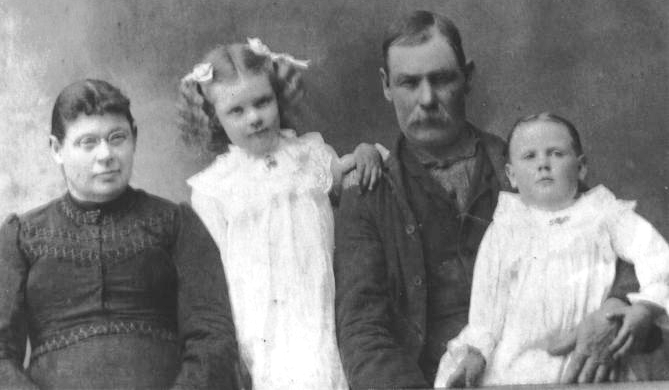
Mary King and Claims Made During George’s Lifetime
Mary King began applying for George Lawhead’s pension while he was still alive.¹ She asserted abandonment and dependency, describing a marriage that had ended when George left her while she was pregnant with their second child. No divorce had ever been obtained.
These early claims were denied, but each filing generated documentation: correspondence, affidavits, and field examiner reports. Pension officials were required to confirm George’s service, identity, marital status, and financial responsibility. As a result, much of the pension file predates George’s death.
Mary’s persistence mattered. Although unsuccessful at the time, her filings preserved testimony and evidence that would later become central to posthumous decisions.
Abandonment, Not Divorce
Under nineteenth-century pension law, abandonment did not dissolve a marriage. Without a legal divorce, Mary King remained George Lawhead’s lawful wife regardless of separation, distance, or the passage of time.
This distinction would later prove decisive. Pension officials consistently noted that George had never obtained a divorce from Mary.² The legal bond between them remained intact until his death, even as George formed subsequent families elsewhere.
Henrietta Savage and a Public Separation
By the early 1890s, George was living with Henrietta Savage. Henrietta was herself legally married and the mother of several children when she left her husband to live with George. In January 1892, a Michigan newspaper reported on the separation, making the situation a matter of public record.³
George and Henrietta lived together for years and had two daughters. Census records show them functioning as a household, and George supported the family financially when able. None of these facts were disputed during the pension investigation.
What remained in question was not whether the family existed, but whether it could be recognized under the law.
The Pension Bureau’s Role
The Bureau of Pensions did not judge morality or domestic harmony. Its task was narrower and more rigid: to determine eligibility under federal statute.
Investigators examined:
- the legality of each marriage
- the absence or presence of divorce decrees
- the timing of relationships
- sworn testimony from claimants and witnesses
Each relationship was assessed not as a lived experience, but as a legal status.
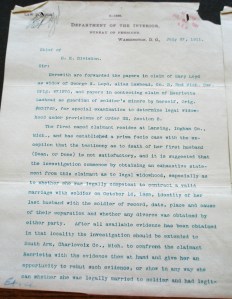
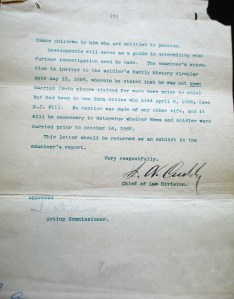
Competing Claims After George’s Death
George Washington Lawhead died on 20 January 1905.⁴ After his death, two women filed pension claims as his widow: Mary King and Henrietta Savage.
This triggered one of the most detailed posthumous investigations in the file. Pension examiners revisited decades-old records, re-interviewed witnesses, and re-evaluated earlier findings—including the determination that George Lawhead and George Loyd were the same man.
Mary King’s claim rested on the absence of divorce and the validity of her marriage. Henrietta’s claim rested on years of cohabitation, financial dependency, and the presence of minor children.
The 1912 Ruling
In 1912, the Bureau of Pensions issued its final ruling.⁵ Mary King was declared George Lawhead’s lawful widow.
The decision rested on two findings:
- George had never divorced Mary King.
- Mary’s earlier marriage was determined to have been legally void due to her age at the time, rendering her free to marry George in 1865.
As a result, all of George’s later marriages were deemed legally invalid for pension purposes. Henrietta Savage’s claim was denied, as were claims filed on behalf of her children.
This ruling did not negate the existence of George’s later family. It simply placed that family outside the boundaries recognized by federal pension law.
Children Acknowledged, Benefits Denied
One of the most difficult aspects of the case was the treatment of George’s children with Henrietta Savage. Pension records acknowledged their birth and dependency. Their relationship to George was not disputed.
However, under the law as applied, their mother was not a lawful widow, and the children were therefore ineligible for benefits derived from her claim. The pension system recognized biological relationships but prioritized marital legality.
Why the File Is So Large
George Lawhead’s pension file is thick because it documents conflict over time, not a single dispute. It contains:
- early abandonment claims
- identity investigations
- medical examinations
- competing widow applications
- posthumous legal review
Each layer built upon the last, preserving voices that would otherwise be lost: Mary King’s persistence, Henrietta Savage’s testimony, family members’ affidavits, and investigators’ conclusions.
Conclusion
The pension file of George Washington Lawhead illustrates the distance between lived family and legal family in nineteenth-century America. It shows how federal systems imposed rigid definitions on complex human relationships—and how those definitions carried lasting consequences.
By the time the government finished reconstructing George Lawhead’s family, the man himself had been dead for years. What remained was a record not just of service and disability, but of how law, identity, and family collided in the aftermath of war.
Sources
- Pension correspondence and affidavits filed by Mary King during George Lawhead’s lifetime.
- Bureau of Pensions examiner notes regarding marital status and absence of divorce.
- Michigan newspaper report, January 1892, documenting Henrietta Savage’s separation.
- Michigan death record for George Washington Lawhead, 1905.
- Bureau of Pensions ruling on lawful widowhood, 1912.
 The Tumbleweed