
By the time George Washington Lawhead’s Civil War pension file reached its final size—nearly three inches thick—it was no longer simply a record of military service and disability. It had become an investigation into identity itself. The central question was deceptively simple: was George Lawhead the same man as George Loyd?
For years, the Bureau of Pensions treated that question cautiously, reopening it repeatedly as new claims, affidavits, and correspondence arrived. What ultimately resolved the matter was not a census record, a marriage license, or even George’s own statements, but a single photograph.
Mary King and the Name “George Loyd”
When Mary King married George in 1865, she believed his name to be George Loyd.¹ She used that name consistently in later correspondence and pension filings, including applications she submitted while George was still alive.
This discrepancy could not be ignored. Pension law required certainty of identity, and the appearance of two different surnames raised the possibility that Mary’s husband and the veteran whose service records existed might not be the same individual. Rather than dismissing her claims outright, the Bureau undertook a prolonged inquiry.
Investigators gathered affidavits, compared timelines, and examined whether the names Loyd and Lawhead represented two separate men or one man using more than one name.
Post-War Name Usage and the Uncle Theory
Within the pension file is a recurring explanation for George’s inconsistent use of surnames. According to testimony and examiner notes, George was believed to have come to Michigan with an uncle following the deaths of his parents. The relationship was reportedly strained.
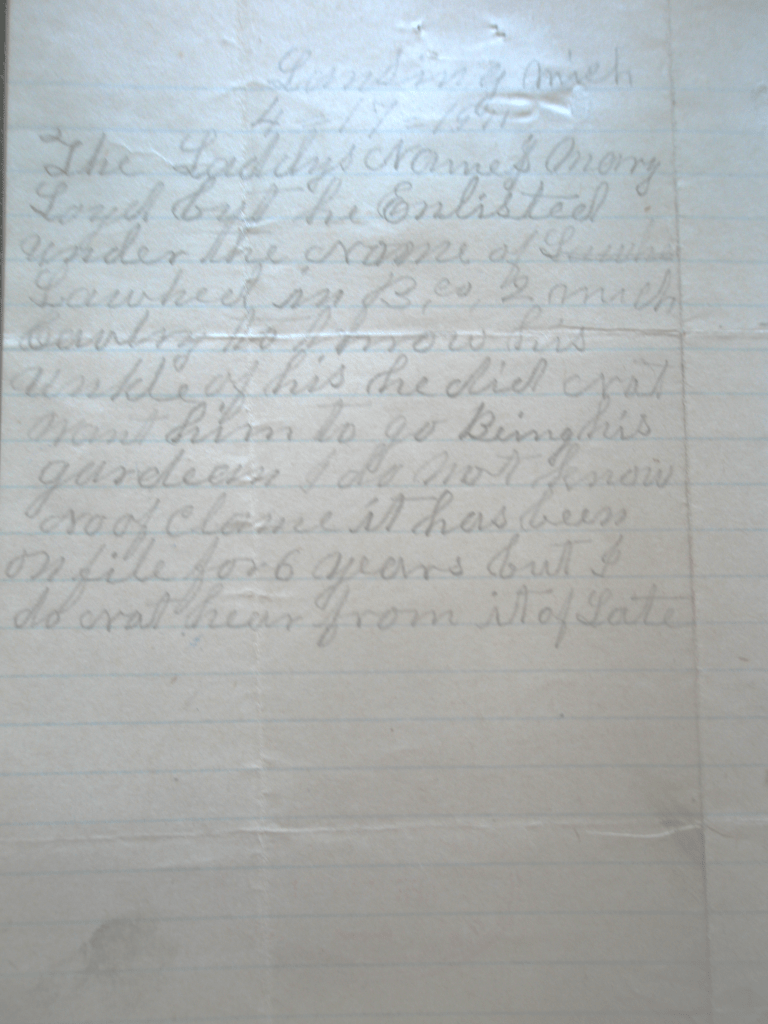
It was suggested—never proven, but treated as plausible—that George enlisted in the Civil War in part to escape that situation and later continued using a different surname in civilian life to avoid contact with his uncle.² Pension officials recorded this explanation explicitly as a theory, not as established fact.
They also noted a practical consideration: Lawhead, when spoken indistinctly, could easily be heard as Loyd. No evidence was found that George legally changed his name or attempted to conceal his identity for fraudulent purposes.
Why Paper Records Were Not Enough
On paper alone, the case remained uncertain. Census records varied. Marriage records conflicted. Informants changed over time. Some records gave George’s birthplace as Ohio, others as Pennsylvania or New York. His reported age fluctuated by several years.
Each document could be explained individually, but taken together they failed to provide certainty. Pension officials needed evidence that could transcend clerical error, memory lapses, and inconsistent reporting.
They found that evidence in a photograph.
The Discharge Photograph
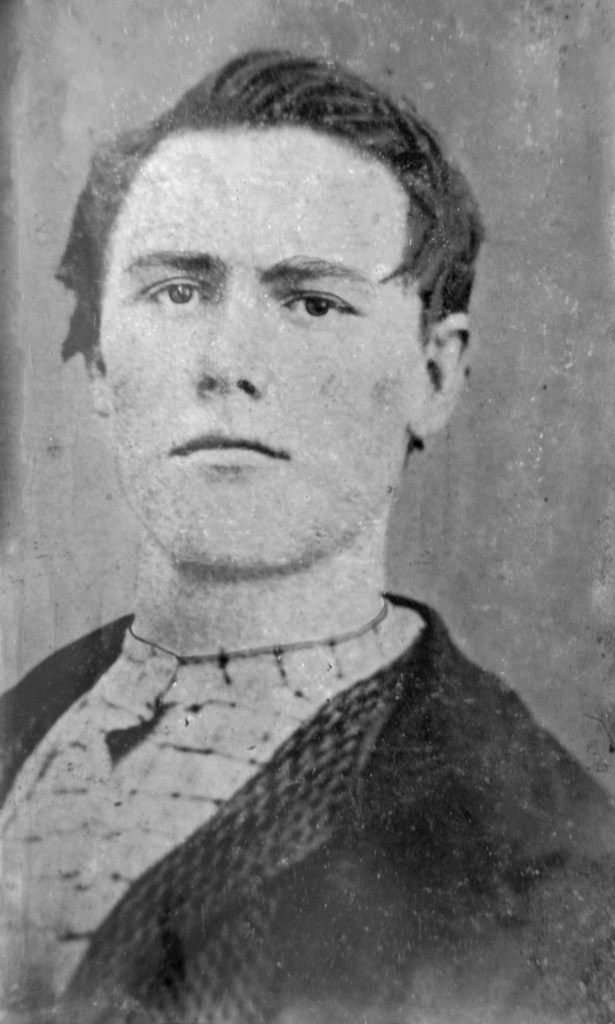
Among the materials submitted during the pension investigation was a photograph taken in Jackson, Michigan at the time of George’s discharge from the army. The image had been preserved for decades and was introduced as part of Mary King’s claim.
Rather than accepting it at face value, pension examiners used the photograph actively. It was shown independently to multiple witnesses, including George’s sister, Margaret A. Dutcher, and a former wartime comrade.³
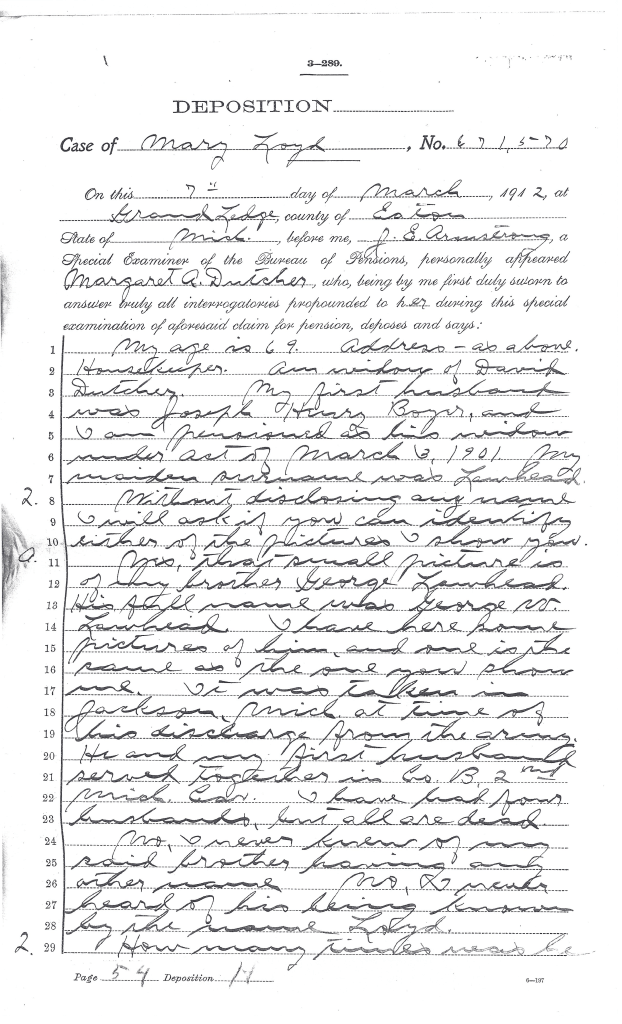
Both identified the man in the photograph as George Washington Lawhead. Their identifications were made separately and without prompting. Each confirmed not only the likeness, but also the circumstances under which the photograph had been taken.
This identification became the turning point in the investigation.
How the Bureau Reached Its Conclusion
With the photograph confirmed by two independent witnesses who knew George under different circumstances, the Bureau of Pensions concluded that George Loyd and George Washington Lawhead were the same individual.
This determination rested not on a single document, but on the convergence of evidence: consistent military service, overlapping residences, family testimony, and visual identification. From that point forward, the question of identity was treated as resolved.
All subsequent pension decisions, including rulings on lawful widowhood and eligibility, were based on this conclusion.
Why the Photograph Mattered More Than Documents
In the late nineteenth and early twentieth centuries, identity documentation was often fluid. People moved frequently, names were spelled phonetically, and informants were commonly neighbors, spouses, or officials with incomplete knowledge.
The photograph cut through those limitations. It connected the man known personally to family members and fellow soldiers with the veteran described in military records. In doing so, it accomplished what no single written document could.
Without that image, Mary King’s claims may have failed permanently. With it, the Bureau was able to reconstruct George Lawhead’s life across decades of inconsistent records.
Conclusion
The question of whether George Lawhead and George Loyd were the same man was not resolved quickly or casually. It took years of investigation, repeated applications, and careful evaluation of evidence. In the end, the decisive proof was visual rather than written.
That photograph anchored George Washington Lawhead in the historical record and allowed pension officials to proceed with judgments that would shape the fate of multiple families long after his death.
Sources
- Pension affidavits and correspondence filed by Mary King.
- Bureau of Pensions examiner notes regarding surname usage and family testimony.
- Deposition of Margaret A. Dutcher and corroborating testimony of a wartime comrade identifying the discharge photograph.
 The Tumbleweed