
A Man of the Revolutionary Era—But Not a Soldier
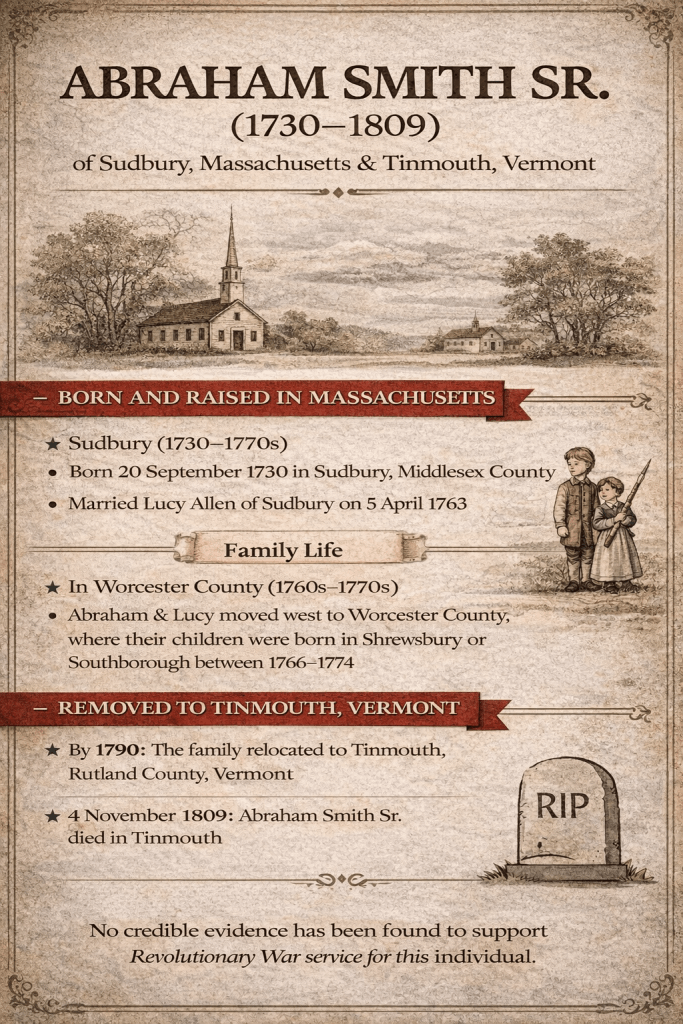
Abraham Smith was born on 20 September 1730 in Sudbury, Middlesex County, Massachusetts, a well-established New England town with extensive surviving eighteenth-century vital records.¹ He married Lucy Allen, and together they raised their family during a period that spanned the colonial era, the American Revolution, and the early years of the United States.²
Abraham’s adult life unfolded during the Revolutionary era, but surviving records do not demonstrate that he participated in the war as a soldier. Instead, the documentary evidence places him firmly in civilian life—raising a family, maintaining a household, and later participating in postwar migration patterns common to New England families.
Family and Household
Abraham Smith and his wife Lucy Allen were the parents of several children, including a son also named Abraham, born in 1768 in Worcester County, Massachusetts.³ This younger Abraham—referred to here as Abraham Smith Jr.—is clearly documented as a separate individual who later settled in Brookfield, Orange County, Vermont, where he left an extensive probate record.⁴
By the outbreak of the Revolutionary War in 1775, Abraham Smith Sr. was forty-five years old and had dependent children still at home. While men of this age sometimes served, many did not, particularly when responsible for sustaining farms and households, a pattern well documented in New England militia demographics.⁵
Move to Vermont
Following the Revolutionary War, Abraham Smith relocated north to Tinmouth in Rutland County, Vermont. This move aligns with a broader postwar migration pattern, as families from Massachusetts and southern New England moved into Vermont towns newly opened to settlement and formalized governance.⁶
Abraham Smith died in Tinmouth on 4 November 1809.⁷ His death is recorded in Vermont vital records, and his probate proceedings further confirm his residence in Tinmouth at the end of his life.⁸
The Question of Revolutionary War Service
Abraham Smith of Tinmouth has long been attributed Revolutionary War service in at least one early DAR lineage record.⁹ That attribution has been repeated in derivative family trees and secondary sources, despite the lack of supporting contemporary evidence.
The DAR Ancestor Database lists numerous men named Abraham Smith who served during the Revolutionary War, across multiple colonies and states, under different commanding officers and with differing life details.¹⁰ Careful comparison of these service profiles shows that none can be conclusively matched to the Abraham Smith born in Sudbury in 1730 and deceased in Tinmouth in 1809.
Critically, Abraham Smith’s probate file contains no references to military service, land bounties, pensions, arrears of pay, or other benefits commonly associated with Revolutionary War veterans or their heirs.¹¹ No pension application or verified service record has been identified that connects him to wartime service.
Resolving the Misattribution
The Revolutionary War service attributed to Abraham Smith of Tinmouth appears to be the result of name conflation. “Smith” is among the most common surnames in eighteenth-century New England, and Abraham was a frequently used given name. Early lineage applications often relied on incomplete records and did not have access to the full range of probate, census-context, and geographic evidence now available.
Subsequent analysis of birth, marriage, residence, probate, and family structure demonstrates that the military service cited in the early DAR record belongs to other men named Abraham Smith, not to the individual who died in Tinmouth in 1809.
Conclusion
Abraham Smith lived through the Revolutionary era, raised a family during a time of upheaval, and participated in the postwar settlement of Vermont. While he was not a Revolutionary War soldier, his life reflects the experience of many New England civilians whose labor, stability, and family networks sustained their communities before, during, and after the war.
Correcting the historical record does not diminish Abraham Smith’s legacy. Rather, it ensures that his story—and the story of Revolutionary War service—is told accurately and supported by evidence.
Footnotes
- Sudbury, Massachusetts, town vital records; Massachusetts Town and Vital Records, 1620–1988 (Ancestry).
- Marriage and family structure inferred from Massachusetts and Vermont vital records and probate context.
- Massachusetts Town Birth Records; Worcester County birth registers (Ancestry).
- Vermont, Wills and Probate Records, 1749–1999, Orange County, estate of Abraham Smith (d. 1849) (Ancestry).
- Massachusetts militia participation patterns discussed in contemporary town and county studies; absence of service-specific documentation for Abraham Smith.
- Vermont settlement and migration patterns following the Revolutionary War; Rutland County land and town histories.
- Tinmouth, Rutland County, Vermont, vital records.
- Rutland County, Vermont, probate records for Abraham Smith (d. 1809).
- DAR Ancestor Database, legacy entry for Abraham Smith, ancestor number A104615.
- DAR Ancestor Search results for “Abraham Smith,” multiple entries with divergent service profiles.
- Rutland County probate file for Abraham Smith (d. 1809), no military references noted.
 The Tumbleweed