
Revolutionary War service is often imagined as long enlistments, dramatic campaigns, and later pension testimony. In reality, many Connecticut men served for brief periods in the early years of the conflict, answering calls before returning home to their families and farms. The military service of Aaron Hull fits that pattern and is supported by compiled federal military records.¹
Born and buried in Wallingford, Connecticut, Aaron Hull spent nearly his entire life within the same community. His Revolutionary War service, though short in duration, is firmly documented and securely attributable to him—making his case a relatively straightforward identification among Connecticut patriots.²
Early Life in Wallingford
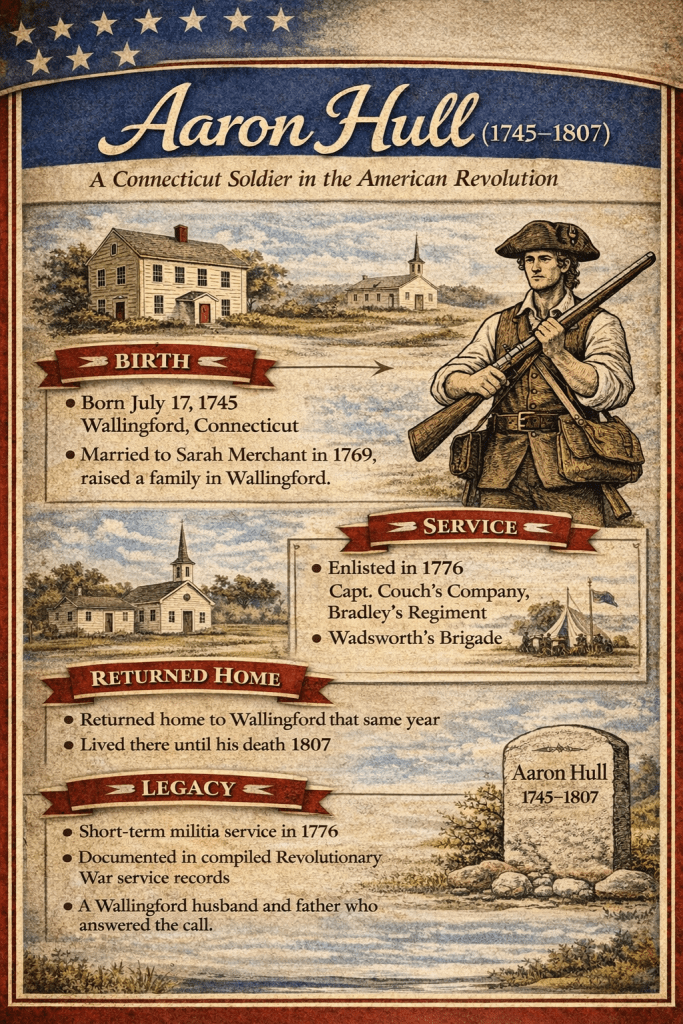
Aaron Hull was born 17 July 1745 in Wallingford, New Haven County, Connecticut, the son of John Hull and Mary Andrews.³ He lost his father in 1755, when Aaron was still a child.⁴
On 16 November 1769, Aaron married Sarah Merchant in Wallingford.⁵ Over the next decade the couple began raising a family. Their children’s births span the years immediately before, during, and after the Revolution, placing Aaron among the many married householders who balanced wartime obligations with domestic life.⁶
Revolutionary War Service
Aaron Hull’s Revolutionary War service appears in compiled federal service records derived from original muster and pay rolls.⁷ Those records indicate that he enlisted in 1776 in Captain John Couch’s company, within Colonel David Wooster’s/Wadsworth-associated Connecticut organization commonly referenced as Bradley’s Regiment (or battalion) in some compiled abstracts.⁸
His service was short-term and he was discharged the same year. Short enlistments of this kind were common for Connecticut men in 1776, particularly in service connected to local defense, regional mobilization, and short campaigns.⁹
A separate lineage-society abstract (compiled from earlier record sources) also reports Aaron Hull’s 1776 enlistment in Captain Couch’s company, Bradley’s battalion, Wadsworth’s brigade, with discharge the same year and identifying him as born in Wallingford, Connecticut.¹⁰ While such membership-era abstracts are not substitutes for original records, the agreement between the abstract and the compiled service record strengthens confidence in the interpretation and identification of the soldier.¹¹
Civilian Life During and After the War
After his wartime service, Aaron Hull returned to civilian life in Wallingford and the nearby Meriden area. The continued births of his children in Connecticut through 1780 reflect a stable household during the postwar years.¹²
Federal census schedules place him in Wallingford in both 1790 and 1800, confirming continuity of residence.¹³ Unlike some veterans who moved westward after the Revolution, Aaron Hull appears to have remained rooted in the same Connecticut community where he was born.
Aaron Hull died on 22 September 1807 in Wallingford; his wife Sarah Merchant Hull died the same day.¹⁴ Local burial information associates the family with the Meriden/Wallingford area, consistent with their long-term residence.¹⁵
Assessing the Evidence
Aaron Hull’s service is supported by a strong combination of sources: compiled federal military records that identify the soldier’s unit and year of enlistment, and civilian records that consistently place the same man in Wallingford before and after the war.
The absence of a pension file does not weaken the case. Many men with short service in 1776 never applied for pensions, and eligibility rules changed over time. Aaron Hull’s documented service fits well within the category of Revolutionary participants whose contribution was real, essential, and only briefly recorded.
Conclusion
Aaron Hull was not a professional soldier and did not leave behind a personal narrative of wartime experience. He was a Wallingford husband and father who served when called in 1776 and returned home to raise his family. His documented service provides a reliable link to the Revolutionary generation and reflects the ordinary, short-term duty on which the war effort frequently depended.
By presenting his story as the records allow—without embellishment—we preserve both historical accuracy and respect for the man himself.
Notes
- National Archives, Compiled Service Records of Soldiers Who Served in the American Army During the Revolutionary War (Record Group 93), publication M881; accessed via Fold3.
- Correlation of military and civilian records for Aaron Hull of Wallingford, Connecticut (birth, marriage, residence, death).
- Wallingford, Connecticut, birth records (Barbour Collection and/or church abstracts), as indexed on Ancestry.
- Wallingford, Connecticut, death record or town record entry for John Hull (d. 1755), as indexed on Ancestry.
- Wallingford, Connecticut, marriage records (Barbour Collection), marriage of Aaron Hull and Sarah Merchant, 1769, as indexed on Ancestry.
- Wallingford/Meriden, Connecticut, town birth records for the Hull children (Barbour Collection and related abstracts), as indexed on Ancestry.
- NARA, Compiled Service Records (RG 93), Aaron Hull service entry; accessed via Fold3.
- Compiled service abstract referencing Capt. John Couch’s Company and Bradley’s Regiment/Battalion within Wadsworth’s brigade framework; accessed via Fold3.
- General context: Connecticut enlistment practices and short-term service patterns in 1776.
- Daughters of the American Revolution lineage entry summarizing Aaron Hull’s service in Capt. Couch’s company, Bradley’s battalion, Wadsworth’s brigade, 1776; compiled publication.
- Agreement between lineage-society abstract and compiled federal service record supports identification and service summary.
- Connecticut town birth records for children born 1770–1780; indexed on Ancestry.
- 1790 and 1800 U.S. Federal Census, Wallingford, New Haven County, Connecticut; images/index on Ancestry.
- Wallingford, Connecticut, death record entries for Aaron Hull and Sarah (Merchant) Hull, 1807; indexed on Ancestry.
- Connecticut cemetery inscriptions/newspaper notices and local burial references (Meriden/Wallingford area); indexed collections on Ancestry.
 The Tumbleweed