
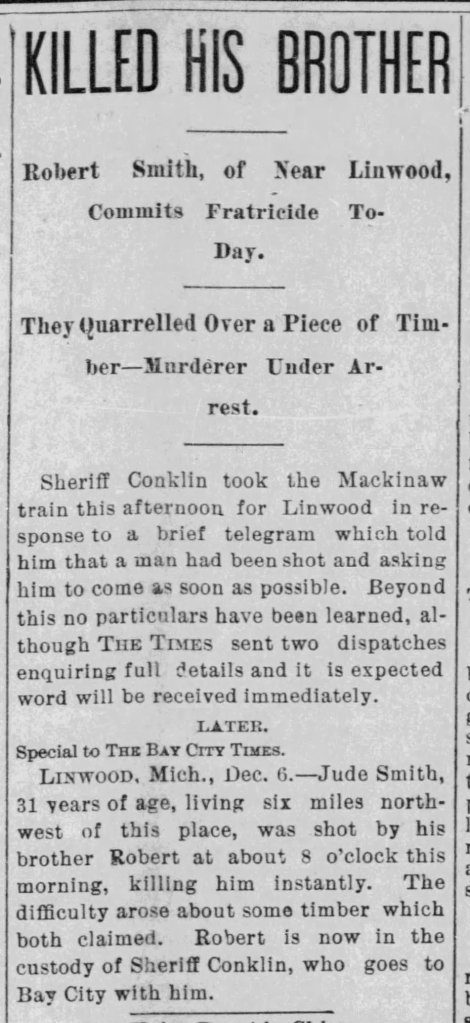
On 6 December 1890, a violent confrontation between two brothers near Linwood in Bay County, Michigan, ended with one man dead and the other facing the gravest criminal charge available under Michigan law. Robert Smith shot and killed his brother, Jude A. Smith, in what newspapers immediately characterized as the culmination of a long-standing family dispute over land and timber.¹ Within days, the case became one of the most closely followed criminal proceedings in Bay County.
The killing of Jude Smith
Early reports placed the shooting in Garfield Township, near Linwood, during an argument concerning ownership and removal of timber. Accounts varied in their details, but the central facts remained consistent: Robert Smith fired a shotgun at close range, killing his brother.² From the earliest coverage through the conclusion of the trial, newspapers referred to the accused almost uniformly as Robert S. Smith.³
The intensity of public interest was evident almost immediately. Smith was arrested, lodged in the Bay County jail, and photographed for inclusion in the local “rogue’s gallery,” an act reported in the press as a matter of routine but revealing the degree to which the case had already entered the public imagination.⁴
Pretrial proceedings and public attention
Throughout December 1890 and into early 1891, Bay City newspapers printed frequent updates on the case. These included notices of arraignment, scheduling delays, and speculation regarding the defense strategy.⁵ At various points, reports suggested that Smith might pursue an insanity defense, though these references appear largely in the context of courtroom rumor rather than formal pleadings.⁶
The coverage also reflected the spectacle of the proceedings themselves: crowded courtrooms, lengthy jury selection, and the presence of spectators from Linwood and surrounding communities who were familiar with the Smith family.⁷
Trial and conviction
Robert Smith’s trial took place in the spring of 1891. Newspaper accounts summarized testimony from witnesses present at the scene, law enforcement officers, and medical professionals.⁸ Despite arguments advanced by the defense, the jury returned a verdict of guilty of murder in the first degree.⁹
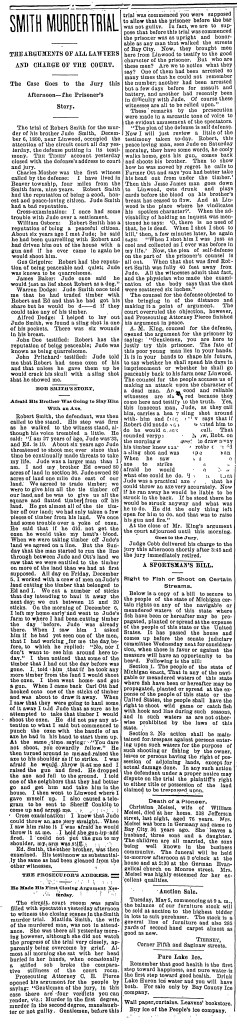
On 12 May 1891, Smith was sentenced to life imprisonment. Several newspapers printed a statement attributed to him shortly thereafter, in which he denied guilt and attempted to justify his actions as self-defense, framing himself as the victim of prolonged harassment by his brother.¹⁰ The letter provides insight into Smith’s own view of events but does not alter the legal outcome of the case.
Incarceration and release
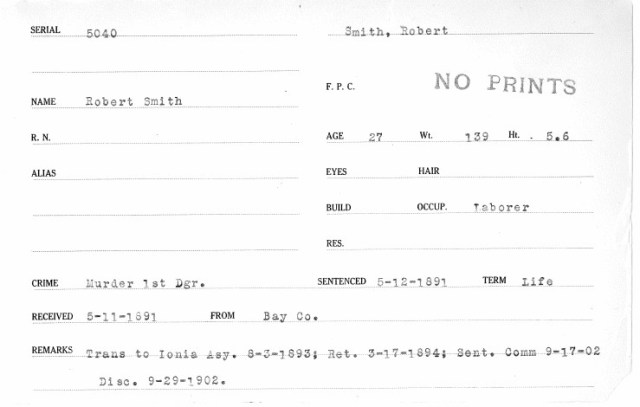
Michigan prison records confirm that Robert Smith was received at the state prison on 11 May 1891 following his conviction in Bay County.¹¹ Although sentenced to life, his incarceration did not remain static. In August 1893, Smith was transferred to the Ionia State Hospital for the Criminally Insane, where he remained for several months before being returned to prison in March 1894.¹²
More than a decade later, his case was reconsidered. In September 1902, Smith was granted a commutation of sentence and formally discharged from custody later that month.¹³ This record is critical, as it establishes that Smith was not imprisoned for life and that his release occurred well before the turn of the century.
A new life in Washington
Nearly two decades later, Robert Smith appears in Washington State records. On 9 June 1919, a marriage was recorded in Centralia, Lewis County, between Robert T. Smith and Edna Myers.¹⁴ The groom was reported as fifty-five years old, born in Pennsylvania, and entering his second marriage. His occupation was listed as laborer. The record names his father as Abraham T. Smith and gives his mother’s maiden name as Thompson.¹⁵
The use of the middle initial “T” in this record contrasts with the consistent use of “S” in Bay County newspaper coverage. Whether this reflects clerical variation, personal choice, or a deliberate alteration cannot be determined from the surviving records. What can be said is that the Washington marriage record aligns closely with other identifying details associated with the Bay County defendant, including age, birthplace, and parental names.
Death in Tacoma
Robert Smith’s life concluded in Tacoma, Pierce County, Washington. His death certificate records that Robert T. Smith died on 10 February 1947 at the age of eighty-two.¹⁶ His birth date is given as 6 May 1864, with birthplace recorded as Blakerlee, Pennsylvania. At the time of death, he was widowed and retired. He was buried at Oakwood Cemetery in Tacoma.¹⁷
The informant for the death certificate was hospital staff, and several personal details—including parental information—were listed as unobtainable.¹⁸ Nonetheless, the combination of birth date, birthplace, and earlier Washington records strongly suggests continuity between the man who married in Centralia in 1919 and the man who died in Tacoma in 1947.
Minnie, the first wife
The 1919 Washington marriage record explicitly states that it was Robert Smith’s second marriage, confirming the existence of an earlier wife. That woman is known from earlier records as Minnie, though it remains unclear whether this was her legal given name or a familiar nickname. Despite extensive documentation surrounding Robert Smith’s criminal case, imprisonment, and later life, no definitive record has yet been identified that accounts for Minnie’s fate. At present, what became of her remains unknown.
Conclusion
Robert Smith’s life cannot be reduced to a single violent act, yet neither can that act be separated from the years that followed. Convicted of first-degree murder in 1891 and sentenced to life imprisonment, he was later released, relocated across the country, remarried, and lived into old age. The surviving records trace a trajectory from public disgrace to relative obscurity, marked by gaps that resist easy explanation. As with many lives reconstructed from fragmentary sources, some questions remain unanswered—but the outline of the story is now firmly grounded in the historical record.
Notes
- Bay City newspapers reporting the killing of Jude A. Smith near Linwood, December 1890.
- Contemporary newspaper descriptions of the shooting and its circumstances, December 1890.
- Bay City press coverage consistently identifying the accused as Robert S. Smith, 1890–1891.
- Newspaper report noting Smith’s photograph taken at the Bay County jail for the rogue’s gallery.
- Bay City newspaper reports on arraignment and court scheduling, December 1890–January 1891.
- Newspaper references to a possible insanity defense during pretrial proceedings.
- Reports describing courtroom crowds and jury selection during early 1891.
- Trial testimony summaries published in Bay City newspapers, April–May 1891.
- Newspaper accounts of the guilty verdict and sentencing, May 1891.
- Published letter attributed to Robert Smith following conviction, May 1891.
- Michigan State Prison prisoner index card for Robert Smith, received May 1891.
- Prison record noting transfer to Ionia State Hospital and subsequent return.
- Prison record documenting commutation and discharge, September 1902.
- Lewis County, Washington, marriage record for Robert T. Smith and Edna Myers, 9 June 1919.
- Ibid., parental and birthplace information.
- Washington State death certificate for Robert T. Smith, Tacoma, 10 February 1947.
- Ibid., burial information.
- Ibid., informant and missing personal details.
 The Tumbleweed