
By the time William Doonan relocated his family to the Temiskaming district of northern Ontario, he was no longer a young man. Newspaper accounts place the family’s move from Michigan to Pense Township by about 1908, when William—described repeatedly as elderly—set about clearing land and establishing a farm in an isolated settlement north of New Liskeard.¹ This move explains his absence from later United States records and marks the final geographic shift of his life.
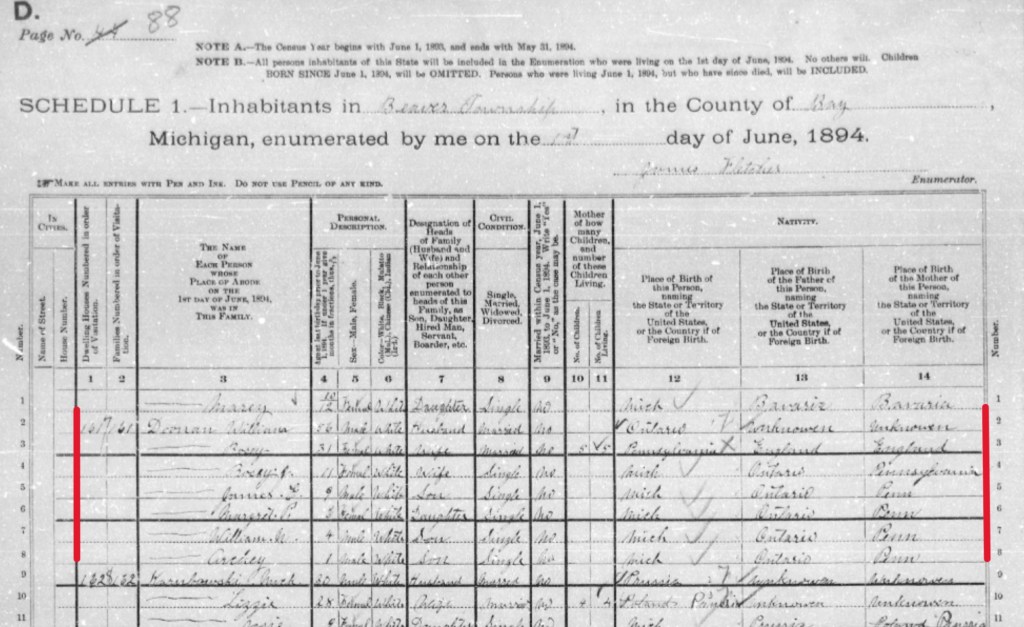
Michigan state census records show that by 1894 William and Rosa Susan Smith were raising a growing family together, firmly established in Bay County.² Those records reflect a household that expanded steadily through the 1880s and 1890s, before economic pressure, family conflict, and William’s advancing age appear to have pushed the family toward a more marginal existence.
Life in Pense Township proved difficult. A June 1910 newspaper account described the settlement as one marked by deep hostility among neighbors, with William Doonan’s farm identified as the center of repeated disputes.³ One incident escalated into violence when neighbors attempted to cross his fields with a wagon and were refused permission. A fight followed in which George Ellis was struck unconscious by William Doonan, described in the article as “Doonan senior.” William was arrested and tried at North Bay, though the court was compelled to cover witness expenses because the family lacked the means to do so. He was ultimately released on a suspended sentence due to his age.⁴
These reports are notable not simply for the violence described, but for what they reveal about William’s condition. The articles consistently emphasize his age, poverty, and the fragile social position of the family. They also record a pattern of accusations and counter-accusations involving livestock, property damage, and threats—suggesting a man under strain in a community where tolerance was wearing thin.⁵
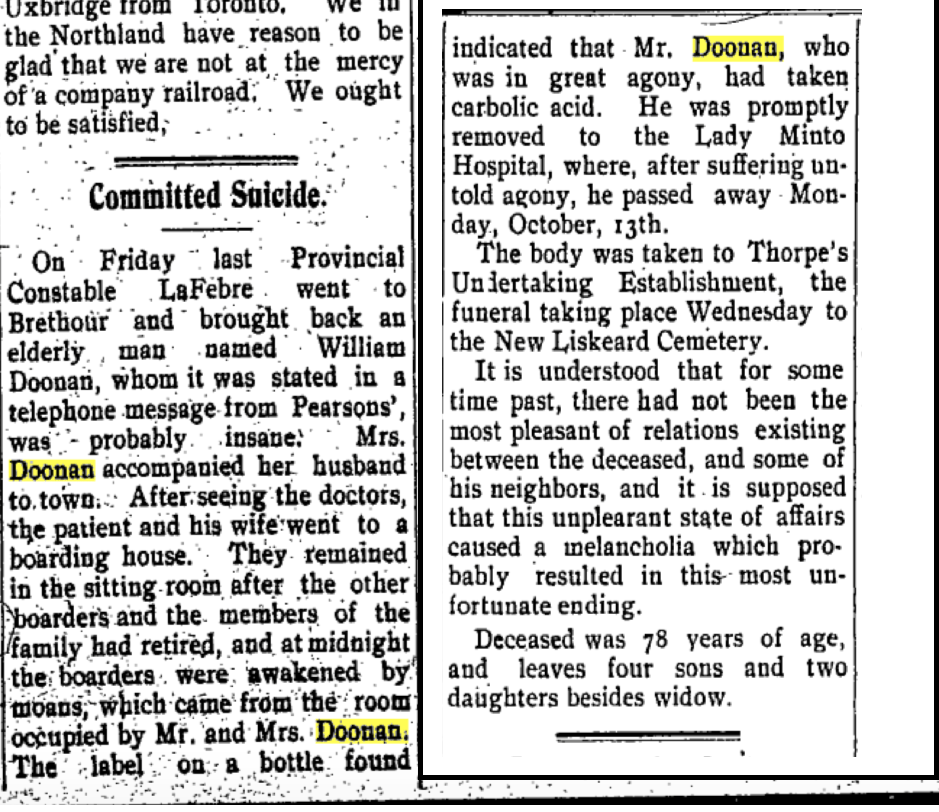
By 1913, William’s health had clearly deteriorated. Newspaper accounts from the Temiskaming district reported his death by suicide, following a period of illness and mental decline.⁶ The articles avoid sensational language, but the circumstances described point to a man worn down by years of conflict, physical decline, and isolation. His death occurred at Lady Minto Hospital, bringing his long and troubled life to an end far from the Michigan communities where he had spent most of his adulthood.⁷
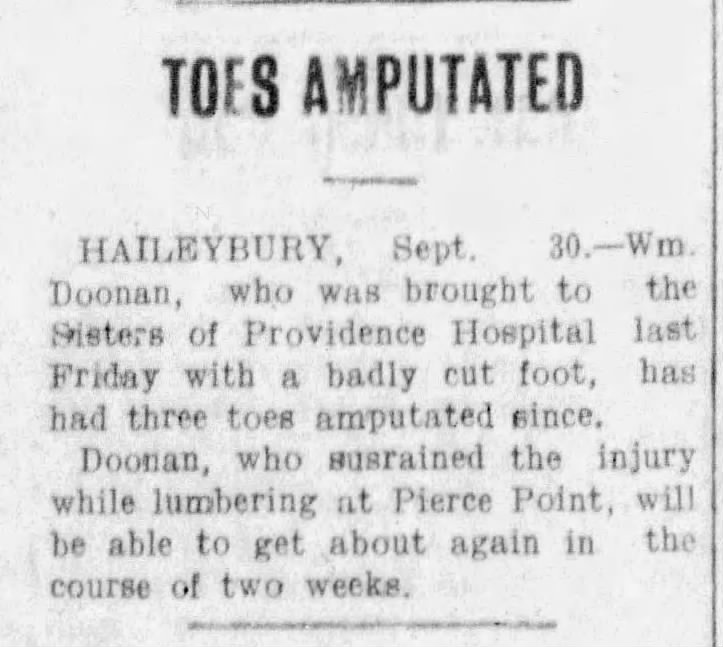
William Doonan’s story is not preserved through orderly civil records or consistent census appearances. Instead, it survives through fragments: state censuses, court proceedings, and the sometimes-blunt language of small-town newspapers. Together, those sources document a life shaped by instability, conflict, and hardship—one that cannot be understood through a single record type alone.
In the end, William Doonan did not disappear from the historical record. He faded out of one jurisdiction and reappeared in another, carrying with him the same struggles that had marked his earlier years. His death closed a chapter defined not by prosperity or permanence, but by endurance in the face of circumstances that steadily narrowed his options.
Sources
¹ North Bay Nugget (North Bay, Ontario), 29 June 1910, p. 7.
² 1884 Michigan State Census, Bay County; 1894 Michigan State Census, Bay County.
³ North Bay Nugget (North Bay, Ontario), 29 June 1910, p. 7.
⁴ Ibid.
⁵ Ibid.
⁶ The Temiskaming Speaker (New Liskeard, Ontario), October 1913.
⁷ Ontario death registration, Temiskaming District, 1913.
 The Tumbleweed