
By the late 1880s, William Doonan was living in Bay County, Michigan, with his wife Rosa Susan Smith and their blended family, which included a daughter from William’s previous marriage. Although William does not appear in either the 1880 or 1900 U.S. federal census, local newspapers and state census records document a pattern of conflict that brought him repeatedly to the attention of neighbors, courts, and eventually authorities on both sides of the international border.
The earliest documented incident occurred in May 1889. The Evening Press reported that William Doonan, then residing in Monitor Township, was arrested after allegedly threatening to shoot a neighbor. According to the article, William drew a revolver during a dispute and was taken before a justice for examination.¹ This report establishes that William’s legal troubles began well before the turn of the century and involved firearms rather than minor civil disagreements.
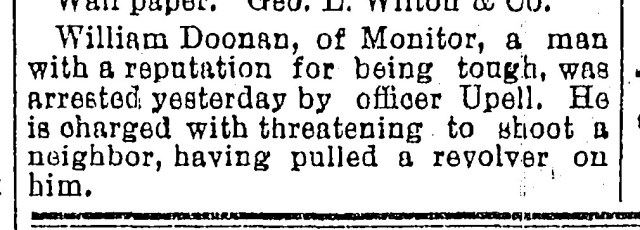
In 1891, William’s name appeared again in the press—this time in connection with a tragedy within his wife’s family. The Bay City Daily Tribune reported on the conviction of Robert Smith for killing his brother Jude Smith, who was also Rosa’s brother. The article states that the gun involved in the homicide was afterward given to William Doonan.² The crime itself belonged solely to Robert Smith, but the transfer of the weapon placed William in possession of a firearm already associated with a notorious and widely reported act of violence. In a small community, such an association would not have gone unnoticed.
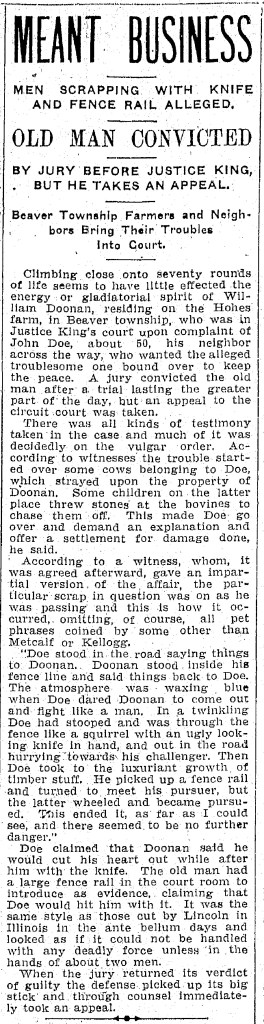
More than a decade later, William again surfaced in Bay City newspapers amid renewed conflict. In June 1905, the Bay City Times reported that a complaint had been filed by a neighbor, John Doe, alleging that William approached him with an open knife and made threats. The matter was adjourned rather than immediately resolved.³ A follow-up article published the following month described a contentious courtroom proceeding in which testimony referenced both a knife and a fence rail used as evidence. That report states William was convicted before a justice and that he appealed the decision.⁴ These accounts show William actively entangled in the local court system, though not always with swift or final resolution.
By 1910, William Doonan was no longer appearing in Michigan newspapers. Instead, his name surfaced in Ontario. In May 1910, the North Bay Nugget reported on William in connection with firearm possession, revisiting earlier concerns about weapons and violent associations tied to the Smith family tragedy.⁵ The Temiskaming Speaker published a related account shortly thereafter, further documenting community concern and official attention.⁶ Later that summer, the North Bay Nugget followed up on William’s legal situation, indicating that the matter continued to draw notice weeks after the initial report.⁷
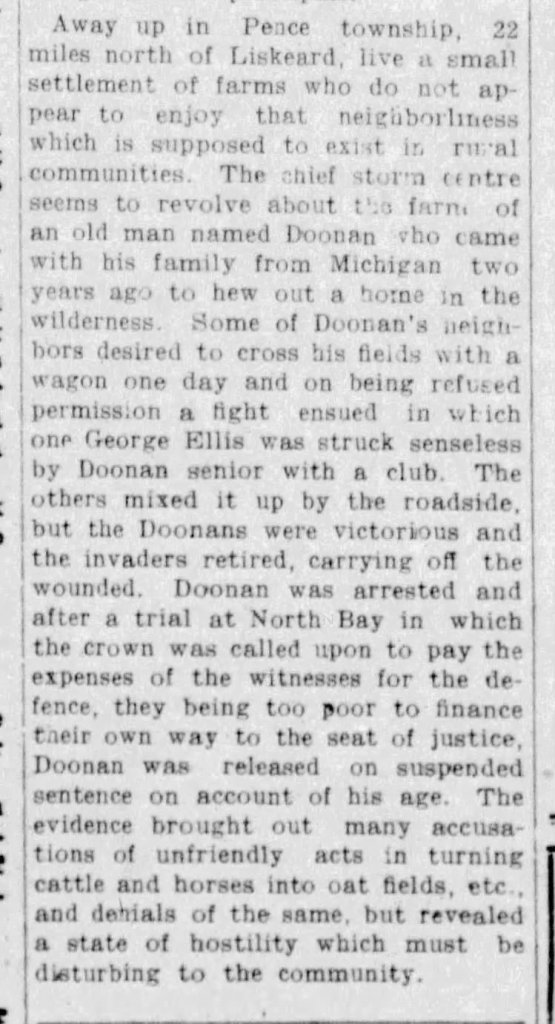
These Canadian newspaper reports demonstrate that William’s conflicts did not end with his departure from Michigan. Rather, they followed him across the border, suggesting a continuity of reputation that transcended geography. The repetition of firearm-related concerns—spanning from 1889 in Monitor Township to 1910 in Ontario—forms one of the most consistent threads in the surviving documentary record.
William’s absence from the 1900 U.S. federal census remains unexplained. Whether this reflects deliberate avoidance, temporary relocation, or simple enumerator omission cannot be determined from existing evidence. What can be established is that William Doonan was repeatedly involved in disputes serious enough to attract legal and press attention over a span of more than twenty years.
The broader context of the Smith family violence is essential to understanding how William’s story was perceived by others. Rosa Susan Smith’s brother Jude Smith was killed by another brother, Robert Smith.⁸ While William was not responsible for that homicide, his later possession of the gun used in the crime and his own documented disputes involving weapons ensured that the shadow of that tragedy remained close.
By 1910, William Doonan was a man known to authorities in multiple jurisdictions, his name intertwined with firearms, courtrooms, and unresolved tensions. His story does not resolve neatly—but the records leave little doubt that his reputation was forged as much by conflict as by kinship.
Sources
¹ Evening Press (Bay City, Michigan), 9 May 1889, p. 8.
² Bay City Daily Tribune (Bay City, Michigan), 13 May 1891, p. 4.
³ Bay City Times (Bay City, Michigan), 18 May 1905, p. 1, “Show Him His Heart.”
⁴ Bay City Times (Bay City, Michigan), 19 June 1905, p. 6, “Meant Business.”
⁵ North Bay Nugget (North Bay, Ontario), 19 May 1910, p. 1.
⁶ The Temiskaming Speaker (New Liskeard, Ontario), 20 May 1910, p. 4.
⁷ North Bay Nugget (North Bay, Ontario), 29 June 1910, p. 7.
⁸ Nancy Little, “Jude Smith’s Legacy,” The Tumbleweed, 14 March 2018, https://familytumbleweed.blog/2018/03/14/jude-smiths-legacy/.
 The Tumbleweed