
William Doonan was born on 29 September 1837 in Hillier Township, Prince Edward County, Upper Canada, the son of James Doonan and Prudence Mary Morton.¹ His early life unfolded within a large family that soon migrated westward into Hastings County, Ontario, where William appears alongside his parents and siblings in mid-nineteenth-century records.² These early movements reflect the broader patterns of rural settlement and land hunger that shaped many Canadian families of the period.
By the 1860s, William was living independently. In the 1861 census of Canada, he appears in Hungerford Township, Hastings County, identified as a single man and a member of the Church of England.³ Within a few years, he crossed the border into Michigan, joining the steady stream of Canadian migrants drawn to land opportunities in the Saginaw Bay region.
On 4 March 1868, William Doonan entered 80 acres of land in Beaver Township, Bay County, Michigan, under the Homestead Act.⁴ Over the following years, he fulfilled the requirements of residence and improvement, constructing a log house and barn, digging wells, fencing and cultivating acreage, and planting fruit trees.⁵ These records establish him not as a transient laborer but as a settler who invested sustained labor and resources into his farm.
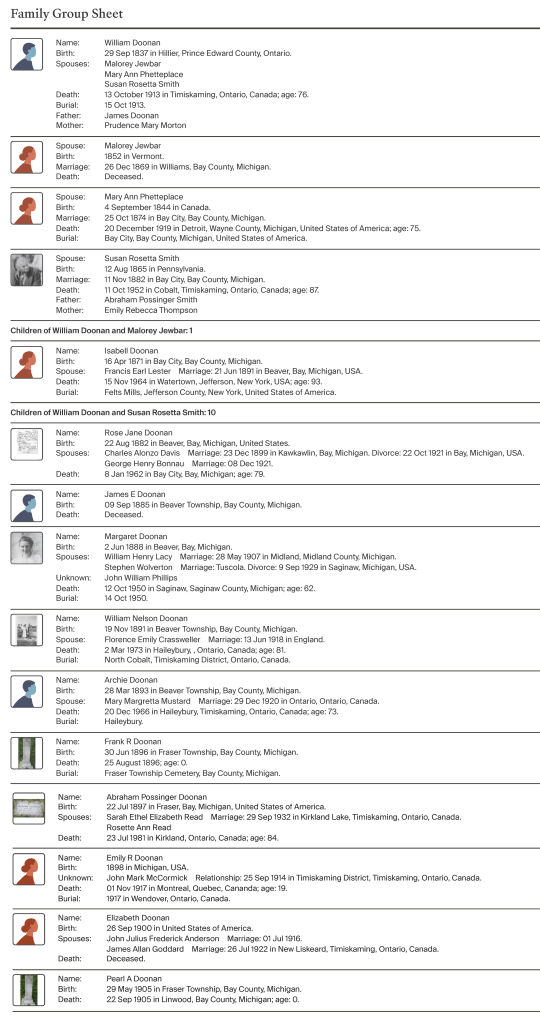
William’s personal life during this period was complex. He married Ann Scott in Bay County on 26 December 1869.⁶ This marriage was short-lived, and no later records place Ann in William’s household. By January 1874, William had married again, this time to Maloney Jewbar.⁷ As with his first marriage, no divorce or death record has been located, but by the early 1880s Maloney no longer appears in records associated with him.
William’s third marriage, to Rosa Susan Smith, marked a turning point in his life. They were married in Bay City, Michigan, on 11 December 1882.⁸ From this point forward, Rosa is consistently identified as William’s wife in census records, newspapers, and later Ontario documents. She was the mother of nearly all of his children and remained with him through the final decades of his life.
One child, Isabel Doonan, predates William’s marriage to Rosa. Isabel appears in the 1884 Michigan state census within William and Rosa’s household.⁹ Based on her age and the date of William’s marriage to Rosa, Isabel was the child of one of William’s earlier marriages. Her presence in the household reflects the blended family structures that were not uncommon in the nineteenth century.
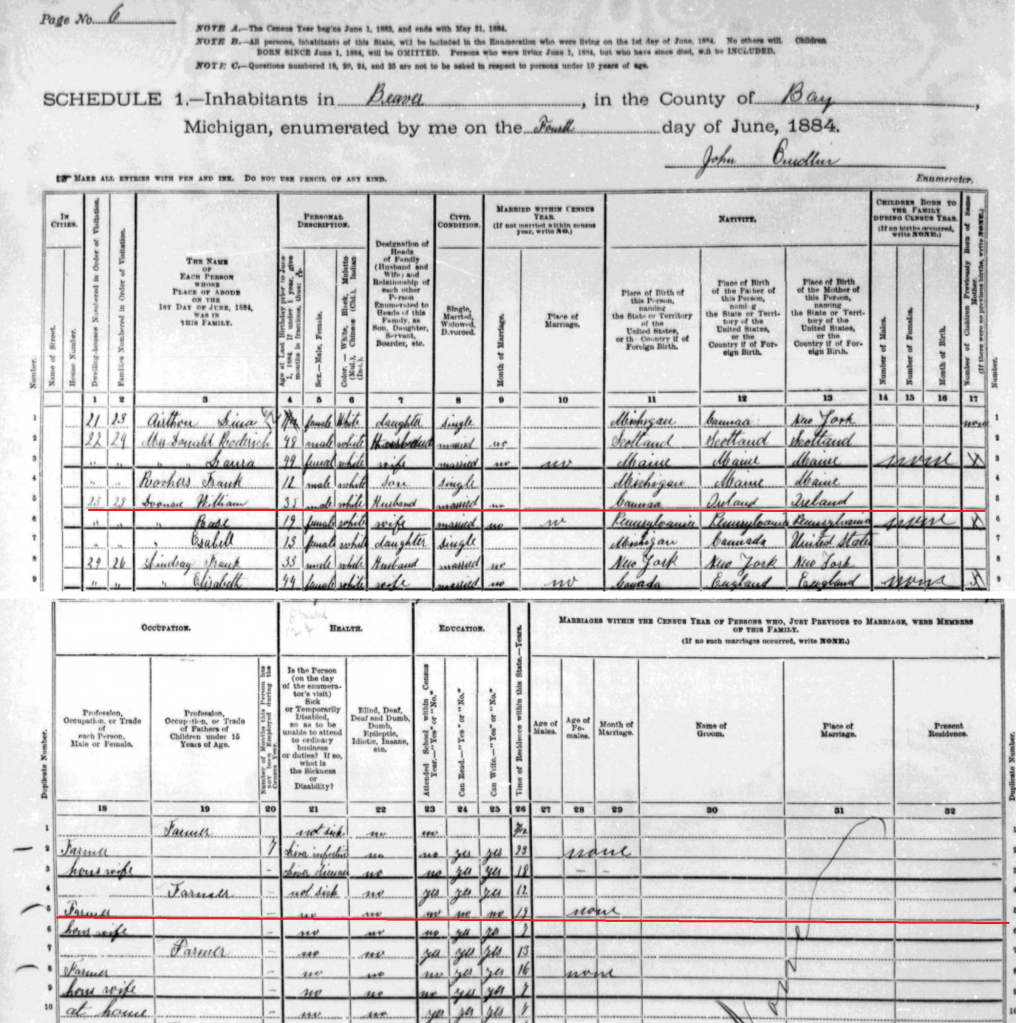
William and Rosa raised a large family in Bay County, and their household appears repeatedly in Michigan state census records during the 1880s and 1890s.¹⁰ During these years, William supported his family through farming and lumbering, work that was physically demanding and increasingly hazardous as he aged.
William does not appear in the 1880 or 1900 United States federal census. This absence is notable but not inexplicable. During this period, he moved frequently between Michigan and Ontario and appears instead in state and provincial records. At the turn of the twentieth century, his household was also affected by violence within his wife’s family, including the killing of Rosa Susan Smith’s brother Jude Smith by another brother, an event documented elsewhere.¹¹ Contemporary newspaper reporting later indicates that William came into possession of the firearm involved.¹² While no direct evidence links these events to census avoidance, the combination of cross-border movement, legal scrutiny, and rural residence provides a plausible explanation for the family’s absence from federal enumeration.
William’s wider family network also remained close. Census proximity and migration patterns suggest that John Doonan, who appears in nearby Michigan census records during the same period, was likely William’s brother.¹³ Although no single record explicitly states this relationship, the accumulated evidence supports a close familial connection.
By the early twentieth century, William and Rosa left Michigan and returned to Ontario, settling in the Temiskaming District. This final chapter of William Doonan’s life would be marked by increasing hardship, legal entanglements, and declining health—subjects that will be examined in the posts that follow.
Notes
- Ontario birth records and compiled family records for William Doonan, Hillier Township, Prince Edward County, Ontario.
- 1861 Census of Canada, Hungerford Township, Hastings County, Ontario.
- Ibid.
- U.S. General Land Office Records, Homestead Entry, Beaver Township, Bay County, Michigan, 4 March 1868.
- Homestead proof affidavits, Beaver Township, Bay County, Michigan.
- Bay County, Michigan, Marriage Register, 1869, marriage of William Doonan and Ann Scott.
- Bay County, Michigan, Marriage Register, 1874, marriage of William Doonan and Maloney Jewbar.
- Bay County, Michigan, Marriage Register, 1882, marriage of William Doonan and Rosa Susan Smith.
- 1884 Michigan State Census, Beaver Township, Bay County, Michigan.
- 1884 and 1894 Michigan State Census records, Beaver Township, Bay County, Michigan.
- Nancy Little, “Jude Smith’s Legacy,” The Tumbleweed, 14 March 2018.
- North Bay Nugget, May 1910, reporting on firearm possession connected to the Smith family incident.
- 1884 and 1894 Michigan State Census records for John Doonan, Bay County, Michigan.
 The Tumbleweed