
In October 2020, I published a post outlining the evidence I had at the time regarding the parentage of my second great-grandmother, Eleanora “Ella” B. Gibbs, wife of John Wortman. That post laid out the problem clearly: census records placed Eleanora in proximity to multiple Gibbs households in Dryden, Lapeer County, Michigan, but did not explicitly state her relationship to any of them.¹
At the time, the strongest conclusion I could reach — based on marriage, probate, and census evidence — was that Eleanora was the daughter of Lester Gibbs and Mary Conly. However, gaps remained, particularly concerning what became of Lester Gibbs, who appeared to vanish from the records after 1860.
Over the past several years, additional records have come to light. When examined together, they significantly strengthen the original conclusion and clarify why earlier records appeared contradictory.
The Core Question, Revisited
The question has never really been who raised Eleanora, but who her biological father was.
In 2020, the competing possibilities were:
- Lester Gibbs, who married Mary Conly in 1850
- Philo Gibbs, with whom Eleanora appears in close proximity in census records
Because nineteenth-century census schedules do not identify relationships, proximity alone could not prove parentage.² What resolves the question is land ownership, guardianship, and inheritance — records that do imply legal relationships.
What We Know Now About Lester Gibbs
Lester Gibbs Did Not Disappear After 1860
Earlier assumptions placed Lester Gibbs’s death near 1860, but new evidence clearly disproves that.
In the 1860 federal census, Lester Gibbs appears in Dryden Township, Lapeer County, Michigan, listed as a farmer with both real and personal estate.³ He was alive, resident, and economically established.
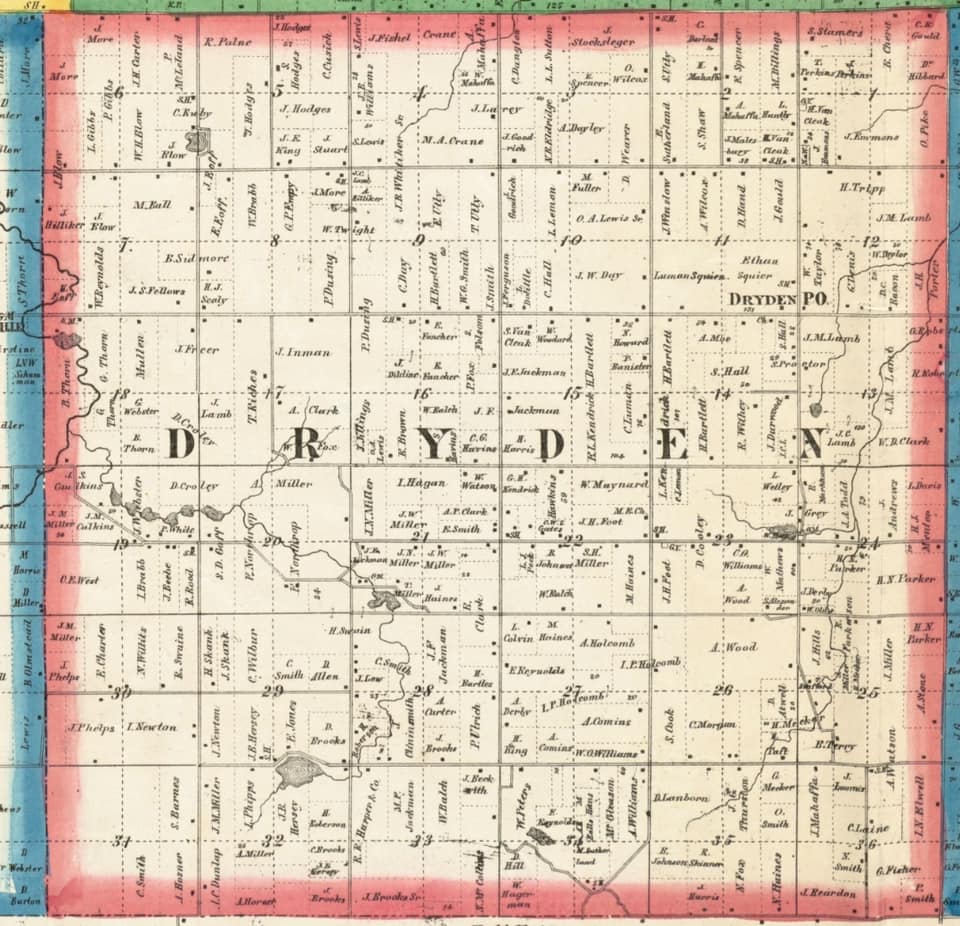
More importantly, an 1863 landowners map of Dryden Township identifies an “L. Gibbs” owning land in close proximity to J. Blow, a man later appearing in court-related records connected to this family.⁴ This confirms that Lester Gibbs was alive and a landholder at least as late as 1863.
Mary Conly’s Movements Explain the Census Confusion
The apparent absence of Mary Conly from Michigan in 1860 and Eleanora’s later association with other households long contributed to confusion. Those movements now make sense.
Mary Conly married Lester Gibbs in Lapeer County in November 1850.⁵ By 1861, she had remarried in New York to Charles Garner.⁶ The couple was living in New York by the mid-1860s, where Mary appears with Eleanora in the 1865 New York State Census.⁷
Charles Garner enlisted in the Union Army in 1863 and died as a prisoner of war at Salisbury Prison, North Carolina, on 21 December 1864.⁸ Mary was again widowed, this time with multiple minor children.
By 1868, Mary had returned to Lapeer County, Michigan, and married Mortimer Hilliker.⁹ These movements fully explain why Mary and Eleanora are absent from Michigan records during parts of the 1860s and why Eleanora later appears associated with extended family rather than her biological father.
The Most Important Evidence: Inheritance and Guardianship
The decisive records are not census schedules, but court-ordered guardianship and land transactions.
In December 1868, the Lapeer County Circuit Court appointed Mary Hilliker as special guardian of Eleanora (“Ella”) Gibbs, authorizing her to sell the minor child’s interest in real estate.¹⁰ The court approved both the guardianship and the conveyance.
Such proceedings occur only when:
- The child inherited property, and
- The property-owning parent is deceased
This establishes that Lester Gibbs died between 1863 and December 1868, and that Eleanora was his legal heir.
Philo Gibbs was not the landowner; Lester Gibbs was.
Why There Is No Probate Record for Lester Gibbs
The absence of a probate estate for Lester Gibbs once appeared problematic. In fact, it is consistent with Michigan legal practice of the period.
When a man died intestate leaving only minor heirs and land as the principal asset, courts often handled the matter through guardianship proceedings rather than formal probate administration.¹¹ This allowed the land to be sold for the child’s benefit without opening an estate.
That is precisely what occurred in this case.
What This Means for Eleanora’s Parentage
When all records are considered together:
- Marriage of Lester Gibbs and Mary Conly (1850)⁵
- Birth of Eleanora Gibbs (1854)¹²
- Census evidence of Lester Gibbs alive in 1860³
- Land ownership by Lester Gibbs in 1863⁴
- Court-ordered guardianship and inheritance in 1868¹⁰
- Probate of Mary Hilliker naming Ella Wortman as an heir¹³
…the conclusion is no longer tentative.
Eleanora “Ella” B. Gibbs was the daughter of Lester Gibbs and Mary Conly.
A Final Reflection
This case illustrates a fundamental genealogical principle:
census records suggest relationships; land and court records confirm them.
Six years ago, the evidence pointed in the right direction. Today, it firmly supports that conclusion.
Footnotes
- “The parentage of Eleanora ‘Ella’ B. Gibbs,” blog post, 27 October 2020.
- U.S. Bureau of the Census, Instructions to Enumerators, 1860.
- 1860 U.S. Census, Lapeer County, Michigan, Dryden Township, Lester Gibbs household.
- Map of Lapeer County, Michigan (1863), Dryden Township landowners, “L. Gibbs.”
- Lapeer County, Michigan, Marriage Records, Lester Gibbs and Mary Conly, 12 November 1850.
- New York State Marriage Records, Mary Conly and Charles Garner, 1861.
- 1865 New York State Census, Cayuga County, Sterling, Mary Garner household.
- Compiled Military Service Record, Charles Garner, Union Army; died 21 December 1864, Salisbury Prison, North Carolina.
- Lapeer County, Michigan, Marriage Records, Mary Conly and Mortimer Hilliker, 29 March 1868.
- Lapeer County, Michigan, Circuit Court Records, Guardianship and deed of Eleanora D. Gibbs, December 1868.
- Michigan Probate Law and Practice, mid-nineteenth century (see Michigan Revised Statutes).
- Birth information for Eleanora D. Gibbs, as reported in multiple census and marriage records.
- Lapeer County, Michigan, Probate Records, Estate of Mary Hilliker, 1872.
 The Tumbleweed