
Bangs Burgess of Rochester, Plymouth County, Massachusetts was not a casual volunteer in the American Revolution. He was a long-serving Continental Army private who marched with Massachusetts regiments through some of the war’s defining campaigns — including Monmouth and Yorktown — and remained in service from the middle years of the war through its conclusion.
Family and Early Life
Bangs Burgess was born in 1747 in Rochester, Massachusetts, a community originally part of Old Rochester (encompassing present-day Rochester, Mattapoisett, and Marion). The Burgess family was well established in the region, appearing in early colonial and town histories.¹
Rochester and its neighboring towns contributed men regularly to the war effort, and Bangs was among those who responded when the conflict expanded beyond local militia service into the full Continental mobilization.
Military Enlistments in the Continental Army
First Enlistments (1776–1777)
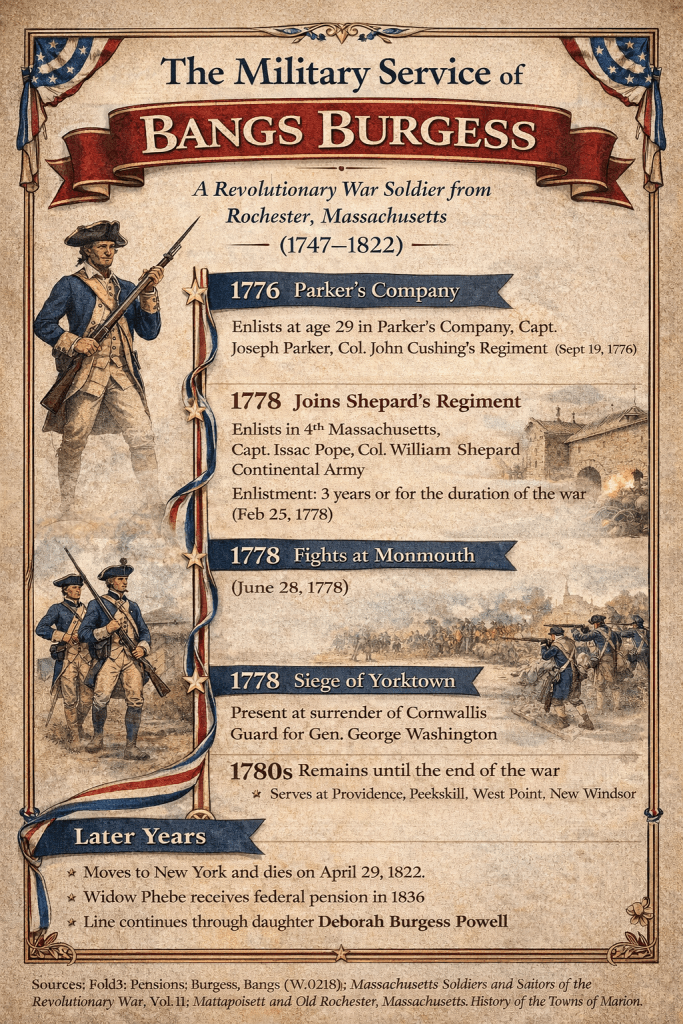
According to Massachusetts Soldiers & Sailors of the Revolutionary War, Bangs Burgess first enlisted on 19 September 1776 as a private in Captain Joseph Parker’s Company, serving under Colonel John Cushing’s Regiment and stationed, at least initially, at Rhode Island.²
He was later recorded reenlisting for brief service, transitioning into longer commitments as the war progressed.
Extended Service with Shepard’s Regiment
The same source records Burgess next with Captain Isaac Pope’s Company, in Colonel William Shepard’s (4th Massachusetts) Regiment, part of the regular Continental Army:
- 25 Feb 1778 – Dec 31, 1779: Continental Army pay accounts list Burgess in Shepard’s regiment.³
- Musters through 1778–1781 place him in the field, with rolls in Phillipsburg, Peekskill, West Point, York Hutts, and New Windsor.⁴
- A February 1780 muster describes him physically: “age 30 yrs., stature 6 ft. 1 in., complexion light, hair light; residence, Rochester.”⁵
These repeated returns of rolls indicate he was part of the Continental establishment, not just a short-term militia enlistment.
Campaigns and Combat
Battle of Monmouth (June 1778)
In sworn pension testimony later accepted by the U.S. Pension Office, Burgess stated that he was present at the Battle of Monmouth on 28 June 1778 — one of the largest engagements of the war and a key proving ground for the newly trained Continental Army.⁶
This battle demonstrated Washington’s ability to stand with British regulars in open field combat, and Burgess’s presence places him with the main army in the mid-Atlantic theater.
Siege of Yorktown and Cornwallis’s Surrender (1781)
Burgess also testified that he took part in the Siege of Yorktown, Virginia, and was present when British General Lord Cornwallis surrendered in October 1781 — the culminating moment of the Revolutionary War.⁷
His pension record further indicates that he served as part of a detachment detailed as guard for General George Washington, a distinction suggesting he was among the more experienced members of his regiment.⁸
Recognition and Pension
Decades after the war, Burgess applied for a federal pension under the Act of 18 March 1818, which provided support for indigent veterans of Revolutionary service. His application was approved, and he was placed on the pension rolls as a veteran of long service in the Continental Army.⁹
The government required detailed proof before granting pensions, and Burgess’s long service, as recorded in both his own testimony and official Continental records, satisfied those requirements.
Later Years and Death
After the Revolution, Burgess moved to New York, first living in Rensselaer County and later in Livonia, Livingston County. He died there on 29 April 1822.¹⁰
Following his death, his widow Phebe (Lillie) Burgess successfully applied for a pension under the Act of 4 July 1836 (Pension File W.20818), ensuring continued federal support and further preserving the documentary record of his service.¹¹
Family and Descendants
Bangs and Phebe Burgess raised a large family. Federal pension correspondence lists their children and identified heirs — including Deborah Burgess, who married John Powell of New York. This documentation forms the genealogical linkage through which many descendants trace their lineage today.¹²
Historical Assessment
Bangs Burgess exemplifies what historians call a career patriot — a man whose wartime service was sustained, documented, and recognized. Unlike many who served only briefly near home or in local militia, he:
🔹 Served multiple enlistments and a long-term Continental contract
🔹 Marched as part of Massachusetts line units
🔹 Saw major actions including Monmouth and Yorktown
🔹 Remained in the army through multiple campaigns and garrisons
🔹 Was later recognized by the federal government with a pension
These facts make him a particularly well-documented example of an enlisted Continental soldier — a story worth telling beyond the genealogical record.
Sources and Citations
- Mattapoisett and Old Rochester, Massachusetts: History of the Towns of Rochester, Mattapoisett, and Marion (Boston: Town Histories Pub.).
- Massachusetts Soldiers and Sailors of the Revolutionary War, Vol. II, entry “Burges, Bangs, Rochester.”
- Ibid., pay accounts, Shepard’s (4th Mass.) Regiment.
- Ibid., muster rolls, 1778–1781.
- Ibid., February 1780 descriptive muster.
- Bangs Burgess pension file, National Archives: NARA M804, War of the Revolution Pension and Bounty Land Warrant Application Files, Burgess, Bangs (W.20818).
- Ibid., pension testimony on Yorktown.
- Ibid., pension testimony regarding Washington’s guard.
- Ibid., pension award documentation.
- Fold3 memorial and summary: Burgess, Bangs — https://www.fold3.com/memorial/664325102/burgess-bangs
- Ibid., widow’s pension continuation under the Act of 1836.
- Ibid., heir verification and family listing in pension correspondence.
 The Tumbleweed