
When we think about the American Revolution, it is easy to imagine famous generals, fiery pamphlets, and dramatic battles. But for most families, the Revolution was something far quieter and far harder: years of uncertainty, absence, and strain that unfolded in ordinary towns and farmsteads. One of those ordinary men was my fifth great-grandfather, Elnathan Tolles.
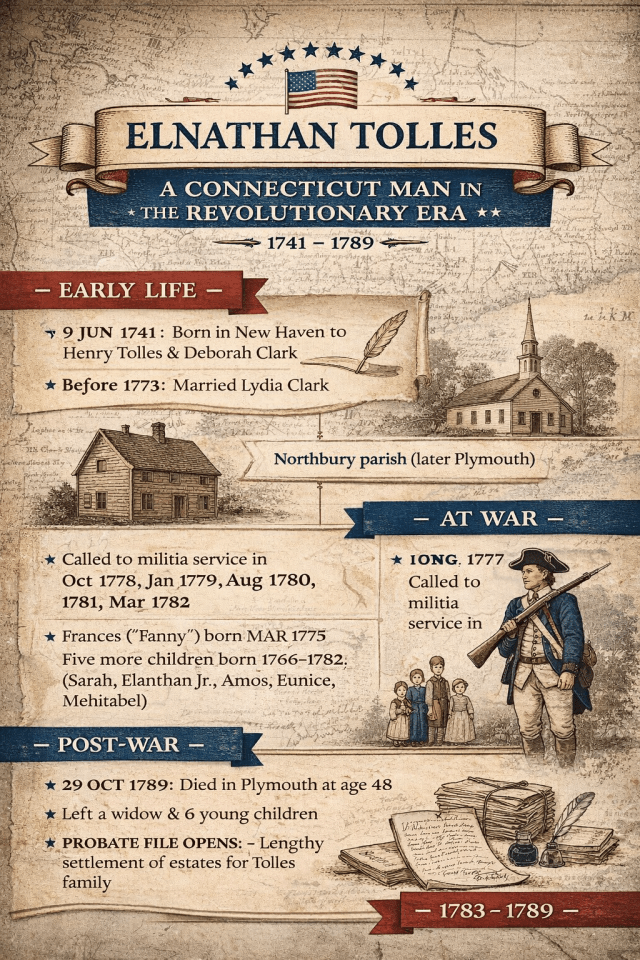
Elnathan was born on 9 June 1741 in New Haven, Connecticut, the son of Henry Tolles and Deborah Clark. He grew up in a family that had already been in New England for several generations. His grandfather and great-grandfather had come from England in the mid-1600s, and by the time Elnathan was born, the Tolles family was firmly rooted in the New Haven Colony.¹ ²
Before 1773, Elnathan married Lydia Clark, a member of another long-established Connecticut family. Lydia was baptized as an adult at Trinity Church in New Haven on 23 May 1773, which strongly suggests their affiliation with the Episcopal Church rather than the Congregational churches that dominated the region.¹ ³
By the early 1770s, Elnathan and Lydia were living in the Northbury parish of Waterbury, a farming community that would later become the town of Plymouth. It was here, in the middle of the Revolutionary era, that their children were born and their family took shape.³
Elnathan’s military service reflects the pattern of a Connecticut militiaman rather than a long-term Continental soldier. Surviving records place him in service in October 1778, January 1779, August 1780, sometime in 1781, and again in March 1782. These repeated call-ups indicate participation in short-term militia service, responding to regional threats and alarms as they arose.⁴
While Elnathan was repeatedly absent, Lydia was raising a growing family. Their daughter Frances (“Fanny”) was born in March 1775, only weeks before the war began. Five more children followed during and immediately after the conflict: Sarah, Elnathan, Amos, Eunice, and Mehitabel.³
Elnathan did not live long after independence. He died on 29 October 1789, at the age of 48, only two years after the United States adopted its Constitution. His widow Lydia survived him for just four more years. Their combined estate would be administered and divided in a lengthy probate process that documented their property and confirmed their surviving children.⁵
Elnathan Tolles left no letters, no memoirs, and no heroic battlefield stories. What remains are church records, militia lists, and probate files — the quiet paperwork of a man who lived, worked, served, and died during the founding generation of the United States.
In the posts that follow, I will turn to the women of his household, beginning with Lydia Clark Tolles, and then to their daughter Fanny, whose identity became one of the most complicated genealogical puzzles in this family’s history.
Sources
- Donald Lines Jacobus, Deacon George Clark(e) of Milford, Connecticut and Some of His Descendants (New Haven: Tuttle, Morehouse & Taylor, 1949), entry for Lydia Clark, wife of Elnathan Tolles.
- William Marshall Tolles & Alyce Jane (Tolles) Morrow, Tolles in America (Baltimore: Gateway Press, 1997), Tolles family genealogy, including Henry Tolles, Deborah Clark, and their son Elnathan.
- Donald Lines Jacobus, Families of New Haven, vol. VIII (New Haven: Tuttle, Morehouse & Taylor, 1932), Tolles family, “Elnathan & Lydia (Clark) Tolles.”
- Connecticut Revolutionary War Military Lists, 1775–1783; and U.S. Compiled Revolutionary War Military Service Records, entries for Elnathan Tolles showing militia service from 1778–1782.
- Probate of Elnathan Tolles (1789) and Probate of Lydia Tolles (1793), Plymouth (Watertown) District, Litchfield County, Connecticut; combined estate file, naming their children and documenting the division of property.
 The Tumbleweed