
When we think of patriotic service during the American Revolution, it is easy to picture soldiers on the battlefield. Yet independence was secured just as surely by men who stayed home and kept their communities functioning during uncertain and dangerous times. One such patriot was Daniel Munson of Milford, Connecticut.
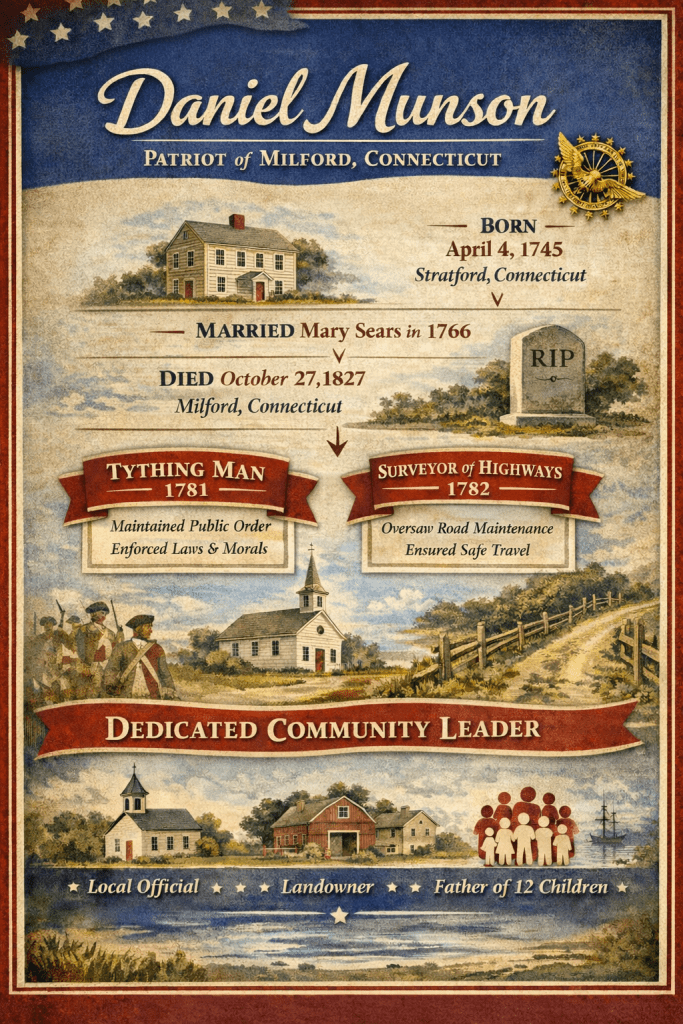
Born on April 4, 1745, in Stratford, Connecticut, Daniel Munson’s early life was shaped by loss. Orphaned as a small child, he was raised within an extended family that valued responsibility and public duty. As an adult, Daniel settled in Milford, where he married Mary Sears and raised a large family while becoming deeply involved in the civic life of the town.
During the Revolutionary War, Milford’s stability depended on capable local leadership. In 1781 and 1782—critical years as the war drew toward its conclusion—Daniel Munson stepped forward to serve the town in two important civil offices: tything man and surveyor of highways. These were not ceremonial positions. They required time, authority, and a willingness to enforce the laws that kept daily life running smoothly.
As surveyor of highways, Daniel was responsible for overseeing the maintenance of local roads—vital routes used for transporting food, supplies, and militia. In a coastal town like Milford, good roads were essential to both commerce and defense. At the same time, his role as tything man placed him in charge of maintaining public order, enforcing Sabbath laws, and addressing disorderly conduct. In a period marked by shortages, political tension, and social strain, this work helped preserve the moral and civil structure of the community.
Daniel Munson’s patriotism did not end with the war. He remained an active citizen for decades, serving his church, managing land and property, and contributing to Milford’s growth well into the early years of the new republic. He lived to see the nation he helped support take firm root, passing away in Milford on October 27, 1827, at the age of eighty-two.
Today, Daniel Munson’s story reminds us that the Revolution was sustained not only by muskets and marches, but by ordinary citizens who accepted responsibility when their communities needed them most. His recognized patriotic service stands as a testament to the power of civic duty—and to the enduring legacy of those who quietly helped build a nation.
Sources:
Full text of “1637-1887, the Munson record : a genealogical and biographical account of Captain Thomas Munson (a pioneer of Hartford and New Haven) and his descendants”, https://archive.org/stream/16371887munsonre02muns/16371887munsonre02muns_djvu.txt
Full text of “Encyclopedia of Connecticut biography, genealogical-memorial; representative citizens” – Internet Archive, https://archive.org/stream/encyc09unse/encyc09unse_djvu.txt
Daniel Munson, Ancestor No. A082998, Daughters of the American Revolution (DAR) Genealogical Research System, Washington, D.C.; patriotic service credited as tything man (1781) and surveyor of highways (1782), Milford, Connecticut; service sourced to Mullen, Connecticut Town Meeting Records, vol. 1, pp. 575–576.

 The Tumbleweed